September 29

GUEST CURATOR: Nicholas Commesso

What was advertised in a colonial American newspaper 250 years ago today?
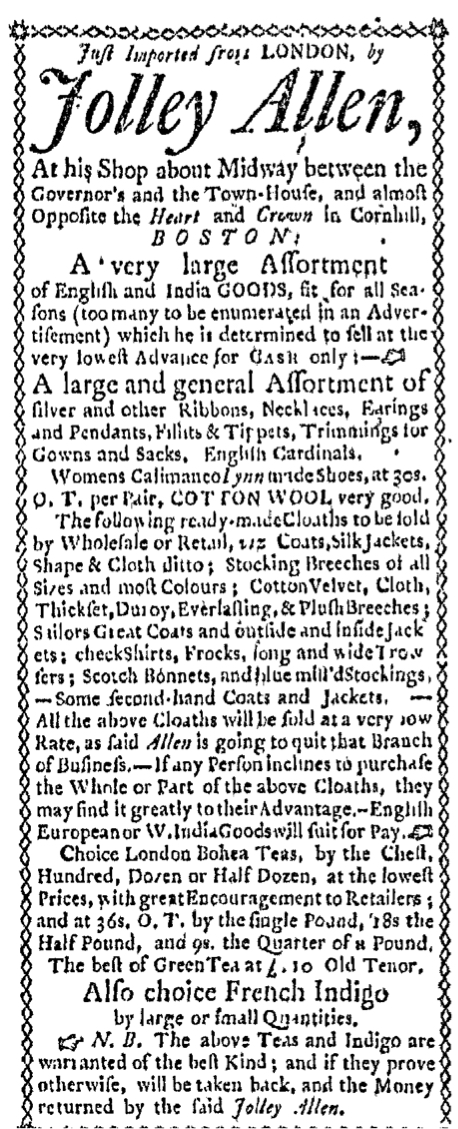
sep-29-9291766-boston-evening-post
Boston Evening-Post (September 29, 1766).

“Warranted of the best Kind; and if they prove otherwise, will be taken back, and the Money returned.”

Jolley Allen’s lengthy advertisement from the Boston Evening-Post features countless common products seen in numerous other advertisements, including tea, silks, textiles, and jewelry. In addition to a long list of merchandise, this one had something else included at the end. Many of the advertisements I have looked at claimed to be selling their assortment of goods the cheapest, and they promised the highest quality products around. However, Allen is the first one I have seen who actually backed it up. This advertisement concluded with a guarantee that if the “Teas and Indigo” were not of the “best Kind,” they “will be taken back, and the Money returned by the said Jolley Allen.

Allen put his name and reputation on the line. He displayed his character in a way favorable to consumers. With the expansion of consumer culture in the colonies, it would have been easy for shopkeepers to make all sales final, yet with more shops opening, consumers could take their business elsewhere. Allen was committed to his name, his shop, and his goods, and made it a point for his shop to stand out from the rest. After further research, however, I also learned that Allen was a Loyalist entrepreneur; it’s interesting that he became a successful businessman regardless of his controversial political views.

**********

ADDITIONAL COMMENTARY: Carl Robert Keyes

Jolley Allen operated his business in an increasingly politicized colonial marketplace. His own politics, however, were not apparent in this particular advertisement. That he was a Loyalist, we learn from other sources from the period.

That’s not to say, however, that all newspaper advertisement published during the imperial crisis of the 1760s and 1770s lacked a political valence. As soon as the colonists learned of the Stamp Act, many advertisers made explicitly partisan appeals as part of their marketing messages, often promoting domestic manufactures or condemning the effects that Parliament’s actions would have on commerce. After the Stamp Act was repealed, some entrepreneurs inserted their own brief celebratory proclamations into their advertisements; even when they did not directly connect the Stamp Act to the merchandise they advertised, they assumed that their political views would influence potential customers to visit their shops.

As a Loyalist, Jolley Allen certainly did not condemn Parliament nor celebrate the demise of the Stamp Act in his advertisements. The advertisements he published in 1766 were devoid of politics, yet Boston was not so large that his political views would have been unfamiliar to friends, neighbors, and potential customers. Perhaps that played a role in inspiring some of the innovative aspects of his advertisements: he needed to overcome suspicions of his allegiances and used distinctive marketing to do so. Nick identified Allen’s reputation and stature as an honest trader as one means of promoting his shop “Opposite the Heart and Crown in Cornhill, BOSTON.” Although not the first colonial advertiser to offer some form of money-back guarantee, he did make an offer that was not a standard part of eighteenth-century advertising. In addition, his advertisements consistently featured distinctive graphic design elements, namely a decorative border, intended to draw more eyes than competitors’ advertisements that appeared elsewhere on the page. Allen also advertised extensively, placing the same advertisement in all four newspapers published in Boston in 1766, thus reaching the largest possible audience of potential customers despite the political leanings of any particular newspaper or its printer.
September 13

What was advertised in a colonial American newspaper 250 years ago today?

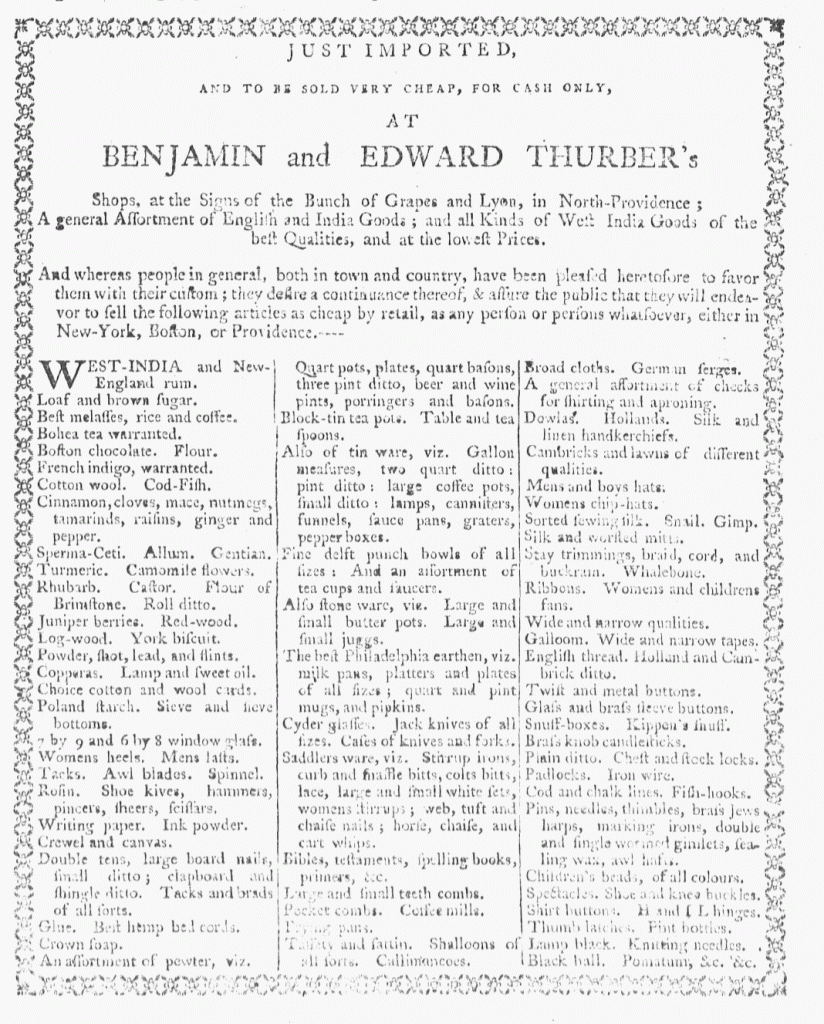
Sep 13 - 9:13:1766 Providence Gazette
Providence Gazette (September 13, 1766).

“AT BENJAMIN and EDWARD THURBER’s Shops, at the Signs of the Bunch of Grapes and Lyon.”

On August 9, 1766, Thompson and Arnold placed an exceptional advertisement in the Providence Gazette, an advertisement guaranteed to attract attention thanks to its innovative graphic design. Unlike the standard advertisement that appeared elsewhere in the Providence Gazette and other newspapers throughout the colonies, Thompson and Arnold’s advertisement extended across two columns, sequestered from other content on the page by a decorative border comprised of printer’s ornaments. Within the advertisement, the extensive list of merchandise was set in three columns, further disrupting the lines formed by the other columns on that page and the rest of the issue. Furthermore, Thompson and Arnold’s advertisement was so large that it dominated the page. At a glance, it seemed more like a trade card or handbill, meant to be distributed separately, yet superimposed on the newspaper page.

Thompson and Arnold’s striking advertisement appeared in the Providence Gazette in subsequent issues, moving to different corners of the page depending on the needs of the printer, but always the focal point no matter the quadrant where it appeared. Then something even more interesting happened just five weeks later. The Providence Gazette featured another advertisement, this one the shops operated by Benjamin and Edward Thurber, that imitated the graphic design of Thompson and Arnold’s advertisement. It was oversized. It spread across two columns. It included a decorative border made of printing ornaments. It further disrupted the lines on the page by dividing the merchandise into three columns. It could have been distributed separately as a handbill or trade card.

Benjamin and Edward Thurber’s advertisement appeared on the third page of the September 13, 1766, issue of the Providence Gazette. Thompson and Arnold’s advertisement continued to appear on the fourth page. What might Thompson and Arnold have thought of their competitors aping their unique graphic design? Advertisers seemed to be paying attention to the commercial notices placed by others and updating their own marketing in response to what they saw and what they anticipated would be effective.

August 9

What was advertised in a colonial American newspaper 250 years ago today?

Aug 9 - 8:9:1766 Providence Gazette
Providence Gazette (August 9, 1766).

“JUST IMPORTED … BY THOMPSON AND ARNOLD, AT THEIR SHOP NEAR THE GREAT BRIDGE.”

The graphic design of Thompson and Arnold’s newspaper advertisement would have certainly caught readers’ attention in the 1760s. Featuring a decorative border and three columns listing “A large and general Assortment of English and India Goods,” it was unlike any other advertisements that appeared in newspapers of the period.

Whenever possible, I highlight innovations in format and graphic design that set particular eighteenth-century advertisements apart from their contemporaries. For the most part, these innovations were fairly conservative as advertisers and printers experimented with new methods yet continued to create advertisements that, to a greater or lesser degree, blended in with other commercial notices.

That was not the case with Thompson and Arnold’s eye-catching advertisement. The border was sufficient to mark this advertisement as different, but a small number of other advertisers (such as Jolley Allen) also used borders to set their advertisements apart from their competitors.

Aug 9 - 8:9:1766 Fourth Page Providence Journal
Fourth Page of Providence Gazette (August 9, 1766).

The number of columns in this advertisement also merited attention. Other advertisers frequently divided their lists of goods into two columns, but Thompson and Arnold managed to squeeze three columns into their advertisement. How did they do that? Their advertisement actually extended across two columns of the Providence Gazette, a mode of setting type not commonly used for either advertisements or new items. Typically only the masthead and the colophon extended across more than one column in any eighteenth-century newspaper.

The printer would have had to set Thompson and Arnold’s advertisement separately. Its design and inclusion required special effort and attention. Visually, it dominated the final page of the Providence Gazette. If a reader were holding open the newspaper to read the second and third pages, this advertisement would have also dominated any observer’s view of the first and fourth pages.

Other newspaper advertisements were certainly set in type specifically for inclusion in newspapers and possessed no other purpose. The size and design of this advertisements, however, suggests that it could have also been printed separately as a trade card or handbill, which would have benefited both the advertisers and the printer who generated revenue for the job.