What was advertised in a colonial American newspaper 250 years ago today?

“Render this Country an essential Service, by establishing a Manufacture necessary to its Prosperity.”
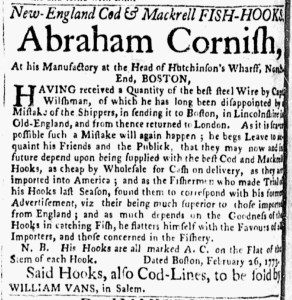
Abraham Cornish had been in business and advertising long enough by the late summer of 1774 that he expected colonizers to be familiar with his brand of “CORNISH’s New-England Cod-Fish HOOKS.” He deployed the name of his product as a headline for his advertisement in the August 18 edition of the Massachusetts Gazette and Boston Weekly News-Letter. Still, for those who needed a refresher or a bit more encouragement to purchase his fishhooks, he provided more information about why those from “his Manufactory” were superior to others. That they were made in America was central to his marketing efforts.
The savvy entrepreneur had recently moved from “the North-End of Boston, to the Upper Part of Charlestown,” where he continued to make fishhooks “warranted of the best Quality.” He called on “all concerned in the Fishery” to “favor him with their Custom, as they will thereby promote their own private Interest, and render this Country an essential Service, by establishing a Manufacture necessary to its Prosperity.” It was a win-win-win situation for “the American Fishery,” the manufacturer, and all colonizers at a time that the political crisis intensified due to the imposition of the Coercive Acts in retaliation for the Boston Tea Party. Those whose livelihood depended on fishing could acquire equipment “found much Superior to any imported, Cornish could maintain or even expand his business, and the colonies would benefit from “domestic manufactures” that both supported a local industry and directly contributed to the local economy. Ever since the boycotts inspired by the Stamp Act nearly a decade earlier, many colonizers had advocated for producing more “domestic manufactures” as a means of reducing their reliance on imported goods. Doing so also served as political leverage in the struggles with Parliament. Such plans placed obligations on both artisans and tradespeople to produce goods and consumers to purchase those goods instead of imported items. Like many other producers of “domestic manufactures,” Cornish assured prospective customers that they did not have to sacrifice quality, decalaring that his fishhooks were “made of the best Wire only” and “better shap’d to take Fish.” He proclaimed that they were “universally approv’d,” having gone into even greater detail in a previous advertisement about how “Fishermen who made Trial of his Hooks … found them … superior to those imported from England.” Cornish devised a “Buy American” campaign before the colonies declared independence.