March 10

What was advertised in a colonial American newspaper 250 years ago today?

Connecticut Gazette (March 10, 1775).

“Please to make your Cloth suitable … and not expect a Silk Purse to be made of a Sow’s Ear.”

As spring approached in 1775, Nathaniel Wollys, “Silk-Dyer and Clothier,” took to the pages of the Connecticut Gazetteto advise the public that “he carries on the Clothing-Business” in “several Branches.”  Those included “fulling, colouring, shearing, pressing and dressing of Bays, Fustian, Ratteen and Bearskin,” dying “Cotton and linnen Yarn blue,” “dy[ing] and dress[ing] Silks of all Kinds,” and “tak[ing] out Colours, Spots or Stains of any Kind.”  Colonizers certainly knew the differences among the various textiles Wollys named, even if they are now unfamiliar to most consumers in the twenty-first century.  Like other advertisers who provided services, Wollys emphasized both his own engagement with customers, his “Fidelity and Dispatch,” and the quality of his work, done in “the neatest and best Manner.”

However, the fuller appended a lively nota bene that reminded prospective customers to have reasonable expectations for what he could accomplish with the textiles they delivered to his mill for treatment or cleaning.  Some feats were beyond the skills of any clothier, no matter how experienced.  “Please to make your Cloth suitable for the Work you intend it for,” Wollys bluntly instructed, “and not expect a Silk Purse to be made of a Sow’s Ear.”  Perhaps he reacted to customers who had recently expressed displeasure or dissatisfaction with the finished product, seeking to set the terms for new clients before they hired his services.  If that was the case, former customers may have given voice to the frustration they experienced as they participated in boycotts of imported fabrics and substituted homespun textiles.  While using such cloth became a mark of distinction permeated with political meaning, garments and other items made from homespun were not of the same quality as those made from imported textiles.  Even as consumers made sacrifices in support of their political principles, some of Wollys’s customers may have transferred their disappointment in not having access to the same finery to the clothier who processed the cloth that they increasingly incorporated into their everyday routines.  Wollys could accomplish a lot when he treated cloth “in the neatest and best Manner,” yet clients also needed to be realistic about the anticipated outcomes.

January 20

What was advertised in a colonial American newspaper 250 years ago today?

Connecticut Gazette (January 20, 1775).

“To be sold … agreeable to the tenth Article of the Association … Apothecaries Drugs.”

On January 12, 1775, the Committee of Inspection for Norwich, Connecticut, placed an advertisement for an upcoming sale of “three Chests and six Casks of Apothecary’s Drugs” that would be held on January 20 in the Norwich Packet.  They ran the notice again a week later, this time stating that the sale would take place on January 24.  That allowed four more days for word of the sale to circulate and attract prospective customers.  It also made possible advertising in the January 20 edition of the Connecticut Gazette, published in New London.

The advertisement specified that the local Committee of Inspection would oversee that sale “at the Town-House in Norwich … agreeable to the tenth Article of the Association of the American Continental Congress.”  That nonimportation, nonconsumption, and nonexportation agreement had been disseminated far wide in the months since the meetings of the First Continental Congress in Philadelphia concluded at the end of October 1774.  The tenth article made provisions for imported goods that arrived in the colonies between December 1, 1774, and February 1, 1775.  The importers had three options.  They could either return the goods, surrender them to the local Committee of Inspection to store until the boycott ended, or entrust them to the committee to sell.  After the sale, the committee reimbursed the importer what they paid for the goods, but applied any profits to relief of Boston where the harbor had been closed to commerce since the Boston Port Act went into effect on June 1, 1774.

The tenth article of the Continental Association also called for “a particular Account [to be] inserted in the publick Papers.”  When the Committee of Inspection for Norwich advertised the sale of “Apothecaries Drugs, Imported in the ship Lady Gage, from London, via New-York, since the first of December last” in both the Norwich Packet and the Connecticut Gazette, they did more than address prospective customers.  They also kept the public throughout the region that the two newspapers circulated updated on compliance with the Continental Association, encouraging others to abide by it as well.

December 16

What was advertised in a colonial American newspaper 250 years ago today?

Connecticut Gazette (December 16, 1774).

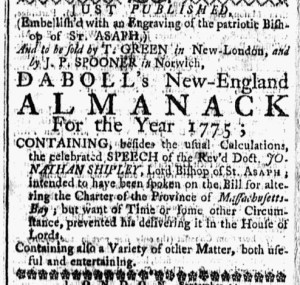
“Embellish’d with an Engraving of the patriotic Bishop of ST. ASAPH.”

With a new year only weeks away, advertisements for almanacs appeared in newspapers throughout the colonies in December 1774.  Most printers who published newspapers also produced almanacs as an alternate revenue stream, joined by other printers who supported themselves by performing job printing.  Consumers had an array of choices when they selected their almanacs for the coming year.

As a result, printers often marketed the contents of their almanacs, emphasizing anything that made them distinctive.  When Timothy Green, the printer of the Connecticut Gazette, advertised “DABOLL’s New-England ALMANACK For the Year 1775,” he indicated that it included the “usual Calculations” as a well as a “Variety of other Matter, both useful and entertaining.”  He emphasized a particular item: “the celebrated SPEECH of the Rev’d Doct. JONATHAN SHIPLEY, Lord Bishop of St. ASAPH; intended to have been spoken on the Bill for altering the Charter of the Province of Massachusetts-Bay; but want of Time or some other Circumstance, prevented his delivering it in the House of Lords.”  Shipley had gained acclaim in the colonies because he had been the only bishop in the Church of England who expressed opposition to the Massachusetts Government Act when Parliament considered how to respond to the Boston Tea Party.  When he did not have a chance to deliver the speech, he opted to publish it instead.

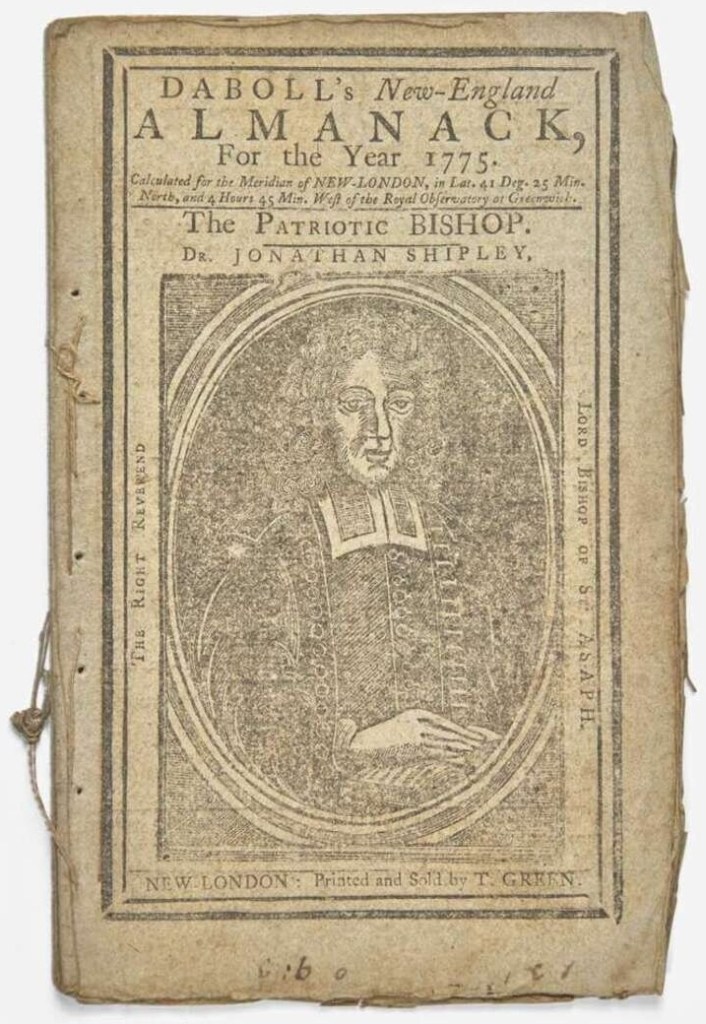
Though Shipley’s speech had little impact in England, the colonizers greeted it warmly.  Several newspapers published the speech, printers advertised pamphlets containing the speech, and Green devoted twelve of the thirty-two pages of Daboll’s New-England Almanack to the speech, anticipating that doing so would entice customers.  Furthermore, he “Embellished [the almanac] with an Engraving of the patriotic Bishop of ST. ASAPH” on the front cover.  Each time readers consulted any of the contents, they glimpsed the bishop whether or not they also read any portion of his speech.  Green advertised Daboll’s New-England Almanack at the same time he promoted his own edition of “The PROCEEDINGS and RESOLUTIONS of The Continental Congress,” joining other printers in producing and disseminating an array of items related to current events and, especially, making a case against the abuses perpetrated by Parliament.

Daboll’s New-England Almanack, For the Year 1775 (New London: Timothy Green, 1774). Courtesy Freeman’s | Hindman.

December 9

What was advertised in a colonial American newspaper 250 years ago today?

Connecticut Gazette (December 9, 1774).

“Glass buttons having the word liberty printed in them.”

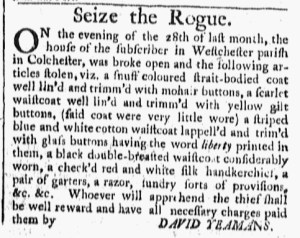
The headline for David Yeaman’s advertisement in the December 9, 1774, edition of the Connecticut Gazette alerted readers that it would document some sort of misbehavior.  “Seize the Rogue,” it proclaimed.  The rogue “broke open” Yeamans’s house and stole several items on November 28.  They included clothing, a “check’d red and white silk handkerchief,” a razor, and “sundry sorts of provisions.”  The unfortunate advertiser offered a reward to whoever apprehended the thief.

Yeamans’s descriptions of the missing garments revealed his taste and sartorial sensibilities.  The thief took a “snuff coloured strait-bodied coat well lin’d and trimm’d with mohair buttons,” a “scarlet waitcoast well lin’d and trimm’d with yellow gilt buttons” that showed very little wear, a “black double-breasted waistcoat considerably worn,” and a “striped blue and white cotton waistcoat lappell’d and trim’d with glass buttons.”  That last piece of clothing testified to more than Yeamans’s sense of fashion. It also said something about his politics and how he felt about the imperial crisis that had been intensifying for the year since the Boston Tea Party.  Those glass buttons had “the word liberty printed in them.”  Yeamans made a statement every time he wore the striped waistcoat adorned with those buttons.

This advertisement, printed immediately below entries from the “CUSTOM-HOUSE, New-LONDON,” and other shipping news in “THOMAS ALLEN’s MARINE LIST,” provided additional coverage of local news, though selected by an advertiser who paid to have it appear in print rather than by the editor who compiled “Fresh Advices from London!” and reports from Boston, New York, Philadelphia, and Hartford.  At first glance, it featured a theft, yet the details about one of the stolen garments prompted readers to think about the contents of the articles and editorials in that issue, including discussion of the Continental Association adopted by the First Continental Congress and the impact of the Boston Port Bill on residents of that city.  Those buttons with “the word liberty printed in them” contributed to discussions about politics when Yeamans wore his waistcoat and when he advertised its theft.

December 2

What was advertised in a colonial American newspaper 250 years ago today?

Connecticut Gazette (December 2, 1774).

“All the Proceedings of the AMERICAN CONGRESS.”

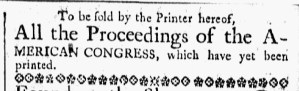
Among the several advertisements that ran in the December 2, 1774, edition of the Connecticut Gazette, a brief notice announced that “All the Proceedings of the AMERICAN CONGRESS, which have yet been printed” were “sold by the Printer hereof.”  That expanded the options that readers had for learning more about the meetings held by the First Continental Congress in Philadelphia from September 5 through October 26.  The Connecticut Gazette and other newspapers provided coverage.  In addition, printers throughout the colonies began publishing, advertising, and selling Extracts from the Votes and Proceedings of the American Continental Congress shortly after delegates concluded their business.  Within a month, William Bradford and Thomas Bradford advertised a “JOURNAL OF THE PROCEEDINGS OF THE CONGRESS,” an even more complete account to keep colonizers informed about current events.

Timothy Green, the printer of the Connecticut Gazette, was among the printers who produced a local edition of the Extracts, yet when he advertised “All the Proceedings … which have yet been printed” he did not refer to a volume from his own press.  Although printers far and wide quickly created and marketed local editions of the Extracts, only a couple opted to print the more extensive Journal.  The Bradfords advertised their Philadelphia edition.  Hugh Gaine, the printer of the New-York Gazette and Weekly Mercury, printed the only other edition.  Green likely sold Gaine’s edition at his printing office in New Haven, given the proximity of that town to New York, though the Bradfords could have dispatched copies via a ship bound from Philadelphia to New England.  No matter which printer supplied Green with copies of the Proceedings, he advertised the journal of the meetings of the First Continental Congress to readers in Connecticut a little over a week after the Bradfords first promoted their edition in the Pennsylvania Journal.  He did so the day after the Continental Association, a nonimportation pact intended to unite the colonies in resisting the Coercive Acts, went into effect.  As readers made decisions about what they would buy and sell, Green presented them with another option for learning about the political principles behind the Continental Association and the other actions taken by the First Continental Congress.

September 9

What was advertised in a colonial American newspaper 250 years ago today?

Connecticut Gazette (September 9, 1774).

“CONSIDERATIONS on the Measures carrying on by GREAT BRITAIN, against the Colonies in North-America.”

As the number of American editions of Considerations on the Measures Carrying On with Respect to the British Colonies in North-America increased in 1774, so did the number of newspapers that carried advertisements for the political tract.  John Holt, the printer of the New-York Journal, advertised his edition.  Benjamin Edes and John Gill, the printers of the Boston-Gazette, did so as well for their edition.  Ebenezer Watson, printer of the Connecticut Courant, ran his own advertisement when he published a Hartford edition.  Yet it was not solely the printers of the various American editions who advertised or sold the popular pamphlet.  Watson listed local agents in eight towns and two post riders who sold his edition.  David Atwater advertised the New York edition for sale in New Haven in the Connecticut Journal.

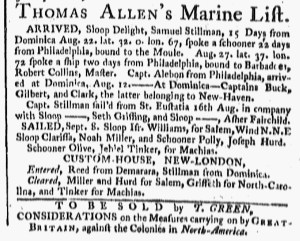
Timothy Green, printer of the Connecticut Gazette, joined their ranks with an advertisement in the September 9, 1774, edition of his newspaper.  That made the pamphlet available for purchase in New London in addition to other towns in New England and New York.  Compared to the other advertisements, however, Green’s notice was quite brief, just three lines that completed the column following “THOMAS ALLEN’S Marine List,” a regular feature, on the third page.  “TO BE SOLD by T. GREEN, CONSIDERATIONS on the Measures carrying on by GREAT BRITAIN, against the Colonies in North-America.”  Green did not provide any of the elaborate description about how well the pamphlet had been received in London and how it had influenced residents there to support the American colonies against the abuses perpetrated by Parliament, nor did he encourage readers to review it for themselves so they could be better informed.  Perhaps he expected that the news he printed throughout the rest of his newspaper and the conversations about current events taking place everywhere anyone went those days provided enough reason for colonizers to acquire the pamphlet.  He also did not state which edition he sold, though the variant title in his advertisement suggests that he carried Watson’s Hartford edition.  In stocking and promoting the pamphlet, Green joined printers, post riders, and others in disseminating a political tract intended to influence colonizers and help them in articulating their grievances against Parliament.

August 12

What was advertised in a colonial American newspaper 250 years ago today?

Connecticut Gazette (August 12, 1774).

“ISAAC DOOLITTLE, of NEW-HAVEN … prepared an Apparatus convenient for BELL-FOUNDING.”

On August 12, 1774, “ISAAC DOOLITTLE, of NEW-HAVEN,” placed an advertisement in the Connecticut Gazette, published in New London, to alert readers that he could cast “any Size Bell commonly us’d in this, or the neighbouring Provinces.”  The entrepreneur explained that he had “erected a suitable building, and prepared an Apparatus convenient for BELL-FOUNDING.”  Furthermore, he “had good Success in his first Attempt,” prompting him to follow that trade and seek customers.  Realizing that the market in and near New Haven would not support his business, he embarked on an advertising campaign in multiple newspapers published in Connecticut.  Along with his notice in the Connecticut Gazette, he simultaneously inserted an advertisement in the Connecticut Journal and New-Haven Post-Boy.  It featured almost identical copy, though Doolittle did not consider it necessary to advise readers of the newspaper that served his town that he was “of NEW-HAVEN.”

Not surprisingly, he did so once again in his advertisement in the August 16 edition of the Connecticut Courant, directing prospective customers in Hartford and nearby towns to send orders and other correspondence to him in New Haven.  He did not, however, run his advertisement in the Norwich Packet, the last of the four newspapers printed in Connecticut at the time.  It was also the newest, having commenced publication less than a year earlier.  Perhaps that influenced Doolittle’s decision not to invest in advertising in yet another newspaper.  He may have been unfamiliar with the Norwich Packet or doubtful that its circulation would justify the cost of advertising.  He was not the only advertiser who opted for notices in the Connecticut Courant, the Connecticut Gazette, and the Connecticut Journal, but not the Norwich Packet during that newspaper’s first year.  Even one advertiser new to Norwich passed over the Norwich Packet in favor of placing his notice in the well-established Connecticut Gazette, though he may have depended on word-of-mouth to reach prospective customers in his new location.  The colophon for the Norwich Packet advised that the printers “thankfully received” both subscriptions and advertisements “for this Paper,” but that was not sufficient to convince some prospective advertisers in other towns to extend their marketing campaigns to include the colony’s newest newspaper.

August 7

What was advertised in a colonial American newspaper 250 years ago this week?
Connecticut Gazette (August 5, 1774).

“All Persons indebted to T. GREEN, either for News-Papers, Advertisements, or otherwise are requested to make immediate Payment.”

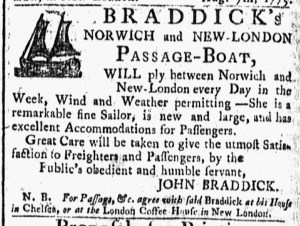
Among the many advertisements that appeared on the final page of the August 5, 1774, edition of the Connecticut Gazette, Timothy Green, the printer, inserted a brief notice calling on readers to settle accounts in his printing office in New London.  “All Persons indebted to T. GREEN, either for News-Papers, Advertisements, or otherwise,” it read, “are requested to make immediate Payment.”  The “otherwise” included books and pamphlets.  Green simultaneously advertised several including “POEMS on various SUBJECTS, RELIGIOUS AND MORAL, By PHILLIS WHEATLEY,” “A PLEA, In Vindication of the Connecticut Title to the contested Lands, lying West of the Province of New-York … By BENJAMIN TRUMBULL,” and “The JUDGMENT of whole Kingdoms and Nations … By Lord Somers.”  Green likely stocked stationery and writing supplies as well.  Many printers even peddled patent medicines for supplementary revenue.

Printers also did job printing, such as blanks (printed forms), broadsides, and handbills.  When Green called on those indebted to him for advertisements to submit payment, he may have meant customers who ordered broadsides, handbills, and other advertising ephemera.  That was sometimes what printers meant when they solicited advertisements.  Such was the case when Joseph Crukshank announced that he opened a printing office in Philadelphia in 1769.  “Particular care will be taken,” he pledged, “to do Advertisements, Blanks, &c. on very short notice.”  Isaiah Thomas was more specific in the colophon that regularly ran at the bottom of the final page of the Massachusetts Spy in the early 1770s: “Small HAND-BILLS at an Hour’s Notice.”  That may have been the kind of work that Green meant, but he may have also intended to include paid notices that appeared in the Connecticut Gazette.  If so, extending credit to newspaper advertisers did not align with the business practice traditionally identified by historians of the early American press: printers supposedly allowed credit for subscriptions yet demanded payment in advance for newspaper advertisements.  The revenue from advertising underwrote whatever subscribers neglected to pay.  Yet printers sometimes inserted notices that indicated they had published newspaper advertisements on credit.  Ebenezer Watson, printer of the Connecticut Courant, reconsidered that policy when he announced that “No Advertisements will for the future be published in this paper, without the money is first paid.”  Green may have allowed credit for advertisements in the Connecticut Gazette.  The wording in his notice does not definitively eliminate that possibility.

July 1

What was advertised in a colonial American newspaper 250 years ago today?

Connecticut Gazette (July 1, 1774).

To be sold by … CONSTITUTIONAL Post-Riders.”

The front page of the July 1, 1774, edition of the Connecticut Gazette featured an open letter “TO THE KING” from “AMERICA” followed immediately by an advertisement for a book, The Judgment of Whole Kingdoms and Nations, Concerning the Rights, Power, and Prerogative of Kings, and the Rights, Privileges, and Properties of the People.  The petition requested a redress of grievances that took into account the “rights and privileges … solemnly given, granted, confirmed, ratified and recognized … by your royal predecessors and their parliaments.”  The book, a constitutional history of Great Britain, echoed that theme in much greater detail, making it hardly a coincidence that advertisement just happened to follow the letter.

American printers in three cities had recently produced American editions of The Judgment of Whole Kingdoms and Nations.  In 1773, John Dunlap printed it in Philadelphia and Isaiah Thomas printed it for John Langdon, a bookseller, in Boston.  The advertisement promoted a 1774 edition “JUST PUBLISH’D and to be sold by SOLOMON SOUTHWICH, in NEWPORT.”  Timothy Green, the printer of the Connecticut Gazette, also sold the book in New London.  In addition, readers could acquire it from “CONSTITUTIONAL Post-Riders” who operated out of Norwich, Lebanon, Tolland, East Haddam, and Enfield.  The National Postal Museum explains that the Constitutional Post was “an alternative to the British run Parliamentary Post.”  William Goddard originally established a “new constitutional Post … between [Philadelphia] and Baltimore” and quickly expanded it.  According to the National Postal Museum, Goddard considered the Parliamentary Post “unacceptable because it was not private – postmasters were allowed to intercept and open letters – and because he saw it as another form of taxation without the colonists’ consent.”  Many shared this view; the number of riders in Connecticut affiliated with the Constitutional Post just a few months after its founding demonstrates that was the case.  In July 1775, the Second Continental Congress assumed responsibility for the Constitutional Post, appointing Benjamin Franklin as postmaster.  Goddard desired the position, but he settled for Riding Surveyor of the Post.  By then, the Constitutional Post had demonstrated its capacity for delivering letters, newspapers, and books.  In the summer of 1774, for instance, the Constitutional Post served as a distribution network for The Judgment of Whole Kingdoms and Nations, consistent with Goddard’s vision for maintaining English rights and liberties in the colonies.

June 24

What was advertised in a colonial American newspaper 250 years ago today?

Connecticut Gazette (June 24, 1774).

“Old Books he can metamorphose into new.”

When Nathaniel Patten, “BOOKBINDER and STATIONER, from BOSTON,” set up shop in Norwich, he placed an advertisement in the Connecticut Gazette, published in New London, but curiously not in the Norwich Packet.  Perhaps he suspected that advertising in the Connecticut Gazette was the better investment since it had been in circulation for more than a decade while the Norwich Packet commenced publication only nine months earlier.  Until that time, the Connecticut Gazette had been the local newspaper for Norwich, though the Connecticut Courant (published in Hartford), the Providence Gazette, and newspapers from Boston and other cities in New England made their way to Norwich, some more consistently than others depending on arrangements that subscribers made with post riders.  In New England and beyond, newspapers served colonies and regions rather than just the towns where they were published.  The full title of the Norwich Packet and Connecticut, Massachusetts, New-Hampshire, and Rhode Island Weekly Advertiser revealed its aspirations to do so as it built up its circulation.  For the moment, however, Patten may have believed that advertising in the Connecticut Gazette would yield more customers.

The bookbinder and stationer made several appeals in hopes of drawing readers to his shop or convincing them to send orders.  Like many others in his trade, he also sold books, giving over more than half the space in his advertisement to a list of books and pamphlets he stocked.  Those “Books upon the most important Subjects” included “the Hon. John Hancock’s Oration on the 5th of March, 1774” in commemoration of the Boston Massacre.  He also listed many kinds of paper and writing equipment, such as “Sealing Wax” and “Brass Ink-Holders,” promising a “variety of other Articles in the Stationery Way.”  Patten declared that he had been “regularly bred to the [bookbinding] Business.”  In other words, he received formal training as a youth, preparing him to “bind, gild and letter Books in as splendid a Manner as if done in London.”  The newcomer from Boston did not merely compare his skills to what was available in that city but instead asserted that the quality of his work was equal to that produced in the metropolis at the center of the empire.  To that end, Patten boasted that “Old Books he can metamorphose into new,” pledging that “at least the Difference will not be perceptible to those who do not open them.”  He could not reverse wear from years of use or repair other damages to the pages themselves, but he could transform the bindings, the most visible part of any books displayed on shelves or elsewhere.  That claim challenged prospective customers to put Patten to the test so they could judge for themselves what the bookbinder was capable of accomplishing.  Even if they started with just one volume, satisfied customers likely meant more business over time.