October 8

What was advertised in a revolutionary American newspaper 250 years ago this week?

Providence Gazette (October 7, 1775).

“He presumes every Friend to America, both in Town and Country, will encourage him occasionally.”

When Cornelius Cooper, a “BRUSH-MAKER, from Philadelphia,” relocated to Providence, he ran an advertisement in the October 7, 1775, edition of the Providence Gazette to introduce himself to his new neighbors and prospective customers.  The newcomer announced that he “makes and sells, Wholesale and Retail, Sweeping, Hearth, Cloaths, Shoe and Buckle Brushes, and every other Article in the Brush Way.”

Realizing that he was unknown to the residents of Providence, Cooper realized that he might increase sales by giving them sound reasons to purchase his brushes, either to use themselves or to stock in their shops to sell to others.  “As our own Fabrications, of every Kind, hold forth their Utility, in a most conspicuous Manner,” the brushmaker declared, “he presumes every Friend to America, both in Town and Country, will encourage him occasionally.”  Cooper did not need to rehearse current events for readers to understand his meaning.  They knew that the siege of Boston continued, following the battles at Lexington and Concord in April and the Battle of Bunker Hill in June.  They also knew that the Continental Association, a nonimportation agreement devised by the First Continental Congress, went into effect on December 1, 1774, in response to the Coercive Acts.  Colonizers sought to use commerce, especially their choices about consumption, as political leverage to convince Parliament to repeal the Boston Port Bill, the Massachusetts Government Act, and other legislation.  The Continental Association also called on colonizers to encourage domestic manufactures or the production of goods in the colonies as replacements or substitutes for imported ones.  Cooper did his part in making brushes.  Now “every Friend to America” needed to do their part by supporting his enterprise.

Making purchases was not the only way they could do so.  In a nota bene, Cooper requested “that People will be careful to save their Hogs Bristles, for which he will give a good Price in Cash.”  Consuming goods made in the colonies was important, but colonizers could also participate in the production of those goods by collecting materials, delivering them to Cooper, and earning some cash for their efforts.  The brushmaker also noted that he sought an apprentice, “a discreet, active Lad, about 14 Years of Age.”  He would pass along knowledge of his trade and make help the next generation contribute to the local economy.  Readers understood the inspiration and political ramifications without Cooper going into detail in his advertisement.  He presented them with a patriotic obligation and encouraged them to do their civic duty in the marketplace.
April 3

What was advertised in a colonial American newspaper 250 years ago today?

Newport Mercury (April 3, 1775).

“No TEA – till duty FREE.”

When Thomas Green advertised a variety of grocery items in the April 3, 1775, edition of the Newport Mercury, he listed “SUGAR, FLOUR, COFFEE, … CHOCOLATE, … PEPPER, … NUTMEGS, CLOVES, and MACE.”  Tea, one of the commodities that so often appeared in such lists, was conspicuously absent.  Many shopkeepers had refused to stock, advertise, or sell tea in the aftermath of the Boston Tea Party in December 1773, just as many consumers refrained from purchasing tea.  Abstaining from tea was not universal, however, as some advertisers did continue to include it in their advertisements even after the colonies received word of the Boston Port Act, the Massachusetts Government Act, and the other Coercive Acts that Parliament passed in response to the destruction of the tea by colonizers who masqueraded as Indigenous Americans.  Tea even merited particular notice in the Continental Association, the nonimportation pact devised by the First Continental Congress during its meetings in Philadelphia in September and October 1774, yet Peter Oliver, a noted Loyalist judge in Boston, alleged in his Origin and Progress of the American Rebellion that colonizers, especially women, manufactured all sorts of justifications for continuing to drink tea.

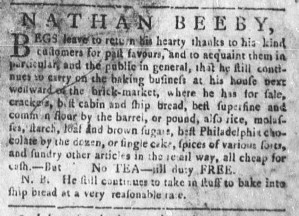
Nathan Beeby, a baker in Newport, took a stand regarding tea in the same issue of the newspaper that carried Green’s advertisement.  He thanked his “kind customers for past favours” and advised the public that “he still continues to carry on the baking business at his house, where he has for sale, crackers, best cabin and ship bread, [and] best superfine and common flour by the barrel, or pound.”  He also peddled “rice, molasses, starch, loaf and brown sugars, best Philadelphia chocolate …, spices of various sorts, and sundry other articles in the retail way.”  As many retailers did at the time, he specified that he did not extended credit, accepting only cash, and then he added: “– But     No TEA – till duty FREE.”  Green left it to readers to realize that tea did not appear in his advertisement, while Beeby made a point of announcing that he did not stock or sell the problematic commodity.  The amount of space that appeared between “But” and “No TEA” amounted to a dramatic pause, further emphasizing Beeby’s commitment and perhaps serving as a reminder to readers of the pledges they made to refuse to consume that beverage.  The baker practiced politics in his advertisement, using the space he purchased in the Newport Mercury to participate in public discourse.

March 27

What was advertised in a colonial American newspaper 250 years ago today?

Newport Mercury (March 27, 1775).

“Worth the Perusal of each TRUE SON OF LIBERTY.”

In the years after British soldiers fired into a crowd of protestors and killed several colonizers on March 5, 1770, the residents of Boston staged an annual commemoration of the “horrid MASSACRE.”  They called on a prominent patriot to give an “ORATION” about what occurred and the dangers of having British soldiers quartered in urban ports during times of peace.  Colonizers did not need to be present for the oration to experience it for themselves.  Each year, printers published and marketed the oration, commodifying an event that played an important role in the imperial crisis becoming a revolution.

New-York Gazette and Weekly Mercury (March 27, 1775).

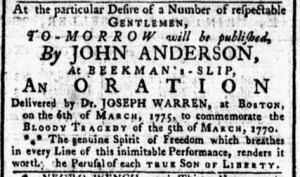
In the first several years, printers in Boston published the oration and newspapers in Massachusetts carried advertisements for it.  In 1775, however, printers in other colonies produced their own editions of Joseph Warren’s oration commemorating the fifth anniversary of the Boston Massacre.  Benjamin Edes and John Gill, the printers of the Boston-Gazette, and Joseph Greenleaf, the publisher of the Royal American Magazine, partnered in printing and advertising a Boston edition.  Not long after, Solomon Southwick, the printer of the Newport Mercury, advertised his own edition, giving the notice a privileged place as the first item in the first column on the first page of the March 27 edition of his newspaper.  On that same day, John Anderson inserted a notice in the New-York Gazette and Weekly Mercury to alert readers of the imminent publication of a local edition undertaken “At the particular Desire of a Number of respectable GENTLEMEN.”  Patriots expressed intertest in obtaining their own copies of Warren’s oration; in turn, printers believed they could generate even greater demand.  To that end, Anderson declared, “The genuine Spirit of Freedom which breathes in every Line of this inimitable Performance, renders it worth the Perusal of each TRUE SON OF LIBERTY.”

The political climate had shifted since printers in Boston disseminated John Hancock’s oration commemorating the fourth anniversary of the Boston Massacre.  Since then, colonizers experienced how Parliament reacted to the destruction of tea during what has become known as the Boston Tea Party.  The Coercive Acts, including the Boston Port Act that closed the harbor until residents paid restitution, prompted delegates from throughout the colonies to gather in Philadelphia for the First Continental Congress in the fall of 1774.  They adopted a nonimportation agreement, the Continental Association, that remained in effect in the spring of 1775.  Given the events that transpired in 1774 and early 1775, it made sense that the anniversary of the “BLOODY TRAGEDY of the 5th of MARCH, 1770” garnered greater attention beyond Massachusetts.

March 17

What was advertised in a colonial American newspaper 250 years ago today?

Massachusetts Gazette and Boston Weekly News-Letter (March 17, 1775).

“AN ORATION … to commemorate the bloody Tragedy of March 5th 1770.”

In the spring of 1771, patriots marked the first anniversary of the “BLOODY TRAGEDY” now known as the Boston Massacre with “AN ORATION Delivered … at the Request of the Inhabitants of the Town of Boston … By JAMES LOVELL.”  That started an annual tradition, with Joseph Warren giving the oration in 1772, Benjamin Church in 1773, and John Hancock in 1774.  Gathering for the oration became an annual ritual.  So did publishing and marketing it.

For the fifth anniversary, the “ORATION … to commemorate the bloody Tragedy of March 5th 1770” was once again “delivered by JOSEPH WARREN.”  Less than two weeks later, advertisements in the March 17 edition of the Massachusetts Gazette and Boston Weekly News-Letter informed readers where they could acquire copies.  One indicated that Benjamin Edes and John Gill, the printers of the Boston-Gazette, sold the oration, implying that they also published it.  According to the imprint, Edes and Gill printed the address in partnership with Joseph Greenleaf, the proprietor of the Royal American Magazine.

Another advertisement gave readers another option: “In the MASSACHUSETTS SPY, of this Day is published, the WHOLE of the ORATION, delivered by JOSEPH WARREN, Esq; on March 6th , 1775, to commemorate the bloody Tragedy of March 5th, 1770.”  Isaiah Thomas, the printer of the Massachusetts Spy, did indeed devote three of the four columns of the third page of his newspaper to Warren’s oration.  In an introduction, he reported that it was “this day published, in a pamphlet” and available for sale in addition to appearing in the newspaper.  The printer offered multiple ways for readers to engage with the oration.  He (and Edes and Gill and Greenleaf) also offered consumers an opportunity to purchase a commemorative item.  Readers who previously purchased the orations by Lovell, Warren, Church, and Hancock on previous anniversaries may have been motivated to add to their collections.

The printer of the Massachusetts Gazette and Boston Weekly News-Letter gave the advertisements a privileged place, likely intended to increase the chances that readers took note of them.  They appeared one after the other immediately after the weekly account of local marriages and deaths.  That meant that the advertisements served as a transition between news items and paid notices.  Readers who perused the news yet merely glanced through the advertisements may have been more likely to take note of these first notices as they realized that the remainder of the page featured advertising.  A manicule also helped call attention to them, signaling their importance in a town experiencing the distresses of the Boston Port Act and the other Coercive Acts.

December 12

What was advertised in a colonial American newspaper 250 years ago today?

New-York Gazette and Weekly Mercury (December 12, 1774).

“He will meet with due encouragement … by every real friend to American manufactures.”

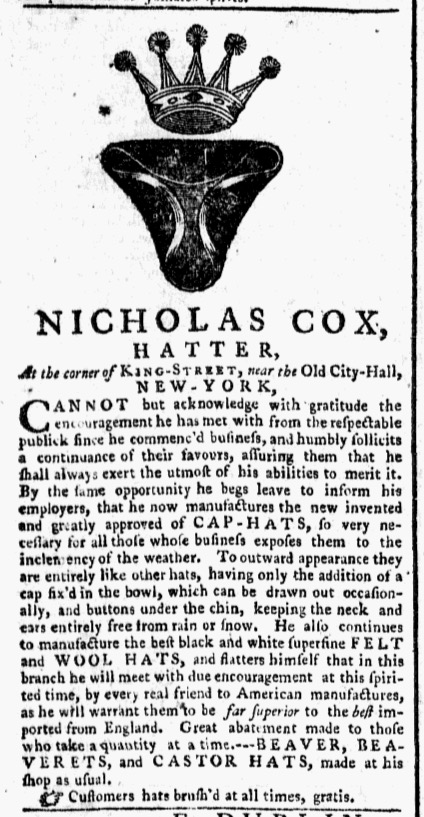
Nicholas Cox, a hatter, made several appeals to consumers in his advertisement in the December 12, 1774, edition of the New-York Gazette and Weekly Mercury.  He commenced with a standard expression of gratitude for “the encouragement he had met with from the respectable publick since he commenc’d business.”  Many purveyors of goods and services did so in their advertisements, signaling to readers that other consumers already considered them worthy of their business.  It was a familiar means of bolstering an advertiser’s reputation.

The hatter also incorporated commentary specific to his trade, proclaiming that he “manufactures the new invented and greatly approved of CAP-HATS.”  For those unaware of this innovation, eh explained that by “outward appearance they are entirely like other hats, having only the addition of a cap fix’d in the bowl, which can be drawn out occasionally.”  In such instances, it “buttons under the chin, keeping the neck and ears entirely free from rain or snow.”  Cox marketed this new style, a very practical element, as “so very necessary for all those whose business exposes them to the inclemency of the weather.”  According to Kate Haulman, colonizers debated whether they should carry umbrellas, “stylistic spoils of empire hailing from India,” in the 1760s and 1770s.  “Some regarded umbrellas as ridiculous and frivolous,” she notes, “serving no purpose that a good hat could not supply.”[1]  Cox produced and sold such hats for men of business who sought to eschew the effeminacy and luxury associated with umbrellas.

His next appeal made an even more explicitly political argument to prospective customers.  He made “the best black and white superfine FELT and WOOL HATS,” like the tricorne hat depicted in the woodcut that adorned his advertisement.  Cox asserted that patriotic consumers had a duty to support his business when they made choices about where to acquire their hats.  He expressed confidence that he “will meet with due encouragement at this spirited time, by every real friend to American manufactures.”  The Continental Association, a boycott of British goods adopted in response to the Coercive Acts, had recently gone into effect.  Cox offered an alternative to colonizers who desired to acquire hats yet wished to remain patriotically correct, either according to their own principles or at least to avoid the ire of others who observed the purchases they made.  Furthermore, his customers did not have sacrifice quality for principles.  The hatter pledged that “he will warrant [his hats] to be far superior to the best imported from England.” That being the case, the crown that appeared above the tricorne hat at the top of his advertisement may have testified to the superior quality of his hats, a general sense of pride in being part of the British Empire, or reverence for the monarch whom many colonizers still hoped would intervene on their behalf in their altercation with Parliament.

In addition to those appeals, Cox included two more common marketing strategies.  He promised a “[g]reat abatement … to those who take a quantity at a time.”  In other words, he gave discounts for buying multiple hats, both for consumers and for retailers who intended to sell them in their own shops.  He also provided a free ancillary service: “Customers hats brush’d at all times, gratis.”  Cox saw to the care and maintenance of the hats he made and sold long after the time of purchase.  He cultivated relationships with customers by encouraging them to return to his shop for assistance in keeping their hats in good order.  Overall, Cox resorted to a variety of familiar and specific appeals when advertising his hats, distinguishing him from competitors who did not put as much effort into marketing their wares.

**********

[1] Kate Haulman, “Fashion and the Culture Wars of Revolutionary Philadelphia,” William and Mary Quarterly, 3rd ser., 62, no 4 (October 2005): 632.

November 7

What was advertised in a colonial American newspaper 250 years ago today?

Newport Mercury (November 7, 1774).

“American SNUFF … equal to any imported from Great-Britain.”

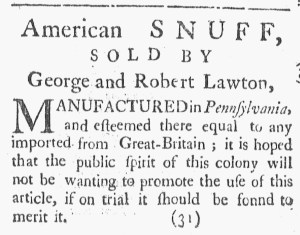
George Lawton and Robert Lawton hoped that their marketing strategy would help them to edge out the competition when they advertised “American SNUFF” in the November 7, 1774, edition of the Newport Mercury.  They explained that the product they sold was “MANUFACTURED in Pennsylvania, and esteemed there equal to any imported from Great-Britain.”  Apparently, it was not yet familiar to consumers in Rhode Island, but the Lawtons hoped that the enthusiasm for the snuff in another colony would convince local customers to give it a try.  Furthermore, they suggested that patriotic consumers had a duty to select this “American SNUFF” and support domestic manufactures over imported alternatives.  “[I]t is hoped,” the Lawtons declared, “that the public spirit of this colony will not be wanting to promote the use of this article, if on trial it should be found to merit it.”  They allowed for some wiggle room, leaving it to consumers to assess the quality of the snuff for themselves, yet proposed that those who did consider it “equal to any imported from Great Britain” should shift their allegiance to the product from the colonies.

Elsewhere on the same page, John Bell a shopkeeper who frequently advertised in the Newport Mercury, hawked “ENGLISH and INDIA GOODS” that he sold “as cheap as can be bought in any shop in AMERICA.”  Following a catalog of some of his inventory, he concluded with a separate entry for “Best Tilloch’s snuff, just imported from Glasgow.”  That city was well known for the quality of the tobacco products made there and then shipped to consumers on both sides of the Atlantic.  Bell expected that customers in Newport recognized “Tilloch’s snuff” as a familiar brand, not an unreasonable supposition considering that other entrepreneurs also advertised that product.  Bell’s effort to market imported snuff did not have the same visual appeal as the advertisement placed by the Lawtons.  Their notice featured “American SNUFF” as a headline in a larger font, calling attention to both the product and the argument about the political principles associated with it at a time that many colonizers advocated for boycotts of British goods as a means of resisting the Coercive Acts passed by Parliament earlier in the year.  They seemingly considered this strategy effective, resorting to it once again after using it several months earlier.

October 17

What was advertised in a colonial American newspaper 250 years ago today?

Boston Evening-Post (October 17, 1774).

“May therefore be … sold … without any Breach on the solemn League and Covenant.”

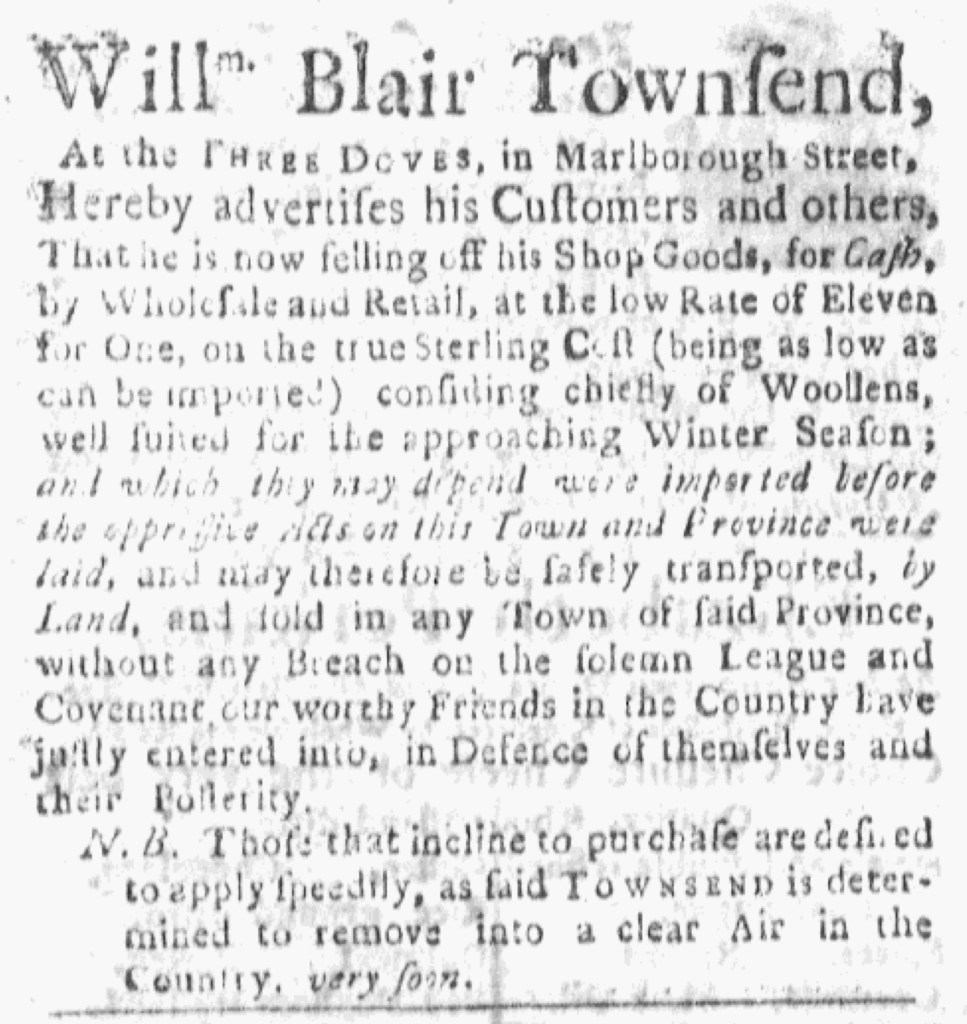
Politics took center stage in William Blair Townsend’s advertisements for “Shop Goods … consisting chiefly of Woollens, well suited for the approaching Season” in the October 17, 1774, edition of the Boston Evening-Post.  He looked to sell his entire inventory “by Wholesale and Retail” and close his shop, a casualty of the blockade of Boston that went into effect with the Boston Port Act that Parliament passed to punish the town for tossing tea into the harbor the previous December.  To that end, he assured prospective customers that “they may depend [the goods] were imported before the oppressive Acts on this Town and Province were laid.”  In addition to the Boston Port Act, Townsend invoked the Massachusetts Government Act and the other Coercive Acts.

Furthermore, he asserted that his wares “may therefore be safely transported, by Land, and sold in any Town of said Province, without any Breach on the solemn League and Covenant our worthy Friends in the Country have justly entered into, in Defence of themselves and their Posterity.”  Townsend referred to a plan outlined in a letter that the Boston Committee of Correspondence circulated on June 8.  After outlining the abuses perpetrated by Parliament, the letter encouraged resistance in the form of “affecting the trade and interest of Great Britain, so deeply as shall induce her to withdraw her oppressive hand.”  The Committee of Correspondence sought to revive nonimportation agreements enacted twice in the past decade, first in response to the Stamp Act and, later, the Townshend duties.  The letter proposed that colonizers “come into a solemn league, not to import goods from Great Britain, and not to buy any goods that shall hereafter be imported from thence, until our grievances shall be redressed.”  Some merchants advocated waiting for more comprehensive measures that enlisted cooperation of other colonies, like the Continental Association that the First Continental Congress was in the process of drawing up in Philadelphia at the time Townsend published his advertisement, yet colonizers in towns throughout Massachusetts supported the Solemn League and Covenant.

Knowing that was the case, Townsend acknowledged the politics of the moment in his advertisement.  He endorsed the pact while also making clear that neither he nor his prospective customers violated it.  They could buy and sell with clear consciences … and without attracting the ire of the public.  Beyond that, Townsend wished to clear out of Boston.  In a nota bene, he encouraged “Those that incline to purchase … to apply speedily” since he “is determined to remove into a clear Air in the Country, very soon.”  The situation had grown so bleak that that he did not intend to remain in Boston much longer.

June 29

What was advertised in a colonial American newspaper 250 years ago today?

Essex Journal (June 29, 1774).

Imported in the last ships from LONDON, A Fresh ASSORTMENT of Summer Goods.”

As June 1774 came to a close, the final issue of the Essex Journal for that month carried news that arrived from Salem, Boston, New London, New York, Philadelphia, Williamsburg, and Charleston.  The editor also selected a short address “To the Farmers in America” from “FREEDOM” to reprint from the most recent edition of the Massachusetts Spy.  It advised, “INCREASE your SHEEP and raise WOOL as far as possible, that you from this time wear LIBERTY CLOTH.”  Although framed as advice to farmers, the suggestion to wear homespun cloth applied to all consumers who wished to protest various abuses by Parliament, especially the Boston Port Act that went into effect at the beginning of the month.  Colonizers discussed their prospects for using commercial means to achieve political ends, recognizing that any boycott of imported goods should be accompanied by encouraging “domestic manufactures” as alternative products.  That included clothing made of homespun fabrics to substitute for textiles imported from London.

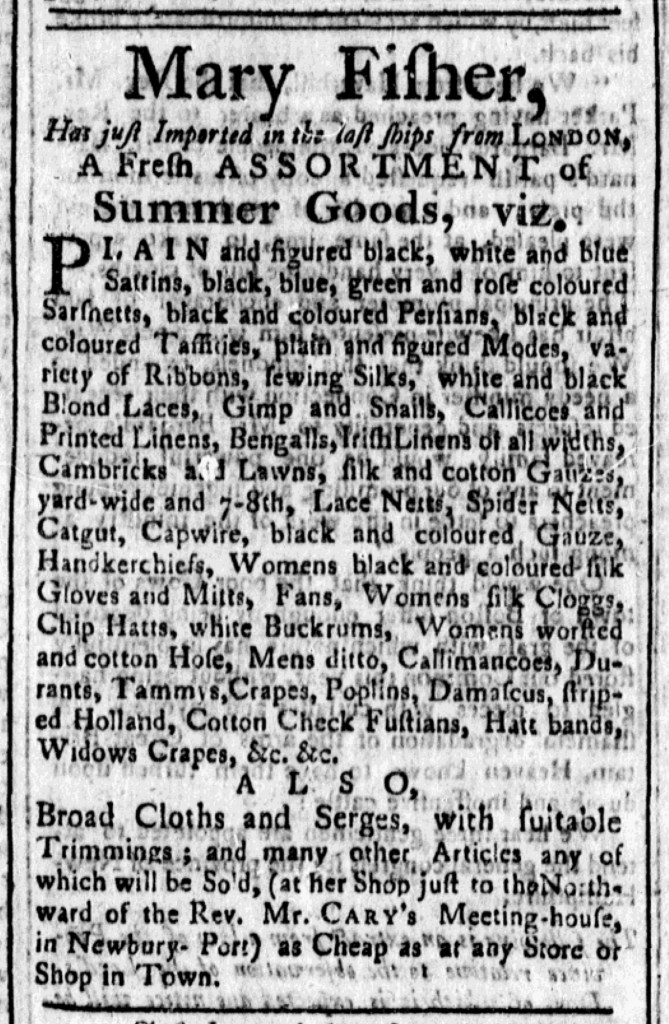
Even as “FREEDOM” promoted “LIBERTY CLOTH” as a symbol of patriotism, merchants and shopkeepers hawked imported goods elsewhere in the newspaper.  No nonimportation or nonconsumption agreement had yet been adopted.  George Searle, for instance, “Just Imported from LONDON … an assortment of Painters Oils and Colours.”  Similarly, John Stickney and Son, announced that they “imported from London, a large assortment of English, India and hard ware GOODS.”  Those goods certainly included garments and fabrics.  Mary Fisher provided more detail, advertising that she “just Imported in the last ships from LONDON, A Fresh ASSORTMENT of Summer Goods.”  She then listed dozens of items, including an array of textiles that ranged from “PLAIN and figured black, white and blue Sattins” to “black, blue green and rose coloured Sarsnetts [sarcenets]” to “Callicoes and Printed Linens.”  Even as such items fell out of favor in some circles, Fisher offered an opportunity for consumers who desired imported textiles, even those who supported the patriot cause, and realized that they should buy what they could before discussions about boycotts became actual boycotts.  Fisher offered her wares “as Cheap as at any Store or Shop in Town,” making it possible for consumers to stockpile items they purchased from her.  Her imported textiles did not have the appearance of homespun “LIBERTY CLOTH,” but, for the moment, customers could at least equivocate that they had not bought those fabrics while a nonconsumption agreement was in effect.  Memories of boycotts in response to the Stamp Act and the duties on certain goods in the Townshend Acts guided consumers in preparing for a new round of protests.

June 13

What was advertised in a colonial American newspaper 250 years ago today?

Supplement to the Newport Mercury (June 13, 1774).

“American SNUFF … MANUFACTURED in Pennsylvania.”

George Lawton and Robert Lawton advertised “American SNUFF” in the Newport Mercury as colonizers from New England to Georgia discussed how to respond to the Boston Port Act, legislation that closed the harbor as punishment for the destruction of tea in December 1773.  Simultaneously, newspapers covered other abuses perpetrated by Parliament.  The June 13, 1774, edition of the Newport Mercury, for instance, featured “A BILL for better regulating the Government of the Province of the Massachusetts-Bay, in North-America” and “A BILL for the impartial Administration of Justice in the Cases of Persons questioned for any Acts, done by them in the Execution of the law, or for the Suppression of Riots & Tumults in the Province of the Massachusetts-Bay, in New-England.”  Although neither had yet been passed when the ship that carried them departed from Bristol more than five weeks earlier, the printer, Solomon Southwick, noted “there is no doubt of their having passed before this time.”  In colorful commentary, he added that “the — [devil] himself can suggest nothing too horrid to be expected from the present administration.”  Another note followed the second bill: “God save the PEOPLE from such Laws!

It was in that context that the Lawtons marketed “American SNUFF … MANUFACTURED in Pennsylvania” as an alternative to snuff imported from Great Britain.  They asserted that consumers in Pennsylvania “esteemed” this snuff “equal to any imported,” so customers did not have to sacrifice quality in their support of “domestic manufacturers,” goods produced in the colonies.  The Lawtons presented trying this snuff as the patriotic duty of consumers who had concerns about current events.  “[I]t is hoped,” they implored, “that the public spirit of this colony will not be wanting to promote the use of this article, if on trial it should be fo[u]nd to merit it.”  In other words, the Lawtons encouraged prospective customers to try the snuff, taking into account the endorsements from colonizers in Pennsylvania, and see for themselves if they liked it as much as imported snuff.  If they did, their subsequent purchases could serve two purposes: acquiring a product they enjoyed while putting political principles into practice.  In many places, colonizers already discussed another round of nonimportation agreements, drawing on a strategy deployed in response to the Stamp Act and the Townshend Acts.  Immediately above the Lawtons’ advertisement, the resolutions from “a town meeting held at Providence” called for “an universal stoppage of all trade with Great-Britain, Ireland, Africa, and the West-Indies” until Parliament opened Boston Harbor once again.  Colonizers sought to use commerce for political leverage.  Similarly, decisions about which products to consume had political implications.  Even with no boycott currently in place, the Lawtons encouraged consumers to think about how they could support the colonies in their contest against Parliament.

April 11

What was advertised in a colonial American newspaper 250 years ago today?

Boston-Gazette (April 11, 1774).

“The SECOND EDITION of Mr. HANCOCK’S ORATION.”

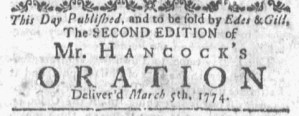
Benjamin Edes and John Gill, printers of the Boston-Gazette, gave their advertisement for the “SECOND EDITION of Mr. HANCOCK’S ORATION Deliver’d March 5th” a privileged place in their newspaper.  Readers did not need further explanation to understand that “March 5th” referred to the date of the Boston Massacre and that Hancock had been selected to give the annual address that memorialized the victims and raised an alarm about the danger of quartering an army in an urban center, like Boston, during times of peace.

Still, Edes and Gill, who printed the “ORATION” as well as the newspaper, did what they could to draw attention to the second edition.  The first time they announced it was “This Day Published,” in the April 4, 1774, edition of the Boston-Gazette, they ran the notice immediately below news and editorials.  Even if readers chose not to peruse other advertisements closely once they realized they had finished the news, they likely took note of the advertisement for the “ORATION” in its place of transition from one kind of content to another.  In the next issue of the weekly newspaper, the notice ran at the bottom of the last column on the first page, the only advertisement on that page.  Once again, the patriot printers increased the likelihood that readers would spot that advertisement and accept an invitation to demonstrate their own commitment to the patriot cause by purchasing copies for themselves.

That Edes and Gill published a “SECOND EDITION” testified to the demand for the first edition.  It sold well enough to justify another printing.  Edes and Gill took it to press just a few months after the Boston Tea Party and just a few weeks after another destruction of tea.  Although that second Boston Tea Party is not nearly as well known today, it was certainly among the current events that would have been on the minds of colonizers as they participated in commemorating the fourth anniversary of the Boston Massacre, discussed the politics of tea, and decried various abuses perpetrated by Parliament.  Purchasing and reading Hancock’s “ORATION” was part of the growing resistance to British rule in the colonies, a means for consumers to practice politics in the marketplace and imbibe the rhetoric of a noted patriot long after the Boston Massacre’s annual commemorative events concluded.