What was advertised in a colonial American newspaper 250 years ago this week?
New-Hampshire Gazette (December 24, 1767).
“MEIN and FLEEMING’s Register for 1768.”
Daniel Fowle and Robert Fowle, the printers of the New-Hampshire Gazette, inserted a short advertisement for an almanac, “MEIN and FLEEMING’s Register for 1768,” in the final issue published in 1767. More than any other aspect, the typography of this notice distinguished it from news items and advertisements that appeared on the same page and throughout the rest of the newspaper. It appeared as a single line that ran across all three columns at the bottom of the second page. Another short advertisement, that one calling on the owner to retrieve a boat recently found adrift, mirrored the position of the Fowles’ advertisement on the facing page, running across all three columns at the bottom of the third page. Had they been set into columns, each advertisement would have consisted of three lines.
Why did the Fowles choose to deviate from the usual format in this issue of their newspaper? They may have wished to draw particular attention to the almanacs for 1768 as the first day of the new year approached. In that case, they might have inserted the notice concerning the boat on the opposite page in order to provide balance. Alternately, they may have received the notice about the boat too late to integrate it into columns that had already been set, but found a creative way to include it in the issue. In that case, the advertisement for the almanac provided balance (though they exercised their privilege as printers to place it first in the issue) and supplemented their lengthier advertisement for “AMES’s Almanack” and “Bickerstaff’s curious Almanack” on the final page.
Measuring the length of the columns on each page would aid in determining the viability of either of these options as explanations for what occurred. That, however, requires access to the original copies rather than digital surrogates. Digitized editions standardize the size of every page to the dimensions of the screen on which they appear. Although metadata, including measurements, could be included in the process of producing digital editions, that would significantly increase the time and cost, ultimately further limiting access to a format intended to broaden access for historians, other scholars, and the general public. Even as librarians and archivists and the communities they serve celebrate new opportunities presented by evolving technologies, they also acknowledge that digital surrogates supplement rather than replace original sources.
What was advertised in a colonial American newspaper 250 years ago today?
South-Carolina and American General Gazette (October 30, 1767).
“Ravens Duck, German Stripes, Holland Shirting.”
It may appear that I have made an error in posting the image of today’s advertisement, but that is not the case. Rather than rotate it ninety degrees counterclockwise to make it easier to read, I have instead chosen to retain its original orientation from the October 30, 1767, edition of the South-Carolina and American General Gazette. A closer look at E. Pierce’s advertisement for “GERMAN Osnaburghs” and other textiles reveals important lessons about both eighteenth-century printing practices and modern remediation projects.
Pierce’s advertisement appeared on the fifth page of the October 30 issue. Although most issues of eighteenth-century newspapers consisted of only four pages (a single broadsheet printed on both sides and folded in half), sometimes printers issued a two-page supplement when they had sufficient news and advertising. Robert Wells took that approach with this issue, though he did not include a masthead that denoted a supplement. Instead, he continued the consecutive page numbering of the issue, indicating that he conceived of the contents of the extra sheet coming after the news and advertising from the standard issue. If the additional sheet had been tucked into the broadsheet to form the third and fourth pages of a six-page issue (which was quite likely, especially considering the lack of a masthead designating a supplemental issue), the page numbers did not match that format. The pages for the broadsheet ran from 213 to 216. The pages on the half sheet were 217 and 218, indicating Wells thought of them as coming after the other content. Otherwise, they would have been pages 215 and 216, the numbers associated with the third and fourth pages of the six-page issue. The numbering suggests that Wells may not have initially intended to issue a six-page issue but instead made that decision only after some of the sheets had been printed.
South-Carolina and American General Gazette (October 30, 1767).
Yet this does not explain the odd orientation of Pierce’s advertisement. In order to fit as much content as possible on the pages of the additional sheet, Wells rotated several advertisements to print in short columns that ran perpendicular to the three columns that ran from the top to bottom of the page. Given the scarcity of paper, this also resulted in maximum efficiency in using his resources.
That being the case, it would be helpful to know more about the dimensions of the extra sheet. From the digitized images of the newspaper, the extra sheet appears to be a different size than the standard issue. The broadsheet featured four columns of text, while the additional pages had only three and the narrow column of rotated advertisements. When printing the images on each page on office paper (once again remediating them to 8.5 x 11 inches), the type on the extra sheet appears much larger than the type from the broadsheet, though it all would have been the same type of a consistent size throughout the entire issue read by colonists in the eighteenth-century. Both the digitized images and hard copies of those images hide the original dimensions of the pages of the original newspaper. That aspect of the materiality of the text has been lost because the database that includes these images does not provide sufficient metadata about the size of each page. As an historian with significant experience investigating these sorts of discrepancies, I realize that if I want to learn more about the dimensions of the original broadsheet and additional sheet, which in turn will tell me more about newspaper production in colonial South Carolina, that I must consult an original copy of the newspaper.
Digitization of eighteenth-century newspapers is wonderful for delivering content. The process makes historical sources much more widely accessible to scholars and the general public. The Adverts 250 Project is possible because of digitization. Yet digitization, especially digitization without extensive metadata, only produces surrogates for the original sources, sometimes hiding certain aspects (such as the size of the page or type of paper) even while revealing others (the contents). Robert Wells found it necessary to print two extra pages to accompany the October 30, 1767, edition of the South-Carolina and American General Gazette. The digitized images, however, obscure elements of the printing process and the actual appearance of the newspapers that subscribers and other readers encountered in the eighteenth century.
What was advertised in a colonial American newspaper 250 years ago today?
Georgia Gazette (October 14, 1767).
“Henry Steerman and Jonathan Remington, TAYLORS and PARTNERS.”
The advertisement placed by Henry Steerman and Jonathan Remington, as well as all of the other advertisements on the same page of the October 14, 1767, edition of the Georgia Gazette, creates a bit of a mystery for modern historian who consult databases of digitized newspapers to conduct their research. These advertisements appeared on the fifth page of that issue.
Why would this be a mystery? Most newspapers published in 1767 followed a standard format: four pages created by printing two pages on each side of a broadsheet and folding it in half. Occasionally printers issued a supplement, either two (using half a broadsheet) or four pages (using an entire additional broadsheet). Usually these supplements had their own masthead that identified them as supplements, though sometimes they were inserted in the center of the newspaper without additional identification. Due to the scarcity of paper, printers carefully filled both sides of any supplement with news items, advertisements, or both, leaving no empty space. If they did not have enough material to issue an even number of pages – four, six, or eight – they inserted notes indicating that news items would be continued in the next issue or advertisements omitted would be in the next.
The Georgia Gazette rarely issued a supplement. The layout sometimes suggested that the printer had difficulty even filling four pages. On such occasions the advertisements featured generous amounts of white space in order to occupy as much space on the page as possible. That Steerman and Remington’s advertisement, along with twenty others, appeared on the fifth page of the Georgia Gazette was out of the ordinary. What was perplexing to this historian, however, was the absence of a sixth page in the database of digitized newspapers. It would have been extraordinary for the printer not to print on both sides of the sheet, yet the sixth page seemed to be missing. Even more curious, the fifth page did not have a masthead that identified it as a supplement. Had Steerman and Remington’s advertisement actually appeared on the fifth page? Or was it on the sixth page and the fifth page, for whatever reason, was missing from the database?
These questions could not be answered merely by examining the digital surrogates. I found definitive confirmation only when I visited the American Antiquarian Society to examine the original issue of the Georgia Gazette that had been photographed and later digitized by Readex. To my surprise, the October 14, 1767, edition of the Georgia Gazette did indeed consist of only five pages. More accurately, it consisted of five printed pages and a blank sixth page, but this was not at all evident from the database. It did not include a photograph of the blank sixth page to provide context and a complete record for researchers.
This points to two lessons when it comes to the creation and use of digital surrogates in historical research. First, digital surrogates should be used in addition to, rather than instead of, original sources. Digital surrogates are valuable resources that have made original documents much more accessible to historians, other scholars, and the general public, but sometimes they hide elements of the past rather than reveal them. They must be consulted with caution and with knowledge of what kinds of questions to also ask about original documents in order not to be misled by digitized ones.
Second, the example of the October 14, 1767, issue of the Georgia Gazette underscores the necessity of content providers, like Readex, consulting with librarians, archivists, historians, and other scholars who are familiar with the original sources and the most likely users of digital surrogates when designing and implementing databases. To a layperson unfamiliar with eighteenth-century newspapers it seemed unnecessary, wasteful, and perhaps even confusing to include a photo of a blank page of a newspaper. To someone who works with eighteenth-century newspapers, both original and digital surrogates, every day, the absence of a blank page in the database actually created confusion that could have been avoided.
Consulting the original issue of the October 14, 1767, edition of the Georgia Gazette cleared up the mystery about its original format, yet another mystery remains, one that will be much harder to solve. Given the scarcity of paper, why did the printer issue an additional halfsheet printed on only one side?
“Just Imported, and to be Sold by Harbottle Dorr.”
Harbottle Dorr’s name jumped off the page when I first spotted this advertisement in the July 20, 1767, edition of the Boston-Gazette. In terms of content and format, his notice was not particularly distinctive. So why did this particular advertisement catch my eye? Why did it create an extra spark of excitement?
In 1767, residents of Boston knew Harbottle Dorr as a merchant, in part because he advertised in several of the local newspapers. In the course of the next quarter century, he joined the Sons of Liberty and “served intermittently as a Boston selectman for many years between 1777 and 1791.” Today he is best known to historians, especially historians of print culture, thanks to his collection of newspapers from the period of the imperial crisis and the American Revolution, now in the collections of the Massachusetts Historical Society. As the MHS explains, “Beginning in 1765, Dorr spent more than a dozen years purchasing newspapers, writing comments in margins, inserting reference marks in articles, and assembling indexes.” He aimed “to form a political history” of events as he witnessed and participated in them. His indexes and annotations demonstrate one reader’s intensive engagement with the public prints. Thanks to digitization and other technologies, scholars and the general public have access to The Annotated Newspapers of Harbottle Dorr, Jr., via the Massachusetts Historical Society’s website.
In addition to advertising in the July 20 issue of the Boston-Gazette, Dorr also acquired a copy for his collection. It does not appear, however, that he purchased every newspaper that ran one of his advertisements. For instance, he inserted the same advertisement in the July 20 edition of the Boston Evening-Post, but that issue is not in the collection he assembled. At the very least, he did not save or add issues merely because they published his commercial notices. He may have confirmed that his advertisements indeed appeared as expected, but that was not sufficient reason for inclusion in his project.
Still, today’s advertisement has a unique twist compared to most others featured by the Adverts 250 Project, though a twist rendered more complex by digitization of historical sources. In most cases, the provenance of the original issue makes little difference. This advertisement, however, came from a copy originally possessed by the advertiser himself. In preparing today’s entry, I consulted Dorr’s newspaper to write about his advertisement. Or did I? Does it make sense to feel a connection to the material text – to feel excited that Dorr owned, touched, and annotated this particular issue – when I have not actually used the physical manifestation of that issue but a digital surrogate instead? Maybe, but maybe not.
In the past I have joined other scholars in arguing that digitized sources are best used as complements to, rather than replacements of, original sources. After all, sometimes consulting originals yields answers just not possible to achieve when examining digital surrogates, despite their many advantages. This response, however, does not factor in the emotional component of archival work, the excitement scholars feel when handling the things owned by the people we study, a physical connection that defies the passage of time.
Yet I still experienced a flash of excitement when I examined today’s advertisement via The Annotated papers of Harbottle Dorr, Jr., that I did not feel when I first saw the advertisement in Readex’s database of America’s Historical Newspapers. I feel a greater connection to the advertisement inserted in the Boston-Gazette, part of Dorr’s collection, than I do to the advertisement in the Boston Evening-Post, not in his collection, even though it was the same advertisement. Even mediated by digitization, “seeing” the original yields emotional satisfaction. In that regard, the Massachusetts Historical Society has done an even greater service than I previously realized. Their online collection of Dorr’s newspapers has enhanced my experience by associating a person with the material text.
What was advertised in a colonial American newspaper 250 years ago today?
Georgia Gazette (June 3, 1767).
“MRS. STEDMAN takes this method of returning her sincere thanks.”
Mrs. Stedman tells an interesting story (or, at least, parts of it) in her advertisement in the Georgia Gazette, but that story has been obscured by at least two factors. First, Stedman did not provide all of the details herself. Second, the quality of the original printing and subsequent photography and digitization makes the advertisement (and much of the rest of the issue) difficult to read. This second factor has ramifications when using digital surrogates to conduct research.
With some effort, the human eye can identify all the words in Stedman’s advertisement. Modern technologies, especially OCR (optical character recognition), often do not do as well when searching through digitized documents. I located Stedman’s advertisement because I read through the entire June 3, 1767, edition of the Georgia Gazette. I wondered, however, whether keyword searches would yield this advertisement. I’ve been frustrated in the past when I’ve had copies of advertisements from eighteenth-century newspapers that came from a particular database yet keyword searches to determine how many times those advertisements appeared did not even produce the originals although I knew very well that they did indeed exist.
I conducted an experiment with Stedman’s advertisement and the database in which I first encountered it, Readex’s America’s Historical Newspapers. What would happen if I did a keyword search for “Stedman,” limiting the date range to 1767 and considering only advertisements? This yielded only two results, both for “ALEX. STEDMAN” in the Pennsylvania Chronicle. The keyword search did not turn up an item that I knew very well had been printed in the Georgia Gazette and was part of the database!
I also recognized, however, that the problem may not have been the OCR but instead could have been a metadata error. What would happen in a keyword search for “Stedman” with the date range limited to 1767 but not specifying that advertisements were the only article types under consideration? That search yielded three results, two for “ALEX. STEDMAN” as above and one for “MRS. STEDMAN.” In this case, the problem was not the OCR but rather a human error made in coding the data. The advertisement had been mistakenly marked as a news item.
Still, I questioned the effectiveness of keyword searches for this particular advertisement because I have learned from experience that OCR often has difficulty with eighteenth-century print. I decided to try a search with an alternate keyword, one that might have been much more likely depending on the interests of the researcher: “tuition.” With the date range limited to 1767 and no specifications for particular article types, a keyword search for “tuition” yielded forty-seven results. It did not, however, uncover Stedman’s advertisement. A similar keyword search for “Stewart,” the woman Stedman recommended as her replacement, similarly did not pick up this particular advertisement among its 203 results.
This experiment demonstrated two types of problems to keep in mind when using digitized sources. OCR is not infallible. Human coding of data can also be flawed. Despite these shortcomings, digitized sources have revolutionized the way historians conduct research, the types of questions they ask, and the answers they find. As with any research tool or methodology, historians and others need to aware of both advantages and potential deficiencies.
What was advertised in a colonial American newspaper 250 years ago today?
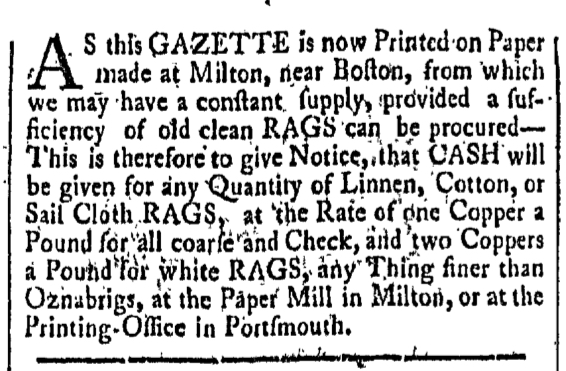
New-Hampshire Gazette (March 6, 1767).
“CASH will be given for any Quantity of Linnen, Cotton, or Sail Cloth RAGS.”
Printers regularly issued calls for rags in their newspapers throughout the eighteenth century. Most were brief, consisting of just a few lines announcing “cash for rags.” Others, like today’s advertisement, were more extensive, specifying which types of rags were desired and the prices awarded for each.
The shorter advertisements often flummox my students. The longer ones, on the other hand, provide sufficient context for figuring out why printers in early America so valued rags, one of the most important raw materials for creating the supplies they needed to pursue their trade. Encountering such notices provides wonderful opportunities for discussing how we are removed from the eighteenth century in a variety of ways.
First, we live in a world in which most paper we use was manufactured from wood pulp. Most students have not even conceived of an alternative prior to reading advertisements in the New-Hampshire Gazette and other newspapers from colonial and Revolutionary America. Here it becomes important to note that even though students are reading these advertisements, they are consulting digital surrogates to do so, keeping them removed from the eighteenth century in important ways even as they seek to better understand the period. Although they have access to the text printed in newspapers – and can even see its format and layout on the page thanks to digital images that provide more than mere transcriptions – they do not actually touch any of the pages from the original publication. In the absence of the material text they miss out on the tactile sensations that would provide clues that paper production has significantly changed in the past quarter millennium.
The more extensive calls for rags also demonstrate how we are removed from the language of consumer culture so fluently spoken in the eighteenth century. Today’s advertisement advised that “CASH will be given for any Quantity of Linnen, Cotton, or Sail Cloth RAGS, at the Rate of one Copper a Pound for all coarse and Check, and two Coppers a Pound for white RAGS, any Thing finer than Oznabrigs.” The printers assumed that readers could identify the many different kinds of fabrics used in early America and advertised for sale elsewhere in their newspapers. They assumed that readers could make distinctions among them, such as determining which were “finer than Oznabrigs.” Although today’s notice did not attempt to sell any goods or services it depended in part on familiarity with consumer culture.
What was advertised in a colonial American newspaper 250 years ago this week?
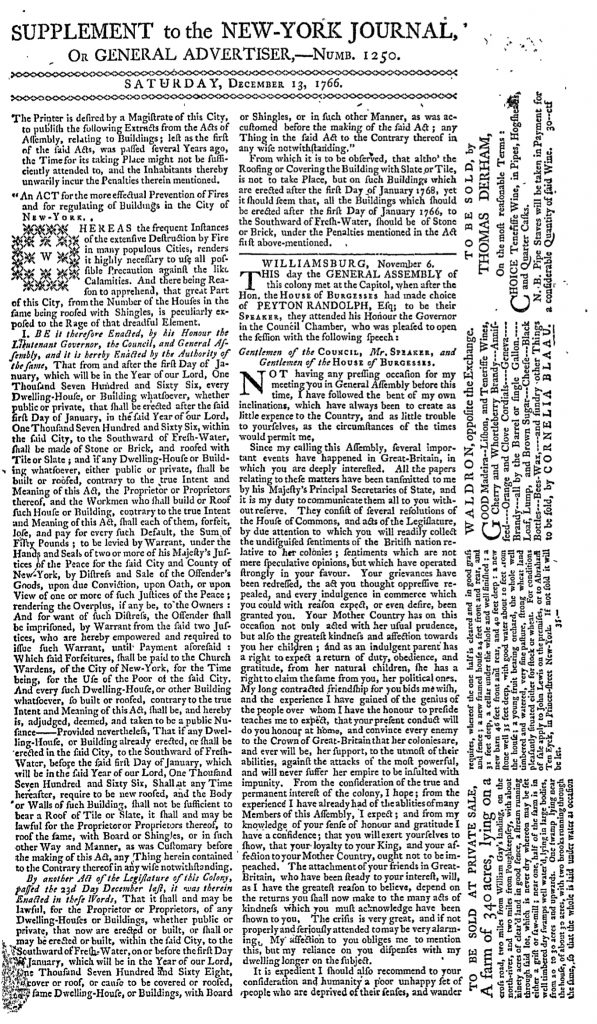
Supplement to the New-York Journal (December 13, 1766).
“TO BE SOLD, by THOMAS DERHAM, … CHOICE Teneriffe Wine.”
Thomas Derham’s advertisement for “CHOICE Teneriffe Wine” occupied a rather unique position on the first page of the Supplement to the New-York Journal, printed two days after that week’s regular issue of December 11. It appeared in the upper right corner, but the entire advertisement had been rotated ninety degrees counterclockwise, such that it was printed perpendicularly to the two columns that comprised the majority of the news and advertising on the page. A narrow column of text – actually four columns, each rotated ninety degrees counterclockwise – appeared on the right side of the page.
Supplement to the New-York Journal (December 13, 1766).
When I first encountered this striking image when consulting the digitized reproductions of eighteenth-century newspaper made available via Readex, I suspected that I knew how to explain it, having examined something similar in the New-Hampshire Gazette earlier this year. It looked as though the supplement had been printed on a smaller broadsheet than the regular issue, reducing the number of columns, but the industrious printer rotated some of the text to squeeze in as much news and advertising as possible. There was no way to know for certain that this was the case, however, without examining original copies of the supplement and standard issues of the New-York Journal from 1766. Readex does not supply metadata about the measurements of broadsheets and columns, nor do I fault the company for not providing this information since it would be prohibitively expensive to collect and code. This is an instance in which working with digital surrogates hides information about the sources that would have been apparent from just a glance at the original. For the record, unless a ruler appeared in every frame of the microfilm reproduction of the New-York Journal, I would have encountered the same difficulty. The shortcoming is not specific to digitization but rather to any sort of surrogate that removes the researcher from interacting with the text in its material form.
Besides, as much as I appreciate the convenience of working with so many digitized newspapers as I pursue this project, sometimes it’s nice to have an excuse for working with the originals. Upon examining the American Antiquarian Society’s copy of the New-York Journal I learned that my assumption was indeed correct. John Holt used a smaller sheet for the supplement (8 & ½ inches by 14 inches rather than 10 inches by 15 & ½ inches). He maintained the same column width, 2 & 7/8 inches, but did not have sufficient space for a third column, at least not unless he rotated some of the text in order to make it fit on the narrower page. Each of the four columns in the “bonus” column measured 2 & 7/8 inches. All of the text from those miniature, rotated columns appeared in a previous issue of the New-York Journal. Holt did not need to set new type; he simply moved around advertisements that had been set already.
Did readers take special notice of Thomas Derham’s advertisement because of its rather unique placement on the page? Possibly, but whatever additional interest it may have generated cannot reasonably be attributed to any sort of intentional effort to produce an innovative layout to draw attention to advertising. Instead, the printer was practical and pragmatic when putting together the December 13 supplement. Examining the original allows me to make such claims with confidence, while the digital surrogate alone could not resolve my questions or point me in the direct of the best possible interpretation to explain the interesting placement of Derham’s advertisement.
What was advertised in a colonial American newspaper 250 years ago today?
Supplement to the Boston Evening-Post (November 10, 1766).
“A fine assortment of neat pinchbeck shoe-buckles.”
As I read this advertisement, I was overwhelmed by the variety of goods imported in the Thames by Captain Watt and offered for sale by “Baker & Bridgham In Union Street.” The assortment of goods ranged from fabrics such as satins and flannels to accessories such as buckles and buttons.
I was intrigued by the description of the shoe buckles made of pinchbeck. Pinchbeck, a form of brass, was commonly used to design accessories during the colonial era. An alloy of copper and zinc, pinchbeck resembled gold in its appearance. At first, many colonists might have thought that pinchbeck was real gold because of its bright and polished image. However, pinchbeck was a “counterfeit” of gold regularly used to craft various jewelry and other adornments, including rings, necklaces, earrings, brooches and shoe buckles.
Colonial smiths and jewelers designed items made of pinchbeck for customers, who asked for their jewelry and accessories to be specific shapes, include precious stones, or have their name engraved. However, there were other colonists who preferred to take advantage of the already stocked and readymade items that were available from shopkeepers like Baker and Bridgham.
**********
ADDITIONAL COMMENTARY: Carl Robert Keyes
The November 10, 1766, issue of the Boston Evening-Post was accompanied by an advertising supplement. Approximately half of the regular issue already consisted of advertising, but T. and J. Fleet sold more advertisements than the issue could contain. As was often the case with colonial newspapers, this issue and its supplement functioned as a delivery mechanism for advertising more than as a means of delivering news items. Rather than a mixture of legal notices and other sorts of advertising that transmitted news and announcements, almost every advertisement that appeared in the supplement promoted consumer goods and services. A couple of dozen merchants and shopkeepers enticed readers in Boston to desire and purchase the merchandise they stocked.
This supplement demonstrates one of the disadvantages of working with digitized sources. The size of the page on which it was printed appears to be different than the broadsheet for the regular issue, but the database does not provide sufficient metadata (or any sort of measurements at all) to make that determination. Each page of the regular issue included three columns, but both pages of the supplement had four. When downloading the entire issue as a PDF, the supplement appears wider, but there’s no way to know if the relative proportions accurately represent the original sources without consulting those sources themselves. This hinders our ability to understand some of the ways that colonists might have interacted with the advertising supplement as a material text.
The content of the advertisements does not tell the entire story. Was the supplement indeed printed on a larger sheet? If so, why? Would it have been simply to squeeze in all the remaining advertisements? Or was that a strategy the Fleets employed to call special attention to the advertisements they published, perhaps making their newspaper more attractive to other advertisers (and, in turn, generating more revenues)? Is there evidence that the supplement was folded in order to fit inside the original issue and delivered at the same time? The digitized images of the November 10 issue and its supplement do not indicate the answers to these questions. Digital surrogates simultaneously allow for greater access to historical sources and conceal some of the important attributes of the originals.
What was advertised in a colonial American newspaper 250 years ago today?
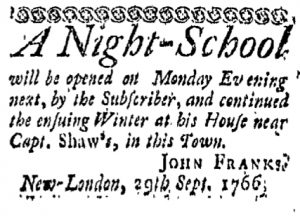
New-London Gazette (October 3, 1766).
“A Night-School will be opened on Monday Evening.”
Evening schools allowed children and adults who would not have normally attained an education to get the opportunity. In my Education class, Schools and American Society (taught by Prof. Casey Handfield), we discussed educational disparity in colonial America.[1] Children’s formal education in the colonies was limited, often to a select group of middling and elite white males. However, there were many other forms of education that took place in the colonies, such as apprenticeship, indentured servitude, and dame schools. Apprenticeship was a way for many children to learn a skill over time; although their formal education may have been limited, they learned a skill that provided them with a livelihood once they were older and finished the apprenticeship. Some forms of indentured servitude also allowed for learning a skill from the master. At dame schools, children learned basic skills from women (usually childless or older and widowed). However, most of these women had little formal schooling themselves, but would teach based on religious ideals.
Evening schools were another important form of education in colonial times, as I learned from also consulting Robert Francis Seybolt’s Evening School in Colonial America.[2] Some of the colonists sent their apprentices or indentured servants to night school during the winter months. Because the days were shorter, less light meant fewer work hours. This allowed some apprentices and servants to learn a skill during the day and then go to an evening school to learn basic writing, reading, and math skills. Apprentices and servants who got to go to evening schools would have been very lucky to learn both a skill that would provide them with a livelihood and the skills to make their future business successful.
Evening schools in the colonies originated in the Dutch colony of New Netherland in 1661. Once that colony became part of the New York in 1674, the evening schools were slowly taken over by English night schools. In Boston, the first mention of an evening school was in 1724 in the Boston Gazette. According to Seybolt, these two port cities, New York and Boston, were the first to establish this sort of schools, with inland towns and villages getting them later.
John Franks advertised his school in the New-London Gazette. He taught it in his home. Starting the classes in October and continuing every Monday for the whole of winter provided Franks’ students ample time for work during the week and then once darkness fell and the work day was done they could go to class.
**********
ADDITIONAL COMMENTARY: Carl Robert Keyes
Elizabeth is a veteran guest curator for the Adverts 250 Project, having already taken on these responsibilities for two weeks as part of my introductory Public History course last spring. As a result, she came to the project this time already possessing familiarity with the advantages and disadvantages of working with digitized sources. Rather than using my additional commentary to elaborate on her analysis of the advertisement she selected for today, I’ve decided instead to discuss one of the challenges inherent in using digital surrogates for the New-London Gazette.
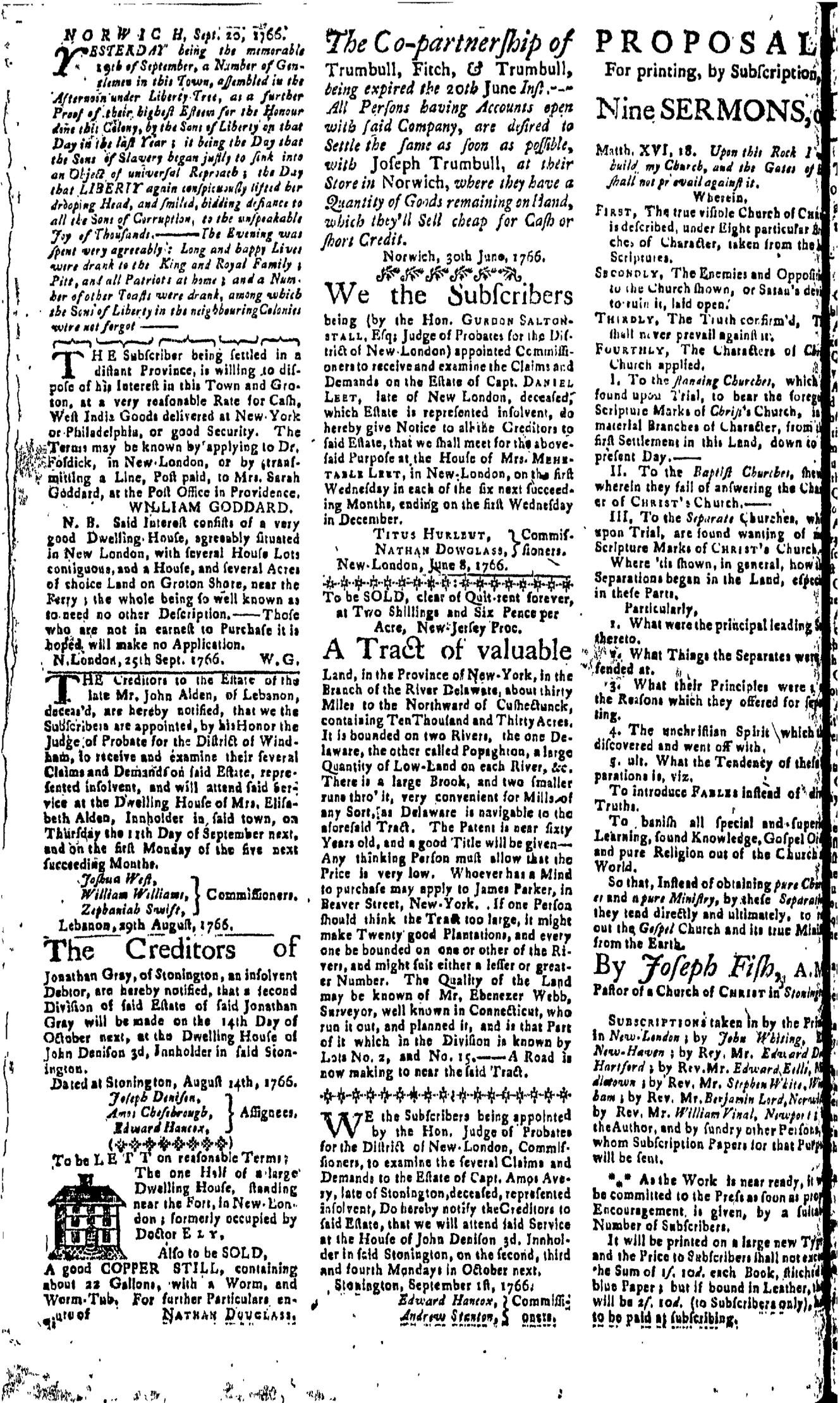
Third Page of New-London Gazette (October 3, 1766).Fourth Page of New-London Gazette (October 3, 1766).
First, it’s necessary to understand the material aspects of the original October 3, 1766, issue of this newspaper. Like other colonial newspapers, each issue consisted of four pages created by printing on both sides of a broadsheet and then folding it in half. While some surviving issues have remained separate, many others have been gathered together, arranged chronologically, and bound into large volumes, either by printers or subscribers in the eighteenth century or by archivists and librarians at some point since. As a result, when historians consult eighteenth-century newspapers, they often work what look like oversized books that must be supported in special wooden cradles in order to preserve the bindings and avoid damage to the individual issues.
As a result of binding so many newspapers together, sometimes it is difficult to read the material in the column printed closest to the fold. Without sufficient space devoted to the margin that could later be used by the bookbinder, the binding draws the pages too close together to read (or photograph or digitize) all of the printing on the page. On the other hand, the distinctive appearance of a newspaper in a tightly bound volume makes it easy to determine at a glance which were even- and odd-numbered pages when reading the newspaper on microfilm or a computer screen. Both media eliminate other aspects of the material text that readers would otherwise use when working with an original issue. Have a look at the third and fourth pages of the issue that included today’s advertisement.
It is easy to tell which side of the page was adjacent to the binding, which also makes it easy to determine which was an even-numbered page and which was an odd-numbered page. Note that the advertisement Elizabeth chose appeared far away from the original fold of the newspaper and, thus, far away from the binding of the bound volume. This helped to make it legible when it was photographed and digitized. On the other hand, news items and advertisements that appeared close to the binding have been partially obscured. It is difficult to read them. Keyword searches using current technologies do not effectively “read” those items either. Readers working with the original bound volume of newspapers can shift position to view the page from a slightly different angle or carefully open the volume just a little wider, but these options are not available to researchers using microfilm or digital surrogates. The image of the page as it appears is the only possible image available to them.
As I have argued many times, digitization is wonderful, but it is not perfect. Sometimes it introduces new problems or eliminates possible solutions that working with original documents would allow. As an Education and History major, Elizabeth is especially interested in advertisements about colonial education. That John Franks’ advertisement for “A Night-School” was is legible for Elizabeth and other historians to consult is a wonderful circumstance that was in no way guaranteed by the historical and technological processes that have contributed to the production, preservation, and dissemination of the original documents.
**********
[1] See also Joel Spring, American Education, 16th ed. (McGraw Hill, 2013)
[2] Robert Francis Seybolt, The Evening School in Colonial America (Urbana: University of Illinois, 1925).
In recent weeks I have questioned some of the decisions made by the printers of the New-Hampshire Gazette in the early months of 1766. Several of the advertisements the guest curators have selected featured rather unconventional formats, sometimes as a line or two running across the bottom of a page and other times entire advertisements tilted counterclockwise ninety degrees. I discovered other irregularities as I consulted Early American Newspapers to see these advertisements in the context of the entire printed page. What were the printers thinking?!
I’ve suggested a couple of theories. For instance, I hypothesized that some of the unusual layout might have been the result of the printers attempting to create front and back pages with equal coverage of text. I also questioned whether some of the decisions about the layout might have been innovative experiments to draw readers’ attention to the advertising. In both instances, I promised to consult the originals, rather than the digital surrogates, to see if that would answer any questions.
It turns out that examining original issues of the New-Hampshire Gazette helped me to solve the mystery! This is an instance that demonstrates that digital surrogates cannot replace original sources. Instead, the two complement each other, allowing scholars to ask new questions and find answers that would not have been possible (or, at the very least, much less likely) when relying on only one or the other.
Here’s what was happening with the New-Hampshire Gazette in 1766. Like other newspapers of the era, this one was published on a broadsheet that was folded in half to create an issue with four pages. In this case, each page measured 9½ inches wide by 14¾ inches high. Each page featured three columns whose width each measured 2¾ inches. Let’s call that a “standard” format for the purposes of this examination.
For the February 7 issue, however, the printers switched to smaller broadsheets. I imagine that the larger ones were in short supply or not available. That issue, as well as the next two (February 14 and 21) still included four pages, but each page was 8 inches wide by 13 inches high rather than 9½ inches x 14¾ inches. Instead of three columns measuring 2¾ inches wide each, the new size accommodated two columns that were 3½ inches wide (in most cases, but I will soon describe some of the very interesting exceptions). Let’s consider these new parameters a “temporary” format for the purposes of this examination.
Starting with the February 28 issue, the newspaper returned to the larger size broadsheet, but not to any sort of “standard” format. That and the following issue, March 7, featured advertising layouts that were even more visually jolting. With the March 14 issue the New-Hampshire Gazette returned to publishing “standard” format issues of four pages with three columns measuring 2¾ inches wide each.
Although Early American Newspapers revealed to me the difference in the number of columns, it did not offer any metadata explaining the transition. The difference was immediately apparent, however, when I viewed the originals at the American Antiquarian Society. I spent quite a bit of time with a ruler measuring the pages and the columns for each issue from January 31 through March 14.
This particular kind of metadata is currently lacking in Early American Newspapers. That is an observation rather than a complaint. I realize that it would be prohibitively expensive to develop this particular metadata: all the measuring, recording, coding, and other tasks required to link this data to the digitized images that substitute for the original newspapers. As somebody who regularly uses digitized newspapers I would much prefer that the partnership of the American Antiquarian Society and Readex continue to produce digital images of as many newspapers as possible, allowing for even more expansive research by scholars working on a variety of projects and members of the general public asking a variety of questions. I understand that the trade off for access to a greater number of sources will often be less metadata for most of them. Still, I feel that the strategy that has been pursued here has been appropriate, as long as those using the digital surrogates are aware that the digital images cannot reveal everything that the original sources do.
This raises important questions about what we miss when we rely exclusively on digital sources. I first began thinking about this issue as a result of Leon Jackson’s presentation at the Digital Antiquarian Conference last summer: “Historical Haptics: Digital and Print Cultures in the Nineteenth Century.” (Check out the slides from his presentation.) He pointed out that every issue of a newspaper appears to “be” the same size when consulting digital sources: the size of the screen. That was certainly my experience with the New-Hampshire Gazette. The digital surrogates hid some important information – the size of the page – from me.
**********
Let’s have a look at some of the unusual layout decisions the printers made when they temporarily used smaller sheets for their newspaper.
Third page of the New-Hampshire Gazette (February 7, 1766).
Consider the third page of the February 7 issue. The first two pages featured the “temporary” format: two columns that were each 3½ inches wide. The third page, however, had two columns supplemented by a third column of four advertisements each rotated ninety degrees counterclockwise. It turns out that each column measures 2¾ inches wide, as do each of the four advertisements in the extra column with perpendicular text. Each of those advertisements previously ran in earlier issues. The printers likely still had the advertisements in the forms. Rather than reset the type for the new format of the newspaper they saved time by reusing the work they had already done (and keep in mind that they would have reused it all the same if they had access to the larger broadsheets that week).
This issue also included advertisements featured here previously, both from Jonathan Moulton. On the first and fourth pages they ran for two lines across both columns at the bottom of the page. Why? Perhaps this was a means of squeezing in a little more advertising. Perhaps it was because Moulton offered a March 1 deadline for purchasing cows, making his notice time sensitive, prompting the printers to insert it even after the rest of the issue had been set for printing.
Second page of the New-Hampshire Gazette (February 14, 1766).
The second page of the February 14 issue included other curious decisions about the layout. At first glance it appears that the printers followed the same course as they did for the third page for February 7. On closer examination, however, it turns out that the first column measure 3½ inches wide while the second is only 2¾ inches wide. The four advertisements rotated to form the third column all measure 2¾ inches wide.
With one exception, the first column features either new items or advertisements repeated from the previous issue and set with a 3½-inch width at that time. The exception is a “new” advertisement from Moulton which combines the two that appeared on the first and last pages of the previous issue into a single advertisement (which was then repeated in subsequent weeks).
All of the advertisements in the second column, measuring 2¾ inches wide, were repeated from issues printed on larger broadsheets on January 31 or earlier. Again, the printers reused type already set in the forms.
Careful attention to the perpendicular column reveals that all four advertisements measure 2¾ inches wide. Each was repeated from type set for the “standard” format. However, one of them underwent minor alterations to make it fit into the space available. The font size for “EDWARD EMERSON” (formerly “Edward Emerson”) was reduced and the advertisement was truncated, removing “at the lowest Rates” and shaving off a line of text as a result.
The February 21 issue, the final one printed on smaller broadsheets and featuring the “temporary” format, had a very regular appearance compared to the previous two. All four pages had two columns that measured 3½ inches wide each, giving the issue a rather clean appearance compared to those that came immediately before it (and, as we will see, those that came after). The only exception was a one-line advertisement that ran across both columns at the bottom of the second page.
Third Page of New-Hampshire Gazette (February 28, 1766).
Printed once again on the larger broadsheets, the February 28 issue returned to the “standard” format of three columns, each measuring 2¾ inches wide, on every page except the third one. That page had what was becoming a familiar layout: two columns accompanied by a narrow column of advertisements rotated ninety degrees counterclockwise. Unlike either of the previous examples, however, the first and second columns measured 3½ inches wide each. All of the content was either new or repeated from issues for which type had been set to accommodate the smaller broadsheets. Again, the printers efficiently used type already in forms.
That final rotated column is definitely the most curious. The printers certainly attempted to maximize content. It featured three items that measured 2¾ inches wide: a news item from London, a new probate notice, and Edward Emerson’s advertisement (restored to its original format). The printers also inserted an advertisement that was 3½ inches in width that had originally appeared in the February 14 issue. It was too long to be wedged in along the right edge of the broadsheet so the printers removed the final four lines and inserted them as a narrow (1 inch wide) addendum next to the rest of the advertisement, giving the upper right corner of the page a rather strange appearance.
Third page of the New-Hampshire Gazette (March 7, 1766).
The printers got even more creative/efficient with the layout of the third page of the March 7 issue. (All the other pages of that issue returned to the “standard” layout.) The upper quarter of the page featured two columns measuring 3½ inches wide each and a now-familiar third column with the text rotated. All of the material in the first two columns was either new or repeated from an issue that had been set intentionally with column widths of 3½ inches.
In order to maximize the number of advertisements they could squeeze into that rotated column, the printers chose two that were 3½ inches wide and a third that was 2¾ inches wide. This allowed them to fill the page in the upper right corner. As with Edward Emerson’s advertisement previously, the font size for the first line of John Wheitfield’s advertisement was reduced in order to make it fit on the page. Similarly, the first line of George Jaffrey’s notice about excise taxes on liquor (“PROVINCE OF NEW HAMPSHIRE”) was removed in the interest of space. The probate notice was left intact from the previous issue.
The lower portion of the page included three columns, each 2¾ inches wide. The printers were continuing to transition back to the “standard” format and setting new type accordingly now that they had access to the larger broadsheets once again. The first two columns included a fresh news item from London and a new advertisement for a “Milch COW.” The third column included slightly updated advertisement by shopkeeper Joseph Bass. To save space, the first line (“Just imported from LONDON”) and a nota bene at the end were removed.
All told, the third page of the March 7 issue is the most visually striking. It also most effectively demonstrates the printers’ creativity and efficiency in printing on the paper that was available to them and conserving their energy and efforts by not completely resetting type for all the advertisements as their paper supply changed and then changed again.
As noted above, the March 14 issue returned to the “standard” format. None of the layout merits further mention, except perhaps acknowledging that the missing lines from Joseph Bass’s advertisement returned now that more space was available. This and other examples in these issues suggest that printers played the primary role in decisions about format even if advertisers called the shots when it came to content.
**********
In the end, I am not able to make the argument that I initially hoped to make about some of the innovative layouts for advertisements in the New-Hampshire Gazette in the early months of 1766. I wish I could argue that the printers were experimenting with the layout as a means of drawing readers’ (and potential customers’) attention to the advertisements, but after consulting the original issues I realize that the evidence just does not bear out that interpretation. What I took for innovation in advertising turned out to be an innovation of necessity and practicality as the printers creatively and efficiently inserted as many advertisements as possible in the wake of printing on smaller broadsheets.
I would not have been able to reach this conclusion had I relied on digitized images of the newspapers alone since that format obscures the size of the newspapers and the changes in the paper supply. As much as possible, original sources and digital surrogates really must be consulted in combination as complements to each other.