January 31

What was advertised in a revolutionary American newspaper 250 years ago today?
Constitutional Gazette (January 31, 1776).

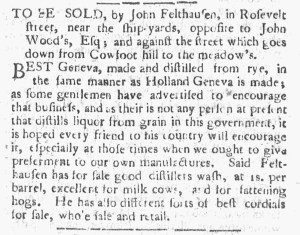
“BEST Geneva, made and distilled from rye.”

Advertisements for consumer goods and services crowded the pages of early American newspaper.  Did they work?  Unfortunately, that question is difficult to answer.  The advertisements reveal what kinds of marketing appeals merchants, shopkeepers, artisans, and other entrepreneurs thought would resonate with consumers and influence them to make purchases, but they rarely indicated how readers responded.

That so many entrepreneurs advertised and that they invested in advertising regularly suggests that they believed that they received a sufficient return on their investment to make the expense worth it.  Consider John Felthausen and his advertisement for “BEST Geneva [or Jenever, a type of gin], made and distilled from rye,” in the January 31, 1776, edition of the Constitutional Gazette.  That was not the first time that Felthausen placed that advertisement.  Three months earlier, he ran an advertisement with nearly identical copy in the New-York Gazette and Weekly Mercury.  If Felthausen believed that previous advertisement had not yielded results, would he have run it again in another newspaper a few months later?

That new advertisement had nearly identical copy, though the compositor for the Constitutional Gazette made very different decisions about the format than the compositor for the New-York Gazette and Weekly Mercury.  Felthausen may have even clipped the advertisement from one newspaper and delivered it to the printing office for the other, making marks on it to indicate copy he wished to update.  Those revisions amounted to adding a sentence at the end: “He has also different sorts of best cordials for sale, wholesale and retail.”  He retained his appeal to “every friend to this country” to “encourage” or support his business, “especially at those times when we ought to give preferment to our own manufactures.”  The distiller apparently believed that his previous advertisement met with sufficient success to merit repeating it to hawk both his “BEST Geneva” and additional products not previously included.

August 26

What was advertised in a revolutionary American newspaper 250 years ago today?

Constitutional Gazette (August 26, 1775).

“He proposes to continue his business of pickling oysters and lobsters.”

John Anderson’s effort to solicit advertisements in the August 23, 1775, edition of the Constitutional Gazette yielded results.  When he published the next issue three days later, the final page carried four advertisements.  The printer was responsible for two of them, one for a pamphlet, “Defensive War in a Just Cause Sinless,” and the other for “All sorts of Blanks used in this Province,” children’s books, and “New Pamphlets.”  Another advertisement hawked “JOYCE’s Grand American Balsam,” a patent medicine sometimes advertised in other newspapers.  Customers could acquire the medicine and directions from “Mrs. Joyce, at Brookland Ferry” and from “Messrs. Anderson, Gaine, and Rivington, Printers in New-York.”  Although Edward Joyce’s widow or the other two printers may have played a role in placing the advertisement, Anderson certainly had a hand in publishing it.

One advertisement, however, had not connection to the printer of the Constitutional Gazette.  Abraham Delanoy placed a notice “to inform his customers, and the public in general, THAT … he proposes to continue his business of pickling oysters and lobsters; and also puts up fired oysters so as to keep a long time even in a hot climate.”  His advertisement featured a woodcut depicting a lobster trap and an oyster cage, accounting for half the space and attracting attention in a newspaper that did not have any other visual images.  That woodcut previously accompanied Delanoy’s advertisement in Rivington’s New-York Gazetteer.  He either retrieved it from another printing office to deliver to Anderson or carefully stored it in anticipation of using it again.  Delanoy also replicated much of the copy from that previous advertisement. The similarities suggest that he either copied directly from it, making minor revisions as he went, or indicated changes directly on a clipping of the advertisement.  Some readers likely recognized Delanoy’s advertisement, but this time it generated revenue for John Anderson and the Constitutional Gazette.  The printer must have been pleased that Delanoy set an example for others to advertise in this new publication.

November 9

What was advertised in a colonial American newspaper 250 years ago today?

Pennsylvania Journal (November 9, 1774).

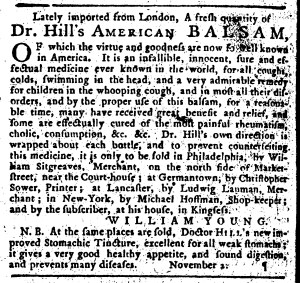
“Dr. Hill’s own direction is wrapped about each bottle.”

In the fall of 1774, William Young and his associates offered consumers exclusive access to “Dr. Hill’s AMERICAN BALSAM.”  According to an advertisement in the November 9 edition of the Pennsylvania Journal, this patent medicine “is an infallible, innocent, sure and effectual” cure for “coughs, colds, [and] swimming in the head” as well as a “very admirable remedy for children in the whooping cough, and in most all their disorders.”  Young implied that such recommendations may not have been necessary since the “virtue and goodness” of the medicine “are now so well known in America,” yet figured that trumpeting the efficacy of Dr. Hill’s American Balsam would aid in convincing consumers not yet familiar with this product.

As a means of guarding the reputation of this medicine and “to prevent counterfeiting,” a limited number of local agents stocked and sold this medicine.  Young made it available in Kingsess (or Kingsessing), just outside of Philadelphia.  William Sitgreaves, a merchant in Philadelphia, Christoper Sower, a printer in Germantown, and Ludwig Lauman, a merchant in Lancaster, each sold it as well.  Young also distributed Dr. Hill’s American Balsam to Michael Hoffman, a shopkeeper in New York, to sell there.  He had relied on that method for some time, having placed similar advertisement in May and October 1772.  Unlike some popular patent medicines widely stocked by apothecaries, merchants, shopkeepers, printers, booksellers, and other retailers throughout the colonies, only a select few carried Dr. Hill’s American Balsam.  The medicine came with “Dr. Hill’s own direction … wrapped about each bottle” to instruct patients how to use it to relieve or even cure “the most painful rheumatism, cholic, consumption,” and other maladies.  Such packaging represented another layer of marketing for this product, continuing to promote it to customers after they purchased it and took it home.

Young apparently considered these various strategies effective given that he invested in them on several occasions.  His marketing of Dr. Hill’s American Balsam incorporated the same elements in November 1774 that he deployed two and a half years earlier in May 1772.  That does not demonstrate the impact those methods had on consumers yet does suggest that Young considered them successful enough to repeat when he advertised once again.

April 26

What was advertised in a colonial American newspaper 250 years ago today?

Supplement to the South-Carolina Gazette and Country Journal (April 26, 1774).

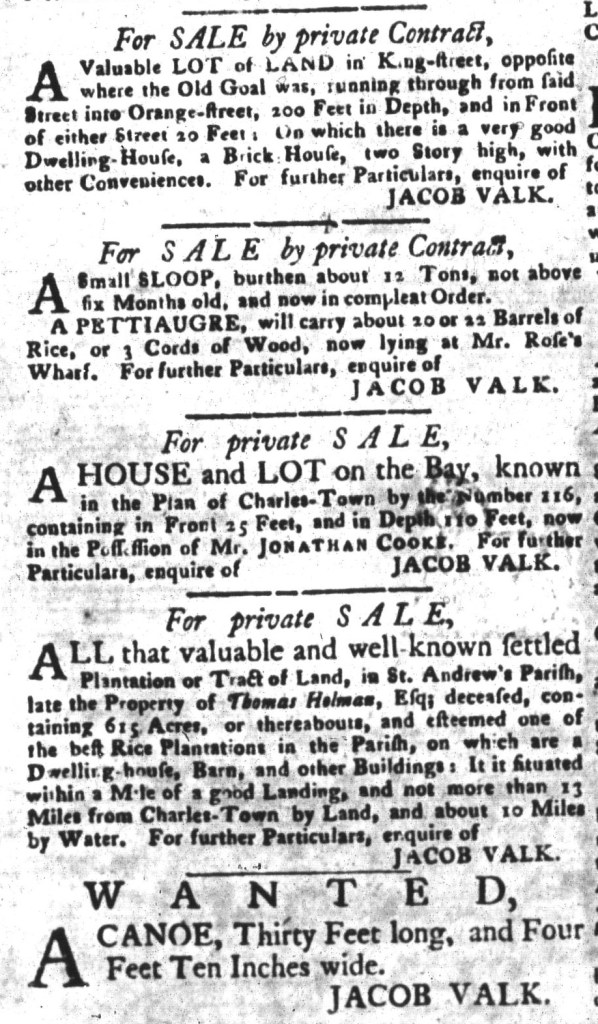
“For further particulars, enquire of JACOB VALK.”

Jacob Valk established a brokerage office in Charleston in the early 1770s.  In his newspaper advertisements, he advised, “Lands, Houses, and Negroes, Bought and sold at private Sale, upon the usual Commission.”  If the pages of the public prints provide any guidance, many colonizers availed themselves of his services, entrusting the broker to conduct business on their behalf.  His name became a familiar sight as he placed advertisement after advertisement for his clients.

Consider the supplement that accompanied the April 26 edition of the South-Carolina Gazette and Country Journal.  Valk purchased an entire column on the third page, running fourteen advertisements.  Some offered tracts of land for sale, while others included houses and other buildings along with land.  Two of them announced sales of enslaved people, one indicating “SEVERAL NEGROES” without giving further details and the other describing “two very valuable Negro Shoe-makers.”  Valk sought buyers for “A Small Sloop” and a pettiaugre (or canoe).  In each instance, he invoked a familiar refrain: “For further Particulars, enquire of JACOB VALK.”  He also assisted executors of estates in calling on those who had unfinished business to settle accounts, inviting them to his office “where the Particulars of that Estate now lay ready for their Perusal.”  Four days earlier, Valk purchased a similar amount of space to run many of the same advertisements in the South-Carolina and American General Gazette.

The broker must have factored the cost of advertising into the “usual Commission” that he received for his services, especially considering that he was one of the best customers for the printing offices in Charleston.  That he continuously placed newspaper advertisement testifies to his confidence in their general effectiveness, though not every notice may have achieved the desired results.  Running so many simultaneously allowed him to distribute the risk and rewards of advertising.  Even if some advertisements did not attract buyers, sellers, or associates seeking to settle accounts, others apparently did.  When considered collectively, Valk came out ahead on what he invested in advertising.  His individual clients, however, would not have had the same experience had they gone it alone.  If they paid Valk on commission following a transaction he facilitated, then they paid only for successful advertisements without losing money on notices that did not produce the intended results.

March 19

What was advertised in a colonial American newspaper 250 years ago today?

Providence Gazette (March 19, 1774).

“… and many other Articles, as cheap as usual.”

Were advertisements in early American newspapers effective?  Did they work?  Did readers become consumers because advertisements incited demand?  Did consumers select where they would shop because of the advertisements they encountered in the public prints.  There are no easy answers to those questions.

What can be asserted with more certainty is that many merchants, shopkeepers, artisans, and others who provided goods and services considered advertising worth the investment, so much so that they placed advertisements for years.  Consider Nicholas Tillinghast and William Holroyd of Providence.  As spring approached in 1774, they once again took to the pages of the Providence Gazette, this time promoting an assortment of “GARDEN SEEDS” as well as a “Variety of English and West India GOODS.”  Perhaps seeing James Green’s advertisement for similar merchandise in the March 5 edition prompted them to insert their own notice in the next edition for fear of losing former and prospective customers to a competitor.

By that time, Tillinghast and Holroyd had been advertising in the Providence Gazette for years.  The Adverts 250 Projecthas not featured every advertisement that they published, but it has examined several of them.  On November 24, 1770, the partners announced that they “newly opened the Shop … at the Sign of the Elephant … where they have to sell a Variety of Articles.”  A year later, they once again hawked “a Variety of well assorted GOODS,” noting that they stocked too many items “to be particularly mentioned in an Advertisement.”  On May 16, 1772, they asserted that they sold a “Variety [of] ARTICLES … at as cheap a Rate as any Goods, of the same Quality, can be purchased in this Town.”  They did not merely announce that they had merchandise for sale.  Instead, Tillinghast and Holroyd repeatedly underscored that they offered choices to consumers and sometimes used prices to encourage prospective customers to choose their store over others.  They did so once again in August 1773 when they directed “their old Customers and the Public” to a new shop “which they have built.”  Their inventory consisted of “English Piece Goods, and Hard Ware of various Sorts, West-India Goods, Groceries and Wines of several Sorts.”  The partners resorted to a familiar refrain: “the Particulars of which would be tedious to enumerate in an Advertisement.”  Instead, they “can be better recounted to any who shall be pleased to make personal Application.”  Tillinghast and Holroyd promised attentive customer service.

Did advertising work?  Tillinghast and Holroyd thought that it worked well enough to justify placing yet another notice in the Providence Gazette in March 1774.  If they suspected that advertising did not yield a return on their investment, would they have continued doing so?

October 18

What was advertised in a colonial American newspaper 250 years ago today?

New-York Gazette and Weekly Mercury (October 18, 1773).

“Every particular in repairing at HALF the price charg’d by others.”

John Simnet regularly advertised his services as a watchmaker in newspapers published in New York in the early 1770s.  Several of his competitors also ran advertisements, but Simnet placed notices so frequently that he achieved a much greater level of visibility in the public prints than other watchmakers in the city.  In the early 1770s, only Thomas Hilldrup’s notices in several newspapers published in Connecticut rivaled the dissemination of Simnet’s notices, a development that may have prompted Simnet to advertise in the Connecticut Courant.  Simnet’s advertisements were often so lively (or so cantankerous) that the Adverts 250 Project has traced his marketing efforts, especially his feuds with other watchmakers, for nearly five years, beginning with his first advertisements in the New-Hampshire Gazette in 1769 and continuing with his notices in New York after he relocated in 1770.  Considering how much money he invested in marketing, the watchmaker apparently believed that his advertisements yielded results.

Supplement to the New-York Gazette and Weekly Mercury (October 18, 1773).

For instance, Simnet ran two advertisements in the October 18, 1773, edition of the New-York Gazette and Weekly Mercury, one in the standard issue and one in the advertising supplement.  The one in the supplement had been running for quite some time, but the one in the standard issue was new.  The watchmaker deployed some of the same appeals in both advertisements, especially underscoring that he undertook “every particular in repairing [watches] at HALF the price charg’d by others, and will keep them in proper order in future, gratis.”  Simnet believed that the combination of bargain prices and additional services at no charge cultivated and secured relationships with customers.  Perhaps he even discovered during his conversations with clients that was indeed the case, a rudimentary form of research into the effectiveness of his marketing strategies.  Simnet also listed his prices for cleaning watches to make comparison shopping easier for prospective clients.  In the new advertisement, he once again incorporated a claim that he frequently made about his status as the “only regular London watch-maker” in New York.  He received his training in London and had decades of experience as a watchmaker there.  Simnet often implied that made his skills superior to competitors who only had experience working in the colonies; on occasion, he explicitly stated that was the case.  Compared to some of his notices, the two advertisements in the October 18 edition of the New-York Gazette and Weekly Mercury were rather placid.  For the moment, Simnet did not seek to benefit from creating controversy.  Instead, he used multiple advertisements to keep his name and his services in front of the eyes of prospective customers as they perused the newspaper.

October 1

What was advertised in a colonial American newspaper 250 years ago today?

Connecticut Journal and New-Haven Post-Boy (October 1, 1773).

“WATCHES are restored to their pristine vigour, and warranted to perform well, free of expence for one year.”

Thomas Hilldrup, “WATCH MAKER from LONDON,” apparently considered his advertising campaign effective.  On October 1, 1773, his notice with the dateline, “Hartford, July 20, 1773,” once again appeared in the Connecticut Journal and New-Haven Post-Boy and the New-London Gazette.  Four days later, the same notice ran once again in the Connecticut Courant, the only newspaper printed in Hartford at the time.  When Hilldrup first arrived in Hartford in 1772 he commenced advertising in the Connecticut Courant, but it did not take long for him to surmise that he might benefit from advertising more widely.  He soon placed notices in the other two newspapers published in the colony.  Other watchmakers inserted their own advertisements in hopes of maintaining their share of local markets, but none of them advertised in multiple newspapers.  Hilldrup’s competitors also discontinued their advertisements after a few insertions, while the newcomer’s notices became a consistent feature in the three newspapers.

Hilldrup likely thought he made a wise investment by marketing his services in all three newspapers.  After all, those publications circulated widely throughout the colony.  Even if residents of New Haven or New London were unlikely to send their watches to Hilldrup at “the sign of the Dial” in Hartford, the watchmaker may have believed that prospective customers in other towns served by the Connecticut Journal and the New-London Gazette would find it as convenient to hire his services as those of his competitors … but only if Hilldrup made the effort to inform the public of his “constant diligence” in restoring watches “to their pristine vigour.”  In addition, his repeated advertisements in the three newspapers highlighted the guarantee he extended to clients, a promise that watches he fixed were “warranted to perform well, free of any expence for one year.”  In placing advertisements so widely and so often, Hilldrup reasoned that he could entice prospective clients beyond Hartford to give him a chance to serve them when they needed “Repeating, Horizontal and plain WATCHES” cleaned and repaired.

September 6

What was advertised in a colonial American newspaper 250 years ago today?

Boston Evening-Post (September 6, 1773).

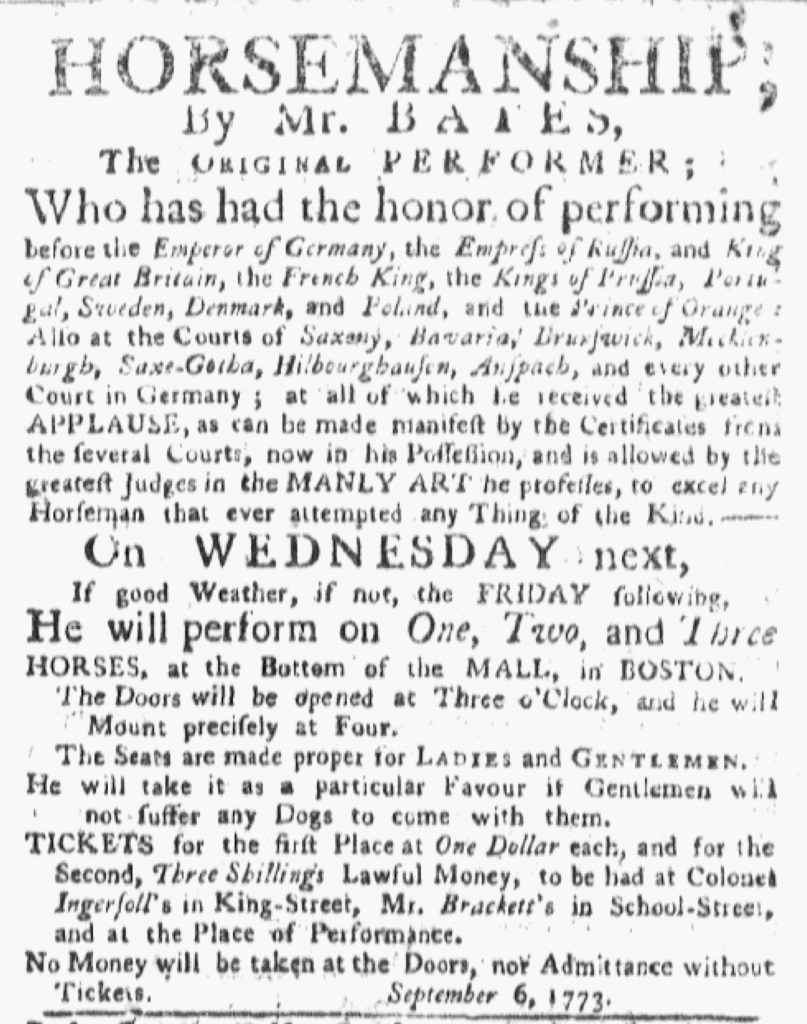
“HORSEMANSHIP, By Mr. BATES.”

Not long after Mr. Bates concluded his performances in New York, he arrived in Boston and began advertising exhibitions of his feats of horsemanship in the newspapers there.  He commenced with notices in the Boston Evening-Post and the Massachusetts Gazette and Boston Post-Boy on Monday, September 6, 1773, informing ladies and gentlemen of the city about his performance on Wednesday or, if the weather did not permit, on Friday.

As he had done in his advertisements in New York, he deployed “HORSEMANSHIP” as a headline for his notice and then introduced himself as “The ORIGINAL PERFORMER; Who has had the honor or performing” for a longlist of royalty in Europe.  He declared that he earned “the greatest APPLAUSE” from those regal audiences, but did not expect colonizers in New York to take his word for it.  Instead, he had “Certificates from the several Courts” that they could examine.  In addition, he asserted that the “greatest Judges in the MANLY ART” of horsemanship considered his skills “to excel any Horseman that ever attempted any Thing of the Kind.”  Bates hoped that the promises of such a spectacle would entice audiences in Boston to attend his show.

He had reason to feel confident in the effectiveness of this marketing strategy.  After all, he gave the same pitch in New York.  He may have delivered newspapers, clippings, or perhaps even handbills from that city to the printing offices in Boston or he may have copied out the advertisement from one of those sources.  Whatever method he deployed, he remained consistent in how he introduced himself and described his skills to prospective audiences, likely sticking with what worked.  He also repeated another technique that he used in New York, encouraging anyone interested in the performance to acquire tickets quickly because “No Money will be taken at the Doors, nor Admittance without Tickets.”  Rather than wait until the time and day of the show, Bates aimed to generate ticket sales in advance.  Through experience, he devised a system that he believed worked best for inciting interest and securing his livelihood.

May 22

Who was the subject of an advertisement in a colonial American newspaper 250 years ago today?

Providence Gazette (May 22, 1773).

“He was seen in New-York. And remained some Days there; but has since taken his Flight to Rhode-Island.”

An advertisement in the Providence Gazette in the spring of 1773 described Jonathan Pinkard, an indentured servant who ran away from watchmaker Samuel Jefferys, and offered a reward for his capture.  Jefferys noted that Pinkard was “by Trade a Watchmaker,” likely the reason they entered the indenture contract together, and cautioned other watchmakers that Pinkard “will probably apply to the Trade for Work.”  He requested that they exercise special vigilance in detecting and detaining this “talkative Fellow.”

Unlike most other advertisements about runaway indentured servants in the Providence Gazette, this one did not concern a fugitive who departed from Providence or a nearby town.  Instead, Pinkard fled from Philadelphia.  What made Jefferys believe that placing an advertisement in the Providence Gazette would yield results?  He reported that Pinkard “was seen in New-York, and remained some Days there; but has since taken his Flight to Rhode-Island, and will probably proceed to Boston.”  Where did Jefferys derive this intelligence?

Another advertisement in another newspaper may very well have put Jefferys on the trail of Pinkard.  In a notice in the April 5 edition of the New-York Gazette and Weekly Mercury, Jefferys offered a similar description of the “talkative cowardly fellow.”  In addition to the clothing that Pinkard took with him, he also had a “silver watch, with a steel chain, maker’s name Thomas Hill, London, No. 11,151,” which would have been easy to identify.  Jefferys did not mention the watch in his advertisement in the Providence Gazette, perhaps suggesting that he had evidence that the runaway servant sold or traded the watch in New York.  The aggrieved Jefferys also increased the reward from five dollars to eight dollars, an indication of his exasperation and his commitment to recovering Pinkard as the indentured servant put more and more distance between himself and the watchmaker in Philadelphia.  Jefferys’s investment in the effort already included advertising in newspapers in two cities.

That investment had not yet resulted in the capture and return of Pinkard, yet the progression of notices in the New-York Gazette and Weekly Mercury to notices in the Providence Gazette suggests some level of effectiveness of the initial advertisement and Jefferys’s belief that another advertisement had a good chance of producing the desired results.

January 8

What was advertised in a colonial American newspaper 250 years ago today?

Connecticut Journal (January 8, 1773).

“Whose motive is to settle here if health permit[s], and the business answers.”

When Thomas Hilldrup arrived in Hartford in the fall of 1772, he commenced an advertising campaign to advise prospective customers that he repaired watches “in a perfect and durable manner, at an easy expence.”  Throughout late September and into October, November, and December, he consistently ran his advertisement in the Connecticut Courant, alerting readers that he planned “to settle here if health permit[s], and the business answers.”  That being the case, he invited the public “to make a trial of his abilities.”  In addition to repairing watches, Hilldrup also sold watches and accessories and provided ancillary services, including consultations with “those who are about to buy, sell or exchange.”

Hilldrup continued placing his advertisement in the Connecticut Courant in the new year.  He also decided to expand his advertising campaign to another newspaper, the Connecticut Journal and New-Haven Post-Boy.  Doing so extended the reach of his advertising and gave him access to a new market.  Why did the watchmaker decide to advertise in another publication?  Did he believe that the notice in the Connecticut Courant had been sufficiently successful to merit advertising in a newspaper in another town?  Among colonizers who perused multiple newspapers as they circulated far and wide in Connecticut and beyond, that certainly likely enhanced Hilldrup’s visibility and name recognition.  That he continued to invest in advertisements in the Connecticut Courant also suggests that he considered the outcomes so far worth the expense.

On the other hand, those advertisements may not have been as successful as Hilldrup hoped.  Perhaps placing the same notice in the Connecticut Journal and attempting to capture a portion of an adjacent market was an attempt to generate enough business to make remaining in Hartford a viable option.  Whatever his reasons for choosing to run his advertisement in an additional newspaper in January 1773, Hilldrup eventually determined that he cultivated a large enough clientele to remain in Hartford.  He continued advertising watches and repairs in newspapers published in that town for nearly two decades.  In the coming months, the Adverts 250 Project will examine some of his subsequent newspaper notices.