November 28

What was advertised in a revolutionary American newspaper 250 years ago today?

Dunlap’s Maryland Gazette (November 28, 1775).

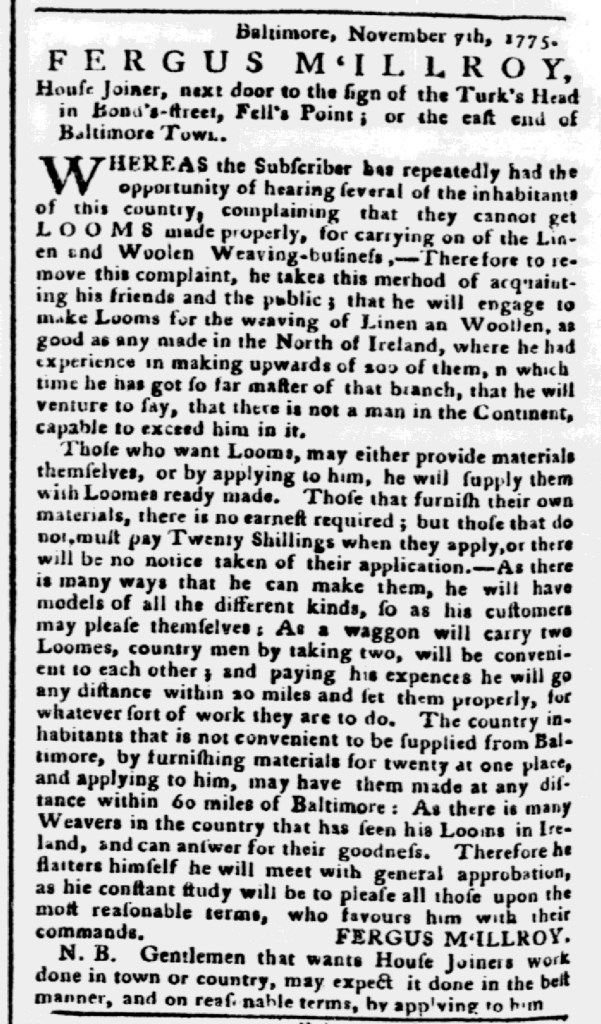
“He will engage to make Looms for the weaving of Linen an[d] Woollen.”

At the same time that David Poe advertised that he “set up … the business of SPINNING WHEEL Making” in Baltimore in November 1775, Fergus McIllroy took to the pages of Dunlap’s Maryland Gazette to inform the public that he “will engage to make Looms for the weaving of Linen an[d] Woolen.”  Both artisans responded to demand for equipment for making textiles that arose in response to the Continental Association, a nonimportation and nonconsumption agreement devised by the First Continental Congress to leverage commerce as a means of achieving political goals.  The text of the pact stated that it would remain in place until Parliament repealed duties on tea and the Coercive Acts that punished Boston for the destruction of tea in what has become known as the Boston Tea Party.  It also issued a call to “encourage Frugality, Economy, and Industry; and promote Agriculture, Arts, and the Manufactures of this Country, especially that of Wool.”

Many colonizers, both men and women, wanted to do their part in producing domestic manufactures as alternatives to imported textiles and other goods, but they needed materials and equipment.  McIllroy reported that he “repeatedly had the opportunity of hearing several of the inhabitants of this country, complaining that they cannot get LOOMS made properly, for carrying on of the Linen and Woolen Weaving-business.”  Although he currently worked as a “House Joiner,” he claimed that he “has experience of making upwards of 200” looms before he migrated to Baltimore.  That being the case, he pledged that his looms were “as good as any made in the North of Ireland.”  Yet prospective customers did not have to take his word for it: “there is many Weavers in the country that has seen his Looms in Ireland, and can answer for their goodness.”  For good measure, he added that he was a “master” when it came to making looms and “there is not a man in the Continent capable to exceed him.”

In addition, McIllroy noted the “many ways that he can make them,” so he had “models of all the different kinds, so as his customers may please themselves.”  Furthermore, they could supply the materials for constructing their looms or leave it to McIllroy to provide the materials.  In the latter instance, customers had to pay a deposit of twenty shillings before McIllroy would make their loom.  He also outlined the conditions for visiting homes to “set them up properly.”  If a town within sixty miles of Baltimore wished to order twenty or more looms, he offered to do the work there to avoid transporting the new looms over long distances.  McIllroy stood ready to contribute to the American cause with his “Industry” that in turn “promote[d] … the Manufactures of this Country,” joining with other artisans who vowed to do the same.

August 6

What was advertised in a revolutionary American newspaper 250 years ago this week?

New-York Journal (August 3, 1775).

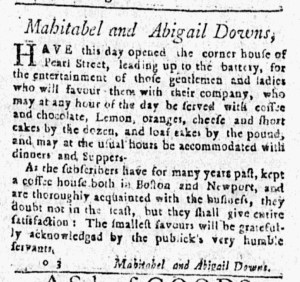
“The subscribers have for many years past, kept a coffeehouse both in Boston and Newport.”

In the summer of 1775, Mahitabel Downs and Abigail Downs published an advertisement that advised residents of New York that they had opened a “house … for the entertainment for those gentlemen and ladies who will favour them with their company.”  They offered hospitality to their guests “at any hour of the day,” serving “coffee and chocolate, Lemon, oranges, cheese and short cakes by the dozen, and loaf cakes by the pound.”  Among the beverages listed in their advertisement, the Downses notably did not include tea.  Although a favorite of many colonizers, tea was at the center of political controversies during the imperial crisis.  In not serving tea to their patrons, the Downses indicated that they supported the American cause or at least abided by the boycott currently in effect.  Guests could gather at their house of entertainment with confidence that they upheld the Continental Association’s prohibition on drinking “East India Tea.”

Apparently the Downses were newcomers in New York.  Accordingly, they believed that they needed to do more to entice guests to dine and socialize at their house of entertainment on Pearl Street than merely list the refreshments that they could enjoy there.  Although new to the city, they were not new to the business, as they explained in their advertisement.  The hostesses shared that they “have for many years past, kept a coffee house both in Boston and Newport, and are thoroughly acquainted with the business.”  As a result, “they doubt not in the least, but they shall give entire satisfaction” to their guests.  Even though readers did not know them by reputation, the Downses hoped that their prior experience operating similar establishments in bustling port cities in New England would convince prospective patrons of the quality of the experience – the food, the beverages, the furnishings, the atmosphere – they could expect at this new house of entertainment.  If the Downses succeeded in persuading guests to visit them once then they anticipated that the food, drink, and service would serve as sufficient recommendation to return.

May 17

What was advertised in a revolutionary American newspaper 250 years ago today?

Pennsylvania Journal (May 17, 1775).

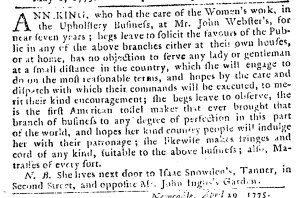
“ANN KING … had the care of the Women’s work, in the Upholstery Business, at Mr. John Webster’s.”

Ann King promoted her experience and expertise when she advertised her services in the May 17, 1775, edition of the Pennsylvania Journal, following an example set by artisans, male and female, who placed notices in newspapers during the era of the American Revolution.  She explained that she “had the care of the Women’s work, in the Upholstery Business, at Mr. John Webster’s, for near seven years.”  Although she had worked with Webster for quite some time, he had not acknowledged her contributions to his enterprise in his own advertisements.  Artisans only occasionally mentioned their assistants in their newspaper notices, yet King’s advertisement testified to the invisible labor performed by employees (as well as family members) in many workshops.  In particular, she reveals that women, whether employees or relative, participated on the production side even though editorials usually depicted them exclusively as consumers.

King took pride in her work.  She proclaimed that she “is the first American tostel [tassel] maker that ever brought that branch of business to perfection in this part of the world.”  If readers had ever admired the tassels that adorned any of the furniture upholstered in Webster’s workshop, then they should hire King when they were in the market for that item.  Even if they were not familiar those tassels, King hoped that her long tenure in a workshop operated by an “Upholsterer from London” who had served “several of the nobility and gentry, both in England and Scotland” would recommend her to prospective clients.  She intended for Webster’s reputation to bolster her own.  In addition to tassels, King “likewise makes fringes and cord of any kind,” part of the “Women’s work” she had overseen for Webster, and even “Mattrasses of every sort.”  She did so with “care and dispatch,” hoping to “merit [the] kind encouragement” of her patrons.

Female shopkeepers and milliners occasionally placed newspaper advertisements, far outnumbering the female artisans who did so.  King took to the public prints to advance her business, demonstrating that women did work alongside men in workshops, though their endeavors were sometimes cast as “Women’s work.”  Webster upholstered furniture “in the best and newest taste” for many years, depending on King and other women for assistance with the final product.  King then leveraged that experience in her effort to earn her livelihood by contracting directly with customers.

June 11

What was advertised in a colonial American newspaper 250 years ago today?

Maryland Journal (June 11, 1774).

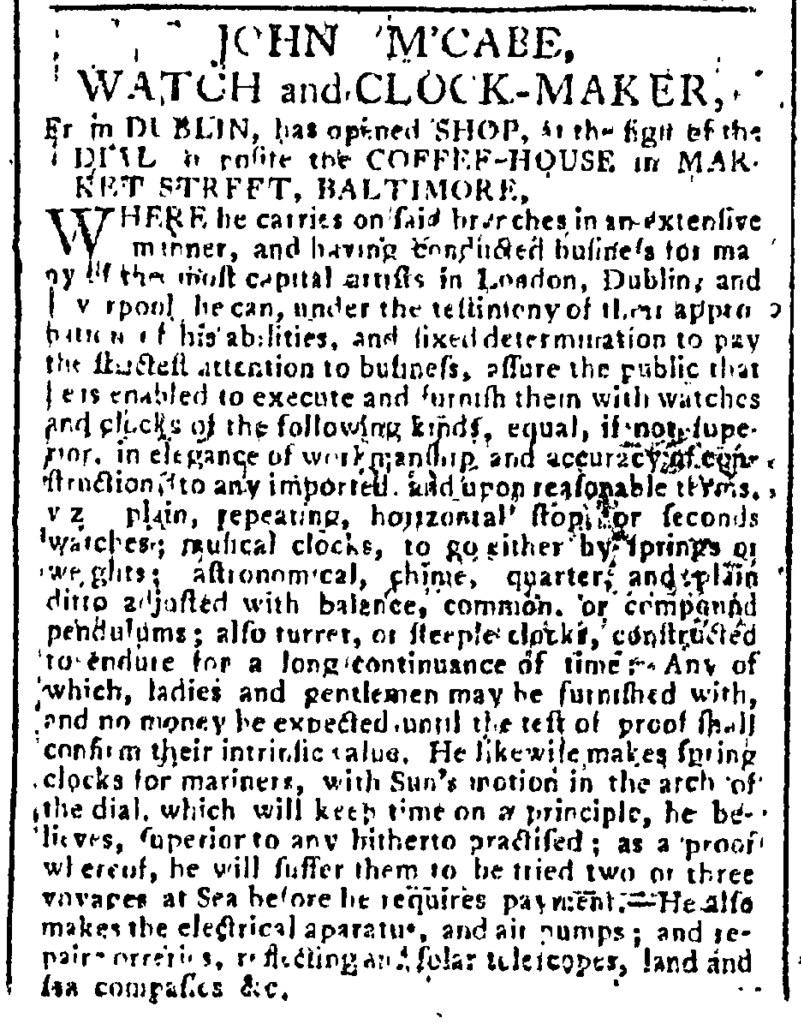
“No money be expected until the test of proof shall confirm their intrinsic value.”

When he set up shop “at the sign of the DIAL” in Baltimore, John McCabe, a “WATCH and CLOCK-MAKER, From DUBLIN,” deployed a marketing strategy commonly undertaken by artisans who migrated across the Atlantic to the colonies.  In an advertisement in the June 11, 1774, edition of the Maryland Journal, he sought to establish his reputation in a town that did not have firsthand knowledge of his skill.  Instead, he relied on an overview of his experience, asserting that he had “conducted business for many of the most capital artists in London, Dublin, and Liverpool.”  Having worked in the most exclusive shops in urban centers, especially the cosmopolitan center of the empire, gave the newcomer a certain cachet, enhanced even more by the “testimony of their approbation of his abilities” that he claimed he could produce.

Yet McCabe did not rest on such laurels that were not immediately apparent to readers.  Instead, he simultaneously declared that his “fixed determination to pay the strictest attention to business.”  Underscoring his industriousness also came from the playbook developed by other artisans, a familiar refrain in their advertisements.  Prospective customers who might have been skeptical of McCabe’s credentials could judge for themselves whether he made clocks and watches “equal, if not superior, in elegance of workmanship and accuracy of construction to any imported.”  They could acquire such timepieces “upon reasonable terms,” getting the same style and quality as watches and clocks from London without paying exorbitant prices.

Even though the initial portions of his advertisement resembled notices placed by other artisans, McCabe, he did include an offer not made nearly as often: allowing a trial period for customers to decide if they wished to purchase or return watches and clocks from his shop.  The enterprising artisan declared that “ladies and gentlemen may be furnished” with any of the variety of clocks and watches listed in his advertisement and “no money be expected until the test of proof shall confirm their intrinsic value.”  McCabe did not explicitly state that customers could return items they found lacking, so confident was he that they would indeed be satisfied with his wares during the trial.  He extended a similar offer for “spring clocks for mariners … which keep time on a principle, he believes, superior to any hitherto practised.”  Customers could make that determination for themselves: “he will suffer them to be tried two or three voyages at Sea before he requires payment.”  Such arrangements would have required some negotiation about the amount of time and the length of those voyages, but allowing for such trials before collecting money from customers did not put McCabe at a disadvantage in the eighteenth-century commercial culture of extending extensive credit to consumers.  Prospective customers likely expected credit, so McCabe gained by transforming the time that would elapse between purchase and payment into a trial, giving those customers the impression that they received an additional benefit from doing business with him.  For some, that may have been the more effective marketing strategy than any claims about his experience working in the best shops in London, Dublin, and Liverpool.

May 3

What was advertised in a colonial American newspaper 250 years ago today?

South-Carolina Gazette and Country Journal (May 3, 1774).

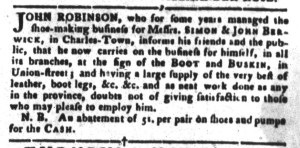
“He now carries on the business for himself … at the Sign of the BOOT and BUSKIN.”

When John Robinson launched his own business in the spring of 1774, he ran an advertisement in the South-Carolina Gazette and Country Journal.  He began by reminding prospective customers that he “for some years managed the shoe-making business for Messrs. SIMON & JOHN BERWICK.”  Now he was prepared to leverage that experience into operating his own enterprise, announcing to “his friends and the public, that he now carries on the business for himself.”  They could find him “at the sign of the BOOT and BUSKIN” on Union Street.

Robinson asserted that he pursued shoemaking “in all its branches,” deploying a familiar phrase that meant that he was capable of performing any task related to his occupation and producing any item associated with his trade.  The device that he chose to mark his location testified to that as well, depicting both a traditional boot and a buskin or a knee-high boot.  To that end, he acquired a “large supply of the very best of leather, boot legs,” and other materials, yet he also realized that the quality of the materials alone would not sell the items produced in his shop.  He declared his work “as neat … as any in the province,” simultaneously drawing on his experience managing the Berwicks’ workshop and drawing comparisons to competitors throughout Charleston and the rest of the colony.

To further entice prospective customers, Robinson concluded with a nota bene that promoted an “abatement of 5s. per pair on shoes and pumps for the CASH.”  He likely extended credit when necessary, but those who paid at the time of sale received a discount of five shillings.  The shoemaker likely hoped that bargain would attract the attention of even those not among his “friends” who knew him from his time at another workshop, convincing them to visit the “sign of the BOOT and BUSKIN” to check out the sale prices on shoes.

April 20

What was advertised in a colonial American newspaper 250 years ago today?

Essex Journal (April 20, 1774).

“A large experience of 34 years at sea.”

Joseph Atkins took to the pages of the Essex Journal to inform the public that “he still continues to teach reading, writing, and arithmetic” in the spring of 1774.  He apparently accepted both boys and girls, though he taught them separately.  In a nota bene, he advised that he “intends to open a school for young ladies” at the end of April.

In addition to the basics of reading, writing, and arithmetic, Atkins also provide instruction in navigation “after the most approv[e]d methods.  Experience mattered to the schoolmaster, not just experience in the classroom but also experience on ships.  He asserted that his confidence in how he taught navigation to his pupils flowed from “a large experience of 34 years at sea.”  Navigation was not merely academic to Atkins but instead a practical matter, an essential part of the occupation he previously pursued.  Prospective students and their parents, he suggested, should feel similar confidence that his decades at sea prepared him to teach navigation to boys and young men who had prospects of working on vessels themselves.  Newburyport was, after all, a maritime community.

The placement of Atkins’s advertisement on the third page of the April 20 edition of the Essex Journal underscored that was the case.  It ran immediately below the “MARINE LIST,” a roster of ships that recently “ARRIVED” and “SAILED” from the “PORT of NEWBURY.”  A day earlier, the town welcomed the Dove from Antigua and the Newhall from Guadeloupe.  Most of the ships that departed in the past ten days made their way to the “West-Indies,” though the Larkventured to Newfoundland.  Although Atkins’s time at sea was presumably behind him, he aimed to pass along a valuable skill to young men who might join the crew of any of the vessels that visited Newburyport.  His “large experience of 34 years at sea” recommended him as a teacher as much as anything he could say about his methods of instruction.

January 28

What was advertised in a colonial American newspaper 250 years ago today?

New-Hampshire Gazette (January 28, 1774).

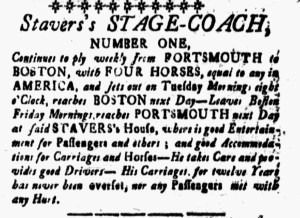
His Carriages, for twelve Years has never been overset, nor any Passengers met with any Hurt.”

John Stavers marketed experience when he advertised his stagecoach service between Portsmouth and Boston in the January 28, 1774, edition of the New-Hampshire Gazette, just as he had done in previous advertisements.  He proclaimed that “His Carriages, for twelve Years has never been overset, nor any Passengers met with any Hurt.”  That was quite the safety record.  The proprietor even invoked his experience in the name of his business, “Stavers’s STAGE-COACH, NUMBER ONE.”  That was not merely a ranking but also a reference to the fact that he had operated service between Portsmouth and Boston longer than any of his competitors.

Stavers also promoted the quality of that service, declaring that “FOUR HORSES, equal to any in AMERICA,” pulled the coach.  In addition, he “takes Care and provides good Drivers,” selecting only the best employees to represent the business he operated for more than a decade.  At the terminus in Portsmouth, Stavers ran an inn and tavern, where he provided “good Entertainment for Passengers and others” as well as “good Accommodations for Carriages and Horses.” Whether or not they rode his stagecoach, Stavers offered hospitality to travelers who visited Portsmouth.  For those who boarded in Boston or along the way to Portsmouth, he offered convenient lodging.

As was typical in advertisements for stagecoaches and ferries, Stavers provided a schedule so prospective clients could plan accordingly.  His service made the trip to Boston and back once a week.  “NUMBER ONE” departed Portsmouth at eight o’clock on Tuesday mornings and arrived in Boston the next day.  Passengers who planned to return to Portsmouth on the next trip had Wednesday evening and the entire day on Thursday to conduct business in Boston before the stagecoach left again on Friday morning and reached Portsmouth on Saturday.

Other operators also established service between Portsmouth and Boston, but Stavers most consistently advertised in the New-Hampshire Gazette and newspapers published in New England’s largest port city.  For instance, the February 3 edition of the Massachusetts Gazette and Boston Weekly News-Letter included the same advertisement with an additional nota bene to inform “Such as want a Passage from Boston, are desired to apply to Mrs. Bean’s in King-Street.”  Perhaps savvy advertising played a role in Stavers’s enterprise achieving such longevity.

December 8

What was advertised in a colonial American newspaper 250 years ago today?

Pennsylvania Journal (December 8, 1773).

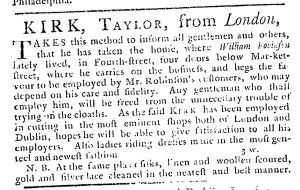
“Any gentlemen who shall employ him, will be freed from the unnecessary trouble of trying on the cloaths.”

Upon arriving in Philadelphia, “KIRK, TAYLOR, from London,” placed an advertisement in the Pennsylvania Journal to introduce himself to prospective clients.  Like so many other artisans who migrated across the Atlantic, Kirk did not have the benefit of his new community’s long familiarity with his work.  Instead, he had to establish his reputation by reporting on his prior experience serving customers in faraway places.  To that end, Kirk proclaimed that he “has been employed in cutting in the most eminent shops of London and Dublin.”  Prospective clients in the largest city in the colonies associated some level of cachet with such connections to even larger and more cosmopolitan cities.  Furthermore, his origins suggested that Kirk had special insight into the latest trends in those places, especially when he declared that he made garments “in the most genteel and newest fashion.”

When he set up shop in Philadelphia, Kirk took the house “where William Robinson lately lived” on Fourth Street.  Not only did he take over that residence, the tailor also hoped to acquire Robinson’s clientele, an efficient means of cultivating relationships in his new city.  The newcomer “begs the favour to be employed by Mr. Robinson’s customers, who may depend on his care and fidelity.”  Earning repeat business, generating word-of-mouth recommendations, and bolstering his reputation depended on attentive service and producing quality work for Robinson’s customers and anyone else who gave him a chance.  Kirk clearly communicated that he was confident in his abilities.  He was such a good tailor, he reported, that “gentlemen who shall employ him, will be freed from the unnecessary trouble of trying on the cloaths,” so precise were his measurements and sewing.  They did not need to tarry in his shop, spending unnecessary time better devoted to their own business or leisure.

Kirk aimed to capture some portion of the market for tailoring services in Philadelphia.  He devised an advertisement that gave prospective clients good reason to give him a chance and then decide for themselves if he merited more orders.  He hoped to gain some of the clients accustomed to visiting a tailoring shop at the same location, but did not entrust his fate to that circumstance alone.  Instead, he advised Robinson’s former customers and other prospective customers that he had experience in the best shops in London and Dublin, knowledge of the latest fashions, and the skills necessary “to give satisfaction to all his employers.”

April 3

What was advertised in a colonial American newspaper 250 years ago today?

Providence Gazette (April 3, 1773).

“Not having lost more than six or eight Patients, out of Hundreds whom he has attended in a great Variety of Disease.”

In the spring of 1773, Ebenezer Richmond took to the pages of the Providence Gazette to inform readers that he “proposes to attend to the Practice of Physic and Surgery in this Town.”  When they advertised in colonial newspapers, physicians often included an overview of their training and credentials as a means of demonstrating their competence and expertise to prospective patients.  Richmond did so, yet did not provide many details.  “Respecting his Qualifications,” Richmond declared, “he will only observe, that the Cultivation of medical Knowledge, and of the Languages and Sciences, preparatory to, or connected therewith, has been the Business of his Life.”

Rather than offer further clarification, Richmond emphasized his experience as a physician.  He asserted that “for several Years past [he] practised with uncommon Success, not having lost more than six or eight Patients, out of Hundred whom he attended in a great Variety of Disease.”  With that record, prospective patients could trust that they were in good hands when they sought treatment from Richmond.  Once again, however, he glossed over details that may have been important to prospective patients, such as where he practiced during those “several Years” and whether anyone in Providence, especially colleagues or former patients, could vouch for him.  When Thomas Truman advertised that he planned to “continue the Practice of Physic and Surgery” in Providence the previous December, he positioned himself as the successor to Dr. Samuel Carew, recently deceased, and reminded residents of the city, especially Carew’s former patients, that he served an apprenticeship with the doctor.  Richmond, on the other hand, did not invoke any such connections.

Richmond apparently hoped that his description of his medical knowledge and record of success during several years of experience would be enough to convince prospective patients to seek his services.  For those who needed more, he also stated that he charged “very moderate Fees.”  In addition, he pledged to given them the care and attention they expected, promising that his patients “may depend upon his attending his Business with utmost Assiduity.”  Some readers may have assumed that quality contributed to the record of “uncommon Success” that Richmond reported in his advertisement.

January 15

What was advertised in a colonial American newspaper 250 years ago today?

New-Hampshire Gazette (January 15, 1773).

“He has set up a STAGE between this Town and Boston.”

As the new year arrived, Theodore Davis launched a new enterprise, informing the public that he established stage service between Portsmouth and Boston.  He first advertised in the New-Hampshire Gazette on December 25, 1772, and then continued placing notices in January 1773.  He had at least one competitor.  John Stavers had been operating a stage along that route for more than a decade, sometimes in partnership with others.

Realizing that he was a newcomer on the scene, Davis advised prospective passengers that he “served his Apprenticeship in the Business,” though he did not give more details.  Perhaps he had previously worked on a route that connected other towns or perhaps he had been involved with one of the competitors that periodically challenged Stavers or perhaps he had even worked with Stavers and now challenged him for business.  Whatever his background, Davis claimed that he was “well acquainted with the best Houses of Entertainment” and other amenities on the route between Portsmouth and Boston.  His advertisement suggested that some prospective clients did know him from one of the stages that plied that route; he requested “the Continuance of their Favours, as he now sets out on his own Account.”

New-Hampshire Gazette (January 15, 1773).

One aspect of Davis’s service certainly distinguished it from the stage operated by Stavers.  Davis departed on Mondays, a day before Stavers made the journey.  When Stavers answered Davis’s advertisement with a notice of his own in the January 15, 1773, edition of the New-Hampshire Gazette, he expressed some exasperation with that ploy.  As he had done on other occasions, he underscored that he established the first route between Portsmouth and Boston, declaring himself “the first Promoter of a Stage Coach in this Province.”  Accordingly, he felt a sense of entitlement, this time adding that “the Public will think he ought to have the Preference, and not countenance others in taking Passengers the beginning of the Week.”  Besides, he lamented, he had a history of accommodating his passengers and “has always been ready to serve them on Monday, as well as Tuesdays, if their Business required it.”  To make that possible, Stavers “expended a large sum of Money.”  The veteran stage operator did more than emphasize his long experience.  He attempted to leverage a sense of obligation on the part of prospective passengers.

That may have been an effective strategy for Stavers, at least in the past.  After all, other competitors had not managed to put him out of business.  Still, he believed that Davis’s new service infringed on a clientele that rightfully should have belonged to him and could have an impact on his livelihood.  He called on his “old Customers and others” to engage his services rather than choosing an upstart who was relatively new to route connecting Portsmouth and Boston.