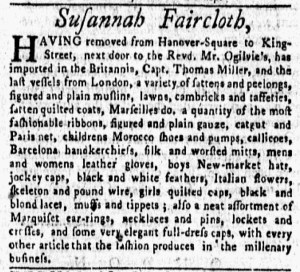
What was advertised in a revolutionary American newspaper 250 years ago today?
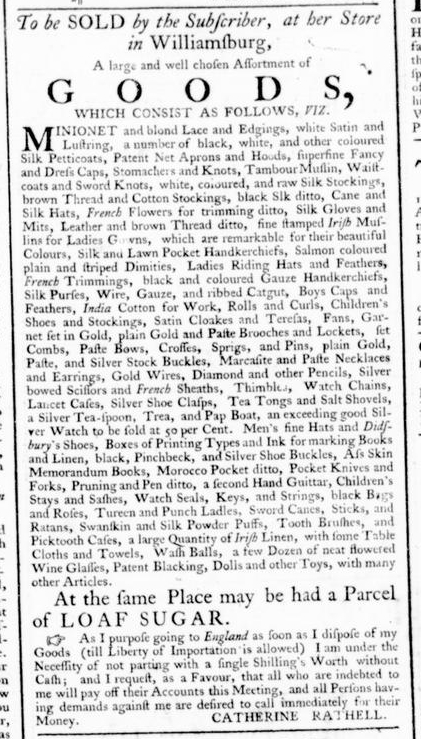
“I purpose going to England as soon as I dispose of my Goods (till Liberty of Importation is allowed).”
In the spring of 1775, Catherine Rathell advertised a “large and well chosen Assortment of GOODS” available at her store in Williamsburg in John Dixon and William Hunter’s Virginia Gazette. She demonstrated the choices available to consumers with a lengthy list that included “black, white, and other coloured Silk Petticoats,” “fine stamped Irish Muslims for Ladies Gowns, which are remarkable for their beautiful Colours,” “plain Gold and Paste Brooches and Lockets,” “a few Dozen of neat flowered Wine Glasses,” and “Dolls and other Toys.”
Rathell did not mention when she acquired her merchandise. Taglines that proclaimed, “Just Imported,” or some variation of that sentiment no longer appeared in American newspapers as often as they had in recent years. The Continental Association, a nonimportation agreement devised by the First Continental Congress in response to the Coercive Acts, had been in effect since December 1, 1774. The shopkeeper did not state that her inventory arrived in the colony before that date, yet she suggested that was the case when she declared that she planned to go to England “as soon as I dispose of my Goods (till Liberty of Importation is allowed).” In acknowledging the Continental Association, Rathell implied that she abided by it.
She also indicated the effect it had on her business. She did not consider it viable to continue operating her store in Williamsburg. She planned to close it as soon as she could liquidate her wares and visit England until regular trade resumed, not knowing when she composed her advertisement that a war for independence would disrupt commerce even more significantly. For the moment, she insisted on cash sales instead of credit, “not parting with a single Shilling’s Worth” with payment in hand, and settling accounts with both those indebted to her and others “having demands against” her. Except for “an exceeding good Silver Watch to be sold at 50 per Cent,” Rathell did not mention any discounts, but prospective customers may have recognized an opportunity to bargain with a shopkeeper determined to leave the colony.