July 18

What was advertised in a revolutionary American newspaper 250 years ago today?
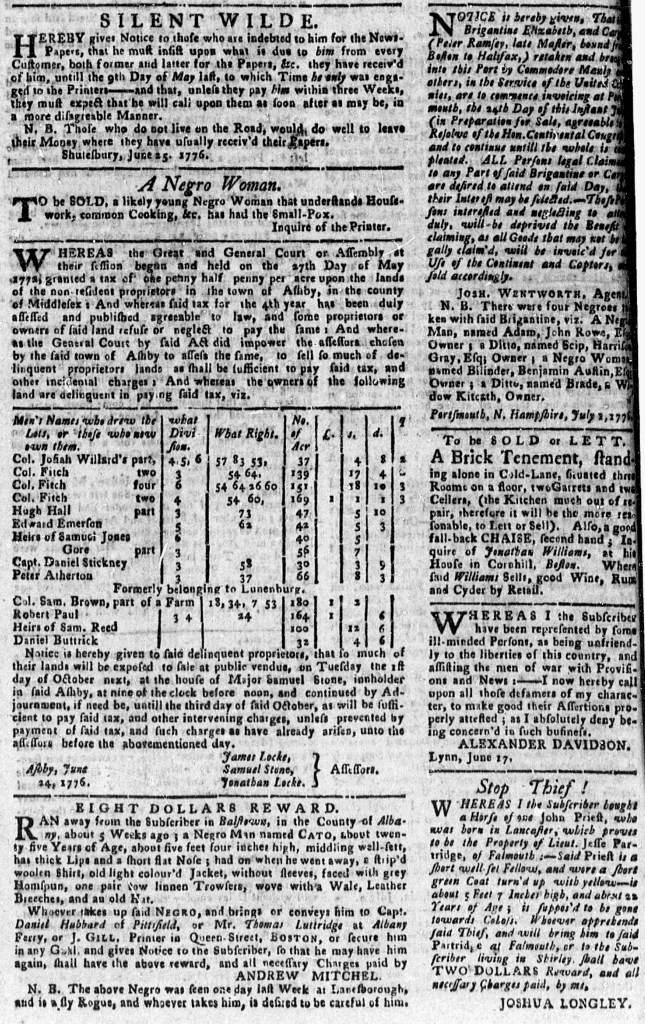
Continental Journal (July 18, 1776).

“WHEREAS the Great and General Court …”

John Gill, the printer of the Continental Journal, faced the same dilemma as his former partner, Benjamin Edes, the printer of the Boston-Gazette, when he received a legal notice with so many columns that its width exceeded that of the columns in his newspaper.  Edes had rotated some advertisements to run perpendicular to the rest of the text on the page, thus maximizing space while also eliminating the need to reset type for other advertisements that followed the standard column width.  Gill made a different decision in his effort to cover every inch of the page with content.  He opted for the same wider width for news and advertising that appeared in the same column as the legal notice the first time that it ran on July 4, 1776, and a narrower width for news and advertising in another column on the same page.

Three advertisements had wider widths: one placed by Silent Wilde, a post rider, calling on customers to make payment for his services, another in which Andrew Mitchel offered a reward for the capture and return of Cato, an enslaved man who liberated himself by running away, and an anonymous notice describing an enslaved woman for sale with instructions for interested parties to “Inquire of the Printer.”  Those three advertisements remained in a block of text with the legal notice for each of its three appearances, though sometimes in different order.  One advertisement that accompanied the legal notice the first time it appeared had a narrower width.  Beneath a headline that exclaimed “Stop Thief!” Joshua Longley described a man who sold him a stolen horse.  That advertisement also remained in the same block of text with the legal notice.  Gill did not need to publish news that appeared in the narrow column a second time.  Instead, he reset the type for three advertisements that previously appeared with the standard width, making them narrower but longer.  This did not save time and effort as Edes had done in the Boston-Gazette, but it did have all the text on the page printed in the same direction instead of rotating some advertisements to run perpendicular to the rest of the content.  Both solutions filled every inch of the page, an especially important consideration considering the shortages of paper during the Revolutionary War.
July 8

What was advertised in a revolutionary American newspaper 250 years ago today?

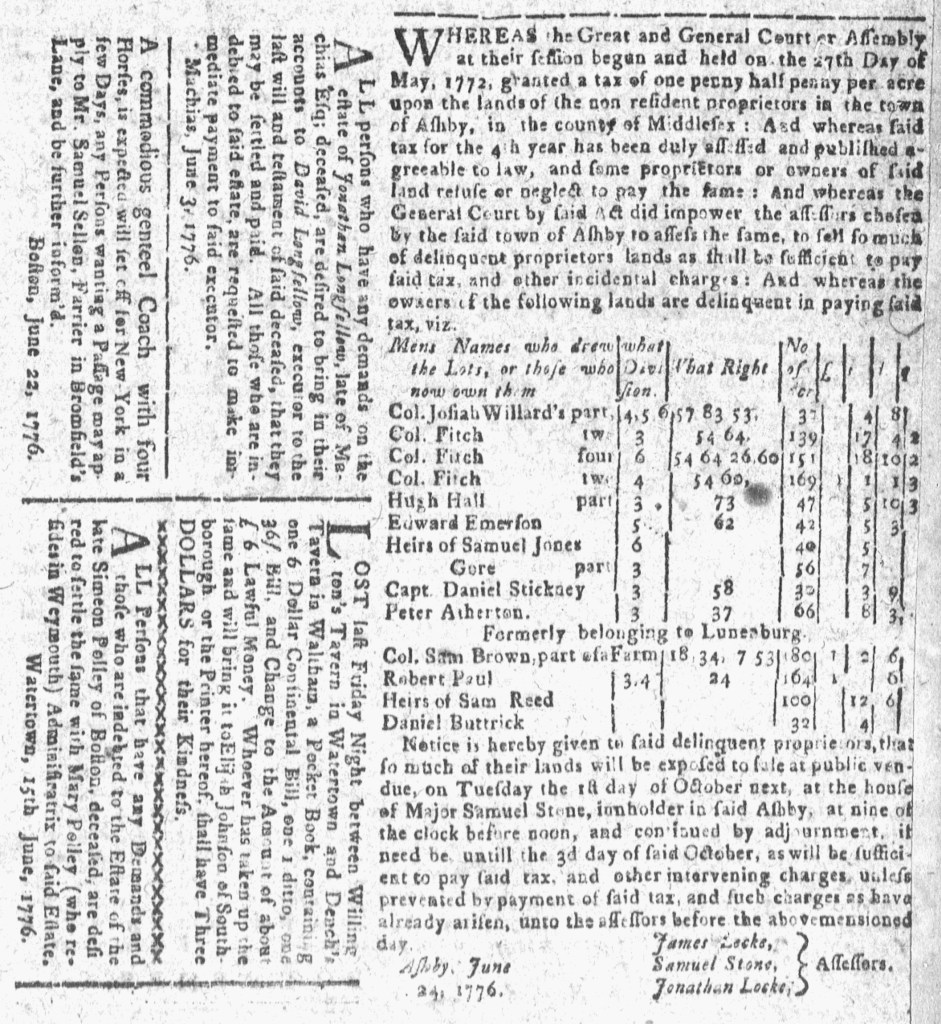
Boston-Gazette (July 8, 1776).

“A commodious genteel Coach … will set off for New-York in a few Days.”

When Benjamin Edes, the printer of the Boston-Gazette, published a legal notice in the July 8, 1776, edition of his newspaper, he had to get creative with the format.  The notice featured several columns, enough that the notice was wider than the usual column width, but not so wide that it extended two columns.  That would have made preparing that issue more straightforward.

Since that was not an option, however, Edes placed the wider notice in the bottom right corner on the last page and then filled in the rest of the page.  The column on the left appeared as usual.  The middle column began as usual, but halfway down the page it could not continue because the legal notice protruded into that column.  Edes also began the right column as usual, filling in the space until reaching the legal notice in the lower corner.  That left a blank space at the bottom of the middle column.

Edes filled that empty space by rotating four advertisements with type set such that they would otherwise fit in any column in the Boston-Gazette, placing then in a two-by-two grid with text that ran perpendicular to everything else on the page.  That meant that type already set could be used in a standard column or in a rotated column, saving the printer time and effort.  It was a clever solution that allowed the printer to publish the various notices submitted to his printing office, collect revenue for each, and not sacrifice any space in his newspaper.  Doing so required careful planning and a good eye for assessing which notices would fit in which places on the page.

How did the advertisers feel about their notices receiving such treatment?  Did they believe that the unique format called more attention to their advertisements and thus worked to their benefit?  Did they worry that the minor inconvenience of rotating the newspaper to read those advertisements might make them easier to overlook?  Did they care at all as long as their notices appeared in print?  The format testifies to Edes’s ingenuity but not to the reception it received from advertisers and readers.

January 17

What was advertised in a colonial American newspaper 250 years ago today?

Pennsylvania Journal (January 17, 1771).

“Each articles will be put up singly, and in the order of the inventory annexed.”

Both the size and format of Richard Tidmarsh’s advertisement on the final page of the January 17, 1771, edition of the Pennsylvania Journal likely attracted attention.  Rather than appearing in a single column, it ran across two columns.  It also extended half a column, creating a large rectangle of text that seemed to dominate the page even though it accounted for about one-third of the content.

Tidmarsh, a druggist, announced an upcoming auction of “DRUGS, MEDICINES, and SHOP FURNITURE” in advance of his departure from the colony “by the first spring vessels.”  He listed the items up for sale, in effect publishing an auction catalog as a newspaper advertisement.  That list made the format of his advertisement even more distinctive.  The introductory material extended across two columns, but the list of items for sale ran in three narrow columns that also did not correspond to the width of any columns that appeared elsewhere in the newspaper.  To help prospective buyers navigate the list, Tidmarsh arranged entries for medicines in alphabetical order.  In the final column, he inserted headers in capital letters for sections enumerating “PERFUMERY,” “PATENT MEDICINES,” and “SPARE UTENSILS and FURNITURE.”  In the introduction, the apothecary explained his rationale for selling items separately rather than as a whole.  He envisioned that “practitioners, as well as Gentlemen of the trade, will have an opportunity of being supplied with such articles as they may be out of.”  Tidmarsh apparently did not anticipate any buyers for his entire inventory, but did anticipate demand for the various drugs and medicines on their own.  He offered credit to buyers who purchased a sufficient quantity and promised that the “whole of the stock of MEDICINES and DRUGS are of the first quality.”  To guide prospective buyers through the auction, he asserted that each article would be sold “in the order of the inventory annexed.”

Tidmarsh advertised an eighteenth-century version of a “going out of business” sale.  In an effort to liquidate his inventory before leaving Philadelphia, he organized an auction that would allow buyers to acquire medicines “of the first quality” at bargain prices compared to retail and perhaps even wholesale transactions.  He published an auction catalog in the public prints, its organized columns guiding prospective bidders through both the items for sale and the order.  He also encouraged participation by offering credit to those who purchased in sufficient quantities.  The unusual format of the apothecary’s advertisement also drew attention to the upcoming auction, helping to generate interest and incite bidders to attend.

January 5

What was advertised in a colonial American newspaper 250 years ago today?

Jan 5 1770 - 1:5:1770 New-Hampshire Gazette
New-Hampshire Gazette (January 5, 1770).

“Ran away last Wednesday … an Apprentice Boy.”

The format and placement of Benjamin Mackay’s advertisement suggests that it was a late addition to the new edition of the New-Hampshire Gazette. Mackay reported that his apprentice, John Bowler, “Ran away last Wednesday” on January 3, 1770. The aggrieved master scrambled to insert an advertisement in the next issue of the colony’s only newspaper, published just two days later on Friday, January 5. Failing to do so would have forced Mackay to wait another week to alert the community by disseminating information about the runaway apprentice in print since the New-Hampshire Gazette, like most other American newspapers published in the early 1770s, appeared only once a week.

Mackay apparently delivered his advertisement to the printing office too late for inclusion in any of the next issue’s twelve columns, three on each of four pages. The compositor had already set the type … but that did not mean that there was not any space for Mackay’s new and urgent advertisement. Compositors sometimes placed short advertisements and news items in the margins, an innovative strategy used only occasionally to include additional content. Mackay’s advertisement ran on the third page of the January 5 edition, running in the bottom margin across all three columns. The unique format possibly attracted the attention of some readers, but it also limited the number of details that Mackay could publish in that particular advertisement. Brevity allowed for speedy publication, but forced Mackay to carefully select which information to circulate to other colonists.

With more time to plan, he remedied that situation in the next edition of the New-Hampshire Gazette. He published another advertisement, nearly three times the length, that provided a much more extensive description of Bowler, including his approximate age, notable physical characteristics, and description of his clothing. In addition to offering a reward for apprehending and returning the apprentice, that second advertisement warned others against “entertaining or carrying off” Bowler.

That Mackay published a second advertisement at all suggests that the first was not successful, at least not in the short time between its publication and the compositor preparing the next edition of the New-Hampshire Gazette. Still, it had no chance of success if it had not appeared in the January 5 issue at all. By resorting to an innovative format for the advertisement, the compositor helped Mackay distribute time-sensitive information in the public prints as quickly as possible.