May 30

What was advertised in a colonial American newspaper 250 years ago today?

Massachusetts Spy (May 27, 1773).

Thursday next will be published … PROPOSALS for printing by Subscription, The ROYAL American MAGAZINE.”

Isaiah Thomas, the printer of the Massachusetts Spy, inserted a brief notice in the May 27, 1773, edition to advise the public that he would soon publish and distribute “PROPOSALS for printing by Subscription, The ROYAL American MAGAZINE.”  Those proposals, a description of the purpose, contents, and price of the magazine, likely appeared on a handbill or broadside, though the printer may have also devised a circular letter to send directly to likely subscribers.  Yet again, a newspaper notice provides evidence of other forms of advertising that circulated in early America in the absence of those materials surviving in research libraries, historical societies, and private collections.  Thomas eventually inserted the proposals in the Massachusetts Spy and other newspapers, providing a glimpse of the handbills or broadsides.  The Adverts 250 Project will examine those newspaper notices in the coming weeks and months.   Despite Thomas’s promotional efforts, he did not publish the first issue of the Royal American Magazine, or Universal Repository of Instruction and Amusement until eight months later in January 1774.

At the time, readers had access to more than two dozen newspapers printed throughout the colonies, including five in Boston, but imported magazines from London.  As Frank Luther Mott explains in A History of American Magazines, 1741-1850, “At the time the first number of the Royal American was issued, there had been no magazine of any kind in the colonies for more than a year and a half, and no general magazine for more than four years.”[1]  According to the “Chronological List of Magazines” that Mott compiled, the Royal American Magazine was only the sixteenth magazine published in the colonies (and that included the Censor, a newspaper-magazine hybrid published in Boston for less than six months from late November 1771 through early May 1772).  Thomas later recollected that his magazine “had a considerable list of subscribers.”[2]  Even so, it lasted for only fifteen months, the last issue published in March 1775. Thomas did not publish the magazine the entire time.  He suspended it in the wake of disruption caused by the Boston Port Bill and later relinquished it to Joseph Greenleaf.  The publication did not continue after the skirmishes at Lexington and Concord.

**********

[1] Frank Luther Mott, A History of American Magazines, 1741-1850 (Cambridge: Harvard University Press, 1939), 83.

[2] Isaiah Thomas, The History of Printing in America: With a Biography of Printers and an Account of Newspapers (1810; New York: Weathervane Books, 1970), 286.

May 13

What was advertised in a colonial American newspaper 250 years ago today?

Massachusetts Spy (May 13, 1773).

“Hand and Shop BILLS.”

At the bottom of the final page of each issue of the Massachusetts Spy, the colophon informed readers that they could purchase subscriptions from Isaiah Thomas at his printing office in Boston or from local agents in several other towns in the colony.  In addition, the colophon stated, “ADVERTISEMENTS taken in,” “PRINTING in its various Branches, performed in a neat Manner,” and “HAND BILLS at an Hour’s Notice.”  Thomas aimed to generate revenue from both notices in the newspaper and advertisements printed to distribute separately.

In the spring of 1773, the printer enhanced his efforts to encourage colonizers to purchase advertising.  He commenced with a newspaper notice that appeared as the first item at the top of the first column on the first page of the April 16 edition.  Thomas advised that “THE extensive circulation of the MASSACHUSETTS SPY, through town and country, renders it very beneficial for those who ADVERTISE therein.”  Furthermore, “Advertisements (sent in season) are inserted in a neat and conspicuous manner on the most reasonable terms.”  The remainder of the notice solicited subscriptions, though the printer’s comment that the newspaper “has met with very great encouragement from the public” also assured advertisers of its “extensive circulation” that made advertising a good investment.

Three weeks later, Thomas inserted another advertisement about advertising, this time for “Hand and Shop BILLS.”  Printers occasionally hawked handbills, as Thomas did in the colophon, but rarely did they advertiser shop bills.  Those billheads, the precursors to modern letterheads, included the name and location of the merchant, shopkeeper, or artisan.  They often featured a visual image or a brief advertisement describing the goods and services available at the shop or both.  Most of the sheet remained blank, leaving space to write in a list of purchases.  Billheads simultaneously served as both advertisements and receipts.

Thomas apparently sought to increase the amount of advertising produced at his shop.  He declared that he “furnished himself with an elegant assortment of LARGE, and other TYPES, for the purpose of printing in the best manner, SHOP and other BILLS.”  He acknowledged that the type he used for printing the newspapers was not always the best choice for freestanding advertisements like broadsides, handbills, and billheads.  Instead, Thomas acquired the necessary equipment for crafting the most effective advertisements.

He also gave his notice about “Hand and Shop BILLs” a privileged spot the first time it appeared, placing it after news from Boston dated May 5 and before news from Boston dated May 6.  Even readers who only skimmed or completely skipped over advertisements were likely to see it there.  His previous notice about advertising in the Massachusetts Spyran as the final item in the Postscript, the only advertisement in that supplement, reinforcing the printer’s efforts to market advertising.  As with other instances of advertising ephemera mentioned in newspaper notices, the “Hand and Shop BILLS” that Thomas promoted in the spring of 1773 testifies to a vibrant culture of advertising in early America, though most such items have not been collected and preserved in research libraries and historical societies.

April 16

What was advertised in a colonial American newspaper 250 years ago today?

Massachusetts Spy (April 16, 1773).

THE extensive circulation of the MASSACHUSETTS SPY, through town and country, renders it very beneficial for those who ADVERTISE therein.”

Many colonial printers promoted their newspapers in the colophon that appeared on the final page.  Isaiah Thomas, the printer of the Massachusetts Spy, did so in one of the lengthier colophons that appeared in newspapers published in the 1770s.  In addition to providing his name and the place of publication, he gave extensive directions to his printing office “At the South Corner of MARSHAL’S LANE, leading from the MILL-BRIDGE into UNION-STREET.”  Thomas noted that “all Persons may be supplied with this Paper” and gave the price for an annual subscription.  He also listed local agents in four towns – Bridgewater, Charlestown, Newburyport, and Salem – who accepted subscriptions on his behalf.  In addition, Thomas solicited advertisements and job printing, including handbills and printed blanks.  He informed prospective customers of “PRINTING in its various Branches, performed in a neat Manner, with the greatest Care and Dispatch, on the most reasonable Terms.”

Massachusetts Spy (April 16, 1773).

Although printers regularly promoted various goods and services available in their printing offices, they did not often include their own newspapers among those advertisements (except to call on recalcitrant subscribers to make payments) nor did they insert notices to encourage the public to place advertisements.  That made Thomas’s notice at the top of the first column on the first page of the April 16, 1773, edition of the Massachusetts Spy rather unusual.  The printer proclaimed, “THE extensive circulation of the MASSACHUSETTS SPY, through town and country, renders it very beneficial for those who ADVERTISE therein.”  Established July 17, 1770, the Massachusetts Spy was the newest of the five newspapers published in Boston at the time, but Thomas suggested that its circulation rivaled its competitors.  Advertising in his newspaper, the printer asserted, drew the attention of readers and, in turn, that attention yielded results for the advertisers.  In making his pitch, Thomas also stated that “Advertisements … are inserted in a neat and conspicuous manner on the most reasonable terms,” offering assurances about the effectiveness, quality, and price of advertising in his newspaper.

Thomas also sought new subscribers.  After extolling advertisements, he addressed “Such gentlemen and ladies, in this Province as are desirous of taking in the SPY.”  The printer characterized its contents as “the earliest and most important Foreign and Domestic Intelligence, with a number of ORIGINAL papers, on a variety of subjects.”  To further entice prospective subscribers, he gave the price of an annual subscription and trumpeted that it “is cheaper than any public paper or other periodical publication whatever, of its bigness [or size], in the four quarters of the globe.”  Accordingly, the Massachusetts Spyhas met with very great encouragement from the public,” a pronouncement intended to resonate with prospective advertisers as well as prospective subscribers.  In a nota bene, Thomas offered to send the newspaper to “Gentlemen and ladies in any of the American colonies, who incline to subscribe,” another testament to the “extensive circulation” that he mentioned as a reason for placing advertisements.

At the bottom of the final page of each issue of the Massachusetts Spy, the colophon informed readers that Thomas accepted subscriptions at the printing office and briefly mentioned “ADVERTISEMENTS taken in.”  Although advertisements accounted for significant revenue for colonial printers, Thomas and others rarely promoted advertising except in the colophons of their newspapers.  In this instance, Thomas apparently recognized an opportunity to cultivate more advertising for his newspaper.  In making his pitch to prospective advertisers, he emphasized price (“reasonable terms”) and, especially, effectiveness (displaying notices in a “conspicuous manner” and the “extensive circulation” of the newspaper).  He coupled those appeals with his efforts to attract more subscribers, hoping to expand both means that the Massachusetts Spy generated revenue.

January 28

What was advertised in a colonial American newspaper 250 years ago today?

Massachusetts Spy (January 28, 1773).

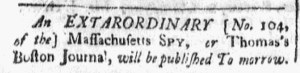
An EXTRAORDINARY … will be published To morrow.”

“Extra!  Extra!  Read all about it!”  That was Isaiah Thomas’s message to readers of the Massachusetts Spy.  The printer included an announcement in the January 28, 1773, edition, alerting subscribers and other readers that “An EXTRAORDINARY [No. 104, of the] Massachusetts SPY, or Thomas’s Boston Journal, will be published To morrow.”  Unlike the supplements and postscripts that sometimes accompanied early American newspapers, Thomas considered the extraordinary, distributed on a Friday, a separate issue.  As he noted in his announcement, it had its own number, 104, following “NUMB. 103,” distributed on Thursdays as usual for the Massachusetts Spy.  Thomas or a compositor who worked in his printing office updated the masthead to include “EXTRAORDINARY.”

The “extra” issue consisted of two pages, compared to four for the weekly standard issues of the Massachusetts Spy and other American newspapers published at the time.  It consisted almost entirely of a single item from the “HOUSE of REPRESENTATIVES” in Boston, along with half a column of news from Salem and one short advertisement for grocery items.  (In similar circumstances, other printers took the opportunity to insert advertisements about the goods and services available at their printing offices.)  The main item that prompted publication of the extraordinary was an “ANSWER to [Governor Thomas Hutchinson’s] SPEECH, to both Houses, at the opening of this session.”  Representatives “ORDERED” that a committee comprised of “Mr. Adams, Mr. Hancock, Mr. Bacon, Col. Bowes, Major Hawley, Capt. Darby, Mr. Philips, Col. Thayer, and Col. Stockbridge” compose that answer.  Members of the committee agreed with the governor that “the government at present is in a very disturbed state.”  They did not, however, identify the same causes.  “[W]e cannot ascribe it to the people’s having adopted unconstitutional principles,” as the governor claimed.  Instead, they believed that problems arose as a result of “the British House of Commons assuming and exercising a power inconsistent with the freedom of the constitution to give and grant the property of the colonists, and appropriate the same without their consent.”

When Thomas published the extraordinary, he already had a reputation as a printer devoted to principles espoused by the patriots.  The masthead for his newspaper described it as “A Weekly, Political, and Commercial PAPER:– Open to ALL Parties, but Influenced by None,” yet immediately below that sentiment appeared this message: “DO THOU Great LIBERTY INSPIRE our Souls,– And make our Lives in THY Possession happy,– Or our Deaths glorious in THY JUST Defence.”  Thomas likely had two reasons for quickly publishing the committee’s response as an extraordinary.  He scooped his competitors while also disseminating rhetoric that matched his own views.  (Most other newspapers printed in Boston included the response as part of their coverage when they distributed their next weekly edition, but that took several days or, in the case of the Massachusetts Gazette and Boston Weekly News-Letter, printed by Loyalist Richard Draper, an entire week.)  Thomas previously published the governor’s speech as an extraordinary, dated and distributed on the same day as the weekly issue on Thursday, January 7.  In so doing, he upheld his pledge that the Massachusetts Spy was “Open to ALL Parties,” yet publishing the governor’s speech also kept colonizers informed about the dangers they faced from the narrative of recent events that Hutchinson constructed.  Releasing the committee’s response as its own extraordinary on a day that no other newspapers were published in Boston and announcing his plans to issue that extraordinary may have garnered more attention more quickly to the version of events that matched Thomas’s own views.  Patriots and imperial officials vied over how to represent what was occurring in Boston and throughout the colonies.  Thomas may have considered getting the committee’s response to the governor in print as quickly as possible an important counteroffensive against the governor’s speech that he published three weeks earlier.

Massachusetts Spy Extraordinary (January 29, 1773).

Happy Birthday, Isaiah Thomas!

Isaiah Thomas, patriot printer and founder of the American Antiquarian Society, was born on January 19 (New Style) in 1749 (or January 8, 1748/49, Old Style).  It’s quite an historical coincidence that the three most significant printers in eighteenth-century America — Benjamin Franklin, Isaiah Thomas, and Mathew Carey — were all born in January.

isaiah_thomas1818
Isaiah Thomas (January 30, 1739 – April 4, 1831). American Antiquarian Society.

The Adverts 250 Project is possible in large part due to Thomas’s efforts to collect as much early American printed material as he could, originally to write his monumental History of Printing in America.  The newspapers, broadsides, books, almanacs, pamphlets, and other items he gathered in the process eventually became the initial collections of the American Antiquarian Society.  That institution’s ongoing mission to acquire at least one copy of every American imprint through 1876 has yielded an impressive collection of eighteenth-century advertising materials, including newspapers, magazine wrappers, trade cards, billheads, watch papers, book catalogs, subscription notices, broadsides, and a variety of other items.  Exploring the history of advertising in early America — indeed, exploring any topic related to the history, culture, and literature of early America at all — has been facilitated for more than two centuries by the vision of Isaiah Thomas and the dedication of the curators and other specialists at the American Antiquarian Society over the years.

Thomas’s connections to early American advertising were not limited to collecting and preserving the items created on American presses during the colonial, Revolutionary, and early national periods.  Like Mathew Carey, he was at the hub of a network he cultivated for distributing newspapers, books, and other printed goods — including advertising to stimulate demand for those items.  Sometimes this advertising was intended for dissemination to the general public (such as book catalogs and subscription notices), but other times it amounted to trade advertising (such as circular letters and exchange catalogs intended only for fellow printers, publishers, and booksellers).

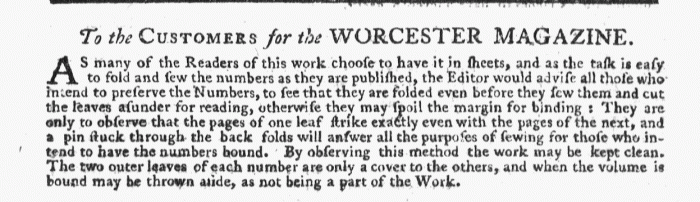
Thomas also experimented with advertising on wrappers that accompanied his Worcester Magazine, though he acknowledged to subscribers that these wrappers were ancillary to the publication:  “The two outer leaves of each number are only a cover to the others, and when the volume is bound may be thrown aside, as not being a part of the Work.”[1]

jan-30-worcerster-magazine-april-1786
Detail of Advertising Wrapper, Worcester Magazine (Second Week of April, 1786).

Thomas’s patriotic commitment to freedom of the press played a significant role in his decision to develop advertising wrappers.  As Thomas relays in his History of Printing in America, he discontinued printing his newspaper, the Massachusetts Spy, after the state legislature passed a law that “laid a duty of two-thirds of a penny on newspapers, and a penny on almanacs, which were to be stamped.”  Such a move met with strong protest since it was too reminiscent of the Stamp Act imposed by the British two decades earlier, prompting the legislature to repeal it before it went into effect.  On its heels, however, “another act was passed, which imposed a duty on all advertisements inserted in the newspapers” printed in Massachusetts.  Thomas vehemently rejected this law as “an improper restraint on the press. He, therefore, discontinued the Spy during the period that this act was in force, which was two years. But he published as a substitute a periodical work, entitled ‘The Worcester Weekly Magazine,’ in octavo.”[2] This weekly magazine lasted for two years; Thomas discontinued it and once again began printing the Spy after the legislature repealed the objectionable act.

jan-30-advertising-wrapper-worcester-magazine-4th-week-may-1786
Third Page of Advertising Wrapper, Worcester Magazine (Fourth Week of May, 1786).

Isaiah Thomas was not interested in advertising for its own sake to the same extent as Mathew Carey, but his political concerns did help to shape the landscape of early American advertising.  Furthermore, his vision for collecting American printed material preserved a variety of advertising media for later generations to admire, analyze, ponder, and enjoy.  Happy 274th birthday, Isaiah Thomas!

**********

[1] Isaiah Thomas, “To the CUSTOMERS for the WORCESTER MAGAZINE,” Worcester Magazine, wrapper, second week of April, 1786.

[2] Isaiah Thomas, The History of Printing in America: With a Biography of Printers, and an Account of Newspapers, vol. 2 (Worcester, MA: Isaac Sturtevant, 1810), 267-268.

December 24

What was advertised in a colonial American newspaper 250 years ago today?

Massachusetts Gazette and Boston Weekly News-Letter (December 24, 1772).

There are some Almanacks with Dr. Ames’s Name thereto that are very erroneous.”

In the December 24, 1772, edition of the Massachusetts Gazette and Boston Weekly News-Letter, Richard Draper continued the efforts to inform the public about counterfeit editions of “AMES’s Almanack for 1773” that he, Thomas Fleet and John Fleet, printers of the Boston Evening-Post, and Benjamin Edes and John Gill, printers of the Boston-Gazette, began three days earlier.  According to a note from Nathaniel Ames, the author of the popular almanac, “The only True and Correct Almanacks from my Copy, are those printed by R. Draper, Edes & Gill and T. & J. Fleet.”

Draper expanded on the notice that previously appeared in other newspapers, advising readers and prospective customers that “there are some Almanacks with Dr. Ames’s Name thereto that are very erroneous.”  In particular, those counterfeits contained misinformation about “Roads and Stages,” but in the “true Almanack” those errors had been “corrected, amended and placed in a better Manner than in any Almanack heretofore published.”  Draper offered a justification not only for choosing Ames’s “true Almanack” over counterfeit editions but also for choosing it over any other almanacs advertised and sold in New England.

Isaiah Thomas, printer of the Massachusetts Spy, advertised some of those almanacs on the same day that Draper published the extended version of the advertisement about Ames’s “True and Correct Almanacks.”  Under a headline that simply declared, “ALMANACKS,” Thomas listed “AMES’s, Lowe’s, Gleason’s (or Massachusetts Calender) and Sterne’s ALMANACKS” available at his printing office.  Thomas did not note whether he sold Ames’s almanac printed by Draper, the Fleets, and Edes and Gill, but his newspaper was the only one in Boston that did not carry the notice from those printers that week.

Postscript to the Massachusetts Spy (December 24, 1772).

In addition, the supplement that accompanied that edition of the Massachusetts Spy contained just one advertisement.  It advised prospective customers about “AMES’s Almanack, for 1773, just published and to be sold by Russell & Hicks, in Union street, next the Cornfield.”  Whether or not Thomas sold the counterfeit almanac at his own shop, he did not seem to have any qualms about generating revenue by running advertisements placed by the printers who published the suspect edition.  Given that households from the most grand to the most humble acquired almanacs each year, those pamphlets were big business for printers.  Rivalries in printing, marketing, and selling almanacs became a regular feature of newspaper advertising each fall and into the winter months.

May 2

What was advertised in a colonial American newspaper 250 years ago today?

Postscript to the Censor (May 2, 1772).

“Just Arrived, The Cream of Goods.”

Gilbert DeBlois placed his advertisement for “The Cream of Goods” imported from England in several newspapers published in Boston in the spring of 1772, including the Censor.  Ezekiel Russell commenced publication of the Censor, more “a political magazine rather than a newspaper,” in November 1771.[1]  He eventually supplemented it with a half sheet Postscript that looked more like a newspaper.  Instead of carrying essays and editorials exclusively, it also featured news and advertising.  Those efforts to diversify the publication, however, did not broaden its appeal to readers in Boston.  As Isaiah Thomas, the ardent patriot who published the Massachusetts Spy and wrote The History of Printing in America (1810), noted, “the circulation of the paper was confined to a few of their own party,” Tories who sympathized with the British government.[2]  Given his politics, DeBlois numbered among that party.  He eventually left Boston as part of the British evacuation in 1776.  He was among the advertisers in the final issue of the Censordistributed by Russell.

Thomas made his contempt for the Censor clear, demeaning it for being “discontinued before the revolution of a year from its first publication.”  In a footnote, Thomas also provided details about a notorious contributor to the Censor.  “Dr. Benjamin Church, a reputed whig, who when the Revolutionary war commenced was appointed surgeon general of the American army, but was soon after arrested and confined, being detected in a traitorous correspondence with the British army in Boston, I have been informed by a very respectable person whom I have long known, was a writer for the Censor.”  Thomas did not reveal his source, but he did state that “[t]his person, then an apprentice to Russell, was employed to convey, in a secret manner, the doctor’s manuscripts to the press, and proof sheets from the press to the doctor.”  Thomas asserted that Church engaged in skullduggery long before his infamous letter to General Thomas Gage was intercepted and decoded in October 1775.  Some historians have suggested that Church’s case was more nuanced than Thomas allowed, as did Church at the time.  Thomas apparently had little use for Church’s rationalizations that he deliberately sent misinformation to the British to ward off attacks against patriots who lacked ammunition, just as he had little use for the Censor.  For a few months, the Postscript to the Censor increased the number of publications that disseminated advertising in Boston, but Russell did not attract enough subscribers or advertisers to continue producing the weekly political magazine and its supplement.

**********

[1] Clarence S. Brigham, History and Bibliography of American Newspapers, 1690-1820 (Worcester, Massachusetts: American Antiquarian Society, 1947), 275.

[2] Isaiah Thomas, The History of Printing in America: With a Biography of Printers and an Account of Newspapers (1810; New York: Weathervane Books, 1970), 285.

March 5

What was advertised in a colonial American newspaper 250 years ago today?

Massachusetts Spy (March 5, 1772).

“MATHEMATICAL INSTRUMENTS … At the Head of the Long-Wharf, King-Street, BOSTON.”

Thick black mourning borders enclosed the columns of the March 5, 1772, edition of the Massachusetts Spy.  Isaiah Thomas, one of the most ardent patriots among the printers in Boston, commemorated the second anniversary of the Bloody Massacre, the Massacre in King Street, better known today as the Boston Massacre.  Colonial printers most often used mourning borders when announcing the death of an official (including Francis Fauquier, lieutenant governor of Virginia, in March 1768) or a prominent figure (including George Whitefield, a minister associated with the revivals now known as the Great Awakening, in September 1770), but in the 1760s and 1770s American printers also deployed mourning borders to lament the death of liberty, doing so in response to the Stamp Act and the “HORRID MASSACRE! Perpetrated in King-street.”

On the second anniversary of the Boston Massacre, Thomas did more than frame the content of the Massachusetts Spywithin mourning borders.  A woodcut depicting a skull and bones, familiar from the Stamp Act protests, appeared near the top of the first column on the front page, just below several lines about massacre that Thomas attributed to Shakespeare.  The printer also inserted a letter written on the occasion of the anniversary of the “fifth of March … to appear with the labours of those able and assiduous patriots, who have rendered the Spy the terror of tyrants, the scourge of traitors, and expositor of the violent and fraudulent usurpations of a set of villains partaking largely the nature of both.”  Thomas also published a memorial to “FIVE of your fellow countrymen, GRAY, MAVERICK, CALDWELL, ATTUCKS and CARR … most inhumanly MURDERED … By a Party of the XXIXth Regiment, Under the command of Capt. Tho. Preston.”  The memorial linked the Boston Massacre to the murder of Christopher Seider, an “innocent youth,” by Ebenezer Richardson, “Informer, And tool to Ministerial hirelings,” on February 22, 1770, just two weeks before the events in King Street.  The memorial expressed dismay that even though Richardson “was found guilty By his Country On Friday April 20th, 1770,” he “Remains UNHANGED” on “This day, MARCH FIFTH! 1772.”  The memorial concluded with a proclamation that “the PRESS” should “Remain FREE” as “a SCOURGE to Tyrannical Rulers.”

The mourning borders did not enclose just the memorial, editorials, and other content related to the Boston Massacre.  Instead, they appeared on all four pages, enclosing even the advertisements for cookbooks, “ENGLISH GOODS,” almanacs, and mathematical instruments.  Even if readers chose to skip over the dense essays that appeared elsewhere in the newspaper, they could not miss the mourning borders when they perused the advertisements.  Merely reading the advertisements on the final page of the Massachusetts Spy required colonizers to engage with the politics of the period.

Happy Birthday, Isaiah Thomas!

Isaiah Thomas, patriot printer and founder of the American Antiquarian Society, was born on January 19 (New Style) in 1749 (or January 8, 1748/49, Old Style).  It’s quite an historical coincidence that the three most significant printers in eighteenth-century America — Benjamin Franklin, Isaiah Thomas, and Mathew Carey — were all born in January.

isaiah_thomas1818
Isaiah Thomas (January 30, 1739 – April 4, 1831). American Antiquarian Society.

The Adverts 250 Project is possible in large part due to Thomas’s efforts to collect as much early American printed material as he could, originally to write his monumental History of Printing in America.  The newspapers, broadsides, books, almanacs, pamphlets, and other items he gathered in the process eventually became the initial collections of the American Antiquarian Society.  That institution’s ongoing mission to acquire at least one copy of every American imprint through 1876 has yielded an impressive collection of eighteenth-century advertising materials, including newspapers, magazine wrappers, trade cards, billheads, watch papers, book catalogs, subscription notices, broadsides, and a variety of other items.  Exploring the history of advertising in early America — indeed, exploring any topic related to the history, culture, and literature of early America at all — has been facilitated for more than two centuries by the vision of Isaiah Thomas and the dedication of the curators and other specialists at the American Antiquarian Society over the years.

Thomas’s connections to early American advertising were not limited to collecting and preserving the items created on American presses during the colonial, Revolutionary, and early national periods.  Like Mathew Carey, he was at the hub of a network he cultivated for distributing newspapers, books, and other printed goods — including advertising to stimulate demand for those items.  Sometimes this advertising was intended for dissemination to the general public (such as book catalogs and subscription notices), but other times it amounted to trade advertising (such as circular letters and exchange catalogs intended only for fellow printers, publishers, and booksellers).

Thomas also experimented with advertising on wrappers that accompanied his Worcester Magazine, though he acknowledged to subscribers that these wrappers were ancillary to the publication:  “The two outer leaves of each number are only a cover to the others, and when the volume is bound may be thrown aside, as not being a part of the Work.”[1]

jan-30-worcerster-magazine-april-1786
Detail of Advertising Wrapper, Worcester Magazine (Second Week of April, 1786).

Thomas’s patriotic commitment to freedom of the press played a significant role in his decision to develop advertising wrappers.  As Thomas relays in his History of Printing in America, he discontinued printing his newspaper, the Massachusetts Spy, after the state legislature passed a law that “laid a duty of two-thirds of a penny on newspapers, and a penny on almanacs, which were to be stamped.”  Such a move met with strong protest since it was too reminiscent of the Stamp Act imposed by the British two decades earlier, prompting the legislature to repeal it before it went into effect.  On its heels, however, “another act was passed, which imposed a duty on all advertisements inserted in the newspapers” printed in Massachusetts.  Thomas vehemently rejected this law as “an improper restraint on the press. He, therefore, discontinued the Spy during the period that this act was in force, which was two years. But he published as a substitute a periodical work, entitled ‘The Worcester Weekly Magazine,’ in octavo.”[2] This weekly magazine lasted for two years; Thomas discontinued it and once again began printing the Spy after the legislature repealed the objectionable act.

jan-30-advertising-wrapper-worcester-magazine-4th-week-may-1786
Third Page of Advertising Wrapper, Worcester Magazine (Fourth Week of May, 1786).

Isaiah Thomas was not interested in advertising for its own sake to the same extent as Mathew Carey, but his political concerns did help to shape the landscape of early American advertising.  Furthermore, his vision for collecting American printed material preserved a variety of advertising media for later generations to admire, analyze, ponder, and enjoy.  Happy 273rd birthday, Isaiah Thomas!

**********

[1] Isaiah Thomas, “To the CUSTOMERS for the WORCESTER MAGAZINE,” Worcester Magazine, wrapper, second week of April, 1786.

[2] Isaiah Thomas, The History of Printing in America: With a Biography of Printers, and an Account of Newspapers, vol. 2 (Worcester, MA: Isaac Sturtevant, 1810), 267-268.

January 2

GUEST CURATOR:  Benjamin Andonian

What was advertised in a colonial American newspaper 250 years ago today?

Massachusetts Spy (January 2, 1772).

“WANTED immediately, a Journeyman COMPOSITER.”

This advertisement struck me because it was related to the production of the newspapers we were reading in class.  This advertisement “WANTED immediately” a compositor at a newspaper. I thought it would be interesting to learn about what a compositor is and how this might increase my knowledge of early American newspapers.

The invention of movable type opened the door for a new age of printing in Europe in the 1500s.  That meant new crafts and careers, including compositors. Compositors arranged the letters in advance of them being covered in ink.  Historian Liz Covart describes the job expectations step by step.  The compositor starts with the composition stick, placing letters in proper order.  The placement of letters is done in opposite order, right to left, so they appear right side up and left to right on final edition.  After a quick check to clean up errors, compositors place their work in a chase to be inked up and printed.

I found it very interesting how the printing press offered positions for compositors and others to make the newspapers we read in class and consulted for this project.  Each sentence, letter, and word or punctuation mark was positioned by a compositor like the one sought in this advertisement.  Seeing such a specific job and the steps involved made me think of the process today and the new jobs and careers that the internet has created, like the printing press did in early America.  Lily Talavera expands on this in an article about the booming market for social media jobs.  According to Talavera, “Social media has created a new category of jobs. You may have heard them as social media jobs or with other names relevant to the requested tasks. These jobs are in high demand, and many people already work full-time on social media.”  Innovations in delivering news today have a similar effect on creating new kinds of jobs as an innovation like the printing press had in creating jobs for compositors in the early modern period.

**********

ADDITIONAL COMMENTARY:  Carl Robert Keyes

When I taught a course about Revolutionary America, 1763-1815, in Fall 2021, I once again incorporated the Adverts 250 Project and the Slavery Adverts 250 Project.  I asked each of the twenty-three students in the class to serve as guest curators for those projects.  Each of them was responsible for compiling a digital archive of newspapers originally published during a particular week in 1772.  Then they scoured the newspapers to identify advertisements about enslaved men, women, and children for inclusion in the Slavery Adverts 250 Project.  For each of those advertisements, the guest curators composed tweets that included the project’s tagline, a quotation, and a citation.  For the Adverts 250 Project, each student selected one advertisement to research in greater detail, consulting at least one secondary source by an historian of early America, and then wrote an entry about what they learned and what the advertisement reveals about some aspect of commerce, politics, or daily life during the era of the American Revolution.

Ben is the first of the students from that class to have his work as a guest curator appear on the Adverts 250 Project and the Slavery Adverts 250 Project.  In many ways, it is very fitting that he starts the entries researched and written for that class with one that examines an advertisement about the printing trade.  We devoted a lot of time to discussing print culture, consumer culture, slavery, and their intersections during the era of the American Revolution.  Compositors set the type for the newspapers, broadsides (including the Declaration of Independence), and pamphlets (such as Thomas Paine’s Common Sense) that kept colonizers informed during the imperial crisis and, ultimately, encouraged them to sever their political allegiance to Great Britain.  Compositors also set the type for the countless newspaper advertisements that offered enslaved people for sale or promised rewards for the capture and return of those who liberated themselves from their enslavers.  Liberty and slavery appeared side by side on the pages of newspaper published during the era of the American Revolution.  Compositors also set the type for advertisements for consumer goods as well as essays that critiqued consumption and editorials that advocated nonimportation agreements and promoted “domestic manufactures” as means of exerting economic pressure to achieve political ends.

I invited students to contemplate all of these developments, not only in the abstract but also taking into consideration actual people and their experiences during the era of the American Revolution.  This advertisement for a “Journeyman COMPOSITER” provides a springboard for considering the many themes woven throughout the Revolutionary America class that I designed and that Ben completed.  Throughout the colonies, compositors played a role in presenting news and opinions about current events to the public.  They also played a role in shaping consumer culture and perpetuating slavery.  Beyond their contributions to producing the printed page, compositors made decisions about their own political activities and what kind of society they wanted to emerge from the American Revolution.  That being the case, Ben’s choice of an advertisement to start a new round of entries from guest curators is very fitting indeed.