May 29

What was advertised in a revolutionary American newspaper 250 years ago today?
New-York Gazette and Weekly Mercury (May 29, 1775).

“Small swords silver mounted … and broad swords as gentlemen may fancy.”

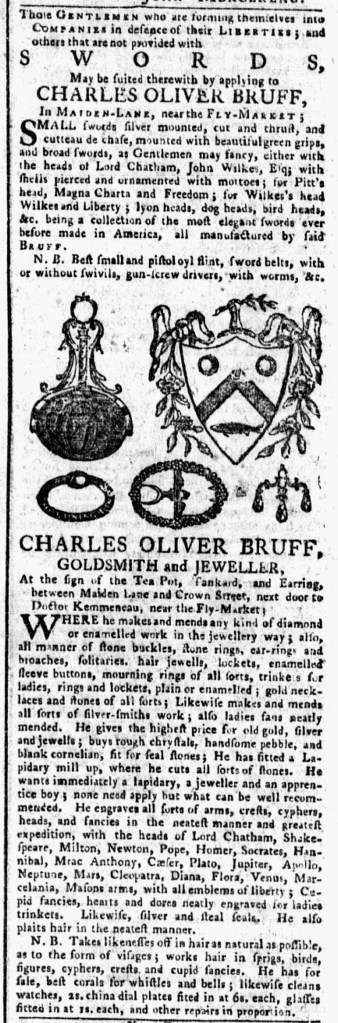
Charles Oliver Bruff, a goldsmith and jeweler who kept a shop at the “sign of the tea-pot, tankard, and ear-ring,” placed a familiar advertisement in the May 29, 1775, edition of the New-York Gazette and Weekly Mercury.  By then it had appeared several times, likely drawing the attention of readers because a woodcut depicting several items made by Bruff adorned the advertisement.  It showed a looking class, a ring, a buckle, and an earning.  It also featured a coat of arms, a sample of the “arms, crests, cyphers, heads and fancies” that he engraved.  The goldsmith and jeweler also declared that he ornamented his wares with “emblems of liberty” for customers who wished to make political statements with their rings, brooches, and other accessories.

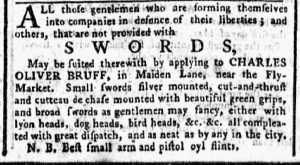
New-York Gazette and Weekly Mercury (May 29, 1775).

In the wake of current events, including the battles at Lexington and Concord and the ongoing siege of Boston, Bruff decided to insert a second advertisement in the New-York Gazette and Weekly Mercury.  He placed it for the purpose of promoting “SWORDS” to “ALL those gentlemen who are forming themselves into companies in defence of their liberties.”  He offered “[s]mall swords silver mounted, cut-and thrust and cutteau de chase mounted with beautiful green grips, and broad swords as gentlemen may fancy,” decorating them with “lyon heads, dogs heads, bird heads,” and other figures.  Bruff encouraged his genteel clients to contemplate how they could be fashionable as they mobilized in support of the American cause.  The latest news out of Massachusetts presented a marketing opportunity for the goldsmith and jeweler.  Kate Haulman has documented how military service during the Revolutionary War allowed men, especially officers, to embrace sartorial splendors.[1]  Yet those in uniform were not alone in embracing what Haulman terms “the military mode, where fashion and politics merged.”[2]  The purveyors of garments, textiles, and accoutrements, including tailors, shopkeepers, and jewelers, welcomed such business at a time that demonstrating patriotism otherwise called for abstaining from consumption so often considered luxurious and unnecessary.  Bruff saw a new avenue for attracting clients and adjusting his marketing efforts accordingly.

**********

[1] Kate Haulman, “Fashion and the Culture Wars of Revolutionary Philadelphia,” William and Mary Quarterly, 3rd ser., 62, no. 4 (October 2005), 644-49.

[2] Haulman, “Fashion and the Culture Wars,” 644.

May 22

What was advertised in a revolutionary American newspaper 250 years ago today?

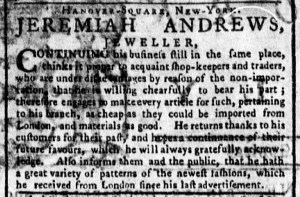
New-York Gazette and Weekly Mercury (May 22, 1775).

“Shop-keepers and traders, who are under disadvantages by reason of the non-importation.”

The Continental Association, a nonimportation agreement devised by the First Continental Congress in response to the Coercive Acts, created an opportunity for Jeremiah Andrews, a jeweler in New York, to market his services in the spring of 1775.  In the May 22 edition of the New-York Gazette and Weekly Mercury, he announced that he “CONTINU[ED] his business still in the same place” and “thinks it proper to acquaint shop-keepers and traders, who are under disadvantages by reason of the non-importation, that he is willing chearfully to bear his part.”  How would Andrews help them with that burden?  By supplying retailers with items that they could not import while the Continental Association remained in effect!

He explained that he could “make every article … pertaining to his branch,” jewelry, “as cheap as they could be imported from London, and materials as good.”  Andrews expected that he offered an attractive alternative.  After all, he used quality materials in crafting his jewelry and set prices comparable to those previously charged for imported items.  His appeals resonated with various articles of the Continental Association, including the eighth article that called for “promot[ing] Agriculture, Arts, and the Manufactures of this Country” and the ninth article that prohibited “tak[ing] Advantage of the Scarcity of Goods” by increasing prices for those “Goods or Merchandise” available for sale.

Andrews also informed both retailers and the public that “he hath a great variety of patterns of the newest fashions, which he received from London since his last advertisement.”  Assessing the situation, he realized that consumers still valued connections to the largest and most cosmopolitan city in the empire.  The Continental Association made importing textiles, accessories (including jewelry), housewares, and other goods from there off limits, but it did not proscribe replicating the styles currently in fashion.  Andrews presented retailers and consumers with a means of keeping up with the latest trends for jewelry without sacrificing support for the American cause.  After all, most colonizers still valued being part of the British Empire, despite the imperial crisis and the battles between regulars and colonial militia in Massachusetts in April and the ongoing siege of Boston.  They thought of themselves as British and hoped for a redress of grievances.  Andrews provided a means for minimizing the disruptions that consumers experienced, his way “chearfully to bear his part” while expanding his business.

December 31

What was advertised in a colonial American newspaper 250 years ago today?

Connecticut Gazette (December 31, 1773).

“Clocks and Watches repaired … as well and cheap as in New-York or Boston.”

John Champlin, a goldsmith and jeweler, ran a shop in New London in the early 1770s.  He occasionally placed advertisements in the Connecticut Gazette to promote the goods and services that he provided.  For instance, as 1773 came to a close, he advised the public that he stocked a “good Assortment of cypher’d and brilliant Ear-ring & Button Stones, Locket Stones, Ring Stones of all Kinds,” “Wires of all Kinds, a neat Assortment of Files,” “Materials for repairing Clocks and Watches,” “best plated Shoe and Knee Buckles,” and “many other Articles.”  Like others advertisers, he intended that a list demonstrating the many choices he offered would entice consumers to visit his shop.

Champlin deployed other marketing strategies as well.  He made an appeal to price, asserting that he sold “All Sorts of Gold-smith, Silver-smith, and Jeweller’s Work as cheap” as anywhere else in the colony.  In so doing, he acknowledged that he operated within a regional rather than a local marketplace.  Prospective customers in New London and nearby towns had the option to send away to smiths and jewelers in New Haven, Hartford, and other towns if they thought they might get better deals, but Champlin assured them that was not necessary.  The market also extended beyond the colony.  Champlin declared that his customers “may have Clocks and Watches repaired at his Shop … as well and cheap as in New-York or Boston.”  In recent months, Thomas Hilldrup, a watchmaker in Hartford, advertised widely in newspapers in Hartford, New Haven, and New London, encouraging colonizers to send their watches to him via post riders.  Champlin may have deliberately avoided alluding to Hartford, not wishing to amplify Hillrup’s marketing efforts, and instead focused on low prices often associated with major ports.  All the same, the message was clear that customers should bring or send their clocks and watches to him rather than sending them for repairs in any other city or town.

The goldsmith and jeweler advanced and adapted some of the most common marketing appeals that appeared in eighteenth-century newspaper advertisements.  He emphasized consumer choice, low prices, and quality.  In so doing, he sought to make himself competitive not only in the town where he kept his shop but anywhere in the colony and throughout New England where readers perused the Connecticut Gazette.

July 17

What was advertised in a colonial American newspaper 250 years ago today?

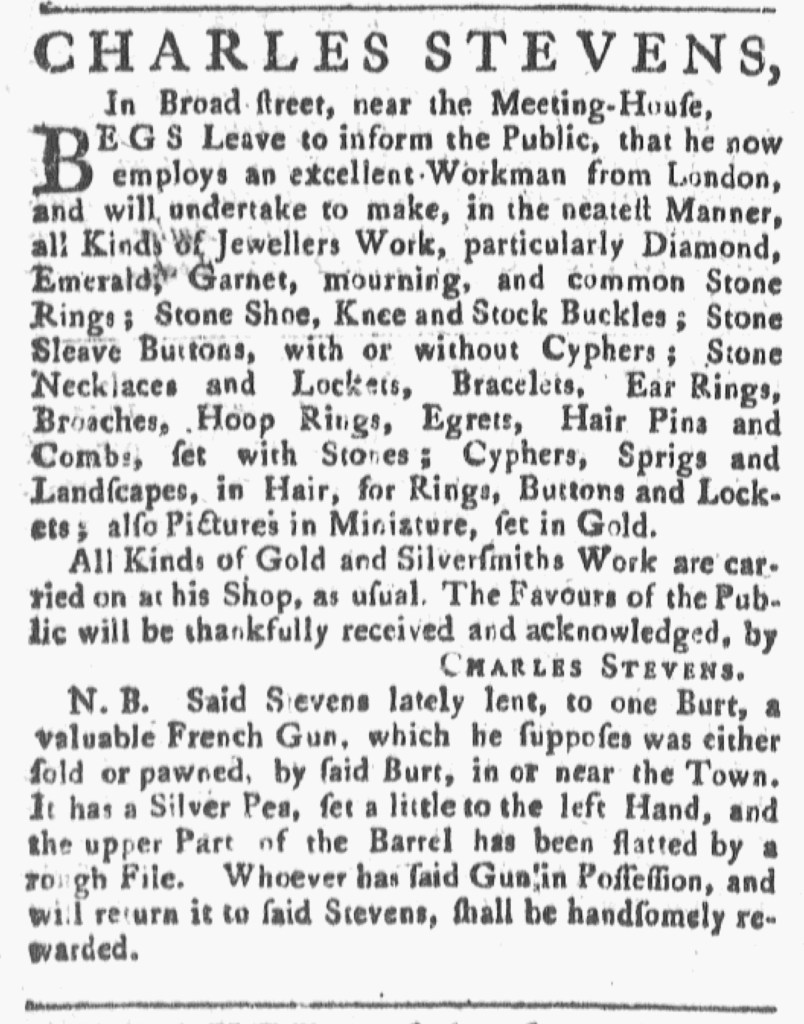
Providence Gazette (July 17, 1773).

“He now employs an excellent Workman from London.”

Charles Stevens, a goldsmith and jeweler, occasionally advertised in the Providence Gazette in the late 1760s and early 1770s.  A new development in his workshop prompted each of his advertisements.  On September 24, 1768, for instance, Stevens advised the public, “particularly those who have hitherto kindly favoured him with their Custom,” that he moved to a new location “in the main Street of Providence, where he continues to carry on his Business, in all its various Branches, and engages to execute his Work in the best and most elegant Manner.”  The goldsmith and jeweler made the same appeals as other artisans, yet they appeared in the public prints only when Stevens wanted to make sure that former clients knew about his new location.  Similarly, when he “removed to BROAD-STREET” in the summer of 1771, Stevens placed an advertisement to inform the public, “particularly his old Customers,” that he “carries on his Business in all its Branches, as usual.”

The goldsmith and jeweler had other news to share two years later.  In July 1773, he placed an advertisement to announce that “he now employs an excellent Workman from London, and will undertake to make, in the neatest Manner, all Kinds of Jewellers Work.”  Artisans who placed newspaper advertisements rarely gave credit to employees and relations who labored in their workshops.  Those who did so usually emphasized one or more of three specific reasons.  Sometimes an employee or associate possessed expertise that the proprietor did not, expanding the offerings available at the shop.  Sometimes their connections to London or other cities suggested greater familiarity with current fashions and tastes as well as superior training in their craft.  Sometimes an additional employee testified to the popularity of a workshop, suggesting that the artisan who ran it required assistance to keep up with orders.  All three reasons may have applied to the “excellent Workman from London” who produced “all Kinds of Jewellers Work” in Stevens’s shop.  The proprietor noted, “All Kinds of Gold and Silversmith’s Work are carried on at his Shop, as usual.”  Stevens may have shifted his focus to that work, leaving jewelry orders to his new employee.  He had already established his reputation in Providence, accepting jobs “as usual,” yet the addition of an employee with specialized skills merited an advertisement to keep existing customers and the public aware of new developments that benefited his patrons.

February 13

What was advertised in a colonial American newspaper 250 years ago today?

Providence Gazette (February 13, 1773).

“Gibbs makes plated Buckles in the newest Fashions, warranted tough and good.”

John Carter, printer of the Providence Gazette, limited the number of advertisements in the February 6, 1773, edition in order to make room for political news from Massachusetts.  A week later, the final page of his newspaper once again consisted entirely of advertising.  Other advertisements appeared on the first and third pages as well.  Collectively, paid notices accounted for nearly half the space in the February 13 edition.

Those advertisements included one from John Gibbs.  The notice ran for the first time, perhaps delayed by a week when Carter made the editorial decision to focus on the politics of the imperial crisis in the previous issue.  Whatever the particulars of the timing, Gibbs, wished to inform prospective customers that he opened a new shop “where he carries on the Goldsmith’s and Jeweller’s Business, in all their various Branches.”  In other words, he possessed the skill to undertake any sort of order he received.

In addition to promoting his abilities, Gibbs made other appeals commonly deployed by artisans in their newspaper advertisements.  He promised exemplary public service, stating that “Ladies and Gentlemen that please to favour him with their Custom, may depend on being served with Fidelity and Dispatch.”  He also promised low prices, declaring that he charged “as low Rates as any can work for in this Colony, or elsewhere.”  According to Gibbs, those were not just reasonable prices but the lowest prices that consumers would find in Rhode Island or anywhere else.  He also emphasized current trends and quality.  In a nota bene, he exclaimed that he “makes plated Buckles in the newest Fashions, warranted tough and good.”

Gibbs purchased a square of advertising, yet in that small amount of space in the Providence Gazette he incorporated multiple appeals intended to entice prospective customers to visit his shop and give him their business.  He demonstrated his familiarity with advertising culture by including so many appeals commonly used in notices published by goldsmiths, jewelers, and other artisans during the era of the American Revolution.  Given the prevalence of newspaper advertising in the second half of the eighteenth century, both Gibbs and readers recognized the standard elements of such advertisements.

January 22

What was advertised in a colonial American newspaper 250 years ago today?

Connecticut Journal (January 22, 1773).

“By Reason of an ill State of Health, and other Misfortunes, he has been for some Time unable to attend his Business.”

Joseph Hopkins, a goldsmith and jeweler in Waterbury, took to the pages of the Connecticut Journal and New-Haven Post-Boy to raise interest in his business in January 1773. He pledged that he “will supply those who may want any Articles in either the Goldsmith or Jewelry Way, on the most reasonable Terms.”  Such appeals, however, were not the primary focus of his advertisement.

Instead, Hopkins sought to generate sympathy among prospective customers.  He reported that he reopened his shop after having been closed, stating that “by Reason of an ill State of Health, and other Misfortunes, he has been for some Time unable to attend his Business.”  The goldsmith did not go into detail about any of those “Misfortunes,” though some readers may have already been familiar with his situation.  He did declare that he “has of late, in some good Measure recovered his Health” and was ready to serve clients once again.

Hopkins offered other news to entice readers into his shop.  He announced that he “engaged an approved Workman,” presumably someone with training and experience as either a goldsmith or jeweler, to provide assistance.  He likely hoped that employing an associate would help alleviate any concerns about what kinds of service customers would experience now that his shop opened again.  Yet Hopkins did not want the public to have the mistaken impression that he merely entrusted orders to his new assistance.  He asserted that he gave “constant Attendance himself.”

In his efforts to attract customers to his shop, Hopkins balanced pleas for sympathy with assurances of competence.  He hoped that recovering from poor health and other unspecified “Misfortunes” would prompt prospective customers to give him their business, but he also realized that sympathy alone might not win them over.  Accordingly, he maintained that both he and his new assistant were qualified to produce “any Articles in either the Goldsmith or Jewelry Way” for customers who gave his shop a chance.

May 31

What was advertised in a colonial American newspaper 250 years ago this week?

South-Carolina Gazette (May 28, 1771).

“He shall receive another CARGO … so that at all Times the Public may be assured of seeing the greatest Variety.”

Philip Tidyman, a jeweler and goldsmith, alerted prospective customers in Charleston that he imported “A LARGE ASSORTMENT OF PLATE, JEWELS,” and other merchandise.  His inventory included gold watches, “Pearls in all Fancies,” tea kettles, and coffee pots.  His wares matched current tastes in London, “all new-fashioned” for discerning consumers.  Tidyman hoped that the items he already stocked would entice readers to visit his shop, but he did not focus exclusively on his current inventory.  Instead, he emphasized that he constantly received new merchandise.  Customers did not have to worry about the selection in his shop stagnating.

Tidyman proclaimed that he “shall receive another CARGO per Captain WILSON” in the near future as well as “Patterns of all new Goods in every London Ship” that arrived in the busy port.  That meant that “at all Times the Public may be assured of seeing the greatest Variety in every Branch of his Business.”  Rather than wait for Tidyman to publish subsequent advertisements, customers could keep current by making repeat visits to his shop.  The jeweler suggested that they were bound to discover something new on each trip.  In so doing, he attempted to create a sense of anticipation among consumers, not only desire for his current merchandise but also longing for whatever might arrive via the next vessels from London.

This strategy may have helped Tidyman distinguish his advertisement from one that Jonathan Sarrazin placed for a “LARGE and ELEGANT Assortment of PLATE and JEWELLERY” in the same issue of the South-Carolina Gazette.  Like Tidyman, Sarrazin stated that he “just imported” this merchandise, but he did not give any indication that he expected additional shipments to keep his inventory fresh.  He published an advertisement for the moment, while Tidyman crafted a marketing strategy intended to endure for quite some time after his notice ran in the newspaper.

January 24

What was advertised in a colonial American newspaper 250 years ago today?

Connecticut Journal (January 24, 1772).

“Garnet topaz amethyst and emeral’d ring stones.”

Abel Buell, a goldsmith in New Haven, placed advertisements in the Connecticut Journal to promote his business in the early 1770s.  He made brief appeals to quality and price, pledging that his wares were “all of the best sort” and that he sold them “very reasonably,” but he devoted much more space to listing his merchandise.  Advertisers throughout the colonies often did so, demonstrating the range of choices available to consumers.

Yet that was not the only purpose of publishing such lists.  Advertisers also sought to help prospective customers imagine the possibilities, hoping that would entice them to make more purchases.  Buell, for instance, could have simply stated that he had on hand a variety of jewelry certain to satisfy the tastes who visited his shop.  Instead, he listed “ROUND, square and oval cypher’d button cristals with cyphers, cypher’d and brilliant ear-ring tops and drops, round oval and square brilliant button stones, paste ear-ring tops and drops, cypher’d and brilliant paste for buttons, garnet topaz amethyst and emeral’d ring stones, mock garnets for rings and buttons, [and] garnet cristal and paste ring sparks,” along with other items.

That list served as Buell’s catalog.  Each entry introduced prospective customers to yet another item they might acquire. As readers perused the list, they likely imagined themselves wearing many of the items.  Buell intended for the list to cultivate desire for various buttons, earrings, stones, and other jewelry as consumers made quick decisions whether they might wear each item.  In many cases, they may not have given much thought to certain items until presented with the possibilities that Buell described.  Offering choices, such as “garnet topaz amethyst and emeral’d ring stones,” encouraged prospective customers to imagine which they desired the most, which might look best on them, or which complemented other items they already owned.  That likely brought consumers one step closer to making purchases.  Buell probably intended for his list to make the possibilities more vivid and more tangible to prospective customers who could be convinced to make purchases with a little bit of encouragement.

January 8

What was advertised in a colonial American newspaper 250 years ago this week?

New-York Gazette and Weekly Mercury (January 6, 1772).

“Will sell them cheaper than any in the city.”

Charles Oliver Bruff, a goldsmith and jeweler, operated a shop at “the Sign of the Tea-pot, Tankard, and Ear-ring” on Maiden Lane in New York in the early 1770s.  He regularly placed newspaper notices to advise prospective clients of his services.  In the January 6, 1772, edition of the New-York Gazette and Weekly Mercury, for instance, he declared that he “makes or mends any kind of diamond or enamel’d work in the jewellery way” and “makes all sorts of silversmiths work, and mends old work.”  In addition, he mended “ladies fans in the neatest manner and at the lowest price” and sold rings, lockets, “hair jewels,” and a variety of other jewelry.

Bruff sought to draw attention to two other aspects of his business.  He informed readers that he had “just finished some of the neatest dies for making sleeve buttons, with the neatest gold cuts to them to stamp all sorts of gold buttons, silver, pinchbeck, or brass.”  Colonizers who desired such distinctive buttons could acquire them from Bruff … and at bargain prices.  He pledged to “sell them cheaper than any in the city.”  In addition to buttons, Bruff also highlighted his interest in working with “gentlemen merchants that travel the country, or pedlars,” anticipating that they would purchase in quantity for resale.  The goldsmith asserted that peddlers “may depend on being used well.”  That included maintaining good relationships as well as offering low prices.  Bruff confided that for such customers he would “make any kind of work cheaper than they can get it in the city elsewhere.”

Whether hawking buttons, cultivating relationships with retailers, or mending fans for fashionable ladies, Bruff deployed superlatives to compare his prices to those of his competitors in the bustling port city.  He did not merely declare that he offered comparable low prices; instead, he claimed that he undersold other goldsmiths and jewelers in New York, hoping that this strategy would bring customers into his shop.

August 28

What was advertised in a colonial American newspaper 250 years ago this week?

New-York Gazette and Weekly Mercury (August 26, 1771).

“Some of the best workmen … that could be had in any part of England.”

In the summer of 1771, Bennett and Dixon introduced themselves to residents of New York as “Jewellers, Gold-smiths, and Lapidaries, from London” and invited prospective customers to their shop near the post office.  The partners recently imported “a great variety of jewellery,” including “necklaces, ear rings, egrets, sprigs and pins for ladies hair, rings, lockets, and broaches of all sorts, ladies tortoise-shell combs plain and sett,” and many sorts of buckles.  They promised low prices for both wholesale and retail prices.

Yet Bennett and Dixon were not merely purveyors of imported jewelry, accessories, and adornments.  They also accepted commissions and fabricated items at their shop.  In promoting that aspect of their business, they underscored the level of skill represented among their employees.  “[F]or the better carrying on the jewellery, goldsmith and lapidary business,” Bennett and Dixon proclaimed, they “engaged some of the best workmen in those branches, that could be had in any part of England.”  The partners imported not only merchandise and materials but also artisans with exceptional skills.  Prospective customers did not need to feel anxious that items they ordered from Bennett and Dixon would be of inferior quality or easily distinguished from imported jewelry.  Even though New York was far away from London, the cosmopolitan center of the empire, consumers could still acquire custom-made jewelry that rivaled anything produced on the other side of the Atlantic.  Bennett and Dixon also declared that their customers did not have to pay a premium for jewelry as “good as in the City of London.”  Their artisans worked “as cheap” as their counterparts there, keeping prices reasonable for customers who placed special orders.

Colonial consumers often worried that they only had access to second best when compared to goods and services available in English cities, especially London.  Advertisers like Bennett and Dixon frequently reassured prospective customers that they had choices that rivaled anything available to consumers in the metropolitan center of the empire.