November 23

GUEST CURATOR: Patrick Keane

What was advertised in a colonial American newspaper 250 years ago this week?
nov-23-11221766-providence-gazette
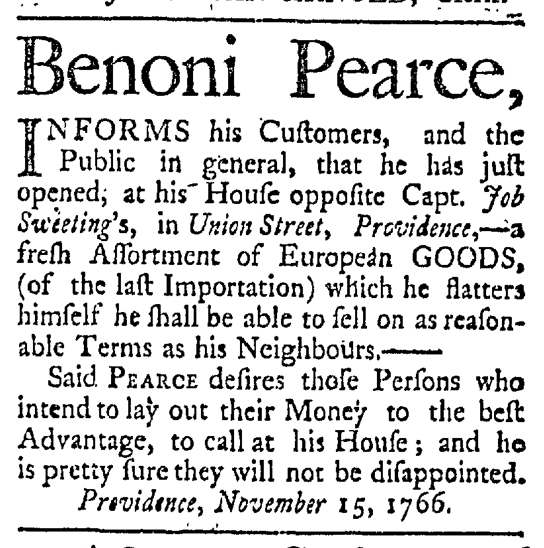
Providence Gazette (November 22, 1766).

“A fresh Assortment of European GOODS, (of the last Importation).”

I chose this advertisement because Benoni Pearce talked about having just received imported goods from Europe that he was ready to sell in the shop he “just opened.” All sorts of “European GOODS” were very popular and valuable among the colonists. Pearce understood that the colonists loved European goods and that they bought them because they wanted to copy the styles popular in London and other parts of England. As David Jaffee explains, “These goods –textiles, furniture, and even table forks – made possible the pursuit of an ideal of refinement.” This was a way for colonists to expand their own culture and share a common consumer identity with people back in England. Pearce did not really list what he was selling; he just said “European GOODS,” expecting he would be able to sell them. He also promised that customers would not be disappointed.

**********

ADDITIONAL COMMENTARY: Carl Robert Keyes

Patrick raises an interesting point about some of the assumptions made by eighteenth-century advertisers. Benoni Pearce did not list any specific merchandise that he stocked. Instead, he offered a general description – “a fresh Assortment of European GOODS, (of the last Importation)” – and trusted that this would entice potential customers.

That’s not to say that this advertisement amounted to nothing more than a mere announcement. Pearce did fold several marketing appeals into his brief commercial notice. He sold his wares “on as reasonable Terms as his Neighbours” to customers who wished to “lay out their Money to the best Advantage.” By noting that his goods were “of the last Importation” he assured potential customers that he was not peddling outdated merchandise that had been pawned off on him by English merchants seeking to clear their warehouses of undesirable goods. Instead, he stock consisted of the latest fashions popular in England and elsewhere in Europe.

Pearce’s advertisement appeared in the same column as the one place by Gideon Young that Patrick examined yesterday. Each was the standard “square” common in many eighteenth-century newspapers, but Young made slightly different decisions about how to fill the space he purchased. He included a short list that named some of his wares before indicated that they were part of a “general assortment of GOODS needless to mention.” Here, again, an advertiser trusted that an appeal to choice and variety, rather than an extensive list of merchandise, was sufficient to attract customers.

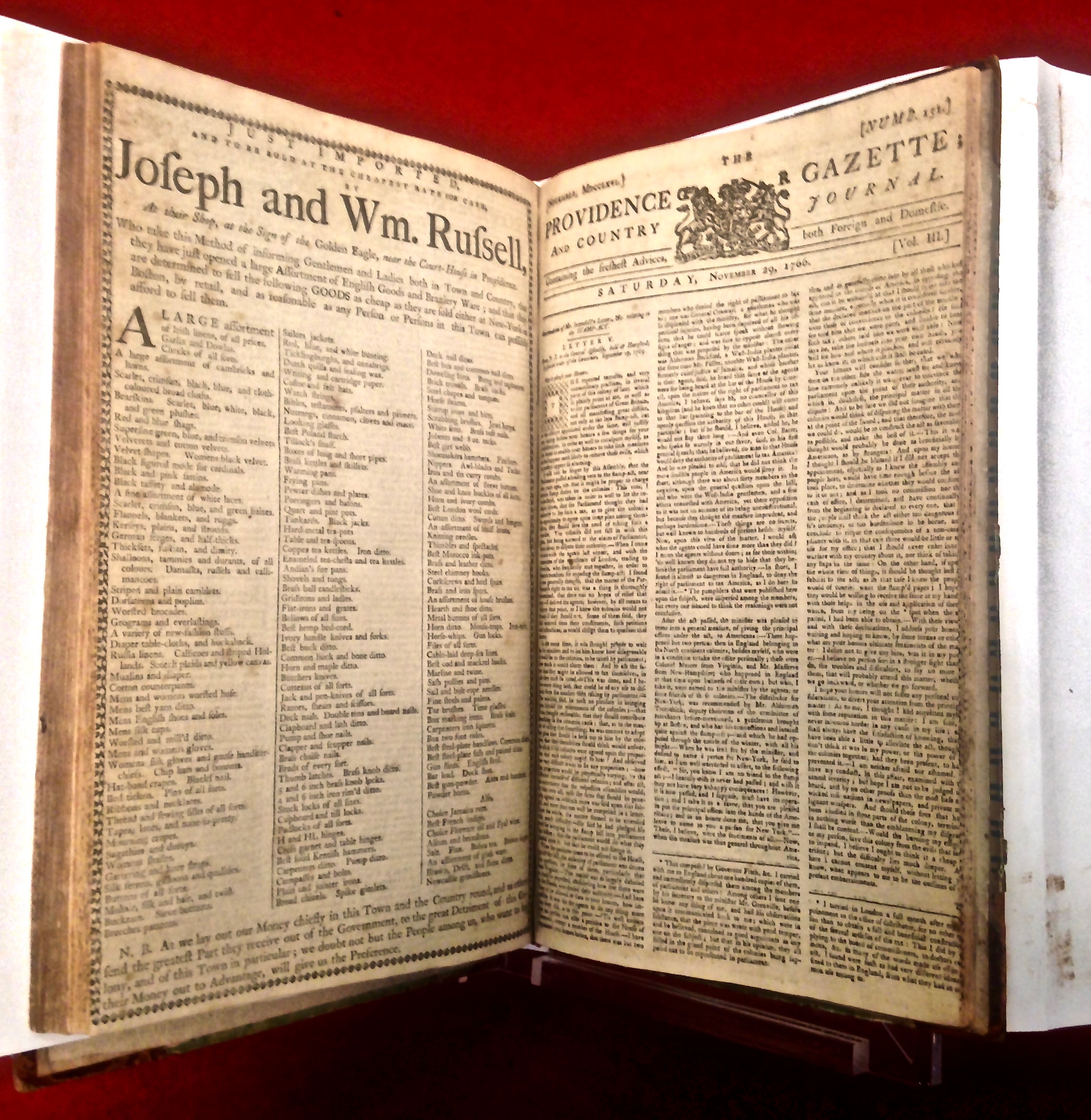
This strategy – no list or a short list contained in a standard advertising square – differed significantly from another advertisement that appeared in the same issue of the Providence Gazette, the first full-page advertisement printed in an American newspaper. Resorting to three columns, Joseph and William Russell listed hundreds of items that comprised their “large Assortment of English Goods and Braziery Ware.”

Benoni Pearce, Gideon Young, and Joseph and William Russell all sought to harness the power of advertising to encourage consumer demand and direct potential customers to their respective shops. In the process, however, they adopted different strategies in writing copy and making graphic design decisions. At a glance, many advertisements from the late colonial era look standard and interchangeable, but even the squares published by Pearce and Young contained noticeable differences when consumers consulted them carefully.
The First Full-Page Advertisement in an American Newspaper

I usually refrain from selecting an additional advertisement to examine on days that my students are serving as guest curators, but I am making an exception in this case because Joseph and William Russell’s advertisement on the final page of the November 22, 1766, issue of the Providence Gazette was just too significant to allow it to pass without acknowledgment. I believe that this is the first full-page advertisement that appeared in an American newspaper!

nov-22-11221766-full-page-providence-gazette
Providence Gazette (November 22, 1766, left; November 29, 1766, right). Courtesy American Antiquarian Society.

For months I have been tracking the innovative layouts designed by Mary Goddard and Company when they began publishing the revived Providence Gazette in the summer of 1766. Between August and November, a trio of advertisers – Thompson and Arnold, Benjamin and Edward Thurber, and Samuel Nightingale, Jr. – placed advertisements that featured decorative borders to set them apart from everything else on the page. Each spanned two columns, dominating the pages on which they appeared. They deviated so significantly from standard eighteenth-century advertisements that they certainly would have attracted the attention of readers. No matter the goods they listed or the appeals the shopkeepers made, these advertisements already caused a visual sensation even before colonists read any of the copy.

Each of these advertisements looked like it could have been printed separately as a trade card that the shopkeepers would have distributed on their own, perhaps recording purchases on the reverse. For the issues of the Providence Gazette in which they appeared, it looked like the oversized advertisements had been positioned in one corner of a page and then the remaining columns built around them.

Given that Mary Goddard and Company were experimenting with size, format, and other graphic design elements on the advertising pages of the Providence Gazette, it probably should not have come as any surprise to find a full-page advertisement occupying the final page of the November 22, 1766, issue. Still, I could not believe my eyes when I saw the digitized image in Readex’s America’s Historical Newspapers database. I needed confirmation, so I visited the American Antiquarian Society and examined the original issue.

nov-22-11221766-full-page-providence-gazette
Providence Gazette (November 22, 1766).

If trade cards had inspired the design of the earlier advertisements, then broadsides must have inspired Joseph and William Russell’s full-page advertisement. Mary Goddard and Company had already played around with mixing genres by placing a trade card within the pages of a newspaper. Making a broadside the entire final page of the newspaper was the logical next step, one that was even more likely to attract notice. Imagine a reader holding up this issue of the Providence Gazette while perusing the pages in the middle. Instead of columns of smaller advertisements typical of other newspapers, observers would have been confronted by a single advertisement larger than any they had preciously encountered in an American newspaper.

I frequently argue that many of the advertising innovations of the twentieth century had precursors in the eighteenth century. Here we see yet another example of eighteenth-century printers and advertisers creating sophisticated marketing materials that have been largely forgotten or overlooked.