March 24

What was advertised in a colonial American newspaper 250 years ago today?
Mar 24 - 3:24:1768 Massachusetts Gazette
Massachusetts Gazette (March 24, 1768).

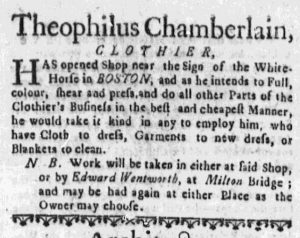
“Work will be taken in either at said Shop, or by Edward Wentworth, at Milton Bridge.”

In the early spring on 1768, Theophilus Chamberlain, a clothier, turned to the public prints to announce that he “HAS opened Shop near the Sign of the White-Horse in BOSTON.” Like many other artisans in the garment trades, he promoted both his skill and his prices, pledging that he did “the Clothier’s Business in the best and cheapest Manner.” Perhaps realizing that this did not sufficiently distinguish him from his competitors, Chamberlain supplemented those appeals by offering prospective customers a choice for dropping off and picking up textiles and garments. In a nota bene, he advised that “Work will be taken in either at said Shop, or by Edward Wentworth, at Milton Bridge; and may be had again at either Place as the Owner may choose.” By extending these options, the clothier marketed convenience to his clients. He acknowledged that his location might be attractive to some, but out of the way for others. In an effort to increase his clientele he made arrangements to serve them at two locations.

The typography of the advertisement highlighted the additional appeal made in the nota bene, placing special emphasis on the convenience that Chamberlain provided that his competitors did not. While the graphic design of the advertisement – indenting the entire nota bene so the additional white space on a page of dense text drew more attention to it – likely drew more eyes, it does not appear that Chamberlain made particular arrangements concerning the format of the advertisement. The advertisement immediately below it also featured a short nota bene and identical decisions concerning the layout.

Chamberlain carefully crafted the copy for his advertisement to entice readers of the Massachusetts Gazette to hire him to dress their textiles and garments, finishing them so as to give a nap, smooth surface, or gloss, depending on the fabric. He underscored price, his skill, and, especially, the convenience of multiple locations. Fortuitously for Chamberlain, the typography of the advertisement amplified the most unique of his appeals. Some of the innovation of his advertisement was intentional, but other aspects that also worked to his benefit seem to have been merely circumstantial since they depended on decisions made by the compositor independently of the advertiser.

February 25

What was advertised in a colonial American newspaper 250 years ago today?

Feb 25 - 2:25:1768 Massachusetts Gazette
Massachusetts Gazette Extraordinary (February 25, 1768).

“Lucerne and Burnett seed, warranted to be of last year’s growth.”

Spring was coming. In late February 1768 colonists in Boston could tell that spring was on its way by looking for certain signs. While watching for changes in the weather and landscape provided clues about the passage of the seasons, colonists also witnessed other indications. The appearance of Susanna Renken’s advertisement in the Massachusetts Gazette testified that spring was indeed on its way. It was the first to promote a variety of seeds that colonists would need to purchase soon so they could plant their gardens.

Renken participated in an annual ritual, one that transformed the pages of newspapers printed in Boston for a few months. She had previously advertised seeds in 1766 and 1767, but she had not been alone. Other women had placed their own advertisements, presenting local customers with many choices for obtaining the seeds they needed. Readers of the newspapers published in Boston knew that in the coming weeks several other female shopkeepers would join Renken, each inserting their own advertisements for seeds. If the past was any indication, they could expect to see these advertisements printed one after the other, sometimes filling entire columns in the Boston Evening-Post, the Boston-Gazette, the Boston Post-Boy, and the Massachusetts Gazette. Renken and her competitors usually inserted their notices in multiple publications.

For now, however, Renken advertised alone. She was the first seed seller to take to the pages of the public prints in 1768, heralding the proliferation of advertisements that would soon appear, bloom for a couple of months, and recede until the next year. Colonists in Boston and its hinterlands observed this annual cycle unfold in their newspapers in the late winter and early spring, just as they saw advertisements for almanacs make their first appearances in the fall, intensify in number and frequency over several months, and taper off after the new year.

Susanna Renken was the first to advertise seeds in 1768, but soon she would not be alone. At the same time colonists noticed certain birds returning to New England as part of their seasonal migration, they also saw advertisements for seeds once again in the pages of their newspapers. The print culture of marketing had its own rhythms that colonists could associate with the changing seasons.

February 21

What was advertised in a colonial American newspaper 250 years ago this week?

Feb 21 - 2:18:1768 Massachusetts Gazette
Massachusetts Gazette (February 18, 1768).

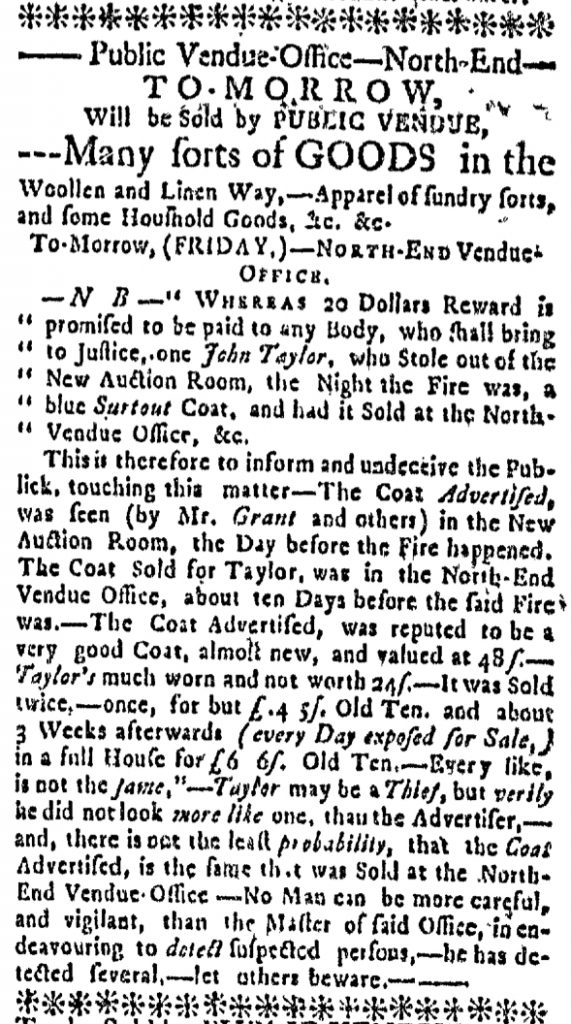
“No Man can be more careful, and vigilant, than the Master of said Office.”

John Gerrish had a bone to pick with Elias Dupee. Gerrish operated the North-End Vendue-Office. Dupee, his rival, ran the New-Auction Room. The two competed for both clients who supplied merchandise and bidders who purchased those wares.

On February 15, 1768, Dupee placed advertisements impugning Gerrish’s reputation in two newspapers, the Boston-Gazette and the Boston Post-Boy. Gerrish was so concerned about the accusations leveled against him that he did not wait a week to respond in the publications that originally ran Dupee’s advertisement. Instead, he published his own rebuttal just three days later in the Massachusetts Gazette. After devoting just a few lines to promoting his upcoming auction, Gerrish addressed Dupee’s allegations at length. Though he never mentioned his rival by name, Gerrish did closely paraphrase a portion of Dupee’s advertisement.

Dupee had offered a reward “to be paid to any Body, who shall bring to Justice, one John Taylor, who Stole out of the New Auction Room, the Night the Fire was, a blue Surtout Coat, and had it Sold at the North-Vendue Office.” Anyone who resided in Boston would have know that John Gerrish was the auctioneer at the North-End Vendue-Office, especially anyone who regularly read any of the local newspapers. Gerrish, like Dupee and Joseph Russell from the Auction-Room in Queen Street, advertised regularly in several newspapers.

In his advertisement, Dupee explicitly accused Taylor of being a thief, but he also implicitly alleged that Gerrish was Taylor’s fence when he stated that the stolen coat had been “Sold at the North-Vendue Office.” Such allegations had the potential to do significant damage to Gerrish’s reputation, scaring away bidders who did not wish to obtain stolen merchandise as well as suppliers who did not want their own names or ware associated with illicit business practices. Gerrish answered Dupee’s charges with a detailed timeline. The “Coat Sold for Taylor” had entered the North-End Vendue-Office ten days before the fire at Dupee’s New Auction Room, therefore it could not have been the same coat stolen the night of the fire. In addition, Gerrish identified discrepancies between the quality and price of the coat auctioned at his establishment and the one stolen from Dupee. Furthermore, the coat had been on display and “every Day exposed for Sale,” suggesting that many witnesses could attest to having seen it at the North-End Vendue-Office. Some of them could confirm the quality and value of that coat.

Feb 21 - 2:15:1768 Boston Post-Boy
Boston Post-Boy (February 15, 1768).

Gerrish acknowledged the possibility that Taylor had stolen a coat from Dupee, but if he had it was not the one that Gerrish auctioned. “Taylor may be a Thief,” he stated, “but verily he did not look more like one, than the Advertiser.” Dupee had attacked Gerrish’s reputation. Gerrish responded in kind. He also underscored, just in case readers had not followed all the complexity of his timeline, that “there is not the least probability, that the Coat Advertised, is the same that was Sold at the North-End Vendue-Office.”

Gerrish concluded with a message for prospective clients and potential bidders. “No Man can be more careful, and vigilant, than the Master of said Office, in endeavouring to detect suspected persons, –he has detected several, –let others beware.” Many colonists participated in the consumer revolution of the eighteenth century via an informal economy that included secondhand and stolen goods. Newspaper advertisements frequently alerted readers about stolen goods. In addition, court records show that theft and fencing regularly occurred. That being the case, Gerrish devoted significant effort to demonstrating that he conducted a legitimate business that did not truck in stolen wares. He needed buyers and sellers, as well as the community more generally, to trust in his character if he wished to continue his business and compete against the rival auction houses in Boston.

February 11

What was advertised in a colonial American newspaper 250 years ago today?

Feb 11 - 2:11:1768 Massacusetts Gazette
Massachusetts Gazette (February 11, 1768).

*** Country Customers may be supplied as well by Letter as if present.”

When his partner passed away, Nicholas Bowes placed an advertisement in the Massachusetts Gazette. In it, he issued an invitation for “all Persons that have Accounts open with said Company to come and settle them.” Yet he also wanted current, former, and prospective customers to know that he continued to sell books and stationery “at the same Shop.” Bowes devoted about half of the space in his advertisement to a nota bene that announced the continuation of the business that he had previously operated with Wharton.

To that end, Bowes advanced several marketing appeals. Like many merchants and shopkeepers, he promised consumers that he offered a variety of choices among his “large and compleat Assortment” of books and stationery. Customers could select items that matched their own needs and tastes. Bowes also sold his wares “at the lowest Rates,” attempting to draw visitors to his shop with competitive prices. In making those appeals, Bowes resorted to two of the most common marketing strategies in eighteenth-century newspaper advertisements. He saved his most innovative appeal for last: “*** Country Customers may be supplied as well by Letter as if present.” He even used distinctive typography – the asterisks and italics – as a visual means of attracting notice to that particular effort to market his merchandise. For the convenience of those who lived outside the busy port and faraway from his shop he made available all of the same benefits enjoyed by his local patrons. In proclaiming that distant customers “may be supplied as well by Letter as if present,” he pledged not to show any preferences or to take advantage of those who submitted their orders through the mail.

Retailers did not invent mail order shopping in the late nineteenth century, despite the proliferation and popularity of catalog shopping during the period. Nor did Bowes pioneer the strategy in the mid eighteenth century … but Bowes did offer a service that was not yet a standard practice promoted to potential customers via advertising. Merchants and shopkeepers sporadically made note that they served customers via the post in their newspaper notices, suggesting that the practice was fairly common even if it had not yet been codified as one of the standard marketing strategies that appeared in print. By inserting it into his advertisement, Bowes confirmed that he did provide this service, expanding his potential market to the hinterlands beyond Boston.

January 31

What was advertised in a colonial American newspaper 250 years ago this week?

Jan 31 - 1:28:1768 Massachusetts Gazette
Massachusetts Gazette (January 28, 1768).

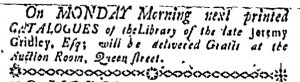
Printed CATALOGUES of the Library of the late Jeremy Gridley, Esq; will be delivered Gratis at the Auction Room.”

In January 1768 auctioneer Joseph Russell deployed multiple media in his efforts to promote a sale devoted to “The LIBRARY of the late Jeremy Gridley, Esq.” He first placed notices in most of the local newspapers, including advertisements that ran in the Massachusetts Gazette on January 21 and in the Boston Evening-Post, the Boston-Gazette, and the Boston Post-Boy on January 25. (He did not place a similar advertisement in the Boston Chronicle. That newspaper had commenced publication only a few months earlier. It featured very few advertisements, an indication that it had not yet attracted significant distribution or readership. Russell may not have considered advertising in that newspaper likely to produce a return on his investment.) Each of these advertisements informed residents of Boston and its environs that Gridley’s library consisting of books on “LAW, HISTORY, DIVINITY, &c.” would be sold “by PUBLIC VENDUE, at the Auction Room in Queen-Street” on the morning of Tuesday, February 2. Notices appeared in multiple newspapers early enough for interested parties to plan to attend the auction.

Russell’s advertisement appeared in the Massachusetts Gazette once again on January 28, but this time a second notice on another page supplemented it. That advertisement announced that “printed CATALOGUES of the Library of the late Jeremy Gridley, Esq; will be delivered Gratis at the Action Room” on the day before the auction. The February 1 editions of the other newspapers that carried Russell’s advertisement each updated Russell’s earlier advertisement with some variation that noted readers could obtain an auction catalog for free. The notice in the Boston Evening-Post, for instance, featured at manicule directing attention to “Printed Catalogues may be had at the Auction-Room, gratis.” Russell used one medium to incite interest not only in the books for sale but also to incite interest in another medium marketing those books.

Newspaper notices and auction catalogs may not have been the only advertising media Russell used to garner attention for an upcoming auction. He may have also distributed handbills or posted broadsides around town. Evidence of the auction catalogs appears in his newspaper advertisements even if none of the catalogs survived, but other ephemeral marketing materials may have simply disappeared after the auction. At the very least, Russell’s original and updated advertisements in four newspapers in combination with his auction catalog suggest a coordinated and extensive effort to attract attention and, ultimately, bidders at the sale of Gridley’s library.

January 21

What was advertised in a colonial American newspaper 250 years ago today?

Jan 21 - 1:21:1768 Massachusetts Gazette
Massachusetts Gazette (January 21, 1768).

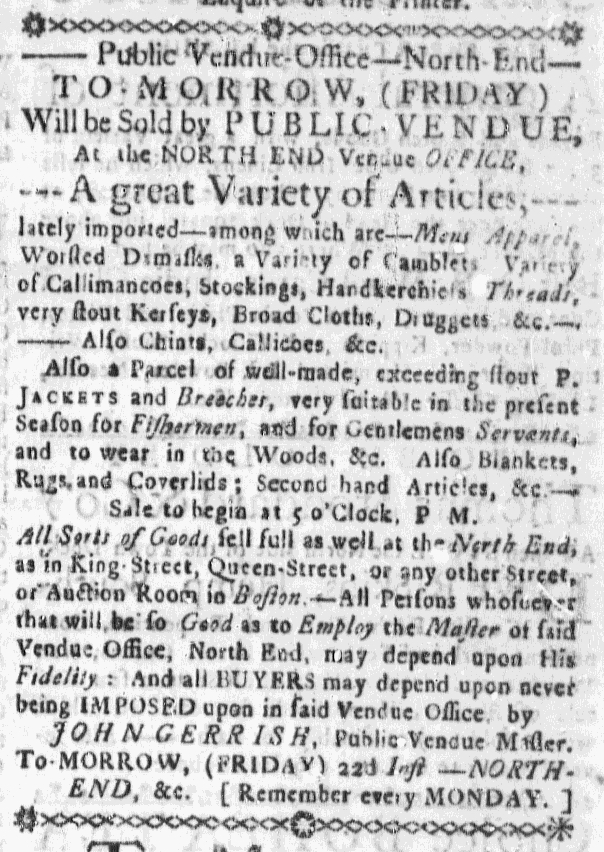
“PUBLIC VENDUE, At the NORTH END Vendue OFFICE.”

Auctioneer John Gerrish inserted advertisements in the Massachusetts Gazette to encourage residents of Boston and its environs to buy and sell at his “Public Vendue-Office” in the North End. His upcoming auctions included “A great Variety of Articles, — lately imported,” including “Mens Apparel,” a “Variety of Callimancoes,” and “a Parcel of well-made, exceeding stout P. JACKETS and Breeches, very suitable in the present Season for Fishermen.” In addition to new merchandise, he also auctioned “Second hand Articles.” This selection matched the inventories listed in advertisements for shops and other auction houses in local newspapers.

To convince both buyers and sellers to do business at his establishment, Gerrish asserted that the experience would compare favorably to commercial transactions conducted elsewhere in the urban port. “All Sorts of Goods sell full as well at the North End,” he proclaimed, “as in King-Street, Queen-Street, or any other Street, or Auction Room in Boston.” In a bustling city, readers had many choices when it came to venues for buying and selling consumer goods. Gerrish did not want them to dismiss the North End out of hand.

The “Public Vendue Master” also underscored that buyers and sellers could depend on fairness when they made their transactions at the “NORTH END Vendue OFFICE.” Realizing that some readers might indeed have preferences for familiar shops and auction houses elsewhere in the city, he strove to bolster his reputation by assuring potential clients and customers that they had nothing to lose if they instead chose his vendue office. Those who decided to “Employ the Master of said Vendue Office” could “depend upon His Fidelity,” trusting that he made every effort to market their merchandise prior to the auction and encourage the highest possible returns during the bidding. Invoking his “Fidelity” also suggested that he kept accurate books and did not attempt to cheat sellers, especially those who could not be present at an auction to witness the bidding. Yet he also served those looking to make purchases, stressing that “all BUYERS may depend upon never being IMPOSED upon in said Vendue Office.” Gerrish pledged not to unduly pressure prospective customers who attended his auctions. Even as he worked as an intermediary who executed exchanges between buyers and sellers, he wanted each to feel as though they ultimately remained in charge of their commercial transactions rather than relinquishing control to potential manipulation on his part.

John Gerrish, Public Vendue Master, did more than merely announce that he conducted auctions in Boston’s North End. He encouraged both buyers and sellers to participate by instilling confidence in the process, promising that he faithfully served them. Colonists had many choices when it came to acquiring and selling consumer goods. Gerrish used his advertisement to assure them that doing business at his auction house was an option well worth their consideration.

January 10

What was advertised in a colonial American newspaper 250 years ago this week?

Jan 10 - 1:7:1768 Massachusetts Gazette
Massachusetts Gazette (January 7, 1768).

“He is determined to sell as cheap as can be bought in any Part of America.”

Frederick William Geyer, a frequent advertiser in Boston’s newspapers in the late 1760s, advanced one of the most common marketing appeals of the eighteenth century: he promoted his low prices. He did not, however, resort to any of the stock phrases or formulaic language often deployed by shopkeepers and merchants in newspaper advertisements throughout the colonies. Instead, he made hyperbolic claims about the bargains prospective customers could expect to encounter upon visiting his shop. Geyer proclaimed that he was “determined to sell as cheap as can be bought in any Part of America, either by Wholesale or Retail.” Some advertisers compared their prices to others in the same city or the same region, but virtually none made such sweeping statements about prices throughout the colonies.

While readers certainly would have been skeptical of such a claim, Geyer won the advantage of forcing consumers to grapple with it. He planted the idea, challenging them to learn his prices and assess them on their own. At the very least, such language set his advertisement apart from others, making it memorable for its bold assertion. It also set the stage for negotiations between buyer and seller. Although Geyer did not promise to match the prices of his competitors, expressing his determination to offer the lowest prices “in any Part of America” suggested his willingness to make a deal in order to satisfy customers that he delivered on his rhetoric.

Eighteenth-century advertisers promoted their prices, not unlike advertisers today. Many relied on standardized language to make the most basic sort of appeal to potential customers, but the language of price was not static. Others, like Geyer, experimented with increasingly audacious descriptions of their prices to overshadow their competition and attract the attention of consumers. Even if readers did not immediately make purchases from Geyer, his advertisement contributed to a reputation that could convince consumers to visit his shop and check out his prices at some point in the future.

December 4

What was advertised in a colonial American newspaper 250 years ago today?

Dec 4 - 12:4:1767 Massachusetts Gazette.jpg
Massachusetts Gazette (December 4, 1767).

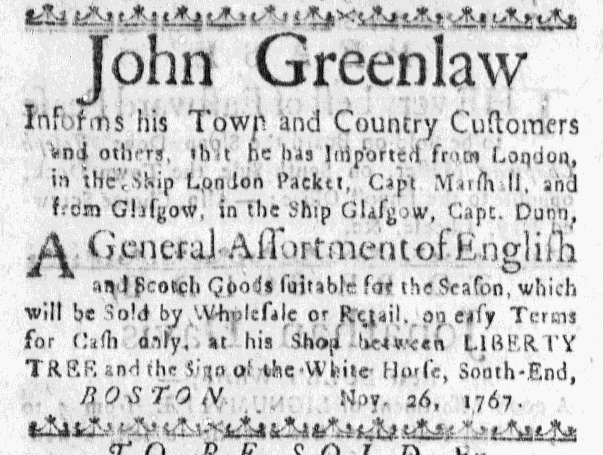
“At his Shop between LIBERTY TREE and the Sign of the White Horse.”

During the era of the American Revolution, advertisers had a variety of means for identifying locations in cities and towns. The largest ports began imposing order on urban environments by assigning standardized street numbers at the very end of the eighteenth century. Until then, colonists relied on a variety of landmarks, shop signs, and other devices for giving directions. In the December 4, 1767, edition of the Massachusetts Gazette and its supplement, for instance, Thomas Hickling invited potential customers to visit “his Shop at the Corner of Black Horse Lane, leading to Charlestown Ferry.” Samuel Hughes sold maritime supplies “At his Store next to Capt. Chever’s in King-Street, BOSTON.” Jonathan Davis indicated that he sold his wares “Near BULL’s Wharf.” Despite the varying levels of specificity, each advertiser assumed he provided enough information for potential customers to find his place of business.

In giving directions to his shop, John Greenlaw not only named local landmarks but also invoked political attitudes expressed widely throughout the colony in recent months. He informed customers that he ran a shop “between LIBERTY TREE and the Sign of the White Horse, South-End, BOSTON.” The Townshend Act went into effect less than a week before Greenlaw first inserted his advertisement in the Massachusetts Gazette in the November 26 issue. In the preceding weeks, all of the Boston newspapers devoted significant coverage to the new duties on imported goods and the local response, including resolutions calling for new non-importation agreements passed at the town meeting at the end of October. Even as he sold “A General Assortment of English and Scotch Goods” imported before the Townshend Act went into effect, Greenlaw associated his business with the Liberty Tree, a symbol of colonial resistance to Parliament.

Colonists like Greenlaw used advertisements to express their political views in the public prints. In the time between the repeal of the Stamp Act and the imposition of the Townshend Act, only John Gore, Jr., consistently incorporated the Liberty Tree into his advertisements. Now that colonists once again experienced Parliamentary overreach, other advertisers in Boston expressed political sentiments by adopting the Liberty Tree as a significant landmark for giving directions to readers. In addition to Greenlaw, another advertiser listed a “handsome Dwelling House” to rent “at the South-End of Boston, near LIBERTY TREE” in the December 4 issue. In an era when advertisers creatively devised a variety of methods for giving directions in print, Greenlaw, Gore, and others could have chosen other landmarks or devices to describe their locations. In selecting the Liberty Tree to include in their advertisements, they communicated more than just where potential customers could find them.

November 26

What was advertised in a colonial American newspaper 250 years ago today?

Nov 26 - 11:26:1767 Massachusetts Gazette
Massachusetts Gazette (November 26, 1767).

“Enquire of the Printer.”

In the late fall of 1767, an anonymous colonist placed a notice in the Massachusetts Gazette announcing that he “WANTED 6 very good Saddle Horses.” Anyone who could provide pacers who met the specifications in the advertisement was requested to “Enquire of the Printer.”

In the November 26 edition, a “Servant Man that will do any Sort of laborious Business in a Family” informed readers that he “WANTS Employ.” He did not provide any additional information about his background or previous experience, but instead stated that “He may be heard of by enquiring at Draper’s Printing Office.”

In the same issue, a slaveholder offered a short description of “A Likely healthy Negro Fellow” who was “TO BE SOLD.” The enslaved man had previously labored as a domestic servant and had cared for a horse, but he was “very capable of learning any other Business.” Anyone interested in acquiring the slave needed to “Enquire ay Draper’s Printing-Office.”

Another colonist sought tenants for “a handsome Dwelling-House … near LIBERTY TREE” in the south end of Boston. The advertisement did not include any other particulars, except for instructions to “Enquire of the Printer” if interested.

Eighteenth-century newspaper advertisements frequently advised readers to “Enquire of the Printer.” As a result, printing offices became places where colonists converged to exchange information, not just locations where printers compiled “the freshest Advices, Foreign and Domestick” (as some mastheads asserted) in newspapers before distributing them to readers near and far. Even as coffeehouses became increasingly popular places to conduct business, printing offices provided an alternate venue. In some instances printers may have done little more than make introductions between advertisers and readers (a service likely provided free of charge to those who purchased advertising space), but that still placed them at the center of networks for exchanging information. Printers served as gatekeepers of information, exercising their own prerogatives in choosing which news, letters, and other items to publish in newspapers as well as withholding certain details relevant to paid notices at the request of advertisers. Their fellow colonists, just like the news, flowed into as well as out of their printing offices.

November 12

What was advertised in a colonial American newspaper 250 years ago today?

Nov 12 - 11:12:1767 Massachusetts Gazette
Massachusetts Gazette (November 12, 1767).

“Joshua Blanchard Going into another Trade, Is selling his GOODS.”

It would have been difficult for readers not to notice Joshua Blanchard’s advertisement in the November 12, 1767, edition of the Massachusetts Gazette. It occupied the entire first column on the first page. In addition, it had a different format than most other advertisements that listed consumer goods. On the left Blanchard listed his inventory; on the right he indicated prices. Approximately fifty entries included specific prices that potential customers could expect to pay at Blanchard’s shop. Throughout the eighteenth century, merchants and shopkeepers rarely inserted prices in their advertisements. When they did, they usually confined themselves to a small number of items. Blanchard, on the other hand, provided an extensive guide to retail prices at his shop on Dock Street.

Why did Blanchard take this extraordinary step? He had previously emphasized the “VERY LOW Price at which he sells” in other advertisements, but had mocked the popular practice of “enumerating every Particular, even to Pins and Needles.” Apparently he changed his mind when he decided to have a going-out-of-business sale. He opened his advertisement by explaining that because he was “Going into another Trade” that he was “selling his GOODS.” He listed specific prices as a means of attracting attention, inciting demand for his merchandise, and demonstrating that he meant business. Prospective customers did not need to worry that Blanchard would lure them into his shop with promises of low prices only to end up haggling over prices similar to those of his competitors. Instead, they knew in advance how much he charged for dozens of items.

Blanchard ceased listing prices about two-thirds of the way through his advertisement, switching to two columns that merely listed other merchandise. Space constraints and the cost of placing a lengthier advertisement may have prevented him from providing prices for every item. Or, he might not have intended to list prices for his entire inventory, preferring instead to use the first items in his advertisement to draw customers into his shop and trusting that they would then encounter other bargains that they could not resist.

Eighteenth-century retailers did not usually use sales as a means of marketing their wares, certainly not to the extent that the practice became standard in the twentieth and twenty-first centuries, but some did experiment with the concept. In effect, Joshua Blanchard advertised a going-out-of-business sale in the fall of 1767.