November 8

What was advertised in a colonial American newspaper 250 years ago this week?
Nov 8 - 11:5:1767 Massachusetts Gazette
Massachusetts Gazette (November 5, 1767).

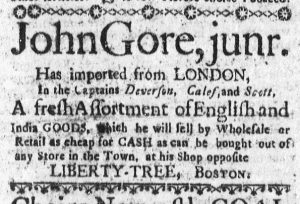
“At his Shop opposite LIBERTY-TREE, BOSTON.”

John Gore, Jr., sold a “fresh assortment of English and India GOODS … at his Shop opposite LIBERTY-TREE” in Boston in the late 1760s. By November 1767, Gore had been referencing the Liberty Tree in his advertisements for more than two years, a practice that he began during the Stamp Act crisis. Other advertisers had used the Liberty Tree as a landmark to direct consumers to their businesses while the Stamp Act was in effect, but Gore was the only shopkeeper in Boston who consistently invoked the Liberty Tree in his commercial notices after Parliament relented and repealed the Stamp Act. Doing so suggested his politics to potential customers. He asserted the appropriate relationship between England and the colonies even as he continued to import and sell English goods.

Making that pitch became more complicated in the fall of 1767. Colonists in Boston accused English merchants of draining the province of hard currency through an imbalance of trade. For several years colonists had imported more from Britain than they exported. Add to that the imposition of new legislation, the Townshend Acts, that assessed new taxes on certain imported goods, set to take effect on November 20, 1767. Residents of Boston determined that they needed to take action. At a town meeting on October 28, 1767, Bostonians pledged “to promote Industry, Oeconomy, and Manufactures, and by this Means prevent the unnecessary Importation of European Commodities, the excessive Use of which threatens the Country with Poverty and Ruin” (according to the report on the first page of the Massachusetts Gazette that carried Gore’s advertisement invoking the Liberty Tree). To that end, Bostonians “VOTED, That this Town will take all prudent and legal Measures to encourage the Produce and Manufactures of this Province.” Furthermore, they promised “that we will encourage the Use and Consumption of all Articles manufactured in any of the British Colonies.” To underscore their resolve, Bostonians voted to institute a new non-importation and non-consumption agreement effective on December 31. The Boston Evening-Post, the Boston-Gazette, and the Boston Post-Boy all carried this news on November 2. Similarly, the Massachusetts Gazette inserted it on November 5. The Boston Post-Boy called special attention to these measures with a rare headline: “Save your MONEY, and you Save your COUNTRY!

Gore found himself in a difficult position. For the past two years he had used his shop’s proximity to the Liberty Tree to identify his business, encouraging patrons to associate his enterprise with resistance to Parliament’s attempts to unjustly tax the colonies. Now, however, his friends and neighbors called for an outright boycott of his imported merchandise. One of his primary appeals to prospective customers, familiar due to its steady repetition in the public prints, suddenly became much less powerful. Would it matter that Gore’s shop was located “opposite LIBERTY-TREE” if he stocked an array of goods imported from London?
November 1

What was advertised in a colonial American newspaper 250 years ago this week?

Nov 1 - 10:29:1767 Massachusetts Gazette
Massachusetts Gazette (October 29, 1767).

“China Ware and Paper, much cheaper than they will come a little while hence.”

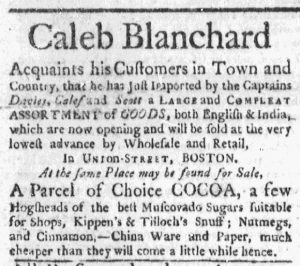
In an advertisement placed in the Massachusetts Gazette at the end of October 1767, Caleb Blanchard “Acquaints his Customers in Town and Country, that he has Just Imported … a LARGE and COMPLEAT ASSORTMENT of GOODS, both English & India” that he sold for low prices at his shop on Union Street in Boston. He also listed several other items that he stocked, including cocoa, sugar, tobacco, nutmegs, and cinnamon. Although he had already announced that he charged “the very lowest advance” for his wares, he concluded with another appeal to price. Blanchard proclaimed that he sold “China Ware and Paper, much cheaper than they will come a little while hence.”

Blanchard implied that the prices of china and paper would soon increase, but he did not explicitly state why he was so certain that customers would soon pay more for those particular items. He did not need to do so. Readers of the Massachusetts Gazette “in Town and Country” already knew that that the Townshend Act was set to go into effect in just three weeks on November 20, 1767. Indeed, residents throughout the colonies were aware of the provisions of the Townshend Act, in large part because newspaper printers from Massachusetts to Georgia had published excerpts of the legislation.

Article I of the Townshend Act assessed duties on dozens of different kinds of imported paper, from twelve shillings “For every ream of paper, usually called or known by the name Atlas Fine” to nine pence “For every ream of paper called Demy Second, made in Great Britain” to ten pence halfpenny “For every single ream of blue paper for sugar bakers.” Article II specified that duties on “all other paper” not specifically mentioned should be calculated on the nearest equivalent. Article III defined how many sheets of paper made a quire and how many quires made a ream.

Articles VII and VIII prohibited drawbacks on “china earthen ware.” In other words, merchants could not expect to receive a refund on any taxes they paid for re-exporting imported china. In the end, this would raise prices for consumers since merchants and shopkeepers would pass along the expense to their customers.

Caleb Blanchard did not name the Townshend Act in his advertisement, but that was not necessary to make his appeal to price resonate with consumers. Readers of the Massachusetts Gazette would have been well aware of the impending duties. They would have made the connection on their own. Blanchard depended on public awareness of politics and imperial economic policy in marketing his wares.

October 18

What was advertised in a colonial American newspaper 250 years ago this week?

Oct 18 - 10:15:1767 Massachusetts Gazette
Massachusetts Gazette (October 15, 1767).

“Desirous of encouraging the Manufactures of the Country.”

During the imperial crisis that led to the American Revolution colonists resisted Parliamentary overreach with several non-importation and non-consumption agreements, each coinciding with particular legislative acts. The first round occurred in response to the Stamp Act, ceasing with the repeal of that hated measure. Colonists once again resorted to non-importation and non-consumption of British goods in response to the Townshend Acts, scheduled to take effect on November 20, 1767.

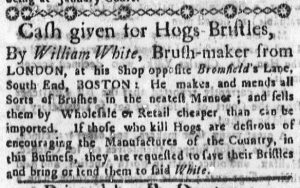
Throughout the last third of the eighteenth century, as colonists moved from resistance to revolution to independence, American advertisers developed marketing appeals that encouraged consumers to “Buy American.” Over time advertisers became much more explicit in their efforts linking consumption to political participation. A notice that appeared in the Massachusetts Gazette five weeks before the Townshend Acts took effect shows an early attempt. William White, a “Brush-maker from LONDON,” did not mention Parliament or the impending legislation, but readers would have made the connection on their own thanks to news items and opinion pieces elsewhere in Boston’s newspapers as well as conversations taking place throughout the city and beyond.

White encouraged potential customers to support domestic production rather than purchase imported wares. He noted that he made and sold brushes “Wholesale or Retail cheaper than can be imported,” prompting consumers to think about the origins of all the goods they acquired, not just the brushes they purchased from him. He also implicitly issued a challenge to retailers to acquire and distribute locally produced goods: presumably those who purchased brushes “Wholesale” did so with the intention of selling them in their own shops.

White framed his comments about the cost of his brushes with a statement even more overtly political. He made an appeal to colonists who were “desirous of encouraging the Manufactures of the Country” rather than continued importation of goods from England. Here he addressed colonists who could supply him with the bristles he needed to make “all Sorts of Brushes.” Not just consumers but producers as well had a duty to support local production over importation. In addition, even though White described his potential suppliers as “desirous of encouraging the Manufacturers of the Country” he implied that consumers should adopt the same attitude and opt to purchase their brushes from him.

William White did not invoke Parliament or the Townshend Acts by name in his advertisement, but contemporary politics still influenced how he structured his appeal to potential customers and how colonists interpreted his advertisement. He did not need to make his case any more explicitly because his advertisement was part of an ongoing conversation – in print and in person – among residents of Boston and throughout the colonies.

October 8

What was advertised in a colonial American newspaper 250 years ago today?

Oct 8 - 10:8:1767 Massachusetts Gazette
Massachusetts Gazette (October 8, 1767).

The Advertisements taking up so much Room, the several Articles intended for this Page are thrown into a SUPPLEMENT.”

This notice appeared at the bottom of the first column on the second page of the October 8, 1767, edition of the Massachusetts Gazette. Richard Draper followed a standard procedure among eighteenth-century printers: when faced with too much content to fit into the allotted space he opted to distribute a two-page supplement along with the regular issue. This happened fairly frequently, especially in major port cities. Higher concentrations of residents meant greater numbers of advertisements to squeeze into each week’s four-page issue, sometimes yielding supplements devoted almost exclusively to advertising. The October 8 supplement, however, consisted primarily of news items as a result of “The Advertisements taking up so much Room” in the regular issue.

Draper and the Massachusetts Gazette did not have a higher number of advertisers than usual. Instead, advertisements placed by two local shopkeepers occupied significant amounts of space. Shopkeeper Jolley Allen continued publication of his lengthy list-style advertisement that filled two entire columns on the final page. Not to be outdone, bookseller John Mein commenced a new full-page advertisement for his “grand Assortment of the most MODERN BOOKS In every Branch of Polite Literature Arts and Sciences,” the one that he intended to launch in the Boston-Gazette three days earlier. That advertisement combined a previous advertisement for “A NEW EDITION of Dilworth’s Spelling Book” (set apart almost as a distinct advertisement in the lower right corner) and descriptions of two other books followed by a list of other books and stationery supplies in stock. The compositor created four narrow columns instead of the usual three slightly wider ones, resulting in a new look for that particular page compared to the rest of the newspaper.

Overall, just two advertisements accounted for nearly half of the October 8 issue of the Massachusetts Gazette, making the supplement practically a necessity. This happened as a result of both the printer and the advertisers experimenting with the format for newspaper notices. Although colonial newspapers published full-page advertisements sporadically in the 1760s, having an issue dominated by only two advertisements would have been an extraordinary event for readers, one that would have garnered even more notice among potential customers for John Mein and Jolley Allen.

August 9

What was advertised in a colonial American newspaper 250 years ago this week?

Aug 9 - 8:6:1767 Massacgusetts Gazette
Massachusetts Gazette (August 6, 1767).

“A Fresh and general Assortment of English Goods.”

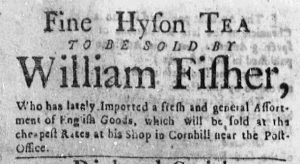
In his short advertisement in the Massachusetts Gazette, William Fisher used “Fine Hyson TEA,” a popular commodity, to attract the attention of readers, but Fisher did not sell just tea “at his Shop in Cornhill near the Post-Office.” Once he had their attention, he informed potential customers that he had also “lately Imported a fresh and general Assortment of English Goods.” To make his merchandise more alluring, he also pledged to charge “the cheapest Rates.” Although brief, especially compared to popular list-style advertisements that enumerated dozens or even hundreds of items, Fisher’s advertisement made several appeals to consumers, including choice, price, and quality.

I chose this advertisement to highlight a recent change in the methodology used for selecting advertisements featured by the Adverts 250 Project. Since the project commenced, every day it has consistently examined an advertisement published 250 years ago that day. When no newspaper had been published on a particular day, the methodology required going back a day to select an advertisement from among newspapers that would have been published most recently in the colonies, a version of consulting the “freshest advices” so often promoted in mastheads of the era. The project resorted to this fairly regularly during the 250th anniversary of the Stamp Act crisis because so many newspapers ceased publication while the act was in effect. After repeal, however, scarcity of newspapers – and advertisements – rarely presented a problem. Colonial printers returned to distributing their weekly publications in the late spring of 1766; that meant that curating the Adverts 250 Project involved working with a much fuller slate of newspapers in the spring of 2016, at least one new publication every day …

… with one exception. No colonial printers distributed newspapers on Sundays. The methodology for selecting advertisements required going back one day. As noted yesterday, the Providence Gazette was the only colonial newspaper distributed on Saturdays in 1766 and 1767. Strict adherence to the project’s methodology meant featuring advertisements from the Providence Gazette two consecutive days every week. Yesterday I celebrated the inclusion of the Providence Gazette in this project. Similarly, the regular inclusion of advertisements from the Georgia Gazette, the only newspaper printed on Wednesdays, has enhanced the project by incorporating yet another newspaper from a smaller city. Yet drawing two out of every seven advertisements from the Providence Gazette seemed to do more than shift the emphasis away from exclusively examining the most significant commercial centers and the advertisements inserted in their more fully developed newspapers. On Mondays and Thursdays, printers in Boston, New York, and Philadelphia issued multiple competing publications, each with a much, much greater array of advertising than appeared in the pages of the Providence Gazette, the Georgia Gazette, and other newspapers from smaller cities and towns. Strict adherence to the project’s methodology meant sometimes passing over important and interesting advertisements.

That prompted an adjustment to the methodology, but only as far as Sundays were concerned. (Keep in mind that Sundays in 1767 correspond to Wednesdays in 2017). The Adverts 250 Project continues to feature an advertisement originally published 250 years ago that day throughout most of the week. However, on the day that no newspapers were published the project now draws from any newspaper published during the previous week. This yields a better representation of advertising from early America. I will continue to consult newspapers from smaller cities regularly, but not at the expense of quite so disproportionately underrepresenting the multitude of publications from Boston, New York, and Philadelphia.

As a result of this modification, William Fisher’s advertisement for “Fine Hyson TEA” and other imported goods found its way into the Adverts 250 Project, displacing a second advertisement from the August 8, 1767, edition of the Providence Gazette. That issue featured only a page and a half of advertising, whereas newspapers from Boston, New York, and Philadelphia usually had at least two pages of advertising and some of them regularly distributed advertising supplements. That being the case, a slight adjustment to the project’s methodology, one that acknowledged its spirit and original intent, seemed appropriate and warranted.

August 6

What was advertised in a colonial American newspaper 250 years ago today?”

Aug 6 - 8:6:1767 Massachusetts Gazette
Massachusetts Gazette (August 6, 1767).

“JACKSON’S Mineral-Well in Boston.”

The proprietor of “JACKSON’S Mineral-Well in Boston” deployed a philanthropic appeal to increase the allure of the spa. In a set of “RULES” published among the advertisements in the August 6, 1767, issue of the Massachusetts Gazette, Jackson first specified the rates for enjoying the waters: one copper for “the Use of the Water” and then another copper for “every Quart Bottle to carry away.” Lest he be seen as withholding access to the therapeutic qualities of the “Mineral-Well” by focusing exclusively on how much revenue it could generate from entry fees paid by middling and affluent colonists, Jackson also proposed a plan that more broadly served the interests of the general public. Should “any Physician in Town” prescribe visiting the spa to impoverished patients, Jackson offered free admission “to any poor Persons” who could produce a certificate verifying their circumstances. These “poor Persons” could enjoy the baths “gratis,” but only after providing sufficient documentation from their doctors. Charity, it seemed, had its limits; Jackson did not want his spa overrun by the lower sorts.

The advertisement also noted that “Rules for the hot, and for the cold Baths, will be fixed up in one of the Rooms.” That Jackson did not specify or elaborate on these additional rules in his notice suggests that he was less interested in informing the public of all the procedures for enjoying the “Mineral-Well” and more concerned with getting out the word that he incorporated humanitarian ventures into his business model. Other eighteenth-century advertisers made similar bids for approval from potential customers and the community in general, including schoolmasters who provided free lessons to less fortunate children. In modern times, corporate philanthropy is a standard public relations practice, but it was not invented after the rise of Madison Avenue. Some eighteenth-century entrepreneurs experimented with promoting their businesses by engaging the needs of the community, demonstrating that they were good citizens and neighbors who merited patronage from consumers.

July 26

What was advertised in a colonial American newspaper 250 years ago this week?

Jul 26 - 7:23:1767 Massachusetts Gazette
Massachusetts Gazette (July 23, 1767).

“A handsome Assortment of Feather Plumes for Ladies Heads.”

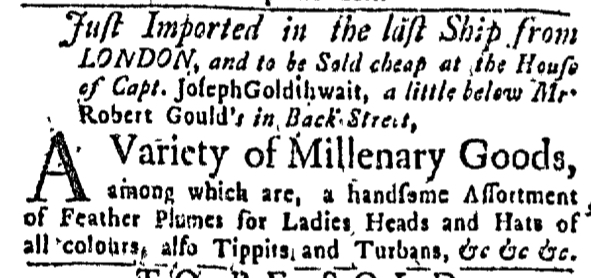
Unlike most advertisements for consumer goods published in eighteenth-century newspapers, this notice for a “Variety of Millenary Goods” did not indicate who sold the “handsome Assortment of Feather Plumes” or “Hats of all colours.” Instead, it simply stated that these items were “Sold cheap at the House of Capt. Joseph Goldthwait.”

Who placed this advertisement and ran a shop out of Goldthwait’s house? It may very well have been a female entrepreneur who did not wish to call widespread attention to her participation in the marketplace as a retailer rather than as a consumer. Women often operated small retail establishments out of their own homes or rooms they rented, especially in urban ports, but they were much less likely to advertise their commercial activities than their male counterparts. Female shopkeepers tended to be disproportionately underrepresented among the advertisements in the public prints.

That did not mean that women did not advertise at all. This advertisement for “Millenary Goods” appeared immediately below Jane Eustis’s own notice for a “Large and beautiful Assortment [of] Silks, Cap Laces,” and other millenary goods. Although she stocked “Mens and Womens silk Hose” and “Mens white silk Gloves,” Eustis promoted mostly textiles and adornments intended for female customers. Like the anonymous advertiser, she concluded by making special note of the “Tippets and Turbans” she sold “for less than the prime Cost.” The type of merchandise hawked by the anonymous advertiser increases the likelihood that a woman placed the notice and operated the shop “at the House of Capt. Joseph Goldthwait.”

This sort of anonymous advertisement was rather rare in colonial America. Certainly newspapers frequently carried notices that advised readers to “enquire of the printer,” but usually those regarded only one or a small number of commodities, not the “Variety” or “handsome Assortment” of imported goods marketed in this advertisement. It even ended with a teaser, “&c &c &c” (the eighteenth-century version of “etc. etc. etc.”), suggesting an even greater array of goods that rivaled what customers would find in the shops kept by Jane Eustis and other advertisers.

Women had a variety of reasons for not calling as much attention to their entrepreneurial activities as their male competitors, including assumptions about their appropriate roles in the household and marketplace. This advertisement may have been designed by a woman eking out a living who hoped to attract female customers yet remain shielded from other readers in colonial Boston.

July 16

What was advertised in a colonial American newspaper 250 years ago today?

Jul 16 - 7:16:1767 Massachusetts Gazette
Massachusetts Gazette (July 16, 1767).

“Just imported and to be Sold by John Mein At the LONDON BOOK-STORE.”

John Mein regularly advertised in the Massachusetts Gazette in 1767. He also advertised in the Boston Evening-Post, the Boston-Gazette, and the Boston Post-Boy. With so many local publications carrying news and advertising to local consumers, he increased the likelihood that potential customers would be exposed to his advertisements.

The length of Mein’s advertisements may have also drawn attention. Shopkeepers frequently placed advertisements that extended half a column or more, but rarely did they exceed a single column. Mein, however, inserted advertisements that overflowed into second and sometimes even third columns. The variable length of his advertisements suggests that he may have submitted extensive sample advertisements to newspaper offices with an understanding that they would include as much as possible but truncate them to fit the space available. In such cases, printers and compositors would have played a role in editing advertising copy even though they were not responsible for generating it.

This particular advertisement may have also drawn attention because it covered almost the entire front page of the July 16 edition of the Massachusetts Gazette, almost squeezing out a notice for a “Variety of Millenary Goods” at the lower right. Its placement may seem strange considering the importance associated with front-page news in the twentieth and twenty-first centuries, but it also demonstrates the evolution in journalism practices and consumption practices. Neither publishers nor readers engaged with newspapers and their content in quite the same way in the eighteenth century that they have in time since then.

Early Americans expected (or at least would not have been surprised) to encounter major news stories nestled within the inner pages of any given issue. Taking into consideration the production of the July 16 edition helps to demonstrate what that was the case. A four-page issue, it resulted from printing two pages on each side of a broadsheet and then folding it in half. The first and fourth pages, comprised entirely of the masthead and advertisements the printer received well in advance (and most of them already set in type for previous issues), were printed first. Only after they dried were the second and third pages printed on the other side. In this case, those pages included the news content for the issue, including items dated the date before and the day of publication.

To modern eyes, John Mein’s (nearly) full-page advertisement on the front page of a newspaper may seem extraordinary. Its lengthy certainly merited notice in the eighteenth-century, but contemporary readers may not have been especially surprised by its placement. That it appeared on the front page just would not have resonated as being all that significant for readers accustomed to seeing advertising, rather than news, immediately under the masthead.

July 12

What was advertised in a colonial American newspaper 250 years ago this week?

Jul 12 - 7:9:1767 Massachusetts Gazette
Massachusetts Gazette (July 9, 1767).

“Ready for Sale, BY Jolley Allen.”

Regular readers of the Massachusetts Gazette may have been surprised when they glimpsed this notice for Jolley Allen’s “Shop about Midway between the Governor’s and the Town-House, and almost Opposite the Heart and Crown in Cornhill, BOSTON.” Allen regularly advertised in the Massachusetts Gazette. He also regularly advertised in the city’s other three newspapers, so the advertisements itself would not have caused surprise. No, that would have resulted from the design of the advertisement. It did not feature a border comprised of printing ornaments, a distinctive aspect of Allen’s advertising that had practically become his trademark in all of his notices, regardless of which newspaper published them. Allen had developed a consistent visual appearance for his advertisements, making them instantly recognizable. This advertisement, however, looked like so many others on the page. It lacked the most significant element that previously set Allen’s notices apart from others.

Perhaps the printer made an error. Perhaps a new compositor now worked in the shop and set the type without realizing that Jolley’s advertisement was supposed to have a decorative border. After all, the shopkeeper seems to have consistently negotiated with the printers of all four of Boston’s newspapers to include that adornment. Perhaps he forgot to underscore this request when he submitted the copy for this advertisement.

Yet later in the week, the Boston Evening-Post, the Boston-Gazette, and the Boston Post-Boy all carried Allen’s newest advertisement. None of them enclosed his list of “English and India Goods” within any sort of border. While it was possible that one printing office overlooked this particular request, it seems unlikely that all four made the same mistake. Apparently Allen had not renewed his instructions concerning the graphic design of his advertisement. Why did he abandon a practice that made his advertisements so easily identifiable to readers and potential customers? Why did he eliminate the most innovative aspect of his advertising?   Even as eighteenth-century advertisers experimented with early forms of branding, they did not consistently adopt new methods, not realizing the value of cementing unique images of their business endeavors in the minds of consumers.

June 18

What was advertised in a colonial American newspaper 250 years ago today?

Jun 18 - 6:18:1767 Massachusetts Gazette.jpg
Massachusetts Gazette (June 18, 1767).

“At the Sign of the Two Wheat-Sheaves.”

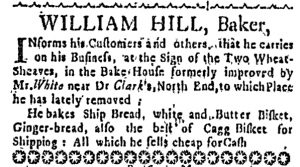
According to his advertisement in the Massachusetts Gazette, William Hill, a baker in Boston, made and sold “Ship Bread,” biscuits, and gingerbread at “the Bake House” appropriately marked with “the Sign of the Two Wheat-Sheaves.” In an era before standardized street numbers organized the streets of towns and cities, shop signs helped both entrepreneurs and customers identify and locate businesses of all sorts. Some shopkeepers and artisans also used the devices depicted on their signs as rudimentary brands, sometimes adopting similar visual images in newspaper advertisements as well as on magazine wrappers, trade cards, and billheads.

Not every advertiser had his or her own shop sign, but that did not prevent them from using the signs of others who ran businesses nearby as landmarks to guide potential customers to their own shops. In the same issue that Hill promoted the breads he sold “at the Sign of the Two Wheat-Sheaves,” Nathaniel Cudworth reported that he kept shop “in KING-STREET, opposite the Sign of Admiral Vernon.” Similarly, Joseph Domett gave the location of his store as “nearly opposite the GOLDEN BALL.” That Domett gave no other directions, not even a street name, suggests the Golden Ball was widely recognized by residents of Boston. The shopkeeper expected potential customers to already be familiar with that landmark, a common point of reference for advertiser and reader alike.

Even without woodcuts depicting the Sign of the Two Wheat-Sheaves, the Golden Ball, or the Sign of Admiral Vernon, the advertisements reveal some of the visual culture of eighteenth-century streets. Advertisements in the Massachusetts Gazette and other newspapers published in Boston named dozens of signs present in the city in 1767, a vibrant display that served several purposes but now can only be imagined. Sighting various signs aided colonists as they navigated through cities. Signs also enticed colonists to become customers as they encountered them because marketing efforts encouraged consumers to associate certain signs with particular businesses and the men and women who ran them.