September 22

What was advertised in a revolutionary American newspaper 250 years ago this week?
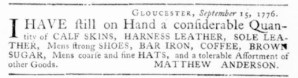
Virginia Gazette [Dixon and Hunter] (September 21, 1776).

“I HAVE still on Hand a considerable Quantity of CALF SKINS … and a tolerable Assortment of other Goods.”

Matthew Anderson ran a lengthy advertisement about merchandise available at his store in Gloucester, Virginia, in John Dixon and William Hunter’s Virginia Gazette in August and September 1776.  He listed dozens of items, enumerating an extensive array of textiles, housewares, hardware, and even books, noting at the conclusion that he also stocked “some other Trifles, too tedious to mention.”  Despite the disruptions caused by the war, consumers could still acquire certain necessities at Anderson’s shop or participate in some retail therapy to distract them for a moment.

By the end of September, Anderson ran a new advertisement, a much shorter one.  He used it to inform prospective customers that he “still [had] on Hand a considerable Quantity of CALF SKINS, HARNESS LEATHER, SOLE LEATHER, Mens strong SHOES, BAR IRON, COFFEE, BROWN SUGAR, [and] Mens coarse and fine HATS.”  In addition, his inventory included “a tolerable Assortment of other Goods.”  He did not replicate the catalog from his previous advertisement, nor did he use the same effusive language about having so many goods that they were “too tedious to mention.”  He also did not mention any of the books, such as “Watts’s Hymns and Psalms” and “Observations on Civil Liberty,” that he highlighted in his previous advertisement.  Perhaps he did not wish to make a significant investment in the new notice, so he reduced the length.  In addition, the changes may have indicated the effectiveness of his first advertisement and a considerable reduction in his inventory, yet he still had plenty of merchandise – that “tolerable Assortment of other Goods” – to delight shoppers when they visited his store.  Anderson may have assumed that many prospective customers who read his new advertisement would have also seen his previous one, making it unnecessary to do more than publish a reminder that mentioned some of the most popular items.  That he inserted a second advertisement suggests that he believed the first one worked.

September 8

What was advertised in a revolutionary American newspaper 250 years ago this week?

Virginia Gazette [Dixon and Hunter] (September 7, 1776).

“Thread Laces, Shoe Thread, Observations on Civil Liberty.”

Matthew Anderson operated a store in Gloucester, Virginia, at the time that the Continental Congress declared independence.  He placed an advertisement in the September 7, 1776, edition of John Dixon and William Hunter’s Virginia Gazette, an advertisement that looked much like those that appeared before the imperial crisis and the Revolutionary War.  The lengthy list of goods he stocked testified to participation in the transatlantic consumer revolution.  Anderson sold everything from “Women’s Worsted Hose” and “Velvet Hoods” to “Thread Laces” and “common Sleeve Buttons” to “Desk and Cupboard Locks” and “Awl Blades” to “Punch Ladles” and “Queen’s China Dishes.”  If that was not enough to excite the imaginations of prospective customers, he also had “some other Trifles, too tedious to mention.”

Among the dozens of items that Anderson did mention, he listed some books.  He had a selection of “Psalters” and “Histories” that he did not name as well the popular “Watts’s Hymns and Psalms.”  He also stocked two books that resonated with current events.  Both had been widely advertised in other newspapers.  One was a work of political philosophy, Richard Price’s Observations on the Nature of Civil Liberty, the Principles of Government, and the Justice and Policy of the War in America.  Anderson shortened the title to “Observations on Civil Liberty.”  He may have sold an American edition published in Charleston, Philadelphia, New York, or Boston.  He also advertised “British Tyranny, or American Liberty triumphant,” a play that had also been printed and promoted in several cities and towns.  Most shopkeepers did not usually advertise such titles.  They tended to stick with almanacs and psalters, items with broad appeal that they had confidence customers would purchase, or popular devotional literature, like Watts’s hymns and psalms.  That Anderson included two books related to current events among his inventory (instead of relegating them “other Trifles, too tedious to mention”) may have been a way of signaling his political sentiments.  If so, that could have been an attempt to gain the approval of prospective customers who supported the American cause without taking a position that alienated other prospective customers who did not.  Anderson stocked the books, but he did not outright endorse their contents.  That allowed for flexibility in how he related to consumers who held a variety of views.