February 8

GUEST CURATOR:  Emma Guthrie

What was advertised in a revolutionary American newspaper 250 years ago today?
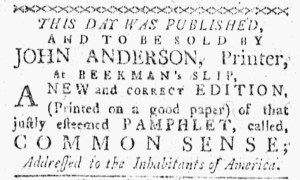
New-York Journal (February 8, 1776).

“A NEW and CORRECT EDITION, (Printed on a good paper) of … COMMON SENSE.”

This advertisement for “COMMON SENSE” promoted a pamphlet written by Thomas Paine.  In one of the most important documents in American history, Paine argued for the independence of the colonies from Great Britain.  John Anderson, a printer in New York, published this edition of Common Sense.  He noted that his edition was “Printed on a good paper.”

Due to the nonimportation agreements of the 1760s and 1770s, “the residual of imported paper was nearly exhausted” when the Revolutionary War began in 1775.[1]  Paper used in printing pamphlets and newspapers had been an incredibly common import.  However, due to the nonimportation agreements, paper became a scarce commodity.  According to Eugenie Andruss Leonard in “Paper as a Critical Commodity during the American Revolution,” the domestic manufacture of paper was not sufficient and could not keep up with the demand for the product.[2] Anderson attempted to make his “NEW and CORRECT EDITION” of Common Sense stand out by stating that it was printed on “good paper,” enticing readers to purchase his pamphlet without having to worry about the quality of the printing and, especially, the paper.

**********

ADDITIONAL COMMENTARY:  Carl Robert Keyes

I was excited when Emma selected Anderson’s advertisement for his edition of Common Sense to feature on the Adverts 250 Project.  I encouraged students enrolled in my capstone research seminar in Fall 2025 to peruse previous entries in the project, but I did not discuss with them which advertisements I planned to feature in the coming months. When Emma chose this advertisement, she did not know that I would craft a series of entries about the marketing of Common Sense in the winter and spring of 1775.

Emma could have selected any one of three advertisements for Common Sense that appeared in the February 8, 1776, edition of the New-York Journal.  William Green inserted a version of the advertisement he originally placed in the January 22 edition of the New-York Gazette and Weekly Mercury.  Green stocked and sold Robert Bell’s unauthorized “Second Edition,” having previously advertised Bell’s first edition.  Another advertisement encouraged readers to reserve copies of a “NEW EDITION (with LARGE and INTERESTING ADDITIONS …)” that Paine did authorize and entrusted to William Bradford and Thomas Bradford to print.  Much of it replicated the advertisement that ran in the January 25 edition of the Pennsylvania Evening Post, including an address “To the PUBLIC” that explained that “the Publisher of the first edition” printed a second edition without the permission of the author.  That edition would not include the new material that Paine arranged for the Bradfords to feature in their edition.  The advertisement in the Pennsylvania Evening Post also noted, “A German edition is likewise in the press,” acknowledging the significant population of German settlers in Pennsylvania and the backcountry.  The version in the New-York Journal, however, changed that note to “A Dutch Edition is likewise in the Press” for the benefit of those families who continued to speak Dutch a little more than a century after the English conquest of New Netherland.

Anderson’s advertisement confirmed what he advertised in his own Constitutional Gazette the previous day: publication of a “NEW and CORRECT EDITION” of Common Sense.  It was the first edition published outside Philadelphia.  Given that the Bradfords’ edition was still “In the PRESS,” Anderson published a local edition of Bell’s edition.  Describing it as “NEW” meant that it was a local edition and describing it as “CORRECT” indicated that Anderson had faithfully reproduced the contents of the original pamphlet.  Emma focused on another important aspect of Anderson’s advertisement.  All the previous advertisements for Common Sense focused on the contents (especially those that listed the section headings) or the dispute between Bell and Paine and which edition readers should consider the superior one.  Anderson was the first to focus on a material aspect of the pamphlet, assuring prospective customers that he used “good paper” when printing his local edition.  The quality of the finished product rivaled any of the pamphlets shipped to New York from Philadelphia.

**********

[1] Eugenie Andruss Leonard, “Paper as a Critical Commodity during the American Revolution,” Pennsylvania Magazine of History and Biography 74, no. 4 (October 195): 488.

[2] Larsen, “Paper as a Critical Commodity,” 488.

January 28

What was advertised in a revolutionary American newspaper 250 years ago this week?

Virginia Gazette [Dixon and Hunter] (January 27, 1776).

“I cannot publish such Advertisements as ought to have appeared this Week.”

John Pinkney should have printed and distributed an edition of his weekly newspaper, the Virginia Gazette, on January 27, 1776, but he did not.  Instead, he placed a notice in the newspaper printed by John Dixon and William Hunter, also named the Virginia Gazette.  “AFTER having received so many Instances of public Favour,” he explained, “I should think myself inexcusable did I not make known the Reason why I do not this Week publish a Gazette.”  It turned out that he experienced the same disruption in his supply of paper that many other printers faced during the first year of the Revolutionary War.  He did not publish a new issue “owing to a Disappointment in receiving Paper from the Northward.”  In their own notice on the next page, Dixon and Hunter confirmed that “a stock of printing-paper … at this time is very scarce” and acquiring it involved “an infinite deal of trouble and expence in transporting it from Pennsylvania.”  Pinkney claimed that “no human Prudence could have prevented” the situation.

He also informed readers that “Next Week … or in a short Time, I expect a very considerable Quantity” and when it arrived he would “endeavour to make up for all Deficiencies.”  Through “unwearied Diligence,” he would continue to collate and disseminate items of “instructive Amusement” and “every Piece of authentic Intelligence.”  He concluded with an acknowledgement for advertisers: “It gives me the greatest Uneasiness that I cannot publish such Advertisements as ought to have appeared this Week, but as far as a Restitution of Money can atone for the Disappointment, it shall be made.”  Advertising was an important revenue stream for most printers who published newspapers.  This “Restitution of Money” put Pinkney in an even more precarious position, especially since Dixon and Hunter indicated that paper “cannot be had without cash.”  Pinkney could not purchase paper on credit.  He managed to get his hands on enough paper to print a new issue on February 3, as promised in his notice, but most likely did not continue printing for long after that.  The February 3 edition is the last known.  Disruptions in Pinkney’s supply of paper likely played a significant role in his Virginia Gazette folding.

January 12

What was advertised in a revolutionary American newspaper 250 years ago today?

Connecticut Gazette (January 12, 1776).

(Advertisements omitted will be in our next.)

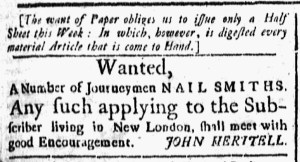
Instead of the usual four pages, the January 12, 1776, edition of the Connecticut Gazette consisted of only two pages.  Most issues of colonial newspapers had four pages, created by printing two pages on each side of a broadsheet and folding it in half.  Timothy Green, the printer of the Connecticut Gazette, had only enough paper that he was forced to condense the contents to a half sheet, one page printed on each side.  He certainly was not the only printer to experience a disruption in his paper supply during the first year of the Revolutionary War.

Green acknowledged the situation with a note that appeared at the top of the first column on the first page: “[The want of Paper obliges us to issue only a Half Sheet this Week: In which, however, is digested every material Article that is come to Hand.]”  In other words, subscribers and other readers did not need to worry that they missed important news because Green did not have enough space to print it.  Instead, he carefully undertook his duties as an editor to include everything of importance received in the printing office since the previous week’s issue of the Connecticut Gazette.  The small font for news items, smaller than the font used for advertisements, also allowed Green to squeeze a significant amount of content into just two pages.

Connecticut Gazette (January 12, 1776).

What about the advertisements?  Only three paid notices appeared in that issue, one for “Journeyman NAIL SMITHS” immediately below the printer’s note on the first page and two more at the bottom of the final column on the second page.  The printer concluded the issue with a brief note: “(Advertisements omitted will be in our next.)”  Green assured advertisers, especially those who paid in advance of publication, that the Connecticut Gazette would indeed disseminate their notices.  In this instance, however, he prioritized the needs of subscribers (many of whom did not make timely payments) and other readers (who did not pay the printer at all) over advertisers (who comprised an important revenue stream).  It was a careful balancing act for all colonial printers as they served multiple constituencies simultaneously.  For this issue, Green considered keeping subscribers and the rest of the public informed about “The King’s SPEECH, to both Houses of Parliament, October 26, 1775,” and news from London, Philadelphia, New York, Newport, Worcester, and Watertown (where the Continental Army continued the siege of Boston) more important than publishing many of the advertisements submitted to his printing office.

October 20

What was advertised in a revolutionary American newspaper 250 years ago today?

Essex Journal (October 20, 1775).

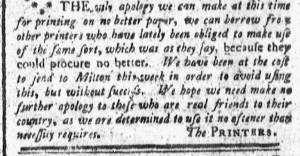
We hope we need make no further apology to those who are real friends to their country.”

John Mycall and Henry-Walter Tinges, the printers of the Essex Journal, found themselves in a situation similar to the one that Daniel Fowle, the printer of the New-Hampshire Gazette, experienced in the fall of 1775.  A disruption in Fowle’s supply of paper in Portsmouth had forced him to print his newspaper on smaller sheets on a few occasions, including the October 17 edition.  Three days later, Mycall and Tinges did the same in Newburyport.  Instead of four pages of three columns each, that issue had four pages of two columns each.  The masthead featured plain type for the title rather than presenting “Essex Journal” in the usual scrolling script.  The woodcuts that usually flanked the title, an Indigenous man with a bow and arrow on the left and a packet ship at sea on the right, did not appear at all.

Immediately above the advertisements, the printers inserted their own notice to explain what happened.  “THE only apology we can make at this time for printing on no better paper,” Mycall and Tinges stated, “we can borrow from other printers who have lately been obliged to make use of the same sort, which was as they say, because they could procure no better.”  They closely paraphrased portions of Fowle’s notice to his readers a couple of weeks earlier: “The only Apology the Publisher can make for this Day’s Paper, is that he could not procure any other.”  Mycall and Tinges printed their newspaper on different paper only as a last resort.  “We have been at the cost to send [an order for more paper] to Milton this week in order to avoid using this,” they informed readers, “but without success.”  With the disruptions and displacements that occurred in the six months since the battles at Lexington and Concord, securing paper became difficult.  The printers tried to get more from the paper mill on the Neponset River in Milton, but to no avail.  They expected their readers to understand, especially those who held the right sort of political principles.  “We hope we need make no further apology to those who are real friends to their country,” Mycall and Tinges proclaimed, “as we are determined to us [the substitute paper] no oftener than necessity requires.”  They hoped that readers would see the smaller newspaper as a minor inconvenience given the stakes of the contest between the colonies and Great Britain.  They did their best with the resources available to continue to disseminate news and advertising to their subscribers and other readers.

October 17

Who was the subject of an advertisement in a revolutionary American newspaper 250 years ago today?

New-Hampshire Gazette (October 17, 1775).

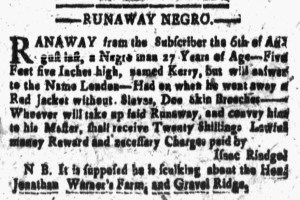
“RUNAWAY NEGRO … named Kerry, but will answer to the Name London.”

During the first year of the Revolutionary War, Daniel Fowle, the printer of the New-Hampshire Gazette, sometimes experienced disruptions to his paper supply that forced him to resort to broadsheets of alternate sizes.  His newspaper carried less content, both news and advertising, on such occasions.  That was the case on October 3, 1775, when he inserted an “Apology” that stated that “he could not procure any other” paper.  Compared to the usual three columns on each of four pages, that issue had only two columns on each of two pages.  Fowle did not include any advertisements.

The following week, Fowle managed to acquire broadsheets of the usual size, but apparently not enough of them for a four-page issue.  Instead, he published a half sheet edition that had three columns on each of two pages.  He found room for advertisements and even a poem, “On LIBERTY.”  On October 17, however, the New-Hampshire Gazette returned to the smaller sheet from two weeks earlier, but he had enough to publish four pages instead of two.  With twice as much space compared to the October 3 edition, he had room for five advertisements, including one by Mrs. Hooper, a milliner, and another for John Williams’s “House of Entertainment … at the Sign of the SALUTATION.”

Another advertisement featured a headline that proclaimed, “RUNAWAY NEGRO.”  Isaac Rindgel described a “Negro man 27 Years of Age … named Kerry, [who] will answer to the Name London.”  Kerry liberated himself by escaping from his enslaver on August 6.  For two and a half months he managed to elude capture, though Rindgel suspected that Kerry “is sculking about Hon. Jonathan Warner’s Farm, and Gravel Ridge.”  He did not indicate why he thought Kerry might be in that area.  Perhaps Kerry had a wife, a parent, a sibling, or a friend at Warner’s farm.  The advertisement, composed by an enslaver seeking to recover his human property, did not include the details about Kerry’s life and experiences that mattered most to the fugitive seeking freedom.  In addition to not explaining why Kerry may have been in the proximity of Warner’s farm, Rindgel did not speculate on why the enslaved man departed when he did.  Kerry was likely aware of the disruptions caused by the battles at Lexington and Concord in April, the ensuing siege of Boston, and the Battle of Bunker Hill in June.  The same events that affected Fowle’s access to paper created an opportunity for Kerry to liberate himself by running away.  It is impossible to know for certain that was the case since the newspaper advertisement reflected his enslaver’s perspective and included only the details Rindgel chose.  Kerry certainly would have told a different and more complete story had he been given the opportunity.

October 3

What was advertised in a revolutionary American newspaper 250 years ago today?

New-Hampshire Gazette (October 3, 1775).

“Brown Bread with Liberty, will please more, than white with Slavery.”

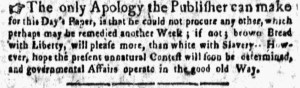
No advertisements appeared in the October 3, 1775, edition of the New-Hampshire Gazette, though the printer, Daniel Fowle, inserted a notice addressing why that was the case.  “The only Apology the Publisher can make for this Day’s Paper,” he stated, is that he could not procure any other.”  He referred to the size of the broadsheet.  The newspaper usually consisted of four pages with three columns on each page, but since hostilities commenced at Lexington and Concord Fowle’s paper supply had been disrupted.  Many issues consisted of only two pages, including the one from the previous week.  Despite having fewer pages, the masthead for the September 26 edition featured an additional note that proudly exclaimed, “This Paper compleats the 19th Year of the New-Hampshire GAZETTE, AND HISTORICAL CHRONICLE.”  The newspaper began its twentieth year with a two-page edition that had only two columns on each page.  Given the limited space, Fowle published news and excluded advertisements.

Fowle hoped that the problem “may be remedied another Week,” but “if not; brown Bread with Liberty, will please more, than white with Slavery.”  Like many other printers, he had been a consistent supporter of the American cause.  Even so, he added his “hope [that] the present unnatural Contest will soon be determine, and governmental Affairs operate in the good old Way.”  In the fall of 1775, most colonizers still sought a redress of grievances from Parliament.  Within a year, however, the Continental Congress would declare independence and the war that started at Lexington and Concord would not end until 1783.  Those “governmental Affairs” would never again “operate in the good old Way.”  Fowle did, however, manage to acquire paper for the next issue of the New-Hampshire Gazette.  The October 10 edition once again had advertisements, including one from Mrs. Hooper, a milliner, and another insertion of John Williams’s invitation to his “House of Entertainment … at the Sign of the SALUTATION.”  It was not the last time, however, that Fowle would experience a disruption in his paper supply during the war.

October 5

What was advertised in a colonial American newspaper 250 years ago today?

South-Carolina and American General Gazette (October 5, 1772).

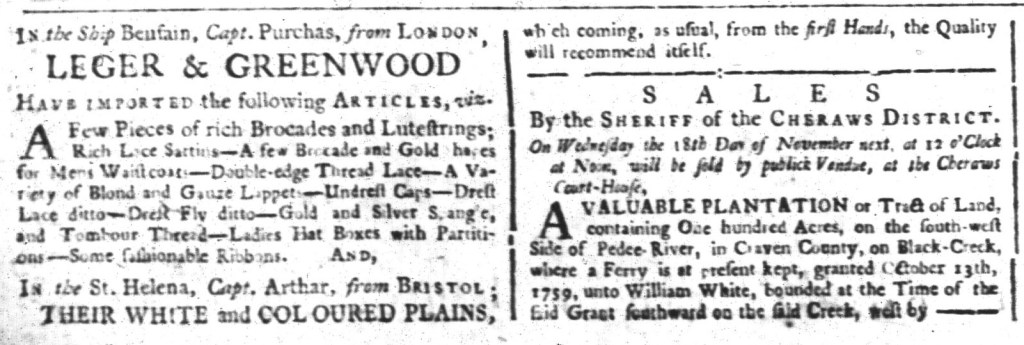
“THEIR WHITE and COLOURED PLAINS, which coming, as usual, from the first Hands, the quality will recommend itself.”

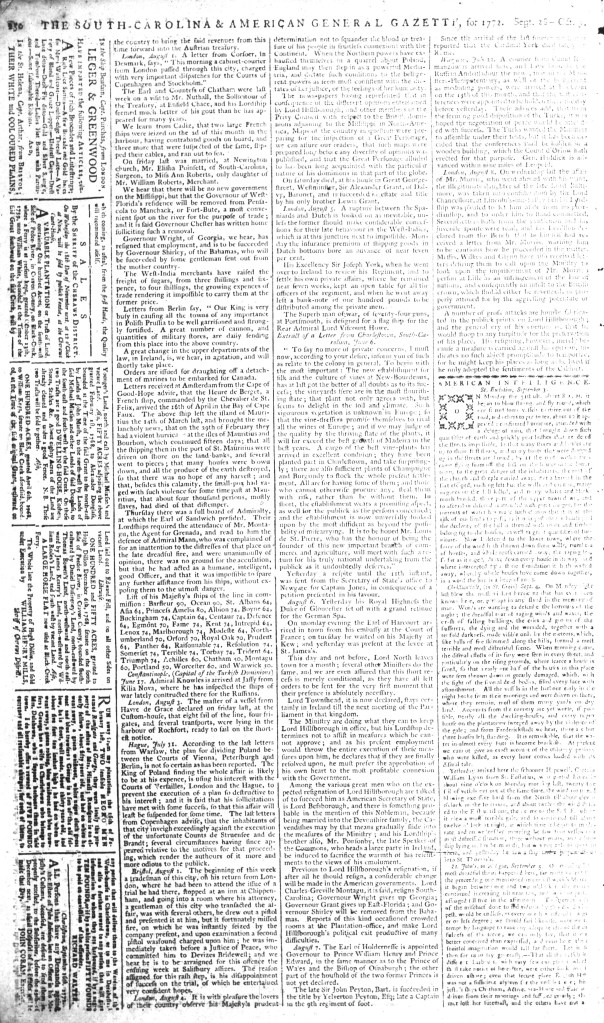
Robert Wells, the printer of the South-Carolina and American General Gazette, may have experienced a disruption in his paper supply in October 1772.  That would explain the unusual format of the October 5 edition.  The newspaper usually featured four columns per page.  The October 5 edition did indeed have four columns on each page, but one of those columns was narrower than the other three.  In order to reuse advertisements with type already set, Wells rotated the text ninety degrees to fill the fourth column with six short columns that ran perpendicular to the rest of the text.  In the past, he had sometimes adopted this strategy when forced to use paper of a different size than usual.  Wells usually selected short advertisements and left them intact.  In contrast, this time he used advertisements that overflowed from one column to another in the October 5 edition.

Whether Wells was forced to do so remains a mystery, due in part to working with digitized images of the newspaper rather than original documents.  Digitized images do not have any particular dimensions.  They fit the size of the screen of the viewer.  They can be magnified to see details betters.  They do not have a fixed size the reader can measure.  As a result, I cannot measure pages of the September 28 and October 5 editions to compare them.  An inspection of one visual aspect further suggests that Wells used a slightly smaller sheet on October 5.  There does not appear to be as much space between the title of the newspaper and the page number running across the top on pages from October 5 compared to pages from September 28.

Those page numbers introduce another uncertainty into figuring out why Wells might have decided to distribute an edition with an unusual format.  The September 28 edition concluded with page 244.  The available pages for the October 5 edition commence with page 249.  It does not have the standard masthead.  This was not a numbering error. Page 249 includes “EUROPEAN INTELLIGENCE. (Continued from Page 246.)”  The four pages with a narrow column of perpendicular text were likely an insert that accompanied the standard issue for the week.  Did Wells use the usual size sheet for the standard issue and then a slightly smaller size for the insert?  Printers sometimes did so with significantly smaller sheets when they did not have sufficient content to fill pages of the usual size, but these pages were not significantly smaller.  Rotating the type and breaking advertisements that previously appeared in a single column into shorter segments that ran in multiple columns seems like unnecessary labor when Wells could have instead inserted more “EUROPEAN INTELLEIGENCE” or “AMERICAN INTELLIGENCE” or even inserted an advertisement from a previous edition gratis to fill the space.

The combination of the missing pages and working with digital surrogates make it difficult to know for certain why Wells adopted an unusual format for the October 5 edition of the South-Carolina and American General Gazette.  Did that format work to the advantage of advertisers?  Did it draw attention to the items in the column set perpendicular to the rest of the page?  Readers may indeed have been curious to discover what kind of content ran along the edges.

Page 250: South-Carolina and American General Gazette (October 5, 1772).

May 26

What was advertised in a colonial American newspaper 250 years ago today?

May 26 - 5:26:1769 Detail New-Hampshire Gazette
New-Hampshire Gazette (May 27, 1769).

“Books given at the Printing Office for clean white Linen RAGS.”

The May 26, 1769, edition of the New-Hampshire Gazette concluded with a notice quite familiar to readers: “Books given at the Printing Office for clean white Linen RAGS.” The printers, Daniel Fowle and Robert Fowle, frequenlty inserted some sort of call for linen rags for use in making paper. The format of the May 26 issues suggests that the Fowles’ regular supply of paper had been disrupted, making it even more important that colonists turn over their rags. This was not the first time something of the sort had happened that year. The Fowles opened the first issue of 1769 with a notice explaining why they printed it “on so small a Paper.” They had not been able to acquire the usual size, but they were determined to print their newspaper “on Paper made in New-England … some of it out of the very Rags collected in Portsmouth.” The printers explicitly stated that they refused to purchase imported paper due to the duties leveled by the Townshend Acts and “spared no Pains to get such as is manufactured here.”

In late May, they did not print on smaller sheets but instead on larger. A standard issue of the New-Hampshire Gazette, like most other newspapers published in the colonies in 1769, consisted of four pages of three columns each (created by folding in half a broadsheet with two pages printed on each side). The May 26 edition, as well as the next seven, had only two pages of four columns. Although the metadata for digital surrogates does not include the dimensions of the sheets, examining the masthead and colophon clearly reveals that the substituted paper was wider. The masthead ran across only three of the four columns on the front page. Other content ran the entire length of the page in the fourth column. Similarly, the colophon ran across three of the four columns on the other side of the broadsheet, with other content again extending the entire length of the fourth column. This format suggests that the Fowles made the masthead and colophon, used from week to week and from issue to issue, fit the available paper rather than setting new type to conform to a different size.

This significantly changed the appearance of the New-Hampshire Gazette for two months in 1769 as the Fowles and others collected rags to transform into paper of the usual size for the publication. This time around the Fowles did not offer an explanation about the change, perhaps assuming that since they had so recently undertaken another substitution that subscribers would readily recognize the cause this time. Even without additional comment in late May, their offer to exchange books “for clean white Linen RAGS” reverberated with political meaning.

[Note:  After working exclusively with the digital surrogates, I had an opportunity to examine the originals at the American Antiquarian Society.  As the visual evidence suggested, the Fowles did temporarily print the New-Hampshire Gazette on a paper of a different size.  Usually a page measured 15 inches by 9.75 inches, with each column 2.75 inches across.  The substitute paper measured 15 inches by 15.5 inches, allowing enough space for a fourth column also 2.75 inches across.]

May 26 - 5:26:1769 New-Hampshire Gazette
Note that the colophon runs across only three of four columns. (New-Hampshire Gazette, May 26, 1769).