December 13

What was advertised in a revolutionary American newspaper 250 years ago today?
Connecticut Journal (December 13, 1775).

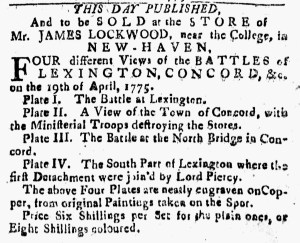
“FOUR different Views of the BATTLES of LEXINGTON, [and] CONCORD.”

The marketing of memorabilia that commemorated events associated with the American Revolution began before the Second Continental Congress declared independence.  Shortly after the Boston Massacre, for instance, Paul Revere, Henry Pelham, and others produced and advertised images depicting the “BLOODY MASSACRE perpetrated in King-Street.”  Revere also marketed a “Copper-Plate PRINT, containing a View of Part of the Town of Boston in New-England, and British Ships of War landing their Troops in the Year 1768.”  As the imperial crisis intensified, Charles Reak and Samuel Okey advertised a print depicting “that truly staunch Patriot, the Hon. SAMUEL ADAMS, of Boston.”  The production of commemorative items accelerated following the battles at Lexington and Concord in April 1775 and the Battle of Bunker Hill in June 1775.

In December 1775, James Lockwood advertised “FOUR different Views of the BATTLES of LEXINGTON, CONCORD, &c. on the 19th of April, 1775.”  He provided a short description of each: “The Battle at Lexington,” “A View of the Town of Concord with the Ministerial Troops destroying the Stores,” “The Battle at the North Bridge in Concord,” and “The South Part of Lexington where the first Detachment were join’d by Lord Percy.”  Lockwood promoted both the quality and accuracy of the prints, noting that the “Four Plates are neatly engraved on Copper, from original Paintings taken on the Spot.”  He almost certainly stocked and sold a series of prints engraved by Amos Doolittle based on paintings by Ralph Earl.  Although Lockwood may have sold the prints separately on request, he promoted them as a package, charging six shillings for as set of “the plain ones” or eight shillings for “coloured” prints.  This collection of prints supplemented news coverage of the battles, helping educate colonizers about recent events, yet many consumers may have desired them as symbols of their patriotism and support of the American cause to display in their homes and offices.  During the first year of the Revolutionary War, the marketing of images that celebrated Americans who defended their towns and their liberties likely encouraged some colonizers to imagine declaring independence rather than merely seeking a redress of grievances.
December 12

What was advertised in a revolutionary American newspaper 250 years ago today?

Pennsylvania Evening Post (December 12, 1775).

“HARE’s and Co. best DRAUGHT and BOTTLED AMERICAN PORTER.”

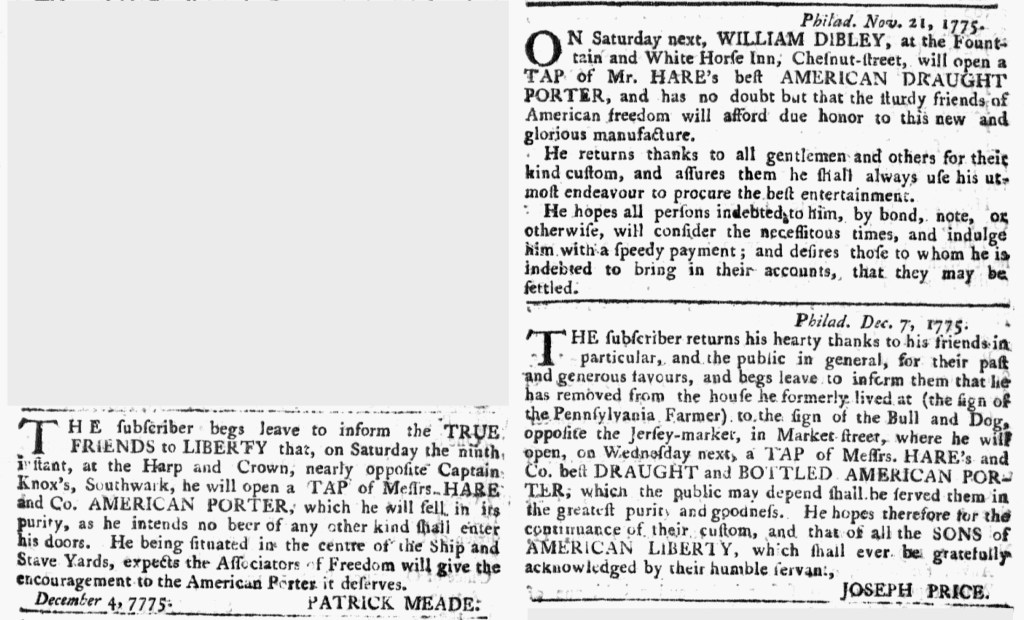
In December 1775, Philadelphia tavernkeeper Joseph Price ran an advertisement to express his gratitude to “his friends in particular, and the public in general,” while simultaneously alerting them that he had moved to a new location.  They could now find him at “the sign of the Bull and Dog” on Market Street rather than at “the sign of the Pennsylvania Farmer.”  To entice readers to visit his new location, he announced that “he will open … a TAP of Messrs. HARE’s and Co. best DRAUGHT and BOTTLED AMERICAN PORTER, which the public may depend shall be served them in the greatest purity and goodness.”

Price was not the only tavernkeeper promoting Hare and Company’s American porter, nor was he the only one associating that beer with support for the American cause.  He proclaimed that he “hopes … all the SONS of AMERICAN LIBERTY” would affirm their commitment by choosing Hare and Company’s American porter.  Price joined two other tavernkeepers who already promoted that brew.  All three of them placed advertisements in the December 12, 1775, edition of the Pennsylvania Evening Post.  William Dibley’s advertisement ran immediately above Price’s notice.  He confidently declared that he “has no doubt but that the sturdy friends of American freedom will afford due honor to this new and glorious manufacture.”  Immediately to the left of Price’s advertisement, Patrick Meade stated that he “expects the Associators of Freedom will give the encouragement to the American Porter it deserves.”  Readers who did not know much about Hare and Company’s American porter encountered endorsement after endorsement, encouraging them to take note of a beer that local tavernkeepers promoted over any others.  Tavernkeepers usually did not mention which brewers supplied their beer, making these advertisements even more noteworthy.  For their part, Hare and Company did not need to do any advertising of their own when they had such eager advocates for their American porter encouraging the public to demonstrate their political principles through the choices they made when they placed their orders at taverns in Philadelphia and nearby Southwark.

December 9

What was advertised in a revolutionary American newspaper 250 years ago today?

Pennsylvania Evening Post (December 9, 1775).

“He will open a TAP of Messrs. HARE’s and Co. AMERICAN PORTER.”

Patrick Meade aimed to create some anticipation among prospective patrons who might visit his tavern, the Harp and Crown, in Southwark on the outskirts of Philadelphia.  In an advertisement that first appeared in the Pennsylvania Evening Post on December 5, 1775, he announced that “on Saturday the ninth … he will open a TAP of Messrs. HARE and Co. AMERICAN PORTER.”  Hare and Company had been building a reputation for their brew.  Two weeks earlier, William Dibley, the proprietor of the Fountain and White Horse Inn in Philadelphia, advertised that he “will open a TAP of Mr. HARE’s best AMERICAN DRAUGHT PORTER.”  Meade’s advertisement ran again on December 9, the day he tapped the celebrated porter.

Meade and Dibley deployed similar marketing strategies to entice “gentlemen and others” to visit their establishments and drink Hare and Company’s porter.  Dibley proclaimed that he “has no doubt but that the sturdy friends of American freedom will afford due honor to this new and glorious manufacture.”  Meade addressed “the TRUE FRIENDS to LIBERTY” and emphasized his location, “situated in the center of the Ship and Stave Yards,” and declared that he “expects the Associators of Freedom will give the encouragement to the American Porter it deserves.”  Meade went all in on promoting Hare and Company’s porter, asserting that “he intends no beer of any other kind shall enter his doors,” especially not porters and other beers imported from England.  The tavernkeeper made a porter brewed in America the exclusive choice for his patron, likely expecting that the lack of other options mattered less to prospective patrons when they gather to drink, socialize, and discuss politics and current events than demonstrating their patriotism by consuming a porter brewed in America.  Meade stated that he would sell Hare and Company’s “AMERICAN PORTER … in its purity,” signaling the quality of the beverage.  Meade issued both an invitation and a challenge: who could desire any beer other than one brewed in America in support of the American cause?

November 30

What was advertised in a revolutionary American newspaper 250 years ago today?

New-York Journal (November 30, 1775).

“A neat Mezzotinto Print of the Hon. JOHN HANCOCK, Esq.”

Richard Sause, a cutler in New York, became a purveyor of patriotic memorabilia during the Revolutionary War.  In October 1775, he advertised “ROMAN’s MAP OF BOSTON,” billing it as “one of the most correct that has ever been published.”  He described the cartographer, Bernard Romans, as “the most skilful Draughtsman in all America,” noting that he earned credibility because he “was on the spot at the engagements of Lexington and Bunker’s-Hill.”  Nicholas Brooks, a shopkeeper who specialized in prints, and Romans collaborated on the project in Philadelphia.  Sause acted as a local agent for marketing and distributing the map in New York.

That was not the only item commemorating current events that Sause advertised and sold.  At the end of November 1775, he took to the pages of the New-York Journal once again, informing the public that he sold a “neat Mezzotinto Print of the Hon. JOHN HANCOCK, Esq.”  The print depicting the merchant from Boston who served as president of the Second Continental Congress was another one of Brooks’s projects.  In addition, Sause also stocked “a view of the BATTLE at Charlestown” and “an accurate Map of the Present Seat of Civil War, taken by an able Draftsman.”  Sause seemingly worked closely with Brooks in acquiring the various prints and marketing them to patriots in New York, perhaps even providing him with advertising copy to adapt for his own notices.  The prints that Sause offered for sale appeared in the same order in his advertisement in the New-York Journal that they did in Brooks’s advertisement in Pennsylvania Journal.  Brooks may have sent a clipping along with the prints that he dispatched to the cutler in New York.

Although Sause had established himself as a cutler who also sold hardware and jewelry in a series of advertisements in New York’s newspapers, his activities in the marketplace in 1775 emphasized his commitment to the American cause.  Before he began selling prints, he promoted “SMALL SWORDS” to gentlemen who anticipated participating in the defense of their liberties and their city.  Even though he continued to advertise an “assortment of Jewellery, Cutlery, Hardware, and Haberdashery,” he made items related to the conflict with Parliament and British troops quartered in the colonies the focal point of his advertisements.

November 25

What was advertised in a revolutionary American newspaper 250 years ago today?

Pennsylvania Evening Post (November 25, 1775).

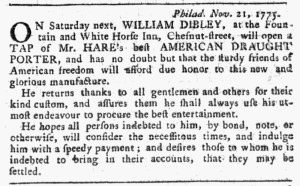
“WILLIAM DIBLEY … will open a TAP of Mr. HARE’s best AMERICAN DRAUGHT PORTER.”

William Dibley was no stranger to advertising his tavern in the public prints.  In February 1775, he announced that he “removed from the Cross Keys … to the Fountain and Three Tuns.”  Both were located on “Chesnut-street” in Philadelphia, so his regular patrons did not have to go far to continue enjoying Dibley’s hospitality, yet he made sure that both “his Friends in particular and the public in general” knew about the “considerably improved” amenities available at his new location.

Nine months later, Dibley ran an advertisement in which he “returns thanks to all gentlemen and others for their kind custom, and assures them he shall always use his utmost endeavour to procure the best entertainment.”  By that time, he updated the name of his establishment to the Fountain and White Horse Inn, perhaps an effort to retain some continuity with a device, the Fountain, that had marked the location while simultaneously distinguishing his business from the one that Anthony Fortune previously operated at the same location, exchanging the Three Tuns for the White Horse.  Dibley’s expression of gratitude suggested that patrons continued gathering at his tavern when he rebranded it.

He aimed to give them more reasons to gather at the Fountain beyond the amenities he highlighted in his earlier advertisement, proclaiming that on Saturday, November 25, he would “open a TAP of Mr. HARE’s best AMERICAN DRAUGHT PORTER.”  This porter was for patriots!  Dibley declared that he “has no doubt but that the sturdy friends of American freedom will afford due honor to this new and glorious manufacture.”  As George Washington and the American army continued the siege of Boston and the Second Continental Congress continued meeting in Philadelphia, Dibley offered an opportunity for supporters of the American cause to drink a porter brewed in the colonies as they gathered to socialize and discuss politics at his tavern.  The tavernkeeper made the porter, a new product, the highlight of a visit to the Fountain, announcing when he would “open a TAP” to create anticipation among prospective patrons.  They may have expected an informal ceremony and a round of toasts to mark the occasion, another enticing reason to visit the Fountain on that day.  Consumption certainly had political overtones at the time.  Dibley tapped into the discourses about purchasing American goods when he marketed a visit to his tavern,

November 24

What was advertised in a revolutionary American newspaper 250 years ago today?

Thomas’s Massachusetts Spy (November 24, 1775).

“This Almanack contains … a very particular Account of … the Battle of Lexington.”

In the fall of 1775, Isaiah Thomas promoted “The NORTH-AMERICAN’s ALMANACK, For the Year 1776.”  He advertised the handy reference manual in the November 24 edition of his newspaper, Thomas’s Massachusetts Spy, Or, American Oracle of Liberty.  According to the imprint on the title page, the almanac was printed in “MASSACHUSETTS-BAY … by I[SAIAH] THOMAS, in WORCESTER, B[ENJAMIN] EDES,” the printer of the Boston-Gazette, “in WATERTOWN; and S[AMUEL] & E[BENEZER] HALL,” the printers of the New-England Chronicle, “in CAMBRIDGE.”  The advertisement also indicated that each of those printing offices stocked and sold the almanac.

Each of those printers earned reputations for their support of the American cause.  In this instance, their marketing efforts reflected their politics.  The advertisement noted that the almanac included “many interesting and entertaining matters” in addition to “what is necessary and useful,” singling out “a very particular Account of the commencement of Hostilities between Great-Britain and America, and the Battle of Lexington, by the Rev. Wm. Gordon.”  The contents listed on the title page included other items that resonated with current events, including “Description of a Tory and a Whig,” “Directions for preserving the Health of the Soldiers in the Camp,” and “Sir Richard Rum’s advice to the Soldiers, shewing the good effects of Spirituous Liquors when they are used with moderation, and their pernicious effects when they are used to excess, with a cure for Drunkenness.”  Such moral lessons often appeared in almanacs, but it had new significance as the siege of Boston continued.

Thomas and his fellow printers considered the account of the Battle of Lexington “worthy to be preserved by every American,” signaling that their almanac featured more than just “interesting and entertaining matters.”  Readers had a patriotic duty to purchase The North-American’s Almanack and then commemorate the first battle of the Revolutionary War and renew their commitment to defending American liberties each time they consulted the almanac.  The printers sought to disseminate it widely, selling it “by the Thousand, Hundred, Groce, Dozen or single,” intending that retailers purchase in volume for resale.  The price on the title page offered a discount, “6 Coppers Single, and 20 Shillings the Dozen,” and the printers may have negotiated even better deals for those purchasing in even greater quantity.  At the same time that they earned their livelihoods by selling almanacs, they also seized an opportunity to commemorate the Battle of Lexington.  Consumers, they asserted, had a patriotic duty to choose this almanac over any of the alternatives.

November 1

What was advertised in a revolutionary American newspaper 250 years ago today?

Pennsylvania Journal (November 1, 1775).

“A NEAT Mezzotinto print of the Hon. JOHN HANCOCK.”

“A large and exact VIEW of the late BATTLE at CHARLESTOWN.”

“An accurate map of the present seat of CIVIL WAR.”

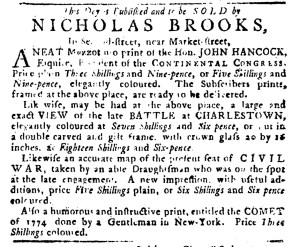
Nicholas Brooks produced and marketed items that commemorated the American Revolution before the colonies declared independence.  In an advertisement in the November 1, 1775, edition of the Pennsylvania Journal, for instance, he packaged together three prints previously advertised separately, each of them related to imperial crisis that had boiled over into a war.  For this notice, Brooks presented them as a collection of prints for consumers who wished to demonstrate their support for the American cause by purchasing and displaying one or more of them.

Brooks announced that a “NEAT Mezzotinto print of the Hon JOHN HANCOCK, Esquire, President of the CONTINENTAL CONGRESS,” that had previously been proposed in other advertisements had been published and was now for sale at his shop on Second Street in Philadelphia.  The subscribers who had reserved copies in advance could pick up their framed copies or arrange for delivery.  Others who had not placed advanced orders could acquire the print for three shillings and nine pence or pay two extra shillings for one “elegantly coloured.”

“Likewise, may be had at the above place,” Brooks reported, “a large and exact VIEW of the late BATTLE at CHARLESTOWN,” depicting what has become known as the Battle of Bunker Hill.  This print competed with an imitation bearing a similar title, “a neat and correct VIEW of the late BATTLE at CHARLESTOWN,” that Robert Aitken inserted in the Pennsylvania Magazine and sold separately.  Brooks, who had long experience selling framed prints, offered choices for his “exact VIEW.”  Customers could opt for an “elegantly coloured” version for seven shillings and six pence” or have it “put in a double carved and gilt frame, with glass 20 by 16 inches,” for eighteen shillings and six pence.  The eleven shillings for the frame, half again the cost of the print, indicated that Brooks anticipated that customers would display the “exact VIEW” proudly in their homes or offices.

He also promoted “an accurate map of the present seat of CIVIL WAR, taken by an able Draughtsman,” Bernard Romans, “who was on the spot of the late engagement.”  Brooks revised copy from earlier advertisements: “The draught was taken by the most skillful draughtsman in all America, and who was on the spot at the engagements of Lexington and Bunker’s Hill.”  The map showed a portion of New England that included Boston, Salem, Providence, and Worcester.   This print, he declared, was a “new impression, with useful additions,” though he did not specify how it differed from the one he previously marketed and sold.  As with the others, customers had a choice of a plain version for five shillings or a “coloured” one for six shillings and six pence.

Brooks added one more item, “a humorous and instructive print, entitled the COMET of 1774, done by a Gentleman in New-York.”  Did this print offer some sort of satirical commentary on current events?  Or was it unrelated to the prints of Hancock, the Battle of Bunker Hill, and the “CIVIL WAR” in New England?  Whatever the additional print depicted, Brooks made the prints that commemorated the American Revolution the focus of his advertisement, gathering together three items previously promoted individually.  In so doing, he not only offered each print to customers as separate purchases but also suggested that they could consider them part of a collection.  Consumers who really wanted to demonstrate their patriotism could easily acquire all three at his shop.

September 14

What was advertised in a revolutionary American newspaper 250 years ago today?

New-York Journal (September 14, 1775).

“SMALL SWORDS … of various sorts.”

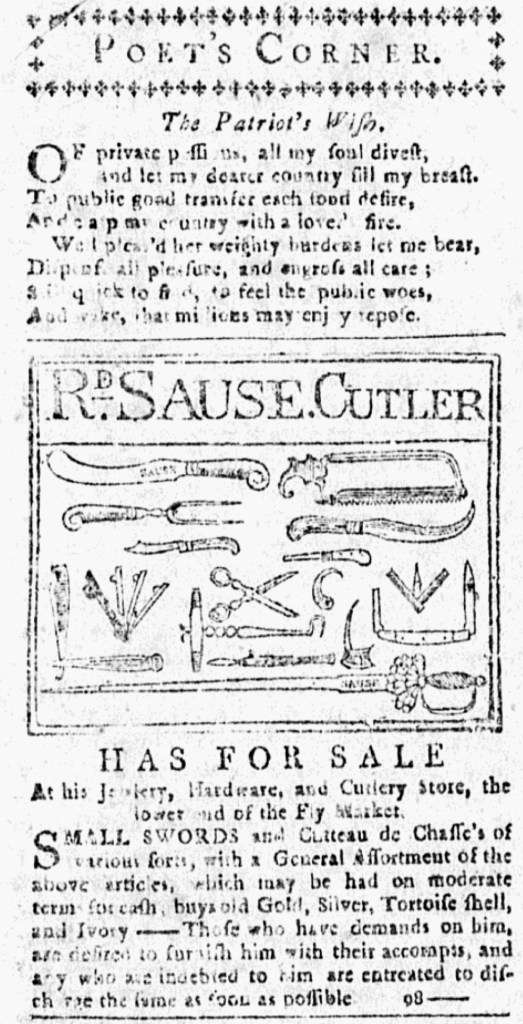
Richard Sause’s advertisement for “SMALL SWORDS” and other items available at his “Jewelery, Hardware, and Cutlery Store” became a familiar sight for readers of the New-York Journal in the summer of 1775.  The woodcut depicting a shop sign with Sause’s name and an array of cutlery, including a sword, made his notice even easier to spot.

On September 14, his notice happened to appear near the top of the left column on the final page of the newspaper, immediately below a regular feature called “POET’S CORNER.”  For that issue, John Holt, the printer, selected a short poem, “The Patriot’s Wish.”

OF private passions, all my soul divest,
and let my dearer country fill my breast,
To public good transfer each fond desire,
And clasp my country with a lover’s fire.
Well pleas’d her weighty burdens let me bear
Dispense all pleasure, and engross all care;
[ ] quick to [ ], to feel the public woes,
And wake, that millions may enjoy repose.

The strained verses were heartfelt even if not especially graceful or elegant.  Perhaps a reader submitted the poem as their way of contributing to the struggle that colonizers endured throughout the imperial crisis and then intensified with the outbreak of hostilities at Lexington and Concord the previous spring.  Sause aimed to make his own contribution by supplying “SMALL SWORDS and Cutteau de Chasse’s,” a type of sword, to the gentlemen of New York who prepared for the possibility that they would have to join the fight.  Although Sause’s advertisement appeared below “The Patriot’s Wish” almost certainly by coincidence, the cutler may have been pleased with the happy accident.  After all, the poem primed readers to think about their duty and to contemplate how to make their own contributions to the cause.  For many, that could have included outfitting themselves with weapons and other military equipment.

September 11

What was advertised in a revolutionary American newspaper 250 years ago today?

Newport Mercury (September 11, 1775).

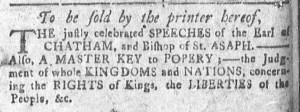
“THE justly celebrated SPEECHES of the Earl of CHATHAM, and Bishop of St. ASAPH.—Also, A MASTER KEY to POPERY.”

To fill the space at the bottom of the last column on the final page of the September 11, 1775, edition of the Newport Mercury, Solomon Southwick, the printer, inserted a short advertisement that listed several books and pamphlet that he sold at his printing office.  Most of them had been featured in longer advertisements, including “the Judgment of whole KINGDOMS and NATIONS, concerning the RIGHTS of Kings, the LIBERTIES of the People, &c.”  Southwick’s edition was one of three printed in the colonies in the past two years.  The printer also stocked the “justly celebrated SPEECHES of the Earl of CHATHAM, and Bishop of St. ASAPH.”  The bishop, a member of Parliament, opposed “altering the Charters of the Colony of Massachusetts Bay,” one of the Coercive Acts enacted by Parliament in retaliation for the Boston Tea Party.  When prevented from delivering his speech during deliberations, he instead published it.  That earned him significant acclaim in the colonies.  William Pitt, the first earl of Chatham, had been “dear to AMERICA” for a decade thanks to his opposition to the Stamp Act.  Southwick’s printing office was clearly a place for Patriots to shop for reading material.

The books on offer included “A MASTER KEY to POPERY.”  Southwick promoted that volume widely even before taking it to press, disseminating subscription proposals in newspapers throughout New England.  They promised an extensive anti-Catholic screed, an exposé of “popery” by a former priest.  Southwick either gained enough subscribers to make the project viable or felt strongly enough about the supposed dangers of Catholicism that he printed the book.  Once he had copies ready for sale, he linked religion and politics in an advertisement that condemned “the infernal machinations of the British ministry, and their vast host of tools, emissaries, &c. &c. sent hither to propagate the principles of popery and slavery, which go hand in hand, as inseparable companions.”  Such prejudices resonated as colonizers expressed dismay over the Quebec Act, yet another of their grievances against Parliament.  That legislation gave several benefits to Catholic settlers in territory gained from the French during the Seven Years War, an insult to Protestants in New England who had sacrificed so much in fighting the British Empire’s Catholic enemies.  For Southwick and many of the readers of the Newport Mercury, support for the American cause and anti-Catholicism went hand in hand during the imperial crisis and the beginning of the Revolutionary War.

August 19

What was advertised in a revolutionary American newspaper 250 years ago today?

Pennsylvania Ledger (August 19, 1775).

“Map of Boston … the engagements of Lexington and Bunker’s Hill.”

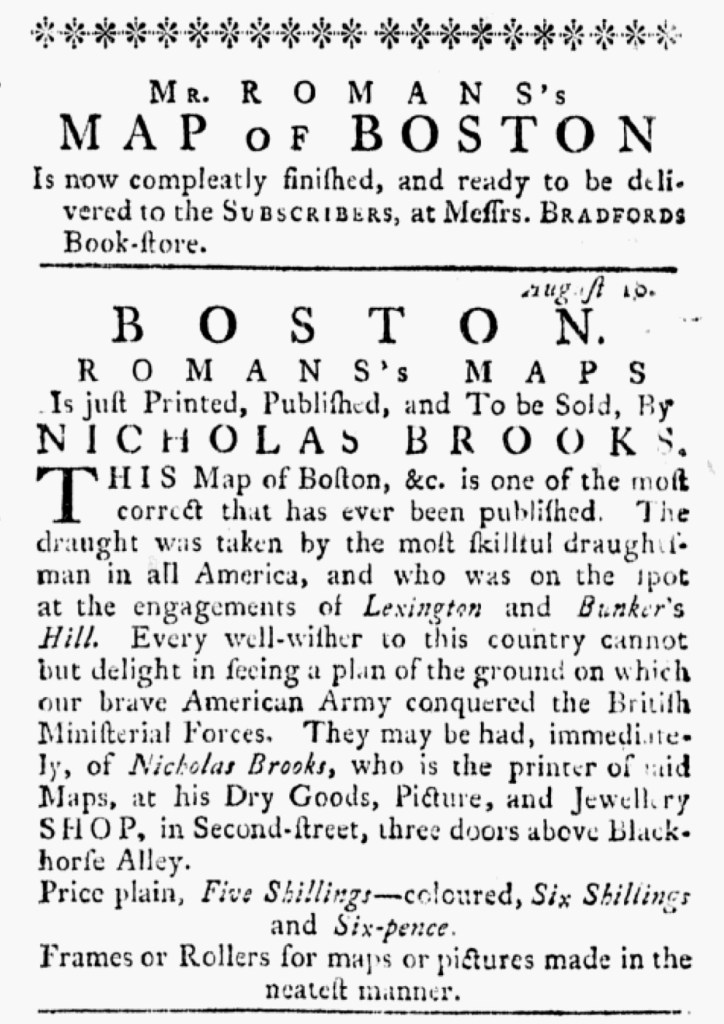
More advertisements for “MR. ROMANS’s MAP OF BOSTON” appeared in the August 19, 1774, edition of the Pennsylvania Ledger.  Bernard Romans, the cartographer who created a “MAP, FROM BOSTON TO WORCESTER, PROVIDENCE AND SALEM. Shewing the SEAT of the present unhappy CIVIL WAR in NORTH-AMERICA,” and Nicholas Brooks, the publisher, previously promoted the project with a broadside subscription proposal that began circulating in the middle of July and scattered references to the map at the end of advertisements in the Pennsylvania Ledger.  Two weeks earlier, for instance, Brooks ran an advertisement that featured an extensive list of merchandise available at his shop and added a nota bene of a single line: “Romans’s map of the seat of war near Boston, &c.”  Robert Aitken mentioned the map in a slightly longer nota bene when he advertised Military Instructions for Officers Detached in the Field.  An advertisement in Rivington’s New-York Gazetteer replicated the copy from the broadside.

Once the map was “completely finished, and ready to be delivered to the SUBSCRIBERS,” as William Bradford and Thomas Bradford put it in their advertisement, or “just Printed, Published, and To be Sold,” as Brooks proclaimed in his own notice, it received greater attention in newspaper notices.  Although many similar projects utilized subscription proposals in newspapers to generate demand attract orders in advance of publication, Romans and Brooks relied on their broadside subscription proposal during their first round of marketing and later added newspaper advertisements once the map was available for sale.

Just four months after the battles at Lexington and Concord, a remarkably short interval for such an endeavor, Brooks advertised copies of Romans’s map of Boston for sale at his “Dry Goods, Picture, and Jewellery SHOP” in Philadelphia.  He touted the quality of the map, declaring it “one of the most correct that has ever been published” and emphasiziong that the “draught was taken by the most skillful draughtsman in all America.”  As if that was not enough to sell it, Romans “was on the spot at the engagements of Lexington and Bunker’s Hill.”  Brooks marketed an eyewitness account of those important battles.  Furthermore, he asserted that consumers had a patriotic duty to examine the map, which they could do by purchasing it.  “Every well-wisher to this country,” Brooks trumpeted, “cannot but delight in seeing a plan of the ground on which our brave American Army conquered the British Ministerial Forces.”  Commemoration and commodification of the American Revolution occurred before the Continental Congress declared independence.