August 19

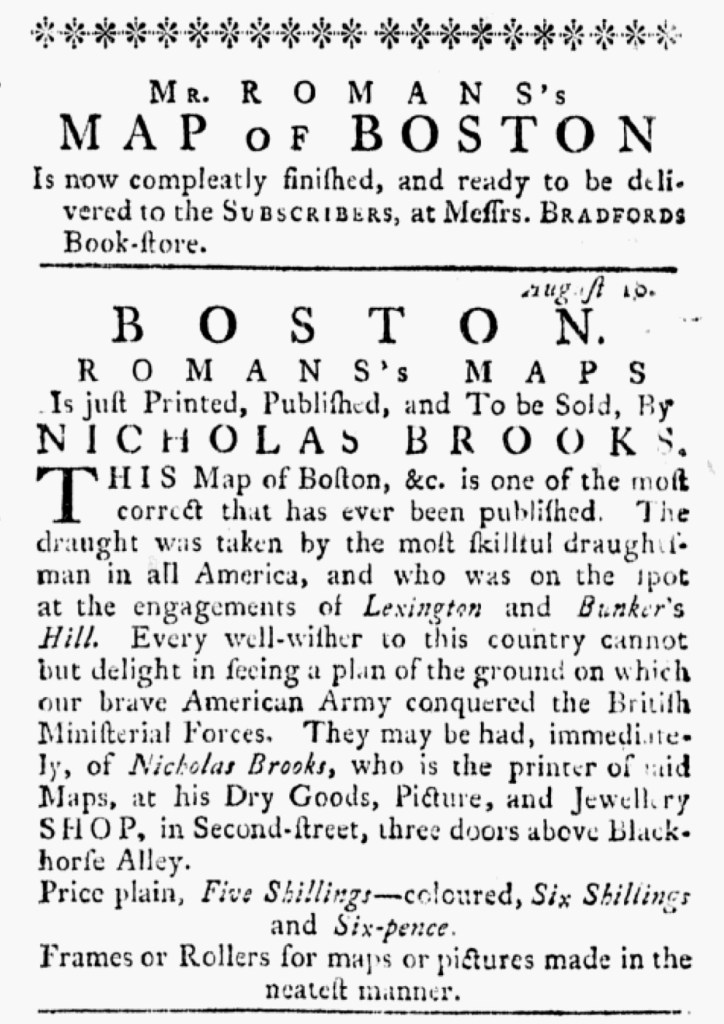
What was advertised in a revolutionary American newspaper 250 years ago today?

Pennsylvania Ledger (August 19, 1775).

“Map of Boston … the engagements of Lexington and Bunker’s Hill.”

More advertisements for “MR. ROMANS’s MAP OF BOSTON” appeared in the August 19, 1774, edition of the Pennsylvania Ledger.  Bernard Romans, the cartographer who created a “MAP, FROM BOSTON TO WORCESTER, PROVIDENCE AND SALEM. Shewing the SEAT of the present unhappy CIVIL WAR in NORTH-AMERICA,” and Nicholas Brooks, the publisher, previously promoted the project with a broadside subscription proposal that began circulating in the middle of July and scattered references to the map at the end of advertisements in the Pennsylvania Ledger.  Two weeks earlier, for instance, Brooks ran an advertisement that featured an extensive list of merchandise available at his shop and added a nota bene of a single line: “Romans’s map of the seat of war near Boston, &c.”  Robert Aitken mentioned the map in a slightly longer nota bene when he advertised Military Instructions for Officers Detached in the Field.  An advertisement in Rivington’s New-York Gazetteer replicated the copy from the broadside.

Once the map was “completely finished, and ready to be delivered to the SUBSCRIBERS,” as William Bradford and Thomas Bradford put it in their advertisement, or “just Printed, Published, and To be Sold,” as Brooks proclaimed in his own notice, it received greater attention in newspaper notices.  Although many similar projects utilized subscription proposals in newspapers to generate demand attract orders in advance of publication, Romans and Brooks relied on their broadside subscription proposal during their first round of marketing and later added newspaper advertisements once the map was available for sale.

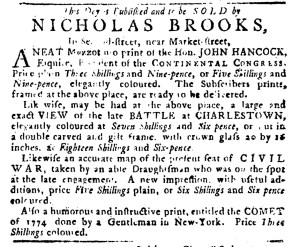
Just four months after the battles at Lexington and Concord, a remarkably short interval for such an endeavor, Brooks advertised copies of Romans’s map of Boston for sale at his “Dry Goods, Picture, and Jewellery SHOP” in Philadelphia.  He touted the quality of the map, declaring it “one of the most correct that has ever been published” and emphasiziong that the “draught was taken by the most skillful draughtsman in all America.”  As if that was not enough to sell it, Romans “was on the spot at the engagements of Lexington and Bunker’s Hill.”  Brooks marketed an eyewitness account of those important battles.  Furthermore, he asserted that consumers had a patriotic duty to examine the map, which they could do by purchasing it.  “Every well-wisher to this country,” Brooks trumpeted, “cannot but delight in seeing a plan of the ground on which our brave American Army conquered the British Ministerial Forces.”  Commemoration and commodification of the American Revolution occurred before the Continental Congress declared independence.

August 3

What was advertised in a revolutionary American newspaper 250 years ago today?

Rivington’s New-York Gazetteer (August 3, 1775)

“MAP … Shewing the SEAT of the present unhappy CIVIL WAR in NORTH-AMERICA.”

On August 3, 1775, Rivington’s New-York Gazetteer carried a subscription proposal for a “COMPLETE and ELEGANT MAP” that extended from Boston to Worcester to the west, Providence to the south, and Salem to the north, “Shewing the SEAT of the present unhappy CIVIL WAR in NORTH-AMERICA.”  The “AUTHOR,” Bernard Romans, realized that colonizers who read and discussed news about the battles at Lexington and Concord in April, the siege of Boston that followed, and the Battle of Bunker Hill would likely be interested in learning more about the geography of New England.  Among the conditions, he specified that “all places where any remarkable event has hitherto occurred, and the provincial lines, &c. shall be particularly pointed out.”  The map itself featured an inset that depicted “BOSTON and itsENVIRONS” that did indeed have its own legend identifying important places, “Provincial Lines,” and “Enemy Lines” as well as an illustration that provided “A View of the Lines thrown upon BOSTON NECK: by the Ministerial Army.”

Romans made support for the American cause an integral part of his marketing effort.  He followed the list of conditions for subscribing (that included the price and descriptions of “good paper and large scale”) with a reflection on the imperial crisis: “Hail, O Liberty! thou glorious, thou inestimable blessing: Banished from almost every part of the old world, America, thy darling, received thee as her beloved: Her arms shall protect thee, – her sons will cherish thee!”  When Romans published the map, it included a dedication “To the Hone. Jno. Hancock Esqre. President of ye Continental Congress … By his Most Obedient Humble Servant.”  As Patriots purchased, collected, and consulted political pamphlets, journals of the proceedings of the First Continental Congress, orations about the Boston Massacre, and sermons about the present state of affairs, Romans presented them with yet another piece of memorabilia that helped them in better understanding current events.  The map was a commemorative item produced and sold even before the colonies declared independence.

**********

The Massachusetts Historical Society has digitized Romans’s map, accompanied by a brief overview of its significance and a short essay about Romans and other cartographers active during the era of the American Revolution.

July 11

What was advertised in a revolutionary American newspaper 250 years ago today?

Dunlap’s Maryland Gazette (July 11, 1774).

“It is hoped that all who wish to see the Manufactures of Great-Britain established in America will encourage this work.”

Robert Moore, a “Cabinet maker in Baltimore Town,” advertised paper hangings (or wallpaper) and “MOCK INDIA PICTURES” to decorate domestic interiors in a notice in Dunlap’s Maryland Gazette in July 1775.  He did not claim that he produced the paper hangings and pictures, only that he sold them.  The cabinetmaker likely aimed to diversity the revenue streams for his workshop.

Yet earning his livelihood was not Moore’s only purpose in hawking those items or promoting them in the public prints.  He also aimed to advance the American cause, doing his part in the commercial realm as readers in Maryland continued to receive news about military encounters, especially the battles at Lexington and Concord, the siege of Boston, and the Battle of Bunker Hill, and the Second Continental Congress and provincial congresses throughout the colonies coordinated responses as the imperial crisis became a war.  Both entrepreneurs and consumers had been using commerce as a means of resistance before the fighting commenced; Moore intended to continue following that strategy.  The Continental Association that the First Continental Congress devised in response to the Coercive Acts, called for boycotting imported goods and encouraging the production and consumption of alternatives made in the colonies.

Moore echoed that ideology in his advertisement.  He proclaimed that he paper hangings and pictures were “all entire the Manufacture of this Country.”  Perhaps he stocked paper hangings produced by Ryves and Fletcher at their “NEW AMERICAN MANUFACTORY” in Philadelphia and advertised in Dunlap’s Pennsylvania Packet.  Whatever the source, Moore emphasized that their quality (“great Perfection”) and price (“lower rates”) rivaled those imported from England.  Consumers did not have to make sacrifices to when they chose to put their political principles into action in the marketplace.  Furthermore, Moore asserted that consumers had a civic responsibility to purchase goods produced in the colonies: “It is hoped that all who wish to see the Manufactures of Great-Britain established in America will encourage this work.”  Even after the fighting commenced in New England, colonizers attempted to continue exerting pressure on Parliament through the choices they made as retailers and consumers.

July 8

What was advertised in a revolutionary American newspaper 250 years ago today?

Pennsylvania Evening Post (July 8, 1775).

“A SELF DEFENSIVE WAR lawful, Proved in a SERMON … before Captain Ross’s company of militia.”

An advertisement in the July 8, 1775, edition of the Pennsylvania Evening Post promoted a forthcoming pamphlet that would certainly be of interest to readers in Philadelphia and beyond.  John Dean, a bookbinder who ran a shop in Laetitia Court, aimed to encourage anticipation for “A SELF DEFENSIVE WAR lawful, Proved in a SERMON … By the Rev. JOHN CARMICHAEL.”  The pamphlet would soon be available for purchase since it was “in the press, and will be published in a few days.”  The advertisement suggested that Dean collaborated with Carmichael on the project.

Dean gave more details about both the origins and the physical attributes of the pamphlet.  Carmichael gave the sermon “at Lancaster, before Captain Ross’s company of militia, in the Presbyterian church on Sabbath morning, June 4th, 1775.”  By then, word of the battles at Lexington and Concord and the siege of Boston had reached the town of Lancaster.  One local militia company apparently appreciated the sermon so much that they wanted copies distributed more widely.  Perhaps some thought that they would purchase their own copies to review at their leisure or even consult it as a means of better rehearsing Carmichael’s arguments and evidence when they needed to explain why they believed a “self defensive war” was indeed lawful.  Francis Bailey, a printer in Lancaster, printed Carmichael’s sermon “for Captain Ross’s Company of Militia,” according to the imprint, and “at the request of said Company,” according to the subtitle.  The new edition, printed in Philadelphia, was “published at the request of the Author, and corrected by himself from the copy printed at Lancaster.”  In addition to being a more accurate rendering of the sermon, the Philadelphia edition would be “Printed on a good paper and type, octavo size.”

Dean and Carmichael envisioned a more extensive audience for the sermon than the Lancaster edition reached.  The advertisement stated that it was “Humbly offered to the perusal of the MILITARY ASSOCIATORS of the city, liberties and county of Philadelphia.”  The bookbinder-publisher and the author hoped to leverage patriotism and current events to sell more copies of the sermon, though they likely also wished to contribute to public discourse about whether military action was justified as the imperial crisis escalated and became a war.  Carmichael’s dedication in the Lancaster edition highlighted another purpose: “TO all the brave SONS of LIBERTY in North-America, but in particular, to the Company of MILITIA in the Borough of Lancaster, known by the name of ROSS’S COMPANY.”  The same dedication appeared in the Philadelphia edition, honoring all the “Officer and Soldiers” who defended American liberties throughout the colonies, especially the local men who did so.

July 2

What was advertised in a revolutionary American newspaper 250 years ago this week?

New-York Journal (June 29, 1775).

“Artillery Company.”

One advertisement in the June 29, 1775, edition of the New-York Journal seems to stand out from the others, at least to this reader perusing that issue 250 years later.  The colonizers who placed the advertisement no doubt hoped that readers would take note and heed its call, intending that the headline, “Artillery Company,” would resonate differently with readers than the headlines for other notices that promoted goods and services, such as “FURRS,” “CLOCKS,” “WATCHES,” and “PUBLIC AUCTION.”  This advertisement certainly served a different purpose once the imperial crisis boiled over into the battles at Lexington and Concord and the siege of Boston that followed.  It may have seemed even more urgent and imperative appearing in the same issue as an “account of the engagement between the Provincials and Regulars on Saturday the 17th,” now known as the Battle of Bunker Hill.

That issue also featured an “Address of the Provincial Congress of the Colony of New-York. To his Excellency GEORGE WASHINGTON, Generalissimo of all the Forces raised, and to be raised, in the Confederated Colonies of America.”  The advertisers sought to do their part in raising forces to defend against British troops.  “[A]n atmosphere of patriotic fervor,” Alan C. Aimone and Eric I. Manders argue, “brought forth a spate of volunteer companies” in the spring and early summer of 1775, companies that “were to be the city’s independent militia.”  Some volunteers had previous experience serving in the colonial militia.  “A Considerable number of inhabitants have proposed to form a Company of Artillery, under the command of Captain Anthony Rutgers,” the advertisement reported.  Aimone and Manders note, “Membership in the independent companies was restricted.  All new volunteers were prosperous city men.”[1]  The advertisement stated other qualifications.  The ranks of this company would be limited to “only … such persons who have steadfastly shewn their attachment to the cause of American Liberty.”  Accordingly, “Such of our fellow citizens as incline to serve in this company, are invited to attend at a general meeting … to determine upon such articles as may be judged necessary for the regulation and discipline of the company.”  Several other independent companies had formed in the city by the time this advertisement appeared in the New-York Journal, yet updates about events unfolding in New England underscored the need to continue recruiting “fellow citizens” devoted “to the cause of American Liberty.”

**********

[1] Alan C. Aimone and Eric I. Manders, “A Note on New York City’s Independent Companies, 1775-1776,” New York History 63, no. 1 (January 1982): 59, 61.

June 29

What was advertised in a revolutionary American newspaper 250 years ago today?

Maryland Gazette (June 29, 1775).

“THE manufactory of snuff of various sorts is now carried on by me at this place.”

On the eve of the American Revolution, Richard Thompson attempted to establish a market for snuff produced in Virginia.  In “The Beginnings of Tobacco Manufacture in Virginia,” Jacob M. Price argues that “there is not even a hint of a local manufacture” of snuff in Virginia from the middle of the 1730s through the late 1760s.  Most of the snuff came from Great Britain with  occasional “bottles, boxes, and kegs of snuff … appear from time to time in notices of arriving cargoes from Antigua, Boston, New York, and Salem.”  According to Price, Thompson “moved his business from Bladensburg [Maryland] to the falls of the Potomac and tried to crash the Virginia market in 1772,” placing a lengthy advertisements in the October 8 edition of William Rind’s Virginia Gazette.  “Little more is known,” Price continues, “of this early Maryland industrial pioneer and of his seemingly premature efforts to introduce a ‘patriotic’ tobacco and snuff manufacture into the Chesapeake.”[1]

An advertisement in the June 29, 1775, edition of the Maryland Gazette, published in Annapolis, reveals that Thompson continued to produce snuff at “George-town, on the Potowmack” at that time.  The “manufactory of snuff of various sorts is now carried on by me at this place,” Thompson proclaimed, “where I can furnish it either in wholesale or retail, at reasonable rates.”  In addition, Thompson had “manufactured tobacco for sale, viz. shag and saffron, and shall shortly begin and continue to manufacture it in all the different forms, if I receive proper encouragement.”  According to the date on the advertisement, Thompson first asked for that encouragement on December 27, 1774, no doubt hoping that the Continental Association, a nonimportation agreement devised by the First Continental Congress in response to the Coercive Acts, created favorable conditions for snuff produced in the colonies.  Patriotic colonizers had an obligation to support his enterprise, to give him that “proper encouragement,” but they did not have to settle for a product inferior to snuff produced elsewhere in the colonies.  In a nota bene, Thompson declared, “I will now say, and with some degree of confidence, that at present I have by me, (and shall continue to make) as good snuff as is manufactured on this continent.”  Even if his business got off to a rocky start, as Price suggests, Thompson asserted that he made improvements over time.  He composed his advertisement less than a month after the Continental Association went into effect (and a notation, “3m,” indicated that it would appear in the Maryland Gazette for three months), yet apparently decided that the time was right to revive it more than six months later after learning of the battles at Lexington and Concord.  Those battles and the events that followed meant that friends of the American cause, after all, had even more reason to support his endeavor.

**********

[1] Jacob M. Price, “The Beginnings of Tobacco Manufacture in Virginia,” Virginia Magazine of History and Biography 64, no. 1 (January 1956): 9, 12, 14.

June 19

What was advertised in a revolutionary American newspaper 250 years ago today?

Postscript to Dunlap’s Pennsylvania Packet (June 19, 1775).

“A NEW AMERICAN MANUFACTORY.”

As summer arrived in 1775, Ryves and Fletcher took to the pages of Dunlap’s Pennsylvania Packet to inform the public that they established a “NEW AMERICAN MANUFACTORY” where they made and sold “all kinds of PAPER HANGINGS” (better known as wallpaper today).  The eighth article of the Continental Association, the nonimportation pact devised by the First Continental Congress in the fall of 1774, called for “promot[ing] Agriculture, Arts, and the Manufactures of this Country” as alternatives to imported goods.  That charge had even greater urgency following once colonizers heard about the battles at Lexington and Concord and the ensuing siege of Boston.  When Ryves and Fletcher ran their advertisement two days after the Battle of Bunker Hill, word of that engagement had not yet arrived in Philadelphia.  When it appeared again in July, readers had even more information about momentous events in Massachusetts that likely shaped how they reacted to Ryes and Fletcher marketing paper hangings made in America.

The “PAPER STAINERS,” as Ryves and Fletcher described themselves, asserted that they “are the first who have attempted that manufacture on this continent.”  Perhaps they were not aware that Plunket Fleeson made, advertised, and sold “AMERICAN PAPER HANGINGS” in Philadelphia in 1769, though they may have conveniently overlooked that enterprise in their efforts to promote their own.  Ryves and Fletcher made significant investment in procuring both workers and materials, noting in particular that their undertaking “consumes a large quantity of the paper of this country.”  In return for their dedication to the patriot cause, they “are therefore induced to hope for the countenance and protection of all well wishers to the infant manufacturers of America.”  They did their duty as producers, but that was not enough; consumers now had an obligation to purchase the paper hangings that Ryves and Fletcher made.  The paper stainers launched a “Buy American” campaign at the beginning of the Revolutionary War.  As part of their marketing efforts, they emphasized quality, extolling the “neatness of patterns and elegance of colour,” and price, pledging that “they will sell on much more reasonable terms than any paper can be disposed of which is imported into America.”  Ryves and Fletcher were among the first to produce and market paper hangings made in America, helping establish a new industry during the era of the American Revolution.

**********

I provide a brief case study of patriotic advertisements for paper hangings in Carl Robert Keyes, “A Revolution in Advertising: ‘Buy American’ Campaigns in the Late Eighteenth Century,” in Creating Advertising Culture:  Beginnings to the 1930s, vol. 1, We Are What We Sell:  How Advertising Shapes American Life … And Always Has, eds. Danielle Coombs and Bob Batchelor (New York:  Praeger, 2013), 1-25.

April 7

What was advertised in a colonial American newspaper 250 years ago today?

Pennsylvania Mercury (April 7, 1775).

“DR. HILL’S AMERICAN BALSAM.”

Enoch Story and Daniel Humphreys began distributing subscription proposals for a new newspaper, the Pennsylvania Mercury and Universal Advertiser, in the middle of January 1775.  They began promoting their newspaper at the same time that James Humphreys, Jr., commenced publication of the Pennsylvania Ledger and Benjamin Towne established Philadelphia’s first tri-weekly newspaper, the Pennsylvania Evening Post.  Those two newspapers brought the total in the city to six, joining Dunlap’s Pennsylvania Packet, the Pennsylvania Gazette, the Pennsylvania Journal, and the Wöchentliche Pennsylvanische Staatsbote.  As the imperial crisis intensified, the number of newspapers published in the largest city in the colonies increased … but did a market exist for yet another?  Could Story and Humphreys attract enough subscribers and advertisers to make a go of the Pennsylvania Mercury?

They decided that they could.  On Friday, April 7, they published the first issue.  In a note to “Subscribers and the Public” on the first page, they explained that they deviated from the conditions in their proposals only slightly, distributing it on Fridays instead of Saturdays, because “one of the eastern mails is now dispatched from Boston, in such time as to arrive here on Thursday (instead of Saturday as formerly).”  That meant that Story and Humphreys could distribute “the most early intelligence from that interesting quarter.”  That meant that the Pennsylvania Mercury scooped the Pennsylvania Evening Post and the Pennsylvania Ledger, both published on Saturday.  The printers also proclaimed that “the TYPE with which THIS Paper is printed are of AMERICAN manufacture,” signaling their support for the article in the Continental Association that called for supporting domestic manufactures, and asked for “every patriotic allowance” if the quality did not give “entire satisfaction to the judicious and accurate eye.”  It was, after all, a small sacrifice.  “[W]e flatter ourselves,” the printers declared, “that the rustic manufactures of America will prove more graceful to the patriotic eye, than the more finished productions of Europe.”

Story and Humphreys also managed to line up advertisers for the first issue of the Pennsylvania Mercury, an importance source of revenue for any newspaper.  In addition to their notice, two advertisements appeared on the first page, including one for “DR. HILL’S AMERICAN BALSAM.”  Advertising filled more than a column on the third page and nearly twice as much on the last page.  In total, paid notices accounted for one-quarter of the content of the inaugural issue.  The colophon encouraged readers to submit advertisements to the printing office in Norris’s Alley near Front Street.  The success of Philadelphia’s newest newspaper would depend in part on advertisers choosing to insert their notices in it.

March 27

What was advertised in a colonial American newspaper 250 years ago today?

Newport Mercury (March 27, 1775).

“Worth the Perusal of each TRUE SON OF LIBERTY.”

In the years after British soldiers fired into a crowd of protestors and killed several colonizers on March 5, 1770, the residents of Boston staged an annual commemoration of the “horrid MASSACRE.”  They called on a prominent patriot to give an “ORATION” about what occurred and the dangers of having British soldiers quartered in urban ports during times of peace.  Colonizers did not need to be present for the oration to experience it for themselves.  Each year, printers published and marketed the oration, commodifying an event that played an important role in the imperial crisis becoming a revolution.

New-York Gazette and Weekly Mercury (March 27, 1775).

In the first several years, printers in Boston published the oration and newspapers in Massachusetts carried advertisements for it.  In 1775, however, printers in other colonies produced their own editions of Joseph Warren’s oration commemorating the fifth anniversary of the Boston Massacre.  Benjamin Edes and John Gill, the printers of the Boston-Gazette, and Joseph Greenleaf, the publisher of the Royal American Magazine, partnered in printing and advertising a Boston edition.  Not long after, Solomon Southwick, the printer of the Newport Mercury, advertised his own edition, giving the notice a privileged place as the first item in the first column on the first page of the March 27 edition of his newspaper.  On that same day, John Anderson inserted a notice in the New-York Gazette and Weekly Mercury to alert readers of the imminent publication of a local edition undertaken “At the particular Desire of a Number of respectable GENTLEMEN.”  Patriots expressed intertest in obtaining their own copies of Warren’s oration; in turn, printers believed they could generate even greater demand.  To that end, Anderson declared, “The genuine Spirit of Freedom which breathes in every Line of this inimitable Performance, renders it worth the Perusal of each TRUE SON OF LIBERTY.”

The political climate had shifted since printers in Boston disseminated John Hancock’s oration commemorating the fourth anniversary of the Boston Massacre.  Since then, colonizers experienced how Parliament reacted to the destruction of tea during what has become known as the Boston Tea Party.  The Coercive Acts, including the Boston Port Act that closed the harbor until residents paid restitution, prompted delegates from throughout the colonies to gather in Philadelphia for the First Continental Congress in the fall of 1774.  They adopted a nonimportation agreement, the Continental Association, that remained in effect in the spring of 1775.  Given the events that transpired in 1774 and early 1775, it made sense that the anniversary of the “BLOODY TRAGEDY of the 5th of MARCH, 1770” garnered greater attention beyond Massachusetts.

March 17

What was advertised in a colonial American newspaper 250 years ago today?

Massachusetts Gazette and Boston Weekly News-Letter (March 17, 1775).

“AN ORATION … to commemorate the bloody Tragedy of March 5th 1770.”

In the spring of 1771, patriots marked the first anniversary of the “BLOODY TRAGEDY” now known as the Boston Massacre with “AN ORATION Delivered … at the Request of the Inhabitants of the Town of Boston … By JAMES LOVELL.”  That started an annual tradition, with Joseph Warren giving the oration in 1772, Benjamin Church in 1773, and John Hancock in 1774.  Gathering for the oration became an annual ritual.  So did publishing and marketing it.

For the fifth anniversary, the “ORATION … to commemorate the bloody Tragedy of March 5th 1770” was once again “delivered by JOSEPH WARREN.”  Less than two weeks later, advertisements in the March 17 edition of the Massachusetts Gazette and Boston Weekly News-Letter informed readers where they could acquire copies.  One indicated that Benjamin Edes and John Gill, the printers of the Boston-Gazette, sold the oration, implying that they also published it.  According to the imprint, Edes and Gill printed the address in partnership with Joseph Greenleaf, the proprietor of the Royal American Magazine.

Another advertisement gave readers another option: “In the MASSACHUSETTS SPY, of this Day is published, the WHOLE of the ORATION, delivered by JOSEPH WARREN, Esq; on March 6th , 1775, to commemorate the bloody Tragedy of March 5th, 1770.”  Isaiah Thomas, the printer of the Massachusetts Spy, did indeed devote three of the four columns of the third page of his newspaper to Warren’s oration.  In an introduction, he reported that it was “this day published, in a pamphlet” and available for sale in addition to appearing in the newspaper.  The printer offered multiple ways for readers to engage with the oration.  He (and Edes and Gill and Greenleaf) also offered consumers an opportunity to purchase a commemorative item.  Readers who previously purchased the orations by Lovell, Warren, Church, and Hancock on previous anniversaries may have been motivated to add to their collections.

The printer of the Massachusetts Gazette and Boston Weekly News-Letter gave the advertisements a privileged place, likely intended to increase the chances that readers took note of them.  They appeared one after the other immediately after the weekly account of local marriages and deaths.  That meant that the advertisements served as a transition between news items and paid notices.  Readers who perused the news yet merely glanced through the advertisements may have been more likely to take note of these first notices as they realized that the remainder of the page featured advertising.  A manicule also helped call attention to them, signaling their importance in a town experiencing the distresses of the Boston Port Act and the other Coercive Acts.