January 16

What was advertised in a colonial American newspaper 250 years ago today?

Boston Evening-Post (January 16, 1775).

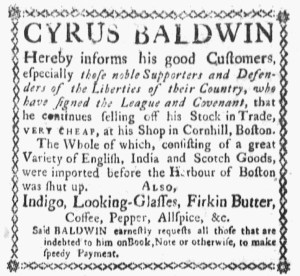
Those noble Supporters and Defenders of the Liberties of their Country, who have signed the League and Covenant.”

The decorative border around Cyrus Baldwin’s advertisement in the January 16, 1775, edition of the Boston Evening-Postdrew attention to it … and the shopkeeper wanted the entire community to see what he had to say about the “great Variety of English, India and Scotch Goods” that he offered for sale “at his Shop in Cornhill, Boston.”  It was a message not only for “his good Customers” but “especially those noble Supporters and Defenders of the Liberties of their Country, who have signed the League and Covenant.”  Baldwin could have invoked the Continental Association that went into effect on December 1, 1774, but made an even stronger statement about fidelity to the American cause demonstrated by some of his customers.

As summer approached in 1774, the Boston Committee of Correspondence disseminated the Solemn League and Covenant, a nonimportation agreement drafted by Samuel Adams and Joseph Warren in response to the Boston Port Act.  Colonizers in Boston and throughout Massachusetts debated the measure, some enthusiastically signing and others arguing that they should wait to engage in a coordinated effort that spanned the colonies.  When the First Continental Congress met in Philadelphia in September and October, the delegates devised a nonimportation pact, the Continental Association, to achieve that unified response.  Newspapers carried details in their coverage of the meetings, printers published and sold pamphlets that included the Continental Association along with other “EXTRACTS FROM THE VOTES AND PROCEEEDINGS OF THE AMERICAN CONTINENTAL CONGRESS,” some printers published broadside versions of the Continental Association for easy reference in homes and offices, and advertisements documented goods surrendered and sold under the conditions of the tenth article of the Continental Association.

Baldwin could have made an appeal to consumers who adhered to the Continental Association.  Instead, he sought to associate his customers and his goods with the uncompromising spirit of the Solemn League and Covenant drafted as soon as the colonies received word about the Boston Port Act.  The resolve of many colonizers strengthened as news about the other Coercive Acts – the Massachusetts Government Act, the Administration of Justice Act, and the Quartering Act – arrived, yet Baldwin declared that many of his customers had been unwavering in their determination to take action before receiving dispatch after dispatch about new abuses perpetrated by Parliament.  Even those who had not signed the Solemn League and Covenant could ameliorate their regrets, Baldwin suggested, by making purchases alongside others who had been “noble Supporters and Defenders of the Liberties of their Country” months before the Continental Association.  As the imperial crisis intensified, he offered consumers an opportunity to revise how they remembered their participation in resistance efforts.

November 10

What was advertised in a colonial American newspaper 250 years ago today?

Virginia Gazette [Pinkney] (November 10, 1774).

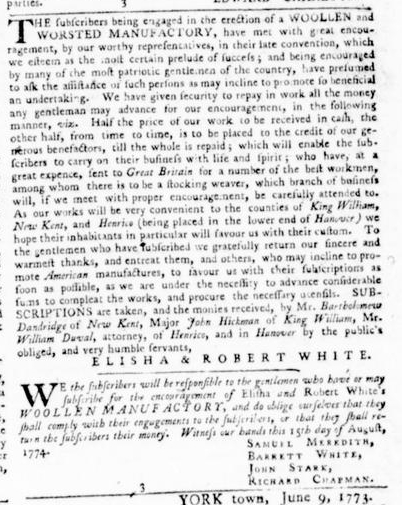
“A WOOLEN and WORSTED MANUFACTORY … American manufactures.”

As John Pinkney published updates from the First Continental Congress in the Virginia Gazette in November 1774, Elisha White and Robert White ran an advertisement to announce that they were “engaged in the erection of a WOOLLEN and WORSTED MANUFACTORY” that they anticipated would meet with great success.  They had already been “encouraged by many of the most patriotic gentlemen of the country,” yet sought even greater support for “so beneficial an undertaking” among the public.  In other words, they sought investors to defray the costs of this endeavor, addressing those “who may incline to promote American manufactures” as alternatives to goods imported from Britain.  The Whites had already gone to some expense, recruiting “a number of the best workmen,” though they still needed to “compleat the works, and procure the necessary utensils.”  Their enterprise would have even greater urgency as colonizers learned more about the Continental Association, a nonimportation pact, adopted by the First Continental Congress.

To raise the necessary funds to make their “MANUFACTORY” viable, the Whites established a subscription and designated local agents in several towns who collected the money on their behalf.  They also outlined their scheme for repaying these loans: “Half the price of our work to be received in cash, the other half, from time to time, is to be placed to the credit of our generous benefactors, till the whole is repaid.”  In case that seemed like too much of a gamble, the Whites appended a note from some of those “most patriotic gentlemen” to offer assurances.  Samuel Meredith, Barrett White, John Stark, and Richard Chapman pledged that they “will be responsible to the gentlemen who have or may subscribe for the encouragement of Elisha and Robert White’s WOOLLEN MANUFACTORY.”  If the project did not succeed, those four men “shall return the subscribers their money.”  That promise reflected their confidence in the Whites’ ability to “carry on their business with life and spirit” while simultaneously underscoring that civic duty called for supporting the “MANUFACTORY” through investing in it and, eventually, purchasing the goods produced there.  Political principles guided participation in both production and consumption of “American manufactures” as the imperial crisis intensified in 1774.

October 23

What was advertised in a colonial American newspaper 250 years ago this week?
Supplement to the New-York Journal (October 20, 1774).

“This being the safest and most efficacious method of convincing the Ministry of Great-Britain of their errour.”

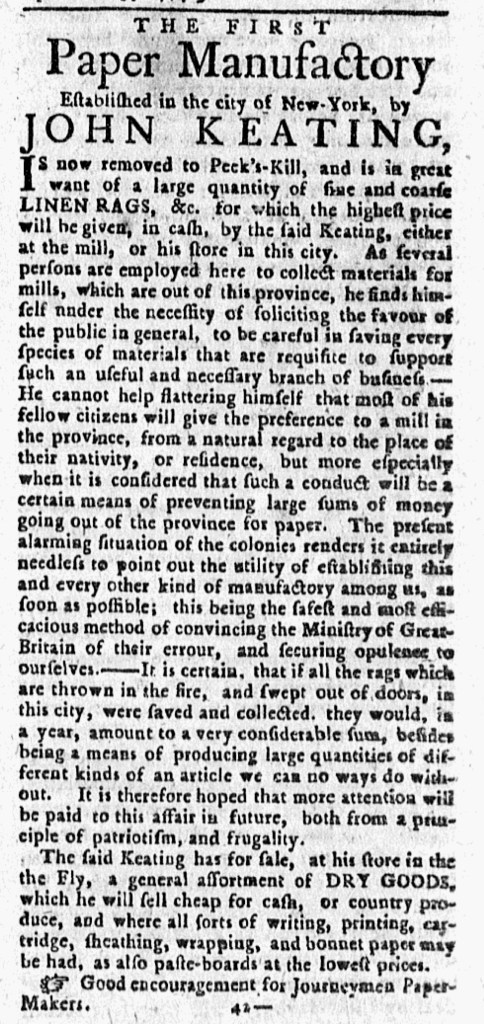
John Keating frequently advertised the “FIRST Paper Manufactory Established in the city of New-York” in the late 1760s and early 1770s.  He often updated his advertisement, yet he incorporated familiar themes about patriotism and supporting the local economy.  He also encouraged readers to save linen rags to make into paper, underscoring that they could play an important role in the production of paper made in the colonies as well as its consumption.

Such was the case in an advertisement in the supplement that accompanied the October 20, 1774, edition of the New-York Journal.  Keating opened with an announcement that his enterprise “is in great want of a large quantity of fine and coarse LINEN RAGS.”  He encouraged “the public in general, to be careful in saving every species of materials that are requisite to support such a useful and necessary branch of business.”  In previous advertisements, he offered instructions for collecting and saving rags as part of the rituals of household management, entrusting women in particular with supplying the resources necessary for the operation of the local paper mill and, in the process, lauding the patriotic spirit of those who heeded his call.  In this instance, he did not distinguish men and women, instead stating that when it came to choosing which paper to consume “that most of his fellow citizens will give the preference to a mill in the province … when it is considered that such a conduct will be a certain means of preventing large sums of money going out of the province.”  In addition to supporting the local economy, Keating asserted that the “present alarming situation of the colonies renders it entirely needless to point out the utility of establishing this and every other kind of manufactory among us, as soon as possible.”  Such a plan, he declared, was “the safest and most efficacious method of convincing the Ministry of Great-Britain of their error, and securing opulence to ourselves.”  Keating effortlessly connected politics, commerce, and the livelihoods and good fortune of colonizers who benefited from domestic manufactures as alternatives to imported goods.  He did so once again with a plea “that more attention will be paid to this affair in the future, both from a principle of patriotism, and frugality.”  In so doing, Keating presented a multitude of reasons for readers to support American industry and buy American products as the imperial crisis intensified.

October 9

What was advertised in a colonial American newspaper 250 years ago this week?

Massachusetts Gazette and Boston Weekly News-Letter (October 6, 1774).

“ALMAN[A]CK … Ornamented with a large and elegant Engraving, representing the VIRTUOUS PATRIOT.”

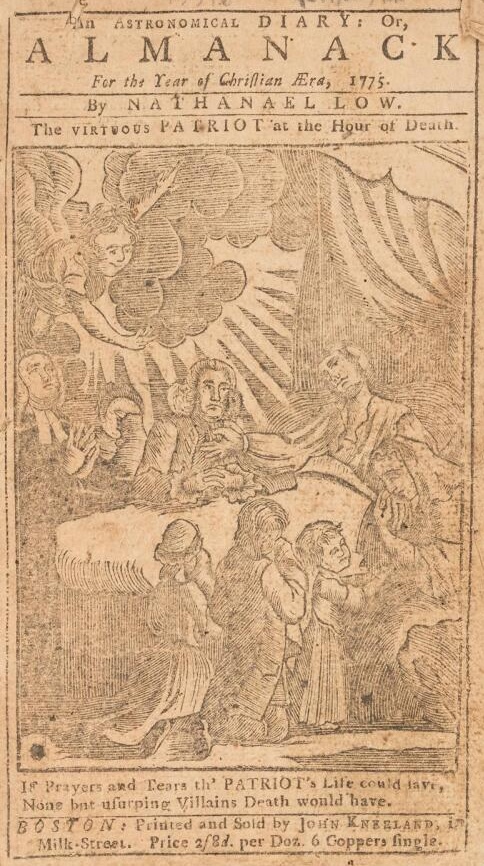
When it came to buying almanacs, residents of Boston had many choices during the era of the American Revolution.  That meant that printers often advertised what made the almanacs they published distinctive from others on the market.  Such was the case for John Kneeland when he advertised Nathanael Low’s Astronomical Diary: Or, Almanack for the Year of Christian Aera, 1775 in the Massachusetts Gazette and Boston Weekly News-Letter in the fall of 1774.  The production of the almanac and its promotion resonated with current events as the imperial crisis intensified.  The Boston Port Act closed the harbor, the Massachusetts Government Act revoked the colony’s charter, and the other Coercive Acts punished the port city for the Boston Tea Party.

Kneeland informed prospective customers that this almanac was “Ornamented with a large and elegant Engraving, representing the VIRTUOUS PATRIOT at the Hour of Death.”  In addition to the usual contents, “every Thing necessary in an Almanack,” it also included a “long and sympathetic Address to the Inhabitants of Boston, with several other Pieces of Speculation, which tends to rend it not only useful, but entertaining.”  The engraving dominated the cover of the almanac.  It depicted a man, the “VIRTUOUS PATRIOT,” on his deathbed. A woman, presumably his wife, and three children kneeled in the foreground.  On the other side of the bed, a minister prayed while another man, perhaps a relative and likely another patriot, joined the family in their vigil.  Above the bed, an angel welcomed the “VIRTUOUS PATRIOT” into heaven.  A caption below the image stated, “IF Prayers and Tear th’ PATRIOT’s Life could save, None but usurping Villains Death would have.”

According to an auction catalog prepared by PBA Galleries, the “long and sympathetic Address” filled the first four pages of the almanac.  Echoing rhetoric that circulated in newspapers and pamphlets, the address “rails against the British,” assuring residents of Boston that “[Your countrymen] are sensible the heavy hand of power under which you are now groaning is designed only as a prelude to the utter abolishment of American freedom.”  The Coercive Acts, the address warned, would enslave the colonies to Britain.  (Two advertisements on the same page as the advertisement for the almanac in the October 6, 1774, edition of the Massachusetts Gazette and Boston News-Letter concerned enslaved people, one presenting an enslaved woman for sale and the other offering a reward for the capture and return of an enslaved man who liberated himself by running away from his enslaver.)  The address proclaimed, “My dear brethren, the destiny of America seems to be suspended on the present controversy; and it is on your fidelity, firmness, and good conduct, for which you have so remarkably signalized yourself on all occasions, that a happy issue of it in a great measure depends.”  The advertisement for the almanac containing this address ran in the newspaper as the First Continental Congress continued its meetings in Philadelphia.  A month earlier, the colonial militia in Worcester County to the west of Boston had closed the courts and removed British authority in what has become known as the Worcester Revolution of 1774.  Six months after Kneeland advertised the almanac with the engraving and the address, a war for independence began with the skirmishes at Lexington and Concord.

Nathanael Low, An Astronomical Diary: Or, Almanack for the Year of Christian Aera, 1775 (Boston: John Kneeland, 1774). Courtesy PBA Galleries.

July 14

What was advertised in a colonial American newspaper 250 years ago today?

Rivington’s New-York Gazetteer (July 14, 1774).

“At this critical and alarming juncture … set up the business of REED-MAKING.”

Nathaniel Pike testified that he wished to do his part to support the American cause in an advertisement in the July 14, 1774, edition of Rivington’s New-York Gazetteer.  He informed the public that he was “willing to assist in promoting manufacturers in America, (especially at this critical and alarming juncture)” and, accordingly, “lately set up the business of REED-MAKING.”  Eighteenth-century readers familiar with weaving knew that reeds were the “part of a loom consisting of a set of evenly spaced wires known as dents (originally slender pieces of reed or cane) fastened between two parallel horizontal bars used for separating, or determining the spacing between, the warp threads, and for beating the weft into place.”[1]  Pike pledged that “weavers and others, both in town and country, may be supplied with reeds of all kinds, as neat and good as any imported.”

Although Pike did not name the Boston Port Act or any of the other Coercive Acts passed by Parliament in retaliation for the Boston Tea Party, readers certainly understood the context for his reference to “this critical and alarming juncture.”  From New England to Georgia, colonizers discussed how to respond, many of them advocating for a new round of nonimportation agreements like the ones enacted in response to the Stamp Act and the duties imposed on certain goods in the Townshend Acts.  That meant that “domestic manufactures” or goods produced in the colonies would become important alternatives to imported goods.  Pike offered his own product made in the colonies, those reeds that matched imported ones in quality, yet his enterprise also facilitated greater production of textiles in the colonies.  Every stage of producing cloth took on greater significance in the face of boycotting fabrics imported from England, from farmers raising sheep for their wool to women participating in spinning bees that put their patriotism on display to consumers choosing and wearing homespun cloth out of allegiance to their political principles.  By supplying weavers with reeds for their looms, Pike served a vital role in protests against the abuses perpetrated by Parliament.  He expected that current events would help in marketing his product.

**********

[1] Oxford English Dictionary, II.11.a.

March 24

GUEST CURATOR:  Madison Kenney

What was advertised in a colonial American newspaper 250 years ago today?

New-York Journal (March 24, 1774).

“The best Price given for ALL SORTS OF LINEN RAGS.”

John Keating, the owner of a “PAPER MANUFACTORY” in New York, uses politics as an advertising strategy. In 1774, “The demand for paper in America, is of late so greatly increased, that very large sums are continually sent abroad, for the purchase of it.” Keating attempted to take advantage of the political tension with Britain by connecting the donation of spare rags to make into paper with patriotism. He argued, “All those who really wish to promote the interest of America … will contribute their aid to the success of the paper manufactory in this place.”

Advertisements asking families to save linen rags to support American printing were not uncommon during the era of the American Revolution. An advertisement printed on the back of Thomas’s Massachusetts, New-Hampshire, and Connecticut Almanack for the Year of our Lord Christ 1779 claims “ fair daughters of Liberty…would not neglect to serve their country, by saving for the paper mill in Sutton, all linen and cotton and linen rags.” Again, entrepreneurs who made paper or printed on it used patriotism to pressure households to support American industry by donating rags. Kayla Haveles argues that printing was “as vital to revolution as guns and gunpowder” because the colonists used it to spread ideology and attack the British.

Thomas’s Massachusetts, Connecticut, and New-Hampshire Almanack for the Year of Our Lord Christ 1779 (Worcester: Isaiah Thomas, 1778).

Additionally, the frequency of these advertisements highlights the contributions of women in the Revolution. Both advertisements focus on saving rags in the home. Keating’s advertisement asked every family to save spare rags in their household. Women were responsible for the housework so Keating’s call to action targeted women. The advertisement on the back of the almanac asked “daughters of Liberty” to save rags. Both advertisements are examples of how women contributed to the Revolution by supporting the American economy.

**********

ADDITIONAL COMMENTARY:  Carl Robert Keyes

John Keating had been placing similar advertisements for the “NEW-YORK Paper MANUFACTORY” for years by the time this advertisement appeared in the March 24, 1774, edition of the New-York Journal.  The Adverts 250 Project first featured one of his advertisements that offered “Ready Money for clean Rags” that ran in that newspaper on February 18, 1768.  During the six years in between, Keating maintained an almost constant presence in the public prints, encouraging colonizers, especially women, to collect rags for paper production and explaining the patriotic benefits of their efforts.  He advertised at times when relationships with Parliament deteriorated, including when nonimportation agreements went into effect to protest various legislation, as well as when the situation cooled and most merchants, shopkeepers, and consumers returned to business as usual.  Keating remained a steady voice in favor of “domestic manufactures” or goods produced in the colonies.

In this instance, Keating ran his advertisement at a time of crisis.  Throughout the colonies, the destruction of the tea in Boston the previous December remained a topic of conversation, including in New York.  The Sons of Liberty anticipated the arrival of the Nancy with a cargo of tea that they did not want landed in their city.  Keating’s advertisement, which had been running since before the Boston Tea Party, appeared on the last page of the March 24 issue, interspersed among other advertisements.  A notice that the Sons of Liberty would meet every Thursday evening “till the Arrival and Departure of the TEA SHIP,” on the other hand, made its second appearance, this time in the first column on the first page.  Only tables showing prices current and sunrise, sunset, and high tide preceded the announcement.  Its placement made it more likely that readers would see it, while also framing how they read other advertisements in the issue.  Most readers likely did not need that notice from the Sons of Liberty to influence their reaction to Keating’s advertisement calling on “all those who really wish to promote the interest of America” to do their part, considering how widely colonizers discussed the politics of tea at the time.  Still, the combination of print culture and public discourse occurring everywhere from the town common to taverns made Keating’s appeals to patriotism even more urgent.

March 10

What was advertised in a colonial American newspaper 250 years ago today?

Pennsylvania Journal (March 10, 1773).

“Made it their particular study to encourage their own manufactures.”

Today, collectors consider precious glassware produced in the eighteenth century by Henry William Stiegel at his American Flint Glass Manufactory, but during his own lifetime the German-American glassmaker did not achieve the same renown.  Like many other artisans, he published newspaper advertisements in an effort to entice consumers and improve his prospects.

In many of those advertisements, Stiegel attempted to convince prospective customers to support “domestic manufactures” by purchasing goods produced in the colonies, especially glassware he made at his manufactory in Manheim in Lancaster County, Pennsylvania, rather than imported alternatives.  Artisans and others launched “Buy American” campaigns during the imperial crisis, suggesting to colonizers that they had a civic responsibility to practice politics through the decisions they made in the marketplace.  In an advertisement in the March 10, 1773, edition of the Pennsylvania Journal, Stiegel and his broker in Philadelphia, William Smith, made the case that the “friends and well-wishers to America have, on all laudable occasions, shewed a spirit of patriotism worthy of themselves, and made it their particular study to encourage their own manufactures in preference to all others.”  Stiegel and Smith reiterated an appeal that Stiegel made in another advertisement in November 1771.

The glassmaker and his broker challenged consumers to take part in “so noble a resolution” to purchase “their own manufactures,” yet that was not the extent of their sales pitch.  They also emphasized price, stating that they sold glassware “on as good terms” as imported goods, and quality, asserting that the “ELEGANT ASSORTMENT” of items was “as neat in their kinds” as “any imported from Europe.”  Prospective customers did not have to take their word for it.  Instead, Stiegel and Smith confidently asserted that if “impartial judges” inspected works from the American Flint Glass Manufactory that they would reach the same conclusion.

Stiegel and Smith presented decisions about consumption as political acts, yet they recognized that politics alone would not motivate some consumers, especially during a lull in tensions between colonizers and Parliament.  That being the case, they assured prospective customers that when they purchased glassware produced by Stiegel that they acquired merchandise equal in quality to items imported from Europe and at the same prices.  They hoped that the combination of appeals would convince consumers to support “their own manufactories” in the colonies.

February 1

What was advertised in a colonial American newspaper 250 years ago today?

New-York Gazette and Weekly Mercury (February 1, 1773).

He most humbly addresses the Fair Sex, requesting their aid.”

John Keating regularly offered “READY MONEY … for CLEAN LINEN RAGS” in the New-York Gazette and Weekly Mercury in the late 1760s and early 1770s.  The papermaker needed as many rags as he could gather to supply his mill with raw materials.  To convince readers to make an effort to collect and submit rags, he developed appeals that emphasized both commerce and devotion to the best interests of the colonies.

In an advertisement that ran on February 1, 1773, for instance, Keating stated that the “advantages that must result to this colony from the establishment of manufactories in it, are so obvious that the subject needs no elucidation.”  Then he elucidated.  “Since paper manufactories were established in Pennsylvania, the money saved and brought into that province, the money saved and brought into the province” amounted to “the many thousand pounds of which is annually drained of[f] by purchasing paper in England.”  Supporting domestic manufactures, goods produced in the colonies, helped to address the trade imbalance with Great Britain.  Keating challenged readers to think about what more they accomplish by working together.  “Might not every shilling of this money be saved?  Have we not materials amongst ourselves?  Is our patriotism all pretence …?

New Yorkers did indeed already have the materials necessary for making paper, clean linen rags.  Keating suggested that women played a vital role in sustaining the patriotic project that he pursued, declaring that he “most humbly addressed the Fair Sex, requesting their aid, without which it will be impossible for him to establish this manufactory upon a respectable or prudent footing.”  He requested that every “frugal matron … hang up a bag … and take care to put every piece of linen that is unfit for any other use, in it.”  When the bag was full, the frugal matron would sell the contents to Keating in an eighteenth-century version of recycling to support a good cause.  The papermaker indicated that in return for the clean linen rags the frugal matron would receive enough money to “supply herself and family with the very essential article of pins.”  Just as significantly, “she will have the satisfaction of being conscious of contributing her part to the advancement of her country.”  Women’s industry served a dual purpose when it manifested patriotism.

The project did not depend solely on those frugal matrons.  Keating also asked “young ladies to co-operate … in saving rags,” though he presented a more romantic rationale to them.  The papermaker asked young women to “observe a very curious remark made by the celebrated Mr. Addison in the Spectator, ‘That a young lady who sends her shift to the paper mill, may very possibly in less than six months, have it returned made into a piece of fair paper, upon which her lover has written a billet doux.’”  Although Keating (and Addision) asked young women to imagine love letters, their shifts and other linen garments may just as likely been transformed into newspapers that kept their households informed about the imperial crisis that faced New York and other colonies.

Women, both “frugal matrons” and “young ladies,” participated in politics and expressed their patriotism when they heeded the call of papermakers who encouraged them to collect clean linen rags.  Similarly, their actions and decisions made an impact when they produced homespun textiles and garments and participated in nonconsumption agreements.  During the era of the American Revolution, both men and women understood that the personal was political.  That included gathering clean linen rags in “a bag in some convenient part of the house.”

April 1

What was advertised in a colonial American newspaper 250 years ago this week?

Boston Evening-Post (March 30, 1772).

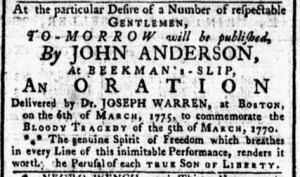
“An ORATION … to commemorate the BLOODY TRAGEDY.”

On the second anniversary of the Boston Massacre, Dr. Joseph Warren delivered “An ORATION … at the Request of the Inhabitants of the Town of BOSTON, to commemorate the BLOODY TRAGEDY of the FIFTH of MARCH, 1770.”  Colonizers gathered to listen to the address, but attending that gathering was not their only means of participating in the commemoration of such a significant event.  Benjamin Edes and John Gill, printers of the Boston-Gazette, published Warren’s “ORATION” and marketed it widely in Massachusetts.

They placed their first advertisement in their own newspaper less than three weeks after Warren addressed “the Inhabitants of the Town.”  Their lengthy notice in the March 23, 1772, edition of the Boston-Gazette included an extensive excerpt about “the ruinous Consequences of standing Armies to free Communities.”  Edes and Gill also stated that they stocked “A few of Mr. LOVELL’S ORATIONS Deliver’d last April, on the same Occasion.”  Prospective customers had an opportunity to collect memorabilia related to the “FATAL FIFTH OF MARCH 1770.”  The following day, Samuel Hall, one of the printers of the Essex Gazette, informed readers that he sold copies of Warren’s address “published in Boston.”  His advertisement did not include an excerpt from the address, nor did subsequent advertisements that Edes and Gill placed in other newspapers in Boston.  They inserted a brief notice in the Massachusetts Gazette and Boston Weekly News-Letter on March 26 and then repeated it in the Boston Evening-Post on March 30.

Edes and Gill advertised widely.  That increased the chances that consumers would see their notices and contemplate purchasing copies of Warren’s “ORATION,” but those patriot printers likely aimed for more than generating sales.  Their advertisements in several newspapers contributed to a culture of commemoration of the American Revolution years before the skirmishes at Lexington and Concord.  Their work in the printing office, publishing newspapers and marketing pamphlets that commemorated the Boston Massacre, played an important role in shaping public opinion as colonizers considered current events and the possibility of declaring independence.

March 23

What was advertised in a colonial American newspaper 250 years ago today?

Boston-Gazette (March 23, 1772).

“AN ORATION … TO COMMEMORATE THE BLOODY TRAGEDY.”

Commemoration and commodification of the Boston Massacre commenced just weeks after British soldiers killed several colonizers when they fired into a crowd of protesters on March 5, 1770.  Paul Revere advertised “A PRINT containing a Representation of the late horrid Massacre in King-Street” in the March 26, 1770, edition of the Boston-Gazette.  He appropriated the image from a sketch done by Henry Pelham.  A week later, Pelham advertised “The Fruits of Arbitrary Power, An Original Print, representing the late horrid Massacre in King Street, taken from the Spot” in the April 2 edition of the Boston-Gazette.  A year later, colonizers in Boston determined that public orations should mark the event.  On April 2, 1771, James Lovell delivered “AN Oration … At the Request of the Inhabitants of the Town of Boston; To Commemorate the Bloody Tragedy of the Fifth of March, 1770.”  Not long after that, an advertisement in the April 15 edition of the Boston-Gazette promoted copies for colonizers to purchase.

In subsequent years, the annual oration occurred on March 5.  From 1771 through 1783, this commemorative event attracted more attention in Boston than Independence Day, but after the Treaty of Paris brought the Revolutionary War to an end July 4 became more widely recognized.  On the second anniversary of the Boston Massacre, Joseph Warren gave “AN ORATION … At the REQUEST of the INHABITANTS OF THE TOWN OF BOSTON TO COMMEMORATE THE BLOODY TRAGEDY Of the FIFTH of March, 1770.”  An advertisement quickly appeared in the March 23 edition of the Boston-Gazette, filling nearly two-thirds of a column.  The advertisement occupied so much space because Benjamin Edes and John Gill, the patriot printers of both the Boston-Gazette and the oration, included an extensive excerpt about “the ruinous Consequences of standing Armies to free Communities.”  The printers hoped that by giving prospective customers a taste of what Warren had to say about the “tyranny and oppression” of an “armed soldiery” who “frequently insulted and abused” the residents of Boston that would entice them to purchase the oration and read more.  Doing so also gave them an opportunity to remember the “horrors of THAT DREADFUL NIGHT” and venerate “the mangled bodies of the dead” who perished as a result of the “barbarous caprice of the raging soldiery.”

At the end of the advertisement, Edes and Gill noted that they also stocked “A few of Mr. LOVELL’S ORATIONS Deliver’d last April, on the same Occasion.”  They made it easy for patriotic consumers to collect memorabilia associated with the Boston Massacre.  Commemoration and commodification of that event occurred simultaneously in the years before the colonies declared independence.