July 14

What was advertised in a colonial American newspaper 250 years ago today?
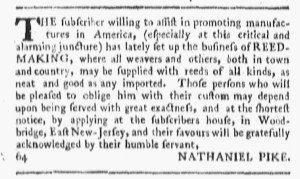
Rivington’s New-York Gazetteer (July 14, 1774).

“At this critical and alarming juncture … set up the business of REED-MAKING.”

Nathaniel Pike testified that he wished to do his part to support the American cause in an advertisement in the July 14, 1774, edition of Rivington’s New-York Gazetteer.  He informed the public that he was “willing to assist in promoting manufacturers in America, (especially at this critical and alarming juncture)” and, accordingly, “lately set up the business of REED-MAKING.”  Eighteenth-century readers familiar with weaving knew that reeds were the “part of a loom consisting of a set of evenly spaced wires known as dents (originally slender pieces of reed or cane) fastened between two parallel horizontal bars used for separating, or determining the spacing between, the warp threads, and for beating the weft into place.”[1]  Pike pledged that “weavers and others, both in town and country, may be supplied with reeds of all kinds, as neat and good as any imported.”

Although Pike did not name the Boston Port Act or any of the other Coercive Acts passed by Parliament in retaliation for the Boston Tea Party, readers certainly understood the context for his reference to “this critical and alarming juncture.”  From New England to Georgia, colonizers discussed how to respond, many of them advocating for a new round of nonimportation agreements like the ones enacted in response to the Stamp Act and the duties imposed on certain goods in the Townshend Acts.  That meant that “domestic manufactures” or goods produced in the colonies would become important alternatives to imported goods.  Pike offered his own product made in the colonies, those reeds that matched imported ones in quality, yet his enterprise also facilitated greater production of textiles in the colonies.  Every stage of producing cloth took on greater significance in the face of boycotting fabrics imported from England, from farmers raising sheep for their wool to women participating in spinning bees that put their patriotism on display to consumers choosing and wearing homespun cloth out of allegiance to their political principles.  By supplying weavers with reeds for their looms, Pike served a vital role in protests against the abuses perpetrated by Parliament.  He expected that current events would help in marketing his product.

**********

[1] Oxford English Dictionary, II.11.a.

March 24

GUEST CURATOR:  Madison Kenney

What was advertised in a colonial American newspaper 250 years ago today?

New-York Journal (March 24, 1774).

“The best Price given for ALL SORTS OF LINEN RAGS.”

John Keating, the owner of a “PAPER MANUFACTORY” in New York, uses politics as an advertising strategy. In 1774, “The demand for paper in America, is of late so greatly increased, that very large sums are continually sent abroad, for the purchase of it.” Keating attempted to take advantage of the political tension with Britain by connecting the donation of spare rags to make into paper with patriotism. He argued, “All those who really wish to promote the interest of America … will contribute their aid to the success of the paper manufactory in this place.”

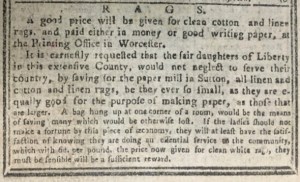
Advertisements asking families to save linen rags to support American printing were not uncommon during the era of the American Revolution. An advertisement printed on the back of Thomas’s Massachusetts, New-Hampshire, and Connecticut Almanack for the Year of our Lord Christ 1779 claims “ fair daughters of Liberty…would not neglect to serve their country, by saving for the paper mill in Sutton, all linen and cotton and linen rags.” Again, entrepreneurs who made paper or printed on it used patriotism to pressure households to support American industry by donating rags. Kayla Haveles argues that printing was “as vital to revolution as guns and gunpowder” because the colonists used it to spread ideology and attack the British.

Thomas’s Massachusetts, Connecticut, and New-Hampshire Almanack for the Year of Our Lord Christ 1779 (Worcester: Isaiah Thomas, 1778).

Additionally, the frequency of these advertisements highlights the contributions of women in the Revolution. Both advertisements focus on saving rags in the home. Keating’s advertisement asked every family to save spare rags in their household. Women were responsible for the housework so Keating’s call to action targeted women. The advertisement on the back of the almanac asked “daughters of Liberty” to save rags. Both advertisements are examples of how women contributed to the Revolution by supporting the American economy.

**********

ADDITIONAL COMMENTARY:  Carl Robert Keyes

John Keating had been placing similar advertisements for the “NEW-YORK Paper MANUFACTORY” for years by the time this advertisement appeared in the March 24, 1774, edition of the New-York Journal.  The Adverts 250 Project first featured one of his advertisements that offered “Ready Money for clean Rags” that ran in that newspaper on February 18, 1768.  During the six years in between, Keating maintained an almost constant presence in the public prints, encouraging colonizers, especially women, to collect rags for paper production and explaining the patriotic benefits of their efforts.  He advertised at times when relationships with Parliament deteriorated, including when nonimportation agreements went into effect to protest various legislation, as well as when the situation cooled and most merchants, shopkeepers, and consumers returned to business as usual.  Keating remained a steady voice in favor of “domestic manufactures” or goods produced in the colonies.

In this instance, Keating ran his advertisement at a time of crisis.  Throughout the colonies, the destruction of the tea in Boston the previous December remained a topic of conversation, including in New York.  The Sons of Liberty anticipated the arrival of the Nancy with a cargo of tea that they did not want landed in their city.  Keating’s advertisement, which had been running since before the Boston Tea Party, appeared on the last page of the March 24 issue, interspersed among other advertisements.  A notice that the Sons of Liberty would meet every Thursday evening “till the Arrival and Departure of the TEA SHIP,” on the other hand, made its second appearance, this time in the first column on the first page.  Only tables showing prices current and sunrise, sunset, and high tide preceded the announcement.  Its placement made it more likely that readers would see it, while also framing how they read other advertisements in the issue.  Most readers likely did not need that notice from the Sons of Liberty to influence their reaction to Keating’s advertisement calling on “all those who really wish to promote the interest of America” to do their part, considering how widely colonizers discussed the politics of tea at the time.  Still, the combination of print culture and public discourse occurring everywhere from the town common to taverns made Keating’s appeals to patriotism even more urgent.

March 10

What was advertised in a colonial American newspaper 250 years ago today?

Pennsylvania Journal (March 10, 1773).

“Made it their particular study to encourage their own manufactures.”

Today, collectors consider precious glassware produced in the eighteenth century by Henry William Stiegel at his American Flint Glass Manufactory, but during his own lifetime the German-American glassmaker did not achieve the same renown.  Like many other artisans, he published newspaper advertisements in an effort to entice consumers and improve his prospects.

In many of those advertisements, Stiegel attempted to convince prospective customers to support “domestic manufactures” by purchasing goods produced in the colonies, especially glassware he made at his manufactory in Manheim in Lancaster County, Pennsylvania, rather than imported alternatives.  Artisans and others launched “Buy American” campaigns during the imperial crisis, suggesting to colonizers that they had a civic responsibility to practice politics through the decisions they made in the marketplace.  In an advertisement in the March 10, 1773, edition of the Pennsylvania Journal, Stiegel and his broker in Philadelphia, William Smith, made the case that the “friends and well-wishers to America have, on all laudable occasions, shewed a spirit of patriotism worthy of themselves, and made it their particular study to encourage their own manufactures in preference to all others.”  Stiegel and Smith reiterated an appeal that Stiegel made in another advertisement in November 1771.

The glassmaker and his broker challenged consumers to take part in “so noble a resolution” to purchase “their own manufactures,” yet that was not the extent of their sales pitch.  They also emphasized price, stating that they sold glassware “on as good terms” as imported goods, and quality, asserting that the “ELEGANT ASSORTMENT” of items was “as neat in their kinds” as “any imported from Europe.”  Prospective customers did not have to take their word for it.  Instead, Stiegel and Smith confidently asserted that if “impartial judges” inspected works from the American Flint Glass Manufactory that they would reach the same conclusion.

Stiegel and Smith presented decisions about consumption as political acts, yet they recognized that politics alone would not motivate some consumers, especially during a lull in tensions between colonizers and Parliament.  That being the case, they assured prospective customers that when they purchased glassware produced by Stiegel that they acquired merchandise equal in quality to items imported from Europe and at the same prices.  They hoped that the combination of appeals would convince consumers to support “their own manufactories” in the colonies.

February 1

What was advertised in a colonial American newspaper 250 years ago today?

New-York Gazette and Weekly Mercury (February 1, 1773).

“He most humbly addresses the Fair Sex, requesting their aid.”

John Keating regularly offered “READY MONEY … for CLEAN LINEN RAGS” in the New-York Gazette and Weekly Mercury in the late 1760s and early 1770s.  The papermaker needed as many rags as he could gather to supply his mill with raw materials.  To convince readers to make an effort to collect and submit rags, he developed appeals that emphasized both commerce and devotion to the best interests of the colonies.

In an advertisement that ran on February 1, 1773, for instance, Keating stated that the “advantages that must result to this colony from the establishment of manufactories in it, are so obvious that the subject needs no elucidation.”  Then he elucidated.  “Since paper manufactories were established in Pennsylvania, the money saved and brought into that province, the money saved and brought into the province” amounted to “the many thousand pounds of which is annually drained of[f] by purchasing paper in England.”  Supporting domestic manufactures, goods produced in the colonies, helped to address the trade imbalance with Great Britain.  Keating challenged readers to think about what more they accomplish by working together.  “Might not every shilling of this money be saved?  Have we not materials amongst ourselves?  Is our patriotism all pretence …?”

New Yorkers did indeed already have the materials necessary for making paper, clean linen rags.  Keating suggested that women played a vital role in sustaining the patriotic project that he pursued, declaring that he “most humbly addressed the Fair Sex, requesting their aid, without which it will be impossible for him to establish this manufactory upon a respectable or prudent footing.”  He requested that every “frugal matron … hang up a bag … and take care to put every piece of linen that is unfit for any other use, in it.”  When the bag was full, the frugal matron would sell the contents to Keating in an eighteenth-century version of recycling to support a good cause.  The papermaker indicated that in return for the clean linen rags the frugal matron would receive enough money to “supply herself and family with the very essential article of pins.”  Just as significantly, “she will have the satisfaction of being conscious of contributing her part to the advancement of her country.”  Women’s industry served a dual purpose when it manifested patriotism.

The project did not depend solely on those frugal matrons.  Keating also asked “young ladies to co-operate … in saving rags,” though he presented a more romantic rationale to them.  The papermaker asked young women to “observe a very curious remark made by the celebrated Mr. Addison in the Spectator, ‘That a young lady who sends her shift to the paper mill, may very possibly in less than six months, have it returned made into a piece of fair paper, upon which her lover has written a billet doux.’”  Although Keating (and Addision) asked young women to imagine love letters, their shifts and other linen garments may just as likely been transformed into newspapers that kept their households informed about the imperial crisis that faced New York and other colonies.

Women, both “frugal matrons” and “young ladies,” participated in politics and expressed their patriotism when they heeded the call of papermakers who encouraged them to collect clean linen rags.  Similarly, their actions and decisions made an impact when they produced homespun textiles and garments and participated in nonconsumption agreements.  During the era of the American Revolution, both men and women understood that the personal was political.  That included gathering clean linen rags in “a bag in some convenient part of the house.”

April 1

What was advertised in a colonial American newspaper 250 years ago this week?

Boston Evening-Post (March 30, 1772).

“An ORATION … to commemorate the BLOODY TRAGEDY.”

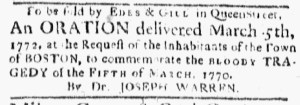
On the second anniversary of the Boston Massacre, Dr. Joseph Warren delivered “An ORATION … at the Request of the Inhabitants of the Town of BOSTON, to commemorate the BLOODY TRAGEDY of the FIFTH of MARCH, 1770.”  Colonizers gathered to listen to the address, but attending that gathering was not their only means of participating in the commemoration of such a significant event.  Benjamin Edes and John Gill, printers of the Boston-Gazette, published Warren’s “ORATION” and marketed it widely in Massachusetts.

They placed their first advertisement in their own newspaper less than three weeks after Warren addressed “the Inhabitants of the Town.”  Their lengthy notice in the March 23, 1772, edition of the Boston-Gazette included an extensive excerpt about “the ruinous Consequences of standing Armies to free Communities.”  Edes and Gill also stated that they stocked “A few of Mr. LOVELL’S ORATIONS Deliver’d last April, on the same Occasion.”  Prospective customers had an opportunity to collect memorabilia related to the “FATAL FIFTH OF MARCH 1770.”  The following day, Samuel Hall, one of the printers of the Essex Gazette, informed readers that he sold copies of Warren’s address “published in Boston.”  His advertisement did not include an excerpt from the address, nor did subsequent advertisements that Edes and Gill placed in other newspapers in Boston.  They inserted a brief notice in the Massachusetts Gazette and Boston Weekly News-Letter on March 26 and then repeated it in the Boston Evening-Post on March 30.

Edes and Gill advertised widely.  That increased the chances that consumers would see their notices and contemplate purchasing copies of Warren’s “ORATION,” but those patriot printers likely aimed for more than generating sales.  Their advertisements in several newspapers contributed to a culture of commemoration of the American Revolution years before the skirmishes at Lexington and Concord.  Their work in the printing office, publishing newspapers and marketing pamphlets that commemorated the Boston Massacre, played an important role in shaping public opinion as colonizers considered current events and the possibility of declaring independence.

March 23

What was advertised in a colonial American newspaper 250 years ago today?

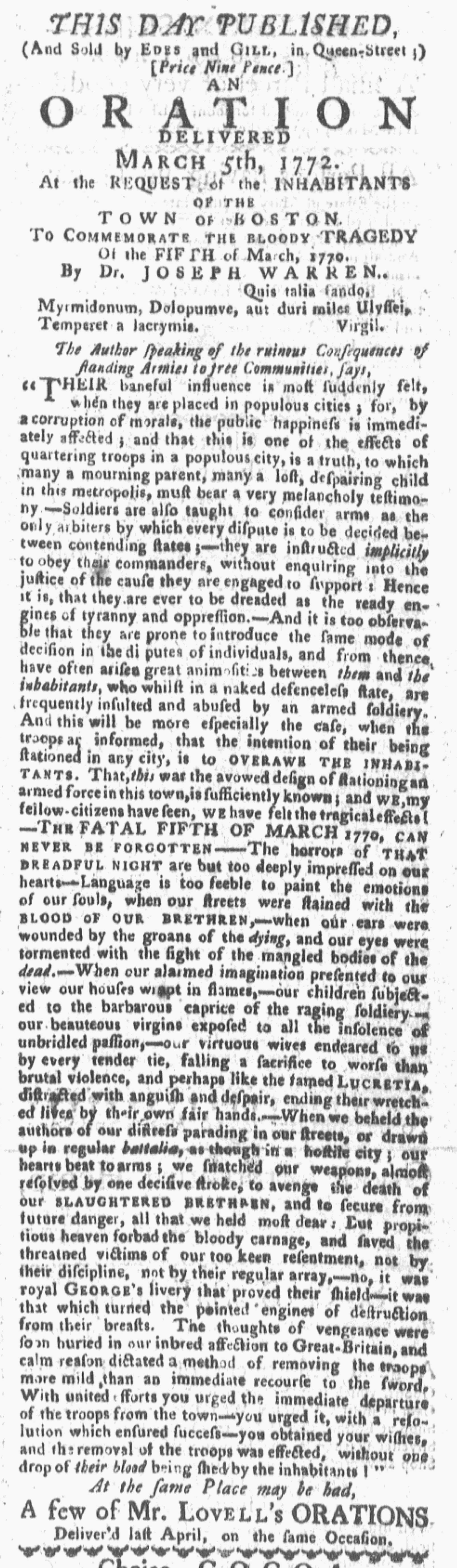
Boston-Gazette (March 23, 1772).

“AN ORATION … TO COMMEMORATE THE BLOODY TRAGEDY.”

Commemoration and commodification of the Boston Massacre commenced just weeks after British soldiers killed several colonizers when they fired into a crowd of protesters on March 5, 1770.  Paul Revere advertised “A PRINT containing a Representation of the late horrid Massacre in King-Street” in the March 26, 1770, edition of the Boston-Gazette.  He appropriated the image from a sketch done by Henry Pelham.  A week later, Pelham advertised “The Fruits of Arbitrary Power, An Original Print, representing the late horrid Massacre in King Street, taken from the Spot” in the April 2 edition of the Boston-Gazette.  A year later, colonizers in Boston determined that public orations should mark the event.  On April 2, 1771, James Lovell delivered “AN Oration … At the Request of the Inhabitants of the Town of Boston; To Commemorate the Bloody Tragedy of the Fifth of March, 1770.”  Not long after that, an advertisement in the April 15 edition of the Boston-Gazette promoted copies for colonizers to purchase.

In subsequent years, the annual oration occurred on March 5.  From 1771 through 1783, this commemorative event attracted more attention in Boston than Independence Day, but after the Treaty of Paris brought the Revolutionary War to an end July 4 became more widely recognized.  On the second anniversary of the Boston Massacre, Joseph Warren gave “AN ORATION … At the REQUEST of the INHABITANTS OF THE TOWN OF BOSTON TO COMMEMORATE THE BLOODY TRAGEDY Of the FIFTH of March, 1770.”  An advertisement quickly appeared in the March 23 edition of the Boston-Gazette, filling nearly two-thirds of a column.  The advertisement occupied so much space because Benjamin Edes and John Gill, the patriot printers of both the Boston-Gazette and the oration, included an extensive excerpt about “the ruinous Consequences of standing Armies to free Communities.”  The printers hoped that by giving prospective customers a taste of what Warren had to say about the “tyranny and oppression” of an “armed soldiery” who “frequently insulted and abused” the residents of Boston that would entice them to purchase the oration and read more.  Doing so also gave them an opportunity to remember the “horrors of THAT DREADFUL NIGHT” and venerate “the mangled bodies of the dead” who perished as a result of the “barbarous caprice of the raging soldiery.”

At the end of the advertisement, Edes and Gill noted that they also stocked “A few of Mr. LOVELL’S ORATIONS Deliver’d last April, on the same Occasion.”  They made it easy for patriotic consumers to collect memorabilia associated with the Boston Massacre.  Commemoration and commodification of that event occurred simultaneously in the years before the colonies declared independence.

November 10

What was advertised in a colonial American newspaper 250 years ago this week?

Pennsylvania Journal (November 8, 1771).

“American FLINT GLASS.”

When Parliament repealed most of the duties on imported goods imposed by the Townshend Acts, leaving only the duty on tea in place, most American merchants counted it as a victory that merited bringing their own nonimportation agreements to end in favor of resuming regular trade with Britain.  Some colonists objected, insisting that they should hold out until Parliament met all of their demands by repealing the duty on tea as well, but they were in the minority.  Merchants and consumers alike welcomed the return to transatlantic business as usual.

That did not, however, prevent American producers from promoting their “domestic manufactures” as alternatives to imported goods.  Henry William Stiegel, for instance, advertised “American FLINT GLASS … made at the factory in Manheim in Lancaster county” in Pennsylvania during the summer of 1771 and into the fall.  Stiegel proclaimed that his product was “equal in quality with any imported from Europe,” reassuring prospective customers that they did not have to sacrifice quality when choosing to support American industry.  He also promised that “merchants, store-keepers and others” could acquire his glass “on very reasonable terms.”  In addition to competitive prices, “Wholesale dealers” received discounts for “buying large quantities.”

Pocket Bottle, attributed to American Flint Glass Manufactory, 1769-1774. Courtesy Metropolitan Museum of Art.

Stiegel also framed purchasing his “American FLINT GLASS” as a patriotic duty for both retailers and consumers, even though the situation between the colonies and Britain was relative calm at the moment.  He declared that “as the proprietor” of the factory in Manheim he “well knows the patriotic spirit of the Americans” and “flatters himself they will encourage the manufactories of their own country” whenever possible instead of purchasing or retailing imported goods.  To help consumers and retailers throughout the region submit orders, Stiegel designated local agents in Philadelphia, Lancaster, and York in Pennsylvania as well as Baltimore in Maryland.

Work attributed to Stiegel and the American Flint Glass Manufactory, including this pocket bottle produced at about the same time he advertised in the Pennsylvania Journal, survives in museums and private collections.  Whether attracted by the quality, price, or invitation to “Buy American,” colonial consumers purchased “domestic manufactures” even as they resumed buying imported goods.  Stiegel managed to garner a share of the market amid the array of choices available. The frequency that he placed notices in newspapers suggests that he apparently believed that advertising aided in that endeavor.

September 18

What was advertised in a colonial American newspaper 250 years ago this week?

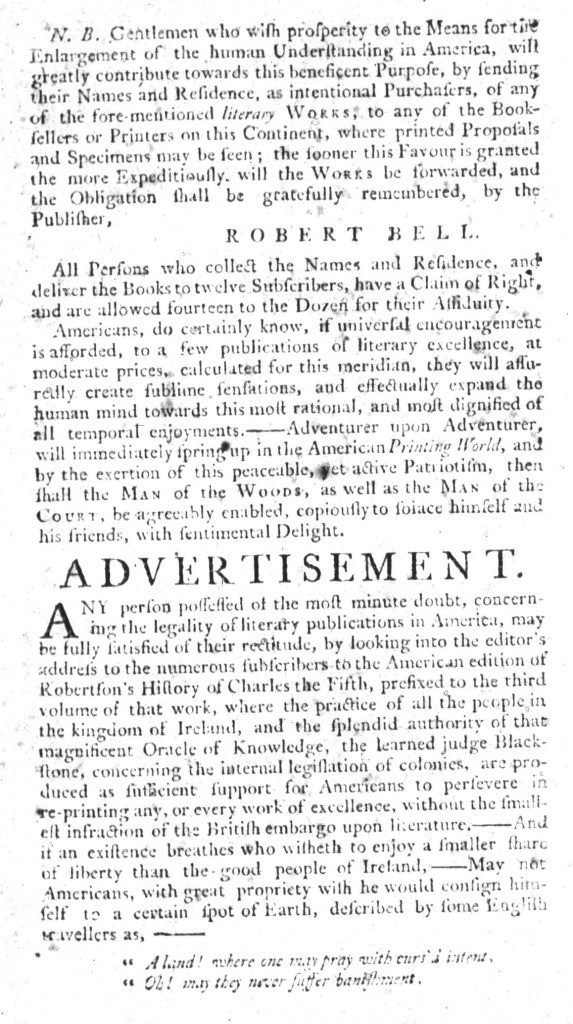
Final page of Robert Bell’s subscription notice for Blackstone’s Commentaries that may (or may not) have been distributed with the September 17, 1771, edition of the South-Carolina and American General Gazette.

“Peaceable, yet active Patriotism.”

Yesterday, the Adverts 250 Project featured Robert Bell’s subscription notice for Blackstone’s Commentaries on the Laws of England that Accessible Archives included with the September 17, 1771, edition of the South-Carolina and American General Gazette and addressed the difficulty of determining whether the subscription notice originally accompanied the newspaper.  Today, the marketing strategies deployed by Bell merit consideration.

First, however, consider the format of the subscription notice, a four-page flier.  On the first page, addressed “TO THE AMERICAN WORLD,” Bell encouraged prospective customers throughout the colonies to purchase American editions rather than imported books.  It could also have been published separately as a handbill, similar to the second page featuring two advertisements for books “Lately Published” by Bell, “YORICK’S Sentimental Journal Through FRANCE and ITALY” by Laurence Stern and “HISTORY OF BELISARIUS, THE HEROIC AND HUMANE ROMAN GENERAL” by Jean-François Marmontel.  On the third and fourth pages, Bell promoted William Robertson’s “HISTORY of CHARLES the FIFTH, EMPEROR of GERMANY,” a work he widely advertised in newspapers throughout the colonies, and other American editions.  The flier concluded with a note defending “the legality of literary publications in America.”

Both before and after the American Revolution, Bell established a reputation as one of the most vocal proponents of creating a distinctly American literary market served by printers and publishers in the colonies and, later, the new nation.  Bell advanced both political, economic, and cultural arguments in favor of an American book trade during the imperial crisis.  He opened his address “TO THE AMERICAN WORLD” by proclaiming that “THE inhabitants of this continent have now an easy, and advantageous opportunity of effectually establishing literary manufactures … the establishment of which will absolutely and eventually produce mental improvement, and commercial expansion.”  In addition, purchasing books published in America would result in “saving thousands of pounds” by consumers as well as keep the money on that side of the Atlantic.  Colonists could pay lower prices and, in the process, what they did spend would be “distributed among manufacturers and traders, whose residence upon the continent of course causeth the money to circulate from neighbour to neighbour, and by this circulation in America there is a great probability of its revolving to the very hands from which it originally migrated.”  Supporting domestic manufactures, including American publications, would create stronger local economies, Bell argued.

“American Gentlemen or Ladies” had a patriotic duty to lend their “auspicious patronage” to such projects by informing their local bookseller or printer that they wished to become “intentional purchasers of any of the literary works now in contemplation to be reprinted by subscription in America.”  In so doing, they would “render an essential service to the community, by encouraging native manufactures.  In turn, they “deserve[d] … grateful remembrance—By their country—By posterity.”  These subscribers would also contribute to the enlightenment of the entire community, the “MAN of the WOODS” as well as the “MAN of the COURT.”  In the hyperbolic prose he so often used in his marketing materials, Bell declared that “Americans, do certainly know, if universal encouragement is afforded, to a few publications of literary excellence … they will assuredly create sublime sensations, and effectually expand the human mind towards this most rational, and most dignified of all temporal enjoyments.”  In addition, he described himself and other American printers and publishers as engaging in “peaceable, yet active Patriotism” in making inexpensive American editions of several “literary WORKS” available to consumers.

Bell frequently inserted advertisements with similar messages into newspapers from New England to South Carolina, but those were not his only means of encouraging “THE AMERICAN WORLD” to support domestic manufactures and the creation of an American literary market that would result in self-improvement among readers far and wide.  In subscription notices (which may have been distributed with newspapers on occasion), book catalogs, and broadsides, he advanced the same arguments much more extensively than space in newspapers allowed.

April 15

What was advertised in a colonial American newspaper 250 years ago today?

Boston-Gazette (April 15, 1771).

“The most strict Compliance with the Non-Importation Agreement.”

Colonial merchants and shopkeepers often included introductory remarks about the origins of their imported goods in their newspaper advertisements.  In the April 15, 1771, edition of the Boston-Gazette, for instance, William Jones advertised goods “JUST IMPORTED In the Ship LYDIA, JAMES SCOTT, Master, from LONDON.”  Similarly, Hugh Tarbett marketed goods “Imported in the Snow Jenny, Hector Orr, Master, from Glasgow.”  Both followed a format familiar to both advertisers and readers.  Samuel Eliot did so as well, announcing that he carried goods that he “has now IMPORTED in the Ships just arrived from LONDON.”  Eliot added an additional note that he sold those goods “after a long Suspension of Business by his strict Adherence to the late Non Importation Agreement.”  John Hancock did the same.  Like Jones and several others who advertised in that issue, Hancock received goods via the Lydia.  He proclaimed that he offered those items to customers “after the most strict Compliance with the Non-Importation Agreement during its Continuance.”

Eliot and Hancock both signaled their support of the patriot cause and suggested that consumers should purchase goods from them, now that trade with Britain commenced again, because they had faithfully obeyed the boycotts enacted in protest of duties imposed on certain imported goods by the Townshend Acts.  Hancock’s version of events, however, did not match coverage in the Boston Chronicle in the summer of 1769.  The committee of merchants who oversaw compliance with the nonimportation agreement singled out John Mein, loyalist printer of the Boston Chronicle, for continuing to import and sell British goods.  In turn, Mein published an exposé of prominent merchants who publicly claimed to support the nonimportation agreement yet continued to receive goods from Britain.  On August 21, 1769, he listed the cargoes of several ships, the owners of those vessels, and the merchants who ordered and received the goods.  That coverage included a “Manifest of the Cargo of the Brigantine Last Attempt, … Owner, JOHN HANCOCK,” a “Manifest of the Cargo of the Brigantine Lydia, … Owner, JOHN HANCOCK,” and a “Manifest of the Cargo of the Brigantine Paoli, … Owner JOHN HANCOCK.”  Mein called on the “PATRIOTIC GENTLEMAN” who owned those vessels to provide the public with more information.  Over the next two months, Mein continued his critique of Hancock and other patriot leaders.  In late October, he published character sketches that included one for “Johnny Dupe,” a jab at Hancock for duping the public by continuing to profit from importing goods despite claiming to support the boycott.  Not long after that, a mob attacked Mein.  He fled Boston, leaving the Boston Chronicle in the hands of his partner, John Fleeming.  The newspaper folded less than a year later.

Hancock’s claim that he sold an “Assortment of Goods” received from London only after “the most strict Compliance with the Non-Importation Agreement during its Continuance” was a polite fiction, at best.  He attempted to deploy patriotism as part of his marketing strategy, asking supporters of the American cause to endorse his version of events despite evidence to the contrary published in the Boston Chronicle two years earlier.  After all, that incident resulted in the disgrace and flight of a loyalist printer, not the prominent merchant and vocal supporter of the patriot cause.  When it came to marketing, image mattered, perhaps even more than reality.

**********

The Massachusetts Historical Society provides access to the August 21, 1769, edition of the Boston Chronicle via their online collections.

February 20

What was advertised in a colonial American newspaper 250 years ago this week?

Pennsylvania Chronicle (February 18, 1771).

“We hope to meet with encouragement from the patriotic gentlemen and ladies of this city.”

In January and February 1771, Russel and Moore ran advertisements informing the residents of Philadelphia and its hinterlands that they had “a fine stocking loom a making, in order to weave silk on, in all its different branches.”  That included “breeches and jacket patterns, stockings, mitts, caps, and gloves” adorned with “all different figures and flowers, such as have not heretofore been manufactured in America.”

Russel and Moore launched an enterprise that they framed for consumers as building on other efforts to create commercial opportunities in the colonies.  For quite some time, colonists from New England to Georgia attempted to produce silk.  According to Russel and Moore, “the inhabitants of this city, and places adjacent, have made satisfactory proof or raising raw silk.”  The partners hoped that would inspire others throughout the colonies “to raise such silk in a more extensive manner, which in a short time will find greatly to their advantage.”  For their part, Russel and Moore stood ready “to weave in said loom” and they would “engage to make gentlemen and ladies gloves and mitts” that matched the designs and patterns “wove in any mitt or glove imported from any part of the world.”  Furthermore, they promised the highest standards and quality for the items they produced, predicting it would be “richer in work than any we have seen imported here.”

The partners sought customers among consumers who had been contemplating the benefits of “domestic manufactures,” goods produced in the colonies, for several years.  In response to the Stamp Act and, especially, duties imposed on imported goods by the Townshend Acts, colonists both called for producing more goods in the colonies and encouraged the consumption of those goods as alternatives to imports.  Producers and purveyors of those domestic manufactures addressed that discourse in their advertisements, providing further incentive for consumers to follow through on purchasing goods made locally.  They reminded consumers of the political meanings attached to goods and offered reassurances that they would not sacrifice quality when they chose to “Buy American.”

Russel and Moore did so when they noted that produced items that “have not heretofore been manufactured in America” and requested “encouragement from the patriotic gentlemen and ladies of this city, and places adjacent.”  The partners did their part in producing alternatives to imported goods; in turn, “patriotic gentlemen and ladies” needed to do their part as well.  Russel and Moore reiterated the importance of consumers supporting entrepreneurs who produced goods in the colonies.  “[A]s we are the first persons,” they proclaimed, “that have erected a machine in America, for making of ribbed stockings, or any kind of figured work in said branch, we hope the public will endeavour to encourage a manufactory.”  Russel and Moore promised quality, stating that they would “give full satisfaction to every friend of America.”  In making a call for patriotic consumption, the partners joined many other advertisers who promoted domestic manufactures in the late 1760s and early 1770s.