
What was advertised in a revolutionary American newspaper 250 years ago today?
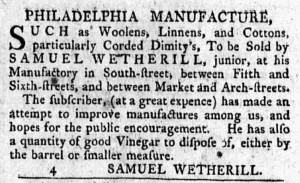
“PHILADELPHIA MANUFACTURE.”
In the summer of 1776, Samuel Wetherill took to the pages of the Pennsylvania Ledger to hawk a variety of textiles produced at his “Manufactory in South-street” in Philadelphia. He offered “Woolens, Linnens, and Cottons, particularly Corded Dimity’s,” to consumers, giving them an alternative to fabrics imported from England. He emphasized that he sold “domestic manufactures” with a headline that proclaimed, “PHILADELPHIA MANUFACTURE.” Wetherill elaborated on that point by noting the “great expence” he had undertaken in his “improve manufactures among us” and, in turn, expected “the public encouragement” for his endeavor.
Wetherill was one of many advertisers who made some sort of “Buy American” appeal during the era of the American Revolution. As T.H. Breen explains in The Marketplace of Revolution, calls to produce and purchase goods made in America began even before the imperial crisis. As colonizers participated in the transatlantic consumer revolution, some noticed the imbalance of trade that emerged within a commercial empire organized around Britain producing goods and the colonies consuming those goods. Once Parliament imposed new regulations on trade, especially duties on imported goods, and the colonies responded with boycotts of those goods, establishing and supporting the production of goods in the colonies became even more important. When the Second Continental Congress devised the Continental Association, a nonimportation and nonconsumption agreement adopted throughout the colonies, the eighth article stated, “That we will, in our several Stations, encourage Frugality, Economy, and Industry; and promote Agriculture, Arts, and the Manufactures of this Country, especially that of Wool.” Producing (and consuming) goods produced in America became even more important after the Continental Congress declared independence.
Wetherill did his part and he used an advertisement in the Pennsylvania Ledger to let prospective customers in Philadelphia and the region know that he did. Along with his “attempt to improve manufactures among us” came a reciprocal obligation for consumers to give their “public encouragement” by purchasing the textiles that Wetherill and his employees produced “at his Manufactory.” He presented an opportunity to acquire “PHILADELPHIA MANUFACTURE,” goods produced in their own city or state as a means of strengthening the local economy.