March 15

What was advertised in a colonial American newspaper 250 years ago today?
Mar 15 - 3:15:1770 Massachusetts Gazette and Boston Weekly News-Letter
Massachusetts Gazette and Boston Weekly News-Letter (March 15, 1770).

“All sorts of English Goods, imported before the Non-importation Agreement took place.”

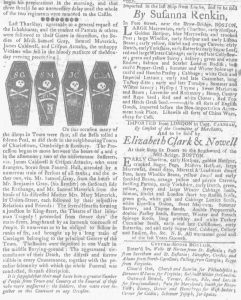
Richard Draper, printer of the Massachusetts Gazette and Boston Weekly News-Letter, included coverage of the “bloody massacre” and the funerals of the victims in the March 15, 1770, edition of his newspaper.  In so doing, he adopted a method commonly used by printers throughout the colonies:  he reprinted news that already appeared in another newspaper.  In this case, he reprinted an article about the funeral procession that Benjamin Edes and John Gill originally printed in the March 12, 1770, edition of the Boston-Gazette, though Draper included a brief addendum at the conclusion.  “It is supposed,” he added, “that their must have been a greater Number of People from Town and Country at the Funeral of those who were massacred by the Soldiers, than were ever together on this Continent on any Occasion.”  Draper even included an image depicting the coffins of Samuel Gray, Samuel Maverick, James Caldwell, and Crispus Attucks.  Edes and Gill presumably loaned him the woodcut.

The article, along with the dramatic image that drew attention to it, aimed to disseminate information about the Boston Massacre to readers in the city and far beyond.  The advertisements that appeared in close proximity may have received more notice – and more scrutiny – than under other circumstances.  The two notices that ran immediately next to the article about the “bloody massacre,” both placed by female seed seller commencing their annual marketing campaigns as spring approached, addressed the politics of the period, though they did not comment explicitly on recent events in King Street or the funeral procession that followed.  Susanna Renken listed the seeds she offered for sale, but also declared that she stocked “all sorts of English Goods.”  She carefully noted that she imported those wares “before the Non-importation Agreement took Place.”  Similarly, Elizabeth Clark and Elizabeth Nowell asserted that they imported their seeds from London and sold them “By Consent of the Committee of Merchants” who oversaw adherence to the nonimportation agreement and reported violators.

These advertisements demonstrate that readers did not experience a respite from politics and current events when they perused advertisements for consumer goods and services during the era of the American Revolution.  Instead, advertisers increasingly inflected politics into their notices as they enticed prospective customers not only to make purchases but also to make principled decisions about which merchandise they did buy.  Those advertisers assured the community that they had already made such principled decisions themselves.
March 12

What was advertised in a colonial American newspaper 250 years ago today?

Mar 12 - 3:12:1770 New-York Gazette and Weekly Mercury
New-York Gazette and Weekly Mercury (March 12, 1770).

“… from a Principle of Love to their Country.”

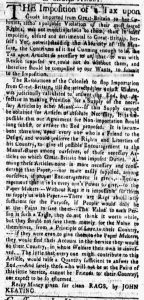
John Keating became a familiar figure in advertisements that appeared in the New-York Gazette and Weekly Mercury and other newspapers in the late 1760s and early 1770s.  He operated a paper manufactory and presented his enterprise as providing a patriotic alternative to paper imported from Britain.  He objected to the duties that Parliament levied on imported paper in the Townshend Acts while simultaneously noting that consumers could foil such attempts to tax them by purchasing paper made locally.  He also frequently took the pages of the New York’s newspapers to encourage colonists to participate in the production of paper by collecting rags and turning them over to him to be transformed into paper, as he did in the March 12, 1770, edition of the New-York Gazette and Weekly Mercury.

His entreaty commenced with a prologue that could have been part of a political tract rather than a newspaper advertisement: “THE Imposition of a Tax upon Goods imported from Great-Britain to her Colonies, altho’ a palpable Violation of their most sacred Rights, was not more injurious to them, than in itself impolitic, absurd and detrimental to Great-Britain, herself: Yet, notwithstanding the Absurdity of the Measure, the Contrivers of it had Cunning enough to lay the Tax upon Articles of necessary to us, that it was with Reason supposed we could not do without them, and therefore should be compelled by our Wants, to submit to the Imposition.”  From there, Keating outlined the nonimportation agreements that went into effect in several colonies, noting that “Friends to their Country” could play an important role in continuing to make paper available if only they would collect their rags and turn them over to the paper manufactory.  Keating estimated that there “are Rags abundantly sufficient for the Purpose” that colonists should save “from a Principle of Love to their Country.”

Keating frequently made such appeals, but on this occasion his exhortation may have gained additional urgency.  It ran next to a news item dated “BOSTON, March 1” that reported “the melancholy Affair at the North End.”  The Massachusetts Historical Society provides this summary of events that took place on February 22: “Ebenezer Richardson, a customs informer, fired a musket through a broken window in his house at a crowd of young men and boys who had been taunting customers of a store selling British imports.”  In addition to wounding others, Richardson killed Christopher Seider, age eleven.  His funeral on February 26 was a significant event.  According to the report in the New-York Gazette and Weekly Mercury, “a great Multitude of People assembled in the Houses and Streets to see the Funeral Procession, which departed “from Liberty-Tree.”  Killed less than two weeks before the Boston Massacre, Seider could be considered the first casualty of the American Revolution.  News of that “Bloody Massacre,” as Paul Revere labeled it, did not yet appear in the New-York Gazette and Weekly Mercury, but the death of Seider may have been sufficient to put Keating’s calls for colonists to collect rags into new perspective.  He offered a practical means for “Service they would do their Country, in whose Welfare their own is involved.”

**********

For a more complete accounting of the death and burial of Christopher Seider, see the series of articles by J.L. Bell on Boston 1775.

February 19

What was advertised in a colonial American newspaper 250 years ago today?

Feb 19 - 2:19:1770 Boston-Gazette
Boston-Gazette (February 19, 1770).

“List of Commissioners and other Officers of the Revenue, WITH THEIR SALARIES!”

In the third week of February 1770, many printers continued to advertise almanacs, hoping to relieve themselves of surplus copies that counted against any profits they might earn on the venture.  In contrast, Benjamin Edes and John Gill, printers of the Boston-Gazette, advertised that they had plans within the next few days to publish their “North-AmericanALMANACK, AND Massachusetts REGISTER, For the Year 1770.”  They either identified demand, even that far into February of the new year, or believed that they could incite sufficient demand to merit the expense of pursuing the project.

In presenting this edition of their almanac to the public, Edes and Gill focused on the contents of the “REGISTER.”  They listed the contents, including useful reference material from tables of colonial currencies to descriptions of “Public Raods, with the best Stages or Houses to put up at” to dates of “Feasts and Fasts of the Church of England.”  Many of the contents had a decidedly political tone, making it clear that Edes and Gill marketed this almanac and register to supporters of the patriot cause.  The printers led the list of contents with “A Prospective View of the Town of Boston the Capital of New-England; and the Landing of – Troops in the Year 1768, in Consequence of Letters from Gov. Bernard, the Commissioners, &c. to the British Ministry.”  This woodcut, fashioned by Paul Revere, depicted eight British warships delivering troops to be quartered in Boston.  In addition to that frontispiece, the almanac and register also contained an overview of many of the other sources of tension between the colonies and Britain, including a “List of the Importers and Resolves of the Merchants &c. of Boston” and a “List of Commissioners and other Officers of the Revenue, WITH THEIR SALARIES!”  More than just a handy register of practical information, this was a primer in patriot politics.  Even items intended for amusement had a political flair, such as “Liberty Song” and “A New Song, to the Tune of the British Grenadier, by a SON OF LIBERTY.”

It was rather late in the year for Edes and Gill to publish an almanac, but they apparently considered it a good time to disseminate patriot propaganda.  The “Judgment of the Weather, Suns and Moon’s Rising and Setting,” and other material commonly contained in almanacs did not receive much notice in their advertisement.  Instead, they emphasized contents related to colonial grievances, presenting consumers with new opportunities to participate in acts of resistance by purchasing items that documented the events unfolding around them.  By bringing those narratives into their homes, colonists would become better informed and perhaps even more politicized in favor of the patriot cause.

February 18

What was advertised in a colonial American newspaper 250 years ago this week?

Feb 18 - 2:15:1770 Massachusetts Gazette and Boston Weekly News-Letter
Massachusetts Gazette and Boston Weekly Mercury (February 15, 1770).

“All of which were imported before the Non-Importation Agreement took Place.”

Colonial merchants and shopkeepers frequently incorporated details about how they came into possession of their imported goods into their efforts to convince consumers to purchase them.  Many newspaper advertisements began with a recitation of which vessels had transported the wares across the Atlantic along with the names of the captains and the ports or origin.  This formulaic introduction to advertisements for consumer goods often began with the phrase “just imported,” meant to signal to prospective customers that purveyors of goods did not expect them to purchase inventory that had been lingering on their shelves or in their storehouses for extended periods.

In the late 1760s and early 1770s, however, many advertisers abandoned that marketing strategy in favor of another.  When the duties placed on imported paper, glass, lead, paint, and tea via the Townshend Acts motivated colonists to protest by boycotting a broad array of goods imported from Britain, the phrase “just imported” took on a different meaning, one with political overtones.  Once nonimportation agreements were place for months, the newness of goods no longer had the same value.  Items “just imported” from London and other English ports lost their cachet when they became symbols of both British oppression and the complicity of any who dared to violate community standards by continuing to import and sell such goods.

Many advertisers developed a new marketing appeal contingent on the politics of the period.  They underscored that they did indeed sell goods that arrived in the colonies many months earlier, perhaps grateful that conspicuously adhering to nonimportation agreements presented an opportunity to sell surplus inventory that had indeed lingered on their shelves or in their storehouses longer than was healthy for balancing their own accounts.  Whatever their motives, they harnessed politics in their attempts to drum up business, informing prospective customers that they acquired their wares in advance of the boycotts going into effect.  Such was the case for William Bant who had “yet on Hand a few English Goods” in February 1770.  He made sure that consumers knew that all those items “were imported before the Non-Importation Agreement took Place.”  He did his patriotic duty … and prospective customers did not have to worry about shirking theirs when they visited his shop.

February 13

What was advertised in a colonial American newspaper 250 years ago today?

Feb 13 - 2:13:1770 Essex Gazette
Essex Gazette (February 13, 1770).

“All the above Articles, were imported before the Agreement, entered into by the Merchants for Non-importation, took Place.”

Thomas Lewis’s advertisement for an assortment of goods available at his shop in Marblehead cataloged dozens of items and extended nearly an entire column. In that regard, it matched advertisements placed by merchants and shopkeepers in other newspapers, especially those published in the largest port cities, but greatly exceeded the length of most that ran in the Essex Gazette in the late 1760s and early 1770s. Lewis listed everything from “ivory horn combs” to “large white stone dishes” to “men’s white and brown thread gloves.”

He apparently determined that if he was going to assume the expense of such a lengthy advertisement that he should extend it a little bit more to address concerns that members of his community might have about his inventory. After concluding his list, he informed readers that “All the above Articles, were imported before the Agreement, entered into by the Merchants for Non-importation, took Place.” Lewis had not violated the boycott in place as a means of protesting the duties Parliament imposed on imported paper, glass, paint, lead, and tea in the Townshend Acts. Prospective customers could confidently purchase his wares without worrying that they became accomplices in undermining the nonimportation agreement. Reputation mattered, to both purveyors of goods and consumers. Lewis aimed to avoid drawing controversy to himself and his customers.

He did, however, provide one clarification concerning “a few Cheshire and Glocester cheeses,” stating that they were “sold by Consent of the Committee.” He did not offer additional details about how and when he came into possession of the cheese or why he had been granted an exception, but in mentioning that he acquired the “Consent of the Committee” that ferreted out violators of the nonimportation agreement Lewis indicated that he operated his shop under the supervision of members of the community entrusted to oversee the public welfare. He demonstrated that he was sufficiently concerned about abiding by the agreement that he consulted with those responsible for overseeing it.

Lewis was one of a growing number of shopkeepers who appended such notices to their newspaper advertisements in the late 1760s and early 1770s. The consumption of goods became an increasingly political act. Purveyors of goods played a significant role in that discourse as they made new kinds of appeals in their advertisements, simultaneously shaping discourse about the politics of goods and reacting to it.

February 5

What was advertised in a colonial American newspaper 250 years ago today?

Feb 5 - 2:5:1770 New-York Gazette and Weekly Mercury
New-York Gazette and Weekly Mercury (February 5, 1770).

“All the Books in this Catalogue are either American Manufacture, or imported long before the Non-Importation Agreement.”

Robert Bell, one of the most industrious booksellers in eighteenth-century America, owed his success in part to savvy advertising. His advertisement for an “Auction of Books” in the February 5, 1770, edition of the New-York Gazette and Weekly Mercury, for instance, incorporated two significant marketing strategies intended to incite consumer demand.

Bell began by announcing that he had just published a “CATALOGUE of new and old BOOKS” that prospective customers could acquire “gratis at the Place of Sale.” Bell likely intended that distributing the catalog would get people through the door. When they came to pick up a catalog many might decide to view the merchandise. Then they carried away a catalog as a reminder of the books they had examined. In passing out catalogs, Bell also enhanced the dissemination of information about his merchandise beyond the reach of his newspaper advertisement. Prospective customers who obtained catalogues could share them with members of their household as well as friends and neighbors. Bell did not rely on a single medium to attract attention to his “Auction of Books.” Instead, he had multiple marketing media in circulation.

He also addressed the politics of consumption, concluding his advertisement with a note about the origins of the books he offered for sale. “[A]ll the Books in this Catalogue,” he assured prospective customers, “are either American Manufacture, or imported long before the Non-Importation Agreement.” Although colonial printers produced some American imprints, the most books in the colonies were imported from England prior to the American Revolution. Bell sought to mediate that reality by focusing on the fact that his books had been imported before merchants, shopkeepers, and others enacted a boycott of imported goods to protest the duties levied on certain imported goods in the Townshend Acts. Rather than focus on where those volumes had been produced he instead emphasized when they had arrived in the colonies. Still, he did make an appeal to the place of production when he could, noting that some of his books were indeed “American Manufacture.” To underscore the importance of these distinctions, he addressed prospective customers as “Lovers and real Practisers of Patriotism,” challenging all readers to consider the political meanings of consumer goods.

Eighteenth-century newspaper advertisements have sometimes been dismissed as mere announcements that made no effort at marketing. Bell’s notice, however, demonstrates that some advertisers engaged in savvy marketing campaigns … and that consumers were exposed to their efforts to shape the colonial marketplace.

February 1

What was advertised in a colonial American newspaper 250 years ago today?

Feb 1 - 2:1:1770 Maryland Gazette
Maryland Gazette (February 1, 1770).

“Nothing has been contrary to the true Spirit and Intention of the Articles of Association.”

Legh Master’s advertisement for “A CARGO of European and East India GOODS” dated December 6, 1769, continued to run in the February 1, 1770, edition of the Maryland Gazette, nearly two months after it first appeared. In it, Master indicated that he had “JUST IMPORTED” the merchandise. He appended a lengthy note to explain some of the circumstances surrounding the arrival of his wares in Annapolis. The digital remediation of the original eighteenth-century newspaper is difficult to decipher, compelling a transcription of that note in its entirety.

“The Committee of Merchants of this City, having fully considered all the Papers, and Evidence relative to this Affair, and being quite satisfied, that in the Purchase and Importation of those Goods, nothing has been done contrary to the true Spirit and Intention of the Articles of Association of this Province, unanimously consented to their being landed, and disposed of in such Manner as I should think proper. L.M.”

Master imported and sold goods during the era of the imperial crisis that ultimately resulted in the American Revolution. He did so at a time that tensions between colonists and Parliament had intensified due to the duties levied on certain imported goods – paper, glass, paint, lead, and tea – in the Townshend Acts. Colonists engaged in various methods of resistance, including leveraging commerce and consumer culture as political tools when they refused to import a much broader array of goods than just those taxed by Parliament. Merchants, shopkeepers, and others collectively committed to such plans, joining local associations and signing nonimportation agreements. Committees oversaw compliance, alerting the public when fellow colonists refused to join the boycott or violated its terms after signing. Reputations hung in the balance as colonists policed the decisions their friends and neighbors made about imported goods.

Master had concerns about running afoul of the local “Committee of Merchants” in Annapolis. He also sought to reassure prospective customers that they could purchase his merchandise without endangering their own standing in the community. He intended for the lengthy note appended to his advertisement to provide those assurances, especially since his fellow colonists could easily verify whether the committee had indeed examined the evidence and “unanimously consented” to Master accepting the shipment and selling the goods as he saw fit. Like other retailers in the late 1760s and early 1770s, Master made a case that consumers could purchase his wares and be patriotically correct in doing so.

January 21

What was advertised in a colonial American newspaper 250 years ago this week?

Jan 21 - 1:18:1770 Pennsylvania Gazette
Pennsylvania Gazette (January 18, 1770).

“Every lover of his country will encourage … American manufactures.”

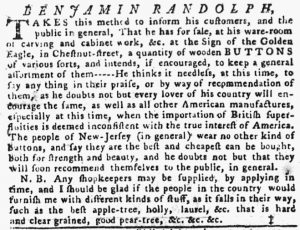
Benjamin Randolph, one of Philadelphia’s most prominent and successful cabinetmakers, was also a savvy advertiser. He inserted notices in the city’s newspapers, but he also distributed an elegant trade card that clearly demonstrated the influence of Thomas Chippendale’s Gentleman and Cabinet-maker’s Director (1754). Known for his furniture, Randolph also promoted other carved items produced in his shop “at the Sign of the Golden Eagle,” including “a quantity of wooden BUTTONS of various sorts.”

Buttons often appeared among the extensive lists of imported merchandise published in advertisements placed by merchants and shopkeepers. When consumers purchased textiles and trimmings to make garments, they also acquired buttons. At a time when colonists participated in nonimportation agreements to protest the duties on imported goods imposed by the Townshend Acts, Randolph offered an alternative to buttons from England. He made it clear to prospective customers that purchasing his buttons served a political function; doing so signaled support for the American cause. Rather than depend on consumer’s familiarity with current events and popular discourse about the political meaning of goods, Randolph plainly stated, “[E]very lover of his country will encourage [his buttons by purchasing them], as well as all other American manufactures, especially at this time, when the importation of British superfluities is deemed inconsistent with the true interest of America.” Randolph encouraged colonists to reject the “Baubles of Britain,” as T.H. Breen has so memorably named the consumer goods produced on the other side of the Atlantic and sent to American markets. Randolph made a bid not only for support of the items he produced but also others made in the colonies, showing solidarity with fellow artisans as they did their part in opposition to Parliament.

Such efforts, however, did not depend solely on Randolph and other artisans. Ultimately, consumers determined the extent of the effectiveness of producing “American manufactures” through the decisions they made about which and how many items to purchase and which to boycott. Randolph had “a quantity” of buttons on hand, but producing more depended on the reception he received from the residents of Philadelphia and its hinterlands. He would “keep a general assortment of them” but only “if encouraged.” Consumers had to demonstrate that they would partner with him in this act of resistance once Randolph presented them with the opportunity.

January 1

What was advertised in a colonial American newspaper 250 years ago today?

Jan 1 1770 - 1:1:1770 Boston-Gazette
Boston-Gazette (January 1, 1770).

“Imported from LONDON (before the Non-Importation Agreement took Place).”

Cyrus Baldwin hoped for prosperity in the new year, greeting 1770 with an invitation for prospective customers to visit his shop at “the Sign of the Three Nuns and Comb” on Cornhill Street in Boston. His advertisement listed a variety of items in stock, including textiles (“Shalloons, Tammies, Durants” and others), tea, coffee, and “other Articles too many to be here enumerated.” Baldwin made clear that he offered choices to consumers.

He also made clear that he abided by the nonimportation agreement adopted by Boston’s merchants and traders in protest of the duties imposed on imported paper, glass, lead, paint, and tea by the Townshend Acts. Like other eighteenth-century retailers, he noted that his goods were “Imported from LONDON,” but he carefully clarified that they had arrived in the colonies “before the Non-Importation Agreement took Place.” Usually advertisers emphasized how recently their merchandise arrived from London and other English cities, but in this case Baldwin realized that many prospective customers would find items imported more than a year ago more attractive and more politically palatable.

It made sense for Baldwin to take this approach. His advertisement appeared at the bottom of the center column on the first page of the January 1, 1770, edition of the Boston-Gazette. Edes and Gill, the noted patriot printers of that newspaper, set the tone for the entire issue with the first item in the first column: “A LIST of the Names of those who AUDACIOUSLY continue to counteract the UNITED SENTIMENTS of the BODY of Merchants thro’out NORTH-AMERICA, by importing British Goods contrary to the Agreement.” This was a regular update that ran in several newspapers printed in Boston. The article accused six merchants and shopkeepers in Boston and another in Marlborough of preferring “their own little private Advantage to the Welfare of America,” labeling them “Enemies to their Country” and promising to view those who “give them their Custom … in the same disagreeable Light.”

Baldwin wanted that neither for himself nor his customers. He needed to make a living, but he did not wish to run afoul of the committee that oversaw the nonimportation agreement or his fellow colonists. To further demonstrate his compliance, he informed prospective customers that he sold “Red Drapery Baize manufactured in this Country, superior in Quality to those imported from England” in addition to goods that arrived from London many months earlier. The imperial crisis continued as a new year and a new decade began. In addition to news items and editorials, many advertisements for consumer goods and services captured the political tensions of the period.

December 18

What was advertised in a colonial American newspaper 250 years ago today?

Dec 18 - 12:18:1769 Boston-Gazette
Boston-Gazette (December 18, 1769).

“Will engage to make any Piece of Work as compleat as can be imported.”

In December 1769, Daniel MacNeill, a “Saddler and Cap-maker from DUBLIN,” turned to the Boston-Gazette to advise residents of Boston and its environs that he operated a shop in King Street. He made and sold a variety of items, including “Neat welted and plain Hunting Saddles,” “Pistol Cases & Holsters,” “Portmanteaus and Saddle Baggs,” and “every Article in the Sadlery Branch.” In addition to offering low prices, he assured prospective customers that he served them “with Fidelity and Dispatch.” He also made appeals to quality and fashion, proclaiming that he constructed these items “in the neatest and genteelest Manner.” MacNeill incorporated many of the most common marketing appeals of the eighteenth century into his advertisement.

As a relative newcomer to the city, MacNeill deployed another strategy that often appeared in newspaper notices placed by artisans who migrated across the Atlantic. He provided an overview of his work history as a means of convincing prospective customers of his competence. MacNeill asserted that he “had the Advantage of many Years Practice in the most principal Shops in Dublin and Towns adjacent.” In so doing, he attempted to transfer the reputation he established in one location to another, asking prospective customers to credit him for his years of experience. Although items he made during that time had not circulated for inspection in Boston, MacNeill hoped that his affiliation with “the most principal Shops” in one of the largest cities in the empire testified to his skill and expertise.

To that end, he pledged that he made saddles and other items “as compleat as can be imported.” Realizing that colonists sometimes had a preference for imported goods with an expectation of higher quality or better craftsmanship, MacNeill promised that his clients did not have to fear that they purchased inferior goods from his workshop. This appeal likely resonated with colonists who adhered to the nonimportation agreements and sought “domestic manufactures,” goods produced in the colonies, as alternatives to those transported across the Atlantic. An article on the first page of the December 18, 1769, edition of the Boston-Gazette proposed bringing artisans and their families to the colonies, suggesting that those migrants were much more welcome than imported goods that Parliament taxed. MacNeill’s advertisement reverberated with political implications, even as he made standard appeals to price, quality, and fashion.