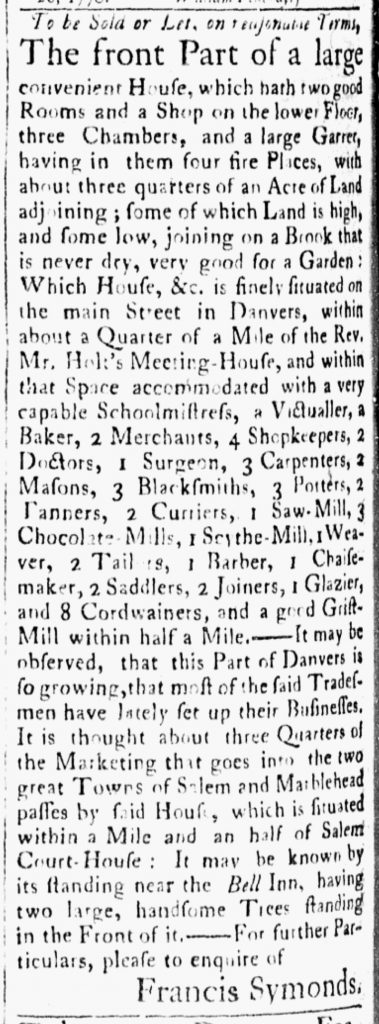
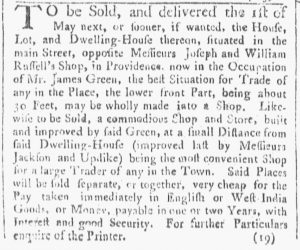
What was advertised in a colonial American newspaper 250 years ago today?
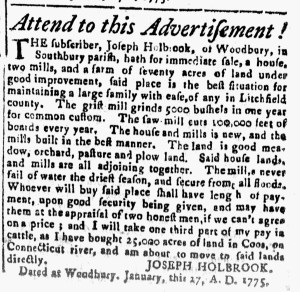
“Attend to this Advertisement!”
When Joseph Holbrook sought to sell a house, two mills, and a farm in Woodbury in the winter of 1775, he placed an advertisement in the Connecticut Journal and New-Haven Post-Boy. In it, he assured prospective purchasers that “said place is the best situation for maintaining a large family with ease.” The house and mills were new. The gristmill “grinds 5000 bushels in one year for common custom,” while the sawmill “cuts 100,000 feet of boards every year.” They operated throughout the year because the mills “never fail of water [during] the driest season,” nor did they flood at other times. The land included “good meadow, orchard, pasture and plow land.”
Holbrook’s notice looked much like other advertisements in colonial newspapers except for a headline that proclaimed, “Attend to this Advertisement!” That headline almost certainly drew the attention of readers, making them curious about what appeared in the notice. Such a command distinguished Holbrook’s advertisement from others, not only because it gave instructions but because it had a headline at all. Several notices in the February 8 edition of the Connecticut Journaldid not have headlines, just the first word in capital letters with a dropped capital for the first letter. Some had the first line in larger font, such as one that began, “Pursuant to a Request made to,” and another that started, “This is to give notice to all.” Among those with headlines, the name of the advertiser usually served that purpose. One headline announced, “Jacob Dagget” in a larger font than anything else on that page. Another used “JOSEPH HOWELL” as the primary headline with two secondary headlines, “Choice good Train & blubber Oil” and “Dry’d and pickled COD-FISH.” Holbrook, however, did not resort to the usual wording and format for advertisements. The headline for his advertisement, in italics and a larger font than its body, suggested that something of consequence followed the edict to “Attend to this Advertisement!” The advertiser and the compositor deployed both copy and design to encourage readers to peruse what otherwise would have been an ordinary real estate notice.