August 11

What was advertised in a colonial American newspaper 250 years ago today?

Massachusetts Gazette and Boston Weekly News-Letter (August 11, 1774).

“Mrs. Draper … proposes to continue publishing the Paper herself.”

With a notice in the August 11, 1774, edition of the Massachusetts Gazette and Boston Weekly News-Letter, Margaret Draper became the sole printer responsible for publishing that newspaper.  Who served in that role had changed several times over the past several months.  On May 5, Richard Draper, Margaret’s husband who had printed the newspaper for many years, placed an advertisement seeking a “Printer that understands collecting News, and carrying on a News Paper” to assist him because his “very low State of Health, prevents his making such Collection of Intelligence and Speculation, as his Customers must have expected.”  A week later, he ran a new notice to advise his customers of “a Co-Partnership with Mr. JOHN BOYLE.”  The “Co-Partnership” of Draper and Boyle, he promised, “will Endeavor to support the Reputation the said Paper has had for many Years past.”  At the same time, he made a pitch for advertisers, noting that the “great number of Customers on the Western Roads, make it peculiarly advantageous for those who advertise therein.”  The following week, an updated masthead for the May 19 issue included the names of both printers.

That partnership lasted only a few weeks.  Richard died on June 5.  A death notice and obituary ran as the first time in the first column of the first page in the June 9 edition, followed immediately by a notice that the “Co-Partnership between RICHARD DRAPER and JOHN BOYLE is dissolved by the Death of the former.”  In turn, the newspaper “will now be carried on by MARGARET DRAPER and JOHN BOYLE,” who renewed pledges that “the utmost Endeavors will be taken to maintain the Character it has had for upwards of Seventy Years past.”  Black borders, indicative of mourning, embellished the mastheads for the standard issue and the supplement that accompanied it.  The masthead for the standard issue stated, “Published by MARGARET DRAPER and JOHN BOYLE, at their Printing-Office in Newbury Street.”  In contrast, the masthead for the supplement only named one of them: “Published by JOHN BOYLE, at his Printing-Office in Newbury Street.”  Apparently portions of the newspaper went to print before the widow and her departed husband’s partner worked out all the details of their new arrangement.  Both names appeared in the masthead for the next several issues as well as in an updated version that first appeared on June 30: “Published by DRAPER and BOYLE in Newbury-Street, where Advertisements, &c. for this PAPER are taken in, and all other Printing-Work performed.”

This new partnership endured for two months, concluding with a notice “To the Public” that “MARGARET DRAPER & JOHN BOYLE, agreeable to Contract, … dissolved by mutual Consent” their partnership.  The colophon portion of the masthead simply declared, “Draper’s,” as it had prior to the Richard’s death.  In addition to announcing that she now operated the newspaper on her own, Margaret issued a call for friends, customers, and the public to provide “some reputable Means of Subsistence” for her.  To that end, she “solicit[ed] the Favor of further Subscriptions” that would allow her to “keep up the Credit which the Paper had for a long Time sustained in the Days of her deceased Husband.”  She ran the printing office on her own for several months before entering into an agreement with John Howe to manage the business.  That made her one of several female printers, along with Sarah Goddard, Anne Catharine Green, and Clementina Rind, in the colonies on the eve of the American Revolution.

May 5

What was advertised in a colonial American newspaper 250 years ago today?

Massachusetts Gazette and Boston Weekly News-Letter (May 5, 1774).

“A very low State of Health, prevents his making Collection of Intelligence and Speculation.”

Printers often inserted notices about their own businesses immediately after any local news items they published, increasing the chances that readers would take note even if they did not closely examine the advertisements that followed.  Such was the case for a notice that Richard Draper placed in the May 5, 1774, edition of the Massachusetts Gazette and Boston Weekly News-Letter.  Right below news from Boston and Worcester, he declared, “The Publisher and Printer of this Paper being in a very low State of Health, prevents his making such Collection of Intelligence and Speculation, as his Customers must have expected to be given them.”  He especially lamented that he had been hampered in gathering news “since the arrival of the last Vessels,” acknowledging that ships arriving from London brought updates about Parliament’s reaction to the destruction of tea in Boston Harbor the previous December.  Colonial printers had to hustle to acquire the latest news and rumors from the other side of the Atlantic, learning what they could from captains and convincing merchants to share excerpts from the letters they received.

Even though a two-page supplement featuring “INTERESTING INTELLIGENCE” from London accompanied the May 5 edition, Draper did not consider himself up to the task of collecting and collating all the news flowing into the busy port.  That being the case, he addressed his subscribers, “beg[ging] their Indulgence till he recovers Strength, or till the Paper falls into other Hands.”  Planning for the latter, at least for the near future, he advised that a “Printer that understands collecting News, and carrying on a News Paper … may be concerned on very advantageous Terms” upon applying to Draper at his printing office.  His appeal met with success.  In the next issue he announced that he entered a “Co-Partnership with Mr. JOHN BOYLE, who was regularly brought up and has since carried on the Printing Business in this Town.”  Together, the partners would “Endeavor to support the Reputation the said Paper has had for many Years past.”  Draper alluded to the long publication history of the newspaper, established seventy years earlier.  In his History of Printing in America (1810), Isaiah Thomas described the Boston News-Letter (later the Massachusetts Gazette and Boston Weekly News-Letter) as “the first newspaper published in this country,” dismissing the single issue of Publick Occurences published in 1690.[1]  Thomas reported that Draper’s “ill health render[ed] him unable to attend closely to business” so Boyle “undertook the chief care and management of the newspaper.”[2]  A month later, Draper died.  Hs widow, Margaret, continued in partnership with Boyle for about a year, but they went their separate ways after the Revolutionary War began.  She then took John Howe as a partner, continuing to publish the newspaper “until the British troops left Boston in 1776.”  Thomas notes that it was the only newspaper “printed in Boston during the siege.”[3]  Despite Draper’s poor health and other turmoil, his newspaper lasted longer than any of the others published in Boston at the time he requested the “Indulgence” of his subscribers.

**********

[1] Isaiah Thomas, The History of Printing in America: With a Biography of Printers and an Account of Newspapers (1810; New York: Weathervane Book, 1970), 231.

[2] Thomas, History of Printing, 145.

[3] Thomas, History of Printing, 231.

January 16

What was advertised in a colonial American newspaper 250 years ago this week?

Massachusetts Gazette and Boston Weekly News-Letter (January 13, 1774).

“People in the Country are already cautious of Counterfeits.”

On behalf of his partners, Richard Draper, printer of the Massachusetts Gazette and Boston Weekly News-Letter, placed an advertisement in the January 6, 1774, edition to inform the public that “Ames’s Almanack For the Year 1774, Is now in the Press, and will be ready for Sale” two days later, “on Saturday next.”  Customers could acquire copies from Draper, Thomas Fleet and John Fleet, and Benjamin Edes and John Gill.  On the following Monday, the Fleets, printers of the Boston Evening-Post, ran an updated version in the January 10 edition of their newspaper, announcing “THIS DAY PUBLISHED. Ames’s Almanack For the Year 1774.”  That advertisement also listed all three printing offices.  Edes and Gill, printers of the Boston-Gazette, ran a similar advertisement on the same day.  Often competitors, those printers collaborated in publishing, advertising, and distributing the popular almanac.

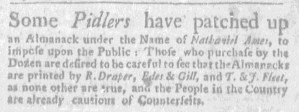
Just a few days later, however, Draper published a very different notice in the January 13 edition of the Massachusetts Gazette and Boston Weekly News-Letter.  “Some Pidlers,” he warned, “have patched up an Almanack under the Name of Nathaniel Ames, to impose upon the Public.”  Someone not affiliated with those printing offices produced and disseminated counterfeit almanacs!  Draper was especially concerned about the impact that would have on sales to retailers who purchased in volume to stock in their shops.  “Those who purchase by the dozen,” he cautioned, “are desired to be careful to see that the Almanacks are printed by R. Draper, Edes & Gill, and T. & J. Fleet, as none other are true.” To encourage such vigilance, Draper asserted that “the People in the Country are already cautious of Counterfeits.”  In other words, retailers better not think they could pass off the false almanacs to their customers because, according to Draper, those consumers knew which printers produced the authentic version and would not accept any other.

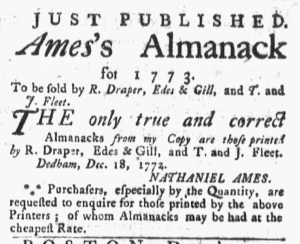
Although the notice did not indicate who printed the “Counterfeits” sold by the peddlers, Draper, the Fleets, and Edes and Gill faced competition for almanacs supposedly authored by Nathaniel Ames from printers in Boston (“Printed and Sold by E[zekiel] Russell”), Hartford (“Reprinted and Sold by Ebenezer Watson”), New Haven (“Reprinted and Sold by Thomas & Samuel Green”), and New London (“Printed and Sold by T[imothy] Green”).  It was not the first time the partners encountered other printers attempting to infringe on what they considered their product to market exclusively.  A year earlier, they advertised widely that they printed the “only true and correct ALMANACKS” by Ames, inserting a testimonial to that effect into their newspaper notices.  The partners showed a similar concern for the effect on sales to retailers, directing “Purchasers, especially by the Quantity, … to be particular in enquiring whether they are printed by” Draper, the Fleets, and Edes and Gill.  Several years earlier, on the other hand, they had been the counterfeiters.  Almanacs generated significant revenue for early American printers, prompting them to print, to reprint, and to counterfeit the most popular titles.

May 16

What was advertised in a colonial American newspaper 250 years ago this week?

Massachusetts Gazette and Boston Weekly News-Letter (May 13, 1773).

“[The Avertisements that are omitted this Week, will have a good Place in out next.]”

Richard Draper, the printer of the Massachusetts Gazette and Boston Weekly News-Letter, inserted notes to readers and subscribers at the bottom of the third page of the May 13, 1773, edition.  In those notes, he provided information about the contents of the current issue and the next issue, acknowledging that he did not have sufficient space for all the materials received in his printing office that week.  Placing the notes on the third page made sense considering how eighteenth-century printers produced each standard issue of a four-page newspaper.  They printed two pages on each side of a broadsheet and then folded it in half, usually printing the first and fourth pages first and the second and third pages later.  That meant that they set the type of the third page last.

It was only when setting type for the third page that Draper or a compositor who worked in his printing office knew the layout of the entire issue.  In this instance, that meant that “A variety of domestic Articles are in the last Page, and London Articles in the SUPPLEMENT.”  That note ran across all three columns at the bottom of the third page, a thick line separating it from the rest of the content.  In another note, this one appearing at the bottom of the first column, Draper advised that “[The Avertisements that are omitted this Week, will have a good Place in out next.]”  Draper may not have yet realized that news from London would occupy only one page of the two-page supplement, leaving room for another entire page of advertisements … or he may have realized that even with the extra space he still would not have enough room for all the paid notices that customers expected to see in his newspaper.  After all, he resorted to a supplement again the following week in order to increase the content he disseminated from four pages to six pages.

Given that advertising represented such an important revenue stream for colonial printers, Draper erred on the side of caution in letting advertisers know that their notices might not appear in the current issue or its supplement and, as a consolation, promised “a good Place” in the next issue.  His advertisers had the option of giving their business to any of the four other newspapers printed in Boston at the time, prompting Draper to provide updates and reassurances about when they could expect to see their notices in the Massachusetts Gazette and Boston Weekly News-Letter.

December 24

What was advertised in a colonial American newspaper 250 years ago today?

Massachusetts Gazette and Boston Weekly News-Letter (December 24, 1772).

There are some Almanacks with Dr. Ames’s Name thereto that are very erroneous.”

In the December 24, 1772, edition of the Massachusetts Gazette and Boston Weekly News-Letter, Richard Draper continued the efforts to inform the public about counterfeit editions of “AMES’s Almanack for 1773” that he, Thomas Fleet and John Fleet, printers of the Boston Evening-Post, and Benjamin Edes and John Gill, printers of the Boston-Gazette, began three days earlier.  According to a note from Nathaniel Ames, the author of the popular almanac, “The only True and Correct Almanacks from my Copy, are those printed by R. Draper, Edes & Gill and T. & J. Fleet.”

Draper expanded on the notice that previously appeared in other newspapers, advising readers and prospective customers that “there are some Almanacks with Dr. Ames’s Name thereto that are very erroneous.”  In particular, those counterfeits contained misinformation about “Roads and Stages,” but in the “true Almanack” those errors had been “corrected, amended and placed in a better Manner than in any Almanack heretofore published.”  Draper offered a justification not only for choosing Ames’s “true Almanack” over counterfeit editions but also for choosing it over any other almanacs advertised and sold in New England.

Isaiah Thomas, printer of the Massachusetts Spy, advertised some of those almanacs on the same day that Draper published the extended version of the advertisement about Ames’s “True and Correct Almanacks.”  Under a headline that simply declared, “ALMANACKS,” Thomas listed “AMES’s, Lowe’s, Gleason’s (or Massachusetts Calender) and Sterne’s ALMANACKS” available at his printing office.  Thomas did not note whether he sold Ames’s almanac printed by Draper, the Fleets, and Edes and Gill, but his newspaper was the only one in Boston that did not carry the notice from those printers that week.

Postscript to the Massachusetts Spy (December 24, 1772).

In addition, the supplement that accompanied that edition of the Massachusetts Spy contained just one advertisement.  It advised prospective customers about “AMES’s Almanack, for 1773, just published and to be sold by Russell & Hicks, in Union street, next the Cornfield.”  Whether or not Thomas sold the counterfeit almanac at his own shop, he did not seem to have any qualms about generating revenue by running advertisements placed by the printers who published the suspect edition.  Given that households from the most grand to the most humble acquired almanacs each year, those pamphlets were big business for printers.  Rivalries in printing, marketing, and selling almanacs became a regular feature of newspaper advertising each fall and into the winter months.

December 21

What was advertised in a colonial American newspaper 250 years ago today?

Boston-Gazette (December 21, 1772).

Purchasers, especially by the Quantity, … be particular in enquiring whether they are printed by the above Printers.”

All three newspapers published in Boston on December 21, 1772, carried a notice concerning Nathaniel Ames’s almanac for 1773.  Two of them announced that the almanac was “JUST PUBLISHED” and “sold by R. Draper, Edes & Gill, and T. and J. Fleet.”  All three contained a note from the author to advise consumers that the “only true and correct ALMANACKS from my Copy, are those printed by R. Draper, Edes & Gill, and T. & [J.] Fleet.”  Either Ames or, more likely, the printers added an additional note suggesting that “Purchasers, especially by the Quantity, … be particular in enquiring whether they are printed by the above Printers; of whom ALMANACKS maybe had at the cheapest Rate.”

In addition to the almanacs printed by Draper, Edes and Gill, and the Fleets, Ezekiel Russell and John Hicks produced and sold An Astronomical Diary; or, An Almanack for the Year of Our Lord, 1773 attributed to Ames.  They printed their edition in Boston.  Printers in other towns in New England reprinted Ames’s almanac from Boston editions, including Ebenezer Watson in Hartford, Thomas Green and Samuel Green in New Haven, and Timothy Green in New London.

Massachusetts Gazette and Boston Post-Boy (December 21, 1772).

The printers who printed the “only true and correct” editions of Ames’s popular almanac each inserted the warning about counterfeit editions in their newspapers.  The Fleets ran in the Boston Evening-Post on December 21, the same day that Edes and Gill published it in the Boston-Gazette.  Richard Draper ran a more extensive version in the Massachusetts Gazette and Boston Weekly News-Letter on December 24.  To disseminate the message even more widely, the printers arranged to have the advertisement also appear in the Massachusetts Gazette and Boston Post-Boy on December 21.  Of the five newspapers published in Boston at the time, only Isaiah Thomas’s Massachusetts Spy did not carry the notice.  Instead, it featured an advertisement for the version printed by Russell and Hicks on December 24.

The brief version of the advertisement devised by Draper, Edes and Gill, and the Fleets in the Boston-Gazette, the variation that did not announce the publication of the almanac, appeared immediately below news items and, unlike other advertisements, without a line to separate it from other content.  In making those choices about placement and typography, Edes and Gill implied that information about pirated editions was newsworthy rather than solely a notice directed at consumers.  Blending news and advertising, they sought to serve the best interests of prospective customers while simultaneously protecting their own interests.

It was an interesting turn of events considering that a few years earlier it had been Draper, Edes and Gill, and the Fleets who published a pirated edition of Ames’s almanac.

October 25

What was advertised in a colonial American newspaper 250 years this week?

Supplement to the Massachusetts Gazette and Boston Weekly News-Letter (October 22, 1772).

“PROPOSALS For Re-Printing by Subscription … Baron de MONTESQUIEU’s celebrated Spirit of Laws”

On October 22, 1772, Richard Draper distributed a two-page supplement to accompany the standard issue of the Massachusetts Gazette and Boston Weekly News-Letter.  That supplement consisted almost entirely of advertising, though it did include brief news items from London and Quebec.  A subscription proposal for an “American Edition of … Baron de MONTESQUIEU’s celebrated Spirit of Laws” filled most of the second page of the supplement.  That subscription proposal would have looked familiar to colonizers who also read the Massachusetts Gazette and Boston Post-Boy since it appeared in that newspaper three days earlier.  It may have also looked familiar to those who had not perused the other publication.  As I argued when examining the first appearance of the subscription proposal in Boston’s newspapers, it likely circulated separately as a handbill or broadside.

Draper adopted the same method of making the subscription proposal fit on the page that John Green and Joseph Russell used in their newspaper.  Since it was wider than two standard columns, he created a narrower third column by rotating the type to run perpendicular to the rest of the page.  Draper also added a colophon, centered at the bottom of the subscription proposal.  This method of making the broadside fit on a newspaper page was not the only similarity between its appearance in two newspapers.  It looks as though the printing offices shared the type.  If that was the case, who produced the broadside?  Draper or Green and Russell?  Even if the subscription proposal did not circulate separately as a broadside or handbill, the printers almost certainly shared type between their offices.  That was not the first time in 1772 that Draper collaborated with other printers in that manner.  In May, Jolley Allen’s advertisements in the Boston-Gazette and the Massachusetts Gazette and Boston Weekly News-Letter had identical copy and format.  At the same time, Andrew Dexter’s advertisements in the Boston Evening-Post and the Massachusetts Gazette and Boston Weekly News-Letter also featured identical copy and format.  At various times, Draper apparently shared type already set with three other printing offices.  Yet he was not always involved in instances of sharing type.  Advertisements for a “Variety of Goods” that ran in the Boston Evening-Post and the Boston-Gazette on October 12, for instance, appear identical, with the exception of the last two lines either added to the notice in the Boston-Gazette or removed from the one in the Boston Evening-Post to make it fit the page.  Examining advertisements reveals several other examples of printers in Boston seemingly sharing type in the early 1770s.

As I have noted on other occasions that I have identified what appears to be type transferred from one printing office to another, these observations are drawn from digitized copies of eighteenth-century newspapers.  Examining the original editions, including taking measurements, may yield additional details that either demonstrate that Boston’s printers did not share type for newspaper advertisements or that further suggest that they did indeed do so.  This question merits further investigation to learn more about business practices in printing offices that competed for both newspaper subscribers and advertisers.

Supplement to the Massachusetts Gazette and Boston Weekly News-Letter (October 22, 1772).

October 15

What was advertised in a colonial American newspaper 250 years ago today?

Massachusetts Gazette and Boston Weekly News-Letter (October 15, 1772).

“WANTED immediately, a Wet-Nurse.”

Richard Draper had too much content to publish all of it in the October 15, 1772, edition of the Massachusetts Gazette and Boston Weekly News-Letter.  He remedied the situation, in part, by printing and distributing a supplement on a smaller sheet.  That supplement included additional news, but no advertising.  Even with the supplement, Draper did not have enough space for all the news and advertising received in the printing office.  A note at the bottom of the final column on the third page instructed readers to “See SUPPLEMENT” and advised that “Other Articles and Advertisements must be defer’d.”

Why insert such a note on the third page instead of placing it at the end of the final column on the last page?  The process of printing newspapers on a manually-operated press provides an explanation.  Like most other newspapers from the era of the American Revolution, a standard issue of the Massachusetts Gazette and Boston Weekly News-Letter consisted of four pages created by printing two pages on each side of a broadsheet and folding it in half.  Printers usually set the type and printed the first and fourth pages on one side of the sheet.  After it dried, they printed the second and third pages on the other side.  That resulted in the latest news often appearing inside the newspaper rather than on the front page.  That also meant that the last portion of the newspaper arranged by the compositor was the third page, not the final page.  That being the case, announcements about supplements and omitted materials usually appeared on the third page.

Draper did manage to include one additional advertisement in the standard issue for October 15 rather than deferring it for a week.  The urgency of the notice may have convinced him to make a special effort to include it.  “WANTED immediately,” the advertisement proclaimed, “a Wet-Nurse, with a young Breast of Milk, that can be well Recommended, to suckle a Child in a Family: Enquire of the Printer.”  That notice ran in the right margin of the third page, almost the entire length of an extensive advertisement that listed merchandise stocked by John Barrett and Sons at their store “near the MILL-BRIDGE” in Boston.  With some creative graphic design, Draper squeezed an advertisement seeking a wet nurse, a notice that likely arrived late to the printing office, into that issue.  In so doing, he adapted to the technology of the printing press while providing a special service to that advertiser.

April 16

What was advertised in a colonial American newspaper 250 years ago today?

Massachusetts Gazette and Boston Weekly News-Letter (April 16, 1772).

Last Thursday’s Paper containing their Advertisements accompany this Day’s Papers.”

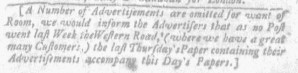
Advertisements accounted for important revenue for colonial printers.  That was certainly the case for Richard Draper, printer of the Massachusetts Gazette and Boston Weekly News-Letter.  So many colonizers submitted advertisements for inclusion in the April 16, 1772, edition, that he resorted to distributing a half sheet supplement devoted almost exclusively to paid notices.  That helped, but still did not provide enough space for all of the advertisements that he should have published that week.  That prompted him to insert a brief note to address the situation.  “A Number of Advertisements,” Draper stated, “are omitted for want of Room.”  He then tried to convince advertisers that they did not need to be concerned because “no Post went last Week” along “the Western Road, (where we have a great many Customers)” so that meant that “last Thursday’s Paper containing their Advertisements accompany this Day’s Papers.”

Would that mollify advertisers who expected to see their notices in print?  Draper did the best he could to give a favorable impression of the situation, assuring advertisers that readers would indeed see their notices that week even if they did not happen to appear in the most recent edition or its supplement.  He did not, however, attempt to explain why they should not be concerned that delivery of the previous edition had been delayed by a week, perhaps because everyone understood he had less control over the post than his press.  He simply expected advertisers to accept that their notices had not been distributed as widely as they anticipated as soon as they intended.  What truly mattered, he sought to convince them, was that their advertisements were now before the eyes of readers.  Interestingly, Draper’s note explicitly addressed advertisers, not subscribers.  He made no apology to subscribers outside of Boston that they had to wait a week to receive either news or notices.  Through that omission, he once again positioned delivery as further beyond his control than the contents of his newspaper.  In this instance, maintaining good relationships with customers and safeguarding an important revenue stream meant focusing on the concerns of advertisers.

January 13

What was advertised in a colonial American newspaper 250 years ago today?

Massachusetts Gazette and Boston Post-Boy (January 13, 1772).

A Mahogony Desk and Book-Case.

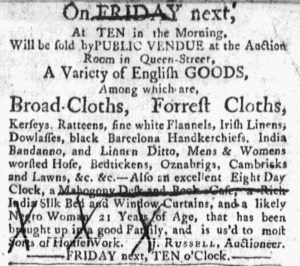
This advertisement presents a conundrum.  It attracted my attention because someone made manuscript notations on the copy of the Massachusetts Gazette and Boston Post-Boy that has been preserved in an archive and digitized for greater accessibility.  They crossed out “FRIDAY” in the portion of the headline that gave the date of an auction, crossed out “a Mahagony Desk and Book-Case” midway through the advertisement, and placed three large “X” over most of the rest of the content.  I suspected that either Joseph Russell or John Green, the partners who published the Massachusetts Gazette and Boston Post-Boy, made those notations to guide the compositor in setting type for a revised version of the advertisement to appear in a subsequent issue.  Russell, the auctioneer who placed the advertisement, focused primarily on operating the “Auction Room in Queen-Street” while Green oversaw the newspaper and the printing office.

A revised version did not appear in a subsequent edition of the Massachusetts Gazette and Boston Post-Boy.  The same advertisement did run in the Boston Evening-Post and the Boston Gazette on Monday, January 13, 1772, the same day it appeared in the Massachusetts Gazette and Boston Post-Boy.  Those newspapers ran the same copy, but with variations in line breaks because the compositors made their own decisions about format.  I also looked for revised versions of the advertisement in other newspapers published in Boston between January 13 and the day of the sale.  The Massachusetts Spy published on Thursday, January 16, the day before the say, did not carry the advertisement, but the Massachusetts Gazette and Boston Weekly News-Letter distributed on the same day did feature a slightly revised version.  Only the first line differed from the original version, stating that the auction would take place “TO-MORROW” rather than “On FRIDAY next.”

Massachusetts Gazette and Boston Weekly News-Letter (January 16, 1772).

The rest of the advertisement was identical to the one that ran in the Massachusetts Gazette and Boston Post-Boy earlier in the week.  The copy was identical and the format (including line breaks, spelling, and capitals) was identical.  Even the lines on either side of “FRIDAY next, TEN o’Clock” on the final line were identical.  Both advertisements lacked a space between “by” and “PUBLIC VENDUE” on the third line.  The manuscript notations on the original advertisement may have directed someone in revising the first line, but not the remainder of the notice.  Even more puzzling, it looks as though Green and Russell shared type already set at their printing office with Richard Draper, the printer of the Massachusetts Gazette and Boston Weekly News-Letter.  This is not the first time that I have detected such an instance in newspapers published by these printers in the late 1760s and early 1770s.  It raises questions about both the logistics and the business practices of those involved, questions that merit greater attention and closer examination of the contents, both news and advertising, in the two newspapers.