September 11

What was advertised in a colonial American newspaper 250 years ago this week?
Rivington’s New-York Gazetteer (September 8, 1774).

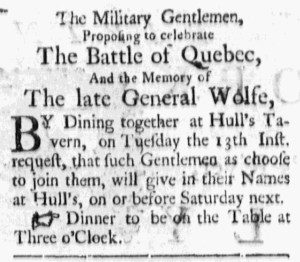
“Celebrate The Battle of Quebec, And the Memory of The late General Wolfe.”

Even as turmoil brewed in the wake of colonizers learning of the Coercive Acts and the Quebec Act in the spring and summer of 1774, most continued to embrace their British identity while condemning Parliament for its treatment of the colonies.  As the First Continental Congress commenced its meetings in Philadelphia at the beginning of September, a notice in the September 8 edition of Rivington’s New-York Gazetteer advised “Military Gentlemen” of an upcoming dinner to celebrate “The Battle of Quebec, And the Memory of The late General Wolfe.”  The event would take place at Hull’s Tavern on September 13, marking the fifteenth anniversary of the death of General James Wolfe on the Plains of Abraham outside the walled city of Quebec during the Seven Years War.  Although Wolfe perished, the battle resulted in a British victory that ended the siege of Quebec, one of the most decisive moments of the war in North America.

At the end of the war, the French withdrew from the continent.  The British Empire gained the territory France had claimed in Canada.  English colonizers in America joined in memorializing Wolfe and celebrating such an important victory, emphasizing their own contributions throughout the war.  In 1770, Benjamin West, an influential American painter who had migrated to England and settled in London in the 1760s, memorialized the battle and celebrated the British Empire in The Death of General Wolfe.  It became his most famous history painting, frequently reproduced.  In the colonies, Americans honored Wolfe in other ways.  In Boston, for instance, William Murray marked the location of the shop where he sold an “Assortment of English Goods” with the “Sign of General WOLFE.”  In New York, veterans of the war and others participated in commemorative dinners, no doubt making toasts in memory of Wolfe and in honor of the British Empire.

On the fifteenth anniversary of Wolfe’s death, most colonizers had not yet determined to separate from the British Empire.  Instead, they sought a redress of their grievances against Parliament, many hoping that the king would intervene on their behalf.  The conversations and the toasts at the dinner celebrating the battle likely included references to English liberties that colonizers believed they were entitled to enjoy as members of the British Empire.  In remembering the Battle of Quebec and memorializing Wolfe, they demonstrated their continued attachment to the British Empire.  As the First Continental Congress began its deliberations in September 1774, the rupture was not yet so significant that declaring independence was inevitable.
September 1

What was advertised in a colonial America newspaper 250 years ago today?

Rivington’s New-York Gazetteer (September 1, 1774).

“Cabinet and Chair-Maker, At the Sign of the Chair.”

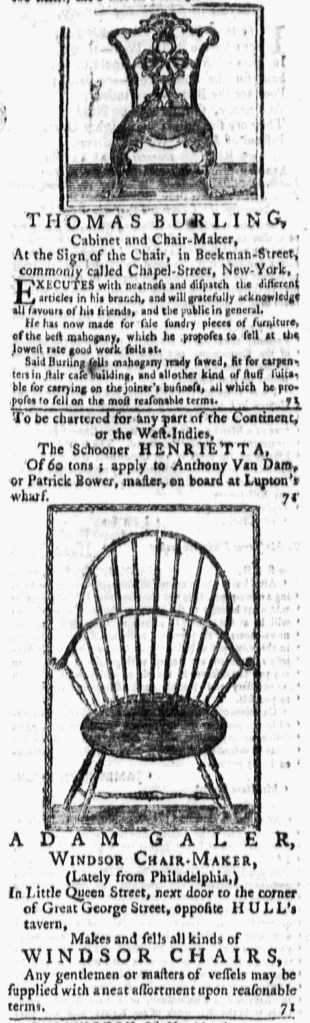
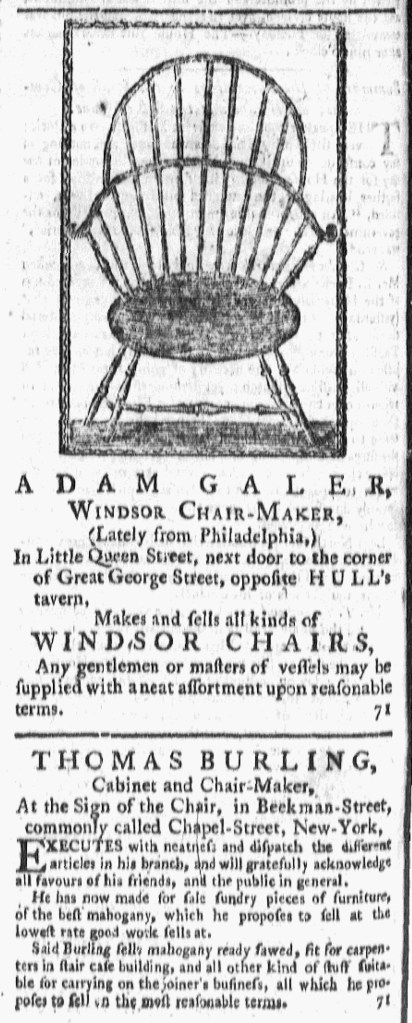
A week ago, the Adverts 250 Project examined advertisements placed by Adam Galer, “WINDSOR CHAIR-MAKER,” and Thomas Burling, “Cabinet and Chair-Maker,” that happened to appear one after the other in the August 25, 1774, edition of Rivington’s New-York Gazetteer.  Galer adorned his advertisement with an image of a Windsor chair within a decorative border, the focal point of his notice, while Burling relied exclusively on copy in making his pitch to prospective customers.

Burling apparently did not like being outdone by Galer.  In the next issue of Rivington’s New-York Gazetteer his advertisement also featured a woodcut of a chair within a border.  Though the image was not as large as Galer’s image, the chair depicted in it was much more elaborate.  That represented the sorts of furniture, the “different articles in his branch,” that Burling produced in his shop, compared to Galer specializing in Windsor chairs.  The woodcut may have also replicated the “Sign of the Chair” that marked Burling’s location “in Beekman-Street, commonly called Chapel-Street.”  Once again, the two advertisements appeared in proximity to each other, though this time Burling’s came first and a short advertisement for chartering the schooner Henrietta separated them since colonial printers did not classify or organize advertisements by purpose or genre.

That Burling first published his advertisement without an image and then so quickly added one suggests that he consulted the newspaper to see his advertisement in print, perhaps to confirm its conclusion or perhaps out of pride to see his name and a description of his “neatness and dispatch” and “good work” in print.  He might have been quite surprised to discover that Galer upstaged him with an image and, adding to his frustration, that the two advertisements appeared together.  While the image drew attention to that portion of the page, increasing the chances that readers noticed Burling’s advertisement immediately below Galer’s, Burling might have felt that it reflected poorly on him that a chairmaker who made only Windsor chairs circulated the more striking notice.  To make his advertisement just as memorable, he added an image of a much more ornate chair at the first opportunity.

August 25

What was advertised in a colonial American newspaper 250 years ago today?

Rivington’s New-York Gazetteer (August 25, 1774).

“Sundry pieces of furniture, of the best mahogany.”

Both Adam Galer and Thomas Burling made and sold furniture in New York in the mid 1770s, yet they took different approaches when they advertised in Rivington’s New-York Gazetteer.  Their advertisements appeared one after the other in the August 25, 1774, edition, not by design but rather by coincidence since printers and compositors did not classify or organize paid notices by genre or purpose.  The proximity of the advertisements made the differences in their marketing efforts even more stark.

For his part, Galer, a “WINDSOR CHAIR-MAKER,” made an image of a Windsor chair within a decorative border the focal point of his advertisement.  That device filled about two-thirds of the space, immediately drawing attention.  Having recently arrived in New York from Philadelphia, Galer may have considered it worth the extra expense of commissioning the woodcut to enhance his visibility in the public prints.  In the copy, he gave his location and advised “gentlemen” and “masters of vessels” that they could acquire Windsor chairs “upon reasonable terms.”

Thomas Burling, on the other hand, relied exclusively on advertising copy without any images.  In that regard, his notice resembled the vast majority of newspapers advertisements.  He informed readers that they could find him “At the Sign of the Chair, in Beekman-Street, commonly called Chapel-Street,” indicating that he deployed visual images in other formats to promote his nosiness.  Burling, a “Cabinet and Chair-Maker,” produced a wider array of furniture than Galer, declaring that he “EXECUTES with neatness and dispatch the different articles in his branch.”  He reinforced his appeal to quality when he described the material, “the best mahogany,” and his own skill as an artisan.  He linked the latter to the price: “he proposes to sell at the lowest rate good work sells at.”

Burling may have benefited from the proximity of the two advertisements if readers took note of the image in Galer’s notice and then happened to continue reading the notice that followed.  Still, both artisans likely felt that they were in a better position than if they had not advertised at all.  Their direct competition in the public prints gave them an advantage over other competitors who did not advertise at all.

July 28

What was advertised in a colonial American newspaper 250 years ago today?

Rivington’s New-York Gazetteer (July 28, 1774).

“Excellent Tea.”

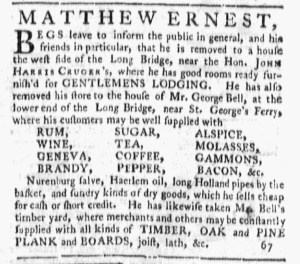
Despite the complicated politics of tea in the wake of the Boston Tea Party and the Boston Port Act that closed and blockaded the harbor as punishment, some merchants and shopkeepers continued to sell tea and printers continued to publish their advertisements in the summer of 1774.  At the same time that many advertisers quietly dropped tea from the lists of merchandise in their newspaper notices, others refused to do so.  In New York, for instance, Matthew Ernest enumerated a dozen commodities that customers could acquire at his store.  In capital letters in three columns, making each item easy for readers to spot, Ernest listed “RUM, WINE, GENEVA, BRANDY, SUGAR, TEA, COFFEE, PEPPER, ALSPICE, MOLASSES, GAMMONS, [and] BACON.”  The merchant supplied tea to consumers willing to purchase it.

Rivington’s New-York Gazetteer (July 28, 1774).

One printer, James Rivington, even sold tea himself or acted as a broker for a customer who did wish for their name to appear in print.  For many weeks, Rivington’s New-York Gazetteer ran an advertisement that announced “Excellent Tea” in a font much larger than almost anything else that appeared among news or advertisements.  It further clarified, “SUPERFINE HYSON, To be sold.  Enquire of the Printer.”  Colonial printers often stocked books, stationery, patent medicines, and other goods, so perhaps Rivington sought to supplement revenues with tea.  On the other hand, an advertisement on the same page as the “Excellent Tea” notice in the July 28 edition promoted “Middleton’s incomparible Pencils, Red and black Lead, Sold by James Rivington.”  Whether or not he was the purveyor of the tea or merely a broker, the printer disseminated the advertisement and sought to earn money through trucking in tea.

In Tea: Consumption, Politics, and Revolution, 1773-1776, James R. Fichter argues that most colonizers who continued to advertise tea did not face significant repercussions, quite a different interpretation than the traditional narrative.  “If we only look at people who got in trouble over tea,” Fichter states, “we will think tea was troublesome.  But if we note the hundreds of people who did not get in trouble over tea, we see a very different story.”[1]  Even as the imperial crisis intensified, there was still space in the public marketplace for advertising and selling tea in the summer of 1774.

**********

[1] James R. Fichter, Tea: Consumption, Politics, and Revolution, 1773-1776 (Ithaca: Cornell University Press, 2023), 145.

July 21

What was advertised in a colonial American newspaper 250 years ago today?

Supplement to Rivington’s New-York Gazetteer (July 21, 1774).

“He proposes to continue his business of pickling oysters and lobsters.”

James Rivington had sufficient content to include in the July 21, 1774, edition of Rivington’s New-York Gazetteer that he distributed a two-page supplement with the standard four-page issue.  The items in that supplement consisted entirely of paid notices, dozens of them.  In addition, advertising accounted for several columns alongside the news in the standard issue.  Only a few of those advertisements, however, featured visual images to aid in drawing the attention of readers.  Three had stock images of ships at sea, one for a sloop for sale, one seeking passengers and freight for a voyage to South Carolina, and one that “WANTS A FREIGHT, To any part of EUROPE.”  The printer supplied stock images for those notices.

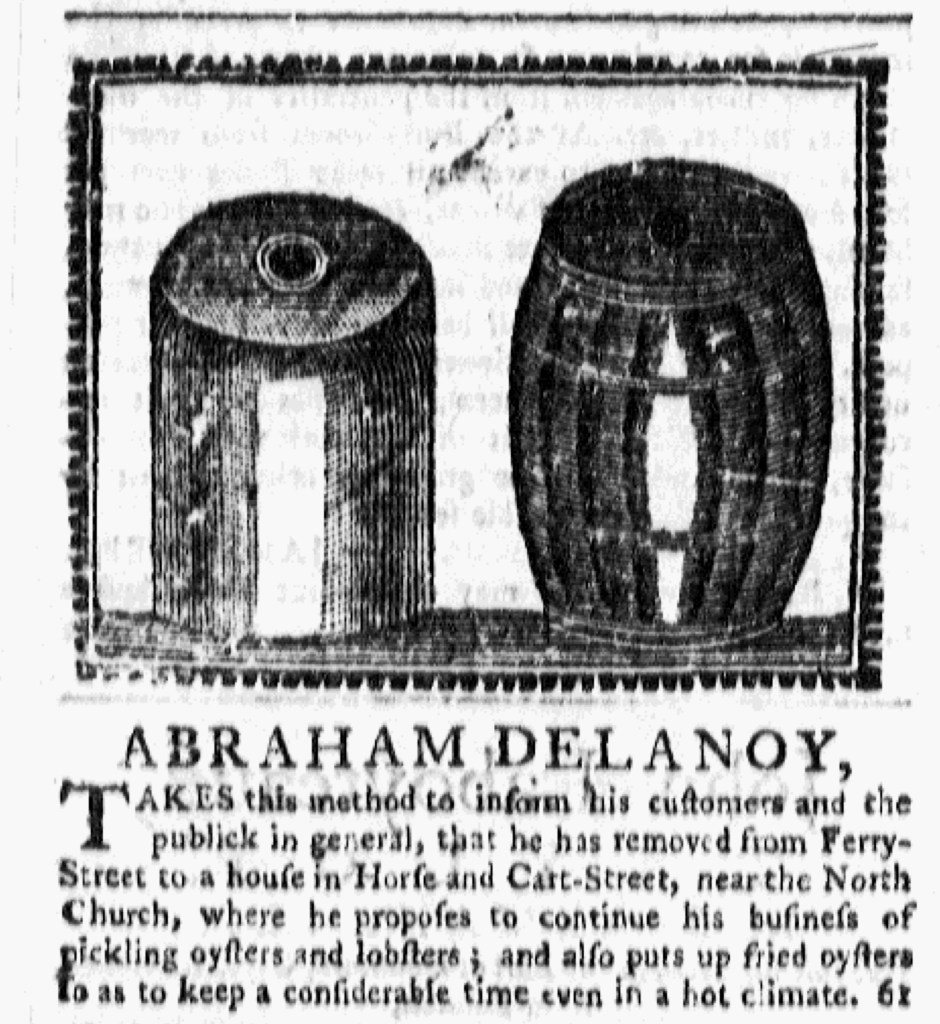
Three other advertisements sported woodcuts commissioned by the advertisers for their exclusive use, each of them providing a visual representation of some aspect of their business.  Thomas Ash, “WINDSOR CHAIR-MAKER,” once again incorporated the image of a chair that had accompanied his advertisements for several months.  Abraham Delanoy and James Webb also deployed images that had become familiar sights to readers over several weeks.  Delanoy advised readers that he moved to a new location where he “continue[d] his business of pickling oysters and lobsters” and “puts up fried oysters so as to keep a considerable time even in a hot climate.”  A woodcut depicting a lobster trap and an oyster cage appeared above his message to consumers.  Like Ash, Delanoy devoted as much space to his image as his copy, apparently believing that a picture was indeed worth a thousand words.  He trusted that the woodcut would as effectively market his wares as anything he might write.  He may have also figured that he had already established his reputation in the local marketplace so his primary purpose for the image could have been increasing the likelihood that customers saw his announcement that he had moved “from Ferry-Street to a house in Horse and Cart-Street.”

Supplement to Rivington’s New-York Gazetteer (July 21, 1774).

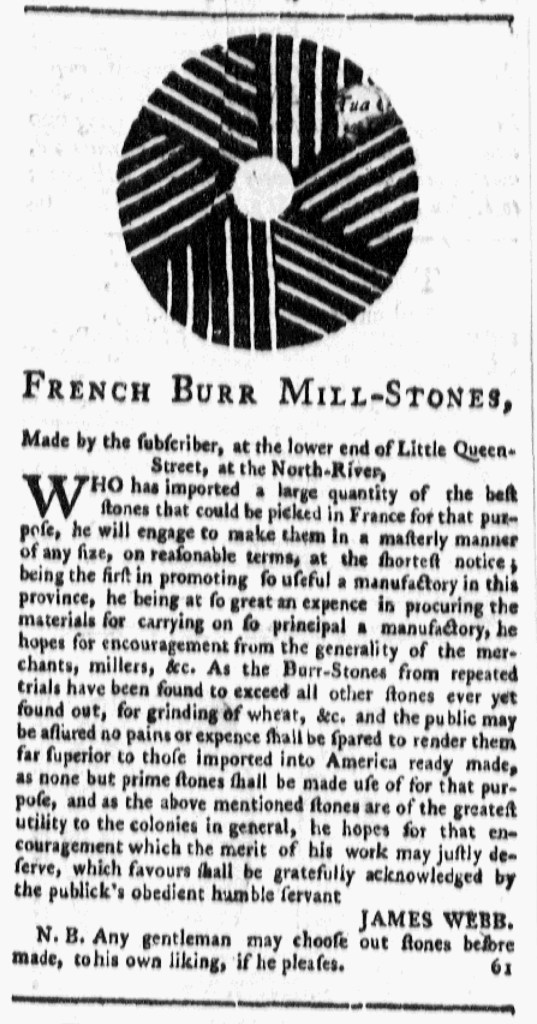
James Webb, on the other hand, used his woodcut of a millstone to advance a new endeavor unfamiliar to readers of Rivington’s New-York Gazetteer.  Accordingly, he devised significantly more copy to sell the “FRENCH BURR MILL-STONES” that he made from “the best stones that could be picked in France for that purpose.”  Webb claimed that he was “the first in promoting [or undertaking] so useful a manufactory in this province,” making it even more necessary that he provide an overview of his enterprise.  He asserted that he made millstones “in a masterly manner of any size, on reasonable terms, at the shortest notice,” succinctly incorporating appeals to quality, price, and convenience.  He suggested that millers, merchants, and others were already familiar with such millstones and knew that “from repeated trials [they] have been found to exceed all other stones ever yet found out.”  His millstones had the added advantage of being made in the colonies at a time that colonizers discussed the prospects of boycotting goods imported from Britain in response to the Coercive Acts passed by Parliament following the destruction of tea now known as the Boston Tea Party.  Webb pledged that “no pains or expence shall be spared to render [his millstones] far superior to those imported into America ready made,” while simultaneously reminding readers that they had a duty to support domestic manufactures.  To that end, his millstones “are of the greatest utility to the colonies in general.”  Just in case all of that did not convince prospective customers, Webb added a nota bene advising that “Any gentleman may choose out stones before made, to his own liking, if he pleases.”  In the end, that would yield even greater satisfaction with the finished product.

In each instance, the woodcuts that Ash, Delanoy, and Webb included in their advertisements happened to be the only visual images that appeared on that page of the July 21 edition of Rivington’s New-York Gazetteer.  Most likely that was by coincidence rather than design, yet it still helped in distinguishing their notices from others.  (The three images of ships appeared in a cluster, one after the other, on another page.)  Ash, Delanoy, and Webb had to pay additional fees to commission their woodcuts, but they very well may have determined that doing so was worth the investment.

July 14

What was advertised in a colonial American newspaper 250 years ago today?

Rivington’s New-York Gazetteer (July 14, 1774).

“At this critical and alarming juncture … set up the business of REED-MAKING.”

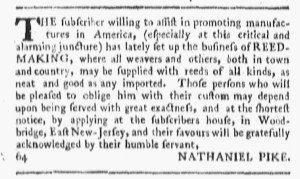
Nathaniel Pike testified that he wished to do his part to support the American cause in an advertisement in the July 14, 1774, edition of Rivington’s New-York Gazetteer.  He informed the public that he was “willing to assist in promoting manufacturers in America, (especially at this critical and alarming juncture)” and, accordingly, “lately set up the business of REED-MAKING.”  Eighteenth-century readers familiar with weaving knew that reeds were the “part of a loom consisting of a set of evenly spaced wires known as dents (originally slender pieces of reed or cane) fastened between two parallel horizontal bars used for separating, or determining the spacing between, the warp threads, and for beating the weft into place.”[1]  Pike pledged that “weavers and others, both in town and country, may be supplied with reeds of all kinds, as neat and good as any imported.”

Although Pike did not name the Boston Port Act or any of the other Coercive Acts passed by Parliament in retaliation for the Boston Tea Party, readers certainly understood the context for his reference to “this critical and alarming juncture.”  From New England to Georgia, colonizers discussed how to respond, many of them advocating for a new round of nonimportation agreements like the ones enacted in response to the Stamp Act and the duties imposed on certain goods in the Townshend Acts.  That meant that “domestic manufactures” or goods produced in the colonies would become important alternatives to imported goods.  Pike offered his own product made in the colonies, those reeds that matched imported ones in quality, yet his enterprise also facilitated greater production of textiles in the colonies.  Every stage of producing cloth took on greater significance in the face of boycotting fabrics imported from England, from farmers raising sheep for their wool to women participating in spinning bees that put their patriotism on display to consumers choosing and wearing homespun cloth out of allegiance to their political principles.  By supplying weavers with reeds for their looms, Pike served a vital role in protests against the abuses perpetrated by Parliament.  He expected that current events would help in marketing his product.

**********

[1] Oxford English Dictionary, II.11.a.

July 10

What was advertised in a colonial American newspaper 250 years ago this week?

Rivington’s New-York Gazetteer (July 10, 1774).

“Fashionable silver, and metal shoe buckles.”

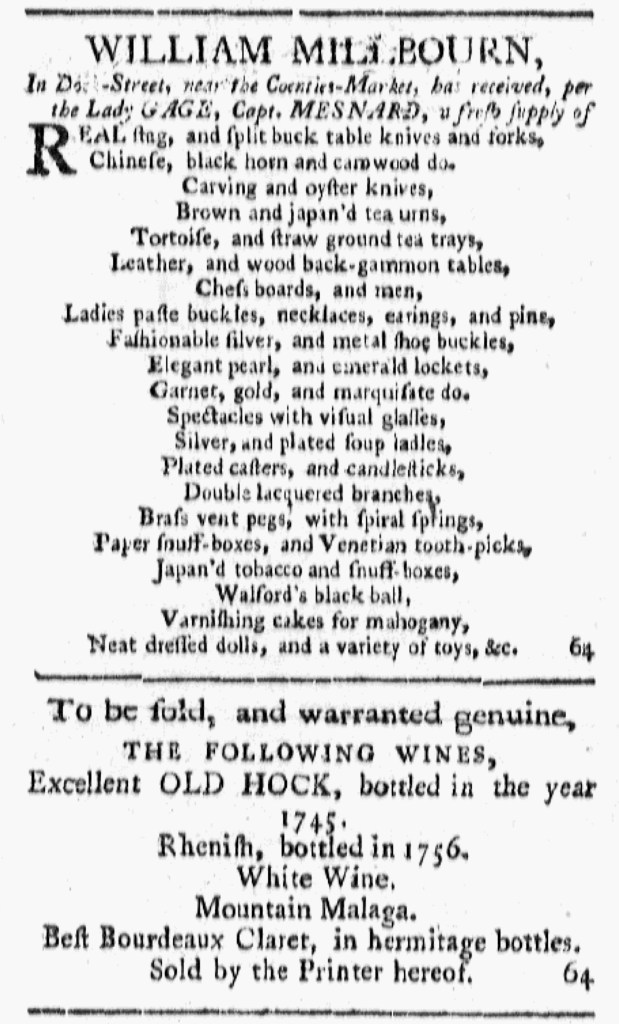
Like other merchants and shopkeepers who advertised imported goods for sale in the July 7, 1774, edition of Rivington’s New-York Gazetteer, William Millbourn listed many of his wares to give consumers a sense of the array of choices available to them.  Yet Millbourn’s advertisement had a different format than most others in that issue.  In the process of giving an inventory of everything from “Carving and oyster knives” to “Chess boards, and men” to “Paper snuff-boxes, and Venetian tooth-picks” to “neat dressed dolls, and a variety of toys,” he named only two or three related items on each line and centered each line.  That gave Millbourn’s advertisement a distinctive appearance with white space on the left and right, ebbing and flowing depending on the length of each line.

Other advertisers deployed other design elements to draw attention to their notices.  James Webb adorned his advertisement for “FRENCH BURR MILL-STONES” with a woodcut depicting a millstone.  Others used headlines in much larger font than the rest of their copy, such as “MUSIC,” “BULL-BAITING,” “NEW RICE,” and “CHINA, GLASS, AND Earthen Ware.”  Below their headline for “IRISH LINENS,” Woodward and Kip gave descriptions in two columns, including “Purple, blue and red copperplate furniture calicoes” and “Black, blue, brown, green, yellow, straw-colour, crimson, garnet, pink and purple moreens.”  Most entries ran two or more lines, with the second and subsequent lines indented and all lines justified on the right.  The indentations introduced some white space into what would have been a dense paragraph, the method that John Haydock used for listing his wares.  Still, the format of Millbourn’s advertisement included much more white space than most others.  He likely submitted instructions concerning how he wished his advertisement to appear along with the copy.

The compositor, either James Rivington himself or someone working in his printing office, apparently liked the look of Millbourn’s advertisement and decided to apply it to a notice about “THE FOLLOWING WINES … Sold by the Printer hereof.”  Both had their initial appearance in the July 7 edition, the advertisement for wine running immediately below Millbourn’s notice.  That suggests that the compositor set the type for one right after the other.  Rather than competing with Millbourn’s advertisement, the second advertisement may have helped focus attention on both notices by extending the unusual use of white space, especially since paragraphs with little white space ran on the right and left as well as above and below.  The distinctiveness of the format had the potential to incite curiosity, increasing the chances that readers engaged with Millbourn’s advertisement.

July 3

What was advertised in a colonial American newspaper 250 years ago this week?

Rivington’s New-York Gazetteer (June 30, 1774).

“Great variety of English, French, German, and Italian cakes.”

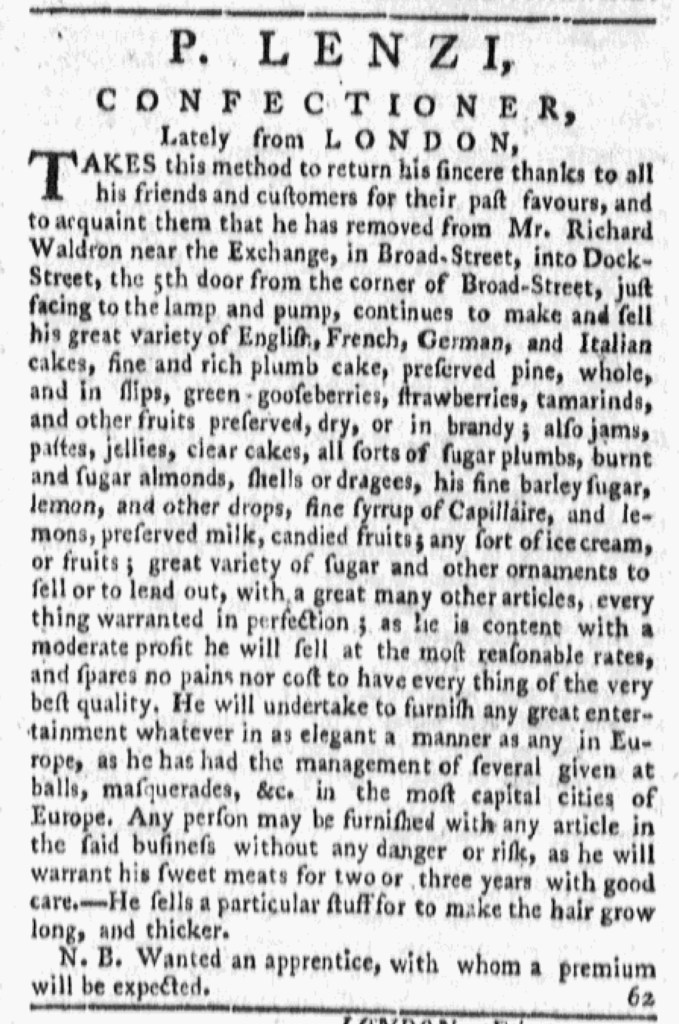
In the summer of 1774, P. Lenzi, a “CONFECTIONER, Lately from LONDON,” took to the pages of Rivington’s New-York Gazetteer to thank “his friends and customers for their past favours,” inform them that he had moved to a new location, and entice the public with descriptions of the sweet treats that he made and sold.  In addition to a “great variety of English, French, German, and Italian cakes,” he offered “fine and rich plumb cake,” a variety of preserved fruits either “dry, or in brandy,” “all sorts of sugar plumbs,” candied fruits,” and “any sort of ice cream” at his shop.  He encouraged prospective customers to imagine the “perfection” of these items or, better yet, take advantage of his low prices to sample these confections for themselves.

Lenzi also promoted his catering services, declaring that he “will undertake to furnish any great entertainment whatever in as elegant a manner as any in Europe.”  That made his London origins even more significant, testifying to his familiarity with parties and events held in the most cosmopolitan city in the empire.  He confided that he had experience supplying cakes and sweets at balls and masquerades “in the most capital cities of Europe.”  Customers looking to impress their guests could depend on his management of their soirees, especially since Lenzi “spares no pain nor cost to have every thing of the very best quality.”  Beyond the confections he supplied, Lenzi encouraged readers to imagine the parties they could host with his assistance.  He had a “great variety of sugar and other ornaments to sell or to lend out, with a great many other articles” to decorate the venues where his clients held their gatherings.

The confectioner sought different kinds of customers.  He recognized the opportunity to generate revenues by providing candies and desserts to clients hosting fêtes while also welcoming patrons who occasionally wished to enjoy a treat, a small indulgence purchased “at the most reasonable rates.”  Recognizing that everyone had their own favorite, Lenzi listed dozens of confections for customers to choose and enjoy.

June 12

What was advertised in a colonial American newspaper 250 years ago this week?

Rivington’s New-York Gazetteer (June 9, 1774).

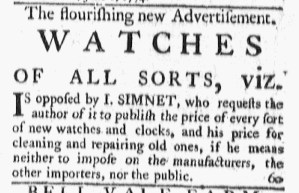
“The flourishing new Advertisement … IS opposed by I. SIMNET.”

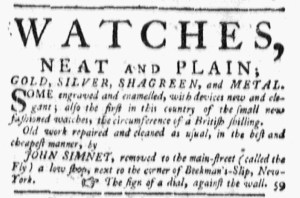
The cantankerous John Simnet once again picked a fight in the public prints in the summer of 1774, having previously engaged in similar behavior targeting competitors in Portsmouth in the late 1760s and New York in the early 1770s.  The watchmaker did not seem content simply promoting his own skill and merchandise, as he did in an advertisement for “WATCHES, NEAT AND PLAIN; GOLD, SILVER, SHAGREEN, and METAL” that first ran in the June 2, 1774, edition of Rivington’s New-York Gazetteer and appeared again a week later.  In that notice, Simnet emphasized a novelty available at his shop, “the first in this country of the small new fashioned watches, the circumference of a British shilling.”

Rivington’s New-York Gazetteer (May 26, 1774).

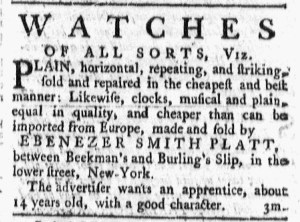
Yet Simnet did not believe that was not enough to distinguish him from his competitors. Instead, he placed a second advertisement in Rivington’s New-York Gazetteer on June 9, that one deriding “The flourishing new Advertisement” with a headline for “WATCHES OF ALL SORTS, viz.” that went on to list “PLAIN, horizontal, repeating, and striking.”  Ebenezer Smith Platt had been running that advertisement in Rivington’s New-York Gazetteer, though Sinmet’s comment about “The flourishing new Advertisement” suggests that his competitor may have distributed handbills or broadsides as well.  The part that really upset Simnet seems to have been Platt’s assertion that he made and sold watches and clocks “equal in quality, and cheaper than can be imported from Europe.”  Even though artisans throughout the colonies, including clock- and watchmakers, often made such appeals, Simnet acted as though they applied solely to him and his business.

Rivington’s New-York Gazetteer (June 9, 1774).

To that end, he quoted the headline of Platt’s advertisement and then trumpeted that he “IS opposed” to the claims made in it.  Simnet went on to demand, though he framed it as a request, that “the author of it” (he did not mention Platt by name) “publish the price of every sort of new watches and clocks, and his price for cleaning and repairing old ones, if he means neither to impose on the manufacturers, the other importers, nor the public.”  On occasion, Simnet had published the prices he charged for cleaning and repairs, though in his current advertisement he merely stated, “Old work repaired and cleaned as usual, in the best and cheapest manner.”  He sought to hold Platt to a higher standard than he met, suggesting that he did so in service to “the public” that might have otherwise been duped by Platt.  In an era when most advertisers promoted their own goods and services without engaging directly with their competitors, Simnet regularly took to the newspapers to demean others who followed his trade, especially those who ran their own advertisements.  He apparently considered such means effective … or at least derived some form of satisfaction from such conduct.

May 26

What was advertised in a colonial American newspaper 250 years ago today?

Rivington’s New-York Gazetteer (May 26, 1774).

“Gentlemen and Ladies, may be furnished with tea and coffee, Morning and Afternoon.”

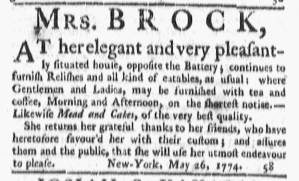
Mrs. Brock invited “Gentlemen and Ladies” to gather at “her elegant and very pleasantly situated house, opposite the Battery,” in New York in the spring of 1774.  In an advertisement in the May 26 edition of Rivington’s New-York Gazetteer, she declared that she “continues to furnish Relishes and all kinds of eatables, as usual.”  She also served “Mead and Cakes, of the very best quality.”  The hostess also took the opportunity to express “her grateful thanks to her friends, who have heretofore favour’d her with their custom.”  Brock had been in business for at least five years, having previously advertised in the New-York Journal.  Given the reputation she had cultivated during that time, she assured her existing clientele and the public “that she will use her utmost endeavour to please.”

Despite such assurances, some readers may not have been pleased with Brock.  In addition to “Relishes” and “eatables,” she also served “tea and coffee, Morning and Afternoon, on the shortest notice.”  New York had recently received word of the Boston Port Act that closed that harbor of that town until residents paid for the tea destroyed the previous December.  Residents were certainly aware of efforts to turn away ships carrying tea to their own colony.  Though no prohibition on buying, selling, or drinking tea had been enacted, many colonizers looked on the commodity with suspicion.  Some merchants and shopkeepers already advertised that they stocked a variety of groceries but not tea, while others made clear that they continued business as usual.  Brock joined their ranks.  Her advertisement could not be mistaken as one merely reprinted after having run for some time, perhaps originating prior to the latest controversy; it was dated “May 26, 1774” and bore the issue number, “58,” of the current edition.  Whatever measures were coalescing around consuming tea, Brock considered it appropriate to continue serving the beverage to “Gentlemen and Ladies” and anticipated that she would meet with a ready market.  Many colonizers, she surmised, were not yet ready to dispense with tea, no matter the complicated politics swirling around it.