What was advertised in a colonial American newspaper 250 years ago this week?
Rivington’s New-York Gazetteer (April 21, 1774).
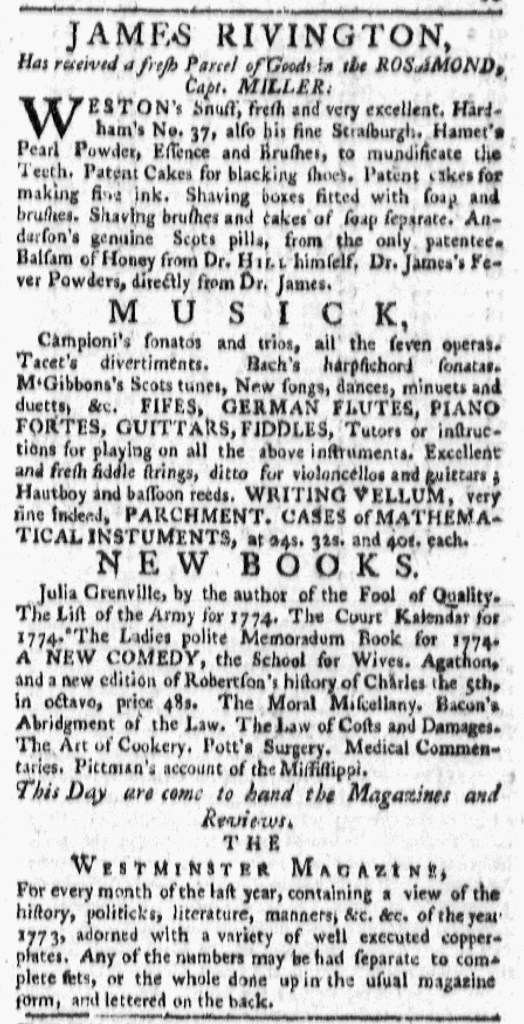
“Any number may be had separate to complete sets, or the whole done up in the usual magazine form.”
James Rivington, the printer of Rivington’s New-York Gazetteer, cultivated alternate revenue streams at his printing office. Many printers were also booksellers, peddling books they imported from England. Such was the case with Rivington. He devoted a portion of his advertisement in the April 21, 1774, edition of his newspaper to “NEW BOOKS,” listing several that he had on hand. He also promoted other items from among the “fresh Parcel of Goods” he recently received. Like many other printers, he sold “cakes for making ink” and popular patent medicines, yet he also stocked a more elaborate inventory of other kinds of goods, including “Shaving boxes fitted with soap and brushes,” “CASES of METHEMATICAL INSTRUMENTS,” and “WESTON’s Snuff, fresh and very excellent.”
The printer and bookseller also advised prospective customers that “This Day are come to hand the Magazines and Reviews.” In particular, he hawked “THE WESTMINSTER MAGAZINE,” proclaiming that he had copies “For every month of the last year.” An associate on the other side of the Atlantic had assembled the annual run of the magazine and shipped it to Rivington to peddle to colonizers interested in a review of “the history, politicks, literature, manners,” and other cultural touchstones “of the year 1773.” To further entice readers, the magazine was “adorned with a variety of well executed copperplates” that buyers could leave intact or remove to frame and display in homes, shops, or offices. For those who had already purchased some editions but not others, Rivington allowed that “Amy of the numbers may be had separate to complete sets.” He also offered “the whole done up in the usual magazine form, and lettered on the back.” In other words, a bookbinder would compile all the issues of the Westminster Magazine from 1773 into a single bound volume and label the spine. That transformed the separate issues from ephemera into an attractive collection that would enhance any library.
Rivington advertised the Westminster Magazine at the same time that Isaiah Thomas continued marketing the Royal American Magazine, the publication that he launched earlier in the year. The Royal American Magazine was the only magazine published in the colonies at the time. Only about a dozen American magazines had been published before that, most of them folding in less than a year and none of them lasting longer than three years. Instead of American magazines, colonizers usually bought imported magazines from booksellers or received them from correspondents. Rivington’s method of importing, advertising, and disseminating the Westminster Magazine and other magazines was familiar and standard practice, making the Royal American Magazine the novelty in the American marketplace.
What was advertised in a colonial American newspaper 250 years ago this week?
Rivington’s New-York Gazetteer (April 7, 1774).
“ETHAN SICKELS, Leather-Dresser and Breeches-Maker.”
Even if imitation is the sincerest form of flattery, Cornelius Ryan, “LEATHER DRESSER and BREECHES MAKER,” probably did not feel particularly flattered when Ethan Sickels, “Leather-Dresser and Breeches-Maker,” ran an advertisement that imitated Ryan’s advertisement a little too much. Compare the copy from Ryan’s notice, which first appeared in the New-York Gazette and Weekly Mercury on March 21, 1774, and Sickels’s notice, which first appeared in Rivington’s New-York Gazetteer on March 31.
Ryan: “MAKES and sells best Buck and Doe Skin Breeches, find ground Lamb do, best Buck and Doe Skin Gloves, also the very best Kind of Caraboo Skin Breeches and Gloves.”
Sickels: “MAKES and sells the best buck and doe skin breeches, fine ground lamb best buck and doe skin gloves; Also the very best Caraboo skin breeches, and gloves.”
Ryan: “He likewise has a great Variety of Buck Skin Breeches for Traders or Country Stores … all which he will sell on as low Terms as they can be had from Philadelphia, or any Part of the Continent.”
Sickels: “he likewise has a great quantity of buckskin breeches for traders, or country stores … all which he will sell on as low terms as they can be had from Philadelphia, or any part of the continent.”
This was not an instance of using standardized or formulaic language as was often the case in eighteenth-century advertisements for consumer goods and services. Instead, Sickels quite clearly borrowed Ryan’s advertising copy … but that was not the only undeniable similarity between the two newspaper notices. Each of them included a woodcut depicting a pair of breeches and the initials of the advertiser that accounted for approximately half of the space occupied by the advertisements. Ryan’s image also included a sun, replicating his “Sign of the SUN and BREECHES,” while Sickels’s image had a border around it instead.
Sickels apparently admired Ryan’s advertisement or feared that it gave his competitor too much of an advantage or recognized a means of drawing more attention to his own business. All those factors may have been at play when he saw Ryan’s notice in the New-York Gazette and Weekly Mercury and decided to cross the street from his workshop “Opposite Mr. RIVINGTON’S PRINTING-OFFICE” to arrange for such a similar advertisement to run in Rivington’s New-York Gazetteer. This suggests that entrepreneurs did not place newspaper advertisements as mere announcements in the eighteenth century but instead some of them monitored the public prints to devise their own marketing efforts or at least keep up with their competitors.
What was advertised in a colonial American newspaper 250 years ago today?
Rivington’s New-York Gazetteer (April 7, 1774).
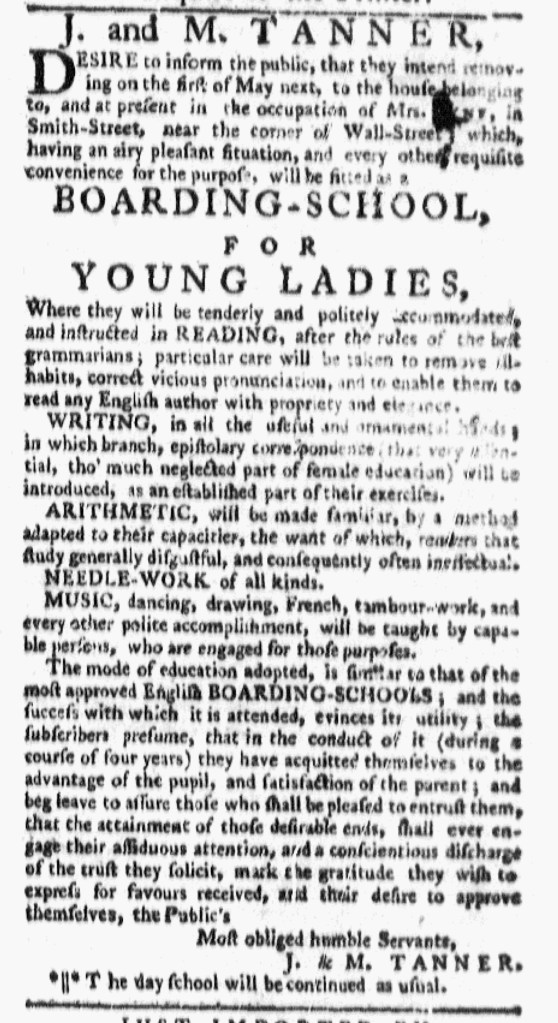
“BOARDING-SCHOOL, FOR YOUNG LADIES.”
J. & M. Tanner’s notice in Rivington’s New-York Gazetteer advertised an opportunity for young women to attend a boarding school “in Smith-Street, near the corner of Wall Street.” At this school, the “YOUNG LADIES” would improve in reading, writing, needlework, music, dancing, and other subjects considered appropriate for them. The Tanners include a comparison of their new school to what a British boarding school had to offer, stating that their curriculum “was similar to that of the most approved English BOARDING-SCHOOLS.” According to Mary Cathcart Borer in Willingly to School: A History of Women’s Education, boarding schools for young ladies popped up in England as early as 1711, with nearly the same curriculum at each.[1] However, arithmetic was a subject that the Tanners’ school in the colonies included that many British schools for girls and young women did not. While still expected to stay in the private sphere, Tanners’ boarding school allowed for young women’s opportunities in arithmetic, which was not always an option for many young women elsewhere. We cannot conclude exactly why the Tanners chose to incorporate arithmetic into their school’s curriculum. However, it indicates that while still using the British model, there were variations of the boarding school systems in the colonies.
The Tanners’ boarding school seems to have been an effort to demonstrate that the colonies could also partake in the same developments that England did, particularly in women’s education and manners. Considering that this advertisement was published in 1774, a year before the first battles of the American Revolution, tensions increasingly inspired colonists to establish self-sufficiency in government and commerce and other aspects of life, such as education, without reliance on Britain. Even as that happened, it is critical to recognize that while the colonies were looking to have their own self-sufficient systems and government, they still included British ideals. Britain was still influential in colonial culture, which was especially shared through ideas of education and what made well-educated and well-mannered young ladies.
**********
ADDITIONAL COMMENTARY: Carl Robert Keyes
Rather than expand on Maria’s interpretation of today’s advertisement, I am reflecting on pedagogy and my experiences integrating the Adverts 250 Project and the Slavery Adverts 250 Project into the courses I teach at Assumption University. Throughout this academic year, including the time that Maria and her peers were enrolled in my Revolutionary America course last fall, faculty and staff have engaged in a series of programs about “awaken[ing] in students a sense of wonder” and how we seek to fulfill the University’s mission. I have learned some valuable lessons along the way, from my colleagues at those events and from my students in the classroom.
Maria and her classmates commence their responsibilities as guest curators by compiling a mini-archive of newspapers published during a particular week in 1774. I provide each of them with a list of extant newspapers that have been digitized and train them in using several databases. Once they have created their mini-archives, each student examines the newspapers for their week to identify all of the advertisements about enslaved people for inclusion in the Slavery Adverts 250 Project and to select an advertisement about consumer goods or services to feature on the Adverts 250 Project. I provide students with hard copies of their newspapers, encouraging them to work back and forth with the digitized ones.
One morning last fall, I arrived in class intending to discuss advertisements about enslaved people and what students learned from that portion of the project. We had a robust discussion, but, to my initial frustration, students did not stick to the topic for the day! Instead of focusing solely on advertisements about enslaved people, they started discussing other kinds of advertisements and asking about other aspects of the newspapers as well. I had a lesson plan, an “agenda” of material that I “needed” to cover that day, and their “off-topic” questions did not facilitate the good order that I had envisioned.
Then I realized that I was witnessing authentic wonder in my classroom, that the conversation taking place was more important than anything I scripted in my mind in advance, and that students were learning more from the experience than by following my outline for that class. I spend so much time working with (digitized) eighteenth-century newspapers that they are as familiar to me as modern media … but having a week’s worth of newspapers published in 1774 in front of them was completely new to my students. The advertisements were new to them, but so were the conventions of eighteenth-century print culture! They immersed themselves in their newspapers, learning as much as they could on their own and then asking questions about life in early America based on what they encountered in those newspapers.
When I finally understood what was happening, I jettisoned my outline so we could have a lengthy conversation about anything my students found interesting or confusing or strange in their newspapers. However unintentional, my first instinct had been to stifle their sense of wonder by attempting to rigidly follow my outline for that class. In the end, we all – professor and students – got so much more out of that class when I learned from my students that I could better facilitate how they learned about the past by giving them opportunities to express their wonder. As the semester progressed, we circled back, repeatedly, to discussing advertisements about enslaved people as my students worked on the Slavery Adverts 250 Project. At the same time, I allowed for more opportunities to “get off track” as we examined a variety of other primary sources. My students learned more and I had a more fulfilling experience as an instructor, energized by the quality of the discussions we had in class on those occasions that my students deviated from what I planned for the day.
**********
[1] Mary Cathcart Borer, Willingly to School: A History of Women’s Education (Cambridge, UK: Lutterworth Press, 1976).
What was advertised in a colonial American newspaper 250 years ago this week?
Rivington’s News-York Gazetteer (March 10, 1774).
“He has not yet obtained a certificate from the Queen’s stay-maker in London.”
Peter Hulick, a “STAY-MAKER, IN HANOVER-SQUARE,” took to the pages of Rivington’s New-York Gazetteer to advise “ladies in this city and the country around it” that he made all kinds of stays. He acknowledged that he “has not yet obtained a certificate from the Queen’s stay-maker in London,” but he likely intended that simply mentioning the possibility planted the idea that he qualified for that honor. Regardless of such recognition, he “flatters himself fully capable of satisfying any ladies who shall be pleased to favour him with their commands.” To that end, he pledged “to give the best of goods and work, with integrity, gratitude and dispatch.” The women of New York could choose from among many staymakers, including John Burchett “at the Sign of the Crown and Stays” (who had “obtained a certificate from the Queen’s Stay-Maker in London”), Thomas Hartley, John McQueen, and Richard Norris. Hulick made and sold stays “after the newest, neatest, and best fashion.” Even without any certificates, “many reputable ladies” in New York and other towns could testify to his skill.
The staymaker also offered stays for “children and growing Misses,” noting that his stays would “give and preserve a shape truly perfect, not dropping or falling in.” He joined some of his competitors in encouraging women and girls to feel self-conscious about their bodies, believing that would incite demand for his services. Norris, for instance, addressed “Ladies uneasy in their shapes” in his advertisements, prompting women to experience uneasiness after perusing his notice even if they previously felt comfortable about their appearance. Like Hulick, Norris placed special emphasis on “young ladies and growing misses,” pushing them to feel alienated by their developing bodies in hopes that they would enlist his aid in achieving the proper form from “their hips [to] shoulders.” Hulick, Norris, and other staymakers sometimes cultivated feelings of insecurity and inadequacy among prospective clients, marketing their services by offering to alleviate those concerns. Promising the “newest, neatest, and best fashion” did not by itself sell their stays.
What was advertised in a colonial American newspaper 250 years ago this week?
Supplement to Rivington’s New-York Gazetteer (March 3, 1774).
“All kinds of Windsor Chairs.”
On and off for several months, Thomas Ash, a “WINDSOR CHAIR MAKER, At the Corner below St. Paul’s Church, In the Broad Way,” adorned his advertisement in Rivington’s New-York Gazetteer with a woodcut depicting the item that he made and sold. In contrast to Abel Buell’s advertisement featuring an image of a gun in the Connecticut Journal, Ash’s woodcut was not the only woodcut commissioned by an advertiser to appear in the March 3, 1774, edition of Rivington’s newspaper. Elsewhere in that issue, Nesbitt Deane once again ran an advertisement featuring a tricorne hat with his name on a banner unfurled beneath it. George Webster, “GROCER, AT THE SIGN OF THE Three Sugar Loaves & Scales,” included an image of three sugar loaves, two shorter ones flanking a taller one, enclosed within a simple border.
Those were not the only visual flourishes intended to draw attention to some of the advertisements in Rivington’s New-York Gazetteer. Decorative borders became a trademark of that newspaper. In the March 3 edition, five advertisements had such borders, including those placed by Richard Sause for merchandise at his “Hardware, Jewellery and Cutlery Store, John Siemon, a furrier, for muffs and tippets, John Simnet for cleaning and repairing watches, and S. Sp. Skinner for rum distilled in New York. Except for Simnet, all those advertisers had experience running other notices with decorative borders, as the links indicate. Simnet previously placed an identical advertisement, including the border. Sause and Siemon also sometimes ran advertisements with woodcuts tied to their businesses. Indeed, Siemon did so in the New-York Journal published the same day, choosing one method of adding visual interest in one newspaper and another method in the other. Webster was the fifth advertiser to use a border of decorative type, taking advantage of both methods in a single newspaper notice.
All the woodcuts and borders in Rivington’s New-York Gazetteer made its pages more vibrant than those in the Connecticut Journal. Advertisements with woodcuts and borders still stood out from others since most did not have either of those features, yet they collectively contributed to a cohesive look that distinguished newspapers published in busy ports from those printed in smaller towns.
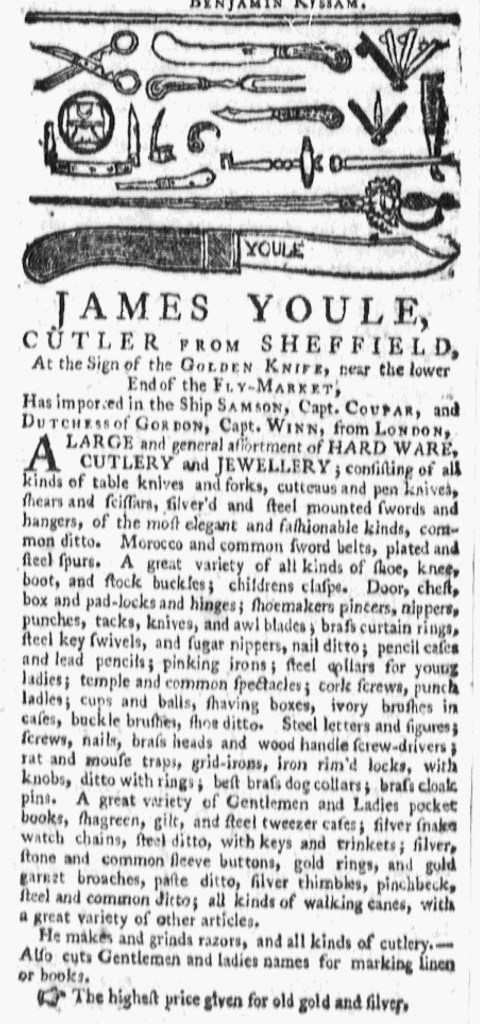
“JAMES YOULE, CUTLER FROM SHEFFIELD, At the Sign of the GOLDEN KNIFE.”
James Youle, a “CUTLER FROM SHEFFIELD,” ran a shop “At the Sign of the GOLDEN KNIFE” in New York in the 1770s. He advertised a “LARGE and general assortment of HARDWARE, CUTLERY and JEWELLERY” in the January 20, 1774, edition of Rivington’s New-York Gazetteer. In addition to the dozens of items he listed in that notice, Youle declared that he “makes and grinds razors, and all kinds of cutlery.” Even given the length of Youle’s advertisement, many readers likely considered the woodcut that adorned it the most significant feature. It depicted more than a dozen items that the cutler made or sold at his shop, including shears, a fork, a table knife, a pocketknife, and a sword. The image rivaled the decorative borders that enclosed other advertisements in the same issue.
Youle had some experience incorporating similar woodcuts into his advertisements. Nearly three years earlier, the partnership of Bailey and Youle included a similar image in their advertisements in the New-York Gazette and Weekly Mercury in March 1771. In the summer of 1772, Youle updated the image to feature his name alone. The partnership having dissolved, Bailey ran advertisements for his own shop “At the Sign of the Cross Swords.” The woodcut that accompanied his advertisement showed several items arrayed around two crossed swords. In the early 1770s, other cutlers in New York, including Richard Sause and Lucas and Shephard, devised similar images for their advertisements, apparently deciding that remaining competitive in their trade required visual images in their notices as well as skill in their shops.
When he returned to pairing advertising copy with a woodcut in 1774, Youle revived the image that he first used when partnered with Bailey and later on his own, though he made one significant alteration. The cutler added a large knife, perhaps a machete, below the sword. The blade bore the name “YOULE,” just as Richard Sause previously included his last name on the blades of both a knife and a sword in his woodcut. Perhaps this new addition was the “GOLDEN KNIFE” from Youle’s sign, a new means of identifying his shop since his earlier advertisements with woodcuts. The cutler may have crafted the woodcut himself. Near the end of his advertisement, he noted that he “cuts Gentlemen and ladies names for marking linen or books. He may have applied the same skill to enhancing his own newspaper advertisements.
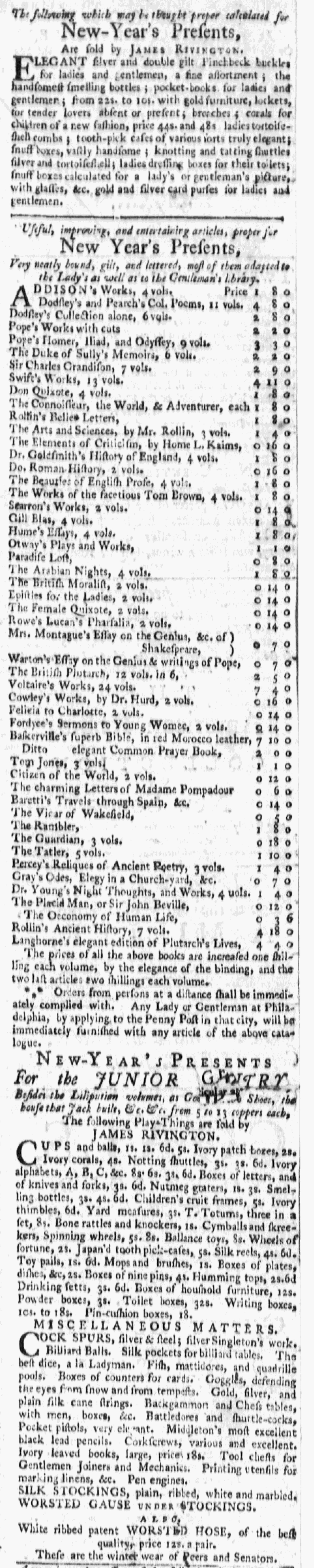
Rarely did retailers associate Christmas and consumption in newspaper advertisements they published in the 1760s and 1770s. They were just as likely to identify the new year as a time to give presents, though relatively few adopted that strategy either. James Rivington, a bookseller, stationer, and printer of Rivington’s New-York Gazetteer, was among those who suggested to consumers that they should purchase presents to commemorate the occasion. His advertisements filled an entire column in the December 30, 1773, edition of his newspaper.
As the first day of the new year approached, Rivington advised that he stocked “[t]he following which may be thought proper calculated for New-Year’s Presents.” He listed a variety of items, including “ELEGANT silver and double gilt Pinchbeck buckles for ladies and gentlemen, a fine assortment,” “snuff boxes, vastly handsome,” “ladies dressing boxes for their toilets,” and “pocket-books for ladies and gentlemen.” Rivington made clear that both women and men could be recipients of these “New-Year’s Presents,” even though editorials and other commentary often depicted women as the perpetrators of conspicuous, frivolous, or unnecessary consumption.
Rivington also presented a catalog of books as “Useful, improving, and entertaining articles, proper for New Year’s Presents,” most of them suitable for recipients of either sex. He described the books as “very neatly bound, gilt, and lettered, most of them adapted to the Lady’s as well as to the Gentleman’s Library.” They included “Pope’s Works with cuts” (or illustrations), “Dr. Goldsmith’s History of England,” “Paradise Lost,” “Mrs. Montague’s Essay on the Genius, &c. of Shakespeare,” “The charming Letters of Madame Pompadour,” and “Gray’s Odes, Elegy in a Church-yard.” Unlike most book catalogs published as newspaper advertisements, this one included the prices for each volume. Those contemplating giving them as gifts could take into account their budget and their relationship to the recipient when considering their purchases. Rivington also encouraged readers living beyond New York to give books as gifts for the new year, declaring that “Orders from persons at a distance shall be immediately complied with.” Those in Philadelphia, he directed, could “immediately” acquire any of the books “by applying to the Penny Post in that city.”
In addition to gifts for adults, Rivington also marketed “NEW-YEAR’S PRESENTS For the JUNIOR GENTRY.” He sold books for children, “Liliputian volumes,” as well as “Play-Things.” The toys included “CUPS and balls,” “Ivory alphabets, A, B, C,” “Bones rattles and knockers,” “Humming tops,” and “Toy pails.” Once again, he listed prices so prospective customers could assess how much they wished to spend on gifts.
Rivington concluded that advertisement with a list of “MISCELLEANOUS MATTERS” that he apparently did not consider as appropriate for giving as presents. In a final advertisement in that column, he promoted a “new and corrected edition” of “Rivington’s Gentleman and Ladys Pocket Almanack.” Although he did not suggest giving the almanac as a gift, the printer considered it “Necessary to every one, in and out of Business, and useful in every Colony upon the Continent.” A couple of days before the new year was the perfect time to purchase an almanac and, according to Rivington, items that customers might not otherwise have purchased but would give as gifts.
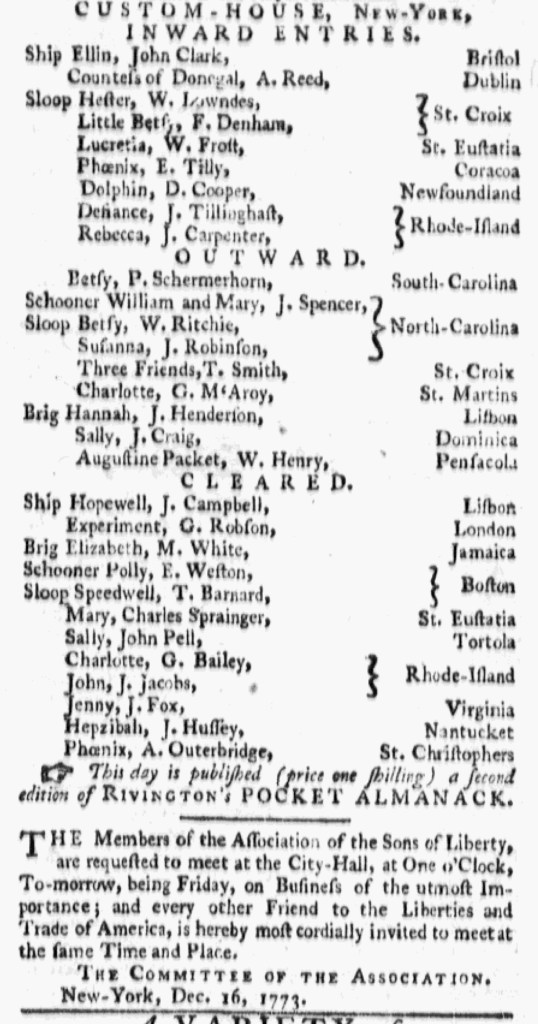
“The Sons of Liberty, are requested to meet at the City-Hall.”
James Rivington, bookseller and printer of Rivington’s New-York Gazetteer, is most often remembered as a Loyalist. He began publishing his newspaper in April 1773. According to Isaiah Thomas, a staunch Patriot printer and author of The History of Printing in America (1810), Rivington’s newspaper “was soon devoted to the royal cause,” yet he does not elaborate on what constituted “soon.”[1] Rivington became so vociferous in expressing Tory sentiments in his newspaper that on November 27, 1775, the Sons of Liberty attacked his printing office and destroyed his press and type. Rivington departed for England, but later returned to New York during the British occupation during the Revolutionary War. He brought a new press and type with him, started publishing his newspaper again, and quickly changed the name to Rivington’s New York Loyal Gazette and then the Royal Gazette. That newspaper continued publication under that title until the end of the war in 1783, then became Rivington’s New-York Gazette. It ceased publication on the final day of that year.
Despite the positions that Rivington ultimately advocated in his newspapers, Thomas acknowledged in his biographical sketch of the printer that “[i]t is but justice to add, that Rivington, for some time, conducted his Gazette with such moderation and impartiality as did him honor.”[2] Thomas reiterated that assessment in his overview of Rivington’s New-York Gazetteer, stating that “for some time Rivington conducted his paper with as much impartiality as most of the editors of that period.”[3] That helps to explain the privileged place that an advertisement placed by the Sons of Liberty occupied in the December 16, 1773, edition of Rivington’s New-York Gazetteer. That notice called on the “Members of the Association of the Sons of Liberty … to meet at the City-Hall” on the following day to discuss “Business of the utmost Importance.” The “COMMITTEE OF THE ASSOCIATION” that placed the advertisement invited “every other Friend to the Liberties and Trade of America” to attend the meeting. Rivington not only published the advertisement, he placed it immediately below the shipping news from the customs house. Like many other colonial newspapers, Rivington’s New-York Gazetteer followed a particular format that placed news items and editorials first, then the shipping news, and finally advertisements. The shipping news, a weekly feature, marked the end of news coverage and the beginning of advertisements. Readers who were not especially interested in perusing the advertisements, many of which repeated from week to week, may have been more likely to take note of the first advertisement that followed the shipping news as they recognized the transition from one type of content to another. That gave the notice from the Sons of Liberty greater visibility than had it appeared embedded among the dozens of advertisements on the next two pages of the newspaper. The savvy Rivington inserted a two-line notice about a pocket almanac he just published, not even separating it from the shipping news, before the announcement by the Sons of Liberty. He certainly tended to his own interests, but he also provided impartial space in the public prints for a while after he commenced publishing Rivington’s New-York Gazetteer.
**********
[1] Isaiah Thomas, The History of Printing in America: With a Biography of Printers and an Account of Newspapers (1810; New York: Weathervane Books, 1970), 479.
“WATCHES justly valued for those who are about to buy, or swop elsewhere.”
John Simnet, who billed himself as the “only regular London watch-maker here,” regularly advertised in the newspapers published in New York. As November 1773 came to a close, he inserted notices in the New-York Gazette and Weekly Mercury, the New-York Journal, and Rivington’s New-York Gazetteer. Over the years, he gained a reputation for his cantankerous advertisements in which he feuded with his competitors. Such aggressive strategies did not account for the only appeals that the watchmaker made to the public. In many of his advertisements, he listed his prices, demonstrating the deals available at his workshop to prospective clients who did some comparison shopping. Simnet asserted, for instance, that he performed “every particular in repairing [watches] at HALF the price charg’d by others.” Furthermore, he “will keep them in proper order in future, gratis,” a valuable service for his customers. He also did appraisals: “WATCHES justly valued for those who are about to buy, or swop elsewhere.”
Those appeals, along with his colorful personality, helped to distinguish Simnet’s advertisements from those placed by other watchmakers. In the November 25 edition of Rivington’s New-York Gazetteer, another aspect of his advertisement attracted attention. The watchmaker joined the ranks of advertisers who decided to have a decorative border enclose his notice. In recent months, that became a style associated with New York’s newest newspaper. Simnet ran the same copy that appeared in the New-York Journal on the same day and a few days earlier in the November 22 edition of the New-York Gazette and Weekly Mercury, but only his notice in Rivington’s New-York Gazetteer featured a border. Simnet joined six other advertisers who opted for that visual element to enhance their notices and attract the attention of readers. Like most other advertisers, he devised the copy on his own, but entrusted the format to the compositors in each printing office. In this case, however, he apparently made a request to incorporate a border after observing so many other advertisements in that newspaper receive that treatment. Considering how much Simnet craved attention, arguably even more than most advertisers, readers familiar with his reputation and his previous notices may have been surprised that it took him so long to run an advertisement with a visual element gaining in popularity.
“Dr. OGDEN’S very successful Method of Cure, which the Printer inserted in the Almanack at the particular request of some of the Inhabitants.”
As the new year approached and printers throughout the colonies advertised almanacs for 1774, James Rivington of New York took to the pages of his own newspaper to advise prospective customers that the “very great Demand for Rivington’s Almanack … HAS occasioned him to print a new Edition.” Like many other printers who marketed the almanacs they published, Rivington provided an extensive list of the contents as a means of generating interest. He enumerated twenty items. They included helpful reference information, such as “Courts in this and the neighbouring Provinces,” “Fairs,” “FRIENDS Meetings,” and “Roads.” They also included six “Cures for Disorders in Horses” and five “Receipts [or cures] from some of the most eminent Physicians” for a variety of symptoms. For entertainment, the almanac contained “Pleasant Jests.” For the edification of readers, it included “A very important Lesson.” Rivington emphasized that the contents of his almanac “vary in many particulars from others” sold by competitors. The items he selected for inclusion “have been so well received by the Public, as to occasion a very large Quantity to be sold in a few Days.” Existing demand served as a recommendation for the new edition.
Before commenting on the reception that the almanac already enjoyed or listing the contents, Rivington opened his advertisement with a note intended to resonate with prospective customers in nearby Connecticut. “The following Almanack is particularly recommended to the Inhabitants of the Colony of Connecticut,” the printer asserted, “where the ulcerous and malignant Sore Throat, at this Time rages in a very high Degree.” Rivington reported that he inserted “Dr, OGDEN’S very successful Method of Cure … at the particular Request of some of the Inhabitants.” Among the contents enumerated in the advertisement, “Dr. JACOB OGDEN’S Method of treating the Malignant Sore Throat Distemper” appeared first. That item alone, Rivington suggested, justified purchasing this particular almanac. He implied that he provided an important service, though his altruism had limits. After all, he could have published the “Method of Cure” in Rivington’s New-York Gazetteer; or the Connecticut, New-Jersey, Hudson’s-River, and Quebec Weekly Advertiser for the benefit of readers throughout the region he distributed his newspaper. Still, Rivington framed his choice of contents for his almanac as an act of benevolence that took current events in account. His awareness of the particular needs of prospective customers in Connecticut led him to respond in a manner that he intended would simultaneously contribute to public health and further his own commercial interests.