What was advertised in a revolutionary American newspaper 250 years ago today?
Pennsylvania Evening Post (February 24, 1776).
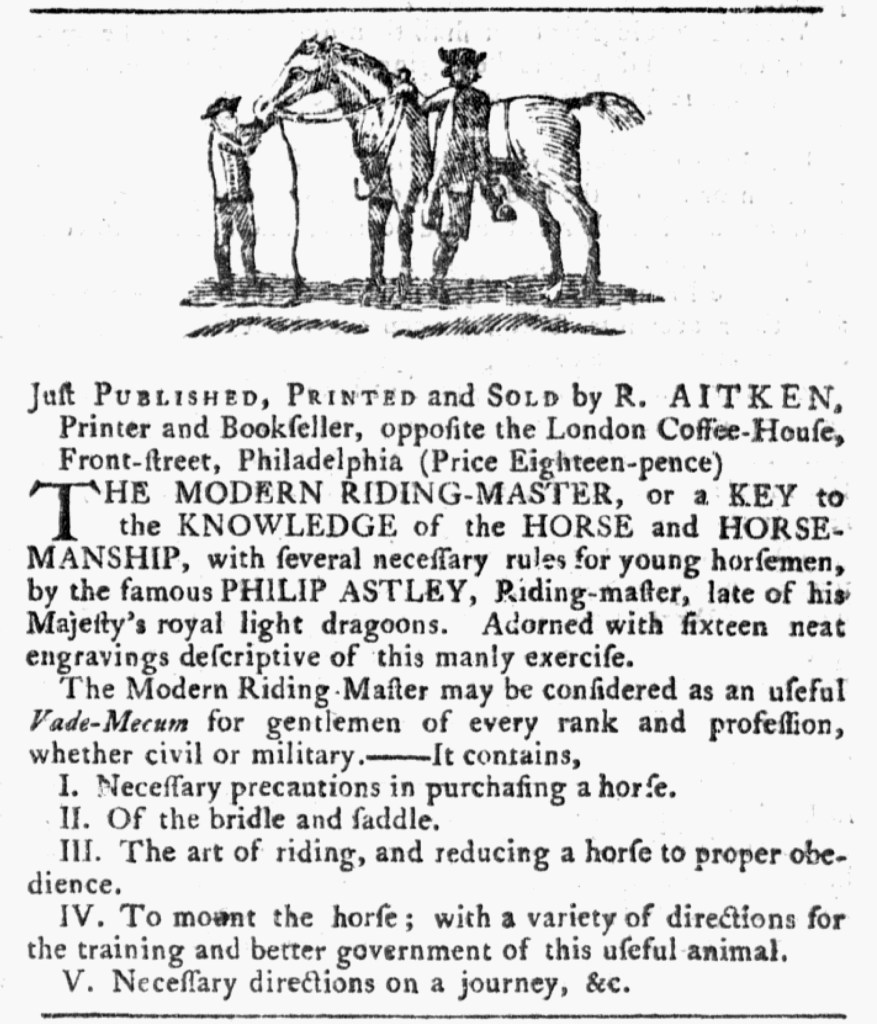
“THE MODERN RIDING-MASTER … Adorned with sixteen neat engravings.”
When Robert Aitken “PUBLISHED, PRINTED and SOLD” an American edition of Philip Astley’s “THE MODERN RIDING-MASTER, or a KEY to the KNOWLEDGE of the HORSE and HORSEMANSHIP,” he placed an advertisement in the Pennsylvania Evening Post. In marketing the manual, he emphasized Astley’s celebrity, identifying him as a “Riding-master, late of his Majesty’s royal light dragoons.” Aitken also promised that the manual included “several necessary rules for young horsemen.” To that end, he declared that The Modern Riding-Master “may be considered as an useful Vade-Mecum” or handbook “for gentlemen of every rank and profession, whether civil or military.” As printers and booksellers often did in their advertisements, Aitken copied the section headings to provide an overview of the contents. The manual began with “Necessary precautions in purchasing a horse” and attention “Of the bridle and saddle,” continued with “The art of riding, and reducing a horse to proper obedience,” and also covered how “To mount the horse; with a variety of directions for the training and better government of this useful animal” and “Necessary directions on a journey.”
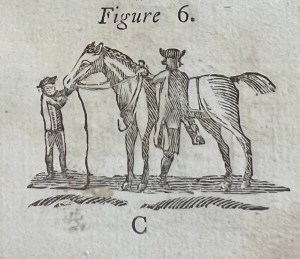
Figure 6 from Philip Astley, The Modern Riding-Master (Philadelphia: Robert Aitken, 1776). Courtesy American Antiquarian Society.
In addition to these directions, the manual featured “sixteen neat engravings descriptive of this manly exercise.” Aitken exaggerated a bit. The handbook did indeed have sixteen illustrations, but they were woodcuts integrated into the text rather than copperplate engravings printed separately. Those images “Adorned” the text, as Aitken stated, but they were not of the same quality as engravings. Still, they provided useful visual aids for readers. To draw the attention of prospective customers, Aitken submitted one of those woodcuts, Figure 6, to accompany his advertisement in the Pennsylvania Evening Post. It depicted a rider placing his “left Foot in the Stirrup” as he prepared to mount a horse held steady by an attendant. Aitken made savvy use of the woodcut, reusing it in an advertisement once he finished printing the manual. It was the only visual image in his notice in the Pennsylvania Evening Post, a newspaper that did not even have a device in its masthead. The woodcut gave a preview of what readers could expect if they purchased Astley’s manual.
Woodcuts in Philip Astley, The Modern Riding-Master (Philadelphia: Robert Aitken, 1776). Courtesy American Antiquarian Society.
What was advertised in a revolutionary American newspaper 250 years ago today?
Pennsylvania Evening Post (February 22, 1776).
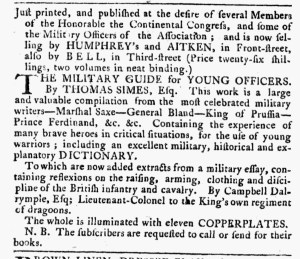
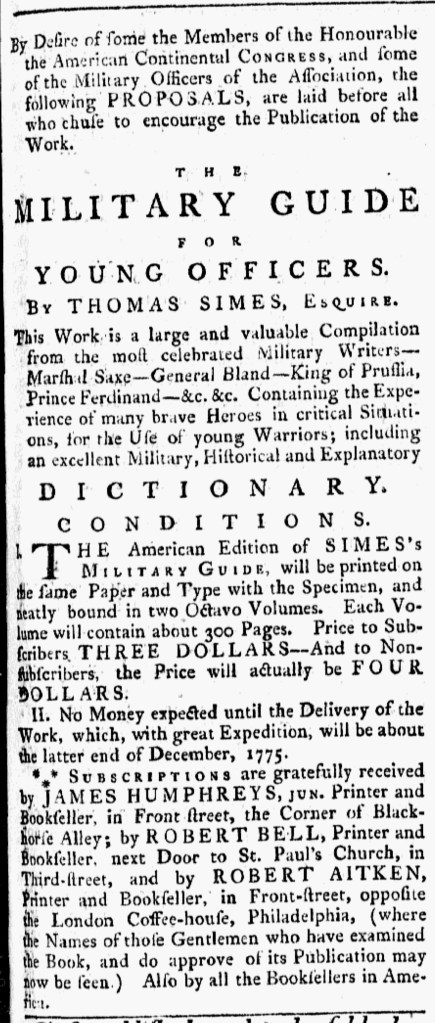
“THE MILITARY GUIDE for YOUNG OFFICERS. By THOMAS SIMES, Esq.”
Several printers in Philadelphia advertised “THE MILITARY GUIDE for YOUNG OFFICERS” by Thomas Simes in February 1776. The manual was published in 1776 and contained a compilation of “works of several military authors, including Humphrey Bland and the comte de Saxe.” When the American Revolution began in 1775, military manuals, such as the one Simes wrote, became popular among young men preparing to join the war and those who had already joined. According to the American Revolution Institute of the Society of the Cincinnati, “to meet the demand for military texts, a flood of printings began to appear from the American presses.” Additionally, the advertisement above, published in the Pennsylvania Evening Post, which was a newspaper located in Philadelphia, displays how that flood of printing was “centered in Philadelphia, where more than thirty works on military subjects were published in the years 1775 and 1776 alone.” The advertisement briefly summarizes the book, stating that it included “the experience of many brave heroes in critical situations, for the use of young warriors” to entice the target audience of young men who would serve as officers to purchase the book as a helpful guide. The advertisement even noted that the guide came with its own “explanatory DICTIONARY,” a bonus section. One signer of the Declaration of Independence, William Floyd, owned a copy of Simes’s guide, which can be taken as an indicator of both the quality and popularity of its contents.
**********
ADDITIONAL COMMENTARY: Carl Robert Keyes
Robert Bell, the publisher of the first edition of Thomas Paine’s Common Sense, continued his feud with William Bradford and Thomas Bradford, the printers of the Pennsylvania Journal, with a new advertisement in the February 22, 1776, edition of the Pennsylvania Evening Post. Dissatisfied with Bell’s bookkeeping, Paine collaborated with the Bradfords on an expanded edition of his popular political pamphlet, yet Bell took an unauthorized second edition to press and simultaneously published diatribes about Paine and the Bradfords. His latest advertisement would be the last in the series that attacked the author and his fellow printers. It filled more than a column, starting on the third page of the February 22 issue of the Pennsylvania Evening Post and overflowing onto the fourth page. The advertisement for Thomas Simes’s Military Guide for Young Officers, jointly published by Bell, Robert Aitken, and James Humphreys, Jr., immediately followed Bell’s advertisement. In the column to the right, the Bradfords promoted their “NEW EDITION of COMMON SENSE, With ADDITIONS and IMPROVEMENTS,” and warned that the “Pamphlet advertised by Robert Bell intitled ADDITIONS to COMMON SENSE … consists of Pieces taken out of News Papers, and not written by the Author of COMMON SENSE.”
The advertisement for Simes’s Military Guide for Young Officers thus appeared in the middle of the controversy over the publication of new editions of Common Sense. Unlike Bell’s questionable decision to produce a second edition of the political pamphlet and then attempt to capitalize off it by publishing another pamphlet of “ADDITIONS” drawn from newspapers rather than written by Paine, he collaborated with Aitken and Humphreys in producing the military manual “at the desire of several Members of the Honorable the Continental Congress, and some of the Military Officers of the Association.” Bell (along with Aitken and Humphreys) had the right endorsements for an American edition of a manual previously published in London and the printers attempted to leverage that in marketing Simes’s Military Guide for Young Officers to prospective customers who, as Madison notes, could choose from among many similar works published in Philadelphia at the time. In the Pennsylvania Evening Post, the advertisement appeared in the middle of the various notices in the February 22 edition, but two days later it had a privileged place in the Pennsylvania Ledger. Humphreys, the printer of that newspaper, placed the advertisement on the first page, making it the first item in the first column. The printers of the Pennsylvania Gazette gave the advertisement the same treatment in the February 28 edition of their newspaper. The flamboyant Bell took a more measured approach to marketing the military manual compared to some of the other books and pamphlets he printed and, especially, his new editions of Common Sense. Perhaps his partners in the endeavor took the lead in marketing Simes’s Military Guide for Young Officers.
What was advertised in a revolutionary American newspaper 250 years ago today?
Dunlap’s Pennsylvania Packet (January 1, 1776).
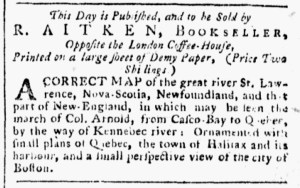
“A CORRECT MAP … in which may be seen the march of Col. Arnold.”
On January 1, 1776, Robert Aitken, a printer and bookseller, advertised that he had for sale a “CORRECT MAP of the great river St. Lawrence, Nova-Scotia, Newfoundland, and that part of New-England, in which may be seen the march of Co. Arnold, from Casco-Bay to Quebec, by wat of Kennebec river.” The map featured insets depicting the “plains of Quebec, the town of Halifax and its harbour, and a small perspective view of the city of Boston.” Like several other maps and prints advertised in the months following the outbreak of hostilities at Lexington and Concord in April 1775, this map supplemented the news that colonizers read in the newspapers and heard when they discussed current events.
This “CORRECT MAP” aided in understanding the dual-pronged American invasion of Quebec that commenced near the end of August. General Richard Montgomery and 1200 soldiers headed from Fort Ticonderoga, New York, recently captured from the British, toward Montreal. That city surrendered to Montogomery on November 13. Meanwhile, Colonel Benedict Arnold and 1100 soldiers sailed from Newburyport, Massachusetts, to the mouth of the Kennebec River on September 15. They made a harrowing trek through the wilderness of northern New England, losing nearly half their number to death or desertion, before reaching Quebec City on November 14. Arnold and his soldiers besieged the city, eventually supported by Montgomery and reinforcements on December 2. The enlistments for many of the American soldiers ended on December 31, prompting Montgomery and Arnold to attack the city during a snowstorm. The weather did not work to their advantage. Montgomery was killed, Arnold wounded, and four hundred American soldiers captured. Arnold assumed command and continued the siege, realizing that British reinforcements would arrive when the St. Lawrence River became navigable again in the spring. When General John Burgoyne arrived in May, Arnold led a retreat to upstate New York. Ultimately, the American invasion of Canada failed.
When they saw Aitken’s advertisement for a “CORRECT MAP … in which may be seen the march of Col. Arnold” in the January 1 edition of Dunlap’s Pennsylvania Packet, they had no way of knowing about the failed attack that occurred the previous day. Supporters of the American cause still hoped that Montgomery and Arnold would capture Quebec City, dealing a significant blow to the British. Along with newspaper coverage, the map chronicled what readers knew about the invasion of Canada, including the hardships endured by Arnold and the soldiers under his command who endured so many hardships in the wilderness of northern New England.
What was advertised in a revolutionary American newspaper 250 years ago today?
Pennsylvania Ledger (December 2, 1775).
“THE American Edition of SIMES’s MILITARY GUIDE.”
In December 1775, James Humphreys, Jr., Robert Bell, and Robert Aitken collaborated in advertising and publishing The Military Guide for Young Officers by Thomas Simes, making yet another military manual available to the public following the momentous events at Lexington and Concord the previous April. More recent developments, both military and political, convinced printers that a market existed for military manuals. According to the introduction to “Books in the Field: Studying the Art of War in Revolutionary America,” an exhibition sponsored by the American Revolution Institute of the Society of the Cincinnati, “a flood of printing began to appear from the American presses. Much of this activity was centered in Philadelphia, where more than thirty works on military subjects were published in the years 1775 and 1776 alone.”
Of the three of the printer-booksellers who partnered in publishing Simes’s Military Guide, Humphreys was the only one who published a newspaper. He gave their advertisement a privileged place at the top of the first column on the first page of the December 2, 1775, edition of the Pennsylvania Ledger. Rather than advertising a book already available for sale, the printer-booksellers distributed subscription proposals, doing so, they claimed, “By Desire of some the Members of the Honourable American Continental CONGRESS, and some of the Military Officers of the Association.” Readers who wished to reserve copies of the work became subscribers by submitting their names to any of those three printer-booksellers, though they also indicated that “SUBSCRIPTIONS are gratefully received … by all the Booksellers in America.” Printers, authors, and others in the book trades had more than one reason for circulating subscription proposals. They hoped to incite greater demand while also learning if sufficient interest existed to make a project viable and, if so, how many copies to produce.
This subscription proposal featured an overview of the contents of the military guide: “a large and valuable Compilation from the most celebrated Miliary Writers … Containing the Experience of many brave Heroes in critical Situations, for the Use of young Warriors” as well as “an excellent Military, Historical and Explanatory DICTIONARY.” This “American Edition … will be printed on the same Paper and Type with the Specimen, and neatly bound in two Octavo Volumes.” Apparently, Humphreys, Bell, and Aitken had specimens or samples of the paper and type on display at their printing offices so prospective subscribers could examine them and assess the material quality of the work for themselves before committing to ordering copies. Printers often circulated specimens along with subscription proposals. The partners planned to print some surplus copies, expecting that demand would warrant doing so, but encouraged subscribers with a discount. Those who reserved their copies paid three dollars, but for “Non-subscribers, the Price will actually be FOUR DOLLARS.” Subscribers did not need to part with their money “until the Delivery of the Work,” anticipated for “the latter end of December, 1775.” Humphreys, Bell, and Aitken did not take the military manual to press as quickly as they expected. The imprint on the title page gives the date of publication as 1776. The partners made one final pitch in the subscription proposals, announcing that “the Names of those Gentlemen who have examined the Book, and do approve of its Publication may now be seen” at Aitken’s printing office. These marketing efforts apparently helped the partners attract enough subscribers to publish the proposed work. Not all subscription proposals met with such success. Current events likely played a role in the outcome when Humphreys, Bell, and Aitken proposed an American edition of The Miliary Guide for Young Officers.
What was advertised in a revolutionary American newspaper 250 years ago today?
Dunlap’s Pennsylvania Packet (October 2, 1775).
“THE SPEECH of EDMUND BURKE, Esq; on moving his Resolutions for Conciliation with the Colonies.”
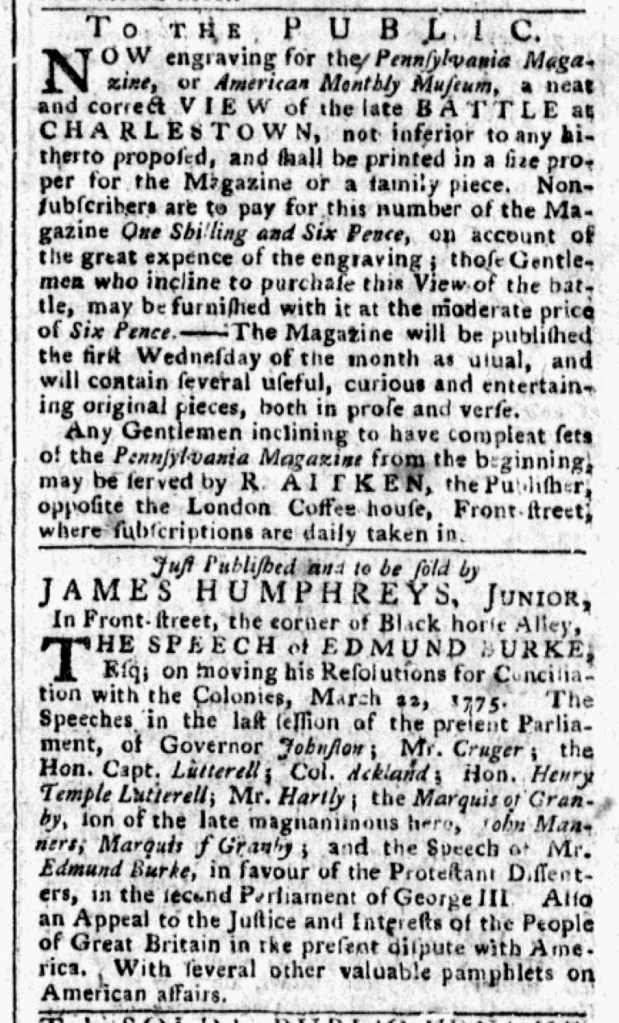
Interest in current events continued to influence some of the products advertised to colonial consumers in the October 2, 1775, edition of Dunlap’s Pennsylvania Packet. Robert Aitken once again ran his advertisement promoting a “neat and correct VIEW of the late BATTLE at CHARLESTOWN,” now known as the Battle of Bunker Hill. Subscribers to the Pennsylvania Magazine would receive the print as a premium, while others could purchase it separately.
Immediately below Aitken’s advertisement, James Humphreys, Jr., announced that he sold “THE SPEECH of EDMUND BURKE, Esq; on moving his Resolutions for Conciliation with the Colonies, March 22, 1775.” In that speech, delivered less than a month before the battles at Lexington and Concord, Burke presented peace and strengthening ties with the colonies as preferable to war. The colonies, after all, were an important market for British goods. Burke proposed allowing the colonies to elect their own representatives to send to Parliament as well as establishing a General Assembly with the authority to regulate taxes that would meet in the colonies. By that time, colonizers already recognized Burke as a friend and advocate for their cause. In April 1774, he had delivered a speech in favor of repealing duties on tea.
Humphreys also advertised a collection of speeches made “in the last session of the present Parliament” by “Governor Johnston; Mr. Cruger; the Hon. Capt. Lutterell; Col. Ackland,” and several others. That anthology included another speech by Burke, that one “in favour of the Protestant Dissenters” and religious liberty from 1773 during “the second Parliament of George III.” In addition, Humphreys stocked an “Appeal to the Justice and Interests of the People of Great Britain in the present dispute with America” by Arthur Lee, born in Virginia yet serving as an agent for Massachusetts in London in 1775. Humphreys concluded with a note that he also sold “several other valuable pamphlets on American affairs.” He most likely marketed American editions published by James Rivington, the printer of Rivington’s New-York Gazetteer often derided as a Tory who supported Parliament. Yet Rivington printed, advertised, and disseminated pamphlets representing a range of views, considering each of them opportunities to generate revenue. Among the “valuable pamphlets” that Humphreys named in his advertisement, he selected only those that supported the American cause, though he may have made a broader range of perspectives available without listing them in the public prints. Whatever the case, he anticipated that pamphlets about current events would attract customers.
What was advertised in a revolutionary American newspaper 250 years ago today?
Pennsylvania Gazette (September 20, 1775).
“A neat and correct VIEW of the late BATTLE at CHARLESTOWN, not inferior to any hithero proposed.”
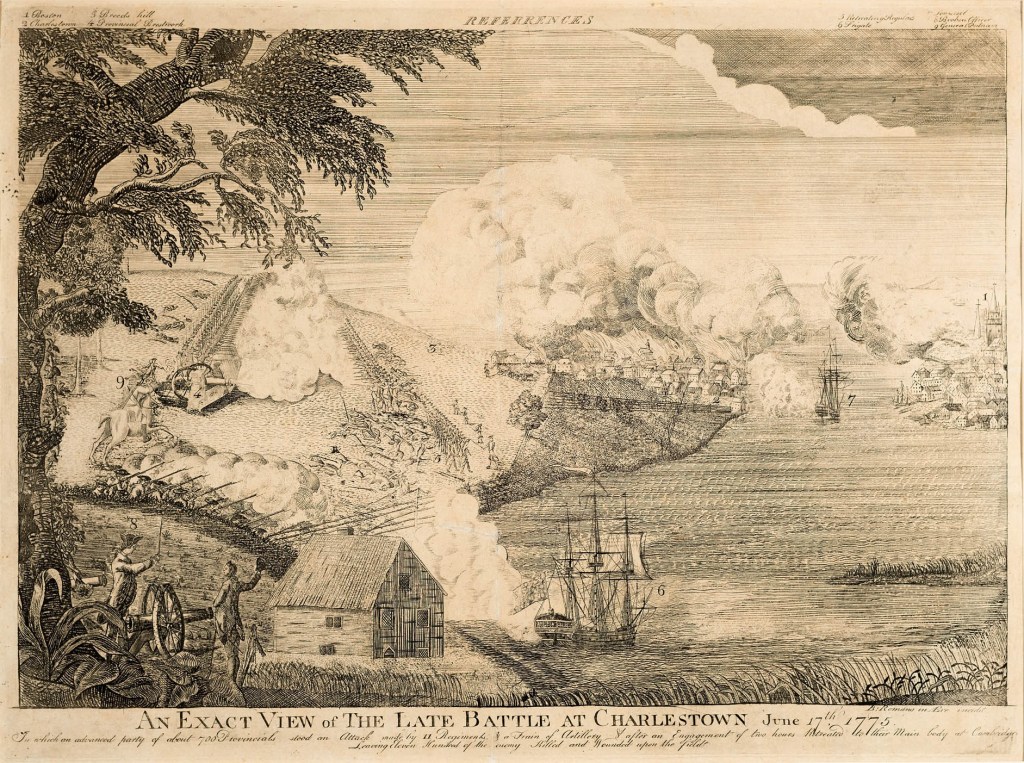
After appearing in the Pennsylvania Ledger on September 16, 1775, the subscription proposal for “An exact VIEW of the late Battle at Charlestown,” now known as the Battle of Bunker Hill, ran in the Pennsylvania Gazette four days later. It featured nearly identical copy, including a list of local agents, among them several printers in Philadelphia, who collected the names of subscribers in that city and other towns from New York to Virginia. The notice named Nicholas Brooks as the “printer of said view,” but did not mention that he collaborated with Bernard Romans, the cartographer and engraver. An addition at the bottom of the advertisement, “Frames and Glass may be had at the abovesaid N. Brooks’s,” suggested that Brooks managed the marketing of the proposed print.
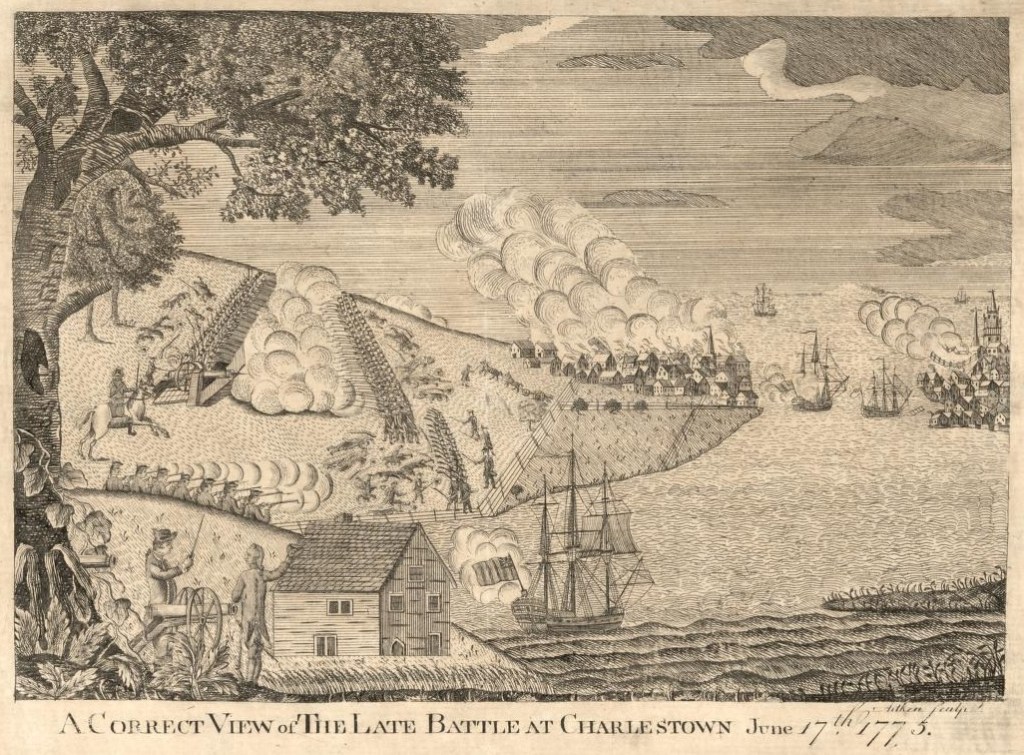
Immediately below that advertisement, Robert Aitken announced, “NOW engraving for the Pennsylvania Magazine, or American Monthly Museum, a neat and correct VIEW of the late BATTLE at CHARLESTOWN, not inferior to any hitherto proposed.” Aitken, who was not among the printers listed as local agents for the Brooks and Romans print, promoted a competing print! This one, however, “shall be printed in a size proper for the Magazine.” The two prints looked strikingly similar, not unlike the competing prints of the Boston Massacre produced by Henry Pelham and Paul Revere in 1770, though one was larger than the other. Aitken’s print measured 18 x 26 cm (approximately 7 x 10 inches), the right size to tuck it inside the magazine for delivery to subscribers. Brooks and Romans’s print measured 31.5 x 42.2 cm (approximately 12.5 x 16.5 inches) on a 40.6 x 50.5 cm sheet (approximately 16 x 20 inches), perhaps making it a better candidate to frame and display.
Robert Aitken (engraver and publisher), “A Correct View of the Late Battle at Charlestown” (1775). Courtesy Library of Congress.
Subscribers to the Pennsylvania Magazine received the print as a premium. Nonsubscribers could purchase the issue for “One Shilling and Sixpence, on account of the great expence of the engraving.” On other occasions, including the September 16, 1775, edition of the Pennsylvania Ledger, Aitken advertised the price as one shilling per issue. He now informed “those Gentlemen who incline to purchase this View of the Battle may be furnished with it at the moderate price of Sixpence.” In effect, he did not give readers who purchased a single issue of the magazine any sort of discount, perhaps hoping to encourage them to subscribe to receive the print as a gift. Whatever the case, Aitken’s print was slightly more expensive than the five shillings that Brooks and Romans charged for their uncolored print.
Nicholas Brooks (publisher) and Bernard Romans (engraver), “An Exact View of the Late Battle at Charlestown” (1775). Courtesy Massachusetts Historical Society.
Given the similarity of the prints, did Aitken pirate his “VIEW of the late BATTLE at CHARLESTOWN” from Brooks and Romans? That had been the case with Revere issuing a print based on a drawing by Pelham before the artist managed to publish his own. Or did Aitken collaborate with Brooks and Romans? It was not the first time that an image that accompanied his magazine resembled one of their projects. The July 1775 issue of the Pennsylvania Magazinefeatured a map, “A New and Correct Plan of the Town of Boston, and Provincial Camp.” Aitken marketed it at the same time that Brooks and Romans published a map of eastern Massachusetts and northern Rhode Island that featured an inset showing a “Plan of BOSTON and its ENVIRONS 1775.” The two did not resemble each other as much as the “VIEW” that each advertised. Whether they collaborated or competed, Aitken and Brooks and Romans all aimed to disseminate a commemorative item that simultaneously kept buyers better informed and inspired them to support the American cause.
What was advertised in a revolutionary American newspaper 250 years ago today?
Pennsylvania Evening Post Extraordinary (September 8, 1775).
“The publisher would be very glad to have some more good original pieces handed to him.”
When Joseph Greenleaf ceased publication of the Royal American Magazine just after the battles at Lexington and Concord, Robert Aitken’s Pennsylvania Magazine, Or American Monthly Museum became the only magazine published in the American colonies. Circumstances in Boston prevented Greenleaf from continuing production of his magazine, acquired from its founder, Isaiah Thomas, the previous summer. Aitken had a more advantageous situation in Philadelphia.
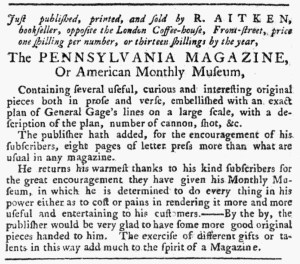
Yet events unfolding in Massachusetts loomed large for Aitken and readers of the Pennsylvania Magazine. When Samuel Loudon, a bookseller in New York, advertised subscriptions for the magazine in August 1775, he noted that the most recent issue came with a bonus item, a “new and correct Plan of the TOWN of BOSTON, and PROVINCIAL CAMP.” Aitken highlighted coverage of the siege of Boston and the threat posed by British troops in his own advertisements. In early September, he informed the public that the contents of the most recent issue included “several useful, curious and interesting original pieces both in prose and verse, embellished with an exact plan of General Gage’s lines on a large scale, with a description of the plan, number of cannon, shot, &c.” When it came to disseminating news about the Continental Army facing off against British forces during the first months of the Revolutionary War, the Pennsylvania Magazine supplemented coverage in newspapers.
While Aitken certainly welcomed any accounts of current events in Massachusetts, he aimed to compile an array of “useful, curious and interesting” content for his readers. To that end, he proclaimed that he “would be very glad to have some more good original pieces handed to him.” During his time as publisher of the Royal American America, Thomas similarly ran advertisements seeking submissions. He solicited “LUCUBRATIONS,” requesting that “Gentlemen” send them “with all speed to his Printing office.” Aitken did not make his request solely of men, perhaps recognizing that genteel women participated in belles lettres literary circles as both readers and writers. Women used pseudonyms, often classical allusions, in those circles. They could do the same when sending pieces for the magazine. “The exercise of different gifts or talents,” Aitken declared, “add much to the spirit of a Magazine.” Like Thomas, he engaged in an eighteenth-century version of crowdsourcing to generate content for his magazine.
What was advertised in a revolutionary American newspaper 250 years ago today?
New-York Gazette and Weekly Mercury (August 21, 1775).
“To the last Number for July, is affix’d a new and correct Plan of the TOWN of BOSTON, and PROVINCIAL CAMP.”
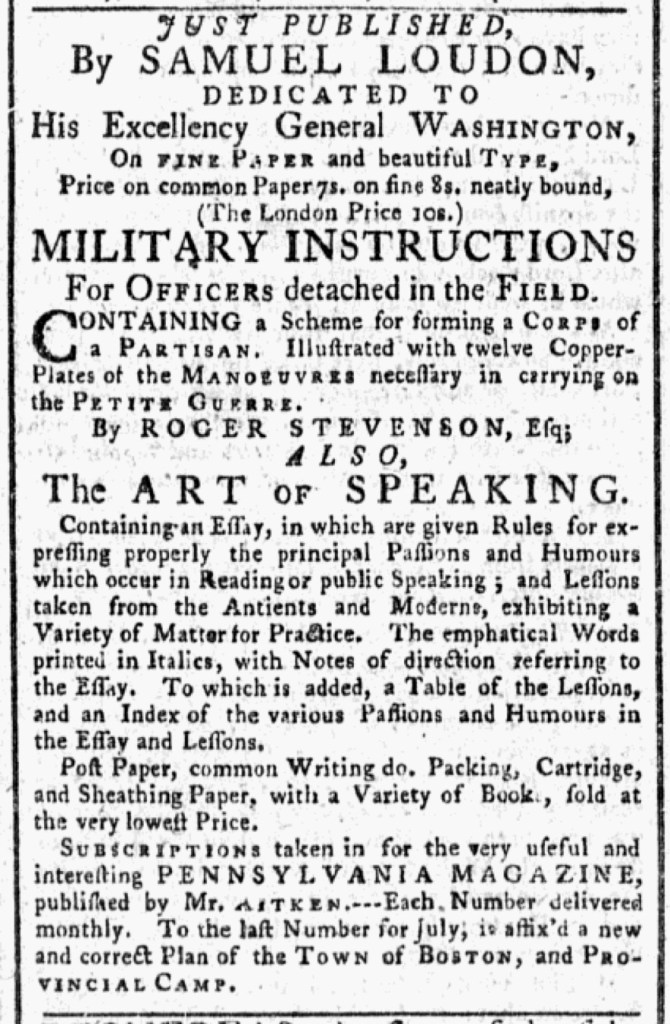
In the summer of 1775, Samuel Loudon, a bookseller in New York, stocked books printed by Robert Aitken in Philadelphia. He advertised Military Instructions for Officers Detached in the Field, “DEDICATED TO His Excellency General Washington,” and The Art of Speaking in the August 21, 1775, edition of the New-York Gazette and Weekly Mercury. He also noted that he stocked an assortment of paper and a “Variety of Books” that he “sold at the very lowest Price.”
Loudon concluded his advertisement by promoting another of Aitken’s projects. The bookseller advised the public that he collected subscriptions “for that very useful and interesting “PENNSYLVANIA MAGAZINE, published by Mr. AITKEN.” The Pennsylvania Magazine, or, American Monthly Museum commenced publication with its January 1775 issue, briefly overlapping with the Royal American Magazine. Upon the demise of the latter, it became the only magazine published in the colonies.
To incite interest, Loudon noted that “the last Number for July” featured a “new and correct Plan of the TOWN of BOSTON, and PROVINCIAL CAMP.” According to the Norman B. Leventhal Map and Education Center at the Boston Public Library, this map “was the earliest printed depiction of Boston after the battle of Bunker Hill, June 17, 1775.” It includes an inset that “shows the location of the location of the battle, as well as provincial (American) lines in the communities surrounding Boston.” This demonstrated “the commanding position enjoyed by the Continental Army.”
Getting a free map of Boston following the Battle of Bunker Hill was certainly an incentive to subscribe to the Pennsylvania Magazine! But was it the first map of Boston created after that battle? Perhaps, but it might better be described as one of the first depictions of Boston after the Battle of Bunker Hill. A note in the Leventhal Center’s online catalog states, “This date is inferred,” likely because the map was “Engrav’d for the Pennsylva. Magazine” for July 1775. Yet the assertion that it was the earliest printed depiction of Boston after the Battle of Bunker Hill may rely on an assumption that colonial printers published magazines at the beginning of the month when they instead issued monthly issues at the end of the month or early in the following month. Thus, Aitken distributed the July 1775 issue of the Pennsylvania Magazine at the same time that he, Nicholas Brooks, and others advertised Bernard Romans’s map of Boston, a map that also featured an inset showing the “Provincial Lines” during the siege of the city and the site of the Battle of Bunker Hill. Aitken may have consulted with Romans when preparing a map to accompany the magazine. For prospective subscribers, it may not have mattered whether they acquired the first map of Boston published after the Battle of Bunker Hill, only that they had access to the map … and at a bargain price since it came as a premium with their subscription to the Pennsylvania Magazine rather than purchasing Romans’s map separately.
What was advertised in a revolutionary American newspaper 250 years ago today?
Pennsylvania Ledger (August 12, 1775).
“MILITARY INSTRUCTIONS FOR OFFICERS DETACHED IN THE FIELD.”
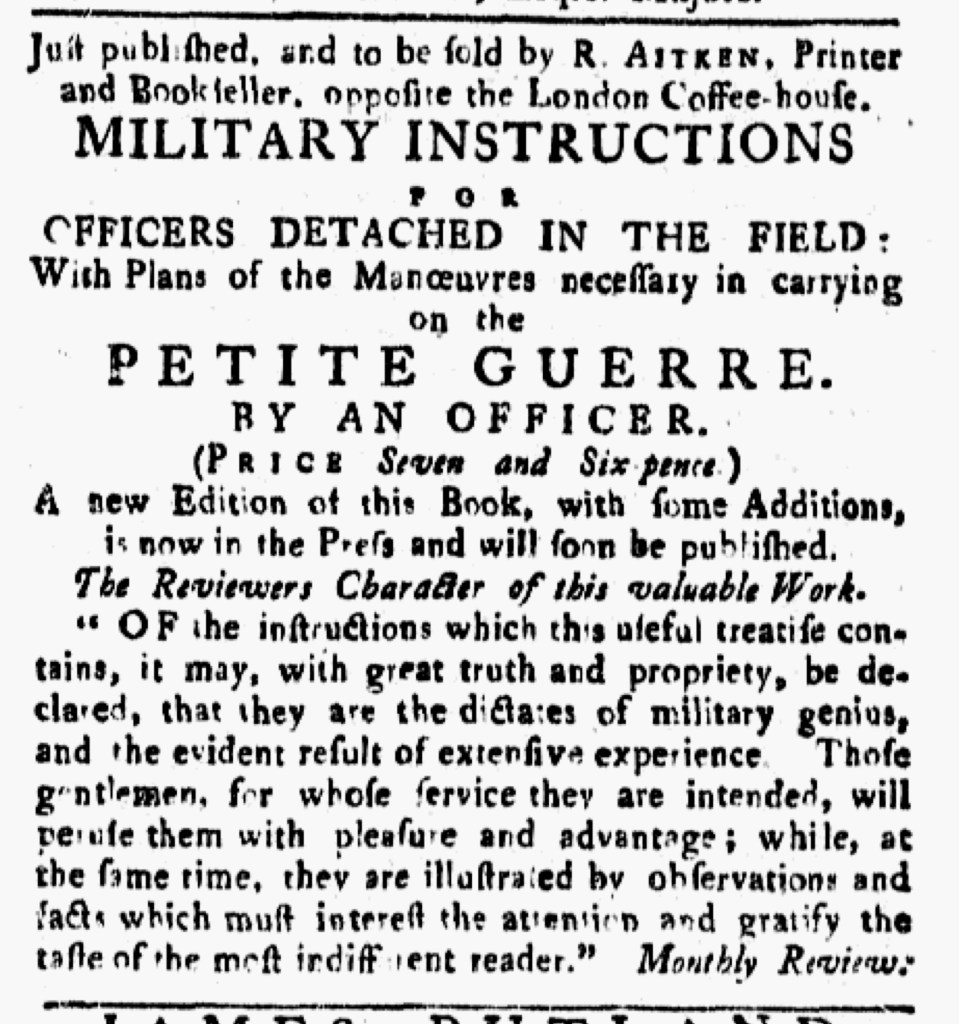
On August 12, 1775, Robert Aitken, a printer in Philadelphia, launched a new advertising campaign to promote his American edition of Military Instructions for Office Detached in the Field by Roger Stevenson. He began with advertisements in the Pennsylvania Evening Post and the Pennsylvania Ledger. Two days later, he placed the same advertisement in Dunlap’s Pennsylvania Packet and then in the Pennsylvania Gazette another two days after that. Aitken’s new advertisement significantly expanded on the notice that he had published in June.
This time, for example, the printer announced that his American edition was “Dedicated to His Excellency GEORGE WASHINGTON, Esq; General and Commander in Chief of the Army of the United Colonies of North-America.” The book itself featured a short dedication essay that extended four pages. In the new advertisement, Aitken promoted some of the usual qualities that printers, publishers, and booksellers often highlighted, noting that the book was printed “On fine Paper, [with] a beautiful new Type” and the “twelve useful Plates” or illustrations “of the Manœuvres” supplemented the text. Each bound copy cost six shillings and six pence, though Aitken also marketed a “few copies on a superfine paper” for one dollar to those who desired even higher quality. The price was a bargain, the printer noted, with a bound copy of the London edition selling for ten shillings.
Beyond those details, Aitken incorporated an address “TO THE PUBLIC” into this advertisement, though he did not generate the copy himself. Instead, he borrowed liberally from the preface of the book, making minor revisions here and there. In effect, he gave prospective customers a preview of what they would read once they purchased Military Instructions for Officers Detached in the Field. In the preface, Stevenson lamented that “inferior officers have had no source from whence they could derive instruction on the duties of their sphere in the field,” but he aimed to remedy that with this volume. He almost certainly had not intended, however, that it would be used by officers in the “Army of the United Colonies of North-America” as they defended their liberties in what would eventually become a war for independence. Aitken saw an opportunity to generate revenues in the wake of the battles at Lexington and Concord.
In a nota bene, the printer added that he stocked “A complete and elegant MAP of the country, shewing the Seat of the present unhappy Civil War in North-America.” Bernard Romans, a prominent cartographer, distributed broadside subscription proposals a month earlier, listing Aitken among the many local agents who collected names of subscribers who ordered copies in advance. The printer gave details about the map not included in the broadside subscription proposal and that had not appeared in newspaper notices. The map featured a “beautiful Draught of the Provincial CAMP: Likewise, A perspective View of BOSTON, and Gen. Gage’s LINE.” Current events certainly shaped which items Aitken produced, advertised, and sold at his printing office in Philadelphia.
Aitken marketed it at a time that readers of the Pennsylvania Ledger already knew about the battles at Concord and Lexington and the siege of Boston. They were just learning about the Battle of Bunker Hill a week earlier. In the column to the left of the advertisement for Military Instructions, the Pennsylvania Ledger reprinted a portion of a letter that reported “our people attempting to take possession of Bunker’s Hill and Dorchester Point … were attacked by the regulars.” The correspondent did not have all the details, but did know that “three Colonels in our service were wounded, Col. Gardner, mortally; how many are slain on either side, is uncertain.” The letter did not mention the death of Joseph Warren, a noted Patriot and the president of the Massachusetts Provincial Congress, nor did it reveal the outcome of the battle. “When the post came away,” the letter stated, “our people kept their ground and made a stand; how they have fared at Dorchester, we do not hear.” Incomplete, it was the most recent update available in Philadelphia at the time the June 24 edition of the Pennsylvania Ledger went to press.
Still, it likely primed some readers to take greater interest in Military Instructions written “BY AN OFFICER.” To help in stimulating demand, Aitken inserted an excerpt of a review that appeared in the Monthly Review, a magazine published in London. “OF the instructions which this useful treatise contains,” the reviewer asserted, “it may, with great truth and propriety, be declared, that they are the dictates of military genius, and the evident result of extensive experience.” That made the book required reading for colonizers serving as officers. “Those gentlemen, for whose service they are intended,” the reviewer pronounced, “will peruse them with pleasure and advantage.” Yet that was not the only prospective audience for Military Instructions. The reviewer insisted that “they are illustrated by observations and facts which must interest the attention and gratify the taste of the most indifferent reader.” With battles being fought in New England and George Washington “appointed commander in chief of all the North-American forces by the Honourable Continental CONGRESS” (according to an update that appeared just below the initial report from Bunker Hill), could any prospective reader have been “indifferent” when they saw Aitken’s advertisement?