November 5

What was advertised in a revolutionary American newspaper 250 years ago this week?

Pennsylvania Evening Post (November 4, 1775).

“A NIGHT SCHOOL.”

“FRENCH ACADEMY.”

Two advertisements in the November 4, 1775, edition of the Pennsylvania Evening Post and its supplement offered opportunities for learning and self-improvement.  In the first notice, Matthew Maguire announced that he had opened a “NIGHT SCHOOL” for “youth of both sexes.”  The curriculum included “the various branches of READING, WRITING and ARITHMETIC,” subjects that both boys and girls typically learned.  Maguire also indicated that he taught “ACCOMPTS [or accounts] in all their different forms, after the latest and most approved methods,” though he did not mention whether he reserved that subject for male students.  Learning how to keep daybooks and ledgers may have been useful for some of the girls and young women who attended Maguire’s school, especially those that attended in the evening because they assisted in running the family business during the day.  Maguire also provided lessons during the day “as usual,” but he specified in a nota bene that he continued admitting “Young ladies only.”  In addition to giving female students a homosocial setting with fewer chances of disruptions, he may he reasoned that most boys and young men who would attend the school he kept in his house in Carter’s Alley did indeed have apprenticeships and other responsibilities during the day.

Supplement to the Pennsylvania Evening Post (November 4, 1775).

In the other advertisement, Francis Daymon, “MASTER of the French and Latin Languages” and “LIBRARIAN of the Philadelphia Public Library” (or the Library Company of Philadelphia), advised prospective pupils that he “HAS opened his FRENCH ACADEMY for the winter season.”  Classes began “punctually at seven o’clock every evening (Saturday excepted),” though it went without saying that he did not give lessons on Sundays.  Daymon delivered lessons “in the Library Room in Carpenters Hall,” the Library Company having moved to the second floor of that building from the Pennsylvania State House when it was completed in 1773.  He presumably admitted students of both sexes since he did not indicate otherwise in his advertisement.  He did note that “Ladies and Gentlemen may be instructed at their places of abode as usual,” an arrangement that allowed his pupils or their parents to determine who would be present.  Unlike Maguire, Daymon offered private lessons, likely setting rates for his students for the convenience of learning in their homes accordingly.

While some of the students who learned reading, writing, arithmetic, and accounts from Maguire could have also sought out French lessons from Daymon, the two schoolmasters cultivated different clienteles.  Maguire emphasized basic skills for everyday use by a wide range of colonizers, while Daymon’s French lessons appealed to genteel residents of Philadelphia and those aspiring to gentility.  With the Continental Association, a nonimportation and nonconsumption agreement, in effect, discourses about fashion had shifted.  Learning French gave some colonizers an alternate way to assert their status.
October 10

What was advertised in a revolutionary American newspaper 250 years ago today?

Dunlap’s Maryland Gazette (October 10, 1775).

A subscription book for the Military Academy, will be opened immediately.”

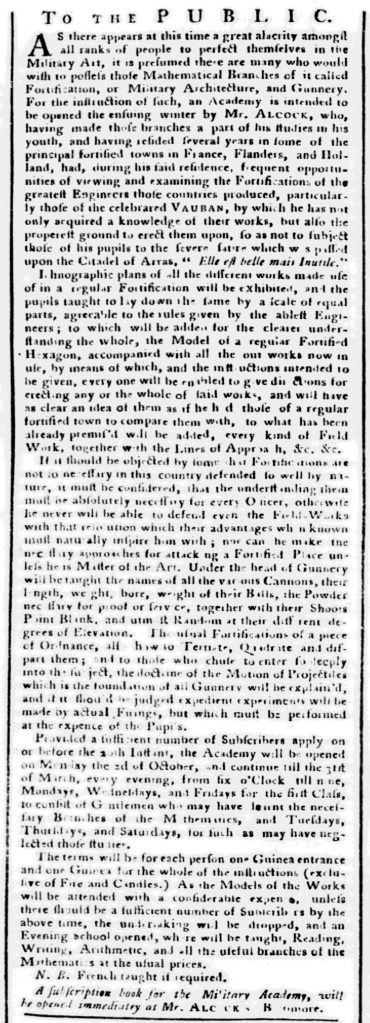
In the fall of 1775, Mr. Alcock advertised an academy with a specialized curriculum.  “AS there appears at this time a great alacrity amongst all ranks of people to perfect themselves in the Military Art,” he declared to readers of the Dunlap’s Maryland Gazette and the Maryland Journal, “it is presumed there are so many who would wish to possess those Mathematical Branches of it called Fortification, or Military Architecture, and Gunnery.”  To that end, Alcock, announced his plans to open a school to teach those subjects.  For his qualifications, he noted that he “made those branches a part of his studies in his youth.”  In addition, he “resided several years in some of the principal fortified towns in France, Flanders, and Holland.”  While there, he took advantage of “frequent opportunities of viewing and examining the Fortifications of the greatest Engineers those countries produced.”  In the first year of the Revolutionary War, Alcock was not the only colonizer to advertise a school of this sort.  In the summer of 1775, John Vinal advertised that he taught “the Doctrine of Projectiles, or Art of GUNNERY,” at his school in Newburyport, Massachusetts.

In advance of opening his academy in Baltimore on October 2, Alcock began advertising in early September.  His lengthy notice appeared in the Maryland Journal on September 6, 13, and 20.  It may have run in Dunlap’s Maryland Gazette as early as September 5, but that issue, if it survives, has not been digitized for wider accessibility.  Alcock’s advertisement did appear in that newspaper for at least five weeks from September 12 through October 10.  With the last two insertions, he likely hoped to pick up stragglers who had not yet enrolled yet had not missed so many classes to join the academy.  From the start, Alcock advised that a “subscription book for the Military Academy, will be opened immediately,” allowing students to commit to enrolling by signing their names.  Prospective students could also peruse the list to see who else in their community planned to attend.  Alcock intended to divide his pupils into two classes, one cohort consisting of “Gentlemen who may have learnt the necessary Branches of the Mathematics” on Mondays, Wednesdays, and Fridays and another series of classes “for such as may have neglected those studies” on Tuesdays, Thursdays, and Saturdays.

Yet Alcock would offer the course on fortifications and gunnery only if “a sufficient number of Subscribers” enrolled.  Those interested in this enterprise needed to encourage their friends and neighbors to sign up or else risk having the classes canceled.  If Alcock did not have enough students, “the undertaking will be dropped and an Evening School opened, where will be taught, Reading, Writing, Arithmetic, and all the useful branches of the Mathematics at the usual prices.”  The schoolmaster did not want to resort to that.  Accordingly, he attempted to convince prospective students of the necessity of his lessons.  “If it should be objected by some that Fortifications are not so necessary in this country defended so well by nature,” he argued, “it must be considered, that the understanding them must be absolutely necessary for every Officer, otherwise he never will be able to defend even the Field-Works with that resolution which their which their advantages when known must naturally inspire him; nor can he make the necessary approaches for attacking a Fortified Place unless he is Master of the Art.”  Prospective students apparently did not find that convincing.  On November 7, Alcock returned to Dunlap’s Maryland Gazette to advertise an evening school “where will be taught Reading, Writing, and Arithmetic” as well as “French, and the most useful branches of the Mathematics, at the usual prices.”  Either he never attracted enough students to open his “Military Academy” or classes fizzled out shortly after they began.

August 11

What was advertised in a revolutionary American newspaper 250 years ago today?

Essex Journal (August 11, 1775).

“The Doctrine of Projectiles, or Art of GUNNERY.”

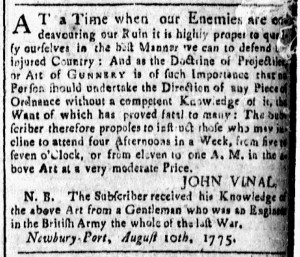
In the spring of 1775, John Vinal advertised a “private School for the Youth of both Sexes” to open in Newburyport, Massachusetts, on April 3.  His notice in the March 29 edition of the Essex Journal specified two locations, “the room he improved last Summer, nearly opposite Mr. Davenport’s Tavern,” with lessons commencing “at 11 o’Clock, A.M.” and “the Town School-House” from “5 to 7 o’Clock, P.M.” for “those who can best attend in the Afternoon.”  The term began just two weeks before the battles at Lexington and Concord.  Four months later, Vinal advertised a very different kind of instruction: “the Doctrine of Projectiles, or Art of GUNNERY.”

Circumstances had certainly changed in Newburyport, in Massachusetts, and throughout the colonies since Vinal announced the opening of his school.  The siege of Boston and the Battle of Bunker Hill followed the skirmishes at Lexington and Concord.  The Second Continental Congress convened in Philadelphia and appointed George Washington to command the Continental Army.  Colonizers from New England to Georgia held local and provincial meetings to determine their own responses.  “AT a Time when our Enemies are endeavouring our Ruin,” Vinal proclaimed, “it is highly proper to qualify ourselves in the best Manner we can to defend out injured Country.”  To that end, some colonizers advertised military manuals and others recruited men to join artillery companies or other regiments to defend their liberties.  Making his own contribution to those efforts, Vinal offered to “instruct those who may incline” to learn about the “Art of GUNNERY.”  He explained that “no Person should undertake the Direction of any Piece of Ordnance without a competent Knowledge of it,” warning that “the Want of which has proved fatal to many.”  What qualifications did the schoolmaster possess to teach “the Doctrine of Projectiles” rather than reading, writing, and arithmetic?  He asserted that he “received his Knowledge … from a Gentleman who was an Engineer in the British Army the whole of the last War,” meaning the Seven Years War.  Britain and the American colonies had worked together to defeat the French and their Indigenous allies in pursuit of imperial interests, but now the expertise of that “Engineer in the British Army” would support the American cause at a time when Parliament and British regulars had become “Enemies … endeavouring our Ruin.”

As had been the case with his “School for Youth of both Sexes,” Vinal provided lessons at two times.  Students could “attend four Afternoons in a Week, from five to seven o’Clock.”  Either the term for his school concluded or this endeavor displaced the lessons he otherwise would have offered.  He also stated that he taught about ordnance “from eleven to one A.M.”  Given the schedule for his school, he likely meant “eleven A.M. to one P.M.” rather than suggesting that he taught the class in the middle of the night.  Hopefully his lessons emphasized greater precision!

July 10

What was advertised in a revolutionary American newspaper 250 years ago today?

New-York Gazette and Weekly Mercury (July 10, 1775).

“Children educated … at a distance from probable, sudden danger and confusion.”

In July 1775, Andrew Wilson, a schoolmaster in Morristown, New Jersey, attempted to leverage current events to enroll students in his school “about twenty-seven miles from Powles-Hook, and eighteen miles from Elizabeth-Town.”  In the late spring and early summer, colonizers in New York followed the news about the battles at Lexington and Concord, the siege of Boston, and the Battle of Bunker Hill.  In addition to updates from Massachusetts, they read and discussed actions taken by the Second Continental Congress, meeting in Philadelphia, and provincial congresses throughout the colonies.  While the fighting had been confined to Massachusetts so far, colonizers anticipated that it would spread.

In such an environment, Wilson saw an opportunity to market his school to parents and guardians in New York City and other coastal towns.  “IN these dangerous and alarming times,” he declared, “the inhabitants of large cities, and other places on the sea coast, may wish to have their children educated in the interior parts of the country, at a distance from probably, sudden danger and confusion.”  He acknowledged that they likely weighed tuition and the quality of instruction against the prospects of danger, suggesting that they would send their children to such a school “if the expence was reasonable, and they could depend on the fitness of the teacher.”  Wilson confidently stated that he could alleviate both concerns.  He claimed that he “was recommended by Dr. Witherspoon, of New-Jersey College, and the Rev. Mr. Mason, in New-York.”  Furthermore, he had experience.  When he ran his advertisement in the July 10, 1775, edition of the New-York Gazette and Weekly Mercury, he had “taught [in Morristown] upwards of ten months, to the satisfaction of his employers.”  When it came to expenses, lodging and board amounted to “much less money than is generally given for the same in other places.”  His pupils did not reside at the school; instead, Wilson placed them in the homes of “good families.”  In addition, the schoolmaster described Morristown and a “healthy place” as well as an accessible one.  “[O]n three different days of the week,” he noted, “a stage goes from it to New-York.”

As resistance to imperial overreach became a revolution, the crafty schoolmaster portrayed Morristown, New Jersey, as a relatively safe place to send children to school.  Parents and guardians could remove their charges from danger while still attending to their education and development, alleviating at least some of the worry they experienced during uncertain times.

June 30

What was advertised in a revolutionary American newspaper 250 years ago today?

Connecticut Gazette (June 30, 1775).

“A Person from Boston … will teach … the several Hands now in Practice.”

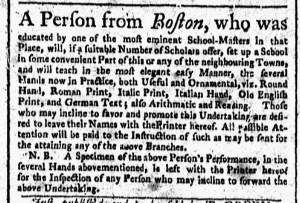
A “Person from Boston” sought to open a school in southwestern Connecticut in the summer of 1775.  He placed an advertisement in the Connecticut Gazette in hopes of reaching prospective pupils and their families, stating that he would commence instruction in New Haven “or any of the neighbouring Towns” if a sufficient number of “Scholars” signed up for lessons.  In addition to reading and arithmetic, he taught “the several Hands now in Practice, both Useful and Ornamental,” including “Round Hand, Roman Print, Italic Print, Italian Hand, Old English Print, and German Text.”

The schoolmaster did not give his name, instead merely identifying himself as a “Person from Boston, who was educated by one of the most eminent School-Masters in that Place.”  He asked that those “who may incline to favor and promote this Undertaking … leave their Names with the Printer” of the Connecticut Gazette.  Timothy Green, the printer, likely did more than keep a list of names of interested students.  He served as a surrogate for the anonymous schoolmaster.  Even though residents of New Haven and the vicinity did not know the “Person from Boston,” they did know Green and could ask him for his impressions of the man, whether he seemed reputable and capable of the instruction he proposed. Furthermore, the unnamed schoolmaster left “A Specimen of the above Person’s Performance, in the several Hands mentioned” at the printing office “for the Inspection of any Person who may incline the forward the Undertaking.”  Anyone who visited the printing office for that purpose could chat with Green about the “Person from Boston” as they examined the “Specimen.”

They might have learned that he was a refugee from Boston who left the city following the battles at Lexington and Concord.  When the siege of Boston commenced, Governor Thomas Gage and the Massachusetts Provincial Congress negotiated an agreement that allowed Loyalists to enter the city and Patriots and others to depart.  Other refugees from Boston resorted to newspapers advertisements to attract customers and clients after taking up residence in new towns.  It may have been a similar situation for the “Person from Boston” who found himself in New Haven at the beginning of the Revolutionary War.

April 20

What was advertised in a colonial American newspaper 250 years ago today?

Essex Journal (April 20, 1774).

“A large experience of 34 years at sea.”

Joseph Atkins took to the pages of the Essex Journal to inform the public that “he still continues to teach reading, writing, and arithmetic” in the spring of 1774.  He apparently accepted both boys and girls, though he taught them separately.  In a nota bene, he advised that he “intends to open a school for young ladies” at the end of April.

In addition to the basics of reading, writing, and arithmetic, Atkins also provide instruction in navigation “after the most approv[e]d methods.  Experience mattered to the schoolmaster, not just experience in the classroom but also experience on ships.  He asserted that his confidence in how he taught navigation to his pupils flowed from “a large experience of 34 years at sea.”  Navigation was not merely academic to Atkins but instead a practical matter, an essential part of the occupation he previously pursued.  Prospective students and their parents, he suggested, should feel similar confidence that his decades at sea prepared him to teach navigation to boys and young men who had prospects of working on vessels themselves.  Newburyport was, after all, a maritime community.

The placement of Atkins’s advertisement on the third page of the April 20 edition of the Essex Journal underscored that was the case.  It ran immediately below the “MARINE LIST,” a roster of ships that recently “ARRIVED” and “SAILED” from the “PORT of NEWBURY.”  A day earlier, the town welcomed the Dove from Antigua and the Newhall from Guadeloupe.  Most of the ships that departed in the past ten days made their way to the “West-Indies,” though the Larkventured to Newfoundland.  Although Atkins’s time at sea was presumably behind him, he aimed to pass along a valuable skill to young men who might join the crew of any of the vessels that visited Newburyport.  His “large experience of 34 years at sea” recommended him as a teacher as much as anything he could say about his methods of instruction.

March 20

What was advertised in a colonial American newspaper 250 years ago today?

Providence Gazette (March 20, 1773).

“WANTED immediately, A SCHOOLMASTER.”

Dr. Jonathan Arnold needed an instructor “to take Charge of the School at Whipple Hall, Providence, North End” in March 1773.  Even though he wished to hire a schoolmaster immediately because he had “a large Number of Scholars being now ready to enter” the school, Arnold refused to settle for just anyone who could teach reading, writing, and other subjects.  Instead, any prospective schoolmaster had to be “temperate and exemplary, in Life and Manners,” in addition to possessing “Ability in his Profession.”  In the era of the American Revolution, advertisements seeking schoolmasters as well as those placed by schoolmasters and -mistresses emphasized manners and morals as much as they did classroom instruction.

Arnold underscored that he was serious about screening applicants.  In a nota bene, he declared, “It is expected, that whoever applies will produce sufficient Testimonials of his Qualifications as above, from Persons of undoubted Credit and Character.”  To make the point even more clear, he added, “None but such need apply.”  Arnold demanded references.  The “Testimonials” that they provided had to cover all of a prospective schoolmaster’s qualifications, including his skill and experience in the classroom and his morals and demeanor.  Furthermore, those giving recommendations had to be beyond reproach themselves.

Although Arnold aimed to hire a suitable instructor as quickly as possible, his advertisement had audiences other than prospective candidates for the position.  He indirectly addressed parents and guardians of current and prospective pupils as well as the entire community.  Arnold made clear that he did not entrust any of the children and youth under his charge to just any schoolmaster.  Parents and the general public could depend on him recruiting instructors who were both effective teachers and good role models.  The notice served an immediate purpose, filling an opening at the school, while also fulfilling a secondary purpose of informing the public, especially parents and guardians of the “Scholars,” about the standards maintained at the school.

January 16

What was advertised in a colonial American newspaper 250 years ago today?

Pennsylvania Chronicle (January 16, 1773).

“By limiting the number of his pupils … he has a singular advantage.”

Samuel Blair ran a boarding school for boys in Philadelphia in the early 1770s.  In an advertisement in the January 16, 1773, edition of the Pennsylvania Chronicle, the schoolmaster announced that he had openings for two pupils and promoted the benefits of learning in such an exclusive setting.  He explained that for the “special benefit” of his students, he limited enrollment to only twelve boys.  He advertised “whenever a vacancy occurs,” alerting parents who “choose … to have [their sons] instructed in a private family rather than a public school.”

Blair briefly outlined his curriculum, but devoted most of his advertisement to the virtues of a residential setting for a small number of students.  The course of study included “the Latin and Greek Languages, Geography, Arithmetic, and all the most useful practical branches of the Mathematics” as well as “the arts of reading, writing, spelling, and speaking English with elegance and propriety.”  His school, he suggested, produced genteel young men.

Their comportment, not just the skills they acquired and the subjects they mastered, made them genteel.  Blair asserted that “limiting the number of his pupils” allowed him to “devot[e] himself wholly to the care of their education,” including “constant intercourse and conversations with them as members of his family.”  That represented a “singular advantage” for his students compared to the attention they received from other schoolmasters.  In addition to “bringing [his pupils] on in these studies and exercises with expedition and accuracy … in such a way as shall render them most easy and agreeable to their young and impatient minds,” Blair declared that he instituted a gentle system of discipline that formed young men of character.  In the course of spending time with his students in and beyond the classroom, he took responsibility “for correcting and forming their tempers, for inspecting and regulating their general deportment, and for governing them by the milder and more successful means of argument and persuasion.”  The schoolmaster did not deploy harsh methods of correction.  Instead, he treated his students as members of an extended family.

Blair did not rely on exclusivity alone to generate interest in his boarding school.  To attract interest from the parents of prospective pupils, he described the benefits of that exclusivity.  His students not only received an education but also an upbringing that transformed them into genteel young men.  When they entrusted their sons to his care, parents could depend on them learning a variety of subjects, both practical and refined, under the watchful eye of a schoolmaster who kept order and instilled good manners without resorting to draconian means.  Blair believed that his program presented a “singular advantage” for his students … and aimed to convince parents of prospective pupils that was indeed the case.

August 17

Who was the subject of an advertisement in a colonial American newspaper 250 years ago today?

Pennsylvania Packet (August 17, 1772).

“He came on redemption, and was disappointed in meeting his expected friend.”

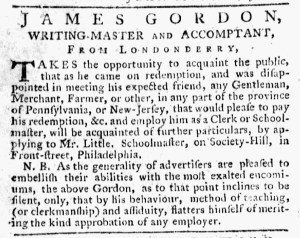
James Gordon found himself in an unanticipated situation when he migrated from Londonderry to Philadelphia in the summer of 1772.  The “WRITING-MASTER AND ACCOMPTANT” declared that he “came on redemption, and was disappointed in meeting his expected friend.”  In other words, he did not pay his passage in advance, nor did he sign an indenture and agree to work for a set number of years in exchange for transportation across the Atlantic.  Instead, Gordon became a redemptioner.  Compared to indentured servants who signed contracts that outlined their commitments in advance of departing European ports, redemptioners were “redeemed” by colonizers who paid their passage upon arrival.  Many redemptioners arranged in advance for family and friends to redeem them.  Others, however, sailed without knowing who might redeem them, sold into indentured servitude after crossing the Atlantic.  That system was especially popular with German-speaking migrants.  Newspapers published in Philadelphia ran the greatest numbers of advertisements offering redemptioners for sale.

Gordon apparently thought that a friend would redeem him when he arrived in Philadelphia, though the friend may not have been aware of that arrangement.  Whatever the circumstances, he placed an advertisement seeking a patron to redeem him by paying for his passage and hiring him “as a Clerk or Schoolmaster.”  Gordon expressed his willingness to work for “any Gentleman, Merchant, Farmer, or other, in any part of the province of Pennsylvania, or New-Jersey.”  If no one who wanted to hire him as a clerk or schoolmaster were to “pay his redemption,” he could be redeemed by someone who had him do other kinds of work that Gordon likely would have found much less agreeable.

To avoid that possibility, Gordon added a nota bene in which he attempted to promote the qualities that made him a good schoolmaster and clerk while simultaneously not scaring off prospective employers by overselling himself.  Perhaps most importantly, he wanted to impress them with his honesty.  “As the generality of advertisers are pleased to embellish their abilities with the most exalted encomiums,” he declared, “the above Gordon, as to that point inclines to be silent, only, that by his behaviour, method of teaching, (or clerkmanship) and assiduity, flatters himself of meriting the kind approbation of any employer.”  Gordon hoped that his advertisement would convince someone would hire him as a schoolmaster or clerk.  Otherwise, he faced the prospects of the owner or captain of the vessel that carried him across the ocean would allow others to “pay his redemption” and employ him as they saw fit.  Gordon may have thought that he had a deal in place when he left Londonderry, but redemption turned out to be a gamble for the writing master and clerk.

September 19

What was advertised in a colonial American newspaper 250 years ago this week?

Newport Mercury (September 17, 1770).

“The ACADEMY in LEEDS … in England.”

Readers of the Newport Mercury likely recognized many or even most of the names that appeared among the advertisements for goods and services in the early 1770s.  Such advertising tended to be local in nature, though local could be broadly defined since colonial newspapers tended to serve regions rather than just the towns where they were printed.  One of two newspapers printed in Rhode Island, for instance, the Newport Mercury served all of the southern portions of the colony.  The Providence Gazette provided news and advertising throughout the north.  Thomas Green, Paul Mumford, Gideon Sisson, and Nicholas Tillinghast all ran businesses in Newport and placed advertisements in the Newport Mercury.  John Borden operated a ferry between nearby Portsmouth and Bristol.  He also placed advertisements in the Newport Mercury.

Most advertisements did not come from places outside of the region that the Newport Mercury served, though occasional exceptions did find their way into the pages of that newspaper.  A. Grinshaw’s notice in the September 17, 1770, edition was one such exception.  Grinshaw, a schoolmaster, promoted his “ACADEMY in LEEDS, Which is pleasantly situated in the County of York, in England.”  He made arrangements from the other side of the Atlantic to place his advertisement in the Newport Mercury, hoping to attract pupils for his boarding school from among the merchant elite who resided in the busy port.  The appearance of Grinshaw’s advertisement raises questions about printing and bookkeeping practices.  Colonial printers frequently ran notices calling on their customers, including advertisers, to settle their accounts or face legal consequences.  Did Solomon Southwick, the printer of the Newport Mercury, extend credit to an advertiser so far away?  Or did he insist that Grinshaw pay in full before printing his advertisement?  Did Grinshaw deal directly with Southwick?  Or did he work through an associate who traveled between England and the colonies?  Did Grinshaw ever see his advertisement in print?  Did that even matter to him?  Did the schoolmaster find a receptive audience in Newport?  Did he gain any new students as a result of placing it?  Other sources may reveal the answers to some of these questions, but the advertisement itself does not.