October 25

Who was the subject of advertisements in a revolutionary American newspaper 250 years ago today?

Constitutional Gazette (October 25, 1775).

“RUN-AWAY … a Negro man, named MINGO.”

“FOR SALE, A VERY healthy Negro Girl.”

In the fall of 1775, John Anderson joined the ranks of newspaper printers who helped perpetuate slavery by disseminating advertisements about enslaved people in their publications.  In this case, one advertisement concerned “a Negro man, named MINGO,” who liberated himself from Benjamin Hutchinson by escaping from Hutchinson of Southold in Suffolk County on Long Island in early October.  The enslaver described the young man, both his physical features and his clothing, and offered a reward for his capture and return.  Another advertisement offered a “healthy Negro Girl, about 18 years of age,” for sale.  She was capable of “all sorts of house work” and sold “only for want of employ” rather than any deficiency.

Those advertisements first appeared in the October 25 edition of the Constitutional Gazette, a newspaper that commenced publication near the beginning of August.  The new publication initially did not carry advertisements, though Anderson began soliciting them by the end of the month.  Local entrepreneurs who had experience advertising in other newspapers, including goldsmith and jeweller Charles Oliver Bruff and Abraham Delanoy, who pickled lobsters and oysters, soon placed notices in the Constitutional Gazette.  Beyond marketing consumer goods and services, others ran advertisements for a variety of purposes, replicating the kinds of notices found in other newspapers of the period.
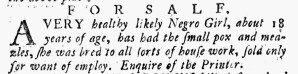
Constitutional Gazette (October 25, 1775).

That included advertisements about enslaved people.  Two months after first soliciting advertisements (and less than three months after publishing the inaugural issue), Anderson disseminated Hutchinson’s advertisement about Mingo’s escape from slavery and another notice offering an enslaved young woman for sale.  Like printers from New England to Georgia, he compartmentalized the contents of his newspaper, not devoting much thought to the juxtaposition of news and editorials advocating on behalf of the American cause and advertisements placed for the purpose of perpetuating slavery and the slave trade.

Even as Anderson used his newspaper to advocate for liberty for colonizers who endured the abuses perpetrated by Parliament, he used it to constrain the freedom of Black men, women, and children.  The advertisement about Mingo encouraged readers to engage in surveillance of Black men to determine if any they encountered matched his description.  In addition to publishing advertisements about enslaved people, Anderson also served as a broker.  The advertisement for the young enslaved woman whose name was once known instructed interested parties to “Enquire of the Printer.”  Anderson did more than merely disseminate information.  He actively participated in the sale of the young enslaved woman as one of the services he provided as printer.
September 5

Who was the subject of an advertisement in a revolutionary American newspaper 250 years ago today?

Postscript to the Baltimore Journal, &c. (September 5, 1775).

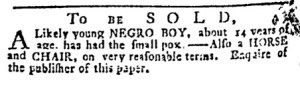
“TO BE SOLD, A Likely young NEGRO BOY, about 14 years of age.”

On September 5, 1775, Mary Katharine Goddard, the printer of the Maryland Journal, and the Baltimore Advertiser, published a two-page Postscript to the Baltimore Journal, &c. to supplement the news and other content that appeared in the standard edition.  It appeared a day ahead of the weekly edition.  Goddard apparently believed that she had news that could not wait as well as not enough space to print it all, making the Postscript necessary.  The first page of the supplement featured news from New York and Watertown, Massachusetts, in a larger font, while the second page consisted almost entirely of news from the “PROVINCIAL CONVENTION” held in Annapolis in a smaller font.  A note preceding the headline indicated that coverage was “Continued from our last.”  Even devoting an entire page in smaller font to that news did not allow Goddard to print all of it.  A note at the end promised, “To be continued.”

That left just enough space for Goddard to insert one advertisement.  An advertisement about a “Likely young NEGRO BOY” and a “HORSE and CHAIR” (a kind of carriage) that ran in the previous issue was the right length to complete the final column on the second page of the Postscript.  It did not provide much information about the enslaved young man, noting only that he was “about 14 years old” and “has had the small pox” so he would not contract that disease again.  Interested parties should “Enquire of the publisher of this paper” the advertisement instructed.  Like other printers who published newspapers from New England to Georgia, Goddard not only disseminated advertisements about enslaved people but also served as a broker who facilitated sales when those advertisements directed readers to learn more at the printing office.  In this instance, publishing news from Maryland’s provincial convention meant greater circulation for an advertisement offering an enslaved youth for sale.  That advertisement ran once again in the standard issue the next day, placing it before the eyes of readers with greater frequency than any other notices in that newspaper.  Even as the provincial convention met to discuss how to defend the liberties of colonizers and the Maryland Journal carried the news, the newspaper also worked to constrain the freedom of enslaved people, including one “Likely young NEGRO BOY” in particular.

April 14

Who was the subject of an advertisement in a colonial American newspaper 250 years ago today?

Story and Humphreys’s Pennsylvania Mercury (April 14, 1775).

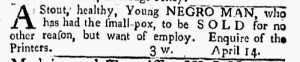
“A Stout, healthy, Young NEGRO MAN … to be SOLD … Enquire of the Printers.”

On April 14, 1775, Enoch Story and Daniel Humphreys published “VOL. I.  NUMB. 2,” the second issue of their new newspaper.  They updated the title in the masthead from The Pennsylvania Mercury; and the Universal Advertiser to Story and Humphreys’s Pennsylvania Mercury, and Universal Advertiser.  The colophon running across the bottom of the final page remained the same, advising readers that they “gratefully received” subscriptions, advertisements, articles, and “Letters of Intelligence” at their printing office in Norris’s Alley in Philadelphia.  Their first issue featured a significant number of advertisements.  The second issue contained even more.  Advertisers were willing to take a chance with this new newspaper, apparently believing that its circulation justified the investment in purchasing space to disseminate their notices.

Among the advertisements that ran for the first time in the second issue of Story and Humphreys’s Pennsylvania Mercury, one offered “A Stout, healthy, Young NEGRO MAN, who has had the small-pox, to be SOLD for no other reason, but want of employ.”  It advised interested parties to “Enquire of the Printers” to learn more.  The notice was dated “April 14” and had a notation, “3 w,” that let the compositor know to include it in three issues.  Last week, Story and Humphreys’s Pennsylvania Mercury made its first appearance in the Adverts 250 Project to examine the advertisements in it (or its second appearance when counting subscription proposals that ran in another newspaper).  Today, the Adverts 250 Project features that newspaper once again because it is making its first appearance in the Slavery Adverts 250 Project.

Yet Story and Humphreys did not merely publish an advertisement that offered an enslaved man for sale.  They published an “Enquire of the Printers” advertisement that made them active participants in the sale.  They may have facilitated an introduction, or they may have negotiated on behalf of the advertiser.  The notice does not reveal the extent of their involvement, but it does indicate that they were involved beyond publishing the advertisement and earning revenue for doing so.  As Jordan E. Taylor documents, American printers acted as slave brokers in thousands of advertisements in newspapers published throughout the colonies and, later, states in the eighteenth century.[1]  Participating in the slave trade was part of the business model for operating a viable newspaper.  Taylor could not identify any printers who refused to run advertisements that offered enslaved people for sale as a matter of principle; the financial incentives were too strong to ignore.  Story and Humphreys very quickly incorporated perpetuating slavery into the practices for their press, both as printers who disseminated advertisements offering enslaved people for sale and as printers who served as slave brokers via “Enquire of the Printers” advertisements.

**********

[1] Jordan E. Taylor, “Enquire of the Printer: Newspaper Advertising and the Moral Economy of the North American Slave Trade, 1704-1807,” Early American Studies: An Interdisciplinary Journal 18, no. 3 (Summer 2020): 287-323.

May 6

Who was the subject of an advertisement in a colonial American newspaper 250 years ago today?

Rivington’s New-York Gazetteer (May 6, 1773).

TO BE SOLD, A Very fine Negro Boy.”

Three issues.  That was how long it took James Rivington to become a broker in the slave trade when he launched Rivington’s New-York Gazetteer or the Connecticut, New-Jersey, Hudson’s-River and Quebec Weekly Advertiser in the spring of 1773.  The Adverts 250 Project has examined some of the advertisements that appeared in the first and second issues of that newspaper.  With the third issue, the Slavery Adverts 250 Project begins chronicling advertisements about enslaved men, women, and children that appeared in Rivington’s New-York Gazetteer.

Rivington, like other colonial printers, generated revenues by publishing and disseminating such advertisements, yet their complicity in perpetuating slavery and the slave trade did not end there.  When they published advertisements that provided descriptions of enslaved people who liberated themselves by running away from their enslavers and offered rewards for their capture and return, colonial printers encouraged and facilitated the widespread surveillance of Black men and women, including by colonizers who did not purport to own enslaved people themselves.  When colonial printers instructed readers to “Enquire of the Printer” for more information about enslaved people for sale, they became brokers in the transactions.

Such was the case with an advertisement in the May 6, 1773, edition of Rivington’s New-York Gazetteer.  In just five short lines, Rivington implicated himself in perpetuating slavery and the slave trade: “TO BE SOLD, A Very fine Negro Boy, about seventeen years old, capable of waiting on a gentleman, and in a family extremly useful, he is strong, well built, and remarkably sober, and well worth £. 100.  Enquire of the Printer.”  In his examination of “Enquire of the Printer” advertisements, Jordan E. Taylor notes, “Printers had several reasons to traffic enslaved people.  Many probably viewed this work as a way of encouraging advertisers.  To refuse to perform this service may have led an advertiser to taker his or her business to competitors.”[1]

Rivington’s competitors certainly did not refuse such business.  On the same day that Rivington’s New-York Gazetteer ran its first “Enquire of the Printer” advertisement, an advertisement describing and offering a reward for Cush, an enslaved man who liberated himself from John Foster of Southampton on Long Island, ran in John Holt’s New-York Journal.  Earlier in the week, Hugh Gaine published three advertisements concerning enslaved people in his New-York Gazette and Weekly Mercury, one seeking a “NEGROE man-servant,” another offering an enslaved woman for sale, and the third describing and offering a reward for Sam, an enslaved man who could speak English and Dutch.  Gaine acted as the broker in the first advertisement, instructing anyone willing to hire out an enslaved “NEGROE man-servant” to learn more “by applying to the printer.”

Still, Rivington made a choice about whether to participate in this aspect of the printing business, just as Nathaniel Mills and John Hicks did when they became proprietors of the Massachusetts Gazette and Boston Post-Boy.  Three days before Rivington published his first advertisement concerning an enslaved person, Mills and Hicks published theirs, joining with other printers in Boston who carried the same notice in their newspapers.  The following week, the fourth issue of Rivington’s New-York Gazetteer carried its first advertisement about an enslaved man, Pompey, who liberated himself.  Rivington had made his editorial decision about what he was willing to publish among the advertisements in his newspaper.  He did not seem to hesitate in doing so.

**********

[1] Jordan E. Taylor, “Enquire of the Printer: Newspaper Advertising and the Moral Economy of the North American Slave Trade, 1704-1807,” Early American Studies 18, no. 3 (Summer 2020): 296.

August 2

Who were the subjects of an advertisement in a colonial American newspaper 250 years ago today?

Aug 2 - 8:2:1770 New-York Journal
New-York Journal (August 2, 1770).

“A Parcel of young healthy NEW NEGROES.”

A woodcut that crudely depicted four figures, presumably enslaved men, women, and children, adorned an advertisement in the August 2, 1770, edition of the New-York Journal.  One of the few visual images in that issue, the woodcut likely drew attention to the advertisement, despite its shortcomings.  Its presence in the New-York Journal testifies to the presence of enslaved people and the operations of the transatlantic slave trade in New York in the era of the American Revolution.  Colonists encountered enslaved people as they went about their daily activities in the busy port.  They also encountered representations of enslaved people in the public prints as well as an even greater number of notices about enslaved people that consisted entirely of text.  John Holt, the printer of the New-York Journal and an enslaver himself, aided in perpetuating slavery in America and the transatlantic slave trade by publishing advertisements offering enslaved people for sale and notices promising rewards for the capture and return of enslaved people who liberated themselves.

The advertisement featuring the woodcut announced the arrival of “NEW NEGROES” in the colony.  Comprised of “Men, Women, Boys, and Girls” ranging in age from ten to twenty-two, these “NEW NEGROES” arrived in New York directly from Africa.  The advertisement did not indicate where in Africa, nor did it specify how many enslaved men, women, and children survived the Middle Passage.  The Slave Voyages database estimates that this “Parcel of young healthy NEW NEGROES” consisted of 103 enslaved people who made it to New York.  (See Voyage #37023.)  An estimated fifteen died during the transatlantic crossing, but such advertisements never revealed that information.  Instead, they focused solely on assuring prospective buyers that the people they treated as commodities were indeed “healthy” and thus a sound investment.

According to the Slave Voyages database, three vessels transported an estimated 376 enslaved people to New York in 1770.  The brigantine Elliot featured in this advertisement was just one of those vessels.  The advertisement placed in the New-York Journal at the culmination of the Elliot’s voyage represented only a fraction of the slave trade undertaken in New York at the time.

March 3

Who was the subject of an advertisement in a colonial American newspaper 250 years ago today?

Mar 3 - 3:3:1770 Providence Gazette
Providence Gazette (March 3, 1770).

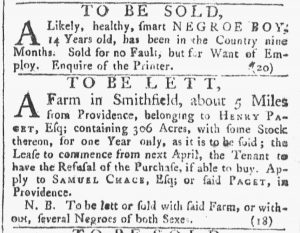
“TO BE SOLD, A Likely, healthy, smart, NEGROE BOY.”

The Slavery Adverts 250 Project chronicles how newspaper advertising contributed to the perpetuation of slavery during the era of the American Revolution.  Every day the project identifies, remediates, and republishes advertisements about enslaved men, women, and children originally published in British mainland North America 250 years ago that day.  In so doing, the project seeks to undo the forced forgetting of enslavement throughout the thirteen colonies that became the United States, especially northern colonies that became free states through immediate or gradual emancipation in the decades following the Revolution.  Newspaper advertisements demonstrate that slavery was part of everyday life in colonies from New England to Georgia during the first three quarters of the eighteenth century.  Readers regularly encountered notices about enslaved people in the public prints, just as they encountered enslaved people in public and private spaces.

Consider the March 3, 1770 edition of the Providence Gazette.  It contained two advertisements that sought to sell enslaved men, women, and children.  The first announced that an unnamed enslaver wished to sell a “Likely, healthy, smart NEGROE BOY” who had been “in the Country nine Months.”  Presumably he survived the Middle Passage from Africa or transshipment from the Caribbean to arrive in Rhode Island in the summer of 1769.  The anonymous advertiser assured prospective purchasers that the enslaved youth was “Sold for no Fault” other than “Want of Employ.”  In other words, the enslaver did not have enough tasks to keep the “NEGROE BOY” busy and wished to recoup the investment.  The second notice focused primarily on a farm “TO BE LETT” and eventually sold in Smithfield.  Henry Pacet advertised more than the farm “with some Stock thereon.”  In a nota bene, a device deployed to draw particular attention to important information, he announced that he would rent or sell “several Negroes of both Sexes,” if tenants or purchasers wished.  They need not have been part of the deal.  Pacet and prospective buyers would determine whether any of the enslaved men and women would remain on the farm.  Those men and women, reduced to commodities, did not have a say.

Along with an array of other sources, newspaper advertisements demonstrate that slavery was not merely a southern phenomenon.  Enslaved people lived and labored in Rhode Island and elsewhere in New England in the era of the American Revolution.  Although historians and other scholars are well aware of their presence, too often the general public has “forgotten,” perhaps all too conveniently, that enslaved people were part of the fabric of everyday life and commerce in New England in the seventeenth and eighteenth centuries.

January 25

What was advertised in a colonial American newspaper 250 years ago today?

Jan 25 - 1:25:1770 New-York Journal
New-York Journal (January 25, 1770).

“A new Non-Importation Agreement.”

“A Likely Negro Man and a Wench.”

The first two advertisements that appeared in the January 25, 1770, edition of the New-York Journal tell very different stories about the era of the American Revolution. The first addressed efforts to resist the abuses of Parliament, the figurative enslavement of the colonies. The second offered a Black man and woman for sale, perpetuating their enslavement rather than setting them free. That one advertisement followed immediately after the other testifies to the uneven rhetoric of the era as well as the stark tension between liberty (for some) and slavery (for many) at the time of the nation’s founding.

The first advertisement called on the “Signers of the Agreement relative to the Traders of Rhode-Island” to meet and discuss how to proceed in their dealings with the merchants in that nearby colony. The trouble arose when Rhode Island did not adhere to nonimportation agreements adopted throughout the rest of New England as well as in New York and Pennsylvania. In response, merchants, shopkeepers, and others in New York decided that they would no longer engage in trade with their counterparts in Rhode Island, broadening the nonimportation agreement to include fellow colonists who acted contrary to the interests of the colonies. When New York received word from Newport of “a new Non-importation Agreement, lately come into at that Place,” those who had ceased trade with the colony met to reconsider once the merchants there had been brought into line.

The second advertisement presented “A Likely Negro Man and a Wench,” instructing “Any person inclining to purchase them” to enquire of the printer. The unnamed advertiser described the enslaved man and woman as “fit for a Farmer, or any private Family” and offered assurances of their health by noting that they “both had the Small-Pox and Measles” so would not contract those diseases again. The advertiser added a nota bene asserting that the man and woman treated no differently than commodities were “Both young,” one more attempt to incite interest from potential buyers. The anonymous enslaver opened with advertisement with an explanation that that Black man and women were “To be sold, for no Fault, but Want of Cash.” In other words, they were not disobedient, difficult to manage, or ill. The enslaver simply needed to raise some ready money; selling the man and woman provided a convenient means of doing so.

One advertisement addressed a widespread movement to use commerce as a political tool to prevent the colonies from being enslaved by Parliament. The other depicted the continued enslavement and disregard for a “Negro Man and a Wench” not entitled to the same liberty that white New Yorkers claimed for themselves. The colonial press, in collaboration with colonists who placed newspaper notices, maintained and even bolstered the contradictory discourse contained in the two advertisements.

October 3

Who was the subject of an advertisement in a colonial American newspaper 250 years ago today?

Oct 3 - 10:3:1769 Essex Gazette
Essex Gazette (October 3, 1769).

“A Likely Negro LAD.”

Nathan Frazier’s advertisement for “a very good assortment of Fall and Winter GOODS” ran once again in the October 3, 1769, edition of the Essex Gazette. The shopkeeper promoted those goods by proclaiming “a single article of which has not been imported since last year.” In other words, his merchandise arrived in the colonies prior to the nonimportation agreement going into effect. He had not violated the agreement; prospective customers who supported the American cause could purchase from him with clear conscience. A new advertisement appeared immediately above it: “To be SOLD, A Likely Negro LAD, about eighteen or nineteen Years of Age, works well at the Cooper’s Trade, and understands working in the Field or Garden.” This produced a striking juxtaposition for readers, moving from an advertisement that contributed to the perpetuation of slavery to one that implicitly asserted the rights of Anglo-American colonists and defended their liberty against encroachments by Parliament. In the era of the imperial crisis that culminated with the American Revolution, colonists unevenly applied demands for liberty.

That these advertisements appeared in a newspaper published in Salem, Massachusetts, underscores that slavery was practiced throughout British mainland North America rather than limited to southern colonies. The proportion of the population comprised of enslaved men, women, and children was certainly smaller in New England than in the Chesapeake and the Lower South, but enslaved people were present, enmeshed in daily life, commerce, and print culture in the region. Fewer colonists in New England enslaved Africans and African Americans, but even those who did not themselves own slaves still participated in networks of commerce and consumption that depended on the labor of men, women, and children held in bondage. Consider another advertisement that ran in the same issue of the Essex Gazette. Richard Derby, Jr., hawked “Choice Jamaica SUGAR, RUM, ALSPICE, GINGER, and COFFEE.” Colonists in New England consumed products cultivated by enslaved laborers in the Caribbean and imported to mainland North America. They were part of transatlantic networks of production and exchange that included the slave trade as an integral component. The economies of their colonies and their personal consumption habits were deeply entangled with slavery and the transatlantic slave trade.

The progression of advertisements in the October 3 edition of the Essex Gazette – from “Choice Jamaica SUGAR” to “A Likely Negro LAD” to “Fall and Winter GOODS” imported the previous year – tells a complicated story of the quest for liberty and the perpetuation of enslavement in the era of the American Revolution. Any narrative that focuses exclusively on the patriotism exhibited by Nathan Frazier in his efforts to support the nonimportation acts tells only part of the story so readily visible in the advertisements that appeared immediately before Frazier’s notice.

September 29

What was advertised in a colonial American newspaper 250 years ago today?

Sep 29 - 9:29:1769 New-Hampshire Gazette
New-Hampshire Gazette (September 29, 1769).

“TO BE SOLD … a NEGRO MAN, that understand the Rope-making Business.”

“What can we learn about the experiences of enslaved people and the history of slavery in America from newspaper advertisements?” This is a question that I regularly pose to students in my Colonial America, Revolutionary America, Slavery and Freedom in America, and Public History classes when I introduce them to the Slavery Adverts 250 Project and explain that they will serve as guest curators. John Clapham’s advertisements in the September 29, 1769, edition of the New-Hampshire Gazette illustrate one of the primary objectives of the project. It usually takes most students by surprise.

First, they are astounded to discover advertisements about enslaved men, women, and children in newspapers published in New England, New York, and Pennsylvania. Like many Americans, they are most familiar with a narrative that places enslaved people in the antebellum South in the nineteenth century, but they do not initially realize the extent that slavery was an institution in every colony in the eighteenth century. Working as guest curators for the Slavery Adverts 250 Project forces them to grapple with the number and frequency of these advertisements as they examine dozens of newspapers from the era of the American Revolution. If I were to present Clapham’s advertisement from the New-Hampshire Gazette in class, some students might not appreciate the magnitude, instead dismissing it as extraordinary. When they examine for themselves all the newspapers published in the colonies in late September and early October 1769, they discover that other advertisements concerning enslaved people appeared in other newspapers in New England and the Middle Atlantic, including the Boston Evening-Post, the Boston-Gazette, Connecticut Courant, the Connecticut Journal, the Essex Gazette, the Massachusetts Gazette and Boston Weekly News-Letter, the Newport Mercury, the New-York Gazette and Weekly Mercury, the New-York Gazette or Weekly Post-Boy, the New-York Journal, and the Pennsylvania Chronicle.

Most of my students grew up in New England or neighboring states. They confess that the presence of slavery in the region was not part of the narrative they encountered, whether in school curricula or in their communities. That allowed them to dismiss slavery not only as part of distant past but also as something that occurred somewhere else, not in the places they call home. Working as guest curators for the Slavery Adverts 250 Project helps them to reconsider the past and achieve a more complete understanding of the tensions between liberty and enslavement in the era of the American Revolution. I’ve learned from experience that it is not nearly as effective to present a selection of advertisements I have carefully culled to make specific points. Instead, my students integrate the history of slavery into their narratives of the eighteenth century much more effectively when they have the experience of examining dozens of newspapers from the period themselves.

September 8

What was advertised in a colonial American newspaper 250 years ago today?

Sep 8 - 9:8:1769 Connecticut Journal
Connecticut Journal (September 8, 1769).

“A Negro Girl, between 2 and 3 Years of Age.”

In the late 1760s, the Connecticut Journal, published in New Haven by Thomas Green and Samuel Green, carried significantly less advertisements that most newspapers printed elsewhere in the colonies. Such was the case for some of the newspapers from smaller towns. For instance, the September 8, 1769, edition of the Connecticut Journal contained only four advertisements. The printers placed two of those advertisements themselves. In one, they announced “A Plan of Exercise, fro the Militia of the Colony of Connecticut” for sale at their printing office. In the other, they promoted two tracts concerning religion, one that would be available soon and the other already in stock.

The other two advertisements merit particular notice. Both offered enslaved people for sale. One described “a healthy, strong NEGRO FELLOW, 22 or 23 Years old” who had “had the Small-Pox” and thus was not at risk of contracting it again. The other listed “a likely Negro Wench, aged about 23 Years” and also “a Negro Girl, between 2 and 3 Years of Age.” Nicholas Street, the colonist who held them in bondage, described the woman as “strong and healthy,” not unlike the “NEGRO FELLOW” in the other advertisement, and specified that she was “well-skilled in all Business suitable for a Wench.” He did not indicate the relationship between the woman and the girl, leaving readers to reach their own conclusions about whether Street compounded the violence being done by separating family members. He certainly did not express any compunction about selling the woman and girl separately.

Advertisements were an important source of revenue for printers. Paid notices made newspapers viable ventures; they funded the circulation of the news far and wide during the era of the American Revolution. Advertisements concerning enslaved people, whether offering them for sale or seeking the capture of those who attempted to seize their liberty by escaping, accounted for a significant portion of the paid notices that made it possible for printers to continue publishing newspapers. These two advertisements in the Connecticut Journal are especially striking because they represent the only advertising revenue the Greens accrued for the September 8 edition. Even in New England, enslavement was enmeshed in print culture. The two served as bulwarks for each other. Newspapers perpetuated slavery through the frequent publication of advertisements concerning enslaved people, while the advertising fees collected from enslavers contributed to the continuing operations of every newspaper published in colonial America.