Who was the subject of an advertisement in a colonial American newspaper 250 years ago this week?
Massachusetts Gazette (April 23, 1767).
“Will also sell … a Negro Man that understands Brewing and Distilling.”
As he prepared to leave Boston for Nova Scotia, Robert Whatley had the eighteenth-century version of a moving sale. He scheduled a “Public Vendue” (or auction) to sell many of his personal belongings, including beds, tables, chairs, and even a “fine large Canoe with Sails.” Whatley, a brewer by trade, also wished to sell his equipment, including “a Copper Boiler with a brass Cock to it, fit for a Coffee-House or Tavern” and his “Brewing Utensils with all Things necessary for that Business.”
In addition to his household furniture and the tools of his trade, Whatley also offered to sell “a Negro Man that understand Brewing and Distilling.” The Adverts 250 Project recently examined an advertisement that included enslaved artisans, including carpenters and coopers, exploited for their expertise and specialized skills in addition to their labor. Whatley’s advertisement further demonstrates the range of occupations and crafts enslaved men and women pursued in the colonial and Revolutionary eras.
Both the copy and the layout of Whatley’s notice suggest that colonists would not have considered it in any way extraordinary that “a Negro Man that understands Brewing and Distilling” played a role in operating the business. Readers who skimmed the advertisements in the Massachusetts Gazette might even have missed the portion of Whatley’s advertisement that mentioned the enslaved brewer; that sentence was nestled in the middle of two dense paragraphs. In some respects, Whatley’s attempt to sell his slave was hidden in plain sight. It was part of his advertisement, but not its main purpose.
As my students and I have pursued the Slavery Adverts 250 Project for the past seven months, the frequency of advertisements like this one has been a striking feature. We expected to encounter advertisements exclusively devoted to slavery, especially those that offered one or more slaves for sale and others concerning runaway slaves. We have been a bit more surprised by how often slaves for sale incidentally appeared in advertisements, listed alongside consumer goods and real estate. The practice of slavery – the presence of slavery in everyday life and commerce – pervaded early American print culture, especially advertising, more subtly and to a much greater extent than we initially expected.
Who was the subject of an advertisement in a colonial American newspaper 250 years ago today?
Providence Gazette (April 18, 1767).
“A Negro Woman who understands all Sorts of houshold Work.”
I chose this advertisement because slavery in northern colonies and states is often overlooked when discussing slavery in American history. For the most part, slavery and the slave trade in the southern colonies get more attention. However, slavery was not only used in the northern colonies (see the census from 1774) but Rhode Island was also a hub for the slave trade. According to historians at the John Carter Brown Library, “Not only did Rhode Islanders have slaves—they had more per capita than any other New England state—but also entered with gusto into the trade.” Rhode Islanders gained so many profits from slavery that “[b]y the close of the eighteenth century, Rhode Islanders had mounted at least a thousand voyages from Africa to the Americas.” Voyages like these not only kept the institution of slavery going but encouraged it. I found this advertisement quite surprising, learning that slavery was so important so close to home.
Recovering the lives of enslaved men, women, and children can be an extremely difficult task. Historians consult many different kinds of sources in their efforts to reconstruct the experiences of slaves, including advertisements like the one Jonathan selected to feature today. That advertisement offers frustratingly few details, but it does reveal the presence of an enslaved woman in Rhode Island. It includes her approximate age and suggests the type of labor she performed for her master, “all Sorts of houshold Work.” The advertisement does not, however, include the enslaved woman’s name nor the name of the slaveholder who wished to sell her. The conditions of the sale were camouflaged by instructions to interested parties: “For further Particulars enquire at the Printing-Office.” This advertisement appeared immediately below another one that revealed the presence of slavery in Rhode Island but advanced few details: “TO BE SOLD, A Likely, healthy Negro Boy, about Fifteen Years old, fit for either Town or Country, having been used to Farming Business.” It also concluded with instructions to “enquire at the Printing-Office in Providence.” Such advertisements aid historians in making generalizations about the experiences of enslaved men, women, and children, even in the absence of enough evidence to sketch more complete biographies.
On the other hand, other sorts of advertisements for slaves tell much more complete stories about their subjects. Advertisements for runaways frequently incorporated extensive descriptions of enslaved men, women, and children, from their physical appearance to their clothing to any goods they carried off. They elaborated on their ethnicity and the languages they spoke. They specified any special skills runaways possessed or trades they practiced. They revealed relationships within slave communities and among others, black and white, that might attempt to aid runaways. In some cases, they even told stories of previous attempts to abscond. Although written by white masters attempting to regain their human property, some scholars consider advertisements for runaways to be the first slave narratives. It would be difficult to deny the agency exhibited by slaves who chose to flee from those who kept them in bondage.
Who was the subject of an advertisement in a colonial American newspaper 250 years ago today?
New-York Gazette: Or, the Weekly Post-Boy (April 2, 1767).
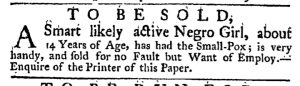
“TO BE SOLD, A Smart likely active Negro Girl.”
I chose this advertisement because it revolves around a controversial and pivotal part of early American society: slavery. In 1767, slavery was a part of life for British North American colonists everywhere. There were large workforces of slaves used to support Southern plantation agriculture. In addition, in other regions slaves were used on smaller scale farms and in domestic service. For the modern reader, the very contemplation of such practices is appalling and repulsive. However, we cannot look at American history without recognizing the integral role slavery played in society and the economy. Slavery also shaped American politics and government.
For instance, the founders focused on slavery during the Constitutional Convention in the summer of 1787, just twenty years after this advertisement was published. Over the course of the Constitutional Convention the delegates discussed multiple issues, including slave importation and whether proportional representation should include slaves. These were important issues that garnered differing opinions during the debates. The Northern states pushed for no representation of slaves to reduce Southern power, while Southerners fought to include slaves in their population.[1] Eventually, the delegates decided to count three out of five slaves in matters of representation; this was known as the Three-Fifths Compromise.[2] The debates about slavery characterized the Constitutional Convention and created intense tension. While the practice of slavery was abysmal, there was no doubt that it shaped the American Constitution and the government it established.
**********
ADDITIONAL COMMENTARY: Carl Robert Keyes
An anonymous slaveholder offered a “Smart likely active Negro Girl” for sale “for no Fault but Want of Employ.” In other words, the enslaved young woman evinced no shortcomings that prompted the sale. Instead, her owner simply did not have enough work to keep her busy and thus had no further use for her. Such explanations commonly appeared in advertisements offering single slaves for sale – both adults and youths – in New England and the Middle Atlantic colonies in the 1760s. This was a significant regional variation that distinguished many advertisements selling slaves in the northern colonies from their counterparts in the Chesapeake and Lower South.
“But Want of Employ” advertisements underscore the commodification of enslaved men, women, and children in eighteenth-century America. Slaveholders faced a choice when they determined that they no longer needed slaves’ labor: sell the slaves or set them free. The decision to sell them signals that slaveholders thought of their human property as any other commodity, an investment to be recouped as much as possible upon exceeding usefulness. A “Girl, about 14 Years of Age” could be traded as easily as textiles or furniture or any other goods that filled the advertising pages in colonial newspapers.
This advertisement and many more like it appeared in newspapers during the imperial crisis, the decade of tensions between colonists and Parliament that ultimately resulted in a war for independence. Colonists contemplated the meaning of liberty in their own lives even as they sold slaves “for no Fault but Want of Employ.” This advertisement makes clear that the promises of liberty were not evenly applied to all residents of the colonies during the transition from protest and resistance to severing political ties with Great Britain. This has been a central theme in my Revolutionary America course: many different kinds of experiences rather than a unified narrative.
As my students continue to curate the Slavery Adverts 250 Project they assess and verify this argument as they examine original sources. In many ways, a single advertisement for a “Smart likely active Negro Girl” to be “sold for no Fault but Want of Employ” is much more convincing than abstract statements that broadly aggregate the experiences of enslaved men, women, and children in the Revolutionary era.
**********
[1] Richard Beeman, Plain Honest Men: The Making of the American Constitution (New York: Random House, 2009), 204-215.
Who was the subject of an advertisement in a colonial American newspaper 250 years ago today?
Georgia Gazette (March 18, 1767).
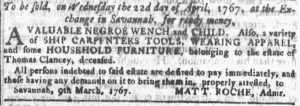
“A VALUABLE NEGROE WENCH and CHILD.”
Scanning through a colonial American newspaper, especially one from Georgia, it is not uncommon to see advertisements selling slaves with other goods. It is appalling to see a woman and her child being sold as property along with carpentry tools and household furniture. Ironically, in the 1730s the Georgia Trustees envisioned their colony as a free settlement. Unfortunately, the economic temptations were too strong and by 1751 slavery was legalized. In contrast, by 1784, the northern states, Pennsylvania, Massachusetts, New Hampshire, Connecticut, and Rhode Island, had all abolished slavery. But Georgia remained a slave state after the Revolution.
Two crops dominated the Georgia economy, rice in the eighteenth century and cotton in the nineteenth century. Rice and cotton plantations required an adequate slave labor force, so as Georgia’s plantations grew so did the demand for slaves. A state law passed in 1793 prohibited the importation of slaves, but the law went into effect in 1798. During the 1790s the number of slaves in Georgia nearly doubled. In 1790 Georgia had 29,264 slaves, but then 54,699 slaves in 1800.
What did it really mean to see a slave advertisement in the colonial American newspaper? It means viewing human beings as property that could contribute to the owner’s own economic growth. They were seen just as equal as household furniture and other common goods that could be sold and advertised in a newspaper.
**********
ADDITIONAL COMMENTARY: Carl Robert Keyes
Today is the 251st anniversary of the repeal of the Stamp Act. Such an odd number merits little notice in a culture that usually prefers to celebrate landmark numbers of years measured in decades. For the purposes of the Adverts 250 Project, however, March 18, 1767, was the first anniversary of the repeal of the Stamp Act. Colonists did not allow that important anniversary to pass unnoticed. Instead, they engaged in commemorations noted in newspapers published throughout the colonies during the week before and several weeks after March 18.
Against that backdrop, today’s advertisement for “A VALUABLE NEGROE WENCH and CHILD” seems especially jarring. The juxtaposition did not go unnoticed during the years prior to the American Revolution. In Taxation No Tyranny, published in 1775, Samuel Johnson famously asked, “How is it that we hear the loudest yelps for liberty among the drivers of negroes?” The British author and lexicographer identified a glaring inconsistency in the rhetoric of colonists who claimed they were being enslaved by Parliament.
Although patriots in northern colonies (later states) did not level the same sort of acerbic observations against their southern counterparts, many increasingly applied the rhetoric of liberty to the circumstances of their own slaves. As Daniel notes, several northern states abolished slavery by the end of the eighteenth century. Others adopted gradual emancipation plans. As a result, advertisements offering slaves for sale tapered off in northern newspapers.
For the past six months, the Slavery Adverts 250 Project has demonstrated, however, that advertisements for slaves were common in newspapers printed in New England and the Middle Atlantic, regions not associated with slavery to the same extent as the Chesapeake and the Lower South (in part because the northern regions abolished or phased out slavery after the Revolution). Today’s advertisement lumping together “A VALUABLE NEGROE WENCH and CHILD” with tools, clothing, and furniture appeared in some variation in newspapers printed in Boston, New York, and Philadelphia during its week of initial publication.
As Daniel and his peers in my Revolutionary America class work on the Adverts 250 Project and the Slavery Adverts 250 Project, I am encouraging them to contemplate the tensions between liberty and enslavement in eighteenth-century America, as well as the uneven application of the rhetoric of the Revolution when it came to slavery. While it is important to realize that approximately half a million slaves resided in the colonies at the time of the Revolution, the micro-histories embedded in slavery advertisements tell the stories of individuals. They provide further insight into the daily lives and lived experiences of enslaved men, women, and children in early America.
Who was the subject of an advertisement in a colonial American newspaper 250 years ago today?
Georgia Gazette (February 25, 1767).
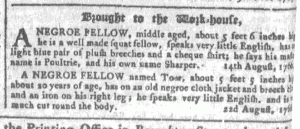
“Brought to the Work-house, A NEGROE FELLOW, middle aged.”
This advertisement caught my attention because it is an advertisement about runaway slaves. After doing further research on runaway slaves, I discovered that advertisements like this were very common during this period. Advertisements similar to this one were used to recapture slaves and indentured servants. They listed specific physical characteristics, such as height and clothing. The abundance of slavery advertisements is why the Slavery Adverts 250 Project also exists. Slavery was such an important part of society and the colonists’ economy at this time that slavery advertisements were abundant in many eighteenth-century newspapers.
Sadly, according to Tom Costa, advertisements sometimes did not need to be posted because many slave owners would recapture their slaves within one to two weeks of their escape. Costa also states that many slave owners would only put out advertisements if the runaway was seen as valuable. Unfortunately, advertisements such as these often made it nearly impossible for slaves to escape to freedom.
Many slavery advertisements, spanning several decades, have been digitized and made available for the public to view in the Virginia Gazette. The Virginia Gazette is the only colonial and revolutionary-era newspaper that has been digitized and made available to the general public, providing the ability to view many advertisements similar to this one from the colonial and revolutionary eras. Also, other slavery advertisements are easy to view via the Slavery Adverts 250 Project. This project also provides the public with hundreds of slavery advertisements from 250 years ago, emphasizing how commonplace slavery advertisements were. The Slavery Adverts 250 Project includes slavery advertisements published in newspapers throughout all of the colonies.
**********
ADDITIONAL COMMENTARY: Carl Robert Keyes
As the guest curators from my Revolutionary America class and I work on this project together, we have many opportunities to discuss methodology, primary and secondary sources, and the availability of digitized documents to scholars and the general public. In the process, my students gain a better understanding of both the past and how historians pursue their work.
From now until the end of the semester, visitors to the Adverts 250 Project may notice that each student incorporates at least one advertisement concerning slavery into her or his week serving as guest curator. This complements the work that each will conduct when curating the companion Slavery Adverts 250 Project during a different week, giving each an opportunity to examine at least one slavery advertisement in greater detail.
Today, Shannon offers important observations about the accessibility of eighteenth-century newspapers, including the advertisements for slaves that prominently appeared in them. To complete their work on both the Adverts 250 Project and the Slavery Adverts 250 Project, students consult several databases of digitized newspapers as they draw material from the nearly two dozen published in the colonies in 1767. They complete most of their research using Readex’s Early American Newspapers, available via databases linked on the campus library’s website. That particular subscription, however, does not include all of the eighteenth-century newspapers Readex has digitized. When students visit the reading room at the American Antiquarian Society they have access to Readex’s America’s Historical Newspapers, which includes all of the newspapers available via Early American Newspapers as well as the Pennsylvania Gazette (perhaps the most important eighteenth-century American newspaper) and both versions of the Virginia Gazette published in 1767 (one by Purdie and Dixon and one by Rind). Students must also visit the American Antiquarian Society to access three newspapers printed in Charleston, South Carolina, via Accessible Archives.
As Shannon notes, it is not necessary to visit a research library or have remote access to their digital resources to examine the Virginia Gazette. Colonial Williamsburg has made these sources available to the general public via their Digital Library, which also includes manuscripts, research reports, and York County estate inventories. This collection of newspapers includes several publications (or continuations of publications with new printers) all published under the title Virginia Gazette: Parks (1736-1740, 1745-1746), Hunter (1751-1757, 1759, 1761), Royle (1762, 1763, 1765), Purdie and Dixon (1766-1774), Rind (1766-1774), Pinkney (1774-1776), Dixon and Hunter (1775-1778), Purdie (1775-1778), Clarkson and Davis (1779-1780), and Dixon and Nicholson (1779-1780).
The Adverts 250 Project includes a daily digest of all slavery advertisements published 250 years ago that day. The citations for advertisements from the Virginia Gazette always includes a link that takes readers to Colonial Williamsburg’s Digital Library, directly to the correct page of the newspaper so readers can examine each advertisement in its original context. Each advertisement tells an important story of human bondage, but they tell even richer and more complete stories when not disembodied from the other advertisements, news items, and other content that accompanied them. It’s not possible for the Adverts 250 Project or the Slavery Adverts 250 Project to provide that kind of access to every eighteenth-century newspaper. Colonial Williamsburg offers unique access to the Virginia Gazette to all readers, not just those associated with colleges and universities or major research institutions.
Who was the subject of an advertisement in a colonial American newspaper 250 years ago today?
Georgia Gazette (February 4, 1767).
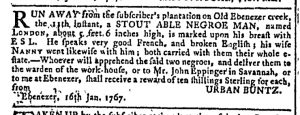
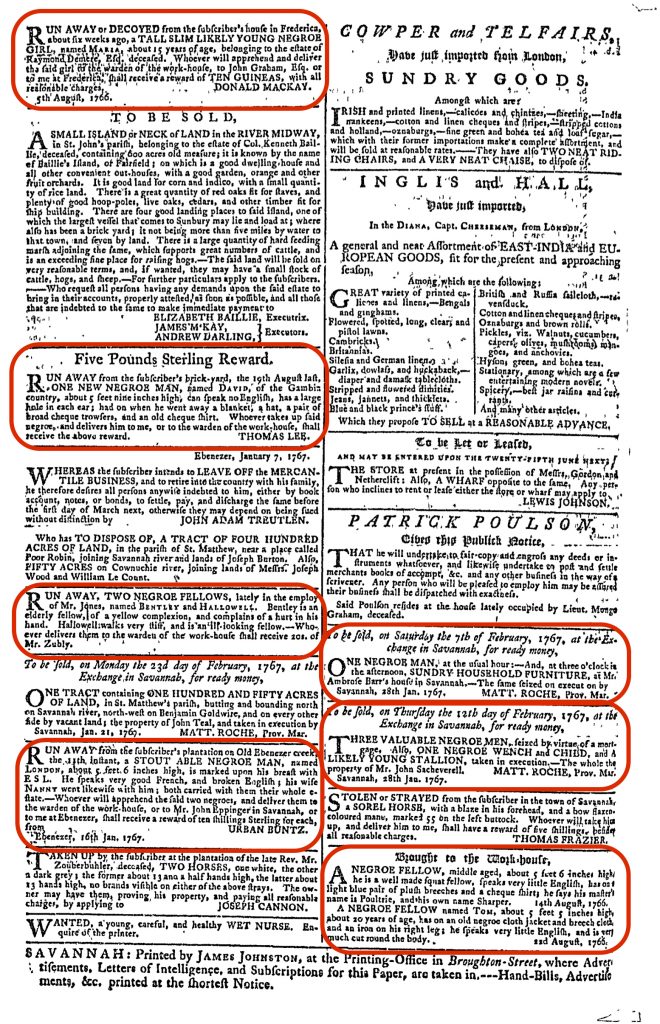
“RUN AWAY … two negroes.”
The Slavery Adverts 250 Project, a companion to the Adverts 250 Project, began last fall as an experimental class project for my Colonial America course. Along with the undergraduate guest curators, I hoped to explore the frequency that advertisements concerning slaves appeared in colonial newspapers and, when appropriate, draw distinctions between the presence of such advertisements among various cities and towns, colonies, or regions. In general, I hoped to use the Slavery Adverts 250 Project to demonstrate to students that slavery was present throughout colonial America, in the northern colonies where they did not expect to encounter it as well as in southern colonies where they already knew slavery was practiced extensively.
Identifying and republishing all of the advertisements for slaves that appeared in colonial newspapers 250 years ago certainly gives a sense of the frequency that such advertisements appeared in colonial newspapers. Slavery was such a part of everyday life and culture, as well as an integral component of colonial economies, that advertisements seeking to buy or sell slaves and notices about runaways and captured fugitive slaves became a mundane part of the advertising pages in newspapers throughout the colonies.
Advertisements concerning slavery on the final page of the Georgia Gazette (February 4, 1767).
That being said, collecting and republishing such advertisements tells an incomplete story. It reveals which newspapers tended to include more advertisements for slaves than others, but removing those advertisements from their original context disguises their ubiquity, especially in newspapers published in the Lower South.
Consider today’s advertisement for runaways London (who “speaks very good French, and broken English”) and his wife, Nanny. In and of itself, this advertisement tells a fascinating story of enslavement and agency in the eighteenth-century Atlantic world. On its own, however, it does not reveal the amount of space given over to advertisements for slaves in the Georgia Gazette. Nine such advertisements appeared in the February 4, 1767, issue, spread over three of its four pages. They accounted for one-third of the twenty-nine advertisements. Seven were printed on the final page, distributed such that readers could not escape noticing them.
A few days ago I noted that advertisements placed by the printer filled a disproportionate amount of space on the final page of the Providence Gazette, perhaps because the publication had difficulty attracting other advertisers. James Johnston did not have that difficulty when he took the Georgia Gazette to press every week. Enslavement was a significant aspect of daily life in Georgia in 1767. If it had not been, the colony’s only newspaper would not have been overflowing with advertisements announcing “ONE NEGROE WENCH and CHILD” for sale or “A NEGROE FELLOW named TOM” committed to the workhouse or “a reward of ten shillings” for anyone who captured London and Nanny.
What was advertised in a colonial American newspaper 250 years ago today?
Pennsylvania Journal (December 18, 1766).
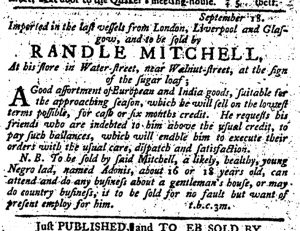
“A likely, healthy, young Negro lad, named Adonis.”
Regular visitors know that students from my Colonial America class have actively participated in the project over the past three months, both as guest curators of the original Adverts 250 Project and as curators of a newer initiative, the Slavery Adverts 250 Project. These two digital humanities and public history projects gave students opportunities to learn about consumer culture and slavery in colonial America, as well as the connections of each to commerce, culture, and politics. As curators of the Slavery Adverts 250 Project, each student identified all advertisements concerning slavery published during a particular week in the fall of 1766. For their final exam, each student wrote an essay in which they used those advertisements, supplemented by other primary and secondary sources from the course, to examine the history of slavery in colonial America.
Randle Mitchell’s advertisement explicitly demonstrates the connections between the emphasis on marketing and consumer culture in the Adverts 250 Project and the focus on enslavement and commerce in the Slavery Adverts 250 Project. It also incorporates aspects of slavery in colonial America that I especially wanted students to uncover and learn by working on the project and taking the course. Drawing on other advertisements, most students commented on many of the aspects of Mitchell’s advertisement that I consider significant.
At first glance, Mitchell’s advertisement appeared to be a standard commercial notice about “A Good assortment of European and India goods” recently imported. However, Mitchell added a nota bene (almost as long as the rest of the advertisement) that offered “a likely, healthy, young Negro lad, named Adonis” for sale. In the colonial marketplace, enslaved men, women, and children were just as much commodities as all the so-called “Baubles of Britain” that merchants imported and shopkeepers peddled.
Mitchell’s advertisement appeared repeatedly in both the Pennsylvania Journal and the Pennsylvania Gazette. Because most people associate slavery with the South in the decades before the Civil War, many students were astonished to discover how extensively slavery was practiced in northern colonies before the American Revolution. They deployed advertisements like this one to argue Pennsylvania, other Middle Atlantic colonies, and New England were “societies with slaves” even if they were not “slave societies” like their counterparts in the Chesapeake and Lower South.
Mitchell noted that Adonis “can attend and do any business about a gentleman’s house, or may do country business,” such as work on a farm. Just as many people associate slavery with the antebellum South, they also assume that slaves worked on plantations. The northern colonies did not develop plantation economies. Some slaves worked on farms, laboring alongside masters rather than with a gang of other slaves and an overseer. Like Adonis, others worked in domestic service, especially in urban ports in the eighteenth century. Some also learned special skills as artisans. This advertisement helps to demonstrate that slaves lived and worked in a variety of place and under a variety of circumstances during the colonial period.
I was generally pleased if students made all of these points in their final essays. I was especially impressed, however, by any who examined the reason Mitchell wanted to sell Adonis: “for no fault but want of present employ for him.” Mitchell did not have enough work to keep his young slave busy. That might have been cause to set the young man free, yet Mitchell opted instead to sell him to a new master, underscoring that the enslaved youth was a commodity and an investment. Several students commented on (and applauded) the agency demonstrated by slaves who ran away, the subject of a great many advertisements, but the most astute also noted that colonists like Mitchell also exercised agency in the choices they made (though in such cases they did not warrant any sort of applause or endorsement). Mitchell did not have to sell Adonis. Instead, he chose to sell the young man. Even in the wake of demonstrations against the Stamp Act and continued vigilance about Parliament’s attempts to “enslave” the American colonies, slaveholders like Mitchell continued to buy and sell men, women, and children.
What was advertised in a colonial American newspaper 250 years ago today?
Boston Evening-Post (December 1, 1766).
“A Parcel of choice JAMAICA SUGARS.”
Since this advertisement from the December 1, 1766, edition of the Boston Evening-Post advertised Jamaican sugar I decided to focus on the plantations the English established in the Caribbean. England was in the race to become the most important economic power in Europe. In order to do that England needed colonies, including Jamaica (taken from the Spanish in 1655), to produce of one of the most popular staple crops.
For this goal plantations needed a large labor force. At first the Spanish utilized natives of the area and African slaves. European diseases became a problem for plantation owners as Indian populations dwindled. Later, English planters also found it difficult to persuade indentured servants to work in the harsh environment so by the end of the seventeenth century they focused on primarily using enslaved Africans because they were able to acquire more of them. The demand for African laborers also rose because they too were dying from diseases and the conditions they worked under. According to the British National Archives, between 1702 and 1808 around “840,000 Africans were shipped to Jamaica and a further 100,000 imported into Virginia and Chesapeake.” Overall, around “four million slaves were brought to the Caribbean, and almost all ended up on the sugar plantations.”
The constant demand for sugar in the colonies as well as England itself drove up the need for African slaves in the Caribbean. Since the cost for slaves was low, planters were able to produce more sugar, which in turn drove down the cost. Boston did not have as many slaves as other parts of the colonies, but readers of the Boston Evening-Post who purchased “choice JAMAICA SUGARS” were part of an economy that depended on slavery.
**********
ADDITIONAL COMMENTARY: Carl Robert Keyes
Joseph Russell was a busy auctioneer. He was also a busy advertiser. Nick has selected one of three advertisements Russell placed in the December 1, 1766, issue of the Boston Evening-Post. The printers grouped the three advertisements together at the top of the third and final column on the third page.
Boston Evening-Post (December 1, 1766).
The first announced an auction to be held “TO-MORROW,” December 2. Given how soon that auction was slated to take place, “TO-MORROW” appeared in a larger font than anything else in any of Russell’s advertisements. Only one other advertisement on the same and the facing page included font that large: shopkeeper Richard Salter’s name in his advertisement for imported goods. As a result, Russell’s advertisement likely caught readers’ eyes and demanded their attention. The large font gave his impending auction the sense of urgency required to attract prospective bidders in the final hours before the vendue began. The advertisement named a series of goods nearly identical to those listed in Russell’s advertisement that appeared in the Massachusetts Gazette three days earlier (featured earlier this week). It repeated ancillary material verbatim, including a nota bene announcing that “Goods are daily selling off at private Sale at the above Auction-Room, VERY CHEAP.”
Russell’s second advertisement promoted the auction of “choice JAMAICA SUGARS” to take place “On THURSDAY next 4th of December,” the advertisement that Nick selected to examine today. Russell’s final advertisement previewed an auction scheduled to take place a week after that, “On THURSDAY the 11th Instant.” At that time, Russell planned to sell different sorts of merchandise than what appeared in either of the other two advertisements: “A great Variety of genteel House Furniture” and “Glass and China Ware.”
In these advertisements Russell used time to his advantage in three different ways. In the first, he created a sense of urgency. The auction was imminent. Readers needed to make plans to attend or risk being shut out of the deals. However, those unable to make it to that auction could still shop at their leisure, as the nota bene about goods “daily selling off at private Sale” made clear. In the latter two advertisements, he advised the public of upcoming auctions with sufficient time to generate interest. Potential buyers had plenty of time to envision bidding on “Mahogany Tables, Looking Glasses,” and other furnishings, perhaps imagining the deals they might get at auction. Depending on their personalities, readers would have reacted to each use of time in different ways. Some would have been more susceptible to the excitement of an impending auction. Others would have responded better to planning for a vendue more than a week away or shopping at their convenience in “the Auction Room in Queen-Street.” Russell creatively deployed all three strategies to attract as many potential consumers as possible.
What was advertised in a colonial American newspaper 250 years ago today?
New-Hampshire Gazette (November 21, 1766).
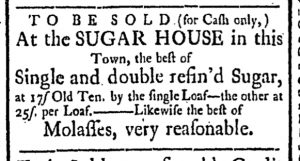
“Single and double refin’d Sugar.”
This advertisement, while very small, was also extremely important because it sold arguably one of the biggest products of colonial times. Sugar was one of the most important and bestselling staple crops in the world. Sugar importation was part of a trade network that brought together people from three continents: Europe, Africa, and the Americas (including the Caribbean islands). Slavery played a major part as, over time, millions of slaves on the Caribbean islands worked on sugar plantations.
During colonial times sugar was produced for all sorts of consumers, including people in the North American colonies. According to the William L. Clements Library’s online exhibit about sugar, “Between the middle of the seventeenth century and the middle of the nineteenth century, sugar was transformed from a luxury to a widely consumed commodity in Great Britain and the United States.” With this production also came high mortality rates for slaves who worked on the plantations. In addition, a lot more slaves produced sugar than other staple crops.
**********
ADDITIONAL COMMENTARY: Carl Robert Keyes
In addition to sugar, the advertisement Patrick chose for today also marketed “Molasses, very reasonable.” It comes as no surprise that the proprietor of “the SUGAR HOUSE” in Portsmouth, New Hampshire, also sold molasses, a byproduct of the sugar refining process. Like sugar, molasses was produced on sugar plantations in the Caribbean and then exported as part of the trading networks that crisscrossed the Atlantic Ocean. Massive quantities of molasses were transported to New England, including Portsmouth, during the eighteenth century.
Why did colonists purchase so much molasses? They used it to produce rum by fermenting the molasses with yeast and water and then distilling the mixture in copper pot stills. During the eighteenth century New England became a major center for the production of rum. In the process, the New England colonies became enmeshed in what is often called the triangular trade. Merchants shipped sugar and molasses produced on plantations in the Caribbean to New England. Distillers purchased molasses and converted it into rum, which merchants then carried to Africa to trade for captive Africans. Those Africans were then transported to the Caribbean, where they labored as slaves on sugar plantations, as Patrick explains above.
Compared to the slave societies of the Chesapeake, Lower South, and Caribbean, colonists in New England owned relatively few slaves in the eighteenth century. That did not mean, however, that their economy and ability to participate in the expanding consumer culture of the era did not depend in large part on slavery. They relied on the transatlantic slave trade and the labor of enslaved Africans as integral parts of their networks of exchange. In other words, colonists in New England were complicit in perpetuating slavery even if they did not own slaves themselves. That was a consequence of their economic decisions.
On a final note, compare the roles of sugar and molasses in today’s advertisement. The sugar was intended for sale to consumers who were end users. The molasses, on the other hand, was not necessarily intended for the consumption of local customers. Instead, it was part of the production process for creating another commodity, rum, that upon its sale allowed colonists to participate more fully in consumer culture. Rum revenues made it possible to purchase imported English goods listed in so many other advertisements in colonial newspapers.
Who was the subject of an advertisement in a colonial American newspaper 250 years ago today?
South-Carolina Gazette and Country Journal (October 28, 1766).
“A CARGO consisting of about ONE HUNDRED and FORTY young and healthy new NEGROES.”
I chose this advertisement because it demonstrates the inhumane and terrible slave industry in colonial America. The advertisement demonstrates how racial barriers dehumanized Africans in the eighteenth century. Because of their skin tone and origin, Africans were thought of as commodities, not as human beings. This idea is horrifying and irrational to modern readers. However, the transatlantic slave trade was a reality of American culture for hundred of years. In fact, slavery persisted in Southern society until the end of the Civil War.
A contributing factor to colonial Americans attachment to slavery was the need for a large workforce to toil over the agricultural endeavors of Southern colonies. Slavery provided landowners with an inexpensive workforce that could be expanded at virtually any time. Thus the demand for slaves persisted throughout the colonial period and into the nineteenth century.
However slavery also occurred in the all the colonies. Slaves were utilized for domestic service Evidenced comes from multiple advertisements for slaves posted in newspapers printed in the New England and Middle Atlantic colonies. There were advertisements regarding slaves in the Connecticut Courant, the Providence Gazette, and the New-York Gazette, among others. In the fall of 1766, the Connecticut Courant included an advertisement that said “TO be sold for Cash or 6 Months Credit … One Negro Boy.” In the Providence Gazette there was a advertisement that stated: “To be sold at Public Vendue … A likely healthy active Negro Boy, about fourteen Years old.” The New-York Journal included this advertisement in one of its October issues: “TO BE SOLD, A fine Female Slave.” It is obvious from the widespread nature of these advertisements that slavery was an established part of society throughout all the colonies.
Connecticut Courant (October 6, 1766).
**********
Providence Gazette (October 11, 1766).
**********
New-York Journal (October 16, 1766).
Thankfully, the practice of slavery was abolished in the 1800s, but the transatlantic slave trade shaped our country in ways no founding father could have imagined. The legacy of slavery persisted after its abolition, causing strife for descendants of slaves. That is why learning about the roots of slavery is important. It has contributed to years of human rights abuses, the rise of humanitarian movements, and important political change. Even though this part of our history is abhorrent, we need to remember our past in order to ensure justice and equality in the future.
**********
ADDITIONAL COMMENTARY: Carl Robert Keyes
Megan notes that slavery was not restricted to colonies in the Chesapeake and Lower South. Instead, as the advertisements she has chosen for today demonstrate, slavery and the slaver trade were part of colonial culture and economics in New England and the Middle Atlantic as well. I appreciate how she shows that advertisements for slavery were spread across newspapers printed in each region of colonial America in the fall of 1766. For my additional commentary, I am examining how such advertisements were concentrated in one particular issue.
According to the project’s methodology, Megan needed to select an advertisement from a newspaper printed exactly 250 years ago today. That gave her only one option in terms of choosing a newspaper: the South-Carolina Gazette and Country Journal was the only newspaper printed on October 28, 1766. It’s not surprising that when she consulted that issue that she chose an advertisement for an impending slave auction. In total, eighty-four advertisements appeared in that issue. Fourteen of them advertised slaves. Some offered dozens of slaves for sale, cargoes recently arrived from Africa, as was the case in the advertisement Megan chose. Others sought to sell individual slaves, sometimes as part of estate sales. Some warned against runaway slaves and offered rewards for their capture and return. Some notified masters that escaped slaves had been captured and told them where to retrieve their human property. It would have been practically impossible to look at this issue of the South-Carolina Gazette and Country Journal without noticing numerous advertisements explicitly connected to slavery and the slave trade.
The visual aspects of the advertisements made it even more likely that readers would focus on advertisements for slaves. Only ten advertisements featured any sort of image, a woodcut that would have been a standard part of any printer’s stock. These woodcuts included two ships (one for a departing vessel and another for imported goods), two houses (both for properties to be leased), and one horse (for a stolen gelding). The other five woodcuts all depicted slaves, three runaways and two Africans on display to promote auctions from cargoes recently arrived from Africa. The woodcuts depicting slaves were spread out over three of the four pages of the broadsheet newspapers. Considering the density of text in the South-Carolina Gazette and Country Journal, these advertisements were among the most prominent items that appeared in that issue.
Megan demonstrated the breadth of advertisements for slaves in newspapers printed in several regions during the fall of 1766. That is important, but it tells only part of the story. The depth of advertising in specific issues and particular newspapers also merits further investigation. That is part of the work my entire Colonial America class is doing with the Slavery Adverts 250 Project.