February 6

What was advertised in a colonial America newspaper 250 years ago today?
feb-6-261767-south-carolina-and-american-general-gazette
South-Carolina and American General Gazette (February 6, 1767).

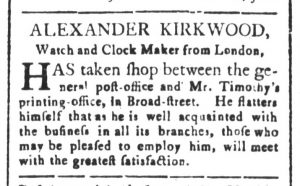
“ALEXANDER KIRKWOOD, Watch and Clock Maker from London, HAS taken shop.”

A print of An Exact Prospect of CHARLESTOWN, the Metropolis of the Province of SOUTH CAROLINA, “Engrav’d for the London Magazine” in the early 1760s, depicted a bustling colonial port city. It provided a view of the waterfront, including the wharves where vessels took on cargoes of rice, indigo, and other local products after unloading commodities imported from Europe and the West Indies, slaves arriving directly from Africa or transshipped through other ports in the New World, and migrants from Europe looking for new opportunities.

08835v
An Exact Prospect of Charlestown, the Metropolis of the Province of South Carolina (ca. 1762).  Courtesy Library of Congress.

Alexander Kirkwood, a “Watch and Clock Maker from London,” made the journey across the Atlantic at some point, though his advertisement in the South-Carolina and American General Gazette did not indicate how recently he had arrived in the colony. Whenever he made the voyage, he likely chose to settle in Charleston because it was indeed “the Metropolis” of South Carolina (though readers of the London Magazine may have chuckled a bit over that characterization when they viewed the print), the largest settlement in Britain’s North American colonies south of Philadelphia. The “Watch and Clock Maker from London” needed a sufficient customer base to succeed, making a prosperous settlement the size of Charleston an attractive place to set up shop.

Most likely Kirkwood was a relatively new arrival when he placed this advertisement, given that he stated that he “has taken shop” rather than “removed” from one shop to another. Like shopkeeper David Conkie in Boston, who placed his own advertisement earlier the same week, Kirkwood needed to make prospective customers aware of his business. To that end, he placed notices in both the South-Carolina and American General Gazette and the South Carolina Gazette, published by his neighbor, “Mr. Timothy’s printing-office, in Broad-street.” Residents may not have been familiar with Kirkwood’s shop just yet, but they certainly knew where to find the businesses on either side of him, Timothy’s printing office and the “general post-office.” Not only did his advertisements serve to garner attention, Kirkwood’s location certainly yielded a fair amount of visibility for his shop.

January 30

What was advertised in a colonial American newspaper 250 years ago today?

jan-30-south-carolina-and-american-general-gazette-slavery-6
South-Carolina and American General Gazette (January 30, 1767).

“TO BE SOLD … ALL the estate of said deceased.”

Today’s advertisement had an exceptionally unusual layout: four columns of about twelve lines each, rotated counterclockwise relative to other items, positioned on the left side of the final page of the South-Carolina and American General Gazette. Another advertisement on the other side of the sheet had a similar layout, rotated clockwise and positioned on the right side of the page.

When I first encountered similar layouts in the New-Hampshire Gazette I hoped to make an argument that advertisers played a role in the graphic design decisions, that they attempted to draw attention to their notices through creative and jarring layouts that departed from readers’ expectations. Upon consulting original copies of the New-Hampshire Gazette, however, I discovered that the printers’ paper supply had apparently been disrupted temporarily and they compensated by finding means to squeeze as much type as had already been set to completely fill smaller broadsheets.

Something similar seems to have happened here. Unfortunately, my local archive does not have copies of the South-Carolina and American General Gazette in its collections and Accessible Archives, like other databases of digitized images of eighteenth-century newspapers, does not provide metadata concerning the dimensions of each page. Still, based on experience working with other newspapers printed in the 1760s as well as their digital surrogates in multiple databases, I can advance a reasonable explanation for the unusual layout of today’s advertisement.

jan-30-south-carolina-and-american-general-gazette-page-6
Final page of South-Carolina and American General Gazette (January 30, 1767).

Most issues of the South-Carolina and American General Gazette, like newspapers printed throughout the colonies, were four pages, created by printing two pages on each side of a broadsheet and then folding it in half. Each page had four columns of news, advertisements, and other content. For the January 30, 1767, issue, these pages were numbered [19] through 22. Pages 23 and 24, featuring the unique layout, appeared to be printed on smaller sheets with just enough room for two regular columns and a third made from dividing an advertisement into four shorter columns and rotating each. Both of the advertisements given this treatment had appeared in a single column in the previous issue. The type had been set, making it relatively easy to reposition it for the smaller sheet. The previous issue also had two extra pages, but apparently on a slightly larger sheet that allowed for three full columns on each side. In neither case were these additional sheets entitled a supplement.

Most likely pages 23 and 24 did not appear sequentially when delivered to, or read by, subscribers. Instead, the smaller sheet would have been tucked inside the larger newspapers. These extra pages featured advertising exclusively, as did the extra pages in the previous issue. Robert Wells, the printer of the South-Carolina and American General Gazette, may have taken in so many advertisements that he considered it necessary to provide the extra sheet as a means of not falling behind in their publication. After all, the colophon encouraged readers to submit advertisements, an important revenue stream for any newspaper publisher in eighteenth-century America. If Wells, who competed with printers of two other newspapers in Charleston, wanted to continue to receive advertisements then he needed to publish and distribute them quickly rather than resorting to an apology sometimes issued by printers: “advertisement omitted will appear in our next.”

In the end, Samuel Wise most likely had little control over the unique layout of today’s advertisement. Still, he and all the other advertisers whose notices appeared on the supplemental sheet perhaps benefitted from the extra attention it may have garnered among readers.

January 23

What was advertised in a colonial American newspaper 250 years ago today?

jan-23-1231767-south-carolina-and-american-general-gazette-page-6
South-Carolina and American General Gazette (January 23, 1767).

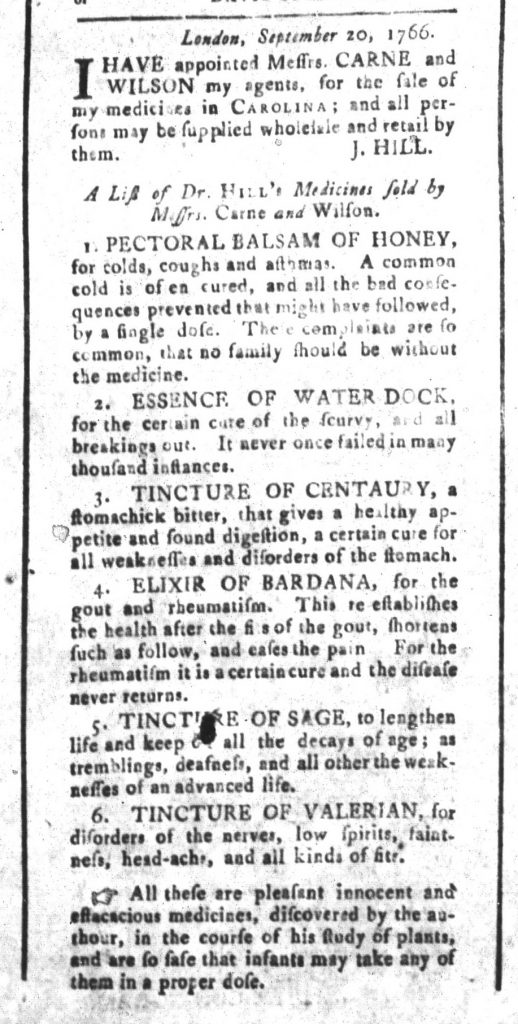
“A List of Dr. HILL’s Medicines sold by Messrs. Carne and Wilson.”

Patent medicines became a staple of American advertising about as soon as the first weekly newspapers were published in the early eighteenth century, so much so that historians of advertising have focused attention disproportionately on these quack remedies. Why not? The advertisements hawked potions with odd names, emphasized strange ingredients, and made wild claims today considered obviously false, making later generations marvel that anyone could have possibly been influenced by that sort of marketing.

Yet patent medicines were indeed popular in eighteenth-century England and America, perhaps the first class of commodities to develop distinct and recognizable brand names. For instance, John Hill’s “PECTORAL BALSAM OF HONEY,” the first of half a dozen medicines listed in today’s advertisement, appeared in advertisements printed in newspapers throughout the colonies. Both apothecaries and shopkeepers announced that they imported and sold elixirs produced by Hill and other English “doctors,” assuming prospective customers recognized names and products like Anderson’s Pills, Batemans’s Drops, Stoughton’s Bitters, and Turlington’s Balsam. Unlike most purveyors of patent medicines, Hill, a botanist and author, did hold a medical degree.

Given the ease of counterfeiting patent medicines in a marketplace without formal regulation of medical supplies, Hill and others made various efforts to protect both their reputations and their share of the market. For instance, Hill designated specific agents authorized to sell his patent medicines. His advertisement first identified the men who operated on his behalf before listing and describing the remedies they sold to colonists: “I HAVE appointed Messrs. CARNE and WILSON my agents, for the sale of my medicines in CAROLINA; and all persons may be supplied wholesale and retail by them.” Others in Charleston and beyond sold patent medicines, including Hill’s various nostrums, but Carne and Wilson sought to benefit from having a seal of approval from Dr. Hill himself as they sold “ESSENCE OF WATER DOCK,” “TINCTURE OF VALERIAN,” and other medicines compounded by the famous doctor.

January 16

What was advertised in a colonial American newspaper 250 years ago today?

jan-16-1161767-south-carolina-and-american-general-gazette
South-Carolina and American General Gazette (January 16, 1767).

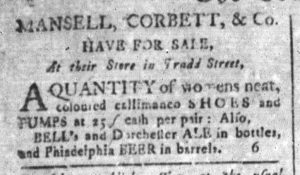
“MANSELL, CORBETT, & Co. HAVE FOR SALE, At their Store in Tradd Street.”

Not much distinguished Mansell, Corbett, and Company’s advertisement from other commercial notices inserted in the same issue of the South-Carolina and American General Gazette. The partners announced that they stocked an interesting combination of women’s shoes, ale (in bottles) from Dorchester, and beer (in barrels) from Philadelphia at their store in Tradd Street. As far as the copy was concerned, Mansell, Corbett, and Company incorporated one aspect that set their advertisement apart from others: they listed a specific price for the shoes, twenty-five shillings per pair.

The shopkeepers may have been fairly conservative in their marketing when it came to making appeals to potential customers, but they did experiment with other methods of attracting notice in the advertising pages of one of their local newspapers. Their advertisement for women’s shoes and Philadelphia beer was not their only contribution to the advertising pages of that issue of the South-Carolina and American General Gazette. They also inserted a separate advertisement that appeared two pages earlier, that one promoting an “ASSORTMENT OF GOODS” that they pledged to “sell very cheap at their new Store in Tradd-street.”

Many eighteenth-century advertisers, especially those who marketed consumer goods and services, ran their advertisements for multiple weeks in order to achieve greater exposure for their businesses. In cities with more than one newspaper, some hedged their bets by placing the same advertisement in multiple publications simultaneously. On the other hand, relatively few colonists who advertised in the 1760s experimented with increasing their exposure by inserting multiple advertisements in a single issue of a newspaper, an iterative method that forced readers to give a business a second consideration even if they skimmed over the first advertisement they encountered.

Given that Mansell, Corbett, and Company described their shop as a “new Store” in the more extensive of their two advertisements, they may have considered this method an effective way of gaining visibility for their endeavor. Whether they were new on the scene in Charleston or had simply moved locations, placing multiple advertisements aided in increasing local awareness of that the partnership sold assorted consumer goods at their shop on Tradd Street.

January 9

What was advertised in a colonial American newspaper 250 years ago today?

jan-9-191767-south-carolina-and-american-general-gazette-page-4
South-Carolina and American General Gazette (January 9, 1767).

“He … proposes opening his school after the holidays.”

Osborne Straton planned to start a new session at his school “after the holidays,” to commence three days after this advertisement appeared in the South-Carolina and American General Gazette. In his attempt to attract students, he noted that he already had four years of teaching experience under his belt. For the past two years, he “had the honour of being intrusted with the tuition of the youth” from many households within the colony. He suggested that parents of prospective new students should “refer to the opinion of those that have employed him.” Straton was confident that he had earned a positive reputation as a teacher during his relatively short time in South Carolina.

In addition to relying on the endorsements from others, the schoolmaster presented further qualifications that were rather unique. Straton explained that he had been “regularly bred a merchant at London” and possessed “forty years experience as head book-keeper in some of the first counting-houses in Europe.” Straton taught what he knew from experience, arguing that he had many “opportunities of ratifying theory by practice.” Teaching was not an abstract occupation for him. He did not rely solely on so-called book learning passed down from the tutors who had educated him. Instead, he incorporated his own experiences from an earlier (yet extensive) career into his classroom and his curriculum in his efforts “to qualify youth for business.”

Straton identified two outcomes parents could expect after enrolling their children in his school. One was a lofty goal – “to open and enlarge the human understanding” – but the other had a purpose many parents might have found might more practical – “to qualify youth for business.” In his advertisement 250 years ago, Osborne Straton did the same dance that many liberal arts colleges, programs, and departments are doing in their marketing efforts today, striking a balance between exhorting the personal benefits of a liberal arts education and demonstrating the preparation for a profession derived from the training undertaken in the process of earning an undergraduate degree.

January 2

What was advertised in a colonial American newspaper 250 years ago today?

jan-2-121767-south-carolina-and-american-general-gazette-page-2
South-Carolina and American General Gazette (January 2, 1767).

“He now teaches LATIN in his Grammar School.”

At the turn of the new year, Walter Coningham sought students for his “Grammar School” in Charleston. He deployed several strategies to convince the parents to enroll their children in his academy.

Coningham opened his advertisements with a message of appreciation for fathers of his current and former students, stating that he “gratefully acknowledges the many favours he has received from those gentlemen who entrusted him with their childrens education.” While probably sincere, this public thank you also allowed the schoolmaster to underscore that other colonists previously sent their children to his school and had been satisfied with the results.

He then announced a new element of his curriculum – Latin – and described his teaching methods. He used “a plan entirely new” that immersed students in the language by consulting “books without English translations.” He assured parents that this method was “both easy and beneficial for the scholar,” but he understood that some readers might harbor some doubts on that account. Accordingly, he offered “ocular demonstration” of the “improvements his scholars make” in studying Latin through “the performance of those now under is care.” In other words, Coningham offered demonstrations. He invited those with reservations about his methods to observe his current students and decide for themselves how well they learned Latin. That he made this offer at all suggested his own confidence in the effectiveness of his pedagogy.

Coningham then elaborated on his curriculum – Greek, Latin, English, writing, and arithmetic – before noting that he cared for the mind, body, and spirit of his students, especially any boarders who were under his supervision at all times of the day and night. He promised that his students would be “improved in their morals” as well as undertake “necessary exercises, during their leisure hours.” (Coningham did not indicate the nature of these “necessary exercises.” Elsewhere on the same page Mr. Pike – a dancing and fencing master who never volunteered a first name in his advertisements in Charleston in the 1760s or in Philadelphia in the 1770s – stated that several days throughout the week he “employs in teaching at the principal boarding schools.” Was it possible that Coningham hired Pike and included fencing and dancing in his curriculum?)

Marketing is a major part of modern education. Anyone who works for a college or university is well aware of the institutional obsession with “the brand” in recent years, yet efforts to promote and to sell education through a variety of hooks and promises are not new to the twentieth and twenty-first centuries. Eighteenth-century educators also developed advertising to entice prospective students and their parents.

December 12

Who was the subject of an advertisement in a colonial American newspaper 250 years ago today?

dec-12-12121766-south-carolina-and-american-general-gazette
South-Carolina and American General Gazette (December 12, 1766).

“RAN AWAY … NERO … many scars about his head.”

Woodcuts frequently accompanied advertisements offering slaves for sale or warning about runaway slaves. As a result, images of Africans and African Americans appeared in newspapers regularly, in contrast to white colonists who were rarely illustrated with visual images. These woodcuts did not depict particular enslaved men, women, or children. Instead, they were stock devices used interchangeably, erasing the individuality of any of the slaves they purported to represent. Significantly, images of black bodies appeared in eighteenth-century newspapers at all because Africans and African Americans were marketed as commodities, just as the multitude of woodcuts depicting ships represented imported goods.

Last week I discovered that I have access to digitized copies of the South-Carolina and American General Gazette, a newspaper not previously incorporated into the Adverts 250 Project. As a result, today I chose to feature an advertisement from that newspaper rather than one either of the other two published 250 years ago today. Both the New-London Gazette and, especially, the New-Hampshire Gazette have contributed a good number of advertisements to this project over the past year. Featuring an advertisement from the South-Carolina and American General Gazette not only increases the number of newspaper included in this project, it also further augments the geographic scope of the project, bringing the number of newspapers printed in Charleston, South Carolina, in 1766 that have since been digitized to three. This rivals Boston with four, New York with three, and Philadelphia with two.

As I perused the December 12, 1766, edition of the South-Carolina and American General Gazette to make my selection for today, I was drawn to this runaway slave advertisement because of the woodcut. This is not the first time that I have examined a woodcut depicting a slave, but this one had an interesting aspect that was not part of similar woodcuts in other newspapers. The torso of the escaped slave was emblazoned with a capital “R,” presumably for “runaway.” The imaginary slave’s body was marked, almost as if it had been branded, while the actual slave – Nero, a sawyer and woodcutter – was also marked with “many scars about his head.” Advertisements for runaway slaves usually included some sort of physical description that allowed readers to scrutinize the black bodies they encountered beyond the pages of the newspaper. Those descriptions often included marks that had been inflicted upon them by masters and overseers. Nero’s scars may have derived from African cultural traditions or they may have been the result of his labors as a sawyer and woodcutter, but it was just as likely that they were indications of punishment and mistreatment. The real Nero was not marked with a capital “R,” but his body may have born other evidence of his enslavement.