January 4

What was advertised in a colonial American newspaper 250 years ago today?
Pennsylvania Gazette (January 4, 1775).

“Printed proposals, with conditions and a specimen of the work, are given gratis.”

Robert Bell, one of the most significant publishers and booksellers of the eighteenth century, frequently ran advertisements in newspapers and disseminated subscription proposals, book catalogues, and other marketing media.  At the beginning of 1775, he promoted an “AMERICAN EDITION of LECTURES on the MATERIA MEDICA, as delivered by WILLIAM CULLEN, M.D. Professor of Medicine in the University of Edinburgh.”  Yet Bell supposedly did not envision this project on his own.  He pursued it, he declared, “At the desire of several PHYSICIANS.”  Given the initial interest expressed by “Gentlemen of that Profession,” Bell inserted an advertisement in the Pennsylvania Gazette in hopes of generating additional demand and determining the viability of publishing an American edition of the influential text.

To that end, he invited physicians and others to obtain “Printed proposals, with conditions and a specimen of the work” at his shop.  Those proposals may have taken the form of a handbill or a short pamphlet, similar to the proposals for A Dissent from the Church of England and the proposals for The Catholic Christian Instructed that Bell disseminated in 1774.  The latter pamphlet devoted two pages to a prospectus that described the purpose of the work, a page to “Conditions” for subscribing (such as number of pages, cost, and payment schedule), and a page to a “Specimen of the type” that demonstrated the quality of an important material aspect of the book.  Based on the description of the printed proposals in Bell’s newspaper advertisement, the proposals for Cullen’s Materia Medica likely had a similar format.

Bell called on “gentlemen, who are desirous of encouraging improvements in the divine art of healing,” to submit their name “speedily” so the book “may be carried into execution immediately.”  He warned against dallying and assuming that surplus copies would be offered for sale after the work went to press: “it will be printed only for those who possess so much animation as to encourage the work by their subscription.”  In other words, anyone who desired copies of this American edition of Cullen’s Materia Medica had only a limited time to pre-order them.  When Bell published the book in 1775, the imprint stated, “Printed for the SUBSCRIBERS,” though perhaps the savvy bookseller produced a small quantity of additional copies to sell to those who neglected to subscribe.  Yet there was no guarantee that he would do so.  Bell attempted to leverage scarcity of the proposed work to encourage customers to reserve copies in advance.

December 24

What was advertised in a colonial American newspaper 250 years ago today?

Providence Gazette (December 24, 1774).

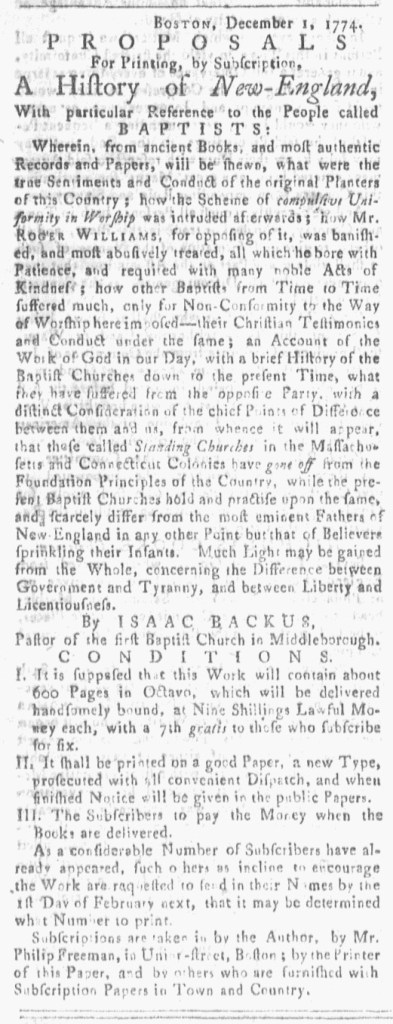
“A History of New-England, With particular Reference to the People called BAPTISTS.”

A subscription proposal for “A History of New-England, With particular Reference to the People called BAPTISTS” appeared among the various advertisements in the December 24, 1774, edition of the Providence Gazette.  Dated “BOSTON, December 1,” it described a work in which Isaac Backus, “Pastor of the first Baptist Church in Middleborough,” consulted “ancient Books, and most authentic Records and Papers” to demonstrate the “true Sentiments and Conduct of the original Planters of this Country” and how the “Scheme of compulsive Uniformity in Worship was intruded afterwards.”  The book included a “brief History of the Baptist Churches down to the present time” and “what they have suffered from the opposite Party, with a distinct Consideration of the chief Points of Difference between them and us, from whence it will appear, that those called Standing Churches in Massachusetts and Connecticut Colonies have gone off from the Foundation Principles of the Country.”  As the imperial crisis intensified, Backus offered his own interpretation of the “Difference between Government and Tyranny, and between Liberty and Licentiousness” when it came to how Baptists had comported themselves and been treated in New England.  Positioning Roger Williams as a protagonist in his narrative, the minister expected to attract subscribers in Rhode Island.

Beyond the contents of the volume, Backus promoted the “CONDITIONS” for publication that subscribers could expect.  He anticipated that the book “will contain about 600 Pages in Octavo, which will be delivered handsomely bound.”  Furthermore, they “shall be printed on good Paper” with a “new Type” to enhance legibility.  Each copy cost nine shillings, though Backus offered a free seventh copy “to those who subscribe for six,” whether to gift to friends or retail in shops and bookstores.  Subscribers did not need to make any payments in advance; sometimes subscription proposals called for deposits to help defray the initial costs of printing, but Backus stated that subscribers would “pay the Money when the Books are delivered.”  Rather than raising funds, he intended for the proposals to gauge interest in the project and incite demand.  To that end, he confided that a “considerable Number of Subscribers have already appeared.”  Given the popularity of the book, Backus suggested, prospective subscribers did not want to miss an opportunity to reserve their own copies.  They could submit their names to Backus or an associate in Boston or the printer of the Providence Gazette.  In addition, the minister disseminated “Subscription Papers in Town and Country,” enlisting the aid of local agents in displaying his marketing materials.

Backus called for subscribers “to send in their Names by the 1st Day of February next, that it may be determined what Number to print.”  Distributing subscription proposals did not always result in books going to press.  In this case, Backus apparently found a sufficient number of subscribers to make the project viable, yet he did not publish the book as quickly as intended.  Given the circumstances, an imperial crisis that became a war between the colonies and Britain in the spring of 1775, Backus published the first of three volumes in 1777 and the other two over the course of two decades.  That first volume covered the period through 1690.  The second, published in 1784, extended from 1690 to 1784, including “a concise view of the American war, and of the conduct of the Baptists therein, with the present state of their churches.”  In 1796, Backus published the final volume, a church history that covered the period from 1783 through 1796 that featured a “particular history of the Baptist churches in the five states of New-England.”  The project extended far beyond what he described in the subscription proposals the minister circulated in December 1774.

August 8

What was advertised in a colonial American newspaper 250 years ago today?

Boston Evening-Post (August 8, 1774).

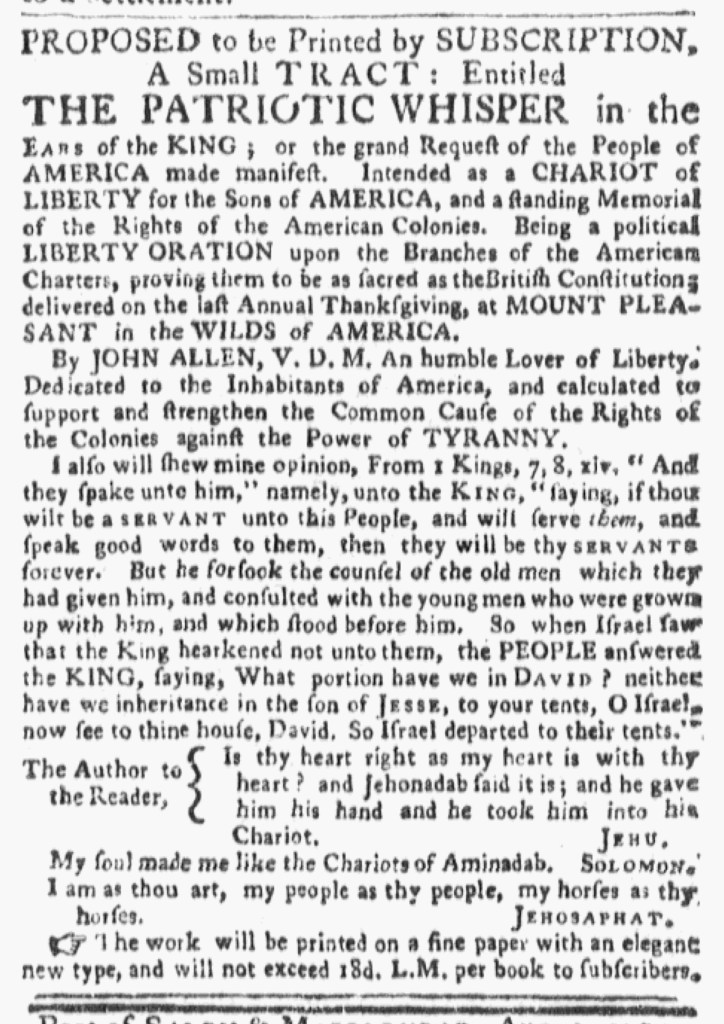
“THE PATRIOTIC WHISPER in the EARS of the KING.”

The imperial crisis intensified in the summer of 1774.  In response to the Boston Port Act, the Massachusetts Government Act, and the other Coercive Acts that Parliament enacted following the Boston Tea Party, printers, booksellers, and others marketed an array of books and pamphlets that advocated for the rights and liberties of the American colonies.  On August 8, Benjamin Edes and John Gill continued advertising Considerations on the Measures Carrying on with Respect to the British Colonies in North-America in the Boston-Gazette.  That same day, a subscription proposal for “A Small TRACT: Entitled THE PATRIOTIC WHISPER in the EARS of the KING” appeared in the Boston Evening-Post.

The lengthy secondary title of the proposed tract deployed similar rhetoric: “the grand Request of the People of AMERICA made manifest.  Intended as a CHARIOT of LIBERTY for the Sons of AMERICA, and a standing Memorial of the Rights of the American Colonies.  Being a political LIBERTY ORATION upon the Branches of the American Charters, proving them to be as sacred as the British Constitution.”  The subscription proposal delivered an impassioned plea to readers whether or not they happened to purchase copies to examine in more detail.

This “PATRIOTIC WHISPER” originated as a sermon that John Allen gave “on the last Annual Thanksgiving.”  Many colonizers in Boston were familiar with his sermons and tracts.  Allen had previously published The American Alarm, or the Bostonian Plea, for the Rights and Liberties, of the People and An Oration, Upon the Beauties of Liberty, or the Essential Rights of the Americans, though he had adopted the pen name “A British Bostonian” for both.  The extended title of the Oration, Upon the Beauties of Liberty identified it as a sermon “Delivered at the Second Baptist-Church in Boston.  Upon the Last Annual Thanksgiving.”  That made it possible for readers to deduce the identity of “A British Bostonian.”  The subscription notice described Allen as a “humble Lover of Liberty, Dedicated to the Inhabitants of America,” and further explained that the tract was “calculated to support and strengthen the Common Cause of the Rights of the Colonies against the Power of Tyranny.”  Again, the advertising copy made a powerful political statement.

That, however, does not seem to have been enough to garner the necessary number of subscribers to take the tract to press.  Yet Allen’s views on the politics of the moment found their way into print in other pamphlets in 1774.  In Salem, Ezekiel Russell printed The Watchman’s Alarm to Lord N—h; or, The British Parliamentary Boston Port-Bill Unwrap[p]ed.  The title page attributed the work to “the British Bostonian.”  In Hartford, Ebenezer Watson reprinted a “carefully corrected” fifth edition of Allen’s Oration on the Beauties of Liberty.  The widespread dissemination of tracts by Allen promoted John M. Bumsted and Charles E. Clark to describe him as “New England’s Tom Paine” in the twentieth century.[1]  Even though Allen’s “PATRIOTIC WHISPER” did not go to press in a crowded market, the subscription proposal that ran in the Boston Evening-Post contributed to the discourse condemning ongoing abuses by Parliament.

**********

[1] John M. Bumsted and Charles E. Clark, “New England’s Tom Paine: John Allen and the Spirit of Liberty,” William and Mary Quarterly, 3rd ser., 21, no. 4 (October 1964): 561-570.

June 4

What was advertised in a colonial American newspaper 250 years ago today?

Maryland Journal (June 4, 1774).

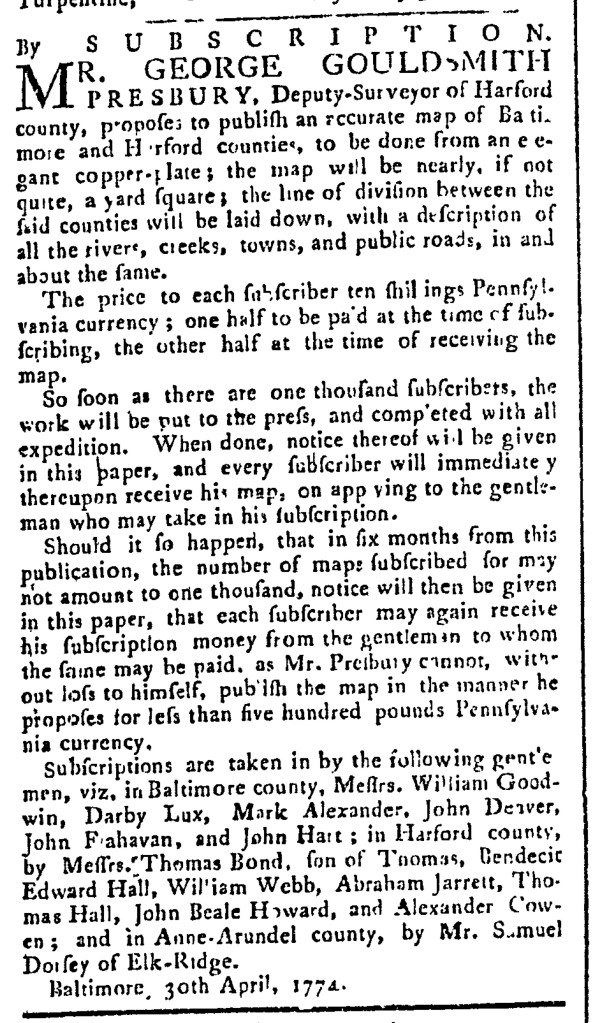
“An accurate map of Baltimore and Harford counties.”

Authors, booksellers, and printers often published books and magazines by subscription in the eighteenth century … or at least attempted to do so.  Before taking publications to press, they distributed subscription proposals to encourage interest and assess demand.  Subscribers reserved copies in advance, sometimes paying deposits.  If the publishers determined that the number of subscribers would make books or magazines viable enterprises, they moved forward with the proposed works.  If subscriptions did not generate sufficient revenue, publishers abandoned projects.

Artists and engravers also used subscriptions for publishing prints, as did surveyors for maps.  George Gouldsmith Presbury, “Deputy-Surveyor of Harford county” in Maryland, published subscription proposals for “an accurate map of Baltimore and Harford counties” in the Maryland Journal, Baltimore’s first newspaper, in 1774.  That the surveyor envisioned a market for this map testified to the growing significance of Baltimore on the eve of the American Revolution.  The map “will be nearly, if not quite, a yard square” and feature “a description of all the rivers, creeks, town, and public roads.”  Presbury needed commitments from “one thousand subscribers” before “the work will be put to press.”  To aid in the endeavor, more than a dozen local agents in Baltimore, Harford, and Anne Arundel Counties accepted subscriptions and deposits.  Upon publication, Presbury would advertise in the Maryland Journal once again, calling on subscribers to collect their maps form the local agents who accepted their subscriptions.

Presbury also allowed for the possibility that the market would not yet support this project.  He allowed for six months for subscribers to reserve their copies, advising that he “cannot, without loss to himself, publish the map in the manner he proposes” if he did not raise enough funds.  If necessary, “notice will then be given in this paper” that the proposal had not succeeded and “each subscriber may again receive his subscription money” from the local agent that received it.  Apparently, that was the case, though Presbury did publish A New and Accurate Map of Baltimore-Town six years later. Presbury and other prospective publishers used subscription proposals to take risks in the marketplace for books, magazines, prints, and maps, but only to an extent, while shielding themselves from losses.

January 21

What was advertised in a colonial American newspaper 250 years ago today?

Connecticut Gazette (January 21, 1774).

“Greatly contribute towards the elevation and enlivening of Literary Manufactures.”

Both before and after the American Revolution, Robert Bell, one of the most influential publishers and booksellers of the eighteenth century, set about creating an American market for books.  That did not always mean publications by American authors but rather editions printed in America for American readers.  More than any other printer, publisher, or bookseller, Bell devised advertising campaigns that spanned the colonies in the early 1770s, distributing subscription proposals and inserting notices in newspapers from New England to South Carolina.  His advertisement addressing “SAGES and STUDENTS of the LAW, in AMERICA,” for instance, appeared in newspapers in several colonies, promoting “American editions” of “celebrated works” undertaken by “ROBERT BELL, Printer and Bookseller, of Philadelphia.”

Readers of the Connecticut Gazette, published in New London, encountered Bell’s “SAGES and STUDENTS” advertisement in the January 21, 1774, edition.  By then, the advertisement had been in circulation in various newspapers for several months as Bell attempted to cultivate a community of readers and consumers not bounded by local geography but instead defined by their common interest in “the elevation and enlivening of Literary Manufactures in America.”  To that end, readers in New London and other places near and far had “had an opportunity of seeing at most of the booksellers shops in the capital towns and cities on the Continent, printed proposals with conditions and specimens” for “American editions” of several books, including “BACON’s new abridgment of the law,” “FERGUSON’s essay on the history of Civil Society,” and “A second American edition of Judge BLACKSTONE’s Commentaries on the laws of England.”  For some of those books, Bell asserted that they matched “page for page with the last London edition,” yet he charged only half the price for the American edition.  The savvy publisher wedded bargain prices and supporting American industry at a time when relations with Parliament deteriorated in the wake of the Tea Act.

To learn more about subscribing to these various American editions, prospective customers could view the conditions in the printed proposals as well as examine specimens (or samples) to confirm that the quality of the type, paper, and printing was not inferior to imported editions.  Bell’s marketing efforts thus incorporated several media, not newspaper advertisements alone.  Bell cultivated a network of printers and booksellers to disseminate his various forms of advertising in the public prints and in their printing offices and bookshops, enlisting distant associates in the project of encouraging a market for American editions of important and popular books.

November 5

What was advertised in a colonial American newspaper 250 years ago today?

New-London Gazette (November 5, 1773).

“HAVING perused all the most material parts of Mr. Gale’s manuscript copy of the complete surveyor, I beg leave to recommend it.”

Samuel Gale, the deputy surveyor general of New York, tried once again.  He had written a manual, “the COMPLEAT SURVEYOR,” that he wished to publish, but first he needed to find a sufficient number of subscribers to make it a viable venture for both the author and the printer, presumably Hugh Gaine in New York.  Gale had previously advertised in Gaine’s newspaper, the New-York Gazette and Weekly Mercury, in June 1773.  In November, he placed an advertisement with identical copy in the New-London Gazette.  It filled nearly an entire column, starting in one and overflowing into another.

Approximately half of the lengthy advertisement consisted of five “RECOMMENDATIONS” for the proposed book. William Alexander, the Earl of Stirling, a member of the American Philosophical Society in Philadelphia, stated that the manual “will be a very useful work to most of the surveyors in North-America, as well as others who are desirous of making themselves acquainted with both the theory and part of that art.”  Alexander Colden, the Surveyor General of New York, testified that he “perused such parts of Mr. Gale’s manuscript copy, as relates to practical surveying in America (which has been omitted in the former authors) and I find it well handled, and worthy of the encouragement of the public.  Similarly, David Rittenhouse, a prominent astronomer, mathematician, and surveyor in Philadelphia, reported that he read the manuscript and “recommend it as a work, in my opinion, well deserving the encouragement of the public.”  John Lukens, the Surveyor General of Pennsylvania, asserted that the work “deserves public encouragement” because “the rules therein laid down in practical surveying, … especially that part relating to surveying our rough lands in America, may be of great advantage to those concerned in surveying, as well as others.” John A. De Normandie, a prominent physician and scientist, proclaimed that Gales’s “rules are extremely good, and his demonstrations easier and better adapted to the understanding of mankind, than any I have ever met with.”  The first four of those testimonials also appeared on a handbill that Gale distributed the previous year.

New-London Gazette (November 5, 1773).

In addition to these endorsements, Gale recruited printers and other local agents to collect subscriptions in more than a dozen cities and towns from Boston to Savannah.  Those included Timothy Green, the printer of the newspaper carrying the surveyor’s subscription proposal.  Gale also indicated that “all the Booksellers and Printers in America and the West-India Islands” accepted and forwarded subscriptions.  Anyone who wished to contact Gale directly could do so “by applying to Hugh Gaine, at New York.”

Gale managed to enlist some subscribers but still needed to entice more.  His advertisement served as an update for “the PUBLIC in general, and to the SUBSCRIBERS in particular,” alerting them that he had “not yet been favoured with a sufficiency of the subscribers to enable me to carry it into immediate execution, without running too great a hazard.” He needed to entice more subscribers among the “well-wishers to mathematical learning among the public.” Apparently, Gale did not manage to do so, despite his advertisements in the New-York Gazette and Weekly Mercury and the New-London Gazette, his handbill, the endorsements for his manual, and the network of local agents collecting subscriptions.  The surveyor deployed a variety of marketing strategies, but that did not guarantee success.