September 5

Who was the subject of an advertisement in a revolutionary American newspaper 250 years ago today?
Postscript to the Baltimore Journal, &c. (September 5, 1775).

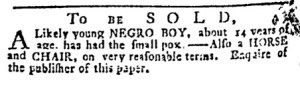
“TO BE SOLD, A Likely young NEGRO BOY, about 14 years of age.”

On September 5, 1775, Mary Katharine Goddard, the printer of the Maryland Journal, and the Baltimore Advertiser, published a two-page Postscript to the Baltimore Journal, &c. to supplement the news and other content that appeared in the standard edition.  It appeared a day ahead of the weekly edition.  Goddard apparently believed that she had news that could not wait as well as not enough space to print it all, making the Postscript necessary.  The first page of the supplement featured news from New York and Watertown, Massachusetts, in a larger font, while the second page consisted almost entirely of news from the “PROVINCIAL CONVENTION” held in Annapolis in a smaller font.  A note preceding the headline indicated that coverage was “Continued from our last.”  Even devoting an entire page in smaller font to that news did not allow Goddard to print all of it.  A note at the end promised, “To be continued.”

That left just enough space for Goddard to insert one advertisement.  An advertisement about a “Likely young NEGRO BOY” and a “HORSE and CHAIR” (a kind of carriage) that ran in the previous issue was the right length to complete the final column on the second page of the Postscript.  It did not provide much information about the enslaved young man, noting only that he was “about 14 years old” and “has had the small pox” so he would not contract that disease again.  Interested parties should “Enquire of the publisher of this paper” the advertisement instructed.  Like other printers who published newspapers from New England to Georgia, Goddard not only disseminated advertisements about enslaved people but also served as a broker who facilitated sales when those advertisements directed readers to learn more at the printing office.  In this instance, publishing news from Maryland’s provincial convention meant greater circulation for an advertisement offering an enslaved youth for sale.  That advertisement ran once again in the standard issue the next day, placing it before the eyes of readers with greater frequency than any other notices in that newspaper.  Even as the provincial convention met to discuss how to defend the liberties of colonizers and the Maryland Journal carried the news, the newspaper also worked to constrain the freedom of enslaved people, including one “Likely young NEGRO BOY” in particular.

January 5

Who was the subject of an advertisement in a colonial American newspaper 250 years ago today?

Supplement to the South-Carolina Gazette and Country Journal (January 5, 1775).

“Several valuable NEGROES.”

The first week of 1775 was a busy one in Charles Crouch’s printing office “on the Bay, the Corner of Elliott-street” in Charleston.  Crouch published the South-Carolina Gazette and Country Journal on Tuesday, January 3, distributing it to subscribers on the usual day.  The standard four-page issue, however, could not contain all the content that Crouch received for that edition.  Accordingly, he released a two-page supplement, composed entirely of advertisements, on the same day.  Yet Crouch’s press was not finished with the “freshest Advices, both Foreign and Domestic,” for the week.  Two days later, a two-page Supplement to the South-Carolina Gazette and Country Journal carried both news and advertising.  It featured updates from Boston, New York, and Philadelphia, as well as local news.  Advertising appeared on both sides of the broadsheet, accounting for just under half of the content.  Many of those advertisements ran in the standard edition or its supplement just two days earlier.  Thanks to the news that Crouch determined to publish immediately rather than wait nearly a week for the next issue, all the advertisements in the January 5 supplement circulated sooner than anticipated.

Initially, I did not notice that Crouch published the second supplement on January 5 rather than January 3.  Both supplements have been cataloged with the standard edition for that week in the database of digitized eighteenth-century newspapers I consult for this project.  It seemed strange to have two two-page supplements rather than one four-page supplement on a single day.  Although uncommon, that arrangement was not unknown, especially when a printer received breaking news after the supplement went to press.  When I downloaded the standard issue and the supplements, I was in enough of a hurry to move on to other tasks that I did not look closely enough at the mastheads to spot “THURSDAY, JANUARY 5” instead of “TUESDAY, JANUARY 3” on the second supplement.  I noticed only later when I worked more intensively with the advertisements, questioning why John Grafton’s advertisement ran twice on the same day.  On closer inspection, I discovered that it made its second appearance in the January 5 supplement.  I could have been frustrated that the database did not include a separate entry for the January 5 supplement, but I recognized that I had overlooked the date in the masthead more than once when working with the file I downloaded.  My own lack of attention to detail had almost led me into attributing incorrect dates to notices compiled for the Slavery Adverts 250 Project (including the advertisement featured above).  This incident served as a good reminder to work carefully with primary sources, including digitized primary sources, because minor errors do happen no matter how carefully and conscientiously catalogers, archivists, librarians, historians, and others go about the work of making documents more widely accessible.

October 15

What was advertised in a colonial American newspaper 250 years ago today?

Massachusetts Gazette and Boston Weekly News-Letter (October 15, 1772).

“WANTED immediately, a Wet-Nurse.”

Richard Draper had too much content to publish all of it in the October 15, 1772, edition of the Massachusetts Gazette and Boston Weekly News-Letter.  He remedied the situation, in part, by printing and distributing a supplement on a smaller sheet.  That supplement included additional news, but no advertising.  Even with the supplement, Draper did not have enough space for all the news and advertising received in the printing office.  A note at the bottom of the final column on the third page instructed readers to “See SUPPLEMENT” and advised that “Other Articles and Advertisements must be defer’d.”

Why insert such a note on the third page instead of placing it at the end of the final column on the last page?  The process of printing newspapers on a manually-operated press provides an explanation.  Like most other newspapers from the era of the American Revolution, a standard issue of the Massachusetts Gazette and Boston Weekly News-Letter consisted of four pages created by printing two pages on each side of a broadsheet and folding it in half.  Printers usually set the type and printed the first and fourth pages on one side of the sheet.  After it dried, they printed the second and third pages on the other side.  That resulted in the latest news often appearing inside the newspaper rather than on the front page.  That also meant that the last portion of the newspaper arranged by the compositor was the third page, not the final page.  That being the case, announcements about supplements and omitted materials usually appeared on the third page.

Draper did manage to include one additional advertisement in the standard issue for October 15 rather than deferring it for a week.  The urgency of the notice may have convinced him to make a special effort to include it.  “WANTED immediately,” the advertisement proclaimed, “a Wet-Nurse, with a young Breast of Milk, that can be well Recommended, to suckle a Child in a Family: Enquire of the Printer.”  That notice ran in the right margin of the third page, almost the entire length of an extensive advertisement that listed merchandise stocked by John Barrett and Sons at their store “near the MILL-BRIDGE” in Boston.  With some creative graphic design, Draper squeezed an advertisement seeking a wet nurse, a notice that likely arrived late to the printing office, into that issue.  In so doing, he adapted to the technology of the printing press while providing a special service to that advertiser.

August 10

What was advertised in a colonial American newspaper 250 years ago today?

South-Carolina Gazette Extraordinary (August 10, 1772).

“ADVERTISEMENTS of some Consequence to the Parties, are brought in so late, that the immediate Insertion of them in the GAZETTE, would delay the Publication thereof.”

Thomas Powell and Company aimed to provide the best possible service for advertisers who chose the South-Carolina Gazette, such as disseminating their notices to the public as quickly as possible.  That included publishing supplements when necessary.  With a few exceptions, most American newspapers published before the Revolution consisted of a single weekly issue.  Powell, Hughes, and Company circulated a new edition of the South-Carolina Gazette on Thursdays in 1772.  Less than two weeks after the death of Edward Hughes, Powell and Company distributed a South-Carolina Gazette Extraordinary on Monday, August 10.

A notice at the top of the first column on the first page explained the purpose of the supplement.  “[I]t frequently happens,” Powell and Company declared, “that ADVERTISEMENTS of some Consequence to the Parties, are brought in so late, that the immediate Insertion of them in the GAZETTE would delay the Publication thereof beyond the stated Day.”  In addition, “others are omitted to make Room for fresh Intelligence” or news just arrived in the printing office. Powell and Company recognized that they had a duty to both subscribers and advertisers, prompting them to “NOW assure the Public, that in EITHER of the above Cases … they will issue a GAZETTE EXTRAORDINARY, as soon after their stated Day as possible.”  Publishing supplements minimized delays for both news and paid notices, allowing Powell and Company to fulfill “their Duty, to contribute … to the ENTERTAINMENT, as well as EMOLUMENT, of that Public which so generously supports them.”

The four-page supplement contained both advertising and news, divided nearly evenly between the two.  The advertisements included five that offered rewards for the capture and return of enslaved men and women who liberated themselves as well as several others promoting consumer goods and services.  Powell and Company inserted a heading for “New Advertisements” on all three pages that carried paid notices, though not all advertisements in the supplement appeared for the first time.  Despite these efforts, Powell and Company suggested that more advertising and news flooded into their printing office than would fit in the supplement.  That may have been a strategy to underscore the viability of the newspaper following the death of one of the partners.  A brief notice at the bottom of final column on the third page, the last item the compositor would have locked into place for the entire supplement, advised that “Several NEW ADVERTISEMENTS, &c. now omitted, shall be inserted in Thursday’s Gazette.”  According to their notice on the first page, Powell and Company hoped “to merit a CONTINUANCE” of the support they already received.  Hughes no longer participated in publishing the newspaper, yet, the notice suggested, subscribers, advertisers, and the general public could depend on the South-Carolina Gazette being in good hands with Powell.

August 7

Who was the subject of an advertisement in a colonial American newspaper 250 years ago today?

Addition to the South-Carolina Gazette and Country Journal (August 7, 1772).

“TWO HUNDRED CHOICE Gambia SLAVES.”

Charles Crouch usually distributed new issues of the South-Carolina Gazette and Country Journal on Tuesdays in 1772.  Like many other printers, however, he sometimes issued a supplement, postscript, or addition on another day, disseminating news more quickly than waiting to print the next weekly edition of his newspaper.  That was the case in early August.  A standard four-page issue came out as scheduled on Tuesday, August 4, followed by a two-page Additionon Friday, August 7.  Crouch either had too much news to fit in the standard issue at the time it went to press or he acquired news that he felt could not wait nearly a week shortly after the usual publication day.  After all, his newspaper competed with two others in Charleston.

Most of the Addition consisted of news from London.  The final column included a few items of local news as well as shipping news from the customs house.  That left room for six short advertisements, three of them concerning ships seeking passengers and freight for trips to Philadelphia, Boston, and London.  Another advertisement advised readers of an upcoming sale of “TWO HUNDRED CHOICE Gambia SLAVES, Mostly MEN and WOMEN,” scheduled for August 18.  William Somarsall asserted that the captives “JUST arrived (after a short Passage) in the Sloop THOMAS & ANTHONY, SOLOMON GIBBS, Master.”  The dateline read “Charles Town, August 7, 1772.”  An entry for “Sloop Thomas & Anthony, Solomon Gibbs,” arriving from St. Kitts on August 6 appeared among the shipping news.  The vessel apparently visited at least one port in the Caribbean before continuing to Charleston.

The publication of an Addition to the South-Carolina Gazette and Country Journal certainly served the interests of participants in the transatlantic slave trade.  Of the six advertisements in the Addition, four previously ran in the standard issue on August 4.  The midweek supplement provided an opportunity for Somarsall to promote an auction of enslaved men and women as soon as the Thomas and Anthony arrived in port.  He wasted no time in submitting copy to Crouch’s printing office, rewarded with immediate publication.  He ran the same advertisement three days later in the South-Carolina and American General Gazette … and a South-Carolina Gazette Extraordinary that circulated three days before the printers distributed the standard issue for that week on August 13.  The appearance of a supplement once again facilitated the slave trade in addition to sharing news and other advertisements with colonizers.

April 27

What was advertised in a colonial American newspaper 250 years ago today?

South-Carolina Gazette and Country Journal Extraordinary (April 27, 1771).

“He carries on his Business as usual, at his Shop in Broad-Street.”

A standard issue for most newspapers published in colonial America consisted of four pages created by printing two pages on each side of a broadsheet and then folding it in half.  This did not always provide sufficient space for all of the news and advertising on hand, so printers adopted a variety of strategies for producing supplements.  In the past week, the Adverts 250 Project has examined some of the decisions made by printers who had too much content and not enough space.  On April 24, 1771, Robert Wells, printer of the South-Carolina and American General Gazette, distributed a smaller sheet that consisted entirely of advertising along with the standard issue for the week.  The following day, Richard Draper, printer of the Massachusetts Gazette and Boston Weekly News-Letter, inserted a note that “for want of Room” several advertisements “must be deferred till next Week.”  He did, however, issue a supplement that contained “Fresh London Articles” that he received from the captain of a ship that just arrived in port.  In that supplement, Draper scooped other newspapers.

Charles Crouch, printer of the South-Carolina Gazette and Country Journal, took another approach.  On April 27, he published an Extraordinary containing both news and advertising that served as a midweek supplement to his newspaper.  Prior to the American Revolution, most newspapers operated on a weekly publication schedule.  When printers did publish supplements, they usually did so on the same day as the standard issue and distributed them together.  Both Draper and Wells did so with their supplements.  On occasion, however, printers produced supplements, extraordinaries, or postscripts midway through the week.  In such instances, supplements consisted of either news or news and advertising, but rarely just advertising.  Typically, breaking news justified publishing and disseminating midweek supplements, but printers determined that advertising supplements could wait until the usual publication day.

Crouch devoted an entire half sheet to his two-page supplement, unlike Draper and Wells who each opted to conserve resources with smaller sheets.  Crouch could have devised a smaller sheet that featured only news accounts.  Instead, he published news and advertising, further disseminating notices about consumer goods and services, real estate for sale, and ships preparing to sail to England and other colonies.  Did those advertisers pay for the additional insertion?  Or did those advertisements appear gratis?  Answering those questions requires consulting Crouch’s ledgers or other sources beyond the newspaper.  Either way, the midweek supplement increased the amount of advertising (and news) circulating in South Carolina near the end of April 1771.

April 24

What was advertised in a colonial American newspaper 250 years ago today?

Detail of supplemental page from the South-Carolina and American General Gazette (April 24, 1771).

“His STOCK of GOODS.”

Robert Wells, printer of the South-Carolina and American General Gazette, had more content than would fit in the standard issue on April 24, 1771.  Wells devoted more than a fifth of the issue to “EUROPEAN INTELLIGENCE,” spread over two columns on the front page and continuing on the second page.  The remainder of the second page consisted of “AMERICAN INTELLIGENCE,” news drawn primarily from Boston and Newport, Rhode Island, as well as limited coverage of local events.  The shipping news from the customs house spilled over, occupying a portion of the first column of the third page.  Paid notices constituted the rest of that edition, filling just shy of ten of the sixteen columns.  Even as he gave more space to advertising than to news, Wells did not have room for all of the paid notices submitted to his printing office.

To address that problem, Wells did what many other early American printers did in similar circumstances.  He distributed an additional sheet that consisted entirely of advertisements, more than two dozen of them.  One in four of those advertisements described enslaved men and women for sale or offered rewards for the capture ad return of those who liberated themselves.  While digital images of the standard issue and the supplementary pages do not indicate precise dimensions, they do reveal that Wells used a smaller sheet (and fewer columns per page) for the additional notices.  Wells depended on revenue generated from advertising to continue publication of the South-Carolina and American General Gazette, but he also carefully budgeted how much paper he used in printing advertisements.  Rather than distribute an additional half sheet that would have allowed him to print more news reprinted from other newspapers Wells instead selected a smaller sheet with room for the paid notices and nothing else.  He carefully balanced the proportion of news and advertising as well as the revenues garnered from adverting and the costs of publishing those notices.

April 23

What was advertised in a colonial American newspaper 250 years ago today?

Apr 23 - 4:23:1770 Boston Evening-Post
Supplement to the Boston Evening-Post (April 23, 1770).

“CHOCOLATE warranted good.”

T. and J. Fleet, printers of the Boston Evening-Post, had far more content to publish than usual when they prepared the April 23, 1770, edition.  Issued once a week, their newspaper, like most others in colonial America, typically consisted of four pages created by printed two pages on each side of a broadsheet and folding it in half.  When printers had sufficient surplus content, they often distributed supplements, sometimes an additional four pages but more commonly two pages that required only half a broadsheet.  The Fleets certainly had sufficient surplus content to justify publishing a supplement.  Indeed, two supplements accompanied the April 23 edition of the Boston Evening-Post.

The first contained “Fresh Advices” that had “ARRIVED here last Week from LONDON.”  The captains of several vessels had delivered “the Public Prints” through February 24.  The Fleets extracted several items to republish from London’s newspapers.  This supplement consisted of only two pages printed on a broadsheet the same size as the standard issue of the Boston Evening-Post.  The second supplement, however, consisted of four pages printed on a smaller sheet. The first three pages delivered “Mr. Kent’s Vindications of his Character, from the Aspersions of Dr. Gardiner and others, in several late News-Papers.”  Given the size of the page, these “Vindications” appeared in two columns of a different width than the three columns per page from the standard issue.

Publishing the “Vindications” required only three pages.  The Fleets filled the remaining space with advertisements that ran in the Boston Evening-Post in previous weeks.  Rather than reset the type to achieve a consistent column width throughout the supplement they instead conserved time and effort through an unusual format for the page.  Two columns of advertisements filled most of the space.  For the remainder, they rotated advertisements to fit them into the space remaining on the right side of the page, creating a third column with text that ran in a different direction.

The Fleets did not improvise this strategy.  Colonial printers resorted to it on those occasions that they issued supplements of different sizes or when they could not acquire broadsheets of the usual size for their standard issues.  Doing so maximized the amount of content they could deliver while generating advertising revenues important to the continued publication of their newspapers.

August 30

What was advertised in a colonial American newspaper 250 years ago today?

Aug 30 - 8:30:1769 South-Carolina and American General Gazette
South-Carolina and American General Gazette (August 30, 1769).

To be sold …”

Like most other newspaper published in the colonial era, a standard issue of the South-Carolina and American General Gazette consisted of four pages created by printing two pages on each side of a broadsheet and folding it in half. Robert Wells, the printer, distributed a four-page issue once a week. On occasion, however, Wells had too much content – news, editorials, advertisements, to include in the standard issue. In order to publish the latest intelligence and paid notices in a timely manner, he supplemented the standard issue with an additional sheet.

Such was the case with the August 30, 1769, edition of the South-Carolina and American General Gazette. It consisted of six pages, the standard four-page issue and another sheet with one page printed on either side. When other printers resorted to this means of increasing the length of an issue, many tended to distribute an additional half sheet that included a masthead that read “Supplement to the …” The half sheet thus matched the size of rest of the issue. It maintained the same format as the standard issue. Wells, on the other hand, distributed his supplemental pages on smaller sheets.

Consider the format of a standard issue of the South-Carolina and American General Gazette. Four columns spanned the page. The supplemental sheet that accompanied the August 30 edition did not bear a separate masthead. Instead, the title ran across the top, as it did on every page, and the numbering continued uninterrupted, making a date unnecessary. The additional sheet featured two columns that ran vertically and a narrower third column that rotated the text of the advertisements ninety degrees in order to make them fit on the page. Why do this? It avoided the time and effort of resetting type for notices that previously appeared in other issues. Wells and the compositor devised a system that allowed them to cover every square inch of the supplementary sheet with content. It avoided wasting any paper when they did not have enough content to fill an entire half sheet, especially important now that paper was in short supply due to the import taxes levied by the Townshend Acts. The supplemental sheet did not match the rest of the issue in its appearance, but it was an efficient way to circulate all the news and advertising received in Wells’s printing office that week.

Unfortunately, working with digital surrogates for the original sources does not allow for exact measurements of the standard issue and the supplementary sheet. Accessible Archives and its counterparts do not include that sort of metadata, in large part because it would be prohibitively expense to do so. The size of both sorts of pages – the standard issue and the supplement – appear the same when viewed in digital format, even though visual evidence demonstrates that the printer used sheets of very different sizes. Digitized primary sources allow for greater accessibility, but they cannot answer every question. Scholars and others must remember that digitized sources are supplements to, rather than replacements for, the original documents.

June 16

What was advertised in a colonial American newspaper 250 years ago today?

Jun 16 - 6:16:1769 New-Hampshire Gazette
New-Hampshire Gazette (June 16, 1769).

“For … other new Advertisements, see the additional PAPER of this Day.”

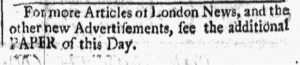
The final column on the first page of the June 16, 1769, edition of the New-Hampshire Gazette concluded with instructions to readers: “For more Articles of London News, and the other new Advertisements, see the additional PAPER of this Day.” The digitized copy that I consulted did not, however, include an “additional PAPER” for June 16. On the other hand, the digitized copy for June 9 did include a second sheet.

Regular visitors to the Adverts 250 Project may remember that the printers of the New-Hampshire Gazette experienced a disruption in their paper supply late in the spring of 1769. Instead of publishing the standard four-page issue created by printing two pages on each side of a broadsheet and folding it in half they temporarily published two-page issues on sheets of a different size. This reduced the amount of content delivered to subscribers each week from twelve to eight columns … unless the printers distributed a second sheet, like the “additional PAPER” mentioned in the June 16 edition.

I realized that the “additional PAPER” might not have survived, but I also suspected that perhaps at some point it had been separated from the June 16 edition and mistakenly attributed to another issue … especially since I knew that the June 9 issue did have a second sheet that included many “new Advertisements.” When I looked more closely at the second sheet from June 9 I discovered that the page I examined last week, including William Appleton’s book catalog, did not include any information that invalidated the date attributed to it.

The other side of the sheet, however, told a very different story. The header for the first column read “Portsmouth, June 16, 1769.” A notice about a meeting of the “Antient and Honorable Society of FREE and ACCEPTED MASONS in New-Hampshire” was dated June 14. Other advertisements bore the dates June 14 and June 15. A second news item from Portsmouth was dated June 15. None of these items could have been published in an “additional PAPER” on June 9, leading me to believe that the second broadsheet had been presented as part of the June edition in error. Most likely, it was the “additional PAPER” mentioned in the June 16 edition.

One piece of evidence undermined that conjecture. The shipping news from the customs house bore the date June 18. Had this sheet been published even later than June 16? I ultimately decided that was unlikely, especially after determining that the previous shipping news had been dated June 8. Most likely the compositor worked too quickly to update the headline for the shipping news, inserting a “1” before the “8” but not substituting whichever digit should have appeared second (most likely a “5” or “6” that could have been mistaken for an “8” at a glance). Since no other issues of the New-Hampshire Gazette made reference to an “additional PAPER,” the second broadsheet associated with June 9 was almost definitely part of the June 16 edition.

This conundrum is exactly the sort of practical lesson that I like to present to my students to underscore that historians must constantly interrogate their sources, even those that seem unequivocally straightforward. When I first examined the second page attributed to the June 9 edition I expected it to be part of the June 9 edition and did not look closely enough at evidence that told a different story. Only after encountering contradictory evidence later did I notice some important details. When I do present this example to students, I will confess to them that I made a mistake the first time I worked with the page mistakenly associated with the June 9 edition, stressing that they should not be afraid to advance their arguments about the sources they consult for their projects but they must simultaneously be vigilant in their examination of those sources and willing to adjust their arguments when they encounter new evidence.