December 8

What was advertised in a colonial American newspaper 250 years ago today?

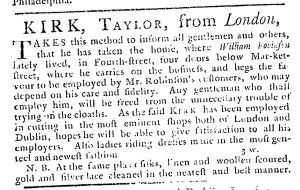
Pennsylvania Journal (December 8, 1773).

“Any gentlemen who shall employ him, will be freed from the unnecessary trouble of trying on the cloaths.”

Upon arriving in Philadelphia, “KIRK, TAYLOR, from London,” placed an advertisement in the Pennsylvania Journal to introduce himself to prospective clients.  Like so many other artisans who migrated across the Atlantic, Kirk did not have the benefit of his new community’s long familiarity with his work.  Instead, he had to establish his reputation by reporting on his prior experience serving customers in faraway places.  To that end, Kirk proclaimed that he “has been employed in cutting in the most eminent shops of London and Dublin.”  Prospective clients in the largest city in the colonies associated some level of cachet with such connections to even larger and more cosmopolitan cities.  Furthermore, his origins suggested that Kirk had special insight into the latest trends in those places, especially when he declared that he made garments “in the most genteel and newest fashion.”

When he set up shop in Philadelphia, Kirk took the house “where William Robinson lately lived” on Fourth Street.  Not only did he take over that residence, the tailor also hoped to acquire Robinson’s clientele, an efficient means of cultivating relationships in his new city.  The newcomer “begs the favour to be employed by Mr. Robinson’s customers, who may depend on his care and fidelity.”  Earning repeat business, generating word-of-mouth recommendations, and bolstering his reputation depended on attentive service and producing quality work for Robinson’s customers and anyone else who gave him a chance.  Kirk clearly communicated that he was confident in his abilities.  He was such a good tailor, he reported, that “gentlemen who shall employ him, will be freed from the unnecessary trouble of trying on the cloaths,” so precise were his measurements and sewing.  They did not need to tarry in his shop, spending unnecessary time better devoted to their own business or leisure.

Kirk aimed to capture some portion of the market for tailoring services in Philadelphia.  He devised an advertisement that gave prospective clients good reason to give him a chance and then decide for themselves if he merited more orders.  He hoped to gain some of the clients accustomed to visiting a tailoring shop at the same location, but did not entrust his fate to that circumstance alone.  Instead, he advised Robinson’s former customers and other prospective customers that he had experience in the best shops in London and Dublin, knowledge of the latest fashions, and the skills necessary “to give satisfaction to all his employers.”

October 14

What was advertised in a colonial American newspaper 250 years ago today?

Massachusetts Spy (October 14, 1773).

“The encouragement they have had … renders a pompous advertisement unnecessary.”

Although they had operated a shop in Boston for quite some time, Thomas Courtney and Son continued to describe themselves as “TAYLORS, from LONDON,” when they advertised in the October 14, 1773, edition of the Massachusetts Spy.  Like many tailors, milliners, and other artisans, they believed that associating themselves with the cosmopolitan center of the empire conferred a certain amount of cachet in the eyes of prospective customers.  The tailors placed the notice to alert the public that they moved to a new location but continued to “carry on the different branches of the Taylor and Habit making business, in the truest and most elegant manner.”

Despite trumpeting their London origins in the headline of their advertisement, Courtney and Son asserted that they did not need to publish an extensive description of the quality of their work, the exceptional customer service they provided, or any of the other appeals that often appeared in notices placed by members of the garment trades.  Their work spoke for itself, as demonstrated by the longevity of their business and the clientele they cultivated during their time in Boston.  “The encouragement they have had for six years past in the town and province,” Courtney and Sons proclaimed, “is a flattering proof of the public approbation of their integrity and abilities.”

That being the case, the tailors considered “a pompous advertisement unnecessary.”  On occasion, eighteenth-century advertisers promoted their goods and services by critiquing the kinds of marketing that appeared in the public prints.  They suggested something unsavory in the manner that many of their competitors boasted of their abilities or told elaborate stories about their merchandise.  Courtney and Son cast suspicion on the extravagant prose presented in many advertisements, implying that those advertisers oversold what they could deliver to customers.  In the process, they attempted to enlist savvy consumers in expressing the same skepticism … and demonstrating that they could not be fooled with clever marketing by giving their business to Courtney and Son.  After all, the tailors insisted, their reputation spoke for itself.  Rather than publishing overzealous appeals to prospective customers, Courtney and Sons “sincerely thank[ed] their Friends and customers for past favours” and pledged to “continue to deserve their recommendation.”  They considered their reputation essential in marketing their business.

September 4

What was advertised in a colonial American newspaper 250 years ago today?

Maryland Journal (September 4, 1773).

Advertisements omitted, will be inserted in our next.”

William Goddard quickly attracted advertisers when he commenced publication of the Maryland Journal, the first newspaper printed in Baltimore, in August 1773.  Paid notices filled four and a half columns, out of twelve total, in the third issue, but that was not all of them submitted to the printing office.  Goddard included a brief note alerting readers and, especially, advertisers who expected to see their notices in print that “Advertisements omitted, will be inserted in our next.”  Advertising represented an important revenue stream for printers, so Goddard must have been pleased with his initial success in attracting advertisers for the Maryland Journal.

For their part, advertisers from Baltimore and beyond welcomed the opportunity to disseminate information in the new publication.  Eleven of the advertisements in the September 4 edition described runaway indentured servants or runaway convict servants and offered rewards for their capture and return to their masters.  Previously, residents of Baltimore and surrounding towns resorted to the Maryland Gazette, published in Annapolis, the Virginia Gazette, published in Williamsburg, and the several newspapers published in Philadelphia to alert colonizers about runaways and encourage them to participate in surveillance of strangers to assess whether they matched the descriptions in the public prints.  The Maryland Journal buttressed the efforts of certain colonizers to use the early American press to uphold what they considered the appropriate order in their communities.

Other advertisers, including purveyors of consumer goods and services, now had a truly local alternative for promoting their businesses.  In the September 4 edition, Ewing and Hart marketed rum, wine, and spirits at their store on Gay Street, John Flanagan hawked tea, coffee, and sugar at his store on Market Street, and Nicholas Brooks promoted jewelry and prints “at the CROWN and CUSHION, in BALTIMORE.”  In addition, John Hamilton, “TAILOR and HABIT-MAKER, from GLASGOW,” introduced himself to prospective clients with an announcement that he “has opened shop in Gay-street, BALTIMORE-TOWN … where he makes mens and womens clothes in the very newest fashions.”  He highlighted his experience “having wrought for eight years past in the best shops in Britain,” hoping that readers would be impressed enough to give the newcomer a chance to build a reputation in Baltimore.  He promised to make it “his constant endeavour to give, to the utmost of his power, entire satisfaction” to his customers in return for “suitable encouragement from the generous public.”  The Maryland Journal provided an introduction to prospective customers beyond those Hamilton happened to meet in the course of his daily routine.

Other advertisers sought the advantages of placing notices in Baltimore’s first newspaper, some with advertisements that ran on September 4 and others with advertisements delayed until the next edition.  A newspaper, complete with shipping news, prices current, and advertisements, marked the port’s growing size and significance in the region.

August 22

What was advertised in a colonial American newspaper 250 years ago this week?

Maryland Journal (August 20, 1773).

“He will be always ready to convey to his partner any new fashions.”

Just a few days before William Goddard distributed the inaugural issue of the Maryland Journal, the first newspaper published in Baltimore, Grant and Garritson, “TAYLORS from PHILADELPHIA,” submitted an advertisement to the printing office on Market Street.  Their advertisement was one of twenty that ran in the first issue of the newspaper.  About half of the notices promoted consumer goods and services.  Others included legal notices, real estate opportunities, an account of a lost bundle of papers, and a description of an indentured servant who ran away from his master.  Two advertisements concerned enslaved people, one seeking a young girl to purchase and the other offering a reward for the capture and return of Prince, an enslaved man who liberated himself and managed to elude his enslaver.  All in all, the advertisements in the Maryland Journal resembled those that ran in other newspapers throughout the colonies.

Grant and Garrison’s advertisement also looked similar to notices by tailors in other newspapers.  They stated that they “will be greatly obliged to all Gentlemen who will be pleased to favour them with their commands” and they pledged that their customers “may depend on having their work done in the neatest and most fashionable manner, with care and dispatch.”  With an economy of prose, Grant and Garritson made appeals to quality, fashion, customer service, and their own skill.  As many artisans did in their notices, the tailors also emphasized their previous experience working in another location, one known for its cosmopolitanism.  Tailors and others often described themselves as “from London” or “from Paris.”  In this instance, Grant and Garritson purposefully presented themselves as “TAYLORS from PHILADELPHIA,” the largest and most cosmopolitan city in the colonies.  Yet they did not merely possess a prior connection to that major urban port.  The tailors explained in a note at the end of their advertisement that Grant “resides and carries on the business in Philadelphia.”  That being the case, “he will be always ready to convey to his partner any new fashions, either in making or trimmings.”  Tailors, seamstresses, milliners, and others in the garment trades in Philadelphia and other port cities eagerly awaited news about new fashions from Europe.  Grant and Garritson provided a direct pipeline for disseminating that information to their clients in Baltimore, making sure that they kept pace with all the latest developments and perhaps even ahead of the curve compared to others colonizers who did not have tailors with such beneficial networks.  As Baltimore gained in prominence as a port and a center of commerce, Grant and Garrison offered their services in keeping their clients advised of the latest fashions so they could demonstrate their own influence.

December 12

What was advertised in a colonial American newspaper 250 years ago today?

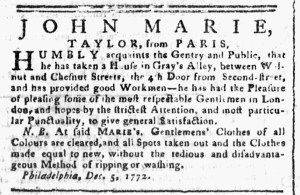
Pennsylvania Chronicle (December 12, 1772).

“He has had the Pleasure of pleasing some of the most respectable Gentlemen in London.”

John Marie, a tailor, wanted the better sort to know that he was well qualified to serve them at the shop he ran out of his house in Gray’s Alley in Philadelphia.  In an advertisement in the December 12, 1772, edition of the Pennsylvania Chronicle, he introduced himself as a “TAYLOR, from PARIS.”  He intended that his connection to one of the most cosmopolitan cities in Europe, a city where the fashionable often set tastes adopted in London, the most cosmopolitan city in the British Empire, would recommend him to genteel consumers in the largest and one of the most cosmopolitan cities in the colonies.  He made clear that he sought a particular kind of client by addressing “the Gentry and Public.”  Consumers and tailor would mutually benefit from their association as Marie enhanced the appearances of his clients and those clients gained the cachet of being dressed by a French tailor.

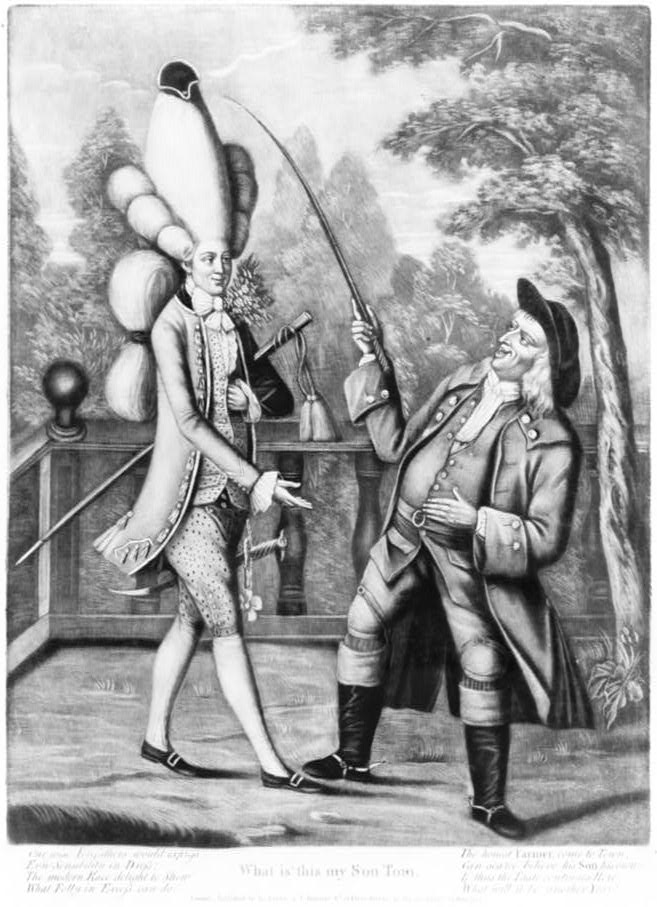
To demonstrate that he was prepared to work with the local gentry, Marie heralded his previous experience.  The tailor proclaimed that he “has had the Pleasure of pleasing some of the most respectable Gentlemen in London,” though he was too discreet to mention names.  That he served “respectable Gentlemen” suggested that he kept them outfitted according to the latest styles but did not resort to anything too frivolous or outrageous.  Prospective clients could depend on him dressing them well without transforming them into the macaronis who were the target of so much derision in both London and Philadelphia in the 1770s.  In “Fashion and the Culture Wars of Revolutionary Philadelphia,” Kate Haulman explains that the term macaroni “applied to elaborately powdered, ruffled, and corseted men of fashion” whose “suits were opulent and closely cut, with incredibly slim silhouettes.”[1]  A series of prints published in London depicted all sorts of men, “from farmers to barristers,” as macaronis.  Thus, Haulman argues, “macaroni could apply to any man who followed fashion to ape high status.”[2]  Marie suggested that he did not seek to serve such pretenders.  The gentry in Philadelphia could depend on him to dress them as “respectable Gentlemen,” just as he had done for his clients in London.

Print depicting a macaroni and his perplexed father. “What is this my Son Tom” (London: R. Sayer and J. Bennett, 1774). Courtesy Library of Congress.

[1] Kate Haulman, “Fashion and the Culture Wars of Revolutionary Philadelphia,” William and Mary Quarterly, 3rd ser., 62, no. 4 (October 2005): 635

[2] Haulman, “Fashion and the Culture Wars,” 636.

August 4

What was advertised in a colonial America newspaper 250 years ago this week?

Maryland Gazette (August 1, 1771).

“Has been regularly bred to the tailoring Trade in the most capital house for that Business.”

James Logan, a tailor, was an outsider when he arrived in Annapolis.  Like many other artisans who migrated across the Atlantic, he introduced himself to his new community (and prospective clients) in a newspaper advertisement that included an account of his credentials.  Until he had an opportunity to establish a reputation in his new home, he relied on his training and experience to recommend him to potential customers.

Logan’s advertisement ran in the August 4, 1771, edition of the Maryland Gazette.  He informed readers that “not only has [he] been regularly bred to the tailoring Trade in the most capital House for that Business, in the City of Cork, but also worked for a considerable Time with much Applause, with most eminent Masters in England and Ireland.”  Having worked with “eminent Masters” enhanced his training, but also testified to a competence that others who followed his occupation recognized in Logan.  Those experiences prepared him to pursue “his Trade in all it’s various Branches,” capable of completing any task requested by clients in his new city “to give the utmost Satisfaction.”  He also leveraged his connections to “the most capital House” in Cork and “eminent Masters in England and Ireland” to suggest a certain amount of cachet associated with hiring him.

The tailor also sought to convince prospective customers of his commitment to his craft combined with his desire to serve them.  He trumpeted his “superior Ability” and in the same breath promised “constant Adherence to the due Assiduity highly necessary in the Execution” of his new undertaking.  Even more verbose than many artisans who advertised in colonial newspapers, Logan aimed to make himself memorable to readers not yet familiar with the garments he made.  For the moment, words by necessity substituted for the reputation that he hoped to cultivate in Annapolis as he built his clientele.

June 2

What was advertised in a colonial American newspaper 250 years ago this week?

Maryland Gazette (May 30, 1771).

“The newest and neatest Fashion, either in Europe or America.”

In the spring of 1771, Peter Sinnott, a “TAYLOR, from Dublin,” introduced himself to the residents of Annapolis in an advertisement in the Maryland Gazette.  He advised prospective clients, both “Gentlemen” and “Ladies,” that he “carries on his Trade in all its Branches.”  The tailor also pledged that his customers “may depend on having their Cloaths well made.”  Like many other artisans, Sinnott incorporated the combination of quality, skill, and expertise into his newspaper notices.

He also included an appeal to fashion, another common marketing strategy for tailors, milliners, and others who made garments.  Sinnott proclaimed that he produced clothing “in the newest and neatest Fashion, either in Europe or America.”  In so doing, he demonstrated that he expected anxieties about wearing the latest styles resonated even in smaller ports.  Simultaneously, he attempted to stoke those anxieties.  Annapolis was not nearly as large as Boston, Charleston, New York, or Philadelphia, but that did not mean that consumers there could not be as cosmopolitan in their appearances as their counterparts in those major urban ports.  Yet that was not the extent of the promise that Sinnott made.  His clients in Annapolis could not only keep pace with fashionable gentlemen and ladies throughout the colonies but also with trendsetters on the other side of the Atlantic.

Sinnott realized that it would take time to establish his reputation and cultivate a clientele for his garments.  In order to earn a living while he did so, he also promoted an ancillary service, declaring that he “scours and cleans Cloaths in a superior Manner than has hitherto been done in this Place.”  Furthermore, he had perfected a method for “taking Spots and Stains out of Scarlet Cloth.”  Each time he interacted with clients who hired him to clean their garments, Sinnott had an opportunity to offer his services as a tailor.  One branch of his business supported the other, possibly resulting in new commissions.

In a short advertisement, Sinnott presented “the PUBLICK” with several reasons to him.  He emphasized his skill and the quality of his garments while reassuring prospective clients that he would outfit them in the latest styles.  He also provided additional services for the benefit of his clients.  As Sinnott’s advertisement demonstrates, eighteenth-century newspaper notices did not merely announce the availability of consumer goods and services.  Instead, advertisers constructed appeals intended to incite demand and convince readers to visit their shops.

May 3

What was advertised in a colonial American newspaper 250 years ago today?

New-Hampshire Gazette (May 3, 1771).

“Ladies Riding Dresses made at Prices in Proportion to the above.”

Edward Griffiths, a tailor from London who migrated to Portsmouth, advertised his services in the May 3, 1771, edition of the New-Hampshire Gazette.  Like many other artisans, he promised “reasonable Rates” for his work.  He did not, however, expect prospective clients to take his word.  Instead, he published a list of what he charged for more than half a dozen items.  A “lappeled Suit,” for instance, cost one pound and eight shillings, as did a “half trimmed Suit.”  A “frock Suit” was slightly less expensive at one pound and four shillings.  Three more items – a pair of breeches, a jacket with sleeves, and a jacket with lapels – all cost four shillings and eight pence.  In contrast, Griffiths charged only four shillings for a jacket without sleeves.  In addition, he made and sold “Ladies Riding Dresses … at Prices in Proportion” to those enumerated in his advertisement.

Prospective clients knew what they should expect to pay even before they visited Griffiths’s shop.  They could assess for themselves whether he did indeed charge “the most reasonable Rates” for his garments.  Furthermore, the tailor facilitated comparison shopping.  Consumers who previously paid other tailors more for the same items could recognize a bargain among his list of prices.  That depended, however, on Griffiths actually setting prices low enough to survive such scrutiny.  Merely naming prices in his advertisement did not necessarily guarantee that he would attract customers, especially if Griffiths misjudged the local market.  This strategy also limited his ability to haggle with customers.  He could still offer discounts at the time of sale, but the published prices prevented him from setting rates any higher on the spot and then allowing clients to feel as though they negotiated significant bargains.  Providing the list of prices in his advertisement had advantages and disadvantages.  Griffiths apparently felt confident enough in his prices that he believed the advantages outweighed the disadvantages.

November 2

What was advertised in a colonial American newspaper 250 years ago today?

New-Hampshire Gazette (November 2, 1770).

“Faxson will work very cheap for Cash or other good Pay.”

In the early 1770s, Jospeh Bass sold a variety of goods at his shop next door to the printing office in Portsmouth.  He opened an advertisement in the November 2, 1770, edition of the New-Hampshire Gazette by noting that he offered his wares “CHEAP for CASH,” a common refrain among shopkeepers from New England to Georgia.  Many specified that they desired cash payments because they had already extended generous amounts of credit to their customers.  Indeed, credit helped make possible the consumer revolution of the eighteenth century, but it also often put retailers and other suppliers of goods and services in precarious positions.  In the same issue that Bass advertised his merchandise, Jacob Treadwell promoted a “General ASSORTMENT of GOODS, at the very lowest Price for Cash.”  William Torrey sold loaf sugar and molasses “for Cash only.”

Yet cash and credit were not the only means of buying and selling goods available to colonists.  Many continued to barter.  James McMaster and Company, for instance, placed a notice seeking pot ash and flax seed.  In exchange, they gave “Cash, or English-Goods,” allowing those who did business with them to select from among textiles, housewares, and hardware in stock at their store.  Christopher Faxson, a tailor, also inserted an advertisement in the same edition of the New-Hampshire Gazette.  He stated that he charged “sixteen Shillings Lawful Money” for “a plain Suit of Cloaths,” but he did not insist on cash like some of the other advertisers.  Instead, he advised prospective customers that he “will work very cheap for Cash or other good Pay.”  Faxson signaled that he would accept a variety of forms of payment, such as shop goods or produce, from clients willing to negotiate on terms.  Most advertisers preferred cash or credit for their transactions with customers, but others continued to present barter as an option, likely making for interesting bookkeeping practices.

June 16

What was advertised in a colonial American newspaper 250 years ago today?

Jun 16 - 6:16:1770 Providence Gazette
Providence Gazette (June 16, 1770).

They may depend on having their Commands executed after the newest and most genteel Fashions.”

When Daniel Stillwell, a tailor, placed an advertisement in the June 16, 1770, edition of the Providence Gazette, he made one of the most common and important appeals deployed by colonists who followed his trade.  He pledged that clients “may depend on having their Commands executed after the newest and most genteel Fashions.”  Tailors and others in the garment trades often made appeals to price, quality, and fashion in their advertisements.  Stillwell, like other tailors, believed that price and quality might not have mattered much to those who wished for their clothing to communicate their gentility if their garments, trimmings, and accessories did not actually achieve the desired purpose.  Reasonable prices and good quality were no substitute for making the right impression.  Stillwell’s work as a tailor required a special kind of expertise beyond measuring, cutting, and sewing.  He had to be a keen observer of changing tastes and trends so he could deliver “the newest and most genteel Fashions” to his clients.

To that end, Stillwell informed prospective customers that he “has had great Opportunities of seeing the different Methods of working.”  Although he did not elaborate on those experiences, this statement suggested to readers that Stillwell refused to become stagnant in his trade.  Rather than learning one method or technique and then relying on it exclusively, he consulted with other tailors and then incorporated new and different techniques, further enhancing his skill.  In so doing, he joined the many artisans who asserted that their skill and experience prepared them to “give Satisfaction” to those who employed them or purchased the wares they produced.  Stillwell was no novice; instead, he “carries on his Business in all its Branches,” proficiently doing so because of the care he had taken in “seeing the different Methods of working.” Simply observing current fashions was not sufficient for someone in his trade who was unable to replicate them.  Stillwell sought to assure prospective clients that he possessed two kinds of knowledge necessary for serving them, a discerning knowledge of the latest styles and a thorough knowledge of the methods of his trade that would allow him to outfit customers accordingly.