February 16

What was advertised in a colonial American newspaper 250 years ago today?

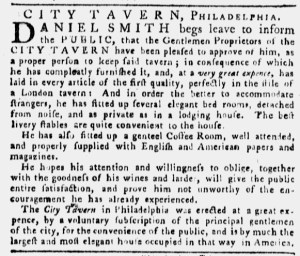
Pennsylvania Gazette (February 16, 1774).

“Perfectly in the stile of a London tavern.”

In February 1774, Daniel Smith took to the pages of the Pennsylvania Gazette and the Pennsylvania Packet to promote his latest enterprise, the City Tavern in Philadelphia.  Residents of the urban port had witnessed the building and marketing of the tavern.  As Smith explained, the building “was erected at a great expence, by a voluntary subscription of the principal gentlemen of the city.”  He billed it as “the largest and most elegant house in that way,” meaning a tavern and inn, “in America.”  The previous summer, the proprietors ran an advertisement seeking a tavernkeeper with “an active, obliging disposition” to rent the building, still under construction with completion expected by September, and operate it “for the convenience and credit of the city.”  Those “Gentlemen Proprietors” wanted the largest and most cosmopolitan city in the colonies to have a tavern that rivaled any found in London.

Smith asserted that he achieved that goal, doing so “at a very great expence.”  He proclaimed that he furnished the building and stocked the storerooms with every necessity.  He “laid in every article of the first quality, perfectly in the stile of a London tavern,” just as envisioned by the affluent subscribers who made the City Tavern one of their projects for improving the bustling urban port and enhancing the city’s reputation throughout the British Atlantic world.  The amenities included a “genteel Coffee Room” where merchants and others could socialize and conduct business.  He “supplied English and American papers and magazines” for their entertainment, but also so they could track the shipping news, prices current, and current events that had an impact on their businesses.  Perhaps his subscriptions included the new Royal American Magazine, the only magazine published in the colonies at the time, demonstrating to his patrons the efforts he made to provide the latest and most interesting publications.  For “strangers” or visitors to the city, Smith “fitted up several elegant bed rooms, detached from noise,” and the “best livery stables,” located “quite convenient to the house.”  Smith expected that all those features, along with “the goodness of his wines and larder,” would “give the public entire satisfaction.”

The City Tavern quickly became a popular meeting place, especially as the imperial crisis intensified.  In addition to merchants and the local gentry frequenting the establishment as part of their everyday routines, concerned citizens met there to debate and discuss politics.  In May 1774, just three months after Smith ran his advertisement, more than two hundred of them gathered at the City Tavern to determine how to respond to messages from Boston in the wake of the Boston Port Act that closed the port until the colonizers paid for the tea destroyed during the Boston Tea Party.  When the First Continental Congress met in Philadelphia in September and October 1774, many influential leaders from throughout the colonies dined and drank at the City Tavern.  John Adams praised it as “the most genteel [tavern] in America.”[1]

**********

[1] See entry for August 29, 1774, in John Adams diary 21, 15 August – 3 September 1774 [electronic edition]. Adams Family Papers: An Electronic Archive. Massachusetts Historical Society. http://www.masshist.org/digitaladams/

October 10

What was advertised in a colonial American newspaper 250 years ago this week?

Rivington’ New-York Gazetteer (October 7, 1773).

“The usual genteel accommodation for set CLUBS, and other private companies large or small.”

Samuel Fraunces (or Samuel Francis) was one of the most prominent American tavernkeepers and restaurateurs in the late eighteenth century.  He remains famous today, in part because Fraunces Tavern at 54 Pearl Street in New York City continues to welcome visitors in a building listed on the National Register of Historic Places.  A tavern and restaurant occupy the first floor and the Sons of the Revolution in the State of New York operate a museum on the second and third floors.

Fraunces frequently advertised during the era of the American Revolution.  In the fall of 1773, for instance, he inserted a notice in Rivington’s New-York Gazetteer to promote the “QUEEN’s HEAD TAVERN, Near the Exchange in Broad-street.”  The industrious entrepreneur presented a visit to the tavern as an experience that incorporated food, drink, entertainment, service, and atmosphere.  He invited “the respectable inhabitants of this city” to dine and socialize in the “large commodious room” that he outfitted for “the reception and entertainment” of his guests.  He encouraged them “to regale themselves with fine ALE of this country produce, equal to any imported,” though he also had on hand “draft, or bottled porter from London, of the first quality” as well as an assortment of wines, punch, and spirits.  Fraunces wanted his patrons to eat as well as drink, serving “beef stakes, mutton or pork chops, veal stakes or cutlets, fry’d oysters,” and other fare throughout the day and evening.

New-York Gazette and Weekly Mercury (June 13, 1772).

The tavernkeeper placed a premium on service.  In addition to his staff preparing and serving the food “in the neatest manner,” Fraunces undertook “every other necessary requisite to give general satisfaction” to his customers, “particularly, the best attendance, the most respectful behaviour, and a hearty acknowledgment of those favours” from his patrons.  Fraunces depicted the Queen’s Head Tavern as an exceptional venue, not only for “one or more persons” who wished to drink and dine together but also for “CLUBS, and other private companies large or small” who wished to hold their gatherings within the “genteel accommodation” he worked so hard to cultivate.  As an additional inducement to visit the tavern, Fraunces moved the “elegant WAX-FIGURES” (that he described in newspaper advertisements than ran a year earlier) from Vaux-Hall Garden to the tavern.  His staff included “proper attendants to shew” the wax figures at “any hour of the day or evening.”  The Queen’s Head Tavern was not just any watering hole.  Fraunces exerted great effort in marketing it as a destination.

New-York Gazette and Weekly Mercury (August 17, 1772).

July 18

What was advertised in a colonial American newspaper 250 years ago this week?

Virginia Gazette (July 15, 1773).

“He hath provided every Thing for the Accommodation of Gentlemen, their Servants, and Horses.”

Daniel Grant, the proprietor of the “INN and TAVERN, at the Sign of the Fountain” in Baltimore, expanded his advertising campaign.  That city did not yet have a newspaper, though subscriptions proposals circulated in hopes of establishing one, so the proprietor of the inn and tavern resorted to advertising in newspapers published in Annapolis and Philadelphia.  Even if Baltimore did have a newspaper at the time that Grant opened his doors to “the Publick,” he likely would have placed notices in newspapers published in other cities in the region.  Colonizers in and near Baltimore would have learned of the new inn and tavern as they traversed the streets of the city and conversed with friends and acquaintances.  Advertisements in newspapers published in Annapolis and Philadelphia, on the other hand, helped to entice readers who might travel to Baltimore.  In addition, Grant previously “kept TAVERN at the Sign of the BUCK, near PHILADELPHIA.”  Advertisements in the Pennsylvania Packet likely reached former patrons familiar with his reputation.

Prospective patrons in Williamsburg and throughout the rest of Virginia may not have been familiar with the tavern at the Sign of the Buck, unless they had happened to travel to Philadelphia, but Grant likely expected that the fact that he had experience operating a tavern would resonate with colonizers in Virginia who might have cause to venture to Baltimore.  His expression of “grateful Thanks to the Gentlemen who did him the Honour to frequent his former House” doubled as a testimonial to his experience.  Noting that he had regulars at the Sign of the Buck suggested that he provided satisfactory service that convinced patrons to return.  In his new establishment, he needed to cultivate a new clientele, both locals and travelers.  To thatend, the innkeeper and tavernkeeper invested in an advertisement in Purdie and Dixon’s Virginia Gazette, extending the reach of his marketing to readers served by that newspaper.  The copy matched what already appeared in the Maryland Gazette and the Pennsylvania Packet, promising that Grant “hath provided every Thing for the Accommodation of Gentlemen, their Servants, and Horses, in the best Manner.”  Rather than seek out food and lodging when they arrived in Baltimore, Grant wanted travelers from Virginia to anticipate staying at the Sign of the Fountain.

July 7

What was advertised in a colonial American newspaper 250 years ago today?

Pennsylvania Packet (July 7, 1773).

“To be lett, THE CITY TAVERN.”

The City Tavern became a landmark in Philadelphia during the era of the American Revolution, but in 1773 it was a new structure that awaited a tenant to oversee its operations.  An advertisement in the July 7 edition of the Pennsylvania Journal described the location “in one of the principal Streets, near the Center of the Town” and described the grand edifice, including the spacious rooms and the lofty ceilings.  Over time, the City Tavern rivaled the London Coffee House as a meeting place for merchants to socialize and conduct business.  Members of the Continental Congress dined at the City Tavern, as did delegates to the Constitutional Convention.  Notable men and women, including George and Martha Washington and John and Abigail Adams, stayed at the City Tavern.  Residents of Philadelphia and visitors to the city alike gathered, dined, and danced at the City Tavern both during the American Revolution and during the decade that Philadelphia served as the capital of the new nation.

What were the origins of such a storied venue?  Why was the “most convenient and elegant structure of its kind in America” in need of a host to run the establishment in the summer of 1773?  Some of the most elite residents of Philadelphia, the largest and most prosperous city in the colonies, determined that their growing metropolis needed “a genteel club the equal of any in England” to serve as “the center of business by day and entertainment at night.”  As the advertisement in the Pennsylvania Journal explained, “the Proprietors have built this tavern without any view of profit, but merely for the convenience and credit of the city.”  The prestige associated with the city having such an establishment was profit enough.  Samuel Powel, a prominent merchant and politician, donated the land.  Seven trustees set about raising funds by subscription, convincing fifty-three subscribers to contribute at least twenty-five pounds each.  In total, they raised more than three thousand pounds for the building.

Once construction was complete, the proprietors needed someone with an “active, obliging disposition” who would certainly “find it in his interest” to oversee operations at the new City Tavern.  They hoped to engage a tenant who would open the tavern to patrons in September.  The proprietors selected Daniel Smith.  In an advertisement in the February 14, 1774, edition of the Pennsylvania Packet, Smith promoted the “genteel Coffee Room … properly supplied with English and American papers and magazines,” the “goodness of his wines and larder,” “several elegant bed rooms, detached from noise,” and the “best livery stables.”  He set about delivering on the “stile of a London tavern” as intended by the proprietors and subscribers who first envisioned the City Tavern as a marker of Philadelphia’s cultural status.

June 3

What was advertised in a colonial American newspaper 250 years ago today?

Maryland Gazette (June 3, 1773).

“He hath opened an inn and tavern, at the sign of the Fountain … in Market-street, Baltimore.”

As summer arrived in 1773, Daniel Grant opened a new inn and tavern in Baltimore.  To attract patrons, he inserted advertisements in the Maryland Gazette, published in Annapolis, and the Pennsylvania Packet, published in Philadelphia, to supplement word-of-mouth news of his establishment in Baltimore.  That city did not yet have its own newspaper, though William Goddard had recently opened a printing office there and distributed subscription proposals for the Maryland Journal.  Even if Grant could have advertised in a local newspaper, it benefited him to alert colonizers throughout the regions served by the Maryland Gazette and the Pennsylvania Packet that they could avail themselves of his services if they had occasion to travel to Baltimore.  Besides, those newspapers were the local newspapers, at least for another few months until Goddard commenced publication of the Maryland Journal near the end of August.

As part of his marketing efforts, Grant emphasized his experience running a tavern “at the sign of the Buck, near Philadelphia.”  He extended “his most grateful thanks to the gentlemen who did mum the honour to frequent his former house.”  In addition, he declared that “it shall ever be his study to please” and “he hopes for a continuance of their favours” when they visited Baltimore.  Such sentiments communicated to those who had not previously visited the tavern “at the sign of the Buck” that Grant had successfully cultivated a clientele and would offer the same quality of service to patrons at the inn and tavern “at the sign of the Fountain … in Market-street, Baltimore.”  He pledged that “those who choose to favour him with their custom, may be assured of his best endeavours to merit their approbation.”  To that end, he promoted the “late and commodious house” that he converted into an inn and tavern and asserted that he “hath provided everything for the accommodation of gentlemen, their servants, and horses, in the best manner.”  Apparently, Grant also operated a stable or made arrangements with a nearby associate to provide hosteling services.  Whatever their needs and desires, Grant promised prospective patrons a pleasant stay at his inn and tavern.

April 20

What was advertised in a colonial American newspaper 250 years ago today?

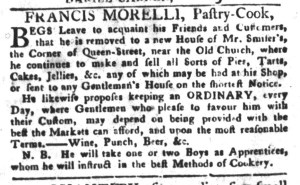
South-Carolina Gazette and Country Journal (April 20, 1773).

“He likewise proposes keeping an ORDINARY, every Day.”

When Francis Morelli, a pastry cook, moved to a new location in the spring of 1773, he informed “his Friends and Customers” in Charleston with an advertisement in the South-Carolina. Gazette and Country Journal.  He assured them that he continued to offer the same services, baking “all Sorts of Pies, Tarts, Cakes, Jellies,” and other pastries that customers could purchase at his shop or have “sent to any Gentleman’s House on the shortest Notice.”

Morelli also took the opportunity to announce that he “proposes keeping an ORDINARY, every Day, where Gentlemen who please to favour him with their Custom, may depend on being provided with the best the Markets can afford.”  He also served “Wine, Punch, Beer,” and other beverages.  The context makes clear to modern readers that Morelli served food.  The Oxford English Dictionary gives additional information about how the term “ordinary” was used in the British Atlantic world in the eighteenth century.

Three related definitions concern foods, including “customary fare; a regular daily meal or allowance of food; (hence, by extension) a fixed portion, an allowance of anything,” and “a meal regularly available at a fixed price in a restaurant, public house, tavern, etc. Formerly also: the company frequenting such a meal, the ‘table.’”  The OED describes the former as “Obsolete” and the latter as “Now chiefly historical.”

The third definition captures the term “ordinary” as used by Morelli in his advertisement: “an inn, public house, tavern, etc., where meals are provided at a fixed price; the room in such a building where this type of meal is provided.”  Similar to the other entries associated with foods and serving meals, this definition is “Now historical and archaic.”  The entry includes more than a dozen examples of the word in use, the earliest dating from 1590, as well as additional notes about its usage.  “In Britain in the 17th-18th centuries,” the entry explains, “the more expensive ordinaries were frequented by men of fashion, and the dinner was usually followed by gambling; hence the term was often used as synonymous with ‘gambling-house.’”  Another note addresses the use of the word in America: “In the U.S., the southern states, esp. Virginia, continued to use ordinary in this sense into the 19th cent., while other states used tavern.”

I plan to file away this advertisement for teaching purposes because it is such a great example of the English language as spoken and written in the eighteenth century sometimes requires “translation” when twenty-first century readers encounter “historical and archaic” terms, even when the words look familiar.  In addition, it presents an opportunity for teaching students how to use the Oxford English Dictionary as a “translation tool.”  I envision an in-class exercise in which I direct students to the entry for “ordinary” but allow them to seek out the relevant definitions (in this case 12a, 12b, and, especially, 12c) on their own before having a discussion about what we all learn from examining the various elements of those definitions provided by the OED.

March 9

What was advertised in a colonial American newspaper 250 years ago today?

Essex Gazette (March 9, 1773).

“Rendered conspicuous by an elegant Sign of KING GEORGE THE THIRD.”

In March 1773, Abraham Safford took to the pages of the Essex Gazette to inform the public that he recently opened a tavern in a “commodious House” in Salem.  He pledged that “Gentlemen and Ladies may be entertained in the best Manner, and on the most reasonable Terms.”  To aid patrons in making their way to his new establishment, Safford advised that it was “rendered conspicuous by an elegant Sign of KING GEORGE THE THIRD.”  In another advertisement in the Essex Gazette, Stephen Higginson gave his location as the “Shop opposite the King’s Arms Tavern, in SALEM.”  Both advertisements appeared in the same issue that reprinted a lengthy account of commemorations that took place in Boston on the third anniversary of the “horrid Massacre perpetrated by a Party of the 29th Regiment,” including an oration on the danger of standing armies in cities by Dr. Benjamin Church, the lighting of a lantern with panes painted to depict the Boston Massacre, and the tolling of bells.

How did Safford happen to choose the “Sign of KING GEORGE THE THIRD” to mark his location and represent his business?  Why did the proprietor of the King’s Arms Tavern continue to use that device?  Did deploying those images suggest loyalist sympathies?  Would colonizers who considered themselves patriots hesitate or even refuse to gather at those taverns?  Not necessarily.  As the imperial crisis unfolded, colonizers tended to critique Parliament and the soldiers that Parliament stationed in American cities while simultaneously embracing their British identity and the benefits of being part of such a powerful empire.  That identify included participating in a transatlantic consumer revolution and adopting fashions popular in London.  Many looked to the king to correct the excesses of Parliament, such as the Stamp Act and the Townshend Acts.  As late as July 1775, the Second Continental Congress sent the Olive Branch Petition to George III in hopes of avoiding war, though by that time John Adams and others considered it a futile gesture.  The king rejected the petition, demonstrating to colonizers that he had little interest in addressing their grievances.  In January 1776, Thomas Paine published Common Sense, a political pamphlet that advocated for independence.  His arguments included critiques “Of Monarchy and Hereditary Succession.”

Colonizers eventually identified George III as responsible for the problems within the empire, but they did not do so throughout the imperial crisis.  Instead, shifting blame from Parliament to the king was a process that occurred over a decade.  That Safford opened a tavern at the “Sign of KING GEORGE THE THIRD” in 1773 may have been a signal that he hoped the monarch would protect the liberties of the colonizers against the abuses perpetrated by Parliament, not necessarily an indication that the proprietor (or his patrons) supported loyalists over patriots.

September 8

What was advertised in a colonial American newspaper 250 years ago today?

Connecticut Courant (September 8, 1772).

“Invite all Captains of Vessels (especially from Connecticut) and Sailors.”

After moving from Stamford, Connecticut, to New York, Foster Lewis kept residents of his former home apprised of his new endeavors.  On September 8, 1772, he inserted an advertisement in the Connecticut Courant to inform readers in Hartford and other towns that he “has opened a public house near Burling-Slip, known by the name of the New England Tavern.”  He promised prospective patrons that if “they give him their Custom … they may depend upon being handsomely used.”  In other words, Lewis made hospitality a priority at the New England Tavern.  He also noted that he “provides good Stabling for Horses” for patrons who arrived in New York by land rather than by sea.

Given the tavern’s location near the waterfront in New York, Lewis addressed his advertisement to mariners, both “Captains of Vessels (especially from Connecticut) and Sailors.”  He hoped to cultivate a sense of community among customers with connections to Connecticut as well as give them an additional reason to choose his tavern over others.  In highlighting his own origins in the neighboring colony, Lewis likely intended to suggest that he exerted even greater effort in making mariners and travelers from New England, especially Connecticut, feel welcome and comfortable in his establishment.  After all, the name of the public house, the New England Tavern, testified to the character of its proprietor and patrons.

Although Lewis no longer lived and worked in Connecticut, he sought to capitalize on identifying with that colony in the advertisement he placed in the Connecticut Courant.  Rather than being treated as strangers and run-of-the-mill customers, patrons who hailed from Connecticut could expect enthusiastic service grounded in their shared connections to that colony.  Lewis apparently suspected that this marketing strategy would resonate with colonizers in Connecticut, making the effort to place his notice in a newspaper published there rather than opting for any of the newspapers published in New York.  Some readers and prospective patrons may even have known Lewis, prompting them to expect a friendly and familiar face if they visited the New England Tavern.

February 11

What was advertised in a colonial American newspaper 250 years ago this week?

Feb 11 - 2:8:1770 Massachusetts Gazette and Boston Weekly News-Letter
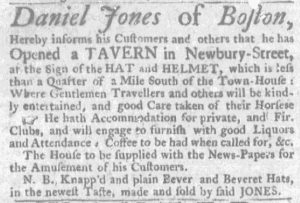
Massachusetts Gazette and Boston Weekly News-Letter (February 8, 1770).

“The House to be supplied with the News-Papers for the Amusement of his Customers.”

When Daniel Jones opened a tavern “at the Sign of the HAT and HELMET” on Newbury Street in Boston, he placed an advertisement in the February 8, 1770, edition of the Massachusetts Gazette and Boston Weekly News-Letter. He listed many amenities that he provide for “Gentlemen Travellers and others,” including coffee, “good Liquors,” and “good Care” taken of their horses. Jones also indicated, “The House to be supplied with the News-Papers for the Amusement of his Customers.”

In making that pledge, Jones revealed that he offered a service available in many eighteenth-century coffeehouses and taverns. Colonists did not need to subscribe to newspapers in order to gain access to them. Instead, they could patronize establishments that maintained subscriptions expressly for the purpose of serving their clientele. Jones stated that customers at the Hat and Helmet would be bale to read “the News-Papers,” indicating that he planned to acquire more than one publication. He likely subscribed to several local newspapers, choosing among the Boston Chronicle, the Boston Evening-Post, the Boston-Gazette, the Massachusetts Gazette and Boston Post-Boy, and the Massachusetts Gazette and Boston Weekly News-Letter. Yet he probably did not limit the selection solely to local newspapers. In addition to the New-Hampshire Gazette, the Newport Mercury, the Providence Gazette, and other newspapers published in New England, he may have subscribed to newspapers printed in New York and Philadelphia or even publications from the southern colonies or London.

Circulation numbers do not tell the entire story when it comes to the dissemination of information via the colonial press in the era of the American Revolution. Jones could have subscribed for a single copy of the Massachusetts Gazette and Boston Weekly News-Letter, yet dozens of customers at his tavern may have read the issues he made available. Some patrons may not even have read the newspaper itself but instead heard portions of it read aloud at the tavern. In both cases, newspapers had a much greater reach than the number of subscribers considered alone would indicate.

September 19

What was advertised in a colonial American newspaper 250 years ago today?

Sep 19 - 9:19:1769 Essex Gazette
Essex Gazette (September 19, 1769).

“At the Sign of the Green Dragon.”

When Henry Sanders opened a “House of Public Entertainment” in Marblehead, Massachusetts, late in the summer of 1769, he inserted an advertisement in the Essex Gazette to invited “Gentlemen, Strangers and others” to experience his hospitality. He informed prospective patrons that they could find the tavern “near the Wharf of the Hon. Robert Hooper, Esq.” In addition to naming a landmark he assumed readers found familiar, Sanders noted that “the Sign of the Green Dragon” marked the precise location.

Like many other colonial tavernkeepers, as well as a good number of shopkeepers and artisans, Sanders adopted a device to represent his business and then displayed it on a sign and incorporated it into his newspaper advertisements. Over the years, those advertisements have become the sole evidence of the existence of some of the signs on display in the streets of colonial cities and towns. Although some were memorialized in letters or diaries and others mentioned in news items when they were connected to momentous events, newspaper advertisements provide the most complete catalog of eighteenth-century shop signs.

Such signs served several important purposes in early America. Standardized street numbers had not yet been developed in the late 1760s, though some of the largest cities would begin to institute them in the final decade of the eighteenth century. Sanders did not have the option of directing “Gentlemen, Strangers and others” to a particular number on a specific street. As we have seen, he instead relied on landmarks, a wharf already familiar to prospective patrons to get them to the general vicinity and a sign that marked his exact location. Once the sign had been erected for sufficient time, locals could incorporate it into the directions they gave for finding other people and businesses. The sign also doubled as the name of his establishment and likely became a logo that visitors and passersby associated with the tavern. Whether the sign depicted a dragon that was fierce or friendly the advertisement does not reveal, but it does hint at the visual culture colonists encountered as they traversed the streets of cities and towns in the eighteenth century. Almost certainly even more signs marked all sorts of businesses than those that appear in newspapers advertisements from the period.