December 22

What was advertised in a colonial American newspaper 250 years ago today?
dec-22-12221766-boston-post-boy
Boston Post-Boy (December 22, 1766).

“A General Assortment of English Goods.”

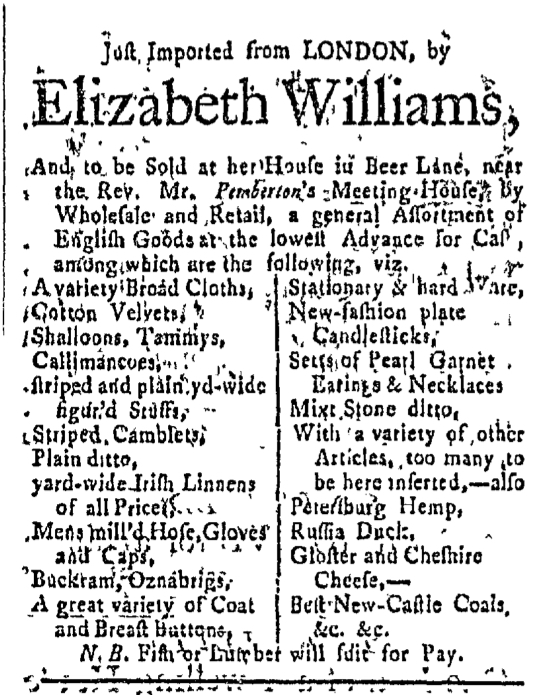
Elizabeth Williams operated a shop out of her “House in Beer Lane, near the Rev. Mr. Pemberton’s Meeting-House” in Boston. She imported “a general Assortment of English Goods” from London, including “Cotton Velvets,” Mens mill’d Hose, Gloves and Caps,” and “Stationary & hard Ware.” Although she listed approximately two dozen types of merchandise, she also carried “a variety of other Articles, to many to be here inserted.”

In promoting a variety of consumer goods recently imported from English ports, Williams advanced one of the most common marketing appeals of the eighteenth century. She offered choices to potential customers, drawing them in by naming popular items and by promising even more for shoppers to discover and examine once they were in her shop. Indeed, “variety” was important in Williams’ marketing efforts. In addition to general descriptions of her merchandise, she inserted the word into her list twice: “A variety of Broad Cloths” and “A great Variety of Coat and Breast Buttons.” Her customers would not be stuck with whatever she happened to have on hand; instead, they could choose according to their own tastes.

Williams also made appeals to price, noting that she sold her English goods “at the lowest Advance.” For one product, “yard-wide Irish Linnens,” she had several different sorts “of all Prices,” again offering choices to her potential customers. In addition, she made implicit appeals to fashion when she listed several textiles, as well as an explicit appeal when she described her candlesticks as “New-fashion.”

In making appeals to choice, price, and fashion, Williams adopted several of the most popular marketing strategies deployed by her male competitors. In that regard, little distinguished her advertisement from others except that a woman’s name appeared at the beginning. Other historians have demonstrated that in the busiest urban ports, like Boston, as many as one-third of shopkeepers were women by the middle of the eighteenth century, although they do not comprise such a high proportion of advertising for consumer goods and services. Women faced challenges when they operated retail establishments, but they were not excluded from participating on the supply – rather than the consumption – side of the marketplace. Elizabeth Williams’ advertisement demonstrates one method used by some female shopkeepers to integrate into a male-dominated occupation.

October 1

GUEST CURATOR: Nicholas Commesso

What was advertised in a colonial American newspaper 250 years ago today?

oct-1-1011766-georgia-gazette
Georgia Gazette (October 1, 1766).

“MARY HUGHES, Takes this Method to inform the Ladies.”

My final post as guest curator introduces the first advertisement by a female entrepreneur I saw in the newspapers I read through. In the Georgia Gazette, Mary Hughes “Takes this Method to inform the Ladies” that she offered an extensive list of goods specifically for women, notably wax and pearl earrings, garnet necklaces, ribbons, “stomachers” (which were “the early ancestors of the corset” and “essential part of a woman’s wardrobe”), and much more. Despite other advertisements catering primarily to men, with a few products aimed for women included, Mary Hughes’ advertisement was aimed solely at women.

This short advertisement ended with Hughes explaining that “she proposes to carry on the millenary business.” A milliner specialized in making women’s hats. Based on the goods listed in her advertisement, it seemed she had all the imported materials necessary to become a continued success! To make that happen, she needed customers. Hughes’ message went on to explain that she would be “very much obliged to those ladies who will grant her their favours.” To me, it seems that this last invitation had a sense of desperation. Perhaps that was not the case; perhaps it is just the formal language that makes it so much different from modern advertisements. Today, I believe this would sound more like a request for charity rather than generating business for her shop.

**********

ADDITIONAL COMMENTARY: Carl Robert Keyes

I’m both surprised and not surprised that this was the first advertisement for consumer goods and services that Nick encountered during his week as guest curator. I’m not surprised because such advertisements by female entrepreneurs were often rare. They certainly appeared in disproportionately low numbers compared to the number of women that historians know operated their own shops or provided other services in eighteenth-century America, especially in urban ports.

On the other hand, advertisements placed by women were present in colonial newspapers. That Nick did not encounter any others earlier in the week says something about what often comes down to serendipity in the research process. Women did place newspaper advertisements in the 1760s, but they were less likely to do so than their male counterparts. As a result, some issues occasionally featured greater numbers of advertisements by women, while others were completely devoid of marketing efforts conducted by women. Chance, as much as any other factor, explains why Nick did not encounter advertisements by women in any of the other newspapers he consulted this week.

Historians have to work with the sources available to us. We tell the stories that the documents allow us to tell, not always the stories that we would like to tell or that we wish the documents would allow us to tell. Uncovering the history of women in the colonial marketplace and, especially, the history of women in eighteenth-century advertising requires special attention and effort. As often as possible, I select advertisements placed by women to feature on the Adverts 250 Project, both as a matter of principle and as an informal part of my methodology. Women’s participation in the marketplace as producers and retailers was already underrepresented in the public prints in the eighteenth century. I do not wish to compound the problem by overlooking their commercial notices when they did appear.

As a result, I especially appreciate that Nick selected Mary Hughes’ advertisement to feature and analyze. He certainly had other choices for today, but by telling a story that he had not yet told he joined other historians in the endeavor to include women in our narratives of the past.

September 9

What was advertised in a colonial American newspaper 250 years ago today?

Sep 9 - 9:9:1766 South-Carolina Gazette and Country Journal
South-Carolina Gazette and Country Journal (September 9, 1766).

“To carry on Business on her own proper Account, as sole Dealer and seperate Trader.”

Anne Raymor published an advertisement with an unusual twist. Throughout the colonies, newspaper readers would have been very familiar with advertisements for runaway wives, a genre in which aggrieved husbands announced that their wives had absconded or “eloped” from them and warning merchants, shopkeepers, and other not to extend any credit to them. In such instances, men exercised financial mastery over women, curtailing their ability to participate in the marketplace as consumers.

According to today’s advertisement, Anne Raymor wished to be more than a consumer. She wanted to “carry on Business on her own proper Account, as sole Dealer and seperate Trader, exclusive and free from any Concern with her Husband.” In this instance, it was the wife who sought to sever financial connections with the husband. This was a particularly transgressive course considering the political and economic rights of women under the laws of coverture in eighteenth-century America.

Upon marriage, a woman became a feme covert, her legal identity subsumed by her husband, the head of the family and household. She could not own property in her own name, sign contracts, control her own earnings, or sue others in court. All of these actions would have been important and necessary, then as now, for women who operated businesses, whether shopkeepers, milliners, seamstresses, or tavernkeepers. An unmarried woman, a feme sole, did not labor under such restrictions.

Raymor did not provide any details about her dispute with her husband, but she sought some means to function as a feme sole and pursue her business interests independently of her husband’s oversight or interference. Obtaining credit “from some of her Friends” provided an avenue to do so, at least according to the “Advice of Council at Law” that she had consulted.

This advertisement demonstrates that women found themselves in a precarious position when it came to being entrepreneurs in eighteenth-century America. Making a living was also difficult for men, but it was even more imperative for most women to rely on others, especially networks of friends, when they operated on their own in the marketplace. Anne Raymor found herself in the position of using the limited space in her advertisement to delineate her relationship with her husband rather than extolling the qualities of her merchandise.

September 6

What was advertised in a colonial American newspaper 250 years ago today?

Sep 6 - 9:6:1766 Connecticut Gazette
Connecticut Gazette (September 6, 1766).

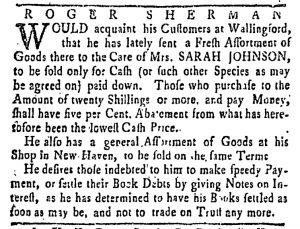
“ROGER SHERMAN … has lately sent a Fresh Assortment of Goods there to the Care of Mrs. SARAH JOHNSON.”

Relative to the number of women who worked as shopkeepers or otherwise operated businesses of various sorts in eighteenth-century America, very few women placed advertisements to promote their endeavors and attract customers. As a matter of principle, I do not wish to further obscure women’s participation in the marketplace as producers and retailers on the supply side of the equation; all too often they are depicted merely as consumers on the demand side. Accordingly, I select advertisements placed by women as frequently as practical.

Today’s advertisement caught my attention because it promotes a business run by a woman, yet it was not placed by the woman herself. Sarah Johnson sold “a Fresh Assortment of Goods” in Wallingford, a town about a dozen miles outside of New Haven. Roger Sherman, however, placed an advertisement in the Connecticut Gazette to “acquaint his Customers at Wallingford” that Johnson sold those goods and provided discounts for customers who bought in volume. He also wanted potential customers in New Haven to know that he sold a similar “Assortment of Goods” on the same terms.

This advertisement raises questions about the arrangements Johnson and Sherman made. It appears that Johnson oversaw the day-to-day operations of the shop in Wallingford, including the necessary accounting and negotiating (as indicated when Sherman allowed for payment in “such other Species as may be agreed on” instead of cash). Yet she seems to have been an employee of some sort rather than a partner. What kind of stake did she have in the enterprise? Did she own any of the inventory she stocked? Did she earn commissions on the goods she sold? How much risk had she assumed compared to Sherman? How much autonomy did she exercise in selecting goods and setting prices? Did she participate in the decisions to offer discounts or to call in debts? Note that Sherman referred to customers Johnson served in Wallingford as “his Customers,” suggesting how he envisioned his relationship to both Johnson and their (his?) clients.

This advertisement acknowledges Sarah Johnson’s presence in the operation of a shop in Wallingford, Connecticut, but it does not fully elaborate on her position relative to Roger Sherman beyond suggesting that even though she participated in the marketplace she did so as a subordinate to Sherman. The advertisement, intended for public consumption, maintained the gender hierarchy of the period, regardless of whatever practices Johnson and Sherman devised outside the public eye.

August 20

What was advertised in a colonial American newspaper 250 years ago today?

Aug 20 - 8:20:1766 Georgia Gazette
Georgia Gazette (August 20, 1766).

“JEAN CAMPBELL … intends to carry on the MILLENARY and MANTUA MAKING BUSINESS.”

When she set up shop in Savannah, Jean Campbell wanted readers of the Georgia Gazette to know that “she intends to carry on the MILLENARY and MANTUA MAKING BUSINESS.” It appears that this was a new endeavor for Campbell, making it especially necessary that she advertise her services to potential customers who would not otherwise have known that she made hats and dresses. Furthermore, Campbell may have been a recent arrival in the city. Note that she did not specify an address for her shop (which may have been her residence as well), but instead stated that “She may be heard of by applying to the printer.” Especially if she were a single woman, Campbell may have been hesitant to publicly announce her location, for reasons of both safety and propriety. If she had lived in Savannah for any amount of time she could have depended on many residents knowing where to find her without directing them to the printing office. After all, the town was not that large in 1766; those who lived in the city became familiar to others who also lived there for any length of time.

In addition, if she had previously operated a “MILLENARY and MANTUA MAKING BUSINESS” in Savannah she might have been able to depend on a network of customers, especially other women, to continue to patronize her as well as spread the word through their social networks. In general, women advertised much less often than men in eighteenth-century America. They did not place commercial notices in newspapers as frequently as their numbers merited, into taking into consideration that women were less likely to operate businesses than men. Campbell may have placed this advertisement as a necessity, at least until she forged relationships with neighbors and customers in Savannah.

August 6

Who was the subject of an advertisement in a colonial American newspaper 250 years ago today?

Aug 6 - 8:6:1766 Georgia Gazette
Georgia Gazette (August 6, 1766).

“TALL SLIM LIKELY YOUNG NEGROE GIRL.”

It would have been impossible to overlook Donald Mackay’s description of Maria, an enslaved young woman: “TALL SLIM LIKELY YOUNG NEGROE GIRL.” Each of the adjectives suggested that Maria was attractive, a young woman that most masters and others would have found desirable, a young woman who most likely would have become increasingly alluring as she continued to mature.

In the absence of any sort of visual image (not even a crude woodcut), Mackay put a black body on display by asking readers to imagine Maria’s appearance and inviting them to scrutinize every black woman they encountered to determine if they might be the runaway Maria.

This advertisement also hints at the treatment that Maria may have already experienced or that she was likely to experience at some point. White men had unfettered access to enslaved women throughout early American history, from the colonial period through the antebellum era and the Civil War. Writing under the pseudonym Linda Brent nearly a century after this advertisement was published, Harriet Jacobs published a slave narrative in which she documented the constant threat of sexual absue she faced as a slave in North Carolina in the early nineteenth century. Various other sources – slave narratives, letters, ledgers, and journals, written by both black and white authors – confirm the sexual violence perpetrated against black women under slavery. Some do so explicitly.

Others, like this advertisement, raise the possibility with more subtlety, asking observers to read between the lines.

A multitude of circumstances probably influenced Maria’s decision to run away, but her vulnerability to sexual abuse was likely one of them. Donald Mackay did not elaborate on all the reasons that he wanted this “TALL SLIM LIKELY YOUNG NEGROE GIRL” captured and returned, but eighteenth-century readers would have been aware of what was unwritten. This advertisement was about more than recovering a piece of human property who could work in the fields or do domestic labor in the household.

Advertisements for enslaved men, women, and children allow us to reconstruct portions of their lives when we read against the grain and interrogate the implications of what white authors have written.

July 22

What was advertised in a colonial newspaper 250 years ago this week?

Jul 22 - 7:21:1766 Newport Mercury
Newport Mercury (July 21, 1766).

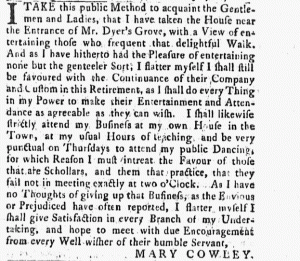
Mary Cowley was the subject of some gossip by “Envious or Prejudiced” residents of Newport. She placed this advertisement in part to promote her business enterprises and in part to set the record straight when it came to some false reports she had heard.

Cowley was a busy woman, which likely brought her under more scrutiny than some of her neighbors and made her a target of “Envious or Prejudiced” gossip. She pursued two occupations, proprietress of a house of entertainment and dancing instructor. Both of these may have made other colonists suspicious of her, especially if she was unmarried or widowed and without a male relative to oversee her activities and interactions with patrons who visited her at “the House near the Entrance of Mr. Dyer’s Grove” or her pupils for the dancing lessons she provided at her own house. Male dancing masters frequently inserted reassuring words in their advertisements to convince potential students and the general public of their propriety, which was especially important given the close physical contact with students inherent in dancing lessons. Cowley was also vulnerable to such suspicions, especially if she offered lessons in the absence of a patriarch to chaperone her. She did venture to address such concerns, but only pledged to “give Satisfaction in every Branch of my Undertaking.”

Entertaining “none but the genteeler Sort” (which may have entailed serving food and beverages and overseeing polite conversation) appears to have been a relatively new endeavor for Cowley. Some may have assumed that it would so distract her from teaching dancing that she would cease meeting with students, but she had “no Thoughts of giving up that Business.”

Unlike many other female advertisers who assured potential customers and the general public that they behaved in appropriately feminine fashion even though they operated businesses of their own and inserted their voice in the public prints to attract business, Mary Cowley took a much more assertive tone. She answered gossip that circulated beyond the newspaper and concluded by thanking “every Well wisher of their humble Servant” for the “due Encouragement” they would bestow upon her.

July 17

What was advertised in a colonial newspaper 250 years ago today?

Jul 17 - 7:17:1766 Pennsylvania Journal
Pennsylvania Journal (July 17, 1766).

Mary Biddle sold “MAPS of the Province of Pennsylvania and PLANS and PROSPECTS of the CITY of PHILADELPHIA” at “the House of Capt. M’Funn, in Third street, above Arch street.” Her advertisement did not provide much additional information, leaving the impression that she might have been a mere retailer of these items. She offered very little detail about the maps, a bit of a surprise considering the labor and expertise that went into creating and producing maps in the eighteenth century. What was Mary Biddle’s connection to the maps she advertised?

Jul 17 - 10:7:1762 Pennsylvania Gazette
Pennsylvania Gazette (October 7, 1762).

Many readers may have already been aware of some of the particulars of the map Biddle sold. Nearly four years earlier she (and others) had published a subscription notice in advance of producing the map. By seeking subscribers, Biddle and her partners were able to gauge interest in their project in order to determine if it would be profitable. The subscription notice also served to incite interest in the project, increasing the chances that it would be successful and turn a profit.

That subscription notice included more information about Biddle’s role in making the map available to the public. She was listed as an editor, along with Matthew Clarkson. Despite the impression created by her later advertisement, Biddle was not merely a retailer. She was a cartographer in her own right!

The Library of Congress provides some biographical information that tells more of Biddle’s story. She was the daughter of Nicholas Scull and Abigail Heap. Scull was a prominent surveyor and cartographer who served as Surveyor General of Pennsylvania from 1748 until his death in 1761. All three of Scull’s sons went on to become surveyors, but it appears that the elder Scull passed along his knowledge to his daughter as well.

Jul 17 - Map of Philadelphia
Nicholas Scull, Matthew Clarkson, and Mary Biddle, To the Mayor, Recorder, Aldermen, Common Council of Freemen of Philadelphia this Plan of the Improved Part of the City (Philadelphia:  Sold by the Editors, Matthew Clarkson and Mary Biddle, 1762).  Library of Congress.  For more detail, zoom in on the map via the Library of Congress.

When Mary Biddle and her husband fell on hard times, she contributed to the family by editing this map, which had been “surveyed and laid down by the late Nicholas Scull.” The map itself included an advertisement in the lower right corner: “Sold by the Editors Matthew Clarkson and Mary Biddle in PHILADELPHIA.” This map was eventually republished many times, but the 1762 edition was the only one that acknowledged Biddle’s contribution.

Today’s short advertisement belies the significant role that Mary Biddle played in the creation, production, and distribution of this important map. In that regard it was similar to many other advertisements placed by men for the businesses they operated that did not acknowledge the labor, skill, expertise, or other contributions their wives and other female relatives contributed to their enterprises.

June 9

What was advertised in a colonial newspaper 250 years ago today?

Jun 9 - 6:9:1766 Boston Evening-Post
Boston Evening-Post (June 9, 1766).

“Sattin … Persians … Taffeties … Patches … Callicoes … Bengals … Ginghams … Cherederies.”

When Jane Gillam announced that she stocked “a Variety of English Goods” she was not exaggerating. The shopkeeper named approximately fifty textiles, but that may not have been an exhaustive list. Even if it was, she offered a dizzying assortment of fabrics, especially considering that some fabrics came in multiple colors or patterns.

To many modern readers, this advertisement may seem disorienting. What’s the difference between “Cherederies” and “Garlicks” or between “Callamancoes” and “Ozenbrigs”? Gillam expected eighteenth-century readers – her potential customers – recognized all the variations, but most of the distinctions are likely lost among modern Americans. Fortunately, historians of material culture have created a variety of resources documenting the different types of fabrics that made their way across oceans and into merchants’ warehouses and retailers’ shops.

Advertisements like those placed by Gillam have aided historians in determining which fabrics were available in early America. Consider the subtitle for one of the standard works in the field, Florence M. Montgomery’s Textiles in America, 1650-1870: A Dictionary Based on Original Documents, Prints and Paintings, Commercial Records, American Merchants’ Papers, Shopkeepers’ Advertisements, and Pattern Books with Original Swatches of Cloth (New York: W.W. Norton, 1984).

Initially I set about providing a short description of each fabric in Gillam’s advertisement as described in Montgomery’s dictionary, but I quickly discovered that the distinctions were too numerous and too complicated to do that here. Instead, how about a quick definition of the four textiles listed above, just to get a sense of what colonial Americans knew about textile that most Americans never learn.

Cherederies = Cherryderry (charadary, carridary): “Striped or checked woven cloth of mixed silk and cotton imported from India from the late seventeenth century.” (199)

Garlicks = Garlick (garlits, garlix, gulick, gulix): “A linen cloth first imported from Goerlitz, Silesia. It could be fully or partially bleached.” (245)

Callamancoes = Calimanco (calamande, calamandre): “A worsted ‘stuff … [with] a fine gloss upon it. There are calamancoes of all colours, and diversly wrought; some ate quite plain; others have broad stripes, adorned with flowers; some with plain broad stripes; some with narrow stripes; and others watered.’” (185)

Ozenbrigs = Osnaburg (oznabrig): “Coarse, unbleached linen or hempen cloth first made in Osnabrück, Germany. It was commonly used for trousers, sacking, and bagging.” (312)

As we can see from the descriptions of just four of the fabrics listed in Gillam’s advertisement, colonial consumers imagined different uses for different kinds of cloth. At a glance, they would have made assumptions about which they desired and which they could afford.

June 8

Who was the subject of an advertisement in a colonial newspaper 250 years ago this week?

Jun 8 - 6:6:1766 Virginia Gazette
Virginia Gazette (June 8, 1766).

“RUN away … some time in October 1762, a Mulatto woman named VIOLET.”

Violet made her escape almost four years earlier, but Philip Kearny was still actively pursuing her in June 1766.

This advertisement demonstrates the efforts enslaved men and women put into making their escapes as well as how vigorously their masters worked to return them to bondage. From hundreds of miles away, Kearny used this advertisement to tell quite a story about Violet. She was born, or so Kearny claimed, in “Princetown” (now Princeton), New Jersey, but in her mid twenties she ran away. She made it to “Frederick town” (now Frederick), Maryland, before being captured and “committed to the gaol.” She managed to escape, which didn’t seem to surprise Kearny, since he described her as “cunning and artful.” He suspected that she was in Maryland, Virginia, or North Carolina, hence his advertisement in the Virginia Gazette.

Even before she ran away, Violet did not recognize Kearny as her master. According to the slaveholder, Violet “pretends to be a free woman,” but his narrative indicates that the story was more complex. She disputed that she was a “slave for life,” suggesting that perhaps she had engaged in some sort of indenture or other contract and then been forced into slavery. The details were murky (and Violet would have given a different account of events than the slaveholder), but Kearney reiterated that “she was born a slave.”

Advertisements for runaway slaves have sometimes been called the first slave narratives. Although Violet did not write this advertisement, it is possible to recognize her resistance and recover some of her story by reading against the narrative presented by Kearny.