March 23

GUEST CURATOR:  Elizabeth Curley

What was advertised in a colonial newspaper 250 years ago this week?
Mar 23 - 3:20:1766 Pennsylvania Gazette
Pennsylvania Gazette (March 20, 1766).

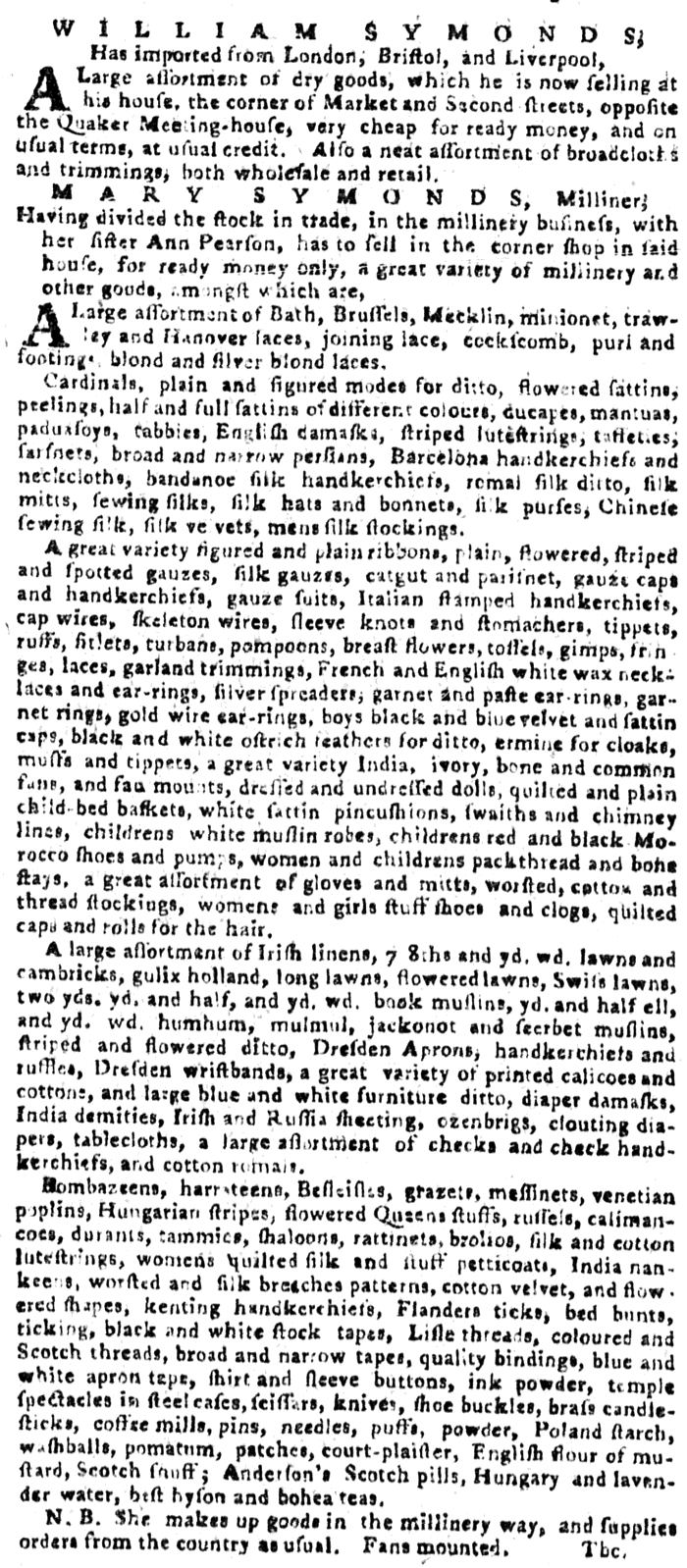
“She makes up goods in the millinery way.”

Mary Symonds owned a corner shop and placed a very lengthy advertisement in the Pennsylvania Gazette.   Symonds was a milliner, which is “a person who designs, makes, trims, or sells women’s hats.”

Symonds describes the different materials and trimmings she sold, such as “a great variety of printed calicoes and cottons” and “A great variety of figured and plain ribbons” along with “sattins of different colours.” Unfortunately, I could not identify a lot of descriptive words, but I could tell that all those paragraphs were different trimmings, fabrics, and their descriptions.

In the 1760s all types of people – from the rich to the poor – wore hats. The difference, however, was the material and how much detail was put into them. Hats could be extremely detailed, depending on how much money the colonist could pay. Milliners could add ribbons and other trimmings like the ones in Symonds’ advertisement if customers so chose. Like today, how people dressed was a status symbol that was very important to American colonists. Whether her customers had enough money to wear a different hat every day or wore the same hat every day, they could keep Symonds in business for years to come.

I was curious about how hats in America and England looked in the 1760s. These paintings all show women with hats during the period.

Mar 23 - Copley Portrait of Mary Clarke
John Singleton Copley, Portrait of Mary Clarke, Mrs. Samuel Barrett (Boston, Massachusetts, ca. 1765-1770).

**********

Mar 23 - Boucher Portrait of Madame Bergeret
Francois Boucher, Madame Bergeret (French, possibly 1766).

**********

Mar 23 - Collett - High Life
John Collett, High Life Below Stairs (London, England, 1763).

**********

ADDITIONAL COMMENTARY:  Carl Robert Keyes

There’s so much going on in this advertisement that it’s hard to know where to begin. Indeed, an entire chapter or more could be devoted to teasing out the various aspects of this advertisement. As Elizabeth notes, average readers today do not recognize the various kinds of textiles and trimming that Symonds listed. Material culture specialists, on the other hand, have written entire books about the quality and characteristics, production and consumption, and social and cultural meanings of these fabrics and accoutrements.

Mary Symonds operated her shop in the same location as William Symonds, but this advertisement suggests that they operated their businesses independently of each other. Although William’s business appeared first in the advertisement, Mary’s list of wares comprised a significantly lengthier section. Mary also noted that she had once been in partnership with “her sister Ann Pearson,” a milliner who ran her own advertisements in Philadelphia’s newspapers. The two sisters ran a series of advertisements in previous weeks announcing that they were dissolving their partnership and dividing the merchandise in anticipation of running separate shops. Such advertisements help to demonstrate that some colonial women operated businesses independently or in partnership with other women. Male relations, including William Symonds, did not necessarily oversee women who acted as retailers.

There’s another reason I was excited when Elizabeth selected this advertisement. I’ve identified only a handful of eighteenth-century trade cards and billheads distributed by women. Mary Symonds is the only female advertiser from Philadelphia with a trade card still extant (as part of the Cadwalader Collection at the Historical Society of Pennsylvania). Her trade card, listed a broad range of millinery supplies similar to what appeared in her newspaper advertisements, circulated in 1770 and perhaps even earlier. It included a border and her name in a rococo-style cartouche. Overall, it was less ornate than some of the trade cards distributed by male advertisers, but it was the most impressive trade card known to have been used by a female advertiser. It appears that Symonds took pride in her business and invested in it accordingly.

Mar 23 - Mary Symonds Trade Card
Trade card (with receipted bill on reverse) distributed  by Mary Symonds in 1770 (Historical Society of Pennsylvania:  Cadwalader Collection, Series II: General John Cadwalader Papers, Box 5: Incoming Correspondence: Pa-Sy, Item 19: Su-Sy).

The copy at the HSP has been dated to 1770 because a receipted bill appears on the reverse. On five different occasions in October and November 1770, somebody – probably Symonds herself – recorded more than a dozen purchases made by “Mrs. Cadwalader” (including “White Gloves,” a “Lace Cap,” and several yards of satin and muslin) amounting to more than £20. This receipted bill indicates that Symonds “Recevd the Contents in full” on November 22, 1770.
March 22

GUEST CURATOR:  Elizabeth Curley

What was advertised in a colonial newspaper 250 years ago this week?

Mar 22 - 3:20:1766 Pennsylvania Gazette
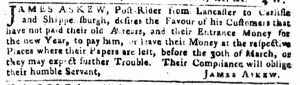
Pennsylvania Gazette (March 20, 1766).

“JAMES ASKEW, Post-Rider … desires the Favour of his Customer that have not paid … to pay him … before the 30th of March.”

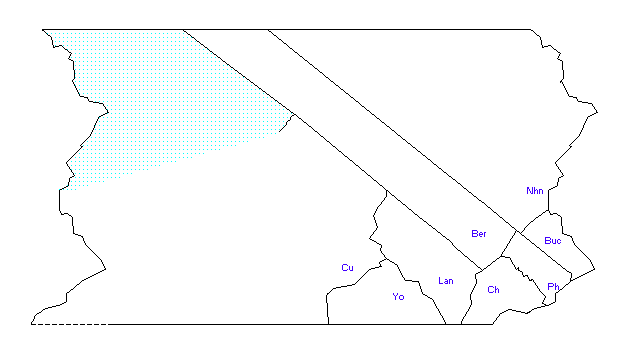
James Askew placed this advertisement in the Pennsylvania Gazette to notify his customers of an impending stoppage of service. As the local post rider he delivered newspapers once a week along with any mail for that area. His route included the towns of Lancaster, Carlisle, and Shippensburg, founded in 1709, 1751, and 1730, respectively, some of the oldest inland settlements in colonial Pennsylvania. Askew seems to have covered the southwestern area of colonial Pennsylvania to the boundary of established counties.

Pennsylvania Counties 1752
Pennsylvania Counties as of 1752 (Ber = Berks; Buc = Bucks; Ch = Chester; Cu = Cumberland; Lan = Lancaster; Nhn = Northampton; Ph = Philadelphia; Yo = York).

He most likely delivered the Pennsylvania Gazette with his own advertisement in it for his own customers to see. Askew used very polite and proper language, such as “desires the favour of his customers that have not paid” and “their compliance will oblige their humble servant,” to get his customers to pay their outstanding bill with him. He then reminds them of their yearly “Entrance Money” for his services, which is common even today for some services. With this advertisement being placed in the March 20 paper he gave customers until March 30 to pay their bills. This would be one more week of newspapers to be dropped off, the Thursday, March 27 issue. Since it was already March that meant that some of these bills were very old because the language that he used made it seems like some of them came from before the new year. Even the “Entrance Money” that was due on March 30 was three months late! Askew gave clear instructions that the money should be left were he delivered his customers’ papers or to pay him in person.

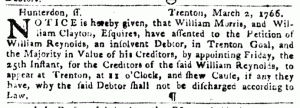
However, a second look at the advertisement that goes beyond the pleasant wording reveals an interesting underlying tone. When I read it I sensed a slightly aggressive or threatening tone by the end. When someone says to “expect further trouble” I do not think of good things. Although each colony had its own laws regarding what would happen to debtors, none of the punishments sound good. As I was doing research for this advertisement I discovered Documents Relating to the Colonial History of the State of New Jersey (edited by William Nelson and published in 1903). It included an excerpt from the Pennsylvania Gazette‘s April 10, 1766, issue: an advertisement calling debtors and their creditors into court to figure out what to do.

Mar 22 - 4:10:1766 Pennsylvania Gazette
Pennsylvania Gazette (April 10, 1766).

Often the offender would be sent to debtors’ prison or would have to sell off his belongings to pay his creditors. In colonial America, even worse then being sent to debtors’ prison was the public shame and embarrassment, often including publishing offenders’ names in the newspaper for everyone to see. Many colonial Americans were not very forgiving of those who fell from grace this way.

**********

ADDITIONAL COMMENTARY:  Carl Robert Keyes

James Askew was anxious for his customers to pay him for the newspapers he delivered from Philadelphia. As Elizabeth explains, some owed arrears from the previous year, while others had not yet paid for the current year. Askew gave plenty of notice that his patrons needed to pay or else face legal consequences. Today’s advertisement also appeared in two previous issues: on March 6 and 13. The post rider gave delinquents fair warning that he would no longer tolerate their refusal to pay for the services he provided.

Advertisements like this one suggest that printers were not the only ones who took a financial risk when extending credit while selling and distributing newspapers. (Recall a recently featured advertisement in which the printers of the New-Hampshire Gazette called on subscribers and advertisers to pay their bills.) John Bolton, another post rider who had patrons from Chester to West Nottingham, placed a similar advertisement in the same issue as this notice from Askew. He also threatened that those who refused to pay “may depend on being dealt with as the Law directs, without respect of Persons, or further Notice.” Bolton stated that he did not care if his (former) customers were the most humble or the most prominent residents in the towns he served. Anyone who contracted a debt with him was expected to pay up.

Mar 22 - Post Rider 3:20:1766 Pennsylvania Gazette
Pennsylvania Gazette (March 20, 1766).

Most of the advertisements featured here highlight attempts to sell goods and services to colonial consumers. Elizabeth has chosen an advertisement that demonstrates another aspect of doing business: some colonists eagerly obtained certain goods and services yet neglected to pay for them, at least not in a timely fashion. As a result, some advertisements encouraged payments from those whose demand had so far outstripped their willingness to pay.

March 21

GUEST CURATOR:  Elizabeth Curley

What was advertised in a colonial newspaper 250 years ago this week?

Mar 21 - 3:20:1766 Massachusetts Gazette
Massachusetts Gazette (March 20, 1766).

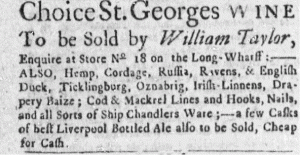
This found this advertisement on the second page. It intrigued me because of the goods described and the layout. From a marketing point of view, I wonder if William Taylor intentionally had the printer put the “Choice St. Georges WINE” at the top in the largest print because that was his best selling item. Wine was a very common drink for the every day as was the ale mention at the bottom of the advertisement. The ale came from Liverpool, England, as did many of the goods on the ships that supplied Taylor and other shopkeepers.

As I was scanning the advertisements the phrase “Ship Chandlers Ware” caught my attention and made me keep reading the other items Taylor sold. A ship chandler is “a person who deals in cordage, canvas, and other supplies for ships.” With Boston being a major seaport, much of the population relied on the shipping, importing, exporting, and shipbuilding industries. Other materials such as the nails, hooks, hemp, and cod and mackerel lines would also been in high demand for day-to-day usage in colonial America, but also in the fishing industry. It makes sense that William Taylor ran his shop on “the Long- Wharff,” where many similar businesses operated.

**********

ADDITIONAL COMMENTARY:  Carl Robert Keyes

Elizabeth notes that today’s advertisement appeared on the second page of the Massachusetts Gazette. This detail gains in significance when examining the customary layout of this publication.

In the eighteenth century American printers tended to take different approaches when it came to the placement of advertisements within broadsheet newspapers folded in half to create four-page issues. Some printers tended to place advertisements on the first and final pages, which would have been printed with one impression (and, after the ink dried, flipped over to print the second and third pages in a single impression). In such instances, the first and last pages were printed earlier in the week; the “freshest advices foreign and domestick” were set in type and printed on the second and third pages later in the week. These seems counterintuitive to modern readers accustomed to headlines for major news stories appearing just below a newspaper’s masthead on the front page.

Other printers relegated advertisements to the final page. If their publication carried enough advertisements, they placed advertisements on the third and fourth pages, which, as explained above, would have been printed at different times during the week. Given that advertisements often repeated for multiple weeks, many would have been set in type already. Although the advertisements appeared together, they were not otherwise organized or “classified” by type. Printers who utilized this system sometimes placed short advertisements earlier in the newspaper as a means of filling space at the end of the final column on a page.

Whatever method they used, colonial printers tended to be fairly consistent from issue to issue. Richard Draper and Samuel Draper took a bit of a different approach. Like the latter method, the fourth page of the Massachusetts Gazette was often covered with advertisements exclusively, but the other three pages were peppered with advertisements. Those notices did not always appear in the final column of a page or at the bottom of a column. They sometimes appeared first or before news items or interspersed with news items. In that regard, the Drapers printed a newspaper that more closely resembled modern publications than many others: it featured both a separate section (page) for advertisements as well as additional advertisements alongside other content.

Such was the case for the Massachusetts Gazette on March 20, 176. The Drapers devoted the fourth page to advertising as usual, but a small number of short advertisements appeared at the end of the first and third columns on the first page. The second page featured news items, but only in the third column. The advertisement Elizabeth selected appeared in the first column of the second page. It would have been one of the first things a reader noticed when opening the newspaper to find more news.

What explains the Drapers’ decisions about layout? Was this mere expediency and efficiency? Or were they experimenting with different formats as a means of delivering advertisements to readers and potential consumers?

March 20

GUEST CURATOR:  Elizabeth Curley

What was advertised in a colonial newspaper 250 years ago today?

Mar 20 - 3:20:1766 Massachusetts Gazette
Massachusetts Gazette (March 20, 1766).

“All such Gentlemen as have generously offered to give Books to the Library of said COLLEGE, would be pleased to send them.”

In this advertisement a well-known university asked students and others to both return and donate books to the College Library. This was 128 years after the college was founded. When I think of Harvard University this advertisement asking for books is not what I usually think of.

Shortly after Harvard was founded and the Great and General Court ordered that it would be established in Newetowne (later renamed Cambridge). In 1638, John Harvard willed his library of approximately 400 books and his estate to the college, making him the first Harvard College benefactor.

My question when I saw this advertisement was: why would a 128 year old well respected college library ask their students in a very public way to return those books they promised or borrowed? The answer to that question: because they didn’t have many books any more. On January 24, 1764, there was a fire in the original Harvard Hall, which burned around 4,500 volumes, and left only one of their original benefactor’s books. The collection went from approximately 5,000 to 500 due to about 400 books being out on loan to students and faculty. An additional 100 new books had yet to be unpacked and were being stored in a different location.

The fire is suspected to have started in the library hearth, where the floor quickly caught fire. Due to the fact that the Massachusetts General Court was there when the fire started they claimed responsibility. Through funds supplied by the Court and numerous generous donations of funds and books, by the end of 1766 a new Harvard Hall had been built and the Harvard library had more books than it did on that cold night in January two years previously.

Beyond my curious nature this advertisement caught my eye because throughout my childhood I loved wandering throughout Boston and Cambridge. From since I can remember I have gone to the Harvard –Yale game every other year, tailgating before and eating pastrami with my family. It’s an honored and loved tradition, and one I can not wait to continue this fall. I might even take detour and stop by Harvard Hall. Go Crimson!

**********

ADDITIONAL COMMENTARY:  Carl Robert Keyes

I appreciate the way that Elizabeth’s personal experiences enrich her appreciation of this advertisement and the story of the Harvard College library that she discovered in the process of asking questions about why this particular advertisement appeared at that particular time. As I have noted several times, the advertisements featured here often hint at hidden stories. In some instances the full details of those stories will likely never be recovered because we simply lack the necessary documents, but in this case the advertisement turned out to be just one of the many pieces of evidence that contribute to reconstructing the events of a particular event that continued to unfold in 1766.

I also like the way that this advertisement helps us to imagine the movement of goods after their initial purchase, in this case the use of books by students at Harvard College. The guest curators and I focus primarily on advertisements for consumer goods that were newly crafted or imported (along with occasional notices for used goods at vendue sales), which allows us to suggest how sellers envisioned that their wares would be used. In examining assorted appeals, we note the reasons that advertisers expected potential customers to visit their shops or engage their services.

This advertisement, however, illuminates the motivations of those who purchased books, whether they bought new ones to pass along to the library immediately, donated volumes that had been in their personal collections for some time, or gave funds for the purpose of acquiring books for the new library. A spirit of generosity animated the exchange of goods – specifically books – in the story this advertisement helps to tell.

Announcement: Guest Curators Return

For the next five weeks the students in my Public History course at Assumption College will return as guest curators. As before, each guest curator will be responsible for a week’s worth of selecting advertisements and analyzing them. I will continue to offer additional commentary and work with the guest curators behind the scenes. Each of the guest curators previously participated in this project. Please visit the “Guest Contributors” page to learn more about them.

March 19

What was advertised in a colonial newspaper 250 years ago this week?

Mar 19 - 3:17:1766 New-York Mercury
New-York Mercury (March 17, 1766).

“Baggammon tables, … flutes and fifes, … fishing reels.”

Peter Goelet presented many choices to potential customers in an advertisement that listed dozens and dozens of items that he stocked in his shop “At the Golden Key, in Hanover-Square, New-York.” What else possibly could have been included among the “great variety of other articles” listed at the end of the advertisement?!

This assortment of goods could be used to glimpse many different aspects of daily life in colonial America, from the types of tools that many artisans would have used to housewares and cooking equipment to supplies for writing letters, accounts, and other documents, to name a few.

This advertisement also suggests leisure activities pursued by some early Americans. Goelet sold “baggammon tables” on which colonists would have played the game now commonly known as backgammon. He also carried musical instruments, including violins and “German and common flutes and fifes,” and supplies, such as “hautboy [oboe] reeds, violin strings, bridges, and pins, [and] brass and steel harpsichord wire.” Although the advertisement does not list other sorts of books or pamphlets, “newest tunes, &c.” may have referred to music. Goelet concluded his advertisement with a list of fishing rods, reels, hooks, and flies.

Games, music, and fishing: advertisements offered colonial Americans the goods they needed to pursue a variety of leisure activities that in turn helped them to express their own status and gentility.

March 18

What was advertised in a colonial newspaper 250 years ago this week?

Mar 18 - 3:17:1766 Newport Mercury
Newport Mercury (March 17, 1766).

“The Encouragement of Manufactures in our own Country is of the greatest Advantage.”

Jonathan Wilson did not sell just any “Packing Paper by the Ream.” His paper was “the Manufacture of this Colony.” As colonists continued to oppose the Stamp Act (as of yet unaware that the king would give royal assent to its repeal the day after this advertisement was published, though it would take several more weeks for word to cross the Atlantic), many advertisers imbued the goods they sold with patriotic value. After all, the success of boycotts and nonimportation agreements depended in part on colonists finding alternate means to supply themselves with goods that previously came from Britain.

In case the initial appeal was too subtle to resonate with some readers, Wilson inserted a final sentence about the value of purchasing domestically produced goods: “As the Encouragement of Manufactures in our Country is of the greatest Advantage, the Paper Mill in this Colony, for which Rags are now wanted, will doubtless be chearfully encouraged by the Public.” In so doing, Wilson not only promoted the paper he sold; he also encouraged consumers to considering buying any sort of “Manufactures” originating in the colonies. He mobilized a “Buy American” message for his own goods, but recommended that consumers should “chearfully encourage” similar endeavors.

Advertisements like this one supplemented public debates about the connections between politics and consumer behaviors that over time forced early Americans to clarify their positions on the relationship between Great Britain and the colonies.

The Stamp Act and Advertisements: The Plan

The Stamp Act, that instrument of taxation without representation that invigorated protests among so many colonists, was officially repealed 250 years ago today on March 18, 1766. Today I will explore how the Stamp Act, one of the most important precursors to the American Revolution, both included and affected newspaper advertisements.

Royal assent for the Stamp Act had been given nearly a year earlier on March 22, 1765, and the measure went into effect on November 1, 1765. (If you’d like to see day-by-day coverage drawing from colonial newspapers printed in late 1765, check out the impressive Twitter project undertaken by Prof. Joseph M. Adelman’s American Revolution class at Framingham State University during the fall 2015 semester.) Colonists began protesting the Stamp Act almost as soon as they learned about it.

On February 21, 1766, Parliament passed a resolution to repeal the Stamp Act. The king gave royal assent nearly a month later. (During the week that the king assented to repealing the Stamp Act, several American newspapers reprinted items had that been published in London newspapers the previous December. A bit of time would pass before colonists learned that the Stamp Act was no more.) On the same day the king also gave royal assent to the Declaratory Act, a warning to the colonists that although the Stamp Act had been repealed Parliament possessed the same authority to oversee affairs in America as it had in Britain.

Advertisements were enumerated in three places in the Stamp Act. Let’s have a closer look at each of them.

I.  … And for and upon every paper, commonly called a pamphlet, and upon every news paper, containing publick news, intelligence, or occurrences, which shall be printed, dispersed, and made publick, within any of the said colonies and plantations, and for and upon such advertisements as are herein after mentioned, the respective duties following (that is to say) …

For every advertisement to be contained in any gazette, news paper, or other paper, or any pamphlet which shall be so printed, a duty of two shillings.

The Stamp Act placed a tax on each newspaper printed in the colonies, but that was not the total potential revenue garnered from newspapers. Many colonists would probably have considered that imposition enough; they certainly did not appreciate an additional duty on every individual advertisement. Depending on the publication, some issues included dozens of advertisements that filled entire columns or pages, sometimes as much as two of the four pages of a broadsheet folded in half to create a four-page newspaper.

While expensive for advertisers, this provision would have been especially devastating for printers. They were unlikely to absorb the costs themselves (see Article XXVIII below), but if they insisted that advertisers paid the duty in addition to the usual costs then they risked attracting far fewer advertisers. Colonial printers rarely made a profit off of newspaper subscriptions. The real money in printing a newspaper came from the advertising.

In addition, printers frequently inserted advertisements for their own wares and services in the newspapers they published. In addition to drumming up business, this sometimes helped them to fill a column or page. Having to pay a duty on their own advertisements, traditionally inserted gratis as a benefit of operating the press, further challenged printers’ business model.

X.  Provided always, That this act shall not extend to charge any proclamation, forms of prayer and thanksgiving, or any printed votes of any house of assembly in any of the said colonies and plantations, with any of the said duties on pamphlets or news papers; or to charge any books commonly used in any of the schools within the said colonies and plantations, or any books containing only matters of devotion or piety; or to charge any single advertisement printed by itself, or the daily accounts of goods imported and exported, so as such accounts or bills do contain no other matters than what have been usually comprized therein; any thing herein contained to the contrary notwithstanding.

This portion of the Stamp Act provided exceptions for God and government: no duties for prayer books or announcements that a day of thanksgiving would be observed nor for official proclamations or reports on voting in colonial legislatures. Schoolbooks and customs information were also exempted.

This section also stated that no duty would be charged for “any single advertisement printed by itself.” This suggests that various advertising media – broadsides, handbills, trade cards, billheads, subscription notices – were exempt, provided that they did not carry other material. Newspaper advertising, however, comprised the vast majority of advertising in colonial America in the 1760s. Trade cards, for instance, gained in popularity after the Revolution, but they were not nearly as common in the colonies in the first two-thirds of the eighteenth century as they were in London. Very few advertisers who used newspapers to disseminate commercial notices also invested in alternate media, in part because doing so would have cost significantly more. Perhaps Parliament’s intention had been either generosity or softening the blow when it approved this provision; if so, it missed the mark.

XXVIII. And be it further enacted by the authority aforesaid, That no officer appointed for distributing stamped vellum, parchment, or paper, in the said colonies or plantations, shall sell or deliver any stamped paper for printing any pamphlet, or any publick news, intelligence, or occurrences, to be contained in one sheet, or any lesser piece of paper, unless such person shall give security to the said officer, for the payment of the duties for the advertisements which shall be printed therein or thereupon.

This provision specified that printers could not even receive the paper necessary for continuing their usual business operations without first giving “security” that the duties on advertisements printed in newspapers would be turned over to stamp agents. In effect, this put printers in the position of collecting duties themselves, making them unwilling arms of Parliament in London. Certainly many colonial printers profited from serving as official printers for colonial assemblies and royally appointed governors, but in such positions they disseminated information. Requiring them to collect stamp duties from their customers would have significantly changed printers’ role in colonial society. The Stamp Act attempted to compel their assistance and cooperation in new ways.

Many colonists objected to the Stamp Act for a variety of reasons, but printers had perhaps more incentives than others to protest Parliament’s new means of raising revenue. The Stamp Act’s treatment of advertising has sometimes been overshadowed by attention to its many other provisions, but its effects on the ability of early Americans to market their goods and services would not have been insignificant.

March 17

What was advertised in a colonial newspaper 250 years ago today?

Mar 17 - 3:17:1766 Boston Post-Boy
Boston Post-Boy (March 17, 1766).

“A Compleat Assortment of Druggs and Medicines; … a fine Assortment of Surgeon’s Instruments.”

Benjamin Church operated a shop that likely attracted many different kinds of customers.

Anderson’s Pills, Bateman’s Drops, Stoughton’s Bitters, and Turlington’s Balsam were all familiar patent medicines that colonists would have purchased both with or without consulting a physician. In some ways, they were the over the counter medications of their day. The first half of Church’s advertisement lists a “Compleat Assortment of Druggs and Medicines” and ingredients that customers from a variety of backgrounds would have purchased.

The second half, on the other hand, lists equipment, “a fine Assortment of Surgeon’s Instruments,” likely intended for specific occupational groups that practiced one form of medicine or another. Everyday consumers may have had some of these supplies in their homes, just as modern American households possess basic first aid materials, but “Midwifry Instruments” and “Surgeon’s Knives” were likely purchased almost exclusively by medical practitioners.

I’m curious to know which volumes were included among the “good Collection of modern Medical Authors.” Did they include any works of general reference? Who would have purchased them?

Overall, this advertisement offers an interesting glimpse of medicine in colonial America, but it also demonstrates how an eighteenth-century business operated. Once upon a time I worked for an independently owned retail pharmacy and home health care supply store. Although the two portions of the business shared a location, most employees were specifically affiliated with either one or the other. Pharmacy staff and home health care staff had distinct areas of expertise and experience and consulted with customers accordingly. In contrast, it is likely that Benjamin Church worked on both sides of the business at his shop in colonial Boston.

March 16

Who was the subject of an advertisement in a colonial newspaper 250 years ago this week?

Mar 16 - 3:14:1766 New-Hampshire Gazette
New-Hampshire Gazette (March 14, 1766).

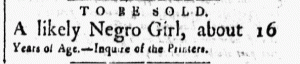
“A likely Negro Girl, about 16 Years of Age.”

I’ve previously made it clear that I wish to feature a new and different advertisement every day. This short advertisement is indeed new to the Adverts 250 Project, though it looks so similar to several others that it’s easy to understand why somebody might question whether it appeared here before.

So why choose it as today’s advertisement? How does it help us to understand early American advertising, consumer culture, or slavery better than any of the previous advertisements for enslaved men, women, and children analyzed here?

Part of the answer lies in the fact that this has become such a familiar type of advertisement. I have not disproportionately selected advertisements seeking to buy or sell enslaved Africans and African Americans. If advertisements for enslaved people have become a familiar part of this project, imagine just how commonplace they appeared to colonists in the eighteenth century. Any reader of a colonial newspaper would have seen far more advertisements for enslaved people than have appeared here, and far more regularly. An advertisement for “A likely Negro Girl” and its counterparts may startle many modern readers, but those advertisements would have been just part of the commercial and cultural landscape in early America.

Only six advertisements for consumer goods and services appeared in this issue of the New-Hampshire Gazette. Two of them offered to sell enslaved youths, “A likely Negro Girl” here and “A NEGRO BOY” (printed just below an advertisement for “BARBADOS whitest LOAF SUGAR,” as featured last week).

These are some of the reasons that I consider it important to continue to feature advertisements for enslaved people. Even in colonial New Hampshire, far removed geographically from the plantations of the Chesapeake, the Lower South, and the Caribbean, slavery was an integral part of advertising as well as commerce more generally. To overlook or ignore these advertisements because they resemble or replicate others would be to misconstrue the past.