July 11

What was advertised in a colonial newspaper 250 years ago today?

Jul 11 - 7:11:1766 Virginia Gazette
Virginia Gazette (July 11, 1766).

To be SOLD, or RENTED, with to without NEGROES, A NEW SAW MILL.”

This advertisement seeking someone to buy or rent “A NEW SAW MILL” on the Chowan River listed a variety of amenities, including the option of “NEGROES” being included in the deal. This differs significantly from commercial and industrial real estate advertisements today. Indeed, before even mentioning any of the other amenities associated with the property, Cullen Pollok announced that the sawmill could be sold or rented “with or without NEGROES.” The enslaved workers were treated like any other part of the infrastructure of the mill.

That slaves could be included in the purchase of this sawmill reveals something about how it operated. While the slaves certainly contributed their labor, the mill’s owner also benefited from the knowledge that slaves brought to the enterprise. Operating a sawmill required specific skills and a routine designed for efficiency. Experience was important as well. A new owner or overseer could certainly train slaves to take on these responsibilities over time, but the advertisement provided the option of a skilled workforce already intact. Reading this advertisement from a twenty-first-century perspective might privilege the labor provided by the enslaved workers, but eighteenth-century readers would have also factored in other advantages – skill and expertise – that those workers provided. Their familiarity with this particular mill would have been invaluable.

Even if a buyer or renter did not wish to set the slaves to work in the sawmill, they were available to work “a small plantation cleared on the river side,” just one of the many amenities listed with the house with “one brick chimney, and a very fine orchard.”

This advertisement seeking someone to buy or rent “A NEW SAW MILL” on the Chowan River listed a variety of amenities, including the option of “NEGROES” being included in the deal. This differs significantly from commercial and industrial real estate advertisements today. Indeed, before even mentioning any of the other amenities associated with the property, Cullen Pollok announced that the sawmill could be sold or rented “with or without NEGROES.” The enslaved workers were treated like any other part of the infrastructure of the mill.

That slaves could be included in the purchase of this sawmill reveals something about how it operated. While the slaves certainly contributed their labor, the mill’s owner also benefited from the knowledge that slaves brought to the enterprise. Operating a sawmill required specific skills and a routine designed for efficiency. Experience was important as well. A new owner or overseer could certainly train slaves to take on these responsibilities over time, but the advertisement provided the option of a skilled workforce already intact. Reading this advertisement from a twenty-first-century perspective might privilege the labor provided by the enslaved workers, but eighteenth-century readers would have also factored in other advantages – skill and expertise – that those workers provided. Their familiarity with this particular mill would have been invaluable.

Even if a buyer or renter did not wish to set the slaves to work in the sawmill, they were available to work “a small plantation cleared on the river side,” just one of the many amenities listed with the house with “one brick chimney, and a very fine orchard.”
July 10

What was advertised in a colonial newspaper 250 years ago today?

Jul 10 - 7:10:1766 Pennsylvania Gazette
Pennsylvania Gazette (July 10, 1766).

“As the Merchants in the Colonies propose a Manufacture of Cloths, this Soap will be of great Advantage.”

In the months after the colonies received word that the Stamp Act had been repealed the frequency that advertisements for goods and services incorporated explicitly political appeals decreased. Yet those appeals did not disappear completely. After all, the Declaratory Act was in effect and wary colonists continued to eye Parliament with suspicion.

In this advertisement for soaps, Thomas Smith and Company referenced recent conversations about the necessity of the colonies becoming more self-sufficient by developing new industries and improving others rather than rely on imports from England. Domestic manufacture and consumption were presented as complementary means of resistance to Parliamentary abuses.

Smith and Company continued this conversation, noting that “the Merchants in the Colonies propose a Manufacture of Cloths” to reduce or eliminate imported textiles. Smith and Company realized that increasing textile production in the colonies would have ripple effects on related industries, including the production of soap that would then be used for washing wool and fulling cloth. Their advertisement emphasized that the soap they made was “such as is made in London” and “known as to be used by most of the Woollen Manufacturers in England, in their various Branches, likewise by the Linen Factories.” The “Manufacture of Cloths” in the colonies would be most successful, Smith and Company suggested, if supported by related ancillary industries. To that end, they provided the same sort of soap of the same quality and “at the same Price Currency as it is sold in England.” This vision, however, would only be possible with “the Favour and Encouragement of the Public.”

Thomas Smith and Company deployed other appeals in this advertisement for their “SOAP FACTORY,” but the political ramifications of supporting their enterprise received the most sustained attention. Their rhetoric was not as shrill as in advertisements published while the Stamp Act was still in effect, but consumers would have recognized the conversation and understood their intent.

July 9

What was advertised in a colonial newspaper 250 years ago today?

Jul 9 - 7:9:1766 Georgia Gazette
Georgia Gazette (July 9, 1766).

“A penny in the pound cheaper than done in Savannah.”

In an advertisement published in the Georgia Gazette, John Hyatt, a blacksmith from Pennsylvania, announced that he had set up shop on the plantation belonging to George Cuthbert. (Presumably this address was sufficient for potential customers to know where to find Hyatt.) Colonists were accustomed to high rates of mobility in the 1760s. New settlers were arriving from England and other parts of Europe at increasing rates after the Seven Years War ended. People who already lived in the colonies moved around, from town to town or from colony to colony, in search of new opportunities. Georgia was a long way from Pennsylvania. Hyatt was just one of many colonists who participated in internal migration within Britain’s colonies in mainland North America.

Relatively new to Georgia, Hyatt used his advertisement to promote his occupation and convince potential customers to patronize him rather than his competitors. He made many of the usual claims, promising to fulfill orders “in the neatest and best manner, with the greatest dispatch.” He also listed a variety of different kinds of work he could do – “mill work, ship work, edge tools of any kind, northward plough irons of different sorts” – and made a blanket statement about being able to complete “any other branch of country work whatsoever.” No matter the job, Hyatt wanted potential customers to know that he could handle it.

His most original appeal, however, appeared in the final line of his advertisement. He pledged that the tools, ploughs, and other goods made in his shop were “as penny in the pound cheaper than done in Savannah.” Appeals to price were common, but offering to beat competitors’ prices (and by how much) was not a standard part of advertisements in the 1760s. Potential customers might have dismissed the first series of appeals as formulaic, but Hyatt’s final appeal to specific lower prices may have convinced them to give the newcomer a chance.

July 8

What was advertised in a colonial newspaper 250 years ago this week?

Jul 8 - 7:7:1766 New-York Gazette
New-York Gazette (July 7, 1766).

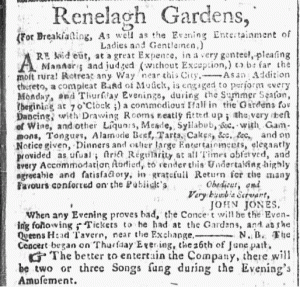
“The better to entertain the Company, there will be two or three Songs sung during the Evening’s Amusement.”

Last month the Adverts 250 Project featured three advertisements for houses of entertainment. Daniel Ocain operated one in Savannah. Samuel Fraunces operated another “at the Sign of Queen Charlotte” in Philadelphia. On the outskirts of Philadelphia, in the Northern Liberties, William and Ann Johnson ran their own “AT the Sign of the Globe.” The two enterprises in Philadelphia offered much more extensive amenities and services than Ocain’s establishment in Savannah. Philadelphia was an older, wealthier, and much larger city. Fraunces and the Johnsons appeared to support themselves primarily by operating their houses of entertainment, while Ocain continued to work as a saddler on the side.

Not to be outdone by his counterparts in Philadelphia, John Jones offered a similar array of services and amenities to entertain guests at his establishment near New York City. His “rural Retreat” even had an impressive name to help advertise the amusements that took place there, Renelagh Gardens. Residents weary of the crowded streets in the city were sure to enjoy the gardens, “laid out … in a very genteel, pleasing Manner” and “judged … to be far the most rural Retreat.” In addition to the gardens, guests could enjoy music and dancing, “the very best of Wine, and other Liquors,” and an assortment of entrees and desserts.

With the Independence Day holiday falling at the beginning of this week, many Americans are in the midst of vacations and summer travel. In addition, others are likely taking advantage of longer summer evenings to make the most of their leisure time. Municipalities and various organizations also host festivals, outdoor concerts, fairs, and other events throughout the summer months, drawing crowds looking for entertainment. Today’s advertisement offers a glimpse of some of the amusements available in colonial America and the methods for promoting them to the public.

July 7

What was advertised in a colonial newspaper 250 years ago today?

Jul 7 - 7:7:1766 Boston Post-Boy
Boston Post-Boy (July 7, 1766).

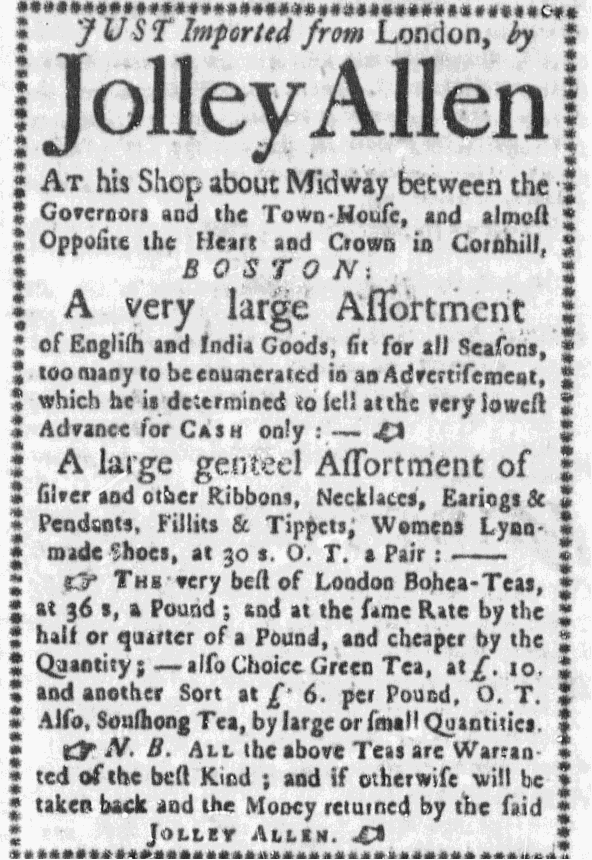
JUST Imported from London, by Jolley Allen.”

Shopkeeper Jolley Allen almost certainly played a role in designing this advertisement. As I have noted previously, the available evidence suggests that advertisers tended to write their own copy and printers tended to make decisions about layout and fonts when they set the type. Printers often adopted formats that were consistent from advertisement to advertisement, giving all commercial notices that appeared in a given newspaper similar visual qualities and making them easy to recognize at a glance.

Allen’s advertisement had a distinctive border that set it apart from other advertisements in the Boston Post-Boy. It seemed unlikely that the printer went through the additional effort of setting ornamental type of his own volition. What was more probable, I hypothesized, was that Allen made special arrangements with the printer (and perhaps paid more) to arrange for this special feature.

Jul 7 - 7:7:1766 Boston Evening-Post
Boston Evening-Post (July 7, 1766).

Allen’s advertisement in other newspapers published in Boston on the same day suggested that was indeed the case. His advertisement in the Boston Evening-Post also had a decorative border, though it was composed of different ornaments. Otherwise, the advertisement had the same copy and nearly identical layout. Another version of the advertisement appeared in the Boston-Gazette. While the copy was the same, the border consisted of yet another style of printing ornaments and the format had two columns within the advertisement. Finally, Allen’s advertisement had previously appeared in Boston’s other newspaper (the only one not distributed on Mondays), the Massachusetts Gazette. Except for yet another method of creating the decorative border, it was nearly identical to the advertisements in the Boston Post-Boy and the Boston Evening-Post. The copy was the same and the format nearly identical.

Jolley Allen placed his advertisement in four newspapers. In each instance, it had a decorative border that would have drawn attention to it, especially since such borders were not a standard part of other advertisements in any of those publications. Allen almost certainly designed that portion of his advertisement, even if he left it to the individual printers to make decisions about setting the rest of the type. Realizing that advertisements often tended to look the same, Allen devised a graphic design innovation intended to set his own apart from the crowd.

Jul 7 - 7:7:1766 Boston-Gazette
Boston-Gazette (July 7, 1766).
Jul 7 - 7:3:1766 Massachusetts Gazette
Massachusetts Gazette (July 3, 1766).

July 6

Who was the subject of an advertisement in a colonial newspaper 250 years ago this week?

Jul 6 - 7:4:1766 Virginia Gazette
Virginia Gazette (July 4, 1766).

The previous issue of the Virginia Gazette included an advertisement announcing that “two hundred choice healthy” slaves from the Windward and Gold Coasts in Africa had “JUST arrived in James river.” It did not give additional information about those slaves, except to announce that they would be sold starting on July 7.

Today’s featured advertisement similarly offered little information about the “THIRTY choice SLAVES” slated to be sold in October, three months later, but it did indicate that “men, women, and children” were included among their ranks. In addition, several of the slaves were tradesmen, though the advertisement did not reveal if they were carpenters, coopers, blacksmiths, or practitioners of other crafts. Those slaves would have been particularly valuable given their ability to make unique contributions beyond agricultural labor to a plantation. Their prospective owners might also stand to make a profit by hiring them out at times that they did not have enough work to keep them busy. Slaves that knew a trade could also teach it to their children, passing down specialized knowledge from generation to generation, further benefiting the master or his heirs.

As if it were not already apparent that these men, women, and children had been reduced to commodities, the advertisement included terms of exchange intended to facilitate the sale. Buyers could receive two years of credit (or more, if necessary), but they would receive a “Five per cent. discount” for payment in full at the time of purchase. In the end, these “THIRTY choice SLAVES” amounted to little more than numbers in a ledger, just like other goods and services during the eighteenth century. Their existence could be summed up as the best sort of deal that could be haggled between buyer and seller.

July 5

What was advertised in a colonial newspaper 250 years ago this week?

Jul 5 - 7:4:1766 Virginia Gazette
Virginia Gazette (July 4, 1766).

“I have settled … in Henrico county, where I purpose to carry on the FULLING business.”

Mathew Dick, a fuller, used an advertisement in the Virginia Gazette to announce that he had just set up shop in Henrico county. Dated July 1, his notice appeared in the next issue of the Virginia Gazette. Although his “FULLING business” was a new establishment, Dick relied on many of the advertising appeals that were commonly deployed in the eighteenth century, reassuring potential customers that he knew his craft and could provide quality service.

He opened with appeals to quality and price, promising that he did his work “in the best and cheapest manner ever done in this colony.” That last bit – “ever done in this colony” – was a bit of hyperbole that underscored his confidence and dared potential customers to give him a chance and see for themselves if his work lived up to the advertisement. In addition, all the equipment and supplies were prepared “in the best order.”

He also offered some words of wisdom specific to his occupation, again reassuring potential customers of his expertise even though he operated a new establishment. “[T]he wool from the neck and shoulders is the best for the finest cloth,” he lectured. Furthermore, “all woolen cloth should be wove at least 5 quarters wide.” Dick knew his business and used his advertisement to testify to the fact.

Finally, Dick promised excellent customer service. He offered two different locations where customers could drop off the fabric they wanted him to process. He would see to it that their orders were fulfilled “in the neatest manner” and as quickly as possible, but not at the expense of deviating from their instructions. Dick fulled cloth to his customers’ specifications and satisfaction: “their directions most punctually observed and followed.”

Dick’s fulling mill may have been new, but he leveraged multiple appeals in his advertisement to demonstrate that he knew his craft and potential customers could depend on him.

July 4

What was advertised in a colonial newspaper 250 years ago today?

Jul 4 - 7:4:1766 New-Hampshire Gazette
New-Hampshire Gazette (July 4, 1766).

“We beg such Delinquent Customers would reflect upon their extreme Ill usage of us.”

Daniel Fowle and Robert Fowle, “THE Printers of this Paper,” meant business. They were exasperated with subscribers and advertisers who refused to pay their bills. To demonstrate that they were not going to put up with such “Arrearages” any longer, they placed this advertisement in a prominent location in their newspaper. It appeared at the top of the final column on the third page, the very last item readers encountered when scanning the interior of a broadsheet folded in half to create a four-page newspaper. In length, it extended halfway down the page. This was valuable space that the printers could have given over to advertising (assuming said advertisers actually paid their bills), but Fowle and Fowle determined that calling in debts was the better investment.

Fowle and Fowle offered a valuable service at a low price – “the most material Foreign and Domestick Intelligence carried with very trifling Expence” – and they expected to be compensated in a timely manner. Credit was an important part of the colonial economy, but the printers were more than generous in extending credit to their patrons. Some subscribers had fallen behind “three, four, five, six, seven, eight and nine Years.” As a result, the printers threatened to sue “delinquent Customers for News Papers, Advertisement, &c.” if those customers did not settle their accounts. The printers even arranged a series of meetings in the towns where they distributed their newspapers. It was not necessary for subscribers to visit their printing office in Portsmouth. The printers were willing pay the necessary expenses to come to them, if only they would pay their bills.

Benjamin Franklin famously made such a fortune as a printer that he was able to retire at a relatively young age to pursue a variety of other vocations. This advertisement demonstrates that other printers experienced challenges to achieving such success.

July 3

What was advertised in a colonial newspaper 250 years ago today?

Jul 3 - 7:3:1766 Pennsylvania Journal
Pennsylvania Journal (July 3, 1766).

“A number of English and Irish MEN and WOMEN SERVANTS.”

A few days ago I featured an advertisement for human cargo, a ship carrying two hundred African slaves that had just arrived on the James River in Virginia. I noted that such advertisements did not appear in newspapers published in New England or the Middle Atlantic where the demand for enslaved labor was significantly lower.

That did not mean, however, that those regions of English settlement did not welcome other vessels with other sorts of human cargo. This advertisement from the Pennsylvania Journal reported that a shipment of English and Irish indentured servants had just arrived in New Castle, Delaware. The partnership of Carsan, Barclay, and Mitchell emphasized that the indentured servants they “Imported” practiced a variety of trades and possessed a variety of skills: “shoemakers; periwig makers; farriers; coachmen; tobacco spinners; dyers; scowerers; shearers; linen, worsted, yarn, broad cloth, stocking, tape and girth webb weavers; breeches makers; glovers; miners; butchers; country carpenters; a number of laborers.”

Human cargo in the form of indentured servants did indeed arrive in other regions. Still, it is important to note that while the existence of indentured servants could be bleak their experiences differed from enslaved Africans in a variety of ways. Although indentured servants were sometimes tricked, most made the voyage to the American colonies voluntarily, unlike enslaved Africans. Many sought new opportunities, especially in the Middle Atlantic colonies, a region sometimes called “the best poor man’s land.” Indentured servants signed contracts, which offered them some protections and also set a limit to their time of servitude. Unlike slaves, indentured servants knew that their situation was temporary rather than permanent.

The “MEN and WOMEN SERVANTS” who arrived in New castle at the end of June 1766 may have experienced some trepidation, but they might have also experienced some hope. They had successfully crossed the Atlantic and a new life awaited them, a life they anticipated would, eventually, be better than the one they left behind in England or Ireland. The enslaved Africans who arrived in Virginia just a few weeks earlier did not exercise the same choices or have the same hopes for a better future.

July 2

Who was the subject of an advertisement in a colonial newspaper 250 years ago today?

Jul 2 - 7:2:1766 Georgia Gazette
Georgia Gazette (July 2, 1766).

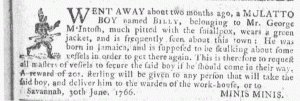
“WENT AWAY about two months ago, a MULATTO BOY named BILLY.”

This runaway advertisement does not fill in many of the details of the life led by “a MULATTO BOY named BILLY,” but it offers enough to imagine some of what his story might have been. The notice indicated that Billy “was born in Jamaica” and speculated that he was spending time on the Savannah waterfront “skulking about some vessels in order to get there again.” The advertiser did not question why Billy might have wanted to return to Jamaica, what would have drawn him there. In addition to being a familiar place, Jamaica may have been where Billy hoped to be reunited with a mother or siblings or other relatives or friends, a network of people that he cared about and who cared about him.

There’s no way to know that for certain. Billy may have had other reasons for wanting to return to Jamaica, but my first thought upon reading this advertisement was that it told the story of a boy who had been separated from his family and wanted to get back to them. I suspect that the advertiser may have had a similar hunch but refused to put it into words. Doing so would have recognized the humanity of Billy, the very real bonds of affection that he felt for his relatives and other significant people in his life. Doing so would have also acknowledged the extent that the slave trade separated families. This advertisement seems to carefully skirt Billy’s humanity in favor of depicting him as a commodity to be delivered back to “the warden of the work-house, or to MINIS MINIS” (presumably the name of the plantation estate of his master, George M’Intosh).