November 25

GUEST CURATOR: Patrick Keane

What was advertised in a colonial newspaper 250 years ago today?
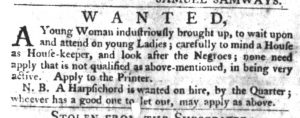
nov-25-11251766-south-carolina-gazette-and-country-journal
South-Carolina Gazette and Country Journal (November 25, 1766).

“WANTED: A Young Woman industriously brought up … carefully to mind a House.”

I liked this advertisement, especially after curating the Slavery Adverts 250 Project, as this has to do with slavery. However, the advertisement did not talk directly about the slaves. Instead, the advertiser was looking for a woman willing to work in the house and watch the master’s slaves. Only women skilled enough to do the job were asked to apply for it: “none need apply that is not qualified as above-mentioned.” The advertiser specifically wanted a woman because during the colonial period woman were expected to do the housework.

One summary of Ruth Cowan Schwartz’s More Work For Mother: The Ironies of Household Technology from the Open Hearth to the Microwave, explains that a “division of labor kept a man and a woman together or joined them in a household in some way.” Other than watching the slaves, the woman in this advertisement would do all of the housework as well, including kitchen work, cooking, cleaning, and taking care of children.

**********

ADDITIONAL COMMENTARY: Carl Robert Keyes

This employment advertisement simultaneously offers a wealth of details concerning domestic life in one South Carolina household and provides frustratingly few specifics. As Patrick indicates, the advertiser sought a young woman who would be responsible for all sorts of housework as well as overseeing slaves. In addition, the young woman was expected to be a servant to an unspecified number of “young Ladies.”

This advertisement reveals quite a bit about women’s responsibilities in early American households. Given traditional gendered divisions of domestic labor that have continued to the present, it comes as little surprise that an eighteenth-century employment advertisement positioned housework as women’s domain. Looking after a house, however, included more than cooking and cleaning, especially in a household with servants or slaves. The work of a housekeeper also included household management intended to keep everything running smoothly.

Who were “the Negroes” mentioned in this advertisement? How many slaves lived and worked in this household? What were their responsibilities? How much of the domestic labor did they perform? Was the successful applicant expected to do any cooking or cleaning herself? Or was she an overseer within the household, someone who delegated tasks and confirmed they were completed?

The advertisement also reveals little about the family that wanted to hire a young woman to join their household. Apparently it was a family of some affluence. Not only did they own slaves and intended to hire a servant, they also, according to a nota bene appended to the advertisement, wished to lease (but not buy) a harpsichord. Perhaps the young ladies of the house took lessons and entertained guests as a means of demonstrating their manners and refinement.

Despite the various details about the prospective housekeeper’s responsibilities, the advertisement does not indicate whether a mistress of the household was present. Did a wife and mother reside in this household? Did the family seek to demonstrate their wealth and status by hiring a servant to take on the tasks that the mistress of the household would have pursued in other homes? Or was the wife and mother deceased or otherwise absent, making it imperative to bring in an outsider to assume those responsibilities?

Answering those questions required applicants to “Apply to the Printer.” Unfortunately, that is not an option for modern readers. I appreciate how Patrick used this advertisement to explore women’s work in colonial America, but I remain puzzled about some of the household dynamics raised in this particular employment notice.

Slavery Advertisements Published November 25, 1766

GUEST CURATOR:  Carolyn Crawford

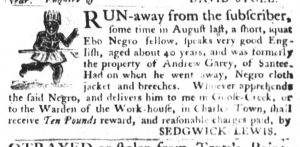
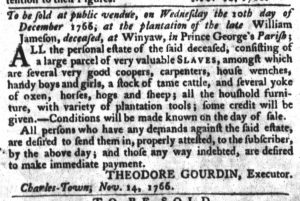
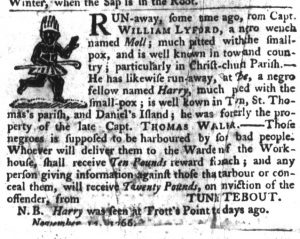
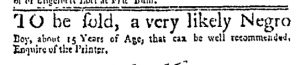
The Slavery Adverts 250 Project chronicles the role of newspaper advertising in perpetuating slavery in the era of the American Revolution. The project seeks to reveal the ubiquity of slavery in eighteenth-century life from New England to Georgia by republishing advertisements about enslaved people – for sale as individuals or in groups, wanted to purchase or for hire for short periods, runaways who liberated themselves, and those who were subsequently captured and confined in jails and workhouses – in daily digests on this site as well as in real time via the @SlaveAdverts250 Twitter feed, utilizing twenty-first-century media to stand in for the print media of the eighteenth century.

The project aims to provide modern audiences with a sense of just how often colonizers encountered these advertisements in their daily lives. Enslaved men, women, and children appeared in print somewhere in the colonies almost every single day. Those advertisements served as a constant backdrop for social, cultural, economic, and political life in colonial and revolutionary America. Colonizers who did not purport to own enslaved people were still confronted with slavery as well as invited to maintain the system by purchasing enslaved men, women, and children or assisting in the capture of so-called “runaways” who sought to free themselves from bondage. The frequency of these newspaper advertisements suggests just how embedded slavery was in colonial and revolutionary American culture in everyday interactions beyond the printed page.

These advertisements also testify to the experiences of enslaved men, women, and children, though readers must consider that those experiences have been remediated through descriptions offered by enslavers rather than enslaved people themselves. Often unnamed in the advertisements, enslaved men, women, and children were not invisible or unimportant in early America.

These advertisements appeared in colonial American newspapers 250 years ago today.

nov-25-south-carolina-gazette-and-country-journal-slavery-1
South-Carolina Gazette and Country Journal (November 25, 1766).

**********

nov-25-south-carolina-gazette-and-country-journal-slavery-2
South-Carolina Gazette and Country Journal (November 25, 1766).

**********

nov-25-south-carolina-gazette-and-country-journal-slavery-3
South-Carolina Gazette and Country Journal (November 25, 1766).

**********

nov-25-south-carolina-gazette-and-country-journal-slavery-4
South-Carolina Gazette and Country Journal (November 25, 1766).

**********

nov-25-south-carolina-gazette-and-country-journal-slavery-5
South-Carolina Gazette and Country Journal (November 25, 1766).

**********

nov-25-south-carolina-gazette-and-country-journal-slavery-6
South-Carolina Gazette and Country Journal (November 25, 1766).

**********

nov-25-south-carolina-gazette-and-country-journal-slavery-7
South-Carolina Gazette and Country Journal (November 25, 1766).

**********

nov-25-south-carolina-gazette-and-country-journal-slavery-8
South-Carolina Gazette and Country Journal (November 25, 1766).

**********

nov-25-south-carolina-gazette-and-country-journal-slavery-9
South-Carolina Gazette and Country Journal (November 25, 1766).

**********

nov-25-south-carolina-gazette-and-country-journal-slavery-10
South-Carolina Gazette and Country Journal (November 25, 1766).

**********

nov-25-south-carolina-gazette-and-country-journal-slavery-11
South-Carolina Gazette and Country Journal (November 25, 1766).

November 24

GUEST CURATOR: Patrick Keane

What was advertised in a colonial American newspaper 250 years ago today?

nov-24-11241766-boston-evening-post-supplement
Supplement to the Boston Evening-Post (November 24, 1766).

“A general assortment of GOODS, suitable for the Season.”

In this advertisement Baker and Bridgham marketed imported goods “suitable for the Season.” They sold a wide variety of fabrics and accessories that appealed to men, women, and children. They also had a lot of competition for the goods they sold. There were at least ten other advertisements that were almost the same in that newspaper. Other stores sold nearly the same products.

Compared to local shopkeepers in small towns, Baker and Bridgham had it much tougher. Those local stores were better known to residents. One online encyclopedia states, “Country storekeepers became important figures in their communities because they were the primary source for goods and information about the outside world.” Compared to country shopkeepers, Baker and Bridgham had to constantly advertise themselves, because in the cities colonists did not always know all the shops. Country shopkeepers did not have as much competition as Baker and Bridgham and other shopkeepers in Boston did.

**********

ADDITIONAL COMMENTARY: Carl Robert Keyes

As Patrick asserts, Baker and Bridgham certainly faced competition for customers from other merchants and shopkeepers in Boston. I would like to build on the work that Patrick has already done by providing a complete census of newspaper advertisements for consumer goods and services in Boston on November 24, 1766, in order to underscore Patrick’s main argument. (Note: I have tabulated only the advertisements for consumer goods and services. Other sorts of advertising, such as ships departing and legal notices, appeared alongside them).

nov-24-11241766-boston-post-boy
Boston Post-Boy (November 24, 1766).

In addition to its regular four-page issue, the Boston Evening-Post published a two-page supplement on November 24. As was often the case in such instance, about half of the supplement consisted of news and the other half of advertising. Overall, ten advertisements for consumer goods and services appeared in the regular issue and another thirteen, including Baker and Bridgham’s advertisement, in the supplement. T. and J. Fleet printed twenty-three newspaper advertisements for consumer goods and services that week.

nov-24-11201766-massachusetts-gazette
Massachusetts Gazette (November 20, 1766).

Yet the story does not end there. Four newspapers were printed in Boston in 1766. Two others, the Boston-Gazette and the Boston Post-Boy, were published on the same day as the Boston Evening-Post. Turning to them yields another ten advertisements for consumer goods and services in the Boston-Gazette and sixteen more in its supplement, as well as fourteen additional advertisements in the Boston Post-Boy. (The Boston Post-Boy had an abbreviated version of Baker and Bridgham’s advertisement.) That amounts to another forty advertisements, twenty-six in the Boston-Gazette and fourteen in the Boston Post-Boy. Although three of Boston’s newspapers were distributed on Mondays, the Massachusetts Gazette found its ways to readers on Thursdays. Its most recent issue from November 20 included twenty-three advertisements for consumer goods and services in the regular issue and another four in an extraordinary, for a total of twenty-seven. (The Massachusetts Gazette featured Baker and Bridgham’s advertisement in its entirety.)

This means that residents of Boston had access to ninety newspaper advertisements for consumer goods and services recently printed in local newspapers at the time that Baker and Bridgham’s advertisement appeared in the Boston Evening-Post on November 24, 1766. In contrast, many of the newspapers from smaller towns ran just a handful of advertisements by shopkeepers and merchants promoting imported wares and other consumer goods and services. Competition for customers in urban ports certainly made advertising seem like a necessity to shopkeepers like Baker and Bridgham.

Even as American celebrate Thanksgiving today, many will already be thinking of the holiday season and the rampant consumption that accompanies it. Today’s holiday will be immediately followed by “Black Friday” and “Cyber Monday.” Critics will inevitably lament the rise of consumerism in America. The newspapers published 250 years ago today, however, suggest that a vibrant consumer culture has been a central part of American life since before the Revolution.

Slavery Advertisements Published November 24, 1766

GUEST CURATOR:  Carolyn Crawford

The Slavery Adverts 250 Project chronicles the role of newspaper advertising in perpetuating slavery in the era of the American Revolution. The project seeks to reveal the ubiquity of slavery in eighteenth-century life from New England to Georgia by republishing advertisements about enslaved people – for sale as individuals or in groups, wanted to purchase or for hire for short periods, runaways who liberated themselves, and those who were subsequently captured and confined in jails and workhouses – in daily digests on this site as well as in real time via the @SlaveAdverts250 Twitter feed, utilizing twenty-first-century media to stand in for the print media of the eighteenth century.

The project aims to provide modern audiences with a sense of just how often colonizers encountered these advertisements in their daily lives. Enslaved men, women, and children appeared in print somewhere in the colonies almost every single day. Those advertisements served as a constant backdrop for social, cultural, economic, and political life in colonial and revolutionary America. Colonizers who did not purport to own enslaved people were still confronted with slavery as well as invited to maintain the system by purchasing enslaved men, women, and children or assisting in the capture of so-called “runaways” who sought to free themselves from bondage. The frequency of these newspaper advertisements suggests just how embedded slavery was in colonial and revolutionary American culture in everyday interactions beyond the printed page.

These advertisements also testify to the experiences of enslaved men, women, and children, though readers must consider that those experiences have been remediated through descriptions offered by enslavers rather than enslaved people themselves. Often unnamed in the advertisements, enslaved men, women, and children were not invisible or unimportant in early America.

These advertisements appeared in colonial American newspapers 250 years ago today.

nov-24-boston-evening-post-slavery-1
Boston Evening-Post (November 24, 1766).

**********

nov-24-boston-evening-post-slavery-2
Boston Evening-Post (November 24, 1766).

**********

nov-24-boston-gazette-slavery-1
Boston-Gazette (November 24, 1766).

**********

nov-24-new-york-gazette-slavery-1
New-York Gazette (November 24, 1766).

**********

nov-24-new-york-mercury-slavery-1
New-York Mercury (November 24, 1766).

**********

nov-24-new-york-mercury-slavery-2
New-York Mercury (November 24, 1766).

**********

nov-24-new-york-mercury-slavery-3
New-York Mercury (November 24, 1766).

**********

nov-24-south-carolina-gazette-slavery-1
South Carolina Gazette (November 24, 1766).

**********

nov-24-south-carolina-gazette-slavery-2
South Carolina Gazette (November 24, 1766).

**********

nov-24-south-carolina-gazette-slavery-3
South Carolina Gazette (November 24, 1766).

**********

nov-24-south-carolina-gazette-slavery-4
South Carolina Gazette (November 24, 1766).

**********

nov-24-south-carolina-gazette-slavery-5
South Carolina Gazette (November 24, 1766).

**********

nov-24-south-carolina-gazette-slavery-6
South Carolina Gazette (November 24, 1766).

**********

nov-24-south-carolina-gazette-slavery-7
South Carolina Gazette (November 24, 1766).

November 23

GUEST CURATOR: Patrick Keane

What was advertised in a colonial American newspaper 250 years ago this week?

nov-23-11221766-providence-gazette
Providence Gazette (November 22, 1766).

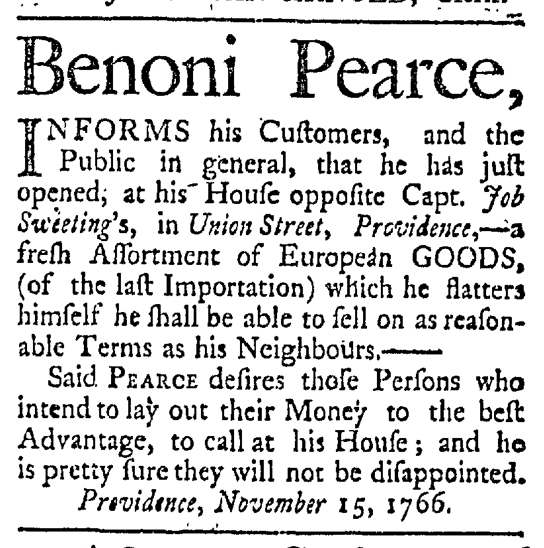
“A fresh Assortment of European GOODS, (of the last Importation).”

I chose this advertisement because Benoni Pearce talked about having just received imported goods from Europe that he was ready to sell in the shop he “just opened.” All sorts of “European GOODS” were very popular and valuable among the colonists. Pearce understood that the colonists loved European goods and that they bought them because they wanted to copy the styles popular in London and other parts of England. As David Jaffee explains, “These goods –textiles, furniture, and even table forks – made possible the pursuit of an ideal of refinement.” This was a way for colonists to expand their own culture and share a common consumer identity with people back in England. Pearce did not really list what he was selling; he just said “European GOODS,” expecting he would be able to sell them. He also promised that customers would not be disappointed.

**********

ADDITIONAL COMMENTARY: Carl Robert Keyes

Patrick raises an interesting point about some of the assumptions made by eighteenth-century advertisers. Benoni Pearce did not list any specific merchandise that he stocked. Instead, he offered a general description – “a fresh Assortment of European GOODS, (of the last Importation)” – and trusted that this would entice potential customers.

That’s not to say that this advertisement amounted to nothing more than a mere announcement. Pearce did fold several marketing appeals into his brief commercial notice. He sold his wares “on as reasonable Terms as his Neighbours” to customers who wished to “lay out their Money to the best Advantage.” By noting that his goods were “of the last Importation” he assured potential customers that he was not peddling outdated merchandise that had been pawned off on him by English merchants seeking to clear their warehouses of undesirable goods. Instead, he stock consisted of the latest fashions popular in England and elsewhere in Europe.

Pearce’s advertisement appeared in the same column as the one place by Gideon Young that Patrick examined yesterday. Each was the standard “square” common in many eighteenth-century newspapers, but Young made slightly different decisions about how to fill the space he purchased. He included a short list that named some of his wares before indicated that they were part of a “general assortment of GOODS needless to mention.” Here, again, an advertiser trusted that an appeal to choice and variety, rather than an extensive list of merchandise, was sufficient to attract customers.

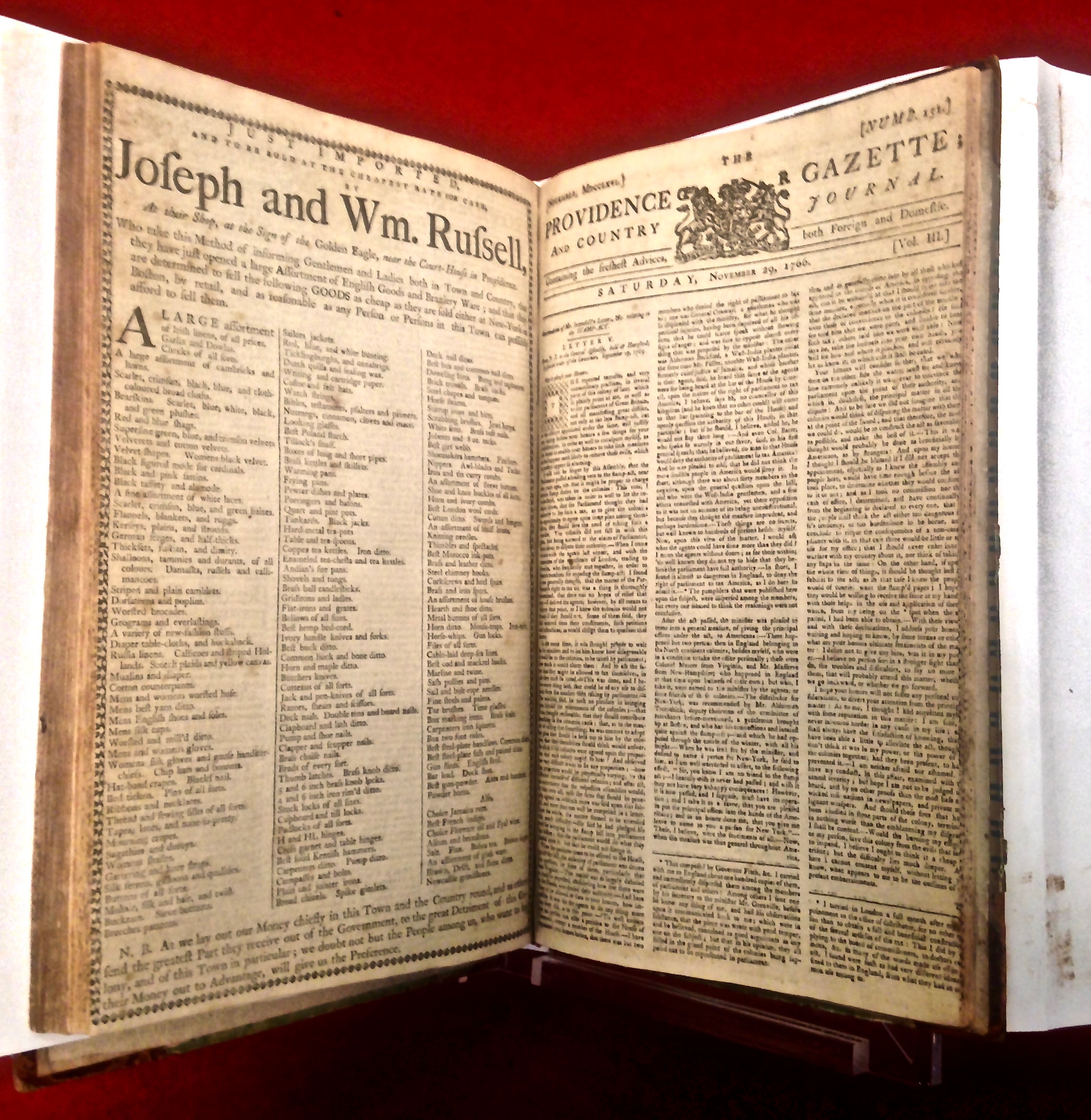
This strategy – no list or a short list contained in a standard advertising square – differed significantly from another advertisement that appeared in the same issue of the Providence Gazette, the first full-page advertisement printed in an American newspaper. Resorting to three columns, Joseph and William Russell listed hundreds of items that comprised their “large Assortment of English Goods and Braziery Ware.”

Benoni Pearce, Gideon Young, and Joseph and William Russell all sought to harness the power of advertising to encourage consumer demand and direct potential customers to their respective shops. In the process, however, they adopted different strategies in writing copy and making graphic design decisions. At a glance, many advertisements from the late colonial era look standard and interchangeable, but even the squares published by Pearce and Young contained noticeable differences when consumers consulted them carefully.

The First Full-Page Advertisement in an American Newspaper

I usually refrain from selecting an additional advertisement to examine on days that my students are serving as guest curators, but I am making an exception in this case because Joseph and William Russell’s advertisement on the final page of the November 22, 1766, issue of the Providence Gazette was just too significant to allow it to pass without acknowledgment. I believe that this is the first full-page advertisement that appeared in an American newspaper!

nov-22-11221766-full-page-providence-gazette
Providence Gazette (November 22, 1766, left; November 29, 1766, right). Courtesy American Antiquarian Society.

For months I have been tracking the innovative layouts designed by Mary Goddard and Company when they began publishing the revived Providence Gazette in the summer of 1766. Between August and November, a trio of advertisers – Thompson and Arnold, Benjamin and Edward Thurber, and Samuel Nightingale, Jr. – placed advertisements that featured decorative borders to set them apart from everything else on the page. Each spanned two columns, dominating the pages on which they appeared. They deviated so significantly from standard eighteenth-century advertisements that they certainly would have attracted the attention of readers. No matter the goods they listed or the appeals the shopkeepers made, these advertisements already caused a visual sensation even before colonists read any of the copy.

Each of these advertisements looked like it could have been printed separately as a trade card that the shopkeepers would have distributed on their own, perhaps recording purchases on the reverse. For the issues of the Providence Gazette in which they appeared, it looked like the oversized advertisements had been positioned in one corner of a page and then the remaining columns built around them.

Given that Mary Goddard and Company were experimenting with size, format, and other graphic design elements on the advertising pages of the Providence Gazette, it probably should not have come as any surprise to find a full-page advertisement occupying the final page of the November 22, 1766, issue. Still, I could not believe my eyes when I saw the digitized image in Readex’s America’s Historical Newspapers database. I needed confirmation, so I visited the American Antiquarian Society and examined the original issue.

nov-22-11221766-full-page-providence-gazette
Providence Gazette (November 22, 1766).

If trade cards had inspired the design of the earlier advertisements, then broadsides must have inspired Joseph and William Russell’s full-page advertisement. Mary Goddard and Company had already played around with mixing genres by placing a trade card within the pages of a newspaper. Making a broadside the entire final page of the newspaper was the logical next step, one that was even more likely to attract notice. Imagine a reader holding up this issue of the Providence Gazette while perusing the pages in the middle. Instead of columns of smaller advertisements typical of other newspapers, observers would have been confronted by a single advertisement larger than any they had preciously encountered in an American newspaper.

I frequently argue that many of the advertising innovations of the twentieth century had precursors in the eighteenth century. Here we see yet another example of eighteenth-century printers and advertisers creating sophisticated marketing materials that have been largely forgotten or overlooked.

November 22

GUEST CURATOR: Patrick Keane

What was advertised in a colonial American newspaper 250 years ago today?

nov-22-11221766-providence-gazette
Providence Gazette (November 22, 1766).

“SUPERFINE broad cloths.”

Gideon Young sold imported materials at his shop that people could use to make clothing. He sold some materials that were intended for the rich (“fashionable silks”) as well as some that were not intended for the rich (“midling and coarse broad cloths”). I found it interesting that he sold at low prices so that he could bring in rich or poor people. He wanted to bring as much attention to his shop as possible; the best way was having “cheap” prices for those who lived in Providence.

On the Colonial Williamsburg website, Edward R. Crews talks about the “18th Century love of fashion and the art of making clothes.” People who bought these materials from Young could then bring them to a milliner to make the clothing for them. Some of the colonists who bought from Young might use the materials to make fancy clothing. Young wanted to appeal to the lower class by having lower prices so that they too could make their own clothes that could also look fancy.

**********

ADDITIONAL COMMENTARY: Carl Robert Keyes

Who were Gideon Young’s customers? As Patrick notes, they could have included colonists from a variety of backgrounds. Young stocked some textiles that would have appealed to genteel gentlemen and ladies as well as others more likely to be purchased by the middling and lower sorts. By offering low prices, he invited all sorts of potential customers to visit his shop.

That Young attempted to cater to different kinds of clients demonstrates a tension that emerged as the consumer revolution of the eighteenth century expanded to include greater numbers of colonists. Products and fashions that had once been reserved for the elite increasingly became more widely accessible as the number of imported goods rose and prices fell. Affluent colonists engaged in conspicuous consumption as a means of continuing to distinguish themselves from their social subordinates. However, even as the elite bought more and more things, other colonists purchased what they could afford and engaged in their own acts of displaying their possessions – and their good taste – to others.

Young certainly wanted to make his customers feel special when he offered “fashionable silks” and “best black sattins, pelong, and alamode.” Yet he balanced a sense of exclusivity against “cheap” prices that suggested that not everyone who visited his shop on Union Street came from the upper echelons of Providence residents.

If all sorts of colonists could buy “fashionable” and “best” goods with all the “trimmings to suit” for low prices from shopkeepers like Young, how could the elite assert their status? A rise in concern for manners as well as attention to personal comportment accompanied the consumer revolution of the eighteenth century. Colonists concentrated on demonstrating their gentility through their actions and interactions with others rather than relying solely on their possessions to testify to their status. In such cases, the clothes did not, by themselves, make the man (or woman). Appearances and possessions were not enough to claim social status. Colonists who wanted to claim a place among the genteel also needed to exhibit politeness and demonstrate that they understood refined rules for social interactions.

November 21

GUEST CURATOR: Patrick Keane

What was advertised in a colonial American newspaper 250 years ago today?

nov-21-11211766-new-hampshire-gazette
New-Hampshire Gazette (November 21, 1766).

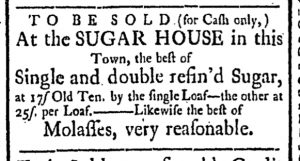
“Single and double refin’d Sugar.”

This advertisement, while very small, was also extremely important because it sold arguably one of the biggest products of colonial times. Sugar was one of the most important and bestselling staple crops in the world. Sugar importation was part of a trade network that brought together people from three continents: Europe, Africa, and the Americas (including the Caribbean islands). Slavery played a major part as, over time, millions of slaves on the Caribbean islands worked on sugar plantations.

During colonial times sugar was produced for all sorts of consumers, including people in the North American colonies. According to the William L. Clements Library’s online exhibit about sugar, “Between the middle of the seventeenth century and the middle of the nineteenth century, sugar was transformed from a luxury to a widely consumed commodity in Great Britain and the United States.” With this production also came high mortality rates for slaves who worked on the plantations. In addition, a lot more slaves produced sugar than other staple crops.

**********

ADDITIONAL COMMENTARY: Carl Robert Keyes

In addition to sugar, the advertisement Patrick chose for today also marketed “Molasses, very reasonable.” It comes as no surprise that the proprietor of “the SUGAR HOUSE” in Portsmouth, New Hampshire, also sold molasses, a byproduct of the sugar refining process. Like sugar, molasses was produced on sugar plantations in the Caribbean and then exported as part of the trading networks that crisscrossed the Atlantic Ocean. Massive quantities of molasses were transported to New England, including Portsmouth, during the eighteenth century.

Why did colonists purchase so much molasses? They used it to produce rum by fermenting the molasses with yeast and water and then distilling the mixture in copper pot stills. During the eighteenth century New England became a major center for the production of rum. In the process, the New England colonies became enmeshed in what is often called the triangular trade. Merchants shipped sugar and molasses produced on plantations in the Caribbean to New England. Distillers purchased molasses and converted it into rum, which merchants then carried to Africa to trade for captive Africans. Those Africans were then transported to the Caribbean, where they labored as slaves on sugar plantations, as Patrick explains above.

Compared to the slave societies of the Chesapeake, Lower South, and Caribbean, colonists in New England owned relatively few slaves in the eighteenth century. That did not mean, however, that their economy and ability to participate in the expanding consumer culture of the era did not depend in large part on slavery. They relied on the transatlantic slave trade and the labor of enslaved Africans as integral parts of their networks of exchange. In other words, colonists in New England were complicit in perpetuating slavery even if they did not own slaves themselves. That was a consequence of their economic decisions.

On a final note, compare the roles of sugar and molasses in today’s advertisement. The sugar was intended for sale to consumers who were end users. The molasses, on the other hand, was not necessarily intended for the consumption of local customers. Instead, it was part of the production process for creating another commodity, rum, that upon its sale allowed colonists to participate more fully in consumer culture. Rum revenues made it possible to purchase imported English goods listed in so many other advertisements in colonial newspapers.

Slavery Advertisements Published November 21, 1766

GUEST CURATOR:  Carolyn Crawford

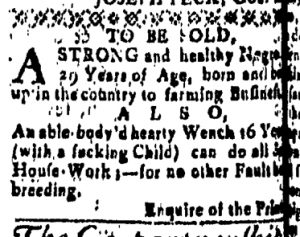
The Slavery Adverts 250 Project chronicles the role of newspaper advertising in perpetuating slavery in the era of the American Revolution. The project seeks to reveal the ubiquity of slavery in eighteenth-century life from New England to Georgia by republishing advertisements about enslaved people – for sale as individuals or in groups, wanted to purchase or for hire for short periods, runaways who liberated themselves, and those who were subsequently captured and confined in jails and workhouses – in daily digests on this site as well as in real time via the @SlaveAdverts250 Twitter feed, utilizing twenty-first-century media to stand in for the print media of the eighteenth century.

The project aims to provide modern audiences with a sense of just how often colonizers encountered these advertisements in their daily lives. Enslaved men, women, and children appeared in print somewhere in the colonies almost every single day. Those advertisements served as a constant backdrop for social, cultural, economic, and political life in colonial and revolutionary America. Colonizers who did not purport to own enslaved people were still confronted with slavery as well as invited to maintain the system by purchasing enslaved men, women, and children or assisting in the capture of so-called “runaways” who sought to free themselves from bondage. The frequency of these newspaper advertisements suggests just how embedded slavery was in colonial and revolutionary American culture in everyday interactions beyond the printed page.

These advertisements also testify to the experiences of enslaved men, women, and children, though readers must consider that those experiences have been remediated through descriptions offered by enslavers rather than enslaved people themselves. Often unnamed in the advertisements, enslaved men, women, and children were not invisible or unimportant in early America.

These advertisements appeared in colonial American newspapers 250 years ago today.

nov-21-new-london-gazette-slavery-1
New-London Gazette (November 21, 1766).

November 20

GUEST CURATOR: Patrick Keane

What was advertised in a colonial newspaper 250 years ago today?

nov-20-11201766-massachusetts-gazette
Massachusetts Gazette (November 20, 1766).

“A general Assortment of Goods.”

I chose this advertisement because Bartholomew Kneeland ran a store that sold a wide variety of products that almost everyone during colonial times used. These products were “imported from London” to be sold at his store in Boston. Kneeland did not sell just one category of products; he sold items such as fabrics to make clothing, tea and spices, “Writing Paper,” “English and Poland Starch,” and “many other articles not mentioned.”

Many of these are everyday products were very much needed in colonial America; many continue to be important even today. I noticed a lot of materials that colonists used to make their own clothing and other necessities. According to Virginia Johnson, “Every colonial family except for the very rich had to be able to make their own soap, candles, furniture, cloth, baskets, toys, and musical instrument.” Families in colonial Boston needed the products Kneeland sold. This made me think of today and how most people do not need to make their own clothing and other household items.

**********

ADDITIONAL COMMENTARY: Carl Robert Keyes

When Patrick and I met to review his advertisements together, I asked him to explain why he selected this particular advertisement for his first day as guest curator of the Adverts 250 Project. Of all the possible advertisements he could have chosen, what was it about this advertisement that attracted his attention. Patrick indicated that he noticed this advertisement because of its length and the number of consumer goods listed separately in its two columns. We then had a discussion in which we compared Bartholomew Kneeland’s advertisement to others that appeared in the same issue of the Massachusetts Gazette.

Kneeland’s advertisement appeared at the top of the first column on the second page of that issue. It extended approximately three-quarters of the way down the column. Readers would have noticed it not only because it was the first advertisement in that issue but also because it occupied so much space on the page. Immediately below it, another advertisement announced “West-India Goods” for sale but did not list any specific items. To the right, similar list-style advertisements by Thomas Hickling and Samuel Eliot extended the entire second and third columns, respectively. Other lengthy list-style advertisements appeared on the third and fourth pages of the issue.

Many other advertisements, however, were markedly shorter. Richard Salter and Joshua Blanchard, for instance, each inserted short advertisements that announced goods imported for London available at low prices, but they did not deploy a list of merchandise as an appeal to attract customers to their shop. One advertisement briefly stated, “Nathaniel Appleton, At his Shop in CORNHILL, has just opened: A General Assortment of English and India Goods, which he will sell cheaper than ever for Cash only.”

nov-20-11201766-appleton-massachusetts-gazette
Massachusetts Gazette (November 20, 1766).

Each advertiser attempted to incite demand and encourage potential customers to visit their shops, but they used different strategies. Bartholomew Kneeland and some of his competitors invested in lengthy list-style advertisements to demonstrate the variety of their merchandise and to make it more likely that readers noticed their advertisements. A quarter of a millennium later this method continued to succeed: Kneeland’s advertisement caught Patrick’s attention and prompted him to read through it to see what the shopkeeper offered for sale.