October 15

GUEST CURATOR: Jordan Russo

What was advertised in a colonial American newspaper 250 years ago today?

oct-15-10151766-georgia-gazette
Georgia Gazette (October 15, 1766).

“Goods, suitable for the season.”

Cowper and Telfairs’ store had just received a large assortment of items imported from London. After the lengthy list of items that they sold, the partners added that “they shortly expect other articles from England and Scotland to make a complete assortment of goods for this country and season.” It was good to add that they would be receiving other items so customers would come back and purchase more from their store.

This advertisement was in the newspaper in October; colonists would soon need items for the winter that was coming, even if it would not be as cold as in New England or even Virginia. The advertisement states the supplies and clothing were “suitable for the season,” making potential buyers aware that this store had goods that would help them get through the winter. Throughout the colonies, settlers made preparations. According to David Robinson, “Mothers taught daughters how to card wool and coax soft fibers from the hard stems of flax; how to spin fibers into threads; how to stitch and mend the heavy coats and hooded cloaks that soon must ward off the biting winds.” Cowper and Telfairs’ store had “a variety of other ready-made cloaths” that colonists could purchase as well as an assortment of textiles they could use to make coats, cloaks, and warmer clothing that they would need for winter weather, even if winter in Georgia was not as extreme as in colonies further north.

**********

ADDITIONAL COMMENTARY: Carl Robert Keyes

Not long ago guest curator Nicholas Commesso examined an advertisement from the Massachusetts Gazette in which William Palfrey marketed “Articles suitable for the approaching Season.” He noted that colonists in Boston and its hinterland needed to take into account that fall had commenced and winter would arrive soon. Palfrey attempted to sell his goods by reminding colonists that it was time to start making preparations.

In my additional commentary I noted that “suitable to the season” was a stock phrase deployed in newspaper advertisements in Philadelphia and, more generally, in New England the Middle Atlantic colonies. I have not worked as extensively with advertisements from the Chesapeake or the Lower South, so I was uncertain if that was the case in those locales or if regional differences existed. I suggested that this merited further investigation.

Jordan turned her eye to that question today, identifying the same language in an advertisement from a newspaper printed in the Georgia Gazette. While one advertisement does not demonstrate a pattern or widespread usage of “suitable for the season,” it does indicate that the phrase was not unknown in the area. Cowper and Telfairs likely meant something a bit different – or had somewhat different merchandise in mind – than William Palfrey did when they described their wares as “suitable for the season.” Each advertiser would have taken into account local conditions.

As Jordan notes, the shopkeepers concluded by describing the items “from England and Scotland” they intended to have in stock soon as “goods for this country and season.” In addition to attempting to lure customers back to their store for subsequent visits, Cowper and Telfairs also signaled that they knew exactly what kind of merchandise would be arriving on ships expected in port soon. Most likely they had negotiated with their contacts on the other side of the Atlantic and placed orders for specific goods. London merchants sometimes tried to pawn off surplus inventory, expecting colonial retailers to accept and sell whatever was sent to them, but Cowper and Telfairs suggested that their customers would be pleased with the selection they offered because their wares had been chosen with Georgia and its climate in mind.

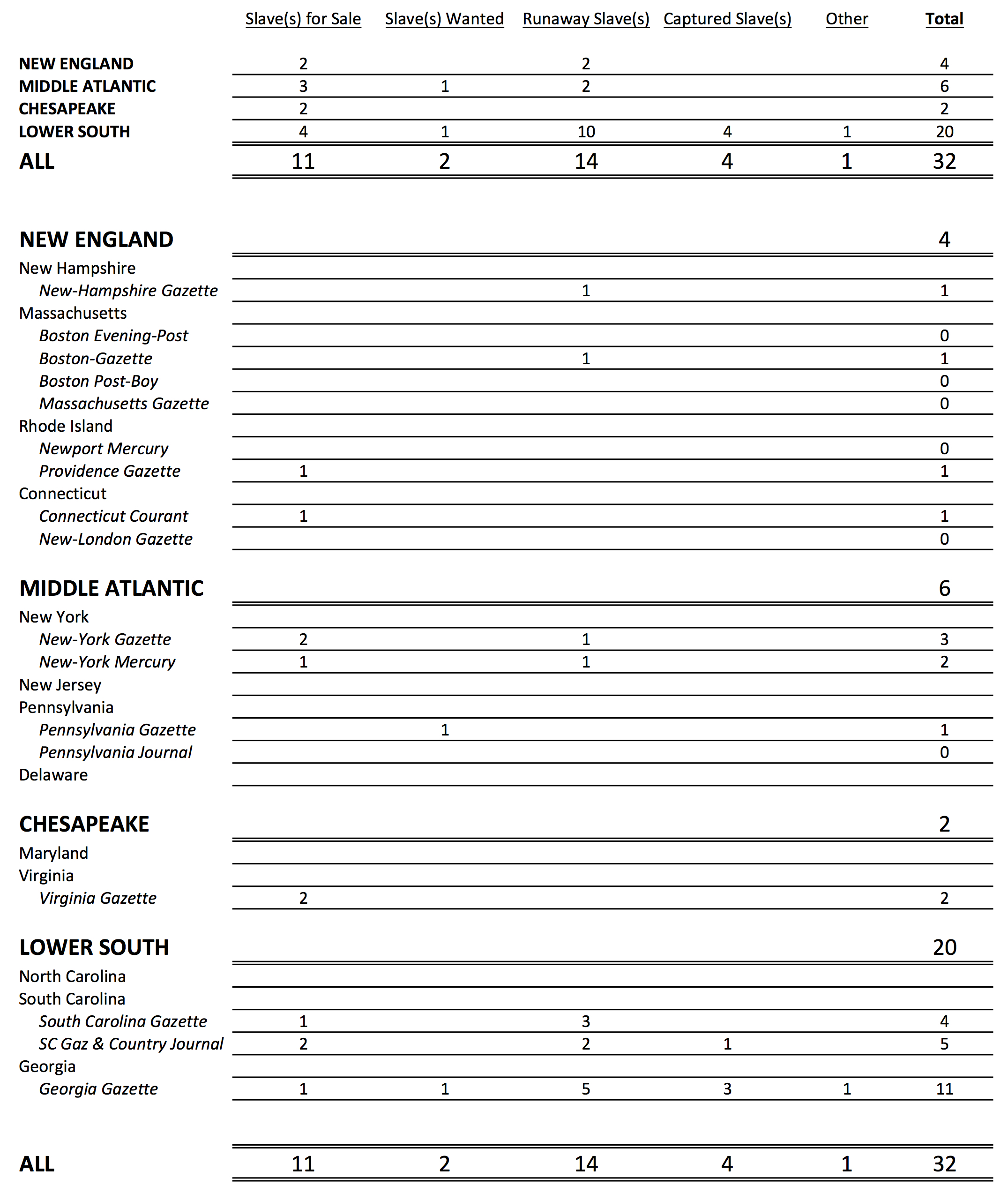
Summary of Slavery Advertisements Published October 9-15, 1766

These tables indicate how many advertisements for slaves appeared in colonial American newspapers during the week of October 9-15, 1766.  Data for both tables was compiled by Ceara Morse.

Note:  These tables are as comprehensive as currently digitized sources permit, but they may not be an exhaustive account.  They includes all newspapers that have been digitized and made available via Accessible Archives, Colonial Williamsburg’s Digital Library, and Readex’s America’s Historical Newspapers.  There are several reasons some newspapers may not have been consulted:

  • Issues that are no longer extant;
  • Issues that are extant but have not yet been digitized; and
  • Newspapers published in a language other than English (including the Wochentliche Philadelphische Staatsbote).

**********

Slavery Advertisements Published October 9-15, 1766:  By Date

slavery-adverts-tables-by-date-oct-9

**********

Slavery Advertisements Published October 9-15, 1766:  By Region

slavery-adverts-table-by-region-oct-9

Slavery Advertisements Published October 15, 1766

GUEST CURATOR:  Ceara Morse

The Slavery Adverts 250 Project chronicles the role of newspaper advertising in perpetuating slavery in the era of the American Revolution. The project seeks to reveal the ubiquity of slavery in eighteenth-century life from New England to Georgia by republishing advertisements about enslaved people – for sale as individuals or in groups, wanted to purchase or for hire for short periods, runaways who liberated themselves, and those who were subsequently captured and confined in jails and workhouses – in daily digests on this site as well as in real time via the @SlaveAdverts250 Twitter feed, utilizing twenty-first-century media to stand in for the print media of the eighteenth century.

The project aims to provide modern audiences with a sense of just how often colonizers encountered these advertisements in their daily lives. Enslaved men, women, and children appeared in print somewhere in the colonies almost every single day. Those advertisements served as a constant backdrop for social, cultural, economic, and political life in colonial and revolutionary America. Colonizers who did not purport to own enslaved people were still confronted with slavery as well as invited to maintain the system by purchasing enslaved men, women, and children or assisting in the capture of so-called “runaways” who sought to free themselves from bondage. The frequency of these newspaper advertisements suggests just how embedded slavery was in colonial and revolutionary American culture in everyday interactions beyond the printed page.

These advertisements also testify to the experiences of enslaved men, women, and children, though readers must consider that those experiences have been remediated through descriptions offered by enslavers rather than enslaved people themselves. Often unnamed in the advertisements, enslaved men, women, and children were not invisible or unimportant in early America.

These advertisements appeared in colonial American newspapers 250 years ago today.

oct-15-georgia-gazette-slavery-1
Georgia Gazette (October 15, 1766).

**********

oct-15-georgia-gazette-slavery-2
Georgia Gazette (October 15, 1766).

**********

oct-15-georgia-gazette-slavery-3
Georgia Gazette (October 15, 1766).

**********

oct-15-georgia-gazette-slavery-4
Georgia Gazette (October 15, 1766).

**********

oct-15-georgia-gazette-slavery-5
Georgia Gazette (October 15, 1766).

**********

oct-15-georgia-gazette-slavery-6
Georgia Gazette (October 15, 1766).

**********

oct-15-georgia-gazette-slavery-7
Georgia Gazette (October 15, 1766).

**********

oct-15-georgia-gazette-slavery-8
Georgia Gazette (October 15, 1766).

**********

oct-15-georgia-gazette-slavery-9
Georgia Gazette (October 15, 1766).

**********

oct-15-georgia-gazette-slavery-10
Georgia Gazette (October 15, 1766).

**********

oct-15-georgia-gazette-slavery-11
Georgia Gazette (October 15, 1766).

October 14

GUEST COMMENTATOR: Jordan Russo

What was advertised in a colonial American newspaper 250 years ago today?

oct-14-10141766-south-carolina-gazette-and-country-journal
South-Carolina Gazette and Country Journal (October 14, 1766).

“Exceeding fine Hyson Tea.”


In addition to “Water Bread” and “superfine Flour in barrels,” Benfield and Jones advertised “two chests of exceeding fine Hyson Tea.” T.H. Breen states, “Perhaps the central item in this rapidly changing consumer society was tea. In the early decades of the eighteenth century, tea began to appear in the homes of wealthier Americans.”[1] Tea was a drink that elite colonists socialized over. Moreau de Saint-Méry, a foreign visitor to Philadelphia in the 1790s, wrote, “The whole family is united at tea, to which friends, acquaintances, and even strangers are invited.” Drinking tea united and brought people together, allowing them to get to know each other better. According to Carla Olson Gade’s summary on Colonial Quills, “Obviously, young men and women enjoyed the sociability of teatime, for it provided an ideal occasion to get acquainted.”

It is also interesting that this advertisement was promoting their goods to be sold to retailers. Benfield and Jones wanted retailers to buy their goods so they could sell them to others. The customers that bought the tea from Benfield and Jones may not have been the end users.

**********

ADDITIONAL COMMENTARY: Carl Robert Keyes

Benfield and Jones did indeed appear to be wholesalers rather than retailers, though some colonial firms did pursue both. This advertisement suggests that they specialized in moving high volumes of staples and supplies (bread, flour, iron, and tea), for which they accepted cash “at a very low advance” or “exchange[d] for coarse goods” that they then likely sold and exported in bulk.

Benfield and Jones provided tea to the Charleston market, but colonial consumers could not enjoy the social rituals Jordan describes without also purchasing a variety of other accouterments and supplies. Drinking tea practically demanded sugar. It also required a variety of equipment: tea sets that included cups, saucers, tea kettles, covered sugar bowls, creampots, hot-water urns, salvers, trays, and canisters for dried tea leaves. Drinking tea required purchasing more than just the tea itself.

As Jordan notes, tea was initially a luxury enjoyed by wealthy colonists, but over time it gained widespread popularity. Colonists of every station and background developed a taste for tea, often considering it just as much a staple as the bread and flour listed alongside it in Benfield and Jones’ advertisement. This prompted a further expansion of consumer activity as colonists purchased tea equipage of various styles and made of various materials. Fashions changed and consumers opted to display and use tea sets that reflected their own tastes, wealth, and status.

In providing tea to the Charleston market, Benfield and Jones distributed an important commodity, one that became an emblem of eighteenth-century consumer culture. Yet they sold only one component necessary for the extensive practices and rituals of socializing over tea: the tea itself. Other advertisers promoted an array of additional items necessary for drinking tea that colonists would have imagined while reading Benfield and Jones’ advertisement, products that may not be as readily apparent to modern readers accustomed to modern convenience and methods of preparing tea.

**********

[1] T.H. Breen, “An Empire of Goods: The Anglicization of Colonial America, 1690-1776,” Journal of British Studies 25, no. 4 (October 1986): 488.

Slavery Advertisements Published October 14, 1766

GUEST CURATOR:  Ceara Morse

The Slavery Adverts 250 Project chronicles the role of newspaper advertising in perpetuating slavery in the era of the American Revolution. The project seeks to reveal the ubiquity of slavery in eighteenth-century life from New England to Georgia by republishing advertisements about enslaved people – for sale as individuals or in groups, wanted to purchase or for hire for short periods, runaways who liberated themselves, and those who were subsequently captured and confined in jails and workhouses – in daily digests on this site as well as in real time via the @SlaveAdverts250 Twitter feed, utilizing twenty-first-century media to stand in for the print media of the eighteenth century.

The project aims to provide modern audiences with a sense of just how often colonizers encountered these advertisements in their daily lives. Enslaved men, women, and children appeared in print somewhere in the colonies almost every single day. Those advertisements served as a constant backdrop for social, cultural, economic, and political life in colonial and revolutionary America. Colonizers who did not purport to own enslaved people were still confronted with slavery as well as invited to maintain the system by purchasing enslaved men, women, and children or assisting in the capture of so-called “runaways” who sought to free themselves from bondage. The frequency of these newspaper advertisements suggests just how embedded slavery was in colonial and revolutionary American culture in everyday interactions beyond the printed page.

These advertisements also testify to the experiences of enslaved men, women, and children, though readers must consider that those experiences have been remediated through descriptions offered by enslavers rather than enslaved people themselves. Often unnamed in the advertisements, enslaved men, women, and children were not invisible or unimportant in early America.

These advertisements appeared in colonial American newspapers 250 years ago today.

oct-14-south-carolina-gazette-and-country-journal-slavery-1
South-Carolina Gazette and Country Journal (October 14, 1766).

**********

oct-14-south-carolina-gazette-and-country-journal-slavery-2
South-Carolina Gazette and Country Journal (October 14, 1766).

**********

oct-14-south-carolina-gazette-and-country-journal-slavery-3
South-Carolina Gazette and Country Journal (October 14, 1766).

**********

oct-14-south-carolina-gazette-and-country-journal-slavery-4
South-Carolina Gazette and Country Journal (October 14, 1766).

**********

oct-14-south-carolina-gazette-and-country-journal-slavery-5
South-Carolina Gazette and Country Journal (October 14, 1766).

October 13

GUEST CURATOR: Jordan Russo

What was advertised in a colonial American newspaper 250 years ago today?

oct-13-10131766-new-york-mercury
New-York Mercury (October 13, 1766).

“BEING the largest and most curious collection …”

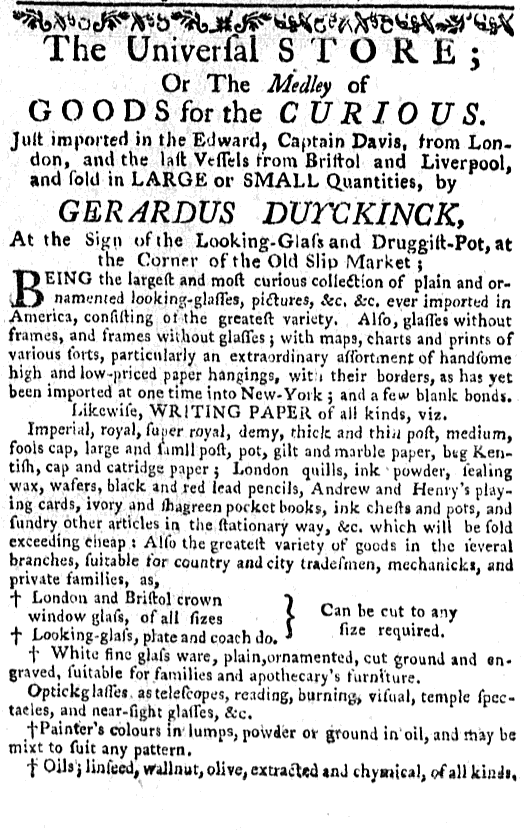
In this advertisement Gerardus Duyckinck described the merchandise in his “Universal STORE” as a “Medley of GOODS for the CURIOUS.” Duyckinck sold “plain and ornamented looking-glasses” and “maps, charts and prints of various sorts.” I imagine the items in Duyckinck’s store were not sold everywhere else or else it would not have made sense to call them “GOODS for the CURIOUS.”

Duyckinck sold items for a variety of customers. Some of merchandise was high end while others was not. For example, his glassware was “plain” or “ornamented.” The differences in merchandise meant that the prices varied between items. Duynkinck said that he had “high and low-priced paper hangings.” Duycknick was not attempting to sell his items to one type of customer; he had items and prices welcoming to all.

T.H. Breen notes that “British imports initially flowed into the households of the well-to-do. These are the goods that catch our eyes in modern museums and restored colonial homes.”[1] When we visit museums today, we are most likely to see the sort of chic merchandise that Duynkinck sold to elite customers.

**********

ADDITIONAL COMMENTARY: Carl Robert Keyes

Historians of eighteenth-century consumer culture and material culture frequently discuss the sense of wonder that colonists experienced as they encountered an expanding array of goods that they purchased and put to use for a variety of purposes. Some goods were completely utilitarian; others were luxury items. Some denoted conspicuous consumption; most testified to the identity of the consumer in one fashion or another.

In some instances historians have carefully excavated the sense of excitement that colonists felt when confronted with new consumer choices. For instance, the standard list advertisement (with its heavy and dense format) may not seem especially exciting when viewed through modern eyes, but thick descriptions of how such lists presented a new world of imagination, sensation, and possession to eighteenth-century consumers uncover raucous enthusiasm.

Jordan has chosen an advertisement that does not require quite as much excavation. Gerardus Duyckinck verbalized the sense of wonder and excitement that he knew consumers felt, mobilizing it to bring customers into his “Universal STORE.” He offered a variety of specialty goods among his “Medley of GOODS for the CURIOUS.” He deployed hyperbole to describe his wares, which included “the largest and most curious collection” of looking glasses “ever imported in America, consisting of the greatest variety.” He stocked paper hangings (wallpaper today): “an extraordinary assortment … as has yet been imported at one time into New-York.” His general merchandise included “the greatest variety of goods in the several branches, suitable for country and city tradesmen, mechanicks, and private families.”

What would it have been like to visit Duyckinck’s shop? Was he as much of an entrepreneur, an early modern carnival barker, in person as he sounded in his advertisement? Interacting with the shopkeeper may have been an important part of the entertainment involved in shopping at his establishment, just as significant as the pleasures of inspecting his merchandise and exercising choice in selecting among his wares.

**********

[1] T.H. Breen, “An Empire of Goods: The Anglicization of Colonial America, 1690-1776,” Journal of British Studies 25, no. 4 (October 1986): 487.

Slavery Advertisements Published October 13, 1766

GUEST CURATOR:  Ceara Morse

The Slavery Adverts 250 Project chronicles the role of newspaper advertising in perpetuating slavery in the era of the American Revolution. The project seeks to reveal the ubiquity of slavery in eighteenth-century life from New England to Georgia by republishing advertisements about enslaved people – for sale as individuals or in groups, wanted to purchase or for hire for short periods, runaways who liberated themselves, and those who were subsequently captured and confined in jails and workhouses – in daily digests on this site as well as in real time via the @SlaveAdverts250 Twitter feed, utilizing twenty-first-century media to stand in for the print media of the eighteenth century.

The project aims to provide modern audiences with a sense of just how often colonizers encountered these advertisements in their daily lives. Enslaved men, women, and children appeared in print somewhere in the colonies almost every single day. Those advertisements served as a constant backdrop for social, cultural, economic, and political life in colonial and revolutionary America. Colonizers who did not purport to own enslaved people were still confronted with slavery as well as invited to maintain the system by purchasing enslaved men, women, and children or assisting in the capture of so-called “runaways” who sought to free themselves from bondage. The frequency of these newspaper advertisements suggests just how embedded slavery was in colonial and revolutionary American culture in everyday interactions beyond the printed page.

These advertisements also testify to the experiences of enslaved men, women, and children, though readers must consider that those experiences have been remediated through descriptions offered by enslavers rather than enslaved people themselves. Often unnamed in the advertisements, enslaved men, women, and children were not invisible or unimportant in early America.

These advertisements appeared in colonial American newspapers 250 years ago today.

oct-13-boston-gazette-slavery-1
Supplement to the Boston Gazette (October 13, 1766).

**********

oct-13-connecticut-courant-slavery-1
Connecticut Courant (October 13, 1766).

**********

oct-13-new-york-gazette-slavery-1
New-York Gazette (October 13, 1766).

**********

oct-13-new-york-gazette-slavery-2
New-York Gazette (October 13, 1766).

**********

oct-13-new-york-gazette-slavery-3
New-York Gazette (October 13, 1766).

**********

oct-13-new-york-mercury-slavery-1
New-York Mercury (October 13, 1766).

**********

oct-13-new-york-mercury-slavery-2
New-York Mercury (October 13, 1766).

**********

oct-13-south-carolina-gazette-slavery-1
South Carolina Gazette (October 13, 1766).

**********

oct-13-south-carolina-gazette-slavery-2
South Carolina Gazette (October 13, 1766).

**********

oct-13-south-carolina-gazette-slavery-3
South Carolina Gazette (October 13, 1766).

**********

oct-13-south-carolina-gazette-slavery-4
South Carolina Gazette (October 13, 1766).

October 12

GUEST CURATOR: Jordan Russo

What was advertised in a colonial American newspaper 250 years ago this week?

oct-12-10101766-new-hampshire-gazette
New-Hampshire Gazette (October 10, 1766).

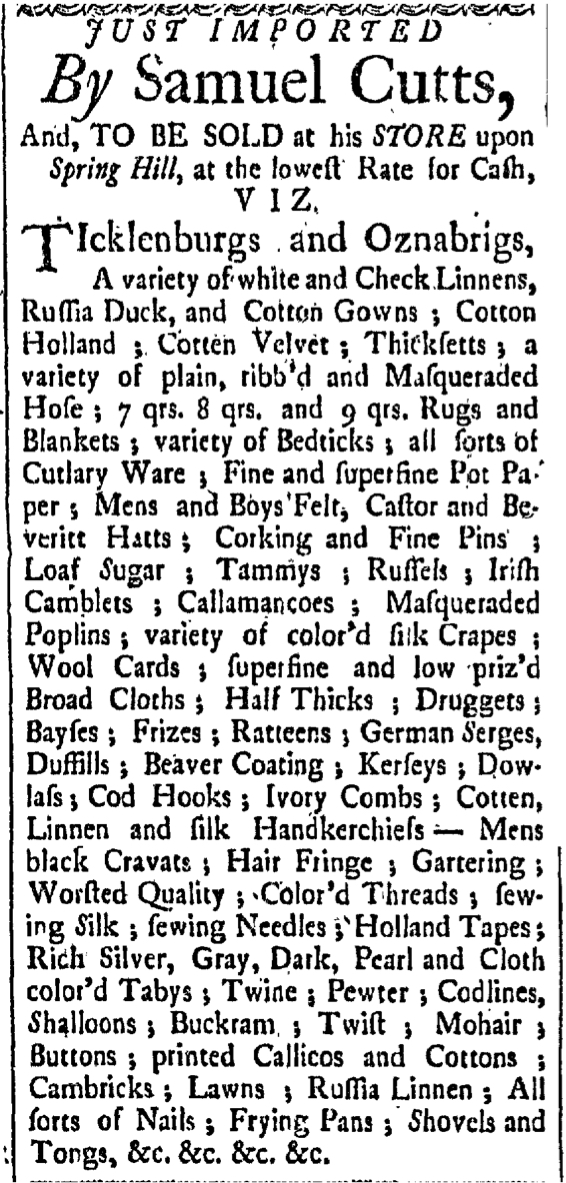
“TIcklenburgs and Oznabrigs.”

Two words in larger type near the top of this advertisement caught my interest: “Ticklenburgs and Oznabrigs.” They were words that I had not seen before. Both of these items are textiles; the majority of the items listed in the advertisement were textiles. As I mentioned earlier this week, clothing was an important way for colonists to indicate their position in society. The list of items is very long and diverse; there were many types of items all different types of people would have wanted.

T.H. Breen indicates that the volume of consumer goods imported into the colonies allowed prices to decrease. Samuel Cutts’ advertisement states that he sold his goods “at lowest Rate.” Cutts was making sure his potential customers knew that he had the lowest prices and they could have the best deals for all these items. We could compare this to today’s consumer culture; stores are always advertising that they are having sales and have better deals than other stores. Modern customers are always attracted to being able to purchase something for the least amount of money.

**********

ADDITIONAL COMMENTARY: Carl Robert Keyes

In her work as guest curator so far, Jordan has identified some of the most significant aspects of eighteenth-century advertising. In one sense, she has returned the Adverts 250 Project to its origins, examining the most common appeals that appeared in early American advertisements. Today we take such appeals — price, choice, fashion — for granted, but that was not the case during the consumer revolution of the eighteenth century. Those appeals were the building blocks of the first generation of advertising for consumer goods and services in American newspapers and magazines, but not all advertisers deployed one or more of those most basic appeals.

As the eighteenth century progressed, appeals to price, choice, and fashion became increasingly common. Some advertisers experimented with incorporating two or all three into their advertisements. In one form or another, each of those appeals appeared in the advertisement Jordan selected for today. Samuel Cutts explicitly made an appeal to price. As Jordan notes, he offered his wares “at the lowest Rate.” Several aspects of his advertisement suggested that customers had many choices in his store, from the extensive list of merchandise to the repetition of the word “variety” to concluding the advertisement with “&c. &c. &c. &c.” Indeed, inserting the eighteenth-century abbreviation for et cetera would have been sufficient to signal that he carried other goods, but repeating it so many times underscored that customers could examine many more items if only they visited his store. Cutts’ appeals to fashion were more subtle, but colonial consumers would have had the ability to classify which textiles were intended for which consumers. Those who wished to attire themselves in the finer textiles, for instance, would not have purchased “Oznabrigs,” a coarse fabric commonly used for clothing for slaves.

In examining some of these most common appeals, Jordan identifies some of the concerns that were most important to eighteenth-century advertisers and consumers. In the process, she also demonstrates that in some regards colonists were not that much different from modern Americans participating in the marketplace.

October 11

GUEST CURATOR: Jordan Russo

What was advertised in a colonial American newspaper 250 years ago this week?

oct-11-10101766-new-london-gazette
New-London Gazette (October 10, 1766).

“A valuable FARM, containing about 130 Acres of choice good Land.”

The majority of people in colonial America lived on farms. This advertisement could have been directed at someone who was new to Connecticut and needed somewhere to start a new life. Settling in the New World offered most colonists the chance to own land for the first time so this advertisement might have attracted colonists that came to New England for that reason. The buyer would not have to start from scratch since the farm already had “a Large double House well finished two good Barns, a good Well, and every Convenience for a pleasant Place.”

Colonists needed to make profits off their farms so a main selling point in this advertisement was that the farm had “a good Orchard, that will make 100 Barrells of Cyder.” The buyer knew that his land would already be making a profit. T.H. Breen states, “Consumer demand was the driving engine of economic change” in the eighteenth century.[1] Purchasing this farm would have allowed a colonist to take part in consumer culture by selling the surplus of products from the farm.

**********

ADDITIONAL COMMENTARY: Carl Robert Keyes

Although the Adverts 250 Project focuses primarily on the marketing of consumer goods and services in eighteenth-century America, newspapers included advertisements that colonists placed for many other purposes. The guest curators often find such advertisements as interesting as those that attempted to persuade readers to become consumers. In addition, those advertisements provide a means of exploring other aspects of the colonial American experience, which is the overarching purpose of the class in which the guest curators are enrolled. Accordingly, I allow each guest curator to select one advertisement that deviates from the usual methodology.

Such entries certainly enhance the Adverts 250 Project by acknowledging and incorporating the other types and purposes of eighteenth-century advertisements. That being said, the guest curators sometimes draw interesting connections between consumer culture and an advertisement that did not explicitly market consumer goods and services. As part of her examination of an advertisement for “A valuable Farm,” Jordan has done so by linking the profits from surplus production on the farm (especially the revenue generated from “100 Barrells of Cyder” coming out of the “good Orchard”) to opportunities to participate in the marketplace as consumers in addition to producers. Potential buyers would have also seen advertisements for goods and services in the New-London Gazette, invitations to be part of a transatlantic network of exchange that accelerated throughout the eighteenth century as the number and variety of possessions in households significantly increased. I appreciate the cause-and-effect relationship that Jordan suggests would have linked the two sorts of advertisements: colonists hoping to be active consumers first needed a means of earning the money (or at least demonstrating that they had the resources to barter or merited credit) necessary to make purchases.

**********

[1] T.H. Breen, “An Empire of Goods: The Anglicization of Colonial America, 1690-1776,” Journal of British Studies 25, no. 4 (October 1986): 476.

Slavery Advertisements Published October 11, 1766

GUEST CURATOR:  Ceara Morse

The Slavery Adverts 250 Project chronicles the role of newspaper advertising in perpetuating slavery in the era of the American Revolution. The project seeks to reveal the ubiquity of slavery in eighteenth-century life from New England to Georgia by republishing advertisements about enslaved people – for sale as individuals or in groups, wanted to purchase or for hire for short periods, runaways who liberated themselves, and those who were subsequently captured and confined in jails and workhouses – in daily digests on this site as well as in real time via the @SlaveAdverts250 Twitter feed, utilizing twenty-first-century media to stand in for the print media of the eighteenth century.

The project aims to provide modern audiences with a sense of just how often colonizers encountered these advertisements in their daily lives. Enslaved men, women, and children appeared in print somewhere in the colonies almost every single day. Those advertisements served as a constant backdrop for social, cultural, economic, and political life in colonial and revolutionary America. Colonizers who did not purport to own enslaved people were still confronted with slavery as well as invited to maintain the system by purchasing enslaved men, women, and children or assisting in the capture of so-called “runaways” who sought to free themselves from bondage. The frequency of these newspaper advertisements suggests just how embedded slavery was in colonial and revolutionary American culture in everyday interactions beyond the printed page.

These advertisements also testify to the experiences of enslaved men, women, and children, though readers must consider that those experiences have been remediated through descriptions offered by enslavers rather than enslaved people themselves. Often unnamed in the advertisements, enslaved men, women, and children were not invisible or unimportant in early America.

These advertisements appeared in colonial American newspapers 250 years ago today.

oct-11-providence-gazette-slavery-1
Providence Gazette (October 11, 1766).