October 10

GUEST CURATOR: Jordan Russo

What was advertised in a colonial American newspaper 250 years ago today?

oct-10-10101766-new-london-gazette
New-London Gazette (October 10, 1766).

Linseed-Oil … for ready CASH.”

Lindseed oil has many uses today, but this advertisement made me wonder how colonists used linseed oil in the eighteenth century. According to the historians at Historic Jamestowne, linseed oil was “used in wood treatments, paint and animal fodder.” Linseed oil had many uses so it is understandable why people would need it back then as well.

For ready CASH” meant that the customer needed to have money for that item right as they bought it. “In colonial America,” according to David Walbert, “nobody had enough cash. There wasn’t enough cash to go around — not enough to cover the value of all the goods and services that were available to be bought and sold.” The advertisement I examined yesterday included some of the goods the colonists wanted to purchase, such as necklaces, ribbons, and teas.” It also stated that the shopkeeper sold those goods “for CASH only.” Both Jolley Allen and the company selling the linseed oil wanted cash right away for the goods they sold. They did not want to give credit over time to colonists it seems.

**********

ADDITIONAL COMMENTARY: Carl Robert Keyes

Linseed oil (or flaxseed oil) is a byproduct of flax production, which made it a widely available product in colonial America because farmers grew flax to process and ultimately weave into linen in small-scale production. Flax possessed many advantages. For instance, it “has the greatest tensile strength of any natural fiber,” except for ramie. On the other hand, “its overwhelming disadvantage [was] the amount of labor, skilled and otherwise, required from sowing to harvest.” Furthermore, processing flax was “an extremely labor-intensive process” that involved many steps, as explained in greater detail by Historic Jamestowne. After harvest, the first step was removing the seeds in a process called rippling, which involved putting flax bundles through coarse combs. Jordan has chosen an advertisement that appears rather plain; it belies the amount of labor involved in producing linseed oil before offering it for sale.

I found the placement of this advertisement rather interesting. Except for the colophon, it was the last item that appeared in the final column of the October 10, 1766, issue of the New-London Gazette. The printer devoted more than half of the issue (the first two pages in their entirety, excepting the masthead, and most of the first column on the third page) to reprinting “The EXAMINATION of Doctor Benjamin Franklin, before an August Assembly, relating to the Repeal of the Stamp-Act.” As we saw last week, colonial printers deployed a bit of subterfuge to publish Franklin’s testimony before Parliament.

The Stamp Act intensified many colonists’ desire to become self-sufficient rather than rely on goods, especially textiles, imported from England and elsewhere. Both news items and advertisements promoted domestic manufactures as a means of reducing Parliament’s influence in North American affairs. However, schemes for the mass production of linen in the colonies continued to fall short because, as Michele Mormul explains, “they lacked funding and labor was too expensive.”

The October 10, 1766, issue of the New-London Gazette opened with explicitly political news coverage. The advertisement for linseed oil that concluded the issue may not appear particularly partisan at first glance, but some colonists may have drawn connections between the recent argument with Parliament, calls for nonimportation and domestic manufactures, and linseed oil’s connections to flax cultivation and linen production. Take into consideration the placement of the advertisement relative to the Franklin’s testimony as well. Although they appeared first and last, spatially they were not separated on the broadsheet newspaper when laid flat. In that case, the advertisement in the third column of the final page appeared next to the first column of Franklin’s testimony on the first page. When a reader held the newspaper open to peruse the second and third pages, observers would have seen the first and final pages, with the advertisement for linseed oil leading into the political news.
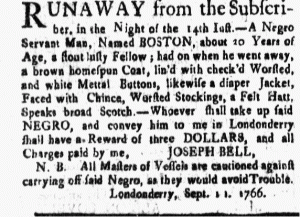
Slavery Advertisements Published October 10, 1766

GUEST CURATOR:  Ceara Morse

The Slavery Adverts 250 Project chronicles the role of newspaper advertising in perpetuating slavery in the era of the American Revolution. The project seeks to reveal the ubiquity of slavery in eighteenth-century life from New England to Georgia by republishing advertisements about enslaved people – for sale as individuals or in groups, wanted to purchase or for hire for short periods, runaways who liberated themselves, and those who were subsequently captured and confined in jails and workhouses – in daily digests on this site as well as in real time via the @SlaveAdverts250 Twitter feed, utilizing twenty-first-century media to stand in for the print media of the eighteenth century.

The project aims to provide modern audiences with a sense of just how often colonizers encountered these advertisements in their daily lives. Enslaved men, women, and children appeared in print somewhere in the colonies almost every single day. Those advertisements served as a constant backdrop for social, cultural, economic, and political life in colonial and revolutionary America. Colonizers who did not purport to own enslaved people were still confronted with slavery as well as invited to maintain the system by purchasing enslaved men, women, and children or assisting in the capture of so-called “runaways” who sought to free themselves from bondage. The frequency of these newspaper advertisements suggests just how embedded slavery was in colonial and revolutionary American culture in everyday interactions beyond the printed page.

These advertisements also testify to the experiences of enslaved men, women, and children, though readers must consider that those experiences have been remediated through descriptions offered by enslavers rather than enslaved people themselves. Often unnamed in the advertisements, enslaved men, women, and children were not invisible or unimportant in early America.

These advertisements appeared in colonial American newspapers 250 years ago today.

oct-10-new-hampshire-gazette-slavery-1
New-Hampshire Gazette (October 10, 1766).

**********

oct-10-virginia-gazette-slavery-1
Virginia Gazette (October 10, 1766).

**********

oct-10-virginia-gazette-slavery-2
Virginia Gazette (October 10, 1766).

October 9

GUEST CURATOR: Jordan Russo

What was advertised in a colonial American newspaper 250 years ago today?

oct-9-1091766-boston-news-letter
Massachusetts Gazette (October 9, 1766).

“A large and general Assortment of silver and other Ribbons, Necklaces, Earings and Pendants.”

This advertisement caught my eye because Jolley Allen ran a store in Boston. I live nearby in Medway, Massachusetts. Allen probably thought the items he sold would be bought mostly by women. His advertisement lists many items that women would want to look more fashionable, including “silver and other Ribbons, Necklaces, Earings and Pendants.” As Linda Baumgarten, Curator of Textiles at the Colonial Williamsburg Foundation, explains, “Like us, eighteenth-century people needed clothing for warmth and comfort, but they quickly abandoned those needs if fashion or the occasion dictated.”

Another reason Allen directed his advertisement towards women was because “the exercise of choice in the marketplace may have been a liberating experience” for women.[1] The choice of where to shop and what to purchase allowed women to bring business where they wanted. Jolley Allen probably knew this was the case and listed so many items to attract women to his store.

**********

ADDITIONAL COMMENTARY: Carl Robert Keyes

This advertisement may look familiar to readers who visit the Adverts 250 Project regularly. Guest curator Nicholas Commesso selected an advertisement by Jolley Allen to feature and analyze on September 29, less than two weeks ago. Doesn’t this advertisement deviate from the methodology established for the project, a commitment to feature a new advertisement every day? Why did I allow Jordan to choose this advertisement instead of sending her back to the Massachusetts Gazette or either of the other two newspapers printed in colonial America on October 9, 1766?

I could justify that decision by noting that Allen’s extensive advertisement merits attention more than once. It possessed features commonly found across advertisements during the colonial period, such as the implicit emphasis on female consumers that Jordan examined today. Allen also incorporated a variety of distinctive features into his advertisement, such as the money-back guarantee that Nick examined or the unique decorative border that was the focus of my analysis. This single advertisement included a multitude of significant aspects that tell us about colonial culture and commerce and the development of marketing techniques in eighteenth-century America. Considering how much was “going on” in Allen’s advertisement, no short analysis by a guest curator (nor my own slightly extended additional commentary) could do this advertisement justice.

Still, that was not the deciding factor when Jordan submitted this advertisement for my consideration and I approved it and told her to move forward with research and writing. After all, I did not know at that time that she would take a different approach than Nick did in his analysis. Although this advertisement looks familiar, it is actually a different advertisement than the one Nick examined on September 29. The copy was almost identical, though today’s version added an additional sentence after the nota bene. In addition, careful analysis reveals that the type was set differently, both for the body of the advertisement and the decorative border, which should come as no surprise considering that today’s advertisement was printed in the Boston News-Letter, but Allen’s advertisement featured on September 29 came from the Boston Evening-Post. While this might seem like a technicality (after all, Allen composed only one advertisement but submitted it to multiple newspapers), that the “same” advertisement appeared in more than one publication tells us something interesting about colonial entrepreneurs attempting to maximize exposure for their advertisements, as guest curator Elizabeth Curley demonstrated with John Taylor’s advertisements last week.

**********

[1] T.H. Breen, “An Empire of Goods: The Anglicization of Colonial America, 1690-1776,” Journal of British Studies 25, no. 4 (October 1986): 489.


Welcome, Guest Curator Jordan Russo

Jordan Russo is a senior at Assumption College, where she is double majoring in Elementary Education and History.  Her favorite historical topics are Ancient Egypt and Ancient China. In addition to her studies, Jordan works at a daycare and is a cheerleader at Assumption College. She has also participated in the annual UMass Medicine Cancer Walk and Run for the past three years and volunteered with Working for Worcester for the last two years. She will be guest curator for the Adverts 250 Project during the week of October 9 to 15, 2016, as well as curator for the Slavery Adverts 250 Project during the week of November 13 to 19, 2016.

Welcome, Jordan Russo!

Slavery Advertisements Published October 9, 1766

GUEST CURATOR:  Ceara Morse

The Slavery Adverts 250 Project chronicles the role of newspaper advertising in perpetuating slavery in the era of the American Revolution. The project seeks to reveal the ubiquity of slavery in eighteenth-century life from New England to Georgia by republishing advertisements about enslaved people – for sale as individuals or in groups, wanted to purchase or for hire for short periods, runaways who liberated themselves, and those who were subsequently captured and confined in jails and workhouses – in daily digests on this site as well as in real time via the @SlaveAdverts250 Twitter feed, utilizing twenty-first-century media to stand in for the print media of the eighteenth century.

The project aims to provide modern audiences with a sense of just how often colonizers encountered these advertisements in their daily lives. Enslaved men, women, and children appeared in print somewhere in the colonies almost every single day. Those advertisements served as a constant backdrop for social, cultural, economic, and political life in colonial and revolutionary America. Colonizers who did not purport to own enslaved people were still confronted with slavery as well as invited to maintain the system by purchasing enslaved men, women, and children or assisting in the capture of so-called “runaways” who sought to free themselves from bondage. The frequency of these newspaper advertisements suggests just how embedded slavery was in colonial and revolutionary American culture in everyday interactions beyond the printed page.

These advertisements also testify to the experiences of enslaved men, women, and children, though readers must consider that those experiences have been remediated through descriptions offered by enslavers rather than enslaved people themselves. Often unnamed in the advertisements, enslaved men, women, and children were not invisible or unimportant in early America.

These advertisements appeared in colonial American newspapers 250 years ago today.

oct-9-pennsylvania-gazette-slavery-1
Pennsylvania Gazette (October 9, 1766).

Reflections from Guest Curator Elizabeth Curley

As this is my third week of working on Adverts 250 it places me at an advantage over some of my other classmates. This may or may not be fair, but I relished the opportunity to work on the project again. For me personally what makes the project so interesting and exciting goes beyond the advertisements. Adverts 250 sometimes looks at the advertisement as a whole, which is important to help us understand the way people organized, wrote, and lived. However, often Adverts 250 looks into a seemingly insignificant part that is only a small part of an advertisement. This is when you find out about the people themselves, what they held to be important to themselves.

Colonial America was filled with influential people beyond the ones we learn about in our text books. Granted those people are very important to history, but what about the “everyday” people and community that influenced their lives? That made them who they are? To me, that is what makes the work of Adverts 250 so fascinating — and important.

As with all work there are challenges and victories; however, because this was my third week as guest curator I was lucky enough to experience more victories than challenges. A challenge that I think all historians from beginner (such as myself) to experienced face is knowing when to stop. By stop, I mean knowing when to move on to the next topic or subject or advertisement. I could spend days looking into just one advertisement. Part of this is because you have to “dig” through sources to find credible information. One day of that can lead to another day of answering all the questions that the first day of “digging” left you. As a budding historian this process consists of me actively involving myself in “doing history.” Another challenge that I believe all historians face while “digging” for the answers to their questions is being stuck at a dead end. This is because of many reasons, however the largest is simply the preservation of information. The amount of preserved information available from any time span will differ. One major victory was getting to piece together multiple different sources to finish each day’s analysis of an advertisement. There are the primary and secondary sources, as well as the historical and not-so historical sources that come into play while “digging “for information.

A large part of working on the Adverts 250 Project is that it is “doing” history.   While “doing history” you get to incorporate history, your experiences, and multiple views that the hindsight of 250 years gives us. Even though we do not have as much information from the colonial American period as I would like, I was able to connect multiple sources together. I was also to connect my colonial American class to my Education class to the Adverts 250 Project.

Another connection that I was able to make was how similar marketing techniques are. Both today and in the 1700s, people marketed their goods and wares for consumers. Colonial America was a center of commerce that had many ports of trade. Trade was an important part of the colonial economy that affected the lives of many people.

All in all I would relish the opportunity to work on the Adverts 250 Project again. Highlighting different aspects of colonial life within the advertisements allows me to look deeper into the “everyday.” Even though it is 250 years later the colonial Americans lived lives similar to ours. They worked hard and had busy lives. They never knew which aspects of their lives would be something that we would later study, but neither do we in 2016 know what historians will examine from our lives.


October 8

GUEST CURATOR: Elizabeth Curley

What was advertised in a colonial American newspaper 250 years ago today?

oct-8-1081766-georgia-gazette
Georgia Gazette (October 8, 1766).

“WENT AWAY from the subscriber about a week ago, AN INDENTED IRISH SERVANT MAN.”

This advertisement caught my eye because my ancestry is Irish. My father came to Boston in 1956. As with many Irish immigrants across time, he did not come with much money.   His aunt who lived in Boston sponsored him, and he had to work very had in the carpenters union to get to where he is now. Jeremiah Herrington, the “INDENTED IRISH SERVANT MAN” in this advertisement from the Georgia Gazette, made a similar journey for Ireland to North America.

In terms of culture and climate, Georgia was a big difference from what Jeremiah was used to in Ireland. Slavery had been banned in colonial Georgia until 1750, so indentured servitude was another way to get laborers during early years of settlement in the colony.

This advertisement had also been placed the week before on October 1, and not taken down. This leads me to believe that Joshua Vaughan had not heard from his Irish servant or any subscribers of the Georgia Gazette.   This could have meant that Herrington as still on the run.   Runaway advertisements were very popular in colonial newspapers; unfortunately, at the time owning a person was very common and desensitized. Missing servants and slaves were noticed quickly and often times if not found reported. If returned to their masters they were often punished. In some colonies, such as Virginia, masters could punish runaways with death if they were repeat offenders.

**********

ADDITIONAL COMMENTARY: Carl Robert Keyes

Elizabeth has chosen an advertisement that provides an important corrective to some of the research she and her classmates are doing this semester. In addition to guest curating the Adverts 250 Project for a week, each student in my colonial America class is also curating the newly established Slavery Adverts 250 Project on Twitter. Regular visitors here know that all of the advertisements from that project are republished here in a daily digest.

In designing that project, I chose to focus exclusively on slaves in colonial America, excluding other sorts of unfree laborers, such as indentured servants and convict servants. In part, I wanted to keep the project focused rather than risk becoming too diffused. In addition, modern Americans continue to grapple with the legacy of slavery in our culture, politics, and economics every single day; we are rather confronted with a legacy of indentured servitude that challenges us in the same way.

From a practical standpoint, I knew that the Slavery Adverts 250 Project would be an experimental collaborative research effort with my students. In launching something new like that I wanted to start off relatively small and leave room to expand at a later time, if the project worked out. As an instructor, I knew that the project needed to be self-contained and manageable for undergraduates who were studying colonial America for the first time and who were new to using digitized primary sources to conduct independent research. To test the viability of the project, I gathered all the slavery advertisements for a single week several months ago. In the process, I determined that the scope in terms of research, effort, and time was an appropriate substitute for the essay assignment the project replaced on the syllabus.

Still, I have questioned my decision because featuring slavery advertisements exclusively tells only part of the story of unfree laborers in early America. Each student submits hard copies of all the newspapers printed in colonial America during his or her week as curator of the Slavery Adverts 250 Project. I carefully skim through them to confirm that all the advertisement they have highlighted belong to the project as well as flag any that they might have missed. In the process, my students and I have encountered significant numbers of advertisements for indentured servants (and a smaller number for convict servants), both for sale and runaways. Such advertisements were especially common in newspapers published in Philadelphia and New York in 1766.

I stand by my decision to focus exclusively on advertisements concerning slavery for the class project, but that does not mean that our conversations in class exclude other forms of unfree labor, nor does it mean that the Adverts 250 Project cannot examine advertisements for indentured servants and convict servants in colonial America. This week Elizabeth has examined and advertisement for each.

Summary of Slavery Advertisements Published October 2-8, 1766

These tables indicate how many advertisements for slaves appeared in colonial American newspapers during the week of October 2-8, 1766.  Data for both tables was compiled by Mary Williams.

Note:  These tables are as comprehensive as currently digitized sources permit, but they may not be an exhaustive account.  They includes all newspapers that have been digitized and made available via Accessible Archives, Colonial Williamsburg’s Digital Library, and Readex’s America’s Historical Newspapers.  There are several reasons some newspapers may not have been consulted:

  • Issues that are no longer extant;
  • Issues that are extant but have not yet been digitized; and
  • Newspapers published in a language other than English (including the Wochentliche Philadelphische Staatsbote).

**********

Slavery Advertisements Published October 2-8, 1766:  By Date

slavery-adverts-tables-oct-2-by-date

**********

Slavery Advertisements Published October 2-8, 1766:  By Region

slavery-adverts-tables-by-region-oct-2

Slavery Advertisements Published October 8, 1766

GUEST CURATOR:  Mary Williams

The Slavery Adverts 250 Project chronicles the role of newspaper advertising in perpetuating slavery in the era of the American Revolution. The project seeks to reveal the ubiquity of slavery in eighteenth-century life from New England to Georgia by republishing advertisements about enslaved people – for sale as individuals or in groups, wanted to purchase or for hire for short periods, runaways who liberated themselves, and those who were subsequently captured and confined in jails and workhouses – in daily digests on this site as well as in real time via the @SlaveAdverts250 Twitter feed, utilizing twenty-first-century media to stand in for the print media of the eighteenth century.

The project aims to provide modern audiences with a sense of just how often colonizers encountered these advertisements in their daily lives. Enslaved men, women, and children appeared in print somewhere in the colonies almost every single day. Those advertisements served as a constant backdrop for social, cultural, economic, and political life in colonial and revolutionary America. Colonizers who did not purport to own enslaved people were still confronted with slavery as well as invited to maintain the system by purchasing enslaved men, women, and children or assisting in the capture of so-called “runaways” who sought to free themselves from bondage. The frequency of these newspaper advertisements suggests just how embedded slavery was in colonial and revolutionary American culture in everyday interactions beyond the printed page.

These advertisements also testify to the experiences of enslaved men, women, and children, though readers must consider that those experiences have been remediated through descriptions offered by enslavers rather than enslaved people themselves. Often unnamed in the advertisements, enslaved men, women, and children were not invisible or unimportant in early America.

These advertisements appeared in colonial American newspapers 250 years ago today.

october-8-georgia-gazette-slavery-1
Georgia Gazette (October 8, 1766).

**********

october-8-georgia-gazette-slavery-2
Georgia Gazette (October 8, 1766).

**********

october-8-georgia-gazette-slavery-3
Georgia Gazette (October 8, 1766).

**********

october-8-georgia-gazette-slavery-4
Georgia Gazette (October 8, 1766).

**********

october-8-georgia-gazette-slavery-5
Georgia Gazette (October 8, 1766).

**********

october-8-georgia-gazette-slavery-6
Georgia Gazette (October 8, 1766)

**********

october-8-georgia-gazette-slavery-7
Georgia Gazette (October 8, 1766)

**********

october-8-georgia-gazette-slavery-8
Georgia Gazette (October 8, 1766).

**********

october-8-georgia-gazette-slavery-9
Georgia Gazette (October 8, 1766).

October 7

GUEST CURATOR: Elizabeth Curley

What was advertised in a colonial American newspaper 250 years ago today?

oct-7-1071766-south-carolina-gazette-and-country-journal
South-Carolina Gazette and Country Journal (October 7, 1766).

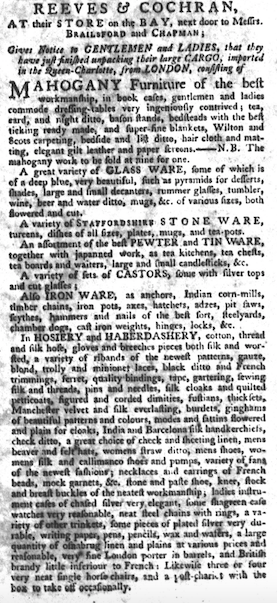
“MAHOGANY Furniture … GLASSWARE … HOSIERY and HABERDASHERY.”

This advertisement has different kinds of letters throughout, and that is originally what made me pay attention to it. I am sure that the middle of the page placement and the large “M” of Mahogany would have caught consumers’ eyes as well. Reeves and Cochran start their advertisement by politely addressing consumers and noting the exact location of their shop. This seems to have been a common practice in the colonial American marketplace. Another common practice in advertisements from the 1760s was to let customers know where goods came from. In this case Reeves and Cochran’s goods came from London on board the Queen Charlotte.

“Furniture of the best workmanship” could be hard to come by in colonial America. Artisans did build fine furniture in the major cities, but mahogany furniture was commonly built in Ireland and imported.[1] Many of the other goods that had just finished unloading from the Queen Charlotte came from different English colonies throughout the world as well as other faraway places. Reeves and Cochran sold “India and Barcelona silk handkerchiefs,” “French trimmings,” and “Manchester velvet.” By naming the origins of the goods that they sold, they made everyday items seem exotic and exciting.

This is not much different than what companies do today to market to twenty-first-century consumers. From the placement of the advertisement to the different kinds of letters to the wording, it is fair to say that colonial merchants and shopkeepers planned their marketing strategies.

Earlier in the week I talked about John Taylor and how he had multi-newspaper marketing technique.   This strategy is not much different than what multiple companies do today, such as placing radio, newspaper, and online advertisements.   As for Reeves and Cochran, their advertisement was designed to catch and keep the eye of consumers. Colonial merchants may have lived and worked 250 years ago, but they used and possibly developed marketing strategies that are still used today.

**********

ADDITIONAL COMMENTARY: Carl Robert Keyes

Elizabeth expresses interest in the layout and graphic design of Reeves and Cochran’s advertisement. While it may seem strange to suggest that this dense advertisement consisting exclusively of text with no woodcuts or ornamental type does indeed have graphic design elements, recall that it must be compared to the hundreds of other advertisements for consumer goods and services that appeared in colonial newspapers during the same week in 1766.

Many of those advertisements were disambiguated lists of goods, often grouped in a single paragraph. Sometimes similar types of goods were listed together, such as mentioning all the textiles before moving on to all the hardware, but in other instances the lists seemed to have no organization at all.

This advertisement listed a great variety of goods, but Reeves and Cochran constructed an advertisement easy for potential customers to navigate, not a hodgepodge favored by some of their competitors. Note that the advertisement was divided into several short paragraphs, each devoted to a different sort of merchandise stocked at Reeves and Cochran’s “STORE on the BAY.” (The final paragraph did revert to the dense list form. Why didn’t Reeves and Cochran divide it into two shorter paragraphs based on the different sorts of goods listed in the first and second halves?) Each paragraph included a key word or phrase in all capitals: “GLASS WARE” or “PEWTER and TIN WARE” or “HOSIERY and HABERDASHERY.” This would have made it easy for potential customers to find the sorts of goods that interested them, but it may have also attracted attention to items readers previously had not realized they might like to purchase.

I have suggested before that most of the evidence indicates advertisers generated the copy but printers had primary responsibility for layout as they set the type. In the manner it deviates from most others of the period, this advertisement seems to be an exception. Quite likely Reeves and Cochran included instructions when they submitted both copy and design specifications to the printer of the South-Carolina Gazette and Country Journal.

**********

[1] James Peill and John Rogers, Irish Furniture: Woodwork and Carving in Ireland from the Earliest Times to the Act of Union (New Haven, CT: Yale University Press for the Paul Mellon Centre for Studies in British Art, 2007).