September 7

What was advertised in a colonial American newspaper 250 years ago today?
Sep 7 - 9:7:1766 Providence Gazette
Providence Gazette (September 7, 1766).

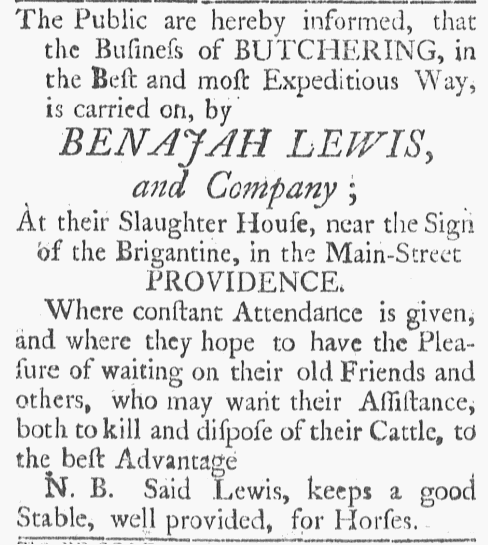
“The Business of BUTCHERING … is carried on, by BENAJAH LEWIS, and Company.”

Benajah Lewis and Company’s advertisement for “their Slaughter House … in the Main-Street PROVIDENCE” reminds us how much the spatial geography of cities has changed since the colonial era. Livestock would have been a fairly common sight in many areas of busy port cities, though cattle and hogs are absent from the urban landscape today. A slaughterhouse would have emitted both loud noises and unpleasant smells, but those have been replaced with loud noises and unpleasant smells of completely other sorts in the wake of urban development, expansion, and industrialization. Today, Armando and Sons Meat Market, Central Meat Market, Joe’s Meat Market, and Plainfield Meat Market each provide specialized butcher services and an enticing array of products to residents of Providence, but none of their websites indicate that live animals are slaughtered on site. That work seems to take place elsewhere (and may even be mandated by health codes and other regulations), distancing most carnivorous consumers from the ultimate source of their meals, much more so than colonists and the animals they ate.

As an aside, it’s interesting to note that two days ago I identified continuity between a newspaper advertisement published in 1766 and current “going out of business” promotions, but today’s advertisement included something that I sincerely doubt would be seen today. Lewis and Company ended their advertisement with a nota bene informing potential customers that “Said Lewis, keeps a good Stable, well provided, for Horses.” Given modern American sensibilities, it seems unlikely that any butchers would mention horses, even just the stabling of horses, in an advertisement promoting the meat sold at their shops or slaughterhouses. To do so would cast suspicion on the quality and the origins of the products they sell.
September 6

What was advertised in a colonial American newspaper 250 years ago today?

Sep 6 - 9:6:1766 Connecticut Gazette
Connecticut Gazette (September 6, 1766).

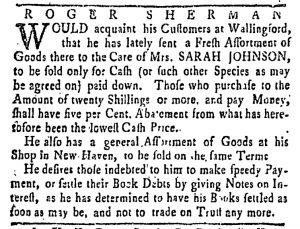
“ROGER SHERMAN … has lately sent a Fresh Assortment of Goods there to the Care of Mrs. SARAH JOHNSON.”

Relative to the number of women who worked as shopkeepers or otherwise operated businesses of various sorts in eighteenth-century America, very few women placed advertisements to promote their endeavors and attract customers. As a matter of principle, I do not wish to further obscure women’s participation in the marketplace as producers and retailers on the supply side of the equation; all too often they are depicted merely as consumers on the demand side. Accordingly, I select advertisements placed by women as frequently as practical.

Today’s advertisement caught my attention because it promotes a business run by a woman, yet it was not placed by the woman herself. Sarah Johnson sold “a Fresh Assortment of Goods” in Wallingford, a town about a dozen miles outside of New Haven. Roger Sherman, however, placed an advertisement in the Connecticut Gazette to “acquaint his Customers at Wallingford” that Johnson sold those goods and provided discounts for customers who bought in volume. He also wanted potential customers in New Haven to know that he sold a similar “Assortment of Goods” on the same terms.

This advertisement raises questions about the arrangements Johnson and Sherman made. It appears that Johnson oversaw the day-to-day operations of the shop in Wallingford, including the necessary accounting and negotiating (as indicated when Sherman allowed for payment in “such other Species as may be agreed on” instead of cash). Yet she seems to have been an employee of some sort rather than a partner. What kind of stake did she have in the enterprise? Did she own any of the inventory she stocked? Did she earn commissions on the goods she sold? How much risk had she assumed compared to Sherman? How much autonomy did she exercise in selecting goods and setting prices? Did she participate in the decisions to offer discounts or to call in debts? Note that Sherman referred to customers Johnson served in Wallingford as “his Customers,” suggesting how he envisioned his relationship to both Johnson and their (his?) clients.

This advertisement acknowledges Sarah Johnson’s presence in the operation of a shop in Wallingford, Connecticut, but it does not fully elaborate on her position relative to Roger Sherman beyond suggesting that even though she participated in the marketplace she did so as a subordinate to Sherman. The advertisement, intended for public consumption, maintained the gender hierarchy of the period, regardless of whatever practices Johnson and Sherman devised outside the public eye.

September 5

What was advertised in a colonial American newspaper 250 years ago today?

Sep 5 - 9:5:1766 New-London Gazette
New-London Gazette (September 5, 1766).

They have a Quantity of Goods remaining on Hand which they’ll Sell cheap.”

Trumbull, Fitch, and Trumbull ended their partnership on June 20, 1766. More than two months later they continued to advertise that their common enterprise had been terminated as they encouraged “All Persons having Accounts open with said Company” to settle them with Joseph Trumbull, one of the partners, “as soon as possible.”

Apparently the former partnership still had inventory remaining to be sold. Trumbull, Fitch, and Trumbull were certainly interested in receiving what they were owed by former customers, but their advertisement also indicated that any reader and potential customer could visit the store they had operated in Norwich and purchase the remaining merchandise. To make this an even more attractive prospect, they noted that “they have a Quantity of Goods remaining on Hand which they’ll Sell cheap for Cash or short Credit.”

The advertisement did not indicate how the current prices compared to what they had been during the partnership, but readers could assume that Trumbull, Fitch, and Trumbull were motivated to sell as they went their separate ways. In effect, the former partners operated an eighteenth-century precursor to a “going out of business” sale, though their advertising was not nearly as bold or flashy as modern promotions of similar events.

Still, this reminds us that some of the most basic marketing techniques were not invented in the twentieth century. Instead, over the last century or so marketers have further developed incipient strategies already deployed in the colonial America. A twenty-first-century version of today’s featured advertisement would likely focus exclusively on offering low prices in order to liquidate inventory (and leave the settling of accounts to be pursued via other means), refining the method used by Trumbull, Fitch, and Trumbull a quarter millennium ago.

September 4

What was advertised in a colonial American newspaper 250 years ago today?

Sep 4 - 9:4:1766 Pennsylvania Gazette
Pennsylvania Gazette (September 4, 1766).

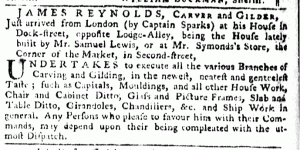
“JAMES REYNOLDS, CARVER and GILDER, … UNDERTAKES to execute all the various Branches of Carving and Gilding.”

James Reynolds, a carver and gilder by trade, announced that he had “Just arrived from London” and set up shop in Philadelphia. He used an advertisement to launch his business in the colonies when he first arrived, but over the next two decades he continued to entice customers to engage his services via advertisements in Philadelphia’s newspapers.

He also passed down his skills in “the various Branches of Carving and Gilding, in the newest, neatest and genteelest Taste” to his sons, James Jr. and Henry. Over time, Reynolds and his sons specialized in selling looking glasses with decorative frames, though they continued to advertise that could be hired to perform the “various Branches” of their trade. In the 1790s the Reynolds brothers offered the same services their father had advertised thirty years earlier, using much of the same language of current and genteel fashions.

They did not, however, restrict their marketing to newspaper advertisements. They also affixed furniture labels to the items they sold “At their LOOKING-GLASS Store, No. 56, Market-street, PHILADELPHIA.” Eighteenth-century artisans, including cabinetmakers and closely affiliated occupations, experimented with various means of advertising the furniture they produced. Like shopkeepers, some distributed trade cards. Others marked their furniture in various ways, including signing, stamping, and branding or pasting labels. Such labels often took the form of miniature trade cards that incorporated copy directly from newspaper advertisements. Marking furniture in this way allowed artisans to continue to advertise their wares to customers long after completing sales.

Sep 4 - Reynolds Furniture Label
Furniture label affixed to looking glass (c. 1795). Decorative Arts Photographic Collection, Winterthur Library.

The elder Reynolds may have devised his own furniture label, though none have survived. His sons certainly labeled the looking glasses they sold as they reminded customers of the variety of goods and services they provided. They wanted to increase the likelihood that customers satisfied with their previous purchases would patronize their shop once again. For many eighteenth-century entrepreneurs, newspaper advertisements were only one aspect of their marketing strategies.

September 3

What was advertised in a colonial American newspaper 250 years ago today?

Sep 3 - 9:3:1766 Georgia Gazette
Georgia Gazette (September 3, 1766).

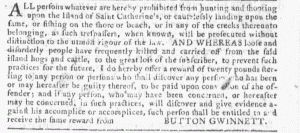
“BUTTON GWINNETT.”

It’s Founders Chic day at the Adverts 250 Project! Today’s advertisement was inserted in the Georgia Gazette a decade before Button Gwinnett became one of the fifty-six men who signed the Declaration of Independence, one of only three signers from Georgia.

Over time Gwinnett has become famous (sort of) for not being famous. He certainly did not become a household name like other signers of the Declaration, especially John Hancock, Benjamin Franklin, John Adams, and Thomas Jefferson. This was in large part due to his late entry in politics (he did not become an outspoken advocate of American rights until 1775, the year that fighting broke out at Lexington and Concord) and he died in 1777 (in a duel with a political rival over a failed invasion of East Florida, controlled by the British).

Gwinnett was not a man of letters, unlike so many other founders who left behind extensive correspondence. As a result, only fifty-one copies of his signature (including the one on the Declaration of Independence) are known to exist, making Gwinnett’s signature much more rare, valuable, and sought after than those of his much more famous and influential counterparts who signed the Declaration. (Learn more about the scarcity of Gwinnett’s signature at “Radiolab,” 7:50-14:40.) Gwinnett has remained so unknown compared to other signers that “The Late Show with Stephen Colbert” even broadcast a spoof “musical” featuring Lin-Manuel Miranda, the composer and star of “Hamilton: An American Musical.”

In today’s advertisement Button Gwinnett issued a cranky warning against others trespassing on his land and stealing his hogs and cattle. He threatened to prosecute offenders and offered a reward to anyone who provided evidence that contributed to a conviction.

This advertisement certainly did not have the historical magnitude of the Declaration of Independence. However, it provides a glimpse of the daily life and concerns of one of the (minor) founders. In 1766 Gwinnett had no way of knowing that he would someday sign the document that officially severed America’s political ties to Great Britain. It’s easy to put the founders on pedestals, but it might be more helpful to remember that they were also men sometimes consumed with ordinary concerns (like “disorderly people” who trespassed on their land). Asserting that only the most exceptional political philosophers have shaped the American experience and that they were inherently more intelligent and more virtuous than subsequent generations implicitly suggests that everyday people, the common folk who comprise the vast majority of the population, cannot even hope to live up to the examples set by the most famous founders. Button Gwinnett, on the other hand, demonstrates that we are all capable of practicing thoughtful citizenship, whether we have penned influential works of political philosophy or not.

September 2

What was advertised in a colonial American newspaper 250 years ago today?

Sep 2 - 9:2:1766 South-Carolina Gazette and Country Journal
South-Carolina Gazette and Country Journal (September 2, 1766).

“DANCING and FENCING.”

Elite and middling colonists consider personal comportment an important aspect of demonstrating their gentility to anyone who happened to observe them, most especially their peers. Comportment consisted of practicing proper manners, dressing appropriately and according to current fashions, and engaging in social rituals (such as drinking tea or dancing) with ease. Much of this could be learned through informal instruction within the household or carefully watching and then putting into practice the comportment of others, especially those generally acknowledged for combining good character and grace. Other aspects could be learned through reading newspapers and magazines and, increasingly throughout the eighteenth century, various sorts of instructional manuals or guides to good etiquette.

A few aspects of genteel comportment, however, required (or at least greatly benefited from) formal instruction by experts. Such was the case with dancing and fencing, two endeavors taught by Mr. Pike in Charleston, South Carolina, for nearly a decade in the late 1760s and early 1770s before he took up residence in Philadelphia and advertised his services there. (In advertisements that appeared in both cities, he was known only as “Mr. Pike,” the absence of a first name perhaps lending authority and cachet to the dancing master.)

Pike announced that his dancing school would open “for the ensuing Season” within the next couple of days. He encouraged all sorts of “scholars” (many of them presumably women and youth of both sexes) to attend his daytime lessons, but he also offered evening lessons for “grown Gentlemen” who needed to brush up on their skills or learn the steps that had most recently come into fashion. At a separate time, early mornings, he also taught “the Use of the SMALL-SWORD.” Fencing certainly would have been a pastime adopted by the select few with sufficient leisure times to pursue it.

Pike concluded his advertisement by announcing that the “BALL for his young Ladies and Gentlemen, will be the second Week in December.” In so doing, he encouraged potential students to envision their dancing abilities – and their ability to make an impression on others – after taking his lessons. Hosting a ball also had the potential to be good for business, putting Pike’s students on display and demonstrating the quality of his instruction. Like any other sort of recital, it also implicitly incorporated elements of competition that might prompt clients to continue to engage his services.

September 1

What was advertised in a colonial American newspaper 250 years ago today?

Sep 1 - 9:1:1766 New-York Gazette
New-York Gazette (September 1, 1766).

“THOMAS MORE’S ALMANACK, For the Year 1767. Is in the Press at W. Weyman’s.”

When it came to the printers and booksellers in colonial America, almanacs were a staple among the merchandise they produced and sold. These inexpensive pamphlets were in great demand, finding their way into the hands of readers from all kinds of backgrounds, from the elite to the most humble. In the 1960s Milton Drake compiled a bibliography of hundreds of almanacs printed in America in the eighteenth-century. Printers met the high demand for these calendars that doubled as reference periodicals by delivering an extensive supply to colonial customers, competing with each other in the process.

Given the diversity of almanacs available for public consumption, printers (as well as the authors of the almanacs themselves) needed to direct potential customers to the volumes they produced. Among the most common appeals, they promoted the accuracy of their almanacs, sometimes underscoring the education or other qualifications of the author or compiler. Benjamin Franklin’s almanacs, authored under the pseudonym Richard Saunders or Poor Richard, gained popularity for the aphorisms the astute printer inserted. (Arguably, those aphorisms made Franklin’s almanacs the most famous of the eighteenth century. Poor Richard’s almanacs remain well known in popular culture today, not just among scholars of early American print culture, thanks not only to their connection to one of the founders but also because the aphorisms have become nuggets of wisdom passed down from one generation of Americans to the next.) The authors and compilers of almanacs, like “Poor Richard,” became brands in and of themselves, contributing to the popularity of certain almanacs and forging a loyalty that predisposed colonists to continue purchasing familiar publications.

William Weyman devised another strategy for placing his almanacs in the hands of readers. He advertised them early (indeed, very early!), which allowed him to bring his almanacs to the attention of potential customers before they even considered others printed by competitors. “THOMAS MORE’S ALMANACK, For the Year 1767” was not yet ready for sale at the time that Weyman placed today’s advertisement. It was merely “in the Press … and will be published in due Time.” This advertisement appeared on September 1, a full four months ahead of the year covered in the almanac, but Weyman was priming customers to consider his almanac. They might not have needed it yet, but it was a product many of them knew that they would purchase eventually.

Modern retailers engage in similar practices. This year many stores started stocking Halloween items in August. Thanksgiving and Christmas merchandise will be available soon, if it is not on shelves already. Today’s merchants did not invent promoting seasonal goods well before customers needed them. William Weyman and others were already doing that in the eighteenth century.

August 31

What was advertised in a colonial American newspaper 250 years ago this week?

Aug 31 - 8:30:1766 Providence Gazette
Providence Gazette (August 30, 1766).

“JUST IMPORTED … BY THOMPSON AND ARNOLD …”

“Still carries on the Business of cleaning and repairing CLOCKS …”

“The Partnership … being now expired …”

“TO BE SOLD … A FARM containing seventy acres of good land …”

“READY MONEY given for Linen Rags of any Sort …”

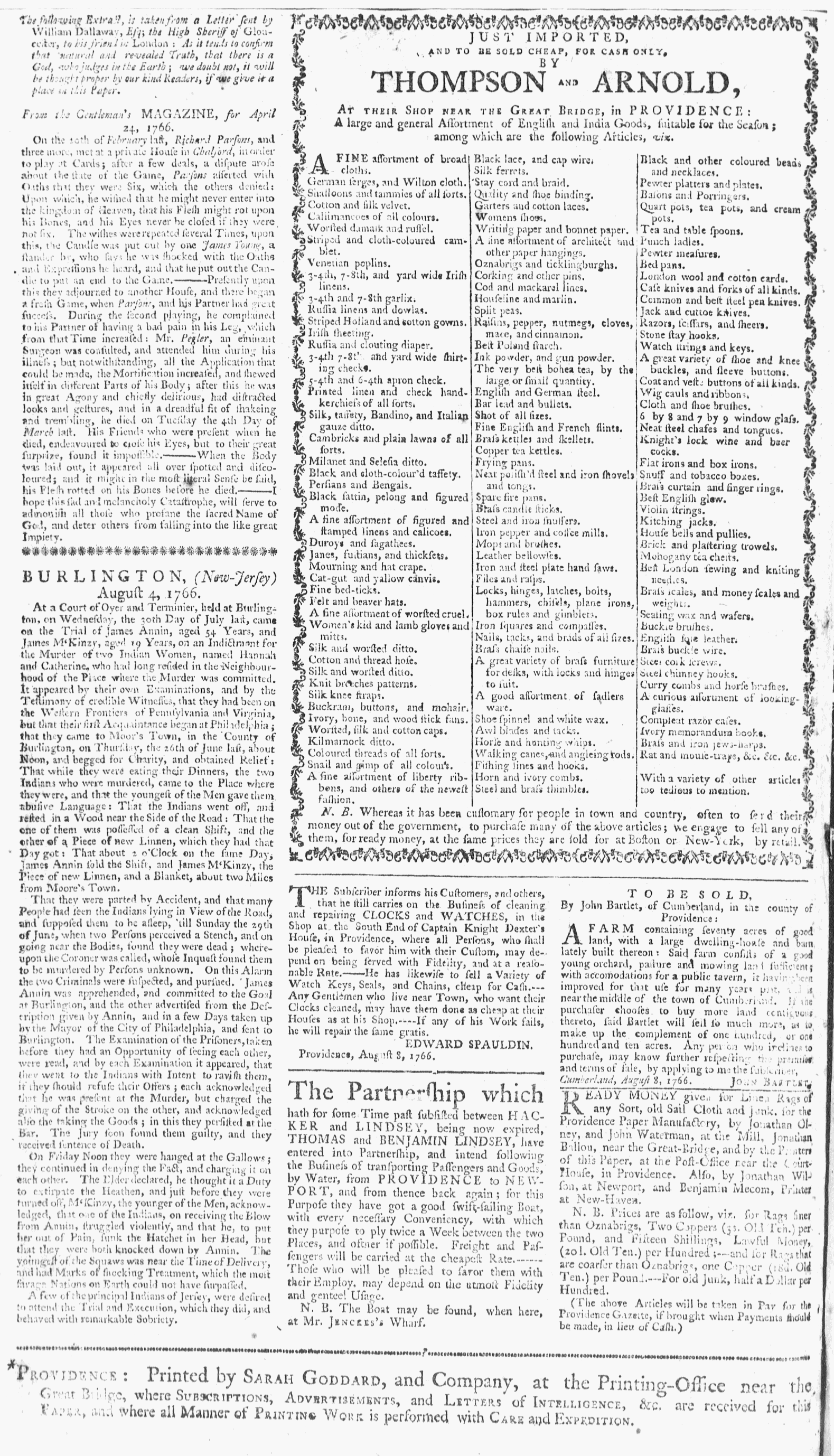
Rather than examine a single advertisement, today’s entry explores the day-to-day operations of the printing trade by examining the advertisements and news items that appeared in the final pages of two consecutive issues of the Providence Gazette: August 23 and 30, 1766. At a glance, these two pages look nearly indistinguishable from each other, thanks in part to the way that Thompson and Arnold’s oversized advertisement draws the eye. But it is not merely the repetition of that particular advertisement that creates the perception of two nearly identical pages. In addition, all five advertisements in the August 30 issue were repeated from in the same configuration that they appeared in the August 23 issue. Finally, the Providence Gazette’s colophon runs across the bottom of each page. New content appeared only in the first column: an extract from the Gentleman’s Magazine and a report about a trial and execution in New Jersey had been replaced with reports of bandits in western Massachusetts and slaves attaching their masters in New Hampshire.

Aug 31 - 8:23:1766 Providence Gazette
Providence Gazette (August 23, 1766).

Here we see that printing advertisement offered several advantages to the men and women who printed newspapers. Not only did these notices generate revenue, once set in type they also streamlined the production of newspapers from week to week. In an age when all type was set by hand, printers benefited from inserting advertisements for multiple weeks. In most instances individual advertisements moved around the page, though it is clear from their format that the type had not been reset. Today we see a more extreme example: none of the advertisements moved at all. For the ease of the printer, they likely stayed in the form, reducing the amount of time and labor necessary to produce the new issue.

The following week the first column of the final page of the Providence Gazette once again included new content, as did the second and third columns on the upper third of the page, but Thompson and Arnold’s oversized advertisement had been shifted to the bottom. The printer once again benefited from reprinting content that subscribers expected to see more than once in their newspapers. At the same time, the printer realized that she could not be too repetitive or risk alienating readers who also demanded new content and desired the “freshest advices, foreign and domestic.”

August 30

What was advertised in a colonial American newspaper 250 years ago today?

Aug 30 - 8:30:1766 Providence Gazette
Providence Gazette (August 30, 1766).

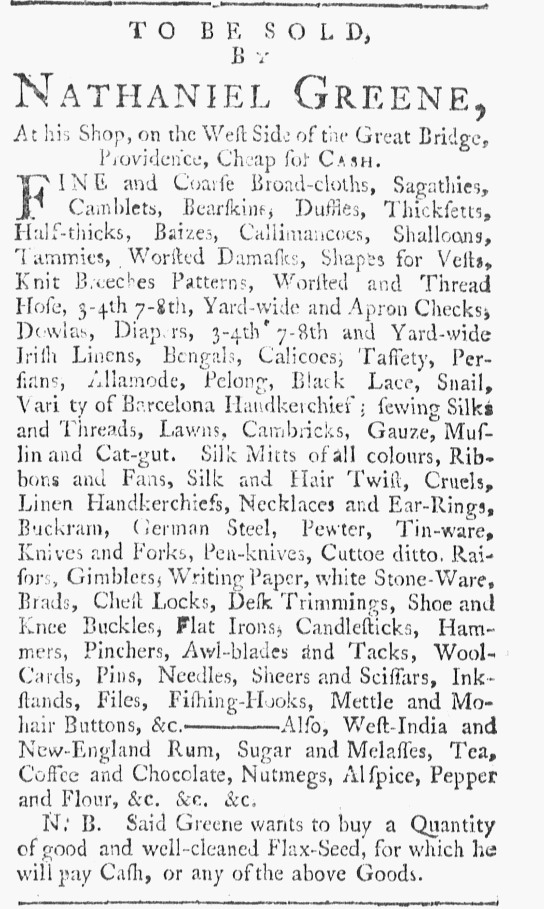
“Tin-ware, Knives and Forks, Pen-knives, Cuttoe ditto, Raisors, Gimblets.”

Reading an eighteenth-century advertisement can sometimes feel like deciphering a foreign language. Often that is the case when encountering an array of textiles (such as the “Sagathies, Camblets, Bearskins, Duffles, Thicksetts, Half-thicks, Baizes, Callimancoes, Shalloons, Tammies” listed in today’s advertisement), but some advertisements included other sorts of merchandise that modern readers likely have difficulty identifying.

For instance, the portion of today’s advertisement that lists metal goods and hardware includes “Tin-ware, Knives and Forks, Pen-knives, Cuttoe ditto, Raisors, Gimblets.” Taking into account the non-standardized spelling of the eighteenth century, “Raisors” were razors, but what did Nathaniel Greene mean by “Cuttoe ditto” and “Gimblets”?

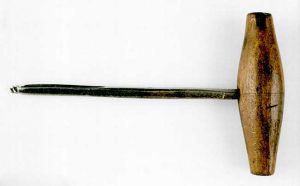
Carpenters may recognize the gimblet as a hand tool similar to an auger, except smaller. Its size made it ideal for drilling small holes without splitting wood. A variety of colonial artisans may have been especially interested in purchasing gimblets for their workshops, but the tool probably had practical use in many homes as well.

Aug 30 - Gimlet
A Gimblet (“Augers, Gimlets, and Braces,” Colonial Williamsburg).

Deciphering “Cuttoe ditto” requires reading this item as part of a larger phrase: “Pen-knives, Cuttoe ditto.” The “ditto” indicates that readers should substitute the word knives.

So, Greene sold cuttoe knives, but what were those? It seems that question generates some amount of uncertainty, which Steve Rayner and Jim Mullins have addressed in “Cuttoe Knives Revealed” at “Of Sorts for Provincials” (supplemented with eighteenth-century trade cards and illustrations). Rayner and Mullins reach the conclusion that cuttoe knives were clasp knives (also called spring knives), not to be confused with the larger cutteau de Chasse (a variety of short sword) also produced and sold in the eighteenth century.

While this advertisement presents a bit of a mystery for modern readers, Rayner and Mullins consulted other advertisements to answer some of their questions. In particular, three newspaper advertisements printed in the 1760s clarified what kind of knife Greene sold. An advertisement in the Boston Evening-Post (June 23, 1760) listed “cutteau and all other sorts of clasp knives,” another in the Boston News-Letter (March 25, 1762) included “spring Knives & Cutteau ditto,” and one in the Pennsylvania Chronicle (May 9, 1768) mentioned “cutteau pocket knives.” The last two distinguished the cutteau knives from penknives.

Cuttoe knives may be unfamiliar to modern readers, but potential customers in eighteenth-century Providence would have readily recognized this product when they encountered it in Greene’s advertisement.

August 29

Who was the subject of an advertisement in a colonial American newspaper 250 years ago today?

Aug 29 - 8:29:1766 Virginia Gazette
Virginia Gazette (August 29, 1766).

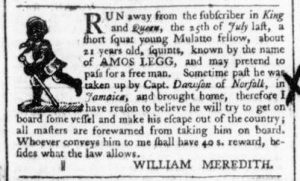
“RUN away … a short squat young Mulatto fellow.”

Amos Legg, an enslaved “young Mulatto fellow,” seemed determined to escape from bondage. In an advertisement alerting readers of the Virginia Gazette that Legg had made his escape, William Meredith also reported that “Sometime past he was taken up by Capt. Dawson of Norfolk, in Jamaica, and brought home.” Legg must have been a particularly recalcitrant slave, one who did not allow the setback of having been captured and returned to his master deter him from making a subsequent attempt to seize his own liberty in an age when Virginia’s gentry protested what they considered “enslavement” via infringements on their liberty by Parliament.

Like other genres of advertisements, those for runaways often followed a general formula and included stock language (just as they often included a stock image of an enslaved person). Advertisements for runaways frequently warned “masters of vessels” against giving passage to suspected runaways attempting to put as much distance between themselves and their masters as possible. That Legg had previously made it to Jamaica from Virginia indicates that masters had real cause to worry about such possibilities.

This advertisement tells a story of the resilience of one man who refused to accept his enslavement, but it also reveals the tenuous position of runaways. No matter how far away from their masters they managed to get, they were never completely free or safe. Their everyday experience included the possibility of capture and return, compounded by threats of punishment for the audacity of having made an escape at all. A sharp-eyed captain had taken up Amos Legg hundreds of miles from Virginia. How many other advertisements about runaway slaves resulted in men and women being returned to their masters after an all-too-brief respite from bondage?