September 17

What was advertised in a colonial American newspaper 250 years ago today?
sep-17-9171766-georgia-gazette
Georgia Gazette (September 17, 1766).

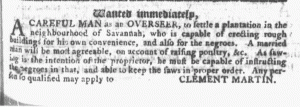
“Wanted immediately, A CAREFUL MAN as an OVERSEER. … A married man will be most agreeable.”

A week ago I examined another employment advertisement from the Georgia Gazette, noting that while some aspects had not much changed since the colonial period the specification that a single man would make a “more agreeable” candidate for the job than a married applicant would not pass muster today.

Clement Martin also sought to hire an overseer, but, unlike John Simpson, he preferred a married man for the job, indicating that “a married man will be most agreeable, on account of raising poultry, &c.” Martin listed several requirements and responsibilities. In general, he expected his overseer “to settle a plantation” near Savannah. That included managing enslaved laborers, “erecting rough buildings,” “keep[ing] the saws in proper order,” and teaching the enslaved laborers the necessary skills for using the saws.

Clement Martin probably did not expect his overseer to be “raising poultry, &c.” Most likely, he envisioned that such tasks would be undertaken by the wife of the married man that Martin considered “most agreeable.” In effect, he was looking to acquire two employees who would see to the various tasks on his plantation, though he only advertised for an overseer. The unpaid labor that an overseer’s wife provided, such as caring for small livestock or gardening, would be an added bonus to Martin.

Women’s contributions to household economies in the colonial era have sometimes been overlooked or downplayed, especially when they did not earn specific wages or other compensation for their efforts. Today’s advertisement pulls back the curtain just a little, suggesting that sometimes men’s employment was contingent, at least partially, on the mostly unseen and unpaid labor that their wives could provide.

September 16

Who was the subject of an advertisement in a colonial American newspaper 250 years ago today?

sep-16-9161766-south-carolina-gazette-and-country-journal
South-Carolina Gazette and Country Journal (September 16, 1766).

“A LIKELY young Negro Fellow, who is a good Ship-Carpenter and Caulker.”

As this advertisement vividly demonstrates, enslaved people contributed far more than just involuntary labor to the developing economies of the American colonies. The unnamed “LIKELY young Negro Fellow” offered for this sale in this advertisement was “a good Ship-Carpenter and Caulker” who possessed very specialized skills that could be gained only through training and experience. His work required knowledge of various materials and resources as well as proficiency with an assortment of tools. This “LIKELY young Negro Fellow” was an artisan in his own right, even if his master and other colonists did not accord him that status but instead chose to think of him as a laborer.

In addition to illustrating the expertise possessed by some slaves in colonial America, this advertisement also testifies to the relationship between print and slavery in the eighteenth century. My students recently read an article by David Waldstreicher, “Reading the Runaways.”[1] Although Waldstreicher examined the Middle Colonies, advertisements like this one suggest that his arguments extend to other regions in British mainland North America. For instance, printers enjoyed financial gains thanks to slavery and the slave trade every time they included advertisements for runaways or seeking to buy and sell slaves in their newspapers. It was not necessary to own slaves or sell slaves to benefit from the enslavement of Africans.

Also note that this advertisement directs interested parties that “For farther Particulars, enquire of the Printer of this Paper.” Such maneuvers placed printers, rather than slave traders or auctioneers, at the center of some networks for buying and selling slaves. Printers often facilitated and oversaw the sales of enslaved men, women, and children. In addition, this advertisement did not name the seller or the slave. Waldstreicher points out that this allowed potential sales to remain secret from those who might be sold. Some slaves were literate and shared the contents of newspapers with their peers, but the absence of names meant that the “LIKELY young Negro Fellow” would not be tipped off about an impending sale and choose to avoid it by running away.

This short advertisement, only five lines, opens up a much broader world of colonial commerce, labor, and culture than might be readily apparent at first glance.

**********

[1] David Waldstreicher, “Reading the Runaways: Self-Fashioning, Print Culture, and Confidence in Slavery in the Eighteenth-Century Mid-Atlantic,” William and Mary Quarterly, 3rd ser., 56, no. 2 (April 1999): 243-272.

September 15

What was advertised in a colonial American newspaper 250 years ago today?

sep-15-9151766-boston-evening-post
Boston Evening-Post (September 15, 1766).

“All Persons may be supplied with DRUGS and MEDICINES of the freshest and best Kinds.”

In his capacity as executor of Thomas Aston’s estate, William Coffin, Jr., placed an advertisement asking “All Persons that have any Demand upon the Estate … to bring in their Accounts.” Likewise, “all those Persons that are indebted to said Estate … are desired to come and settle with said Executor.” Such announcements were fairly standard in eighteenth-century America.

The next portion of the advertisement, however, deviated from most estate notices placed by executors. Coffin announced that he “proposed to carry on the Business of the Shop as heretofore.” Aston had been an apothecary. Coffin marketed the remaining inventory of “DRUGS and MEDICINES of the freshest and best kinds” that had been imported from England the previous spring. Coffin was not simply clearing out existing inventory. He reported that “another [shipment of medicines] is expected to arrive this Fall from England.” In addition, he carried “Groceries and Dye Stuffs.”

Coffin and Aston’s relationship was not readily apparent in this advertisement, though it would have been well known to residents of Boston. Aston, an apothecary, was father-in-law to Coffin, a merchant and shopkeeper. Their familial connection tied together their business interests, even prompting Coffin to peddle the “DRUGS and MEDICINES” that had previously been his father-in-law’s specialty.

That’s not to say that Coffin lacked experience selling medicines. He began placing advertisements in Boston’s newspapers at least a decade earlier, though he initially promoted “CHOICE Philadelphia FLOUR” exclusively (Boston-Gazette, July 5, 1765). By the early 1760s he was also advertising goods imported from London, especially hardware. Throughout that period his advertisements indicated that he moved from location to location, setting up shop at various stores and warehouses in Boston. He continued to diversify the merchandise he sold, placing an advertisement for a variety of textiles, hardware, and groceries that he sold “At Store No. 12 on the Long Wharf” (Boston Evening-Post, October 22, 1764; Boston-Gazette, October 29, 1764)). In the same advertisement he noted that he “could be spoke with at Dr. Aston’s, next Door to the Governor’s.” It was only in subsequent advertisements that Coffin included “A general Assortment of Drugs and Medicines” among the inventory listed in his advertisements (Boston-Gazette, December 2, 1765).

Coffin almost certainly did not have the same expertise as his father-in-law, an apothecary, when it came to “DRUGS and MEDICINES,” but their familial relationship and mentorship by the elder man likely played a role in Coffin’s decision to expand his business interests.

September 14

What was advertised in a colonial American newspaper 250 years ago this week?

sep-14-9131766-providence-gazette
Providence Gazette (September 13, 1744).

“Likewise to be sold at the same Place …”

Most readers of the Providence Gazette in 1766 probably would not have paused to question if this constituted one advertisement or two separate advertisements. For historians of printing and/or advertising interested in quantifying and analyzing the number of advertisements that appeared in colonial newspapers, on the other hand, it raises a conundrum.

At first glance, it appears to be a single advertisement, especially since the phrase “Likewise to be sold at the same place” functions as a transition from a list of books for sale to a more elaborate description of a particular book sold by the same advertiser. However, the two halves of this advertisement appeared separately, in different columns, in the previous issue. The list of books appeared at the bottom of a column and the advertisement for the pamphlet on making pearl ashes was at the top of the next column. This would have had the effect of presenting them sequentially to anybody who read the newspaper from first page to last, even through they were spatially separated. The printer likely intended them to be distinct, yet related advertisements. Still, the absence of a line separating them when they appeared one above the other (the same sort of line that defined the boundaries of other advertisements that appeared in the issue) serves as a visual cue indicating a single advertisement.

For the most part, it doesn’t much matter if this was one advertisement or two, though it does demonstrate that printers were able to leave some content (namely advertisements) in their forms and move them around to fit their needs from issue to issue.

Still, this presents a frustrating situation for certain research questions. For other projects I have attempted to count the number of advertisements placed by members of the book trade as a proportion of total advertisements. This example, if counted only once, downplays the influence of printers and booksellers on eighteenth-century advertising, especially considering its length relative to other advertisements in the same issue. This suggests that tabulating column inches would be a better method for making such assessments, but that method would be much more labor intensive (not necessarily a good justification for not doing it) as well as impossible to do with microfilmed and/or digitized sources that do not include measurements among the metadata (a better explanation for not measuring column inches). For researchers that do not have access to the original newspapers, tabulating column inches simply would not be possible. Counting how many advertisements appeared, while flawed, at least allows for some sort of metrics when working with surrogates rather than original sources.

September 13

What was advertised in a colonial American newspaper 250 years ago today?

Sep 13 - 9:13:1766 Providence Gazette
Providence Gazette (September 13, 1766).

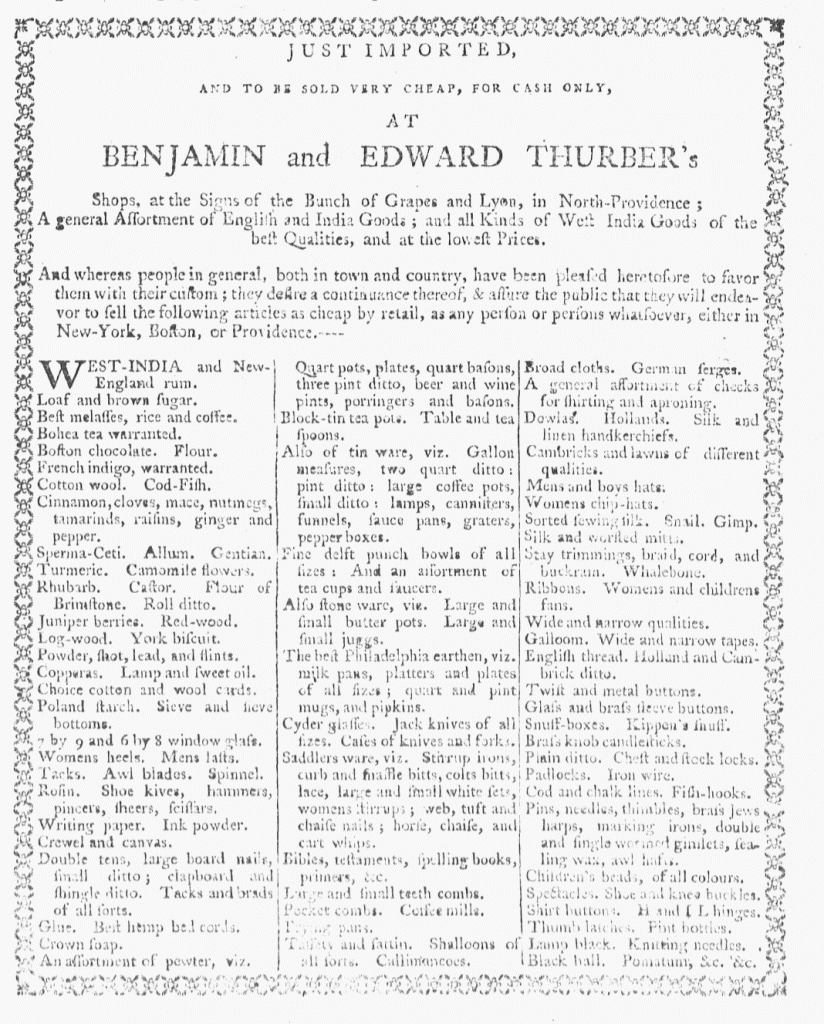
“AT BENJAMIN and EDWARD THURBER’s Shops, at the Signs of the Bunch of Grapes and Lyon.”

On August 9, 1766, Thompson and Arnold placed an exceptional advertisement in the Providence Gazette, an advertisement guaranteed to attract attention thanks to its innovative graphic design. Unlike the standard advertisement that appeared elsewhere in the Providence Gazette and other newspapers throughout the colonies, Thompson and Arnold’s advertisement extended across two columns, sequestered from other content on the page by a decorative border comprised of printer’s ornaments. Within the advertisement, the extensive list of merchandise was set in three columns, further disrupting the lines formed by the other columns on that page and the rest of the issue. Furthermore, Thompson and Arnold’s advertisement was so large that it dominated the page. At a glance, it seemed more like a trade card or handbill, meant to be distributed separately, yet superimposed on the newspaper page.

Thompson and Arnold’s striking advertisement appeared in the Providence Gazette in subsequent issues, moving to different corners of the page depending on the needs of the printer, but always the focal point no matter the quadrant where it appeared. Then something even more interesting happened just five weeks later. The Providence Gazette featured another advertisement, this one the shops operated by Benjamin and Edward Thurber, that imitated the graphic design of Thompson and Arnold’s advertisement. It was oversized. It spread across two columns. It included a decorative border made of printing ornaments. It further disrupted the lines on the page by dividing the merchandise into three columns. It could have been distributed separately as a handbill or trade card.

Benjamin and Edward Thurber’s advertisement appeared on the third page of the September 13, 1766, issue of the Providence Gazette. Thompson and Arnold’s advertisement continued to appear on the fourth page. What might Thompson and Arnold have thought of their competitors aping their unique graphic design? Advertisers seemed to be paying attention to the commercial notices placed by others and updating their own marketing in response to what they saw and what they anticipated would be effective.

September 12

What was advertised in a colonial American newspaper 250 years ago today?

Sep 12 - 9:12:1766 New-Hampshire Gazette
New-Hampshire Gazette (September 12, 1766).

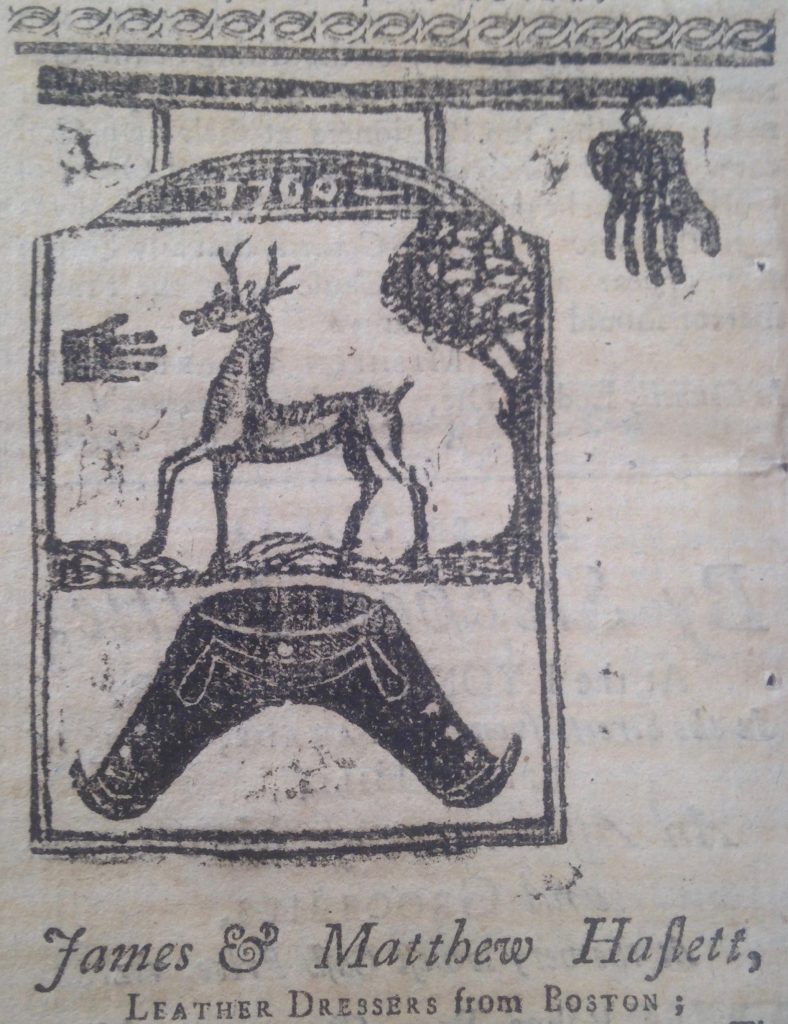
James & Mathew Haslett … have set up their Factory at the Sign of the Buck and Glove.”

Relatively few artisans or shopkeepers included images in their newspaper advertisement during the eighteenth century. Although printers already possessed the type, advertisers were responsible for providing any woodcuts beyond the stock printers ornaments. As a result, most advertisements placed by artisans and shopkeepers lacked images. In contrast, advertisements for runaway slaves, real estate, and vessels clearing port often sported woodcuts of slaves, houses, or ships, respectively. Each type of those stock ornaments could be used interchangeably for advertisements from the associated genre.

On the other hand, when advertisements placed by artisans and shopkeepers included woodcuts, those images were specific to a particular advertiser. In most cases, the text of the advertisement suggested that the image illustrated the shop sign that marked the advertiser’s establishment. The woodcut in James and Matthew Haslett’s advertisement even depicted a shop sign!

Sep 12 - Haslett 8:29
Detail of James and Matthew Haslett’s advertisement in the New-Hampshire Gazette (August 29, 1766). American Antiquarian Society.

The visual culture of the newspaper corresponded to the scenes readers saw on the street. But how closely did these woodcuts replicate the shop signs they were intended to portray? It’s tempting to assume that they were designed to reproduce the original as much as possible, yet the woodcut in the Hasletts’ advertisement throws that supposition to question. The image that appeared in the September 12 issue was the second one used by the Hasletts. Just two weeks earlier they published the same advertisement with a different (but similar) woodcut, before replacing it in the September 4 and September 12 issues. (The woodcut did not appear in the New-Hampshire Gazette again after that throughout the rest of 1766.)

Sep 12 - Haslett 9:4
Detail of James and Matthew Haslett’s advertisement in the New-Hampshire Gazette (September 4, 1766). American Antiquarian Society.

Why did the Hasletts switch from one woodcut to another? What kind of expenses were involved in that decision? Was including a woodcut in their advertisement worth the investment? Did the Hasletts distribute any handbills or billheads that incorporated the same woodcut? Did the new woodcut more closely replicate their actual shop sign?

Today’s advertisement offers some refreshing visual culture among eighteenth-century advertisements usually comprised exclusively of text. However, it also raises questions about the decisions made by advertisers and how closely the crude proto-logos that appeared in newspaper advertisement portrayed the shop signs they were supposed to reference.

Sept 12 - Haslett 9:12
Detail of James and Matthew Haslett’s advertisement in the New-Hampshire Gazette (September 12, 1766). American Antiquarian Society.

While researching this entry, I consulted the original newspapers in the collections of the American Antiquarian Society in addition to the digital surrogates in Readex’s Early American Newspapers.

September 11

What was advertised in a colonial American newspaper 250 years ago today?

Sep 11 - 9:11:1766 Pennsylvania Journal
Pennsylvania Journal (September 11, 1766).

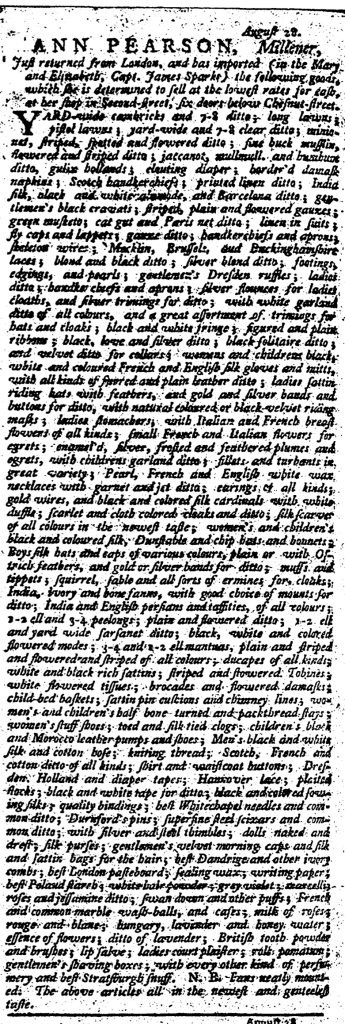
“The above articles all in the newest and genteelest taste.”

Milliners and shopkeepers often promoted their merchandise by noting that it had been imported from London or other English ports, suggesting that this gave their wares special cachet in terms of both taste and quality. They frequently named both the ship and the captain that transported their goods across the Atlantic, which allowed savvy newspaper readers to recognize vessels recently listed in the shipping news elsewhere in the newspaper. In this way, potential customers could assess for themselves that an advertiser stocked the most current fashions.

In most instances, milliners and shopkeepers relied on networks of correspondence involving faraway merchants and producers to obtain the goods they sold to colonists. American retailers – and the customers they served – had to trust that they had indeed received merchandise currently fashionable in metropolitan London, though many suspected that the distance that separated them from the capital allowed correspondents to pawn off leftover or undesirable goods that otherwise would not have been sold.

In this advertisement, however, Ann Pearson stated that she had “Just returned from London” and had imported a vast array of textiles and accouterments for personal adornment. Rather than accept whatever goods distant correspondents dispatched, she had an opportunity to select which items she wished to offer to her customers. She concluded her advertisement with an assurance that the “above articles [were] all in the newest and genteelest taste.” Unlike most other milliners and shopkeepers who sold imported English goods, Pearson was in a unique position to make this claim, having witnessed current styles in London herself rather than relying on the good will of intermediaries and middlemen.

September 10

What was advertised in a colonial American newspaper 250 years ago today?

Sep 10 - 9:10:1766 Georgia Gazette
Georgia Gazette (September 10, 1766).

“AN OVERSEER … will meet with good encouragement by applying to JOHN SIMPSON.”

When John Simpson needed to hire an overseer he placed an advertisement in the Georgia Gazette to alert potential employees that the position was available. Though brief, a mere five lines, the advertisement demonstrates both continuity and change over time when compared to modern hiring practices.

Simpson listed three necessary qualifications. A qualified overseer “understands his business” and could demonstrate both “fidelity and industry.” In other words, Simpson wanted to hire somebody who possessed expertise (likely gained through experience), who was dependable, and who worked hard. Although the advertisement did not specify, the overseer was probably expected to oversee enslaved laborers as well as other operations on Simpson’s property. To “understand his business” likely included previous experience managing (including disciplining) slaves. To demonstrate their qualifications, applicants needed to “bring proper vouchers” that stated they fulfilled these qualifications. Letters of introduction in eighteenth-century America played a similar role to letters of recommendation today.

Simpson also included an additional preference, though it was not a requirement for obtaining the position. It would be “more agreeable” for prospective overseers to be single men. Simpson did not explain why he considered this “more agreeable,” but it may have been linked to the “fidelity and industry” that could be expected of the overseer. Perhaps Simpson assumed (or had learned by experience) that single men devoted more time, energy, and attention to their work in the absence of distractions caused by wives and families. In addition, if an overseer was expected to live on the property, Simpson may have been concerned about incorporating any dependents the operations.

Whatever Simpson’s reason for finding it “more agreeable” to hire an unmarried man, that he specified any preferred marital status at all makes this notice incongruous with modern employment advertisements that make no reference at all to various personal attributes that have no bearing on an individual’s ability to do the job.

September 9

What was advertised in a colonial American newspaper 250 years ago today?

Sep 9 - 9:9:1766 South-Carolina Gazette and Country Journal
South-Carolina Gazette and Country Journal (September 9, 1766).

“To carry on Business on her own proper Account, as sole Dealer and seperate Trader.”

Anne Raymor published an advertisement with an unusual twist. Throughout the colonies, newspaper readers would have been very familiar with advertisements for runaway wives, a genre in which aggrieved husbands announced that their wives had absconded or “eloped” from them and warning merchants, shopkeepers, and other not to extend any credit to them. In such instances, men exercised financial mastery over women, curtailing their ability to participate in the marketplace as consumers.

According to today’s advertisement, Anne Raymor wished to be more than a consumer. She wanted to “carry on Business on her own proper Account, as sole Dealer and seperate Trader, exclusive and free from any Concern with her Husband.” In this instance, it was the wife who sought to sever financial connections with the husband. This was a particularly transgressive course considering the political and economic rights of women under the laws of coverture in eighteenth-century America.

Upon marriage, a woman became a feme covert, her legal identity subsumed by her husband, the head of the family and household. She could not own property in her own name, sign contracts, control her own earnings, or sue others in court. All of these actions would have been important and necessary, then as now, for women who operated businesses, whether shopkeepers, milliners, seamstresses, or tavernkeepers. An unmarried woman, a feme sole, did not labor under such restrictions.

Raymor did not provide any details about her dispute with her husband, but she sought some means to function as a feme sole and pursue her business interests independently of her husband’s oversight or interference. Obtaining credit “from some of her Friends” provided an avenue to do so, at least according to the “Advice of Council at Law” that she had consulted.

This advertisement demonstrates that women found themselves in a precarious position when it came to being entrepreneurs in eighteenth-century America. Making a living was also difficult for men, but it was even more imperative for most women to rely on others, especially networks of friends, when they operated on their own in the marketplace. Anne Raymor found herself in the position of using the limited space in her advertisement to delineate her relationship with her husband rather than extolling the qualities of her merchandise.

September 8

What was advertised in a colonial American newspaper 250 years ago today?

Sep 8 - 9:8:1766 South Carolina Gazette
South Carolina Gazette (September 8, 1766).

“DAVID & JOHN DEAS, HAVE JUST IMPORTED … an assortment of other goods.”

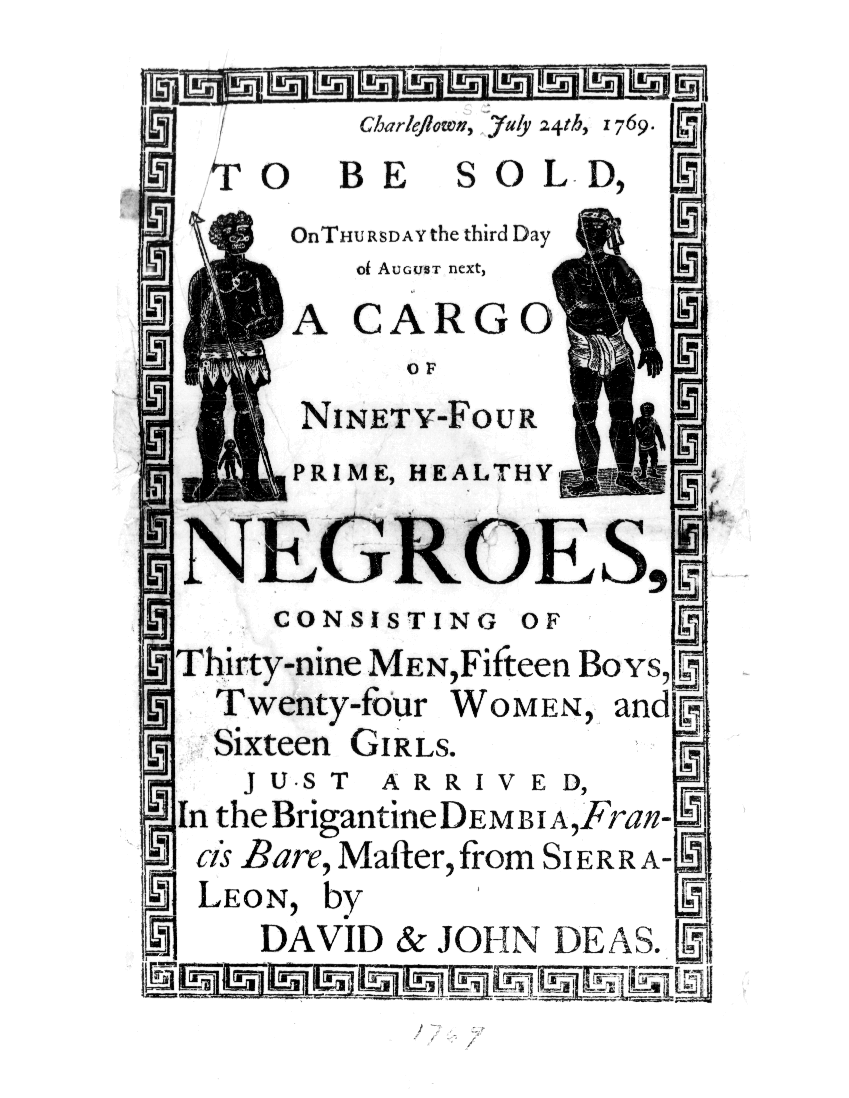
Contrary to what this short advertisement, rather plain and unremarkable in its appearance, may suggest, David and John Deas made their mark on the history of advertising thanks to the infamous broadsides (what we would call posters today) that they distributed in Charleston, South Carolina, in the decade before the American Revolution.

Not much distinguishes this advertisement for textiles, including “A LARGE supply of WHITE and COLOURED PLAINS,” from other commercial notices about imported goods that appeared in the same issue of the South Carolina Gazette. David and John Deas are much better remembered (and not just by scholars who specialize in economic history or advertising) for this broadside that circulated in Charleston and beyond nearly three years later.

Sep 8 - Deas Broadside
David and John Deas’s broadside for a slave auction (Charleston, 1769). American Antiquarian Society.

This broadside measures 32 x 20 cm (12 ½ x 8 in), which would have made it a good size to post around town or pass out as a handbill. The woodcuts depicting “PRIME, HEALTHY NEGROES” and the graphic design are both crude, but exceptionally memorable, at least to modern viewers. The haunting images of Africans treated as commodities elicit emotional responses today, but that would not necessarily have been the case in the 1760s. While it would have been impossible not to notice the images on the broadside, colonial consumers would not have been shocked by advertisements treating people as commodities. Accustomed to trade cards and billheads with images more skillfully and effectively rendered, colonists likely would not taken particularly favorable notice of the artistic or aesthetic qualities of the broadside.

David and John Deas’s newspaper advertisement for textiles did not indicate any direct involvement with the slave trade, though the merchandise they stocked made them part of transatlantic networks of commerce and consumption that depended on human cargoes and the staple crops produced through the labor of enslaved men, women, and children. Still, the juxtaposition of their newspaper advertisement and their broadside offers an important reminder that advertisements often provide evidence concerning only a portion of a shopkeeper’s, merchant’s, or firm’s business enterprises. How many other advertisers who promoted general merchandise via their advertisements at one time or another imported and auctioned slaves?