June 5

What was advertised in a colonial American newspaper 250 years ago this week?
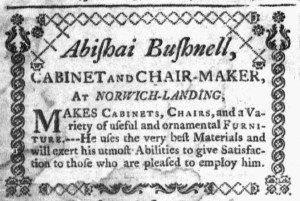
Norwich Packet (June 2, 1774).

“CABINETS, CHAIRS, and a variety of useful and ornamental FURNITURE.”

Alexander Robertson, James Robertson, and John Trumbull had been publishing the Norwich Packet for less than a year when Abishai Bushnell, “CABINET AND CHAIR-MAKER,” ran an advertisement with distinctive graphic design elements.  One of the printers or one of the compositors who worked in the printing office enclosed Bushnell’s copy within a border comprised of decorative ornaments.  That set it apart from other content, both news and advertising, in the Norwich Packet.  Bushnell may have also arranged to have his advertisement printed separated to use as labels for the “CABINETS, CHAIRS, and a variety of useful and ornamental FURNITURE” he made in his shop.

Except for the packet ship carrying letters from one port to another depicted in the masthead, the Norwich Packet did not usually feature visual images, neither to accompany news nor to adorn advertisements.  That included woodcuts of ships, houses, horses, indentured servants, and enslaved people, stock images that many printers made available to advertisers.  Yet the compositors did make liberal use of printing ornaments to indicate where one news item or editorial ended and another began and, especially, to separate advertisements from each other.  An intricate border also enclosed the first letter of the first word in the first article on the first page of each edition of the Norwich Packet, a design that changed every few weeks.  The masthead also made use of decorative type above and below the date of the newspaper, though that was a more recent innovation as the compositor experimented with the appearance of the front page.

Apparently, that was enough to convince Bushnell that Robertson, Robertson, and Trumbull could produce an advertisement that would attract attention with an ornate border that made it unlike anything else that appeared in the pages of the Norwich Packet.  The cabinetmaker almost certainly placed a special order or gave specific instructions about how he wished his advertisement to look.  After all, even though the compositor incorporated a lot of decorative type into each edition of the newspaper, no other advertisements received such treatment.  Bushnell did not opt for a woodcut of a chair or other piece of furniture representing his trade, but he did find a way to make his advertisement more visible and more memorable.

Decorative borders enclosing the first letter of the first word in the first item on the first page of the Norwich Packet (left to right: March 24, 1774; April 21, 1774; April 28, 1774; May 5, 1774; May 12, 1774).

September 4

What was advertised in a colonial American newspaper 250 years ago today?

Sep 4 - 9:4:1766 Pennsylvania Gazette
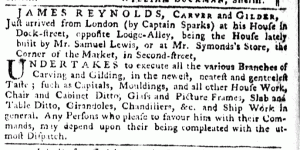
Pennsylvania Gazette (September 4, 1766).

“JAMES REYNOLDS, CARVER and GILDER, … UNDERTAKES to execute all the various Branches of Carving and Gilding.”

James Reynolds, a carver and gilder by trade, announced that he had “Just arrived from London” and set up shop in Philadelphia. He used an advertisement to launch his business in the colonies when he first arrived, but over the next two decades he continued to entice customers to engage his services via advertisements in Philadelphia’s newspapers.

He also passed down his skills in “the various Branches of Carving and Gilding, in the newest, neatest and genteelest Taste” to his sons, James Jr. and Henry. Over time, Reynolds and his sons specialized in selling looking glasses with decorative frames, though they continued to advertise that could be hired to perform the “various Branches” of their trade. In the 1790s the Reynolds brothers offered the same services their father had advertised thirty years earlier, using much of the same language of current and genteel fashions.

They did not, however, restrict their marketing to newspaper advertisements. They also affixed furniture labels to the items they sold “At their LOOKING-GLASS Store, No. 56, Market-street, PHILADELPHIA.” Eighteenth-century artisans, including cabinetmakers and closely affiliated occupations, experimented with various means of advertising the furniture they produced. Like shopkeepers, some distributed trade cards. Others marked their furniture in various ways, including signing, stamping, and branding or pasting labels. Such labels often took the form of miniature trade cards that incorporated copy directly from newspaper advertisements. Marking furniture in this way allowed artisans to continue to advertise their wares to customers long after completing sales.

Sep 4 - Reynolds Furniture Label
Furniture label affixed to looking glass (c. 1795). Decorative Arts Photographic Collection, Winterthur Library.

The elder Reynolds may have devised his own furniture label, though none have survived. His sons certainly labeled the looking glasses they sold as they reminded customers of the variety of goods and services they provided. They wanted to increase the likelihood that customers satisfied with their previous purchases would patronize their shop once again. For many eighteenth-century entrepreneurs, newspaper advertisements were only one aspect of their marketing strategies.