Happy Birthday, Benjamin Franklin!

Today is an important day for specialists in early American print culture, for Benjamin Franklin was born on January 17, 1706 (January 6, 1705, Old Style), in Boston.  Among his many other accomplishments, Franklin is known as the “Father of American Advertising.”  Although I have argued elsewhere that this title should more accurately be bestowed upon Mathew Carey (in my view more prolific and innovative in the realm of advertising as a printer, publisher, and advocate of marketing), I recognize that Franklin deserves credit as well.  Franklin is often known as “The First American,” so it not surprising that others should rank him first among the founders of advertising in America.
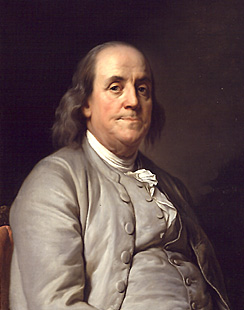
benjamin-franklin
Benjamin Franklin (Joseph Siffred Duplessis, ca. 1785).  National Portrait Gallery.

Franklin purchased the Pennsylvania Gazette in 1729.  In the wake of becoming printer, he experimented with the visual layout of advertisements that appeared in the weekly newspaper, incorporating significantly more white space and varying font sizes in order to better attract readers’ and potential customers’ attention.  Advertising flourished in the Pennsylvania Gazette, which expanded from two to four pages in part to accommodate the greater number of commercial notices.
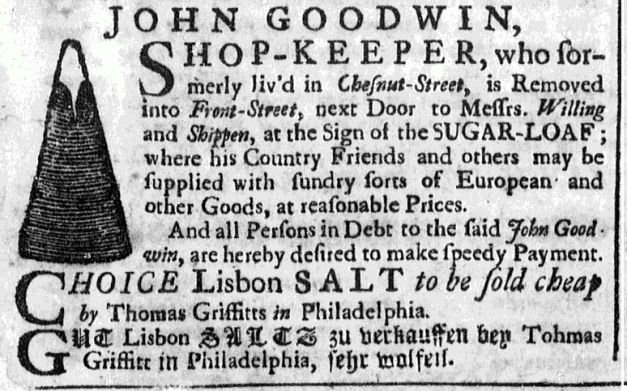
jan-17-pennsylvania-gazette-19-161736
Advertisements with white space, varying sizes of font, capitals and italics, and a woodcut from Benjamin Franklin’s Pennsylvania Gazette (December 9-16, 1736).

Many historians of the press and print culture in early America have noted that Franklin became wealthy and retired as a printer in favor of a multitude of other pursuits in part because of the revenue he collected from advertising.  Others, especially David Waldstreicher, have underscored that this wealth was amassed through participation in the colonial slave trade.  The advertisements for goods and services featured in the Pennsylvania Gazette included announcements about buying and selling slaves as well as notices offering rewards for runaways.

jan-17-pennsylvania-gazette-slave-19-161736
An advertisement for slaves from Benjamin Franklin’s Pennsylvania Gazette (December 9-16, 1736).

In 1741 Franklin published one of colonial America’s first magazines, The General Magazine and Historical Chronicle, for all the British Plantations in America (which barely missed out on being the first American magazine, a distinction earned by Franklin’s competitor, Andrew Bradford, with The American Magazine or Monthly View of the Political State of the British Colonies).  The magazine lasted only a handful of issues, but that was sufficient for Franklin to become the first American printer to include an advertisement in a magazine (though advertising did not become a standard part of magazine publication until special advertising wrappers were developed later in the century — and Mathew Carey was unarguably the master of that medium).
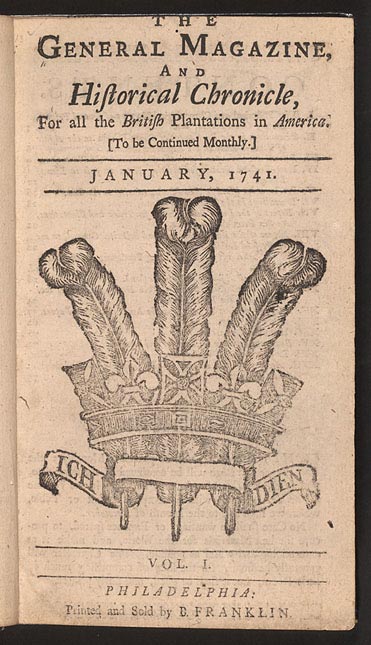
general-magazine
General Magazine and Historical Chronicle, For all the British Plantations in America (January 1741).  Library of Congress.

In 1744 Franklin published an octavo-sized Catalogue of Choice and Valuable Books, including 445 entries.  This is the first known American book catalogue aimed at consumers (though the Library Company of Philadelphia previously published catalogs listing their holdings in 1733, 1735, and 1741).  Later that same year, Franklin printed a Catalogue of Books to Be Sold at Auction.

Franklin pursued advertising through many media in eighteenth-century America, earning recognition as one of the founders of American advertising.  Happy 312th birthday, Benjamin Franklin!
January 17

What was advertised in a colonial American newspaper 250 years ago this week?

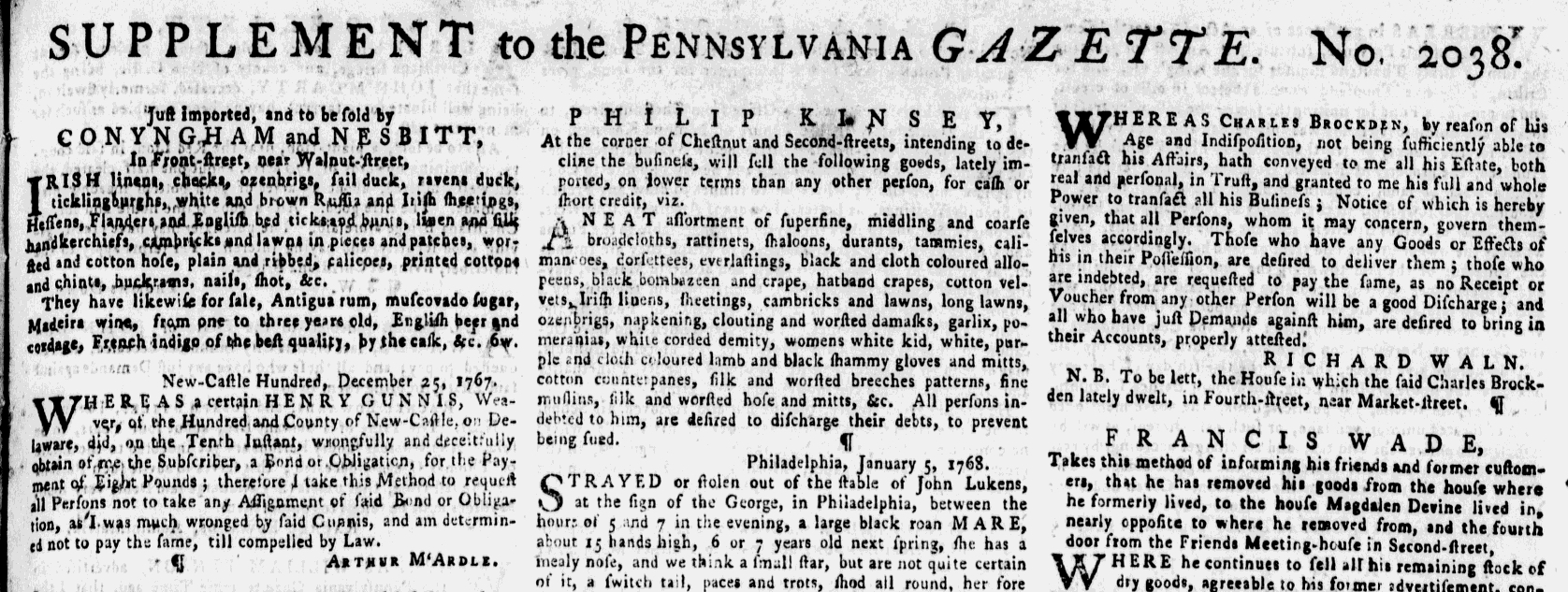
Jan 17 - 1:14:1768 Pennsylvania Gazette Supplement
Detail from Supplement to the Pennsylvania Gazette (January 14, 1767).

“SUPPLEMENT to the PENNSYLVANIA GAZETTE.”

No advertisements were published in colonial America on January 17, 1768. That was because January 17, 1768, was a Sunday, the one day of the week that no newspapers were published in any of the colonies. The methodology for the Adverts 250 Project allows for selecting an advertisement printed earlier in the week if none were published on a particular date; I’ll comment more on today’s featured advertisement after establishing the context for its publication. Due to the time, labor, and technology involved in printing in the 1760s, printers issued their newspapers just once a week, though they sometimes circulated a supplement or an extraordinary later in the week if circumstances merited a special publication of momentous news that demanded immediate coverage. That situation occurred with increased regularity as the imperial crisis intensified in the late 1760s and 1770s.

Even though newspapers published only one issue each week, printers staggered their distribution dates. In January 1768, Monday was the most popular date with at least ten newspapers, including four in Boston, made available at the beginning of the week. Only two newspapers, however, appeared on Tuesdays, the South-Carolina Gazette and Country Journal in Charleston and the Wochentliche Philadelphische Staatsbote in Germantown, Pennsylvania. The Georgia Gazette was the sole newspaper published on Wednesdays, followed by five newspapers, including the Pennsylvania Gazette, on Thursdays. Four newspapers, three from New England and the other from South Carolina, appeared on Fridays. The week ended with the publication of the Providence Gazette, conveniently timed to reprint news from the Boston papers as soon as they arrived at the printing office. This accounting includes only those currently available in databases of digitized newspapers. It overlooks only a couple of publications. Their inclusion would not alter the pattern of publishing most newspapers at the beginning of the week, especially in the largest port cities.

For most newspapers, the weekly issue consisted of four pages, a single broadsheet printed on both sides and folded in half. Between news items and advertising, however, some newspapers consistently had sufficient content to publish a two-page half sheet supplement for distribution with the regular issue. Often advertisements filled the entire supplement. Rather than select a particular advertisement to feature today, I have instead chosen one of those supplements filled with advertisements, the Supplement to the Pennsylvania Gazette. Advertisements filled two of the four pages of the standard issue for January 14, 1767, as well as the entire supplement. Overall, advertising comprised two-thirds of the content that week.

David Hall and William Sellers frequently issued an advertising supplement with the standard issue, doing so with such regularity that it practically became a standard feature of the weekly publication. Subscribers were likely more surprised not to receive a supplement overflowing with advertisements than to discover one accompanying the newest edition. Although newspapers in Boston, Charleston, and New York sometimes issued such supplements, the Pennsylvania Gazette did so with the greatest consistency in the late 1760s. This resulted in part from the size of Philadelphia, but also from the attention that the Pennsylvania Gazette’s former proprietor, Benjamin Franklin, devoted to developing newspaper advertising. Among his other accomplishments, Franklin is considered the “Father of American Advertising.” It seems appropriate on his birthday to feature an advertising supplement from the newspaper that he cultivated into the most prominent American publication of the eighteenth century. Advertising, especially the revenue from advertising that allowed for prolonged and widespread distribution, aided in making the Pennsylvania Gazette so influential.

January 16

What was advertised in a colonial American newspaper 250 years ago today?

Jan 16 - 1:16:1768 Providence Gazette
Providence Gazette (January 16, 1768).

“BLANKS of all Kinds sold by the Printers hereof.”

The shortest advertisement – consisting of only nine words – in the January 16, 1768, edition of the Providence Gazette appeared at the bottom of the first column on the final page. In it, Sarah Goddard and John Carter, the printers, advised readers that that they sold “BLANKS of all Kinds,” deploying contemporary terminology for items known today as forms. Goddard and Carter suggested that they could supply any sort of printed blanks customers desired, making it unnecessary to provide a list. Other printers, however, sometimes specified the various types of blanks they produced on their presses.

For instance, James Johnston, printer of the Georgia Gazette, regularly inserted an advertisement in his newspaper that enumerated more than a dozen blanks, each with a distinct purpose. He kept on hand “bills of sale, mortgages, powers of attorney, bonds of arbitration, indentures, bills of lading, articles of agreement between masters of vessel and seamen, summonses, warrants,” and other legal or commercial documents. He also concluded his list with “&c.” (the abbreviation for et cetera commonly used in the eighteenth century) to indicate that the list was not exhaustive. Goddard and Carter likely stocked all or most of these forms. They could also print any others for clients who submitted orders for job printing.

The advertisement about “BLANKS of all Kinds” supplemented the announcement in the colophon published in every issue of the Providence Gazette. In addition to specifying the printers and place of publication, Goddard and Carter treated the colophon as advertising space for the various endeavors undertaken in their shop. They invited others to submit “Subscriptions, Advertisements, and Letters of Intelligence” for the newspaper to their printing office at “the Sign of Shakespear’s Head,” but they also stated that they did “all Manner of PRINTING WORK” at the same location. Despite its brevity, their advertisement for “BLANKS of all Kinds” testified to a wide range of printed forms that circulated widely and would have been familiar to colonists in Providence and beyond.

Slavery Advertisements Published January 16, 1768

The Slavery Adverts 250 Project chronicles the role of newspaper advertising in perpetuating slavery in the era of the American Revolution. The project seeks to reveal the ubiquity of slavery in eighteenth-century life from New England to Georgia by republishing advertisements about enslaved people – for sale as individuals or in groups, wanted to purchase or for hire for short periods, runaways who liberated themselves, and those who were subsequently captured and confined in jails and workhouses – in daily digests on this site as well as in real time via the @SlaveAdverts250 Twitter feed, utilizing twenty-first-century media to stand in for the print media of the eighteenth century.

The project aims to provide modern audiences with a sense of just how often colonizers encountered these advertisements in their daily lives. Enslaved men, women, and children appeared in print somewhere in the colonies almost every single day. Those advertisements served as a constant backdrop for social, cultural, economic, and political life in colonial and revolutionary America. Colonizers who did not purport to own enslaved people were still confronted with slavery as well as invited to maintain the system by purchasing enslaved men, women, and children or assisting in the capture of so-called “runaways” who sought to free themselves from bondage. The frequency of these newspaper advertisements suggests just how embedded slavery was in colonial and revolutionary American culture in everyday interactions beyond the printed page.

These advertisements also testify to the experiences of enslaved men, women, and children, though readers must consider that those experiences have been remediated through descriptions offered by enslavers rather than enslaved people themselves. Often unnamed in the advertisements, enslaved men, women, and children were not invisible or unimportant in early America.

These advertisements appeared in colonial American newspapers 250 years ago today.

Jan 16 - Providence Gazette Slavery 1
Providence Gazette (January 16, 1768).

January 15

What was advertised in a colonial American newspaper 250 years ago today?

Jan 15 - 1:15:1768 New-Hampshire Gazette
New-Hampshire Gazette (January 15, 1768).

“Mein and Fleeming’s REGISTER … With all the BRITISH LISTS.”

John Mein and John Fleeming marketed “Mein and Fleeming’s REGISTER FOR NEW ENGLALD [sic] AND NOVA SCOTIA, With all the BRITISH LISTS, AND AN Almanack for 1768” in several newspapers in New England in late 1767 and early 1768. Their advertisement in the January 15, 1768, edition of the New-Hampshire Gazette indicated that readers could purchase copies directly from Mein at his “London Book Store, in Kingstreet Boston” or from local vendors, either William Appleton, a bookseller, or Daniel Fowle and Robert Fowle, the printers of the colony’s only newspaper.

Their advertisement, which extended an entire column, also elaborated on the contents. Despite the length, the advertisement placed relatively little emphasis on many of the standard items included in almanacs, such as “Sun’s rising and setting” and other astronomical details. Instead, Mein and Fleeming devoted much more space to the various “BRITISH LISTS” in their Register, including “Marriages and Issues of the Royal Family,” “Summary of the house of Commons,” and “Officers of His Majesty’s houshold.” The Register also contained lists of colonial officials in Massachusetts, New Hampshire, Connecticut, Rhode Island, and Nova Scotia.

Both the contents and the advertisement distinguished “Mein & Fleeming’s REGISTER” from all other almanacs for 1768 advertised anywhere in the colonies. Though useful, the astronomical calculations seemed secondary to content that positioned the American colonies within an expansive and powerful British empire. Mein and Fleeming, both Tories, began publishing the Boston Chronicle, near the end of December 1767. Although that publication only ran until 1770, it qualifies as a Loyalist newspaper based on the editorial position of the printers. Mein and Fleeming pursued a single purpose in simultaneously publishing the Boston Chronicle and their Register: deploying print culture to celebrate their identity as Britons at a time that the imperial crisis intensified as a result of an ongoing trade imbalance between colonies and mother country, the imposition of new duties when the Townshend Act went into effect in November 1767, and renewed nonimportation agreements that commenced at the beginning of 1768.

Even if readers of the New-Hampshire Gazette and other newspapers that carried Mein and Fleeming’s advertisements did not purchase or peruse the Register, the extensive notice reminded them that they shared a common culture with king, nobles, and commoners on the other side of the Atlantic. Lengthy lists of officials that served the empire and colonies on both sides of the Atlantic suggested good order and the benefits of being British, a system that many colonists did not wish to disrupt unnecessarily in the process of seeking redress of grievances from Parliamentary overreach. Mein and Fleeming may not have been able to make such arguments explicitly among the news items in newspapers published by others, but they could advance that perspective implicitly in the advertisements they paid to place in those publications.

Slavery Advertisements Published January 15, 1768

The Slavery Adverts 250 Project chronicles the role of newspaper advertising in perpetuating slavery in the era of the American Revolution. The project seeks to reveal the ubiquity of slavery in eighteenth-century life from New England to Georgia by republishing advertisements about enslaved people – for sale as individuals or in groups, wanted to purchase or for hire for short periods, runaways who liberated themselves, and those who were subsequently captured and confined in jails and workhouses – in daily digests on this site as well as in real time via the @SlaveAdverts250 Twitter feed, utilizing twenty-first-century media to stand in for the print media of the eighteenth century.

The project aims to provide modern audiences with a sense of just how often colonizers encountered these advertisements in their daily lives. Enslaved men, women, and children appeared in print somewhere in the colonies almost every single day. Those advertisements served as a constant backdrop for social, cultural, economic, and political life in colonial and revolutionary America. Colonizers who did not purport to own enslaved people were still confronted with slavery as well as invited to maintain the system by purchasing enslaved men, women, and children or assisting in the capture of so-called “runaways” who sought to free themselves from bondage. The frequency of these newspaper advertisements suggests just how embedded slavery was in colonial and revolutionary American culture in everyday interactions beyond the printed page.

These advertisements also testify to the experiences of enslaved men, women, and children, though readers must consider that those experiences have been remediated through descriptions offered by enslavers rather than enslaved people themselves. Often unnamed in the advertisements, enslaved men, women, and children were not invisible or unimportant in early America.

These advertisements appeared in colonial American newspapers 250 years ago today.

Jan 15 - South-Carolina and American General Gazette Slavery 1
South-Carolina and American General Gazette (January 15, 1768).

**********

Jan 15 - South-Carolina and American General Gazette Slavery 2
South-Carolina and American General Gazette (January 15, 1768).

**********

Jan 15 - South-Carolina and American General Gazette Slavery 3
South-Carolina and American General Gazette (January 15, 1768).

**********

Jan 15 - South-Carolina and American General Gazette Slavery 4
South-Carolina and American General Gazette (January 15, 1768).

**********

Jan 15 - South-Carolina and American General Gazette Slavery 5
South-Carolina and American General Gazette (January 15, 1768).

**********

Jan 15 - South-Carolina and American General Gazette Slavery 6
South-Carolina and American General Gazette (January 15, 1768).

**********

Jan 15 - South-Carolina and American General Gazette Slavery 7
South-Carolina and American General Gazette (January 15, 1768).

**********

Jan 15 - South-Carolina and American General Gazette Slavery 8
South-Carolina and American General Gazette (January 15, 1768).

**********

Jan 15 - South-Carolina and American General Gazette Slavery 9
South-Carolina and American General Gazette (January 15, 1768).

**********

Jan 15 - South-Carolina and American General Gazette Slavery 10
South-Carolina and American General Gazette (January 15, 1768).

**********

Jan 15 - South-Carolina and American General Gazette Slavery 11
South-Carolina and American General Gazette (January 15, 1768).

**********

Jan 15 - South-Carolina and American General Gazette Slavery 12
South-Carolina and American General Gazette (January 15, 1768).

**********

Jan 15 - South-Carolina and American General Gazette Slavery 13
South-Carolina and American General Gazette (January 15, 1768).

January 14

What was advertised in a colonial American newspaper 250 years ago today?

Jan 14 - 1:14:1768 Pennsylvania Gazette
Pennsylvania Gazette (January 14, 1768).

“He hath a medallion in clay … as a specimen of his abilities.”

In addition to marketing a “Neat assortment” of ceramics and hardware, Joseph Stansbury also used his advertisement in the January 14, 1768, edition of the Pennsylvania Gazette to “acquaint the public, he is well versed in designing and executing any kind of ornaments in stucco, for cielings or walls of rooms, basto relievo’s, &c.” He offered his services as an artisan to colonists interested in sprucing up the interior architecture of their homes according to the prevailing styles and tastes.

Stansbury did not expect prospective clients merely to take him at his word that he was “well versed in designing and executing” those decorative elements. Instead, he presented an opportunity for them to examine a sample of his work and determine for themselves whether he possessed the level of skill he claimed. Interested parties could visit his shop on Market Street where “he hath a medallion in clay, of the present King of Poland, executed here from his coronation medal … which he will shew to the curious, as a specimen of his abilities.” This sample likely had some cachet among genteel colonists. According to Richard Butterwick, in 1764 the Polish king’s coronation medal had been “struck in England by Thomas Pingo, who had earlier struck the medal for George III’s coronation.”[1] As early as 1765 descriptions of the medal, supplemented by engraved images, circulated in magazines published in England and Ireland, which may have been Stansbury’s source for his clay specimen.[2]

Stansbury did not consider newspaper advertising alone sufficient to entice potential clients to commission his services. Advertisements acted as an opening salvo that informed colonists of the services he offered, but the specimen he displayed may have been the more powerful marketing tool. No matter how elaborate the description of his work he might publish, words could not compare to the opportunity to examine, by sight and by touch, a sample that demonstrated his abilities.

Jan 14 - Engraving
Detail of engraving of coronation medal for Stansilaw II from Gentleman’s and London Magazine (March 1765).

**********

[1] Richard Butterwick, Poland’s Last King and English Culture: Stanislaw August Poniatowski, 1732-1798 (Oxford: Clarendon Press, 1998), 221.

[2] Gentleman’s and London Magazine; or Monthly Chronologer (Dublin: John Exshaw, March 1765), 156 and leaf between 156 and 157.

Slavery Advertisements Published January 14, 1768

The Slavery Adverts 250 Project chronicles the role of newspaper advertising in perpetuating slavery in the era of the American Revolution. The project seeks to reveal the ubiquity of slavery in eighteenth-century life from New England to Georgia by republishing advertisements about enslaved people – for sale as individuals or in groups, wanted to purchase or for hire for short periods, runaways who liberated themselves, and those who were subsequently captured and confined in jails and workhouses – in daily digests on this site as well as in real time via the @SlaveAdverts250 Twitter feed, utilizing twenty-first-century media to stand in for the print media of the eighteenth century.

The project aims to provide modern audiences with a sense of just how often colonizers encountered these advertisements in their daily lives. Enslaved men, women, and children appeared in print somewhere in the colonies almost every single day. Those advertisements served as a constant backdrop for social, cultural, economic, and political life in colonial and revolutionary America. Colonizers who did not purport to own enslaved people were still confronted with slavery as well as invited to maintain the system by purchasing enslaved men, women, and children or assisting in the capture of so-called “runaways” who sought to free themselves from bondage. The frequency of these newspaper advertisements suggests just how embedded slavery was in colonial and revolutionary American culture in everyday interactions beyond the printed page.

These advertisements also testify to the experiences of enslaved men, women, and children, though readers must consider that those experiences have been remediated through descriptions offered by enslavers rather than enslaved people themselves. Often unnamed in the advertisements, enslaved men, women, and children were not invisible or unimportant in early America.

These advertisements appeared in colonial American newspapers 250 years ago today.

Jan 14 - Massachusetts Gazette Slavery 1
Massachusetts Gazette (January 14, 1768).

**********

Jan 14 - Massachusetts Gazette Slavery 2
Massachusetts Gazette (January 14, 1768).

**********

Jan 14 - New-York Journal Slavery 1
New-York Journal (January 14, 1768).

**********

Jan 14 - New-York Journal Slavery 2
New-York Journal (January 14, 1768).

**********

Jan 14 - Pennsylvania Gazette Slavery 1
Pennsylvania Gazette (January 14, 1768).

**********

Jan 14 - Pennsylvania Gazette Supplement Slavery 1
Supplement to the Pennsylvania Gazette (January 14, 1768).

**********

Jan 14 - Virginia Gazette Purdie and Dixon Slavery 1
Virginia Gazette (January 14, 1768).

January 13

What was advertised in a colonial American newspaper 250 years ago today?

Jan 13 - 1:13:1768 Georgia Gazette
Georgia Gazette (January 13, 1768).

“PROPOSED to be published, a PAMPHLET.”

James Johnston inserted a subscription notice for “a PAMPHLET … entitled ‘Religious and Moral Observations selected from the Writings of approved Authors’” in the January 13, 1768, edition of the Georgia Gazette. He did not promote a product already available for customers to purchase; instead, like many other eighteenth-century publishers, he presented a proposal in order to gauge public interest in the pamphlet. It would go to press only once a sufficient number of “subscribers” pledged to purchase it.

Publishing by subscription significantly reduced the financial risk. No printer wanted to invest time and materials only to produce a book or pamphlet that never sold enough copies to turn at least a small profit. With that in mind, Johnston instructed that readers “willing to encourage” the proposed pamphlet “may send in their names to the printer of this paper.” As names arrived, he would compile a subscription list (which printers sometimes inserted in proposed publications as a means of acknowledging patrons who supported the project). Johnston did not specify a publication date. Instead, he stated, “The publication will commence as soon as a sufficient number have sent in their names to defray the first expence of publishing.” Although that would not cover all of his costs, the printer considered it enough to indicate that other buyers would eventually step forward to acquire the pamphlet. For initial subscribers “the price of the pamphlet will be two shillings sterling.” Subsequent buyers could expect to pay a higher price. Offering a bargain to those who invested in the project early often helped to stimulate interest.

As part of his effort to promote the pamphlet, Johnston offered a brief description and outline. He estimated that it would be approximately sixty-four pages or “four sheets in 8vo. [octavo].” (This meant that a single sheet was folded in half three times in order to form eight leaves that were one-eight the size of the original sheet. With text printed on both sides of each leaf, this produced sixteen pages per sheet. Four sheets yielded sixty-four pages.) As the title suggested, these sixty-four pages would contain “Religious and Moral Observations” intended to bring together “the opinions and most enforcing arguments of different eminent authors.” The passages would be carefully organized “under proper Heads” and the names of the authors or books included for further reference. The pamphlet would also include “original Notes” intended to “illustrate and enforce the several passages.”

Johnston published the subscription notice to determine interest in the pamphlet, but he also planned to use the pamphlet to assess interest in “a larger publication of the same nature.” He considered the pamphlet a “specimen.” If consumers reacted positively, he would publish a more extensive version. The combination of the initial subscription notice and, eventually, sales of the pamphlet (if the subscription notice proved successful) constituted market research to guide his decisions about printing a substantial volume.

Summary of Slavery Advertisements Published January 7-13, 1768

These tables indicate how many advertisements for slaves appeared in colonial American newspapers during the week of January 7-13, 1768.

Note:  These tables are as comprehensive as currently digitized sources permit, but they may not be an exhaustive account.  They includes all newspapers that have been digitized and made available via Accessible Archives, Colonial Williamsburg’s Digital Library, and Readex’s America’s Historical Newspapers.  There are several reasons some newspapers may not have been consulted:

  • Issues that are no longer extant;
  • Issues that are extant but have not yet been digitized (including the Pennsylvania Journal); and
  • Newspapers published in a language other than English (including the Wochentliche Philadelphische Staatsbote).

**********

Slavery Advertisements Published January 7-13, 1768:  By Date

Slavery Adverts Tables 1767 By Date Jan 7

**********

Slavery Advertisements Published January 7-13, 1768:  By Region

Slavery Adverts Tables 1767 By Region Jan 7