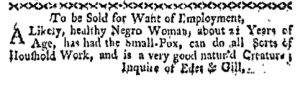
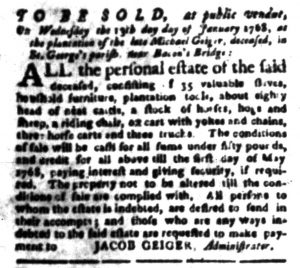
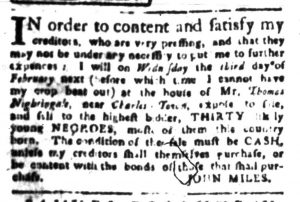
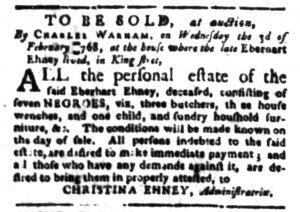
Slavery Advertisements Published January 13, 1768

The Slavery Adverts 250 Project chronicles the role of newspaper advertising in perpetuating slavery in the era of the American Revolution. The project seeks to reveal the ubiquity of slavery in eighteenth-century life from New England to Georgia by republishing advertisements about enslaved people – for sale as individuals or in groups, wanted to purchase or for hire for short periods, runaways who liberated themselves, and those who were subsequently captured and confined in jails and workhouses – in daily digests on this site as well as in real time via the @SlaveAdverts250 Twitter feed, utilizing twenty-first-century media to stand in for the print media of the eighteenth century.

The project aims to provide modern audiences with a sense of just how often colonizers encountered these advertisements in their daily lives. Enslaved men, women, and children appeared in print somewhere in the colonies almost every single day. Those advertisements served as a constant backdrop for social, cultural, economic, and political life in colonial and revolutionary America. Colonizers who did not purport to own enslaved people were still confronted with slavery as well as invited to maintain the system by purchasing enslaved men, women, and children or assisting in the capture of so-called “runaways” who sought to free themselves from bondage. The frequency of these newspaper advertisements suggests just how embedded slavery was in colonial and revolutionary American culture in everyday interactions beyond the printed page.

These advertisements also testify to the experiences of enslaved men, women, and children, though readers must consider that those experiences have been remediated through descriptions offered by enslavers rather than enslaved people themselves. Often unnamed in the advertisements, enslaved men, women, and children were not invisible or unimportant in early America.

These advertisements appeared in colonial American newspapers 250 years ago today.
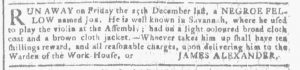
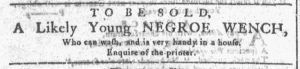
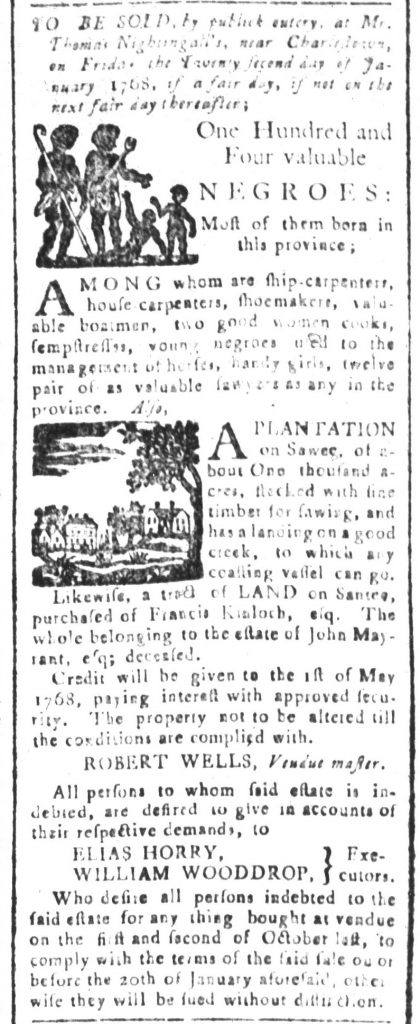
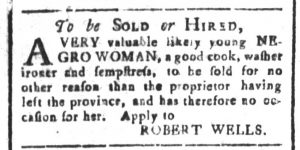
Jan 13 - Georgia Gazette Slavery 1
Georgia Gazette (January 13, 1768).

**********
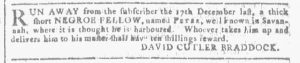
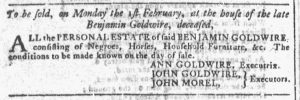
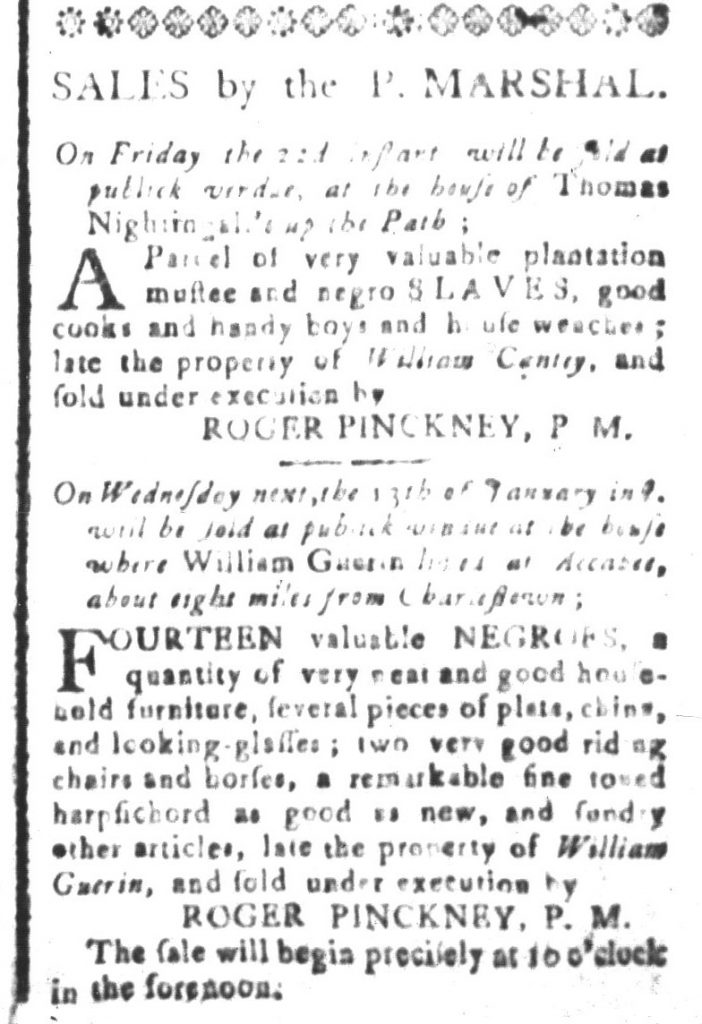
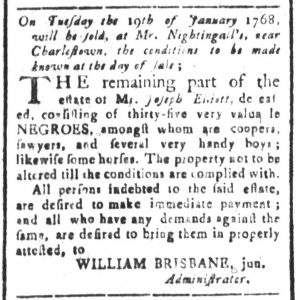
Jan 13 - Georgia Gazette Slavery 2
Georgia Gazette (January 13, 1768).

**********

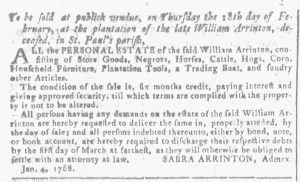
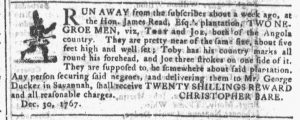
Jan 13 - Georgia Gazette Slavery 3
Georgia Gazette (January 13, 1768).

**********

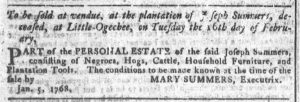
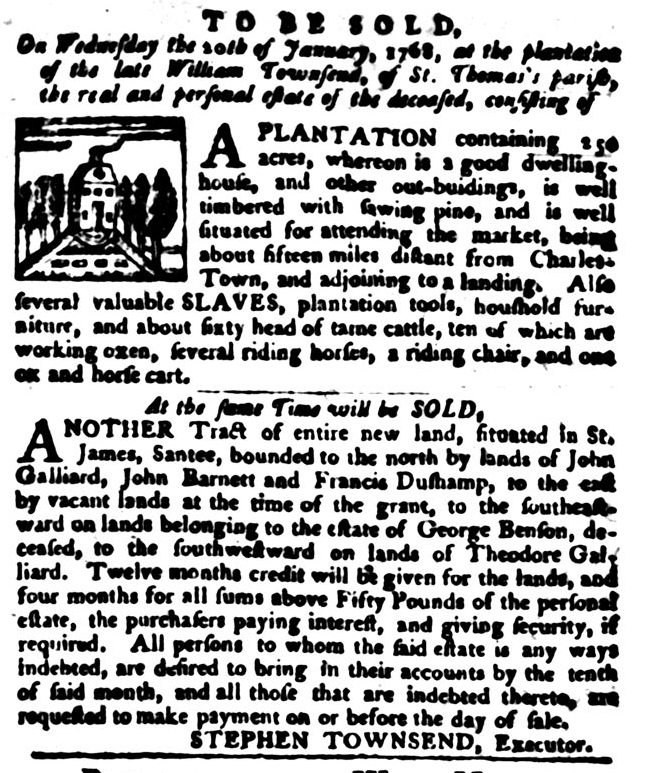
Jan 13 - Georgia Gazette Slavery 4
Georgia Gazette (January 13, 1768).

**********

Jan 13 - Georgia Gazette Slavery 5
Georgia Gazette (January 13, 1768).

**********

Jan 13 - Georgia Gazette Slavery 6
Georgia Gazette (January 13, 1768).

**********

Jan 13 - Georgia Gazette Slavery 7
Georgia Gazette (January 13, 1768).

**********

Jan 13 - Georgia Gazette Slavery 8
Georgia Gazette (January 13, 1768).

**********
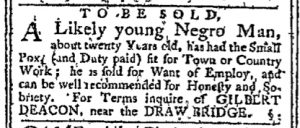
Jan 13 - Georgia Gazette Slavery 9
Georgia Gazette (January 13, 1768).

January 12

What was advertised in a colonial American newspaper 250 years ago today?

Jan 12 - 1:12:1768 South-Carolina Gazette and Country Journal
South-Carolina Gazette and Country Journal (January 12, 1768).

“For further particulars enquire of the Printer.”

Charles Crouch received so many advertisements for the January 12, 1768, issue of the South-Carolina Gazette and Country Journal that he simultaneously published a two-page supplement devoted exclusively to advertising. Between the standard issue and the supplement, subscribers received six total pages of content, though four entire pages – two-thirds of the entire issue – consisted of paid notices. This advertisement for a “Collection of BOOKS” to be sold “very cheap” appeared among the other advertisements, but it may or may not have been a paid notice. Readers interested in the books were instructed to “enquire of the Printer” for further information. Who placed this advertisement?

Many colonial printers supplemented their revenues by acting as booksellers; they peddled both titles they printed and, especially, imported books. Crouch may have inserted this advertisement in his own newspaper, though the collection of books could have been a private library offered for sale by someone who preferred to remain anonymous in the public prints. After all, the list included several novels that critics sometimes claimed entertained rather than edified readers. The owner may not have wished to publicize reading habits that some considered lowbrow and chose instead to have the printer act as broker in selling the books.

The placement of the advertisement also suggests that may have been the case. Crouch boldly promoted an almanac he published and sold in an advertisement that appeared as the first item in the first column on the first page of the issue, making it impossible for readers to overlook. He included his name and the location of his printing office “in Elliott-street, the Corner of Gadsden’s Alley.” The notice concerning the “Collection of BOOKS” for sale, on the other hand, appeared near the bottom of the middle column on the third page. Printers often gave their own advertisements privileged places in their newspapers. Given that Crouch was not shy about deploying that strategy elsewhere in the issue increases the possibility that he was not hawking the books in this notice but instead facilitated an introduction between seller and prospective buyers.

Eighteenth-century advertisements often included instructions to “enquire of the Printer” for additional information. Printing offices served as brokerages and clearinghouses for information that did not appear in print, allowing colonists to initiate sales in newspaper advertisements while also remaining anonymous. They harnessed the power of the press without sacrificing their privacy when they resorted to directing others to “enquire of the Printer.”

Slavery Advertisements Published January 12, 1768

The Slavery Adverts 250 Project chronicles the role of newspaper advertising in perpetuating slavery in the era of the American Revolution. The project seeks to reveal the ubiquity of slavery in eighteenth-century life from New England to Georgia by republishing advertisements about enslaved people – for sale as individuals or in groups, wanted to purchase or for hire for short periods, runaways who liberated themselves, and those who were subsequently captured and confined in jails and workhouses – in daily digests on this site as well as in real time via the @SlaveAdverts250 Twitter feed, utilizing twenty-first-century media to stand in for the print media of the eighteenth century.

The project aims to provide modern audiences with a sense of just how often colonizers encountered these advertisements in their daily lives. Enslaved men, women, and children appeared in print somewhere in the colonies almost every single day. Those advertisements served as a constant backdrop for social, cultural, economic, and political life in colonial and revolutionary America. Colonizers who did not purport to own enslaved people were still confronted with slavery as well as invited to maintain the system by purchasing enslaved men, women, and children or assisting in the capture of so-called “runaways” who sought to free themselves from bondage. The frequency of these newspaper advertisements suggests just how embedded slavery was in colonial and revolutionary American culture in everyday interactions beyond the printed page.

These advertisements also testify to the experiences of enslaved men, women, and children, though readers must consider that those experiences have been remediated through descriptions offered by enslavers rather than enslaved people themselves. Often unnamed in the advertisements, enslaved men, women, and children were not invisible or unimportant in early America.

These advertisements appeared in colonial American newspapers 250 years ago today.

Jan 12 - South-Carolina Gazette and Country Journal Slavery 1
South-Carolina Gazette and Country Journal (January 12, 1768).

**********
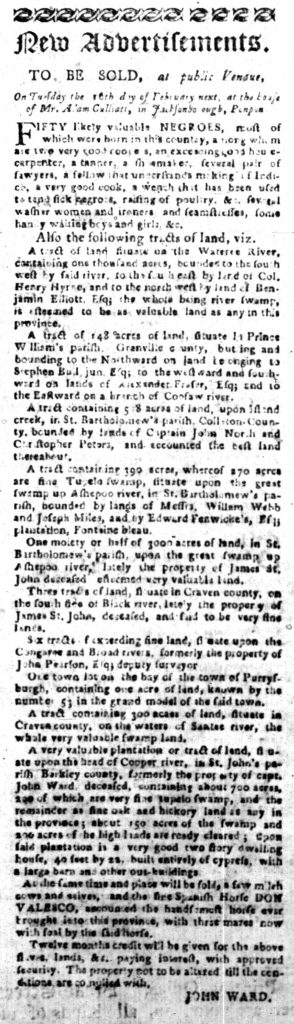
Jan 12 - South-Carolina Gazette and Country Journal Slavery 2
South-Carolina Gazette and Country Journal (January 12, 1768).

**********

Jan 12 - South-Carolina Gazette and Country Journal Slavery 3
South-Carolina Gazette and Country Journal (January 12, 1768).

**********
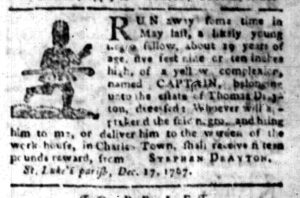
Jan 12 - South-Carolina Gazette and Country Journal Slavery 4
South-Carolina Gazette and Country Journal (January 12, 1768).

**********
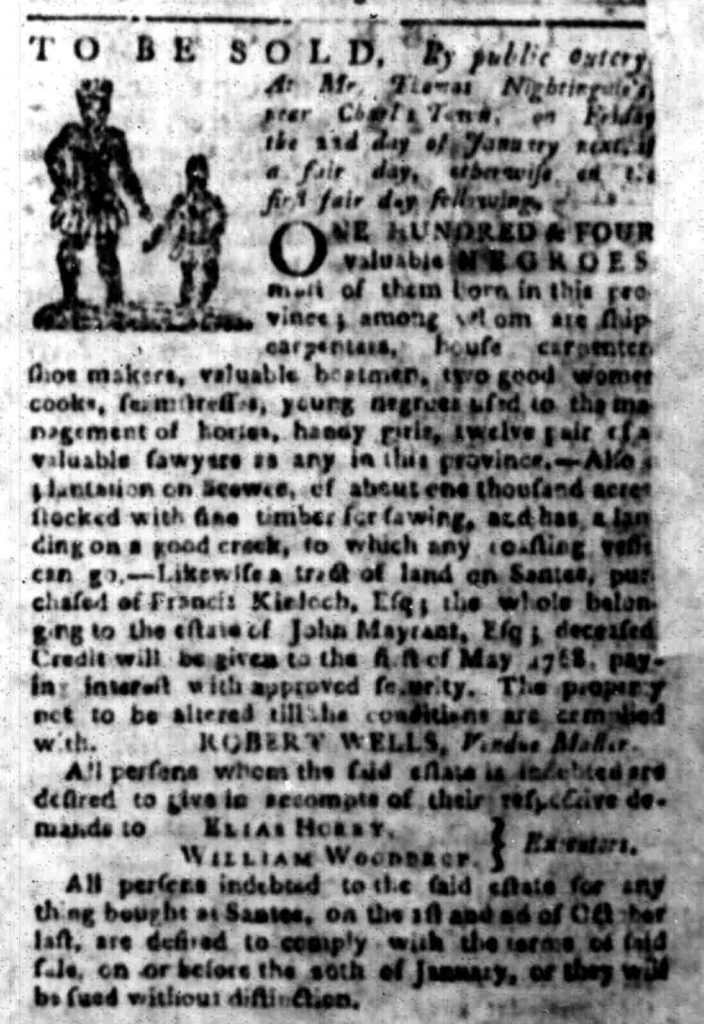
Jan 12 - South-Carolina Gazette and Country Journal Slavery 5
South-Carolina Gazette and Country Journal (January 12, 1768).

**********

Jan 12 - South-Carolina Gazette and Country Journal Slavery 6
South-Carolina Gazette and Country Journal (January 12, 1768).

**********

Jan 12 - South-Carolina Gazette and Country Journal Slavery 7
South-Carolina Gazette and Country Journal (January 12, 1768).

**********

Jan 12 - South-Carolina Gazette and Country Journal Slavery 8
South-Carolina Gazette and Country Journal (January 12, 1768).

**********

Jan 12 - South-Carolina Gazette and Country Journal Slavery 9
South-Carolina Gazette and Country Journal (January 12, 1768).

**********

Jan 12 - South-Carolina Gazette and Country Journal Slavery 10
South-Carolina Gazette and Country Journal (January 12, 1768).

**********

Jan 12 - South-Carolina Gazette and Country Journal Supplement Slavery 1
Supplement to the South-Carolina Gazette and Country Journal (January 12, 1768).

**********

Jan 12 - South-Carolina Gazette and Country Journal Supplement Slavery 2
Supplement to the South-Carolina Gazette and Country Journal (January 12, 1768).

**********

Jan 12 - South-Carolina Gazette and Country Journal Supplement Slavery 3
Supplement to the South-Carolina Gazette and Country Journal (January 12, 1768).

**********

Jan 12 - South-Carolina Gazette and Country Journal Supplement Slavery 4
Supplement to the South-Carolina Gazette and Country Journal (January 12, 1768).

**********

Jan 12 - South-Carolina Gazette and Country Journal Supplement Slavery 5
Supplement to the South-Carolina Gazette and Country Journal (January 12, 1768).

**********

Jan 12 - South-Carolina Gazette and Country Journal Supplement Slavery 6
Supplement to the South-Carolina Gazette and Country Journal (January 12, 1768).

**********

Jan 12 - South-Carolina Gazette and Country Journal Supplement Slavery 7
Supplement to the South-Carolina Gazette and Country Journal (January 12, 1768).

**********

Jan 12 - South-Carolina Gazette and Country Journal Supplement Slavery 8
Supplement to the South-Carolina Gazette and Country Journal (January 12, 1768).

**********

Jan 12 - South-Carolina Gazette and Country Journal Supplement Slavery 9
Supplement to the South-Carolina Gazette and Country Journal (January 12, 1768).

January 11

What was advertised in a colonial American newspaper 250 years ago today?

Jan 11 - 1:11:1768 New-York Gazette Weekly Post-Boy
New-York Gazette: Or, the Weekly Post-Boy (January 11, 1768).

“Whatever Tobacco is sold by the Subscriber, has only the Marks B.M. on the Papers.”

Blaze Moore, a tobacconist in New York, had created a reputation for himself among consumers in the city. He had done so well that a competitor attempted to horn in on his success, passing off other tobacco as Moore’s. This prompted Moore to insert an advertisement in the New-York Gazette: Or, the Weekly Post-Boy to warn customers about the subterfuge perpetrated against him and, ultimately, against them as well.

Moore had practiced his trade in New York “for several Years past.” In that time, he had “acquired some Credit with his Tobacco,” establishing a reputation based on “his Care and Skill.” Proud of his work and not wanting it mistaken for that of any other tobacconist, he packaged it in tobacco papers marked with his initials, “B.M.” To some extent, he created a trademark intended to make it easy to identify his tobacco.

Yet that attempt to market tobacco that came from his workshop presented an opportunity for counterfeiting his product. Moore reported that other tobacconists had “manufactured and sold their Tobacco, with the Marks M.B.” and were “imposing it on the Publick” as his product. By switching the order of the initials, the counterfeiters devised nearly indistinguishable packaging that could easily confuse and fool customers who did not carefully examine it before making their purchases.

Moore suspected two possible motives. The unknown tobacconists may have been “envying his Success” and desired a boost to their sales with the fraudulent packaging. That would have been harmful enough to Moore’s business, but another explanation had the potential to be even more damaging. The counterfeiters could have been “coveting to take away his Bread and Credit.” The spurious tobacco not only deprived Moore of sales but also endangered his reputation. Acquiring an inferior product could convince duped customers not to obtain Moore’s tobacco when they made subsequent purchases. The harm to his reputation extended beyond losing out on a single sale; it imperiled his livelihood.

To combat the bogus tobacco distributed as his own, Moore used an advertisement to caution “all concerned” that his tobacco “has only the Marks B.M. on the Papers, and any other Mark with a Pretence of its being [Moore’s], is an Imposture.” He did what he could to warn customers, but depended on their care and vigilance as consumers to protect his interests while simultaneously protecting their own as they avoided unsavory competitors’ attempts to fool them.

Slavery Advertisements Published January 11, 1768

The Slavery Adverts 250 Project chronicles the role of newspaper advertising in perpetuating slavery in the era of the American Revolution. The project seeks to reveal the ubiquity of slavery in eighteenth-century life from New England to Georgia by republishing advertisements about enslaved people – for sale as individuals or in groups, wanted to purchase or for hire for short periods, runaways who liberated themselves, and those who were subsequently captured and confined in jails and workhouses – in daily digests on this site as well as in real time via the @SlaveAdverts250 Twitter feed, utilizing twenty-first-century media to stand in for the print media of the eighteenth century.

The project aims to provide modern audiences with a sense of just how often colonizers encountered these advertisements in their daily lives. Enslaved men, women, and children appeared in print somewhere in the colonies almost every single day. Those advertisements served as a constant backdrop for social, cultural, economic, and political life in colonial and revolutionary America. Colonizers who did not purport to own enslaved people were still confronted with slavery as well as invited to maintain the system by purchasing enslaved men, women, and children or assisting in the capture of so-called “runaways” who sought to free themselves from bondage. The frequency of these newspaper advertisements suggests just how embedded slavery was in colonial and revolutionary American culture in everyday interactions beyond the printed page.

These advertisements also testify to the experiences of enslaved men, women, and children, though readers must consider that those experiences have been remediated through descriptions offered by enslavers rather than enslaved people themselves. Often unnamed in the advertisements, enslaved men, women, and children were not invisible or unimportant in early America.

These advertisements appeared in colonial American newspapers 250 years ago today.

Jan 11 - Boston-Gazette Slavery 1
Boston-Gazette (January 11, 1768).

**********

Jan 11 - Boston-Gazette Slavery 2
Boston-Gazette (January 11, 1768).

**********

Jan 11 - Boston-Gazette Slavery 3
Boston-Gazette (January 11, 1768).

**********

Jan 11 - New-York Gazette Weekly Post-Boy Slavery 1
New-York Gazette: Or, the Weekly Post-Boy (January 11, 1768).

**********

Jan 11 - New-York Mercury Slavery 1
New-York Mercury (January 11, 1768).

**********

Jan 11 - New-York Mercury Slavery 2
New-York Mercury (January 11, 1768).

**********

Jan 11 - New-York Mercury Slavery 3
New-York Mercury (January 11, 1768).

**********

Jan 11 - New-York Mercury Slavery 4
New-York Mercury (January 11, 1768).

**********

Jan 11 - New-York Mercury Slavery 5
New-York Mercury (January 11, 1768).

**********

Jan 11 - New-York Mercury Supplement Slavery 1
Supplement to the New-York Mercury (January 11, 1768).

**********

Jan 11 - New-York Mercury Supplement Slavery 2
Supplement to the New-York Mercury (January 11, 1768).

**********

Jan 11 - New-York Mercury Supplement Slavery 3
Supplement to the New-York Mercury (January 11, 1768).

**********

Jan 11 - Pennsylvania Chronicle Slavery 1
Pennsylvania Chronicle (January 11, 1768).

**********

Jan 11 - South Carolina Gazette Slavery 1
South Carolina Gazette (January 11, 1768).

**********

Jan 11 - South Carolina Gazette Slavery 2
South Carolina Gazette (January 11, 1768).

**********

Jan 11 - South Carolina Gazette Slavery 3
South Carolina Gazette (January 11, 1768).

**********

Jan 11 - South Carolina Gazette Slavery 4
South Carolina Gazette (January 11, 1768).

**********

Jan 11 - South Carolina Gazette Slavery 5
South Carolina Gazette (January 11, 1768).

**********

Jan 11 - South Carolina Gazette Slavery 6
South Carolina Gazette (January 11, 1768).

**********

Jan 11 - South Carolina Gazette Slavery 7
South Carolina Gazette (January 11, 1768).

January 10

What was advertised in a colonial American newspaper 250 years ago this week?

Jan 10 - 1:7:1768 Massachusetts Gazette
Massachusetts Gazette (January 7, 1768).

“He is determined to sell as cheap as can be bought in any Part of America.”

Frederick William Geyer, a frequent advertiser in Boston’s newspapers in the late 1760s, advanced one of the most common marketing appeals of the eighteenth century: he promoted his low prices. He did not, however, resort to any of the stock phrases or formulaic language often deployed by shopkeepers and merchants in newspaper advertisements throughout the colonies. Instead, he made hyperbolic claims about the bargains prospective customers could expect to encounter upon visiting his shop. Geyer proclaimed that he was “determined to sell as cheap as can be bought in any Part of America, either by Wholesale or Retail.” Some advertisers compared their prices to others in the same city or the same region, but virtually none made such sweeping statements about prices throughout the colonies.

While readers certainly would have been skeptical of such a claim, Geyer won the advantage of forcing consumers to grapple with it. He planted the idea, challenging them to learn his prices and assess them on their own. At the very least, such language set his advertisement apart from others, making it memorable for its bold assertion. It also set the stage for negotiations between buyer and seller. Although Geyer did not promise to match the prices of his competitors, expressing his determination to offer the lowest prices “in any Part of America” suggested his willingness to make a deal in order to satisfy customers that he delivered on his rhetoric.

Eighteenth-century advertisers promoted their prices, not unlike advertisers today. Many relied on standardized language to make the most basic sort of appeal to potential customers, but the language of price was not static. Others, like Geyer, experimented with increasingly audacious descriptions of their prices to overshadow their competition and attract the attention of consumers. Even if readers did not immediately make purchases from Geyer, his advertisement contributed to a reputation that could convince consumers to visit his shop and check out his prices at some point in the future.

January 9

What was advertised in a colonial American newspaper 250 years ago today?

Jan 9 - 1:9:1768 Providence Gazette
Providence Gazette (January 9, 1768).

“At their New Shop and Store, the sign of the Bunch of Grapes.”

Benjamin Thurber and Daniel Cahoon informed residents of Providence and its hinterland that they had formed a partnership in an advertisement that ran in the Providence Gazette in the fall of 1767. In their initial notice the shopkeepers emphasized their retail space, trumpeting that they “have built and compleated the best and largest Shop and Store in Providence.” They also proclaimed that they had “furnished it with a very large and general Assortment of the very best of English and India Piece Goods, Hard Ware, all Sorts of West-India Goods, and Groceries of all Kinds.”

In their subsequent advertising Thurber and Cahoon turned to demonstrating the extent of their inventory, listing dozens of items available for purchase “at their New Shop and Store, the sign of the Bunch of Grapes.” Just as they claimed to operate the largest shop in town, their advertisement occupied the most space in the January 9, 1768, edition of the Providence Gazette, although it had been rivaled by Jonathan Russell’s advertisement in the previous issue. Thurber and Cahoon may have been motivated, in part, by Russell’s lengthy advertisement and its extended run in their local newspaper. It commenced in mid November, shortly after they announced their partnership, and continued for eight weeks, disappearing from the pages of the Providence Gazette after the first issue of the new year. Thurber and Cahoon may have determined that they needed to place an advertisement of similar length to challenge Russell and to remind potential customers of the size of their shop, supposedly the largest in Providence.

Their advertisement extended nearly three-quarters of a column, twice the length of the next longest advertisement in the January 9 issue. It also featured unique typography. Rather than list their wares in a single continuous and dense paragraph, they instead enumerated one or tow items per line and created two narrower columns within the single column that contained their advertisement. Not only did this typographical strategy make their notice appear even longer, it may have conjured up rows of shelves in their shop, suggesting how much space Thurber and Cahoon made available for customers to leisurely browse through their merchandise. By comparison, the other advertisements in the same issue looked much more cramped, implying that their shops were equally crowded and difficult to navigate.

Thurber and Cahoon used the amount of space on the page and design elements to their advantage when they placed their advertisement in the Providence Gazette. Although they echoed many of the same appeals to price, quality, and service that appeared in other commercial notices, the typography set their advertisement apart and buttressed the claims they made to potential customers.

January 8

What was advertised in a colonial American newspaper 250 years ago today?

Jan 8 - 1:8:1768 South-Carolina and American General Gazette
South-Carolina and American General Gazette (January 8, 1768).

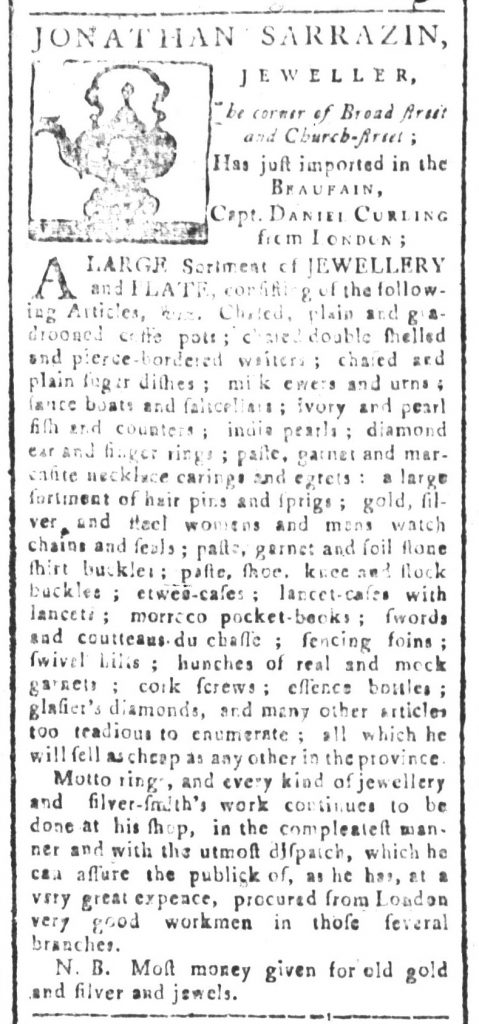
“JONATHAN SARRAZIN, JEWELLER.”

Jonathan Sarrazin once again placed his advertisement for “a LARGE Sortment of JEWELLERY and PLATE” in the January 8, 1768, edition of the South-Carolina and American General Gazette, continuing a series that originated in that newspaper in early December 1767. The same advertisement, including a woodcut depicting a fashionable teapot, also appeared in another newspaper published in Charleston, the South Carolina Gazette.

Last week I examined some of the difficulties in tracing Sarrazin’s marketing efforts in the face of an incomplete archive. Missing or inaccessible issues make it impossible to definitively document when and how often advertisers placed newspaper notices. Today I offer some comments on another challenge inherent in working with surrogates, whether photographs, microfilm, or digital databases, rather than original sources.

A woodcut of a teapot did indeed accompany Sarrazin’s advertisement in both newspapers that carried his notice. Was it the same woodcut? Or was it two separate woodcuts that closely resembled each other? Seemingly trivial at first glance, the answer offers important insights into the effort and expense Sarrazin invested in advertising as well as the business practices of the printers of the newspapers.

Careful examination of the images in the South Carolina Gazette and the South-Carolina and American General Gazette suggests that Sarrazin did commission two separate woodcuts. However due to imperfect remediation, via photography and digitization, it is impossible to definitively state that Sarrazin had two nearly identical woodcuts of an ornate teapot, even thought the visual evidence indicates that was most likely the case.

Accepting that assumption leads to certain conclusions. Along with the copy for his advertisement, Sarrazin submitted a woodcut to the printing office for each newspaper. Acquiring two woodcuts meant that the jeweler incurred greater costs. It also eliminated any need for Sarrazin to shuttle a single woodcut back and forth between printing offices, carefully coordinating with the printers and their production schedules. It also eliminated the possible need for printers to engage in any sort of cooperation required for incorporating a single woodcut into multiple publications. Had Sarrazin commissioned only one woodcut, publishing it in two newspapers would have necessitated greater coordination between advertiser and printer and perhaps even cooperation between competing printers.

The available evidence suggests the most likely circumstances, but examination of the original sources would allow for a much more forceful assertion. Digitized sources tell much of the story, but they are not exhaustive in the clues about the past they reveal. Accurately telling the most complete story of the past requires using digitized and original sources in combination.

Slavery Advertisements Published January 8, 1768

The Slavery Adverts 250 Project chronicles the role of newspaper advertising in perpetuating slavery in the era of the American Revolution. The project seeks to reveal the ubiquity of slavery in eighteenth-century life from New England to Georgia by republishing advertisements about enslaved people – for sale as individuals or in groups, wanted to purchase or for hire for short periods, runaways who liberated themselves, and those who were subsequently captured and confined in jails and workhouses – in daily digests on this site as well as in real time via the @SlaveAdverts250 Twitter feed, utilizing twenty-first-century media to stand in for the print media of the eighteenth century.

The project aims to provide modern audiences with a sense of just how often colonizers encountered these advertisements in their daily lives. Enslaved men, women, and children appeared in print somewhere in the colonies almost every single day. Those advertisements served as a constant backdrop for social, cultural, economic, and political life in colonial and revolutionary America. Colonizers who did not purport to own enslaved people were still confronted with slavery as well as invited to maintain the system by purchasing enslaved men, women, and children or assisting in the capture of so-called “runaways” who sought to free themselves from bondage. The frequency of these newspaper advertisements suggests just how embedded slavery was in colonial and revolutionary American culture in everyday interactions beyond the printed page.

These advertisements also testify to the experiences of enslaved men, women, and children, though readers must consider that those experiences have been remediated through descriptions offered by enslavers rather than enslaved people themselves. Often unnamed in the advertisements, enslaved men, women, and children were not invisible or unimportant in early America.

These advertisements appeared in colonial American newspapers 250 years ago today.

Jan 8 - South-Carolina and American General Gazette Slavery 1
South-Carolina and American General Gazette (January 8, 1768).

**********

Jan 8 - South-Carolina and American General Gazette Slavery 2
South-Carolina and American General Gazette (January 8, 1768).

**********

Jan 8 - South-Carolina and American General Gazette Slavery 3
South-Carolina and American General Gazette (January 8, 1768).

**********

Jan 8 - South-Carolina and American General Gazette Slavery 4
South-Carolina and American General Gazette (January 8, 1768).

**********

Jan 8 - South-Carolina and American General Gazette Slavery 5
South-Carolina and American General Gazette (January 8, 1768).

**********

Jan 8 - South-Carolina and American General Gazette Slavery 6
South-Carolina and American General Gazette (January 8, 1768).

**********

Jan 8 - South-Carolina and American General Gazette Slavery 7
South-Carolina and American General Gazette (January 8, 1768).

**********

Jan 8 - South-Carolina and American General Gazette Slavery 8
South-Carolina and American General Gazette (January 8, 1768).

**********

Jan 8 - South-Carolina and American General Gazette Slavery 9
South-Carolina and American General Gazette (January 8, 1768).

**********

Jan 8 - South-Carolina and American General Gazette Slavery 10
South-Carolina and American General Gazette (January 8, 1768).

**********

Jan 8 - South-Carolina and American General Gazette Slavery 11
South-Carolina and American General Gazette (January 8, 1768).

**********

Jan 8 - South-Carolina and American General Gazette Slavery 12
South-Carolina and American General Gazette (January 8, 1768).

**********

Jan 8 - South-Carolina and American General Gazette Slavery 13
South-Carolina and American General Gazette (January 8, 1768).

January 7

What was advertised in a colonial American newspaper 250 years ago today?

Jan 7 - 1:7:1768 New-York Journal
New-York Journal (January 7, 1768).

“I … have been cured of the Rheumatick Pains, by the above Person.”

In late 1767 and early 1768, the enigmatic “T.F.” placed a series of advertisements in the New-York Journal and other local newspapers. T.F. announced that he had “just arriv’d” from London, where he “had the Honour of curing some of the Nobility and Gentry” of their “Rheumatick Pains.” Some of his patients had been confined to hospital for nearly a year without experiencing relief until T.F. “restored [them] to their former Health.” T.F. now offered his services to the residents of New York.

The brief account of his successes in London sounded too good to be true, so T.F. attempted to assure prospective clients that he was not a quack. To that end, he inserted two testimonials in his advertisement to serve as confirmation of his claims. In the first, the more elaborate of the two, Thomas Johnson described his ailment: “My Pains being in my Knees, Ancles, &c. attended with very great Swellings, in such a Manner as deprived me of the Power of stirring about.” T.F. assisted Johnson in overcoming these debilitating symptoms. The patient proclaimed that he “had been cured of the Rheumatick Pains, by the above Person.” To increase the credibility of his testimonial, Johnson listed his occupation (“School-master”) and address (“in Broad-Street, near the Old City-Hall, New-York”). The second testimonial, signed jointly by three patients, was much shorter. It simply stated, “We have been cured of the same Disorder, by the same Person, in a short Time.” The lack of additional identification beyond the names of these patients made this endorsement more suspect. Still, readers could have been persuaded that a short note concurring with Johnson’s account was more credible than a solitary testimonial. Simply listing the names of three other patients satisfied with his services gave the impression of broader approbation for the accuracy of his claims to cure “Rheumatick Pains … so that no Persons need despair.”

Advertisers frequently incorporated testimonials into their marketing campaigns in the nineteenth century and beyond, but that strategy originated earlier. In the eighteenth century, providers of goods and services experimented with endorsements from satisfied customers to convince others to purchase their products or hire their services.