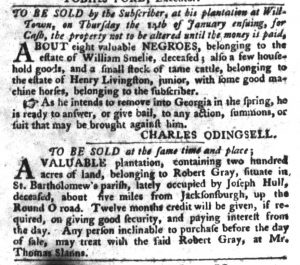
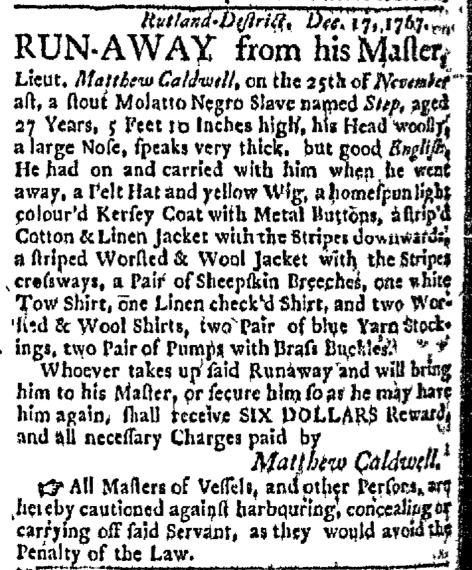
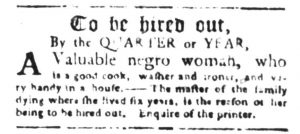
Slavery Advertisements Published January 7, 1768

The Slavery Adverts 250 Project chronicles the role of newspaper advertising in perpetuating slavery in the era of the American Revolution. The project seeks to reveal the ubiquity of slavery in eighteenth-century life from New England to Georgia by republishing advertisements about enslaved people – for sale as individuals or in groups, wanted to purchase or for hire for short periods, runaways who liberated themselves, and those who were subsequently captured and confined in jails and workhouses – in daily digests on this site as well as in real time via the @SlaveAdverts250 Twitter feed, utilizing twenty-first-century media to stand in for the print media of the eighteenth century.

The project aims to provide modern audiences with a sense of just how often colonizers encountered these advertisements in their daily lives. Enslaved men, women, and children appeared in print somewhere in the colonies almost every single day. Those advertisements served as a constant backdrop for social, cultural, economic, and political life in colonial and revolutionary America. Colonizers who did not purport to own enslaved people were still confronted with slavery as well as invited to maintain the system by purchasing enslaved men, women, and children or assisting in the capture of so-called “runaways” who sought to free themselves from bondage. The frequency of these newspaper advertisements suggests just how embedded slavery was in colonial and revolutionary American culture in everyday interactions beyond the printed page.

These advertisements also testify to the experiences of enslaved men, women, and children, though readers must consider that those experiences have been remediated through descriptions offered by enslavers rather than enslaved people themselves. Often unnamed in the advertisements, enslaved men, women, and children were not invisible or unimportant in early America.

These advertisements appeared in colonial American newspapers 250 years ago today.

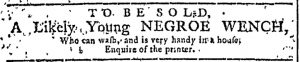
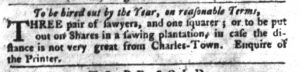
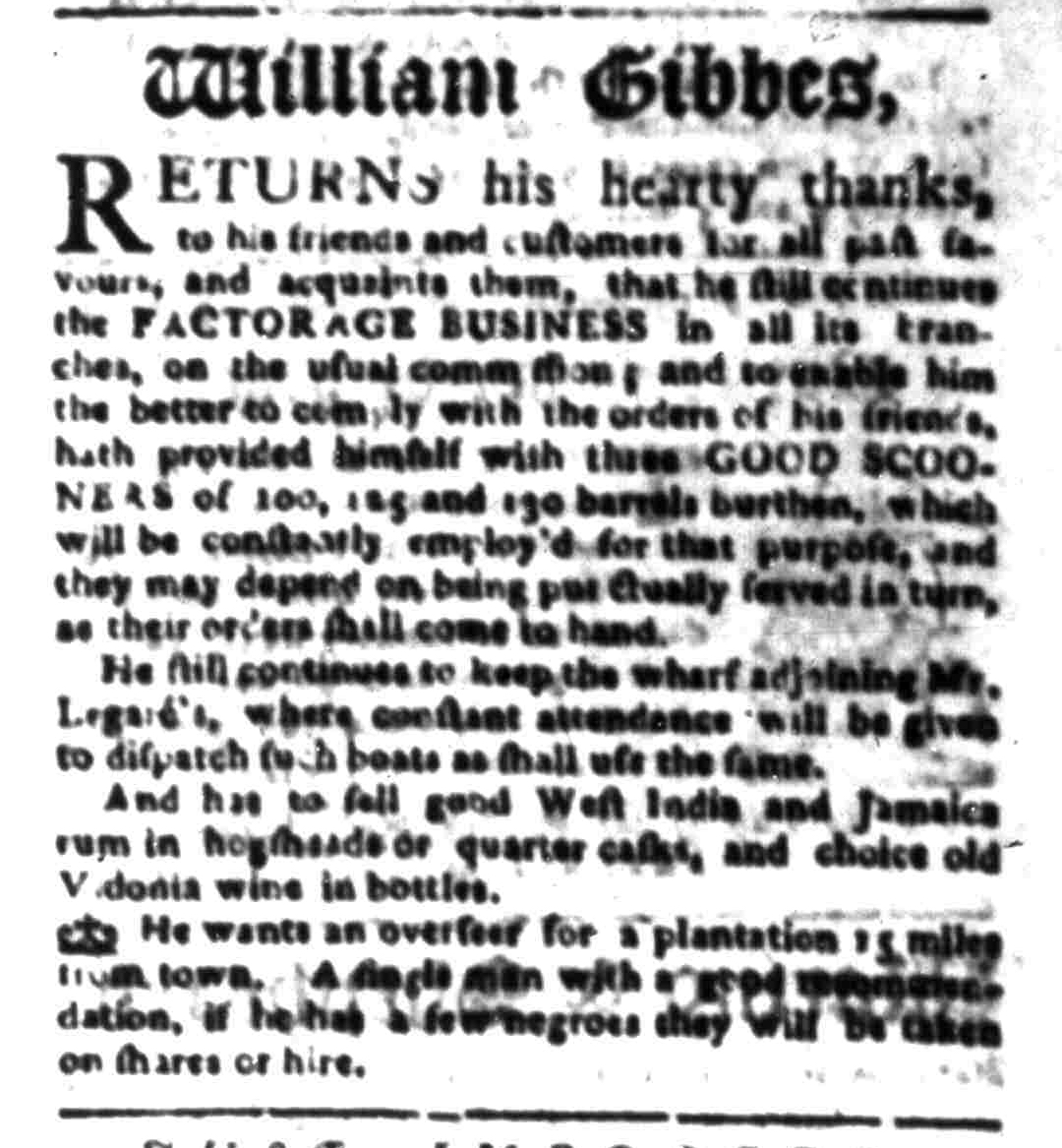
Jan 7 - Massachusetts Gazette Slavery 1
Massachusetts Gazette (January 7, 1768).

**********

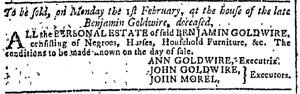
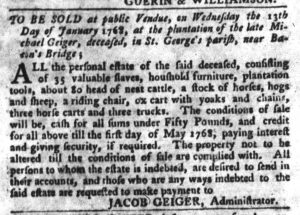
Jan 7 - Massachusetts Gazette Slavery 2
Massachusetts Gazette (January 7, 1768).

**********
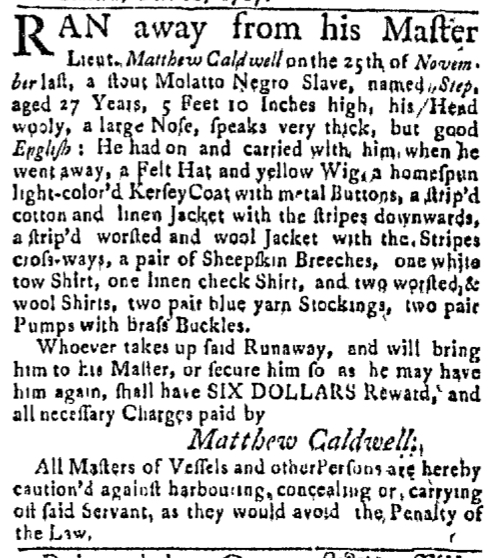
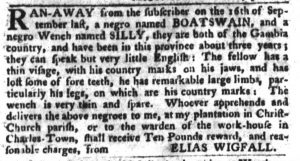
Jan 7 - Massachusetts Gazette Slavery 3
Massachusetts Gazette (January 7, 1768).

**********
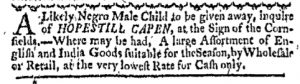
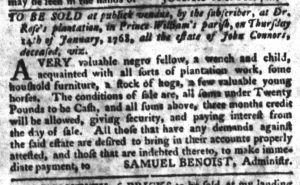
Jan 7 - Pennsylvania Gazette Slavery 1
Pennsylvania Gazette (January 7, 1768).

**********
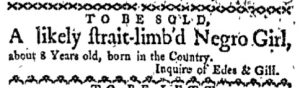
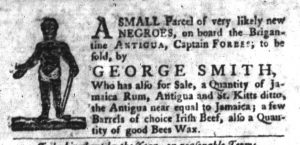
Jan 7 - Pennsylvania Gazette Supplement Slavery 1
Supplement to the Pennsylvania Gazette (January 7, 1768).

**********
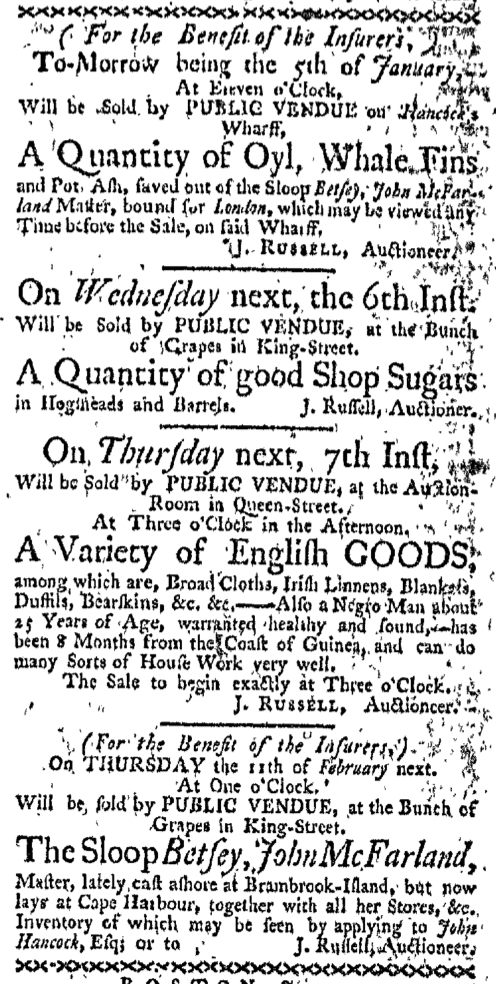
Jan 7 - Pennsylvania Gazette Supplement Slavery 2
Supplement to the Pennsylvania Gazette (January 7, 1768).

**********

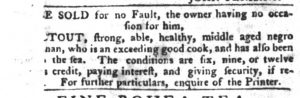
Jan 7 - Virginia Gazette Purdie and Dixon Slavery 1
Virginia Gazette (January 7, 1768).

**********
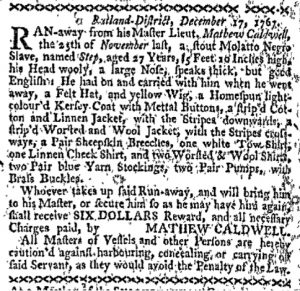
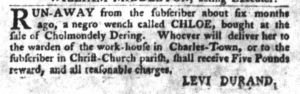
Jan 7 - Virginia Gazette Purdie and Dixon Slavery 2
Virginia Gazette (January 7, 1768).

**********
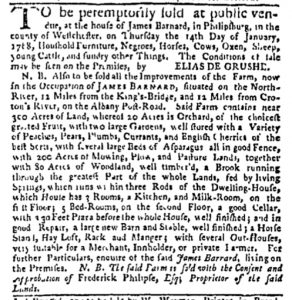
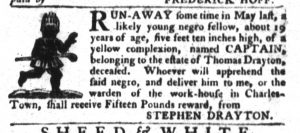
Jan 7 - Virginia Gazette Purdie and Dixon Slavery 3
Virginia Gazette (January 7, 1768).

January 6

What was advertised in a colonial American newspaper 250 years ago today?

Jan 6 - 1:6:1768 Georgia Gazette
Georgia Gazette (January 6, 1768).

“An Assortment of Delft Ware.”

In the January 6, 1768, edition of the Georgia Gazette, William Moore advertised several commodities frequently purchased in bulk, including rum, sugar, and nails. He concluded his list with “an Assortment of Delft Ware,” perhaps for sale directly to consumers or perhaps intended for retailers to stock their shops in Savannah and its hinterland.

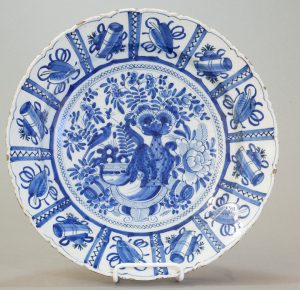
Delftware, a type of earthenware with an opaque white glaze enhanced with an overglaze decoration (usually done in blue), came in many designs and patterns. According to Amanda E. Lange, delftware was the most common kind of ceramic imported into the American colonies in the seventeenth and eighteenth centuries. “Produced in a wide variety of forms, ranging from the purely decorative to the decidedly utilitarian, plates, dishes, punch bowls, mugs, tea wares, tiles, apothecary jars, and chamberpots formed the bulk of delftware imported to America.”

Jan 6 - Delftware Plate
Delftware Plate (early 18th century). Courtesy Five Colleges and Historic Deerfield Museum Consortium (AC C.1936.17).

Although delftware derived its name from the town of Delft in the Netherlands, the center for delftware production had shifted to England by the eighteenth century. Whether made in England, the Netherlands, France, or elsewhere, delftware represented a less expensive alternative to fashionable Chinese porcelain.

Moore advertised his “Assortment of Delft Ware” in the final years of its popularity. More durable pottery produced in Staffordshire, England, displaced the fragile delftware in the late eighteenth century. Josiah Wedgwood, Lange notes, “perfected his version of creamware in the 1760. Wedgwood’s effective marketing skills and knowledge of current fashions eventually ruined the market for delftware.” Production in England sharply declined in the 1760s; by the end of the century it ceased.

At the time of Moore’s advertisement, however, delftware remained popular in the English colonies. Selecting among a variety of designs, sometimes imitating Chinese patterns and sometimes depicting European scenes, allowed consumers to assert their own tastes as well as demonstrate their knowledge of the latest fashions. Given the costs of Chinese import porcelain, acquiring delftware served as a substitute for displaying gentility on a budget.

Summary of Slavery Advertisements Published December 31, 1767 – January 6, 1768

These tables indicate how many advertisements for slaves appeared in colonial American newspapers during the week of December 31, 1767 – January 6, 1768.

Note:  These tables are as comprehensive as currently digitized sources permit, but they may not be an exhaustive account.  They includes all newspapers that have been digitized and made available via Accessible Archives, Colonial Williamsburg’s Digital Library, and Readex’s America’s Historical Newspapers.  There are several reasons some newspapers may not have been consulted:

  • Issues that are no longer extant;
  • Issues that are extant but have not yet been digitized (including the Pennsylvania Journal); and
  • Newspapers published in a language other than English (including the Wochentliche Philadelphische Staatsbote).

**********

Slavery Advertisements Published December 31, 1767 – January 6, 1768:  By Date

Slavery Adverts Tables 1767 By Date Dec 31

**********

Slavery Advertisements Published December 31, 1767 – January 6, 1768:  By Region

Slavery Adverts Tables 1767 By Region Dec 31

Slavery Advertisements Published January 6, 1768

The Slavery Adverts 250 Project chronicles the role of newspaper advertising in perpetuating slavery in the era of the American Revolution. The project seeks to reveal the ubiquity of slavery in eighteenth-century life from New England to Georgia by republishing advertisements about enslaved people – for sale as individuals or in groups, wanted to purchase or for hire for short periods, runaways who liberated themselves, and those who were subsequently captured and confined in jails and workhouses – in daily digests on this site as well as in real time via the @SlaveAdverts250 Twitter feed, utilizing twenty-first-century media to stand in for the print media of the eighteenth century.

The project aims to provide modern audiences with a sense of just how often colonizers encountered these advertisements in their daily lives. Enslaved men, women, and children appeared in print somewhere in the colonies almost every single day. Those advertisements served as a constant backdrop for social, cultural, economic, and political life in colonial and revolutionary America. Colonizers who did not purport to own enslaved people were still confronted with slavery as well as invited to maintain the system by purchasing enslaved men, women, and children or assisting in the capture of so-called “runaways” who sought to free themselves from bondage. The frequency of these newspaper advertisements suggests just how embedded slavery was in colonial and revolutionary American culture in everyday interactions beyond the printed page.

These advertisements also testify to the experiences of enslaved men, women, and children, though readers must consider that those experiences have been remediated through descriptions offered by enslavers rather than enslaved people themselves. Often unnamed in the advertisements, enslaved men, women, and children were not invisible or unimportant in early America.

These advertisements appeared in colonial American newspapers 250 years ago today.

Jan 6 - Georgia Gazette Slavery 1
Georgia Gazette (January 6, 1768).

**********

Jan 6 - Georgia Gazette Slavery 2
Georgia Gazette (January 6, 1768).

**********

Jan 6 - Georgia Gazette Slavery 3
Georgia Gazette (January 6, 1768).

**********

Jan 6 - Georgia Gazette Slavery 4
Georgia Gazette (January 6, 1768).

**********

Jan 6 - Georgia Gazette Slavery 5
Georgia Gazette (January 6, 1768).

**********

Jan 6 - Georgia Gazette Slavery 6
Georgia Gazette (January 6, 1768).

January 5

What was advertised in a colonial American newspaper 250 years ago today?

Jan 5 - 1:5:1768 South-Carolina Gazette and Country Journal
South-Carolina Gazette and Country Journal (January 5, 1768).

“At his store in Beaufort.”

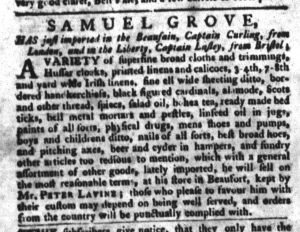
Samuel Grove advertised imported textiles and “a general assortment of other goods” in the January 5, 1768, edition of the South-Carolina Gazette and Country Journal. Unlike most of the merchants, shopkeepers, and artisans who advertised in that newspaper or its local competitors, Grove’s business was not located in Charleston. Instead, he owned a store in Beaufort, “kept by Mr. PETER LAVINE.” Grove’s advertisement testifies to the reach of both consumer culture and print culture, especially the distribution of newspapers, in eighteenth-century America.

Chartered in 1711, Beaufort is located on Port Royal, one of the Sea Islands in the South Carolina Lowcountry, approximately midway between Charleston and Savannah. The town did not have its own newspaper; instead the newspapers printed in Charleston served the residents of Beaufort and the rest of the colony. According to Edward Connery Lathem’s Chronological Table of American Newspapers, South Carolina’s newspapers were published exclusively in Charleston until the appearance of the South-Carolina Gazette in Parker’s Ferry in 1782, just as the revolution neared its end.[1] Only one issue survives, though items reprinted in other newspapers suggest that the Parker’s Ferry South-Carolina Gazette commenced in April and continued at least until the end of June.[2] No other newspaper printed beyond Charleston appeared until James Carson published the South-Carolina Independent Gazette in Georgetown, also in the Lowcountry, in 1791.[3] In the interim, a variety of newspapers commenced (and many of them ceased) publication in Charleston. The colony’s oldest city remained the primary hub for disseminating information, both news and advertising, for a quarter century after Samuel Grove inserted his advertisement for a store in Beaufort in Charleston’s South-Carolina Gazette and Country Journal. He placed that advertisement with confidence that prospective customers in Beaufort would see it. In addition, he realized that readers in other parts of the country would also encounter it. To that end, he accepted “orders from the country” beyond Beaufort.

Charleston’s newspapers served an extensive hinterland. Samuel Grove turned to the advertising pages of one of those newspapers to attract customers who resided in that hinterland.

**********

[1] Edward Connery Lathem, Chronological Tables of American Newspapers, 1620-1820 (Barre, MA: American Antiquarian Society and Barre Publishers, 1972), 21.

[2] Clarence S. Brigham, History and Bibliography of American Newspapers, 1690-1820 (Worcester, MA: American Antiquarian Society, 1947), 1052.

[3] Lathem, Chronological Tables, 40

Slavery Advertisements Published January 5, 1768

The Slavery Adverts 250 Project chronicles the role of newspaper advertising in perpetuating slavery in the era of the American Revolution. The project seeks to reveal the ubiquity of slavery in eighteenth-century life from New England to Georgia by republishing advertisements about enslaved people – for sale as individuals or in groups, wanted to purchase or for hire for short periods, runaways who liberated themselves, and those who were subsequently captured and confined in jails and workhouses – in daily digests on this site as well as in real time via the @SlaveAdverts250 Twitter feed, utilizing twenty-first-century media to stand in for the print media of the eighteenth century.

The project aims to provide modern audiences with a sense of just how often colonizers encountered these advertisements in their daily lives. Enslaved men, women, and children appeared in print somewhere in the colonies almost every single day. Those advertisements served as a constant backdrop for social, cultural, economic, and political life in colonial and revolutionary America. Colonizers who did not purport to own enslaved people were still confronted with slavery as well as invited to maintain the system by purchasing enslaved men, women, and children or assisting in the capture of so-called “runaways” who sought to free themselves from bondage. The frequency of these newspaper advertisements suggests just how embedded slavery was in colonial and revolutionary American culture in everyday interactions beyond the printed page.

These advertisements also testify to the experiences of enslaved men, women, and children, though readers must consider that those experiences have been remediated through descriptions offered by enslavers rather than enslaved people themselves. Often unnamed in the advertisements, enslaved men, women, and children were not invisible or unimportant in early America.

These advertisements appeared in colonial American newspapers 250 years ago today.

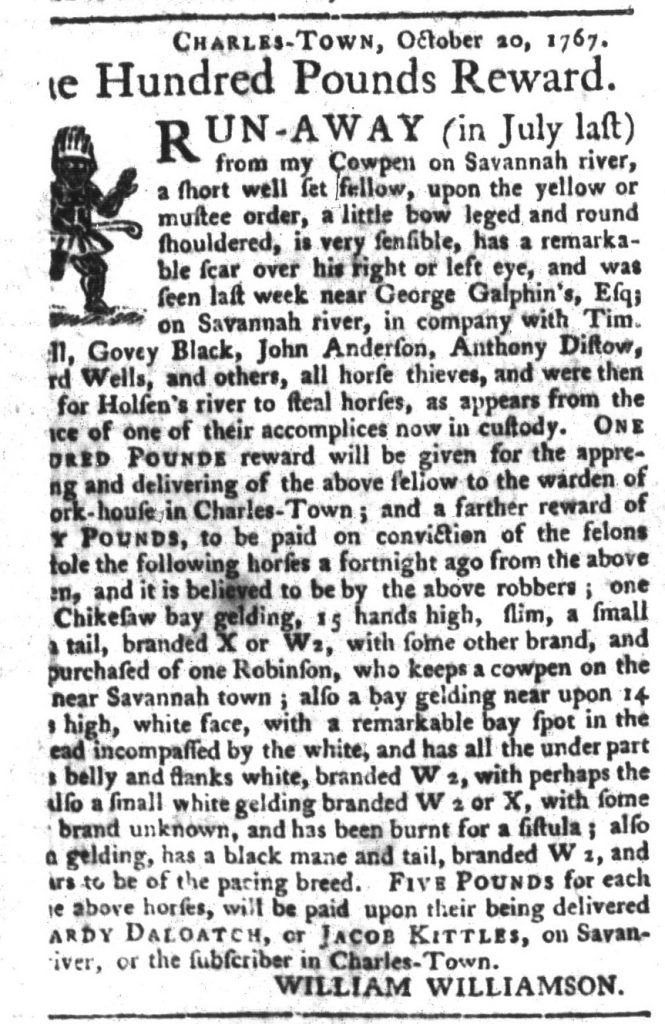
Jan 5 - South-Carolina Gazette and Country Journal Slavery 1
South-Carolina Gazette and Country Journal (January 5, 1768).

**********

Jan 5 - South-Carolina Gazette and Country Journal Slavery 2
South-Carolina Gazette and Country Journal (January 5, 1768).

**********

Jan 5 - South-Carolina Gazette and Country Journal Slavery 3
South-Carolina Gazette and Country Journal (January 5, 1768).

**********

Jan 5 - South-Carolina Gazette and Country Journal Slavery 4
South-Carolina Gazette and Country Journal (January 5, 1768).

**********

Jan 5 - South-Carolina Gazette and Country Journal Slavery 5
South-Carolina Gazette and Country Journal (January 5, 1768).

**********

Jan 5 - South-Carolina Gazette and Country Journal Slavery 6
South-Carolina Gazette and Country Journal (January 5, 1768).

**********

Jan 5 - South-Carolina Gazette and Country Journal Slavery 7
South-Carolina Gazette and Country Journal (January 5, 1768).

**********

Jan 5 - South-Carolina Gazette and Country Journal Slavery 8
South-Carolina Gazette and Country Journal (January 5, 1768).

**********

Jan 5 - South-Carolina Gazette and Country Journal Slavery 9
South-Carolina Gazette and Country Journal (January 5, 1768).

**********

Jan 5 - South-Carolina Gazette and Country Journal Slavery 10
South-Carolina Gazette and Country Journal (January 5, 1768).

**********

Jan 5 - South-Carolina Gazette and Country Journal Slavery 11
South-Carolina Gazette and Country Journal (January 5, 1768).

**********

Jan 5 - South-Carolina Gazette and Country Journal Slavery 12
South-Carolina Gazette and Country Journal (January 5, 1768).

**********

Jan 5 - South-Carolina Gazette and Country Journal Slavery 13
South-Carolina Gazette and Country Journal (January 5, 1768).

January 4

What was advertised in a colonial American newspaper 250 years ago today?

Jan 4 - 1:4:1767 South-Carolina Gazette
South Carolina Gazette (January 4, 1767).

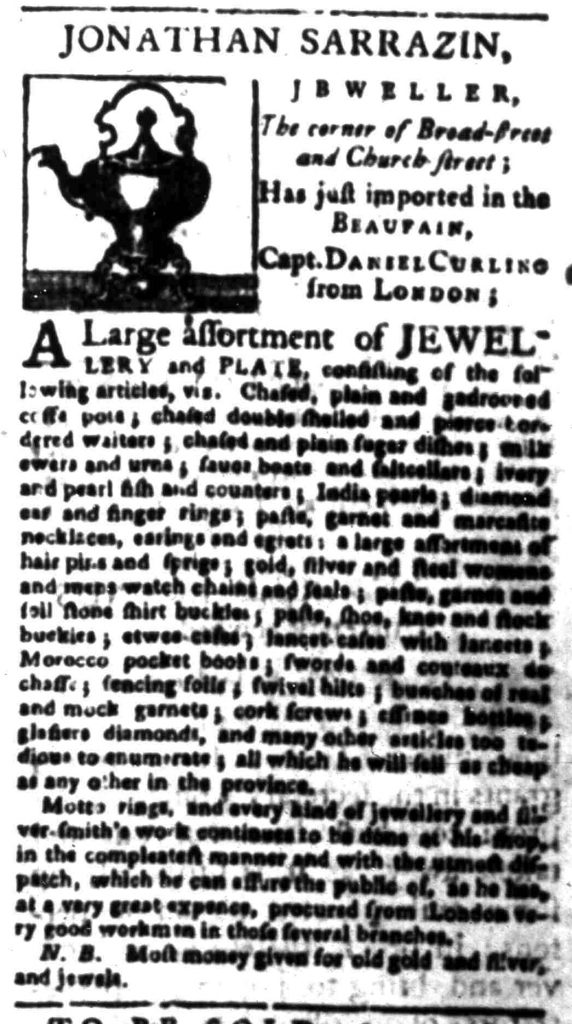
“A Large assortment of JEWELLERY and PLATE.”

Jonathan Sarrazin, a jeweler in Charleston, used a woodcut of a teapot, one of the items he sold, to distinguish his newspaper advertisements from others that also appeared among the pages of dense type. Throughout 1767 and into 1768, his advertisements in the South-Carolina and American General Gazette regularly included this device. Sarrazin’s enthusiasm for associating an image of a fashionable teapot with his business, however, has been partially obscured by a gap in the archive.

Sarrazin could have advertised in any of the three newspapers published in Charleston. In addition to Robert Wells’ South-Carolina and American General Gazette, Peter Timothy printed the South Carolina Gazette and Charles Crouch printed the South-Carolina Gazette and Country Journal. Although all three newspapers had print runs that extended through 1767 and 1768, not all of the issues have been converted into digital surrogates that are digitally accessible to historians, other scholars, and the general public. Accessible Archives provides a complete digital archive for the South-Carolina and American General Gazette and the South-Carolina Gazette and Country Journal for 1767 and 1768, but lacks images of the South-Carolina Gazette for several months of 1767. (The database does include transcripts of the text of issues published during the period.) As a result, consideration of Sarrazin’s advertising campaign in 1767 has been truncated. Working with the available issues reveals that the jeweler advertised regularly in the South-Carolina and American General Gazette, but not in the South-Carolina Gazette and Country Journal. Consulting the transcripts of the South Carolina Gazette could establish whether Sarrazin also advertised in that publication, but that process requires much more time and labor than examining photographs of the original issues. This method also eliminates the most striking feature of Sarrazin’s commercial notices, the woodcut that made it so easy for readers – then and now – to identify his advertisements. (Keyword searches are notoriously unreliable, rendering them inconclusive as well.) Furthermore, the transcripts do not include metadata that indicates when woodcuts accompanied advertisements and news items. In the absence of photographs of the original issues, Sarrazin’s advertising campaign cannot be reconstructed definitively.

Fortunately, Accessible Archives does make available photographs for extant issues of the South Carolina Gazette for all of 1768. Those issues reveal that not only did Sarrazin opt to advertise in a second publication but that he also included a woodcut depicting an ornate teapot in his notices. This demonstrates the jeweler’s commitment to establishing a trademark for his business. He wanted consumers in Charleston and its hinterland to readily identify his advertisements and associate his wares with the fashionable and genteel teapot that appeared in his notices and perhaps doubled as the sign that marked the location of his shop. This testifies to a thoughtful effort to achieve consistency in his advertising in multiple newspapers.

Slavery Advertisements Published January 4, 1768

The Slavery Adverts 250 Project chronicles the role of newspaper advertising in perpetuating slavery in the era of the American Revolution. The project seeks to reveal the ubiquity of slavery in eighteenth-century life from New England to Georgia by republishing advertisements about enslaved people – for sale as individuals or in groups, wanted to purchase or for hire for short periods, runaways who liberated themselves, and those who were subsequently captured and confined in jails and workhouses – in daily digests on this site as well as in real time via the @SlaveAdverts250 Twitter feed, utilizing twenty-first-century media to stand in for the print media of the eighteenth century.

The project aims to provide modern audiences with a sense of just how often colonizers encountered these advertisements in their daily lives. Enslaved men, women, and children appeared in print somewhere in the colonies almost every single day. Those advertisements served as a constant backdrop for social, cultural, economic, and political life in colonial and revolutionary America. Colonizers who did not purport to own enslaved people were still confronted with slavery as well as invited to maintain the system by purchasing enslaved men, women, and children or assisting in the capture of so-called “runaways” who sought to free themselves from bondage. The frequency of these newspaper advertisements suggests just how embedded slavery was in colonial and revolutionary American culture in everyday interactions beyond the printed page.

These advertisements also testify to the experiences of enslaved men, women, and children, though readers must consider that those experiences have been remediated through descriptions offered by enslavers rather than enslaved people themselves. Often unnamed in the advertisements, enslaved men, women, and children were not invisible or unimportant in early America.

These advertisements appeared in colonial American newspapers 250 years ago today.

Jan 4 - Boston Evening-Post Slavery 1
Boston Evening-Post (January 4, 1768).

**********

Jan 4 - Boston Post-Boy Slavery 1
Boston Post-Boy (January 4, 1768).

**********

Jan 4 - Boston Post-Boy Slavery 2
Boston Post-Boy (January 4, 1768).

**********

Jan 4 - Boston-Gazette Slavery 1
Boston-Gazette (January 4, 1768).

**********

Jan 4 - Boston-Gazette Slavery 2
Boston-Gazette (January 4, 1768).

**********

Jan 4 - Boston-Gazette Slavery 3
Boston-Gazette (January 4, 1768).

**********

Jan 4 - Boston-Gazette Slavery 4
Boston-Gazette (January 4, 1768).

**********

Jan 4 - Boston-Gazette Slavery 5
Boston-Gazette (January 4, 1768).

**********

Jan 4 - New-York Mercury Slavery 1
New-York Mercury (January 4, 1768).

**********

Jan 4 - New-York Mercury Slavery 2
New-York Mercury (January 4, 1768).

**********

Jan 4 - New-York Mercury Slavery 3
New-York Mercury (January 4, 1768).

**********

Jan 4 - Newport Mercury Slavery 1
Newport Mercury (January 4, 1768).

**********

Jan 4 - Newport Mercury Slavery 2
Newport Mercury (January 4, 1768).

**********

Jan 4 - South Carolina Gazette Slavery 1
South Carolina Gazette (January 4, 1768).

**********

Jan 4 - South Carolina Gazette Slavery 2
South Carolina Gazette (January 4, 1768).

**********

Jan 4 - South Carolina Gazette Slavery 3
South Carolina Gazette (January 4, 1768).

**********

Jan 4 - South Carolina Gazette Slavery 4
South Carolina Gazette (January 4, 1768).

**********

Jan 4 - South Carolina Gazette Slavery 5
South Carolina Gazette (January 4, 1768).

**********

Jan 4 - South Carolina Gazette Slavery 6
South Carolina Gazette (January 4, 1768).

**********

Jan 4 - South Carolina Gazette Slavery 7
South Carolina Gazette (January 4, 1768).

**********

Jan 4 - South Carolina Gazette Slavery 8
South Carolina Gazette (January 4, 1768).

**********

Jan 4 - South Carolina Gazette Slavery 9
South Carolina Gazette (January 4, 1768).

**********

Jan 4 - South Carolina Gazette Slavery 10
South Carolina Gazette (January 4, 1768).

January 3

What was advertised in a colonial American newspaper 250 years ago this week?

Jan 3 - 1:1:1768 South-Carolina and American General Gazette
South-Carolina and American General Gazette (January 1, 1768).

A large and well sorted CARGO of GOODS.”

As part of their efforts to entice potential customers to visit “their store in Broad street” in Charleston, Michie and Robertston emphasized consumer choice in their advertisements in the South-Carolina and American General Gazette. Extending approximately one-third of a column, their advertisement in the January 1, 1768, issue listed dozens of items in their inventory, from “German serges” to “rich black, white, blue and crimson sattin” to “mens, womens and boys cotton, thread and worsted hose.” In addition to textiles and garments, they also stocked housewares and grocery items.

On its own, this list of goods presented prospective customers with a multitude of choices available at Michie and Robertson’s shop, yet the shopkeepers supplemented an implicit appeal concerning their vast selection with explicit descriptions to shape readers’ assessment of their wares and the experience of shopping at their store. Before commencing the list of merchandise, Michie and Robertson first proclaimed that they had imported “a large and well sorted CARGO of GOODS.” Then they inserted further descriptions attesting to consumer choice as they cataloged their wares. For instance, they did not merely enumerate an array of fabrics, but instead promoted “a large sortment of shalloons, callimancoes, durants, camblets, queen’s stuff, harragon, black and blue everlasting, black russet, bombazeens and poplins.” Similarly, they sold “A Variety of very neat London dressed broad cloths with suitable trimmings,” “handkerchiefs of all sorts,” and “a compleat sortment of iron wares.” Their selection was not haphazard or random; customers were bound to find exactly what they needed or wanted among Michie and Robertson’s merchandise.

In taking this approach, Michie and Robertson adopted an advertising strategy that became increasingly popular as greater numbers of colonists participated in the consumer revolution. The length of such list-style advertisements dramatically increased in the second half of the eighteenth century, in part because of their capacity to incite sales. Listing an assortment of goods – informing potential customers of the vast array of possibilities – likely stimulated demand by prompting readers to imagine possessing items they may not have previously considered acquiring (especially when combined with appeals to price and fashion). It also encouraged them to examine the merchandise in person to select items that best suited their own tastes, allowing consumers to exercise their judgment in distinguishing among the many options available.

January 2

What was advertised in a colonial American newspaper 250 years ago today?

Jan 2 - 1:2:1768 Providence Gazette
Providence Gazette (January 2, 1767).

“Very CHEAP.”

The typography of Thompson and Arnold’s advertisement in the January 2, 1768, edition of the Providence Gazette deviated from the standard format for notices placed by merchants and shopkeepers throughout the rest of the issue. Each advertisement had a headline of sorts, but in most instances the headline announced the name of the advertiser. In fonts several sizes larger than the text for the rest of the advertisement, those headlines marked notices inserted by Samuel Carew, Nathl. Greene, J. Mathewson, Benoni Pearce, Jonathan Russell, J. & Wm. Russell, and Darius Sessions. Some of them abbreviated their names in order to fit on a single line.

Thompson and Arnold’s notice, on the other hand, included their names in larger font than most of the advertisement yet reserved the largest font for a marketing appeal that appeared first, preceding their names and all other information included in the advertisement. “Very CHEAP” proclaimed their headline, immediately signaling to prospective customers what kinds of prices they could expect to pay if they decided “to call at [Thompson and Arnold’s] Store, near the Great Bridge.” Each of the other advertisers included an appeal to price somewhere in their notices. Some deployed elaborate language to convince consumers that they sold their wares “cheaper than any Person or Persons in Providence” or “at the very cheapest rate.” Yet readers had to at least skim the notices places by J. Mathewson, Jonathan Russell, and their counterparts to encounter those appeals to price. Associating low prices with Thompson and Arnold required nothing more than a quick glance at their advertisement.

Perhaps the deployment of this typography was merely circumstantial in this case. After all, the name of their partnership contained more characters than the much shorter Samuel Carew or Darius Sessions and could not be abbreviated conveniently like Nathl. Greene or J. & Wm. Russell. Neither situation, however, prevented advertisers and the compositor devising other solutions that still gave primacy to the name of the advertiser in other advertisements elsewhere in the same issue. Nicholas Brown and Company, for instance, listed Brown’s name in large font on the first line, followed by “and COMPANY” in middling-sized font (but strategic capitals) on the next line. “THURBER AND CAHOON” used fonts as large as those in any other advertisement for their names, inserting one word on each of the first three lines of their advertisement.

Thompson and Arnold could have adopted a similar strategy. Doing so would have adhered to custom when it came to the standard format for advertisements in the Providence Gazette and other newspapers throughout the colonies in the 1760s. Finding themselves in the same position as their competitors – making an appeal to price – the partners innovatively wrote their copy in such a way that made their marketing strategy double as the headline for their advertisement. As a result, the typography of their advertisement promoted their business in a manner unique among the paid notices that appeared throughout the same issue.