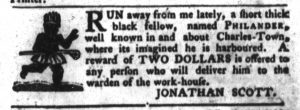
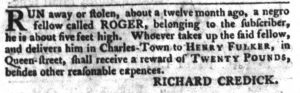
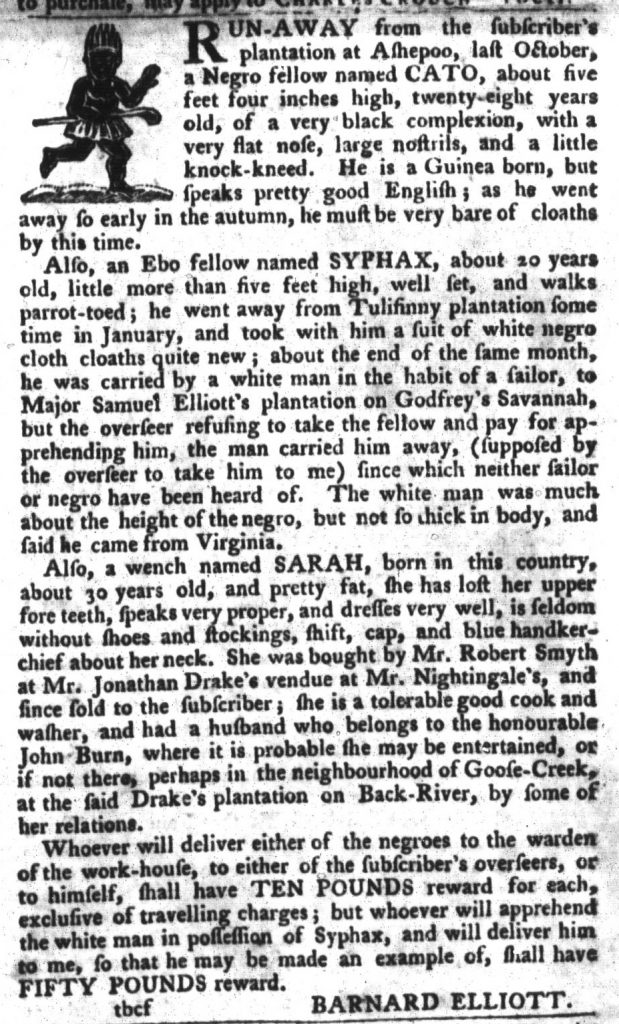
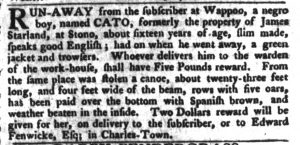
Slavery Advertisements Published March 17, 1768

The Slavery Adverts 250 Project chronicles the role of newspaper advertising in perpetuating slavery in the era of the American Revolution. The project seeks to reveal the ubiquity of slavery in eighteenth-century life from New England to Georgia by republishing advertisements for slaves – for sale, wanted to purchase, runaways, captured fugitives – in daily digests on this site as well as in real time via the @SlaveAdverts250 Twitter feed, utilizing twenty-first-century media to stand in for the print media of the eighteenth century.

The project aims to provide modern audiences with a sense of just how often colonists encountered these advertisements in their daily lives. Enslaved men, women, and children appeared in print somewhere in the colonies almost every single day. Those advertisements served as a constant backdrop for social, cultural, economic, and political life in colonial and revolutionary America. Colonists who did not own slaves were still confronted with slavery as well as invited to maintain the system by purchasing slaves or assisting in the capture of runaways. The frequency of these newspaper advertisements suggests just how embedded slavery was in colonial and revolutionary American culture in everyday interactions beyond the printed page.

These advertisements also testify to the experiences of enslaved men, women, and children, though readers must consider that those experiences have been remediated through descriptions offered by slaveholders rather than the slaves themselves. Often unnamed in the advertisements, enslaved men, women, and children were not invisible or unimportant in early America.

These advertisements appeared in colonial American newspapers 250 years ago today.

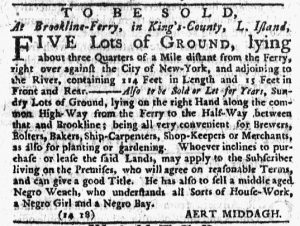
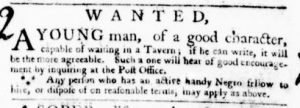
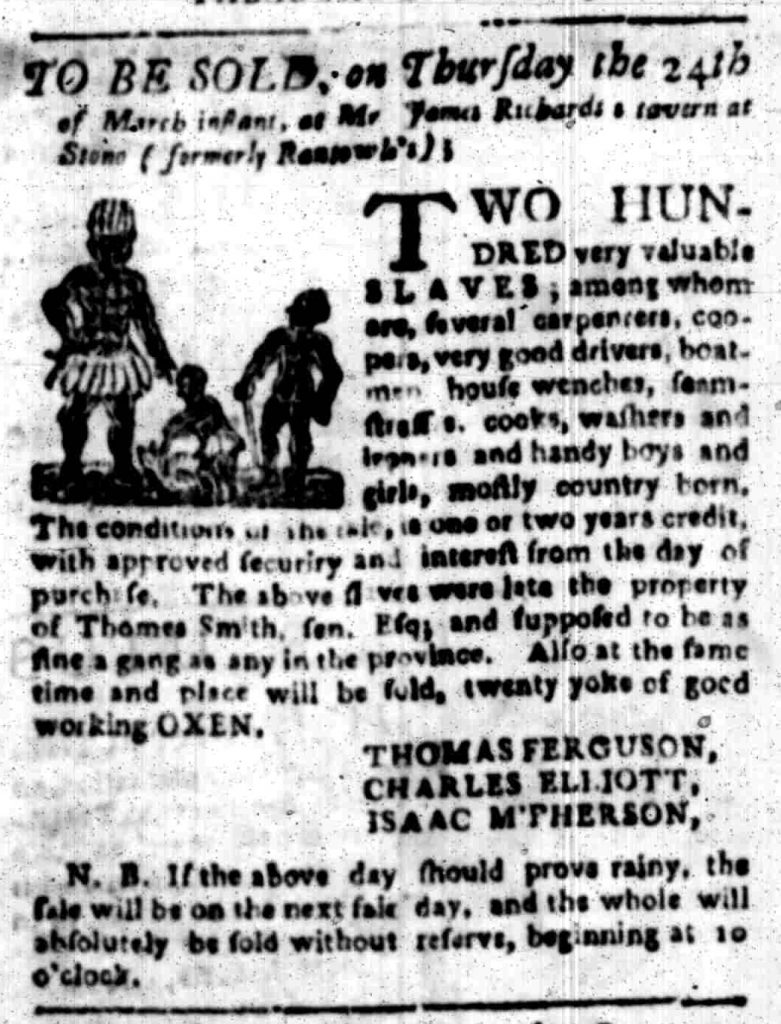
Mar 17 - Massachusetts Gazette Slavery 1
Massachusetts Gazette (March 17, 1768).

**********

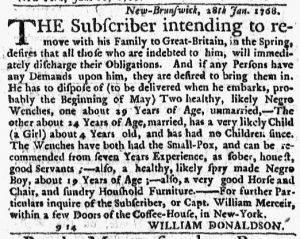
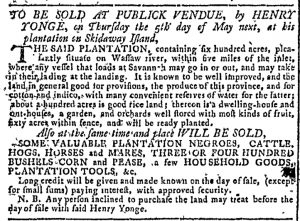
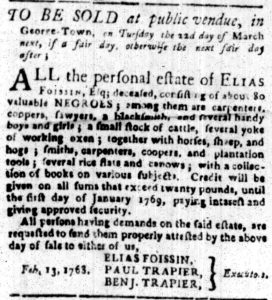
Mar 17 - Massachusetts Gazette Supplement Slavery 2
Supplement to the Massachusetts Gazette (March 17, 1768).

**********
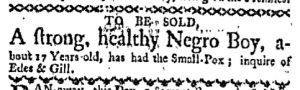
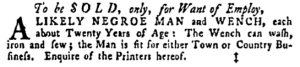
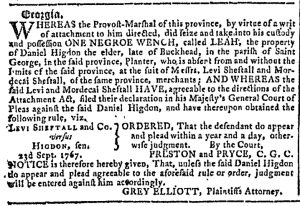
Mar 17 - New-York Journal Slavery 1
New-York Journal (March 17, 1768).

**********

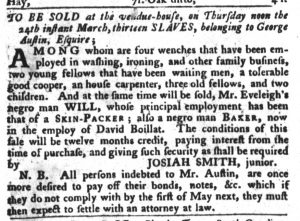
Mar 17 - New-York Journal Slavery 2
New-York Journal (March 17, 1768).

**********

Mar 17 - New-York Journal Slavery 3
New-York Journal (March 17, 1768).

**********

Mar 17 - New-York Journal Supplement Slavery 1
Supplement to the New-York Journal (March 17, 1768).

**********

Mar 17 - Pennsylvania Gazette Slavery 1
Pennsylvania Gazette (March 17, 1768).

**********
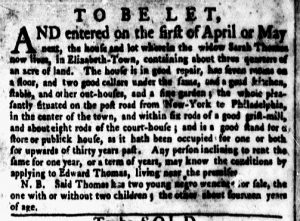
Mar 17 - Pennsylvania Gazette Slavery 2
Pennsylvania Gazette (March 17, 1768).

**********

Mar 17 - Pennsylvania Gazette Slavery 3
Pennsylvania Gazette (March 17, 1768).

**********
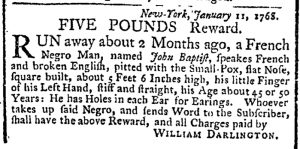
Mar 17 - Pennsylvania Gazette Supplement Slavery 1
Supplement to the Pennsylvania Gazette (March 17, 1768).

**********
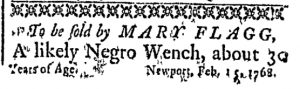
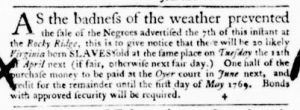
Mar 17 - Virginia Gazette Purdie and Dixon Slavery 1
Virginia Gazette [Purdie & Dixon] (March 17, 1768).

**********

Mar 17 - Virginia Gazette Purdie and Dixon Slavery 2
Virginia Gazette [Purdie & Dixon] (March 17, 1768).

**********

Mar 17 - Virginia Gazette Purdie and Dixon Slavery 3
Virginia Gazette [Purdie & Dixon] (March 17, 1768).

**********

Mar 17 - Virginia Gazette Purdie and Dixon Slavery 4
Virginia Gazette [Purdie & Dixon] (March 17, 1768).

**********

Mar 17 - Virginia Gazette Purdie and Dixon Slavery 5
Virginia Gazette [Purdie & Dixon] (March 17, 1768).

**********

Mar 17 - Virginia Gazette Rind Slavery 1
Virginia Gazette [Rind] (March 17, 1768).

**********

Mar 17 - Virginia Gazette Rind Slavery 2
Virginia Gazette [Rind] (March 17, 1768).

**********

Mar 17 - Virginia Gazette Rind Slavery 3
Virginia Gazette [Rind] (March 17, 1768).

**********

Mar 17 - Virginia Gazette Rind Slavery 4
Virginia Gazette [Rind] (March 17, 1768).

March 16

What was advertised in a colonial American newspaper 250 years ago today?

Mar 16 - 3:16:1768 Georgia Gazette
Georgia Gazette (March 16, 1768).

“WHEREAS the following advertisement was stuck up at divers places …”

John Joachim Zubly placed an advertisement concerning a dispute over real estate in the March 16, 1768, edition of the Georgia Gazette. In it, Zubly responded to a separate advertisement that George Galphin and Lachlan McGillivray “stuck up at divers places at Augusta and New-Windsor the beginning of this month.” Zubly opened his own advertisement with an extensive quotation from Galphin and McGillivray’s advertisement, providing readers with the context they needed to understand his rebuttal.

Although the Adverts 250 Project usually features advertisements for consumer goods and services rather than real estate, this notice merits inclusion because it provides a glimpse of another medium used for advertising in eighteenth-century America. Newspaper notices comprised the vast majority of advertising of the period, but advertisers also distributed broadsides, handbills, trade cards, billheads, magazine wrappers, catalogs, and a variety of other printed media for the purposes of disseminating information or attempting to incite demand for goods and services. Although Galphin and McGillivray’s advertisement concerned real estate, others “stuck up” advertisements that promoted the goods they sold in their shops. On occasion, the charges recorded in printers’ ledgers indicate that advertisers paid an additional fee for a boy from the shop to paste their advertisements around town, saving them the time and effort of distributing the advertisements themselves.

Based on Zubly’s description, the advertisement “stuck up at diverse places at Augusta and New-Windsor” was most likely a broadside, a sheet printed on only one side, the eighteenth-century equivalent of a poster (though the size of this particular item may have been closer to a handbill or flier). Zubly responded in print, intending that his advertisement in the Georgia Gazette would reach as many colonists as possible, but he may have also commissioned his own broadside to post in the same places that Galphin and McGillivray distributed theirs.

Even more ephemeral than newspapers, most eighteenth-century broadsides have likely been lost over time. Zubly’s advertisement, however, testifies to the rich landscape of advertising that colonists encountered in their daily lives beyond the pages of the newspapers.

Slavery Advertisements Published March 16, 1768

The Slavery Adverts 250 Project chronicles the role of newspaper advertising in perpetuating slavery in the era of the American Revolution. The project seeks to reveal the ubiquity of slavery in eighteenth-century life from New England to Georgia by republishing advertisements for slaves – for sale, wanted to purchase, runaways, captured fugitives – in daily digests on this site as well as in real time via the @SlaveAdverts250 Twitter feed, utilizing twenty-first-century media to stand in for the print media of the eighteenth century.

The project aims to provide modern audiences with a sense of just how often colonists encountered these advertisements in their daily lives. Enslaved men, women, and children appeared in print somewhere in the colonies almost every single day. Those advertisements served as a constant backdrop for social, cultural, economic, and political life in colonial and revolutionary America. Colonists who did not own slaves were still confronted with slavery as well as invited to maintain the system by purchasing slaves or assisting in the capture of runaways. The frequency of these newspaper advertisements suggests just how embedded slavery was in colonial and revolutionary American culture in everyday interactions beyond the printed page.

These advertisements also testify to the experiences of enslaved men, women, and children, though readers must consider that those experiences have been remediated through descriptions offered by slaveholders rather than the slaves themselves. Often unnamed in the advertisements, enslaved men, women, and children were not invisible or unimportant in early America.

These advertisements appeared in colonial American newspapers 250 years ago today.

Mar 16 - Georgia Gazette Slavery 1
Georgia Gazette (March 16, 1768).

**********

Mar 16 - Georgia Gazette Slavery 2
Georgia Gazette (March 16, 1768).

**********

Mar 16 - Georgia Gazette Slavery 3
Georgia Gazette (March 16, 1768).

**********

Mar 16 - Georgia Gazette Slavery 4
Georgia Gazette (March 16, 1768).

**********

Mar 16 - Georgia Gazette Slavery 5
Georgia Gazette (March 16, 1768).

**********

Mar 16 - Georgia Gazette Slavery 6
Georgia Gazette (March 16, 1768).

March 15

What was advertised in a colonial American newspaper 250 years ago today?

Mar 15 - 3:15:1768 South-Carolina Gazette and Country Journal
South-Carolina Gazette and Country Journal (March 15, 1768).

“A fresh assortment of GARDEN SEEDS, pease, beans and flower-roots.”

James McCall stocked and sold a variety of imported merchandise “at his store in Tradd-street” in Charleston. Like many other merchants and shopkeepers, he attempted to incited demand for his wares by placing an advertisement that listed many of them in a dense paragraph, everything from “neat Wilton carpeting” to “shot of all sizes” to “coffee and chocolate.” His inventory included groceries, clothing, housewares, and much more.

For the most part McCall did not make special efforts to promote any particular items, with one exception. Deploying typography strategically, he did draw attention to his “fresh assortment of GARDEN SEEDS, pease, beans and flower-roots.” Very few words in his advertisement appeared in all capital letters; most of those that did were names: his own name that served as a headline, the name of the ship and captain that transported the goods, and the name of the English port of departure. In the main body of the advertisement, the list of items for sale, the first word appeared in all capitals, as was the convention for all advertisements in the South-Carolina Gazette and Country Journal. Otherwise, the words “GARDEN SEEDS” about midway through the list of goods were the only words in all capitals in the body of McCall’s notice.

Although advertisers usually wrote copy and left it to compositors to determine the graphic design elements of eighteenth-century newspaper advertisements, deviations from the standard appearance of notices within particular publications suggest that advertisers could and did sometimes request specific typography for certain aspects of their notices. Such appears to have been the case for McCall’s advertisement since the compositor would have had little reason to randomly set “GARDEN SEEDS” in all capitals. On the other hand, McCall had particular interest in drawing attention to such seasonal merchandise. In other advertisements, he developed a habit for singling out a specific item to promote to prospective customers. For instance, the previous August he included “CHOICE DOUBLE GLOSTER CHEESE” in a list-style advertisement that did not feature any other items in all capitals.

McCall could have chosen to highlight these items by listing them first or writing a separate nota bene to append to his advertisements. Instead, he opted to experiment with variations in typography to accentuate his “GARDEN SEEDS” and “CHOICE DOUBLE GLOSTER CHEESE.” Although rudimentary compared to modern understandings of graphic design, his choices indicate some level of understanding that the appearance on the page could be just as effective as the copy when it came to delivering advertising content to consumers.

Slavery Advertisements Published March 15, 1768

The Slavery Adverts 250 Project chronicles the role of newspaper advertising in perpetuating slavery in the era of the American Revolution. The project seeks to reveal the ubiquity of slavery in eighteenth-century life from New England to Georgia by republishing advertisements about enslaved people – for sale as individuals or in groups, wanted to purchase or for hire for short periods, runaways who liberated themselves, and those who were subsequently captured and confined in jails and workhouses – in daily digests on this site as well as in real time via the @SlaveAdverts250 Twitter feed, utilizing twenty-first-century media to stand in for the print media of the eighteenth century.

The project aims to provide modern audiences with a sense of just how often colonizers encountered these advertisements in their daily lives. Enslaved men, women, and children appeared in print somewhere in the colonies almost every single day. Those advertisements served as a constant backdrop for social, cultural, economic, and political life in colonial and revolutionary America. Colonizers who did not purport to own enslaved people were still confronted with slavery as well as invited to maintain the system by purchasing enslaved men, women, and children or assisting in the capture of so-called “runaways” who sought to free themselves from bondage. The frequency of these newspaper advertisements suggests just how embedded slavery was in colonial and revolutionary American culture in everyday interactions beyond the printed page.

These advertisements also testify to the experiences of enslaved men, women, and children, though readers must consider that those experiences have been remediated through descriptions offered by enslavers rather than enslaved people themselves. Often unnamed in the advertisements, enslaved men, women, and children were not invisible or unimportant in early America.

These advertisements appeared in colonial American newspapers 250 years ago today.

Mar 15 - South-Carolina Gazette and Country Journal Slavery 1
South-Carolina Gazette and Country Journal (March 15, 1768).

**********

Mar 15 - South-Carolina Gazette and Country Journal Slavery 2
South-Carolina Gazette and Country Journal (March 15, 1768).

**********

Mar 15 - South-Carolina Gazette and Country Journal Slavery 3
South-Carolina Gazette and Country Journal (March 15, 1768).

**********

Mar 15 - South-Carolina Gazette and Country Journal Slavery 4
South-Carolina Gazette and Country Journal (March 15, 1768).

**********

Mar 15 - South-Carolina Gazette and Country Journal Slavery 5
South-Carolina Gazette and Country Journal (March 15, 1768).

**********

Mar 15 - South-Carolina Gazette and Country Journal Slavery 6
South-Carolina Gazette and Country Journal (March 15, 1768).

**********

Mar 15 - South-Carolina Gazette and Country Journal Slavery 7
South-Carolina Gazette and Country Journal (March 15, 1768).

**********

Mar 15 - South-Carolina Gazette and Country Journal Slavery 8
South-Carolina Gazette and Country Journal (March 15, 1768).

**********

Mar 15 - South-Carolina Gazette and Country Journal Slavery 9
South-Carolina Gazette and Country Journal (March 15, 1768).

**********

Mar 15 - South-Carolina Gazette and Country Journal Slavery 10
South-Carolina Gazette and Country Journal (March 15, 1768).

**********

Mar 15 - South-Carolina Gazette and Country Journal Slavery 11
South-Carolina Gazette and Country Journal (March 15, 1768).

**********

Mar 15 - South-Carolina Gazette and Country Journal Supplement Slavery 1
Supplement to the South-Carolina Gazette and Country Journal (March 15, 1768).

**********

Mar 15 - South-Carolina Gazette and Country Journal Supplement Slavery 2
Supplement to the South-Carolina Gazette and Country Journal (March 15, 1768).

**********

Mar 15 - South-Carolina Gazette and Country Journal Supplement Slavery 3
Supplement to the South-Carolina Gazette and Country Journal (March 15, 1768).

**********

Mar 15 - South-Carolina Gazette and Country Journal Supplement Slavery 4
Supplement to the South-Carolina Gazette and Country Journal (March 15, 1768).

**********

Mar 15 - South-Carolina Gazette and Country Journal Supplement Slavery 5
Supplement to the South-Carolina Gazette and Country Journal (March 15, 1768).

**********

Mar 15 - South-Carolina Gazette and Country Journal Supplement Slavery 6
Supplement to the South-Carolina Gazette and Country Journal (March 15, 1768).

March 14

What was advertised in a colonial American newspaper 250 years ago today?

Mar 14 - 3:14:1768 Boston-Gazette
Boston-Gazette (March 14, 1768).

“A Fresh Assortment of Garden Seeds.”

Colonists in Boston glimpsed a sign that spring was on its way when Susanna Renken inserted an advertisement for seeds in the Massachusetts Gazette in late February 1768. It was the first of many similar advertisements that residents of Boston would have recognized as part of an annual ritual. As the first day of spring approached, other seed sellers, most of them women, joined Renken in advising the public of the many sorts of seeds they stocked, from vegetables to herbs to flowers.

Such advertisements appeared in newspapers published in other cities, but they were especially prevalent in Boston. A greater number of women who participated in the seed trade turned to the public prints to attract customers. Many of them advertised in multiple newspapers. Renken, for example, launched her advertising campaign for 1768 in the Massachusetts Gazette but very quickly followed up with notices in the Boston Evening-Post, the Boston-Gazette, and the Boston Post-Boy. For instance, her advertisement was the first item in the first column on the final page of the March 14, 1768, edition of the Boston-Gazette.

By then her competitors had joined her in hawking their wares in the city’s newspapers. Advertisements placed by women who sold seeds filled almost the entire column (with the exception of a two-line advertisement for “Scotch COALS” and the colophon). Rebeckah Walker, Elizabeth Greenleaf, Bethiah Oliver, Elizabeth Clark, and Lydia Dyar each promoted their seeds, renewing their efforts from the spring of 1768. Elsewhere in the same issue Anna Johnson’s advertisement even featured a headline for “Garden Seeds, Peas, Beans, &c.” that distinguished her notice from the others. On the same day, Sarah Winsor advertised seeds in the Boston Post-Boy.

Advertisements by Renken, Greenleaf, Dyar, and other women who sold seeds cropped up in Boston’s newspapers each spring, but even though several of them indicated that they also sold “all sorts of Groceries” or “English Goods” or other merchandise at their shops they disappeared from the advertising pages throughout the rest of the year. Why did these women consider it imperative to advertise only seeds and only as spring approached? In general, female shopkeepers were disproportionately underrepresented compared to their male counterparts when it came to placing newspaper advertisements. Considered separately, a survey of advertisements for seeds suggests that selling them was a feminized occupation in the late 1760s. Did women who otherwise avoided drawing attention to their participation in the marketplace as retailers who competed with men (rather than solely as consumers) feel more latitude to place advertisements when they knew that they competed predominantly with other women?

Slavery Advertisements Published March 14, 1768

The Slavery Adverts 250 Project chronicles the role of newspaper advertising in perpetuating slavery in the era of the American Revolution. The project seeks to reveal the ubiquity of slavery in eighteenth-century life from New England to Georgia by republishing advertisements about enslaved people – for sale as individuals or in groups, wanted to purchase or for hire for short periods, runaways who liberated themselves, and those who were subsequently captured and confined in jails and workhouses – in daily digests on this site as well as in real time via the @SlaveAdverts250 Twitter feed, utilizing twenty-first-century media to stand in for the print media of the eighteenth century.

The project aims to provide modern audiences with a sense of just how often colonizers encountered these advertisements in their daily lives. Enslaved men, women, and children appeared in print somewhere in the colonies almost every single day. Those advertisements served as a constant backdrop for social, cultural, economic, and political life in colonial and revolutionary America. Colonizers who did not purport to own enslaved people were still confronted with slavery as well as invited to maintain the system by purchasing enslaved men, women, and children or assisting in the capture of so-called “runaways” who sought to free themselves from bondage. The frequency of these newspaper advertisements suggests just how embedded slavery was in colonial and revolutionary American culture in everyday interactions beyond the printed page.

These advertisements also testify to the experiences of enslaved men, women, and children, though readers must consider that those experiences have been remediated through descriptions offered by enslavers rather than enslaved people themselves. Often unnamed in the advertisements, enslaved men, women, and children were not invisible or unimportant in early America.

These advertisements appeared in colonial American newspapers 250 years ago today.

Mar 14 - Boston Evening-Post Slavery 1
Boston Evening-Post (March 14, 1768).

**********

Mar 14 - Boston-Gazette Slavery 1
Boston-Gazette (March 14, 1768).

**********

Mar 14 - New-York Gazette Weekly Mercury Slavery 1
New-York Gazette and Weekly Mercury (March 14, 1768).

**********

Mar 14 - New-York Gazette Weekly Mercury Slavery 2
New-York Gazette and Weekly Mercury (March 14, 1768).

**********

Mar 14 - New-York Gazette Weekly Mercury Supplement Slavery 1
Supplement to the New-York Gazette and Weekly Mercury (March 14, 1768).

**********

Mar 14 - New-York Gazette Weekly Mercury Supplement Slavery 2
Supplement to the New-York Gazette and Weekly Mercury (March 14, 1768).

**********

Mar 14 - New-York Gazette Weekly Mercury Supplement Slavery 3
Supplement to the New-York Gazette and Weekly Mercury (March 14, 1768).

**********

Mar 14 - New-York Gazette Weekly Mercury Supplement Slavery 4
Supplement to the New-York Gazette and Weekly Mercury (March 14, 1768).

**********

Mar 14 - New-York Gazette Weekly Post-Boy Slavery 1
New-York Gazette: Or, the Weekly Post-Boy (March 14, 1768).

**********

Mar 14 - Newport Mercury Slavery 1
Newport Mercury (March 14, 1768).

**********

Mar 14 - South Carolina Gazette Slavery 1
South Carolina Gazette (March 14, 1768).

**********

Mar 14 - South Carolina Gazette Slavery 2
South Carolina Gazette (March 14, 1768).

**********

Mar 14 - South Carolina Gazette Slavery 3
South Carolina Gazette (March 14, 1768).

**********

Mar 14 - South Carolina Gazette Slavery 4
South Carolina Gazette (March 14, 1768).

**********

Mar 14 - South Carolina Gazette Slavery 5
South Carolina Gazette (March 14, 1768).

**********

Mar 14 - South Carolina Gazette Slavery 6
South Carolina Gazette (March 14, 1768).

**********

Mar 14 - South Carolina Gazette Slavery 7
South Carolina Gazette (March 14, 1768).

**********

Mar 14 - South Carolina Gazette Slavery 8
South Carolina Gazette (March 14, 1768).

**********

Mar 14 - South Carolina Gazette Slavery 9
South Carolina Gazette (March 14, 1768).

March 13

What was advertised in a colonial American newspaper 250 years ago this week?

Mar 13 - 4:10:1768 Pennsylvania Journal
Supplement to the Pennsylvania Journal (March 10, 1768).

“Tea pots and sugar-pots … Slop-bowls.”

Cornelius Bradford, a pewterer, operated a shop “At the sign of the dish in Second Street” in Philadelphia. According to an advertisement that appeared in the Pennsylvania Journal, he made and sold “All Sorts of Pewter Ware,” including “Dishes and plates of all sizes,” “Half pint and gill tumblers,” “Porringers,” and “Saltcellars.” Like many other shopkeepers and artisans who placed advertisements in colonial newspapers, he provided a list of his wares. When it appeared in print, however, Bradford’s list had a fairly unique appearance, suggesting that either the advertiser or the compositor aimed to use typography to distinguish that notice from others in the same newspaper.

Advertisements that included a list of merchandise most commonly took the form of dense paragraphs that extended anywhere from five to dozens of lines. The shorter advertisements occupied the traditional square, often the unit that printers used when determining prices for paid notices, but others extended for half a column or more. Such dense advertisements demanded active reading on the part of prospective customers. In other instances, advertisements that listed goods also featured typography that made it easier for readers to peruse those items. Such advertisements sometimes divided the space to create narrower side-by-side columns within the column. Each line then listed only one or two items.

Two advertisements in the Supplement to the Pennsylvania Journal distributed on March 10, 1768, were designed with columns instead of dense paragraphs. Joseph Wood’s advertisement for textiles took the standard format: two columns of equal width. Cornelius Bradford’s advertisement, on the other hand, looked quite different from the side-by-side columns that usually appeared in the Pennsylvania Journal and other colonial newspaper. Rather than two columns of equal width, it had one wider column on the left and one narrower column on the right with the merchandise sorted accordingly.

This demonstrates that someone seriously contemplated the typography of the advertisement. Who? Ultimately the compositor set the type. Was it set exactly according to the copy submitted by Bradford? Or did the compositor revise the order of Bradford’s wares in order to create a more efficient and visually attractive use of space? What kinds of instructions did Bradford give when he submitted the copy? Did the advertiser and the compositor consult with each other at any point in the production of the advertisement? Bradford’s advertisement raises intriguing questions about the process for publishing newspaper advertisements in the eighteenth century. It also testifies to the careful consideration that went into the visual elements of some advertisements. Although composed entirely of text, Bradford’s advertisement had a unique graphic design that set it apart from others of a similar format.

March 12

Who was the subject of an advertisement in a colonial American newspaper 250 years ago today?

Mar 12 - 3:12:1768 Providence Gazette
Providence Gazette (March 12, 1768).

“TO BE SOLD, (For no Fault, but on Account of her breeding fast) A healthy likely Negroe Wench.”

For several weeks in February and March 1768 John Lyon inserted an advertisement for a “healthy likely Negroe Wench” and “two male Children” in the Providence Gazette. He informed potential buyers that the woman could “do all Kinds of House-Work” and also implied that she was capable of various sorts of agricultural labor since she “has lived on a Farm.” Lyon was uncertain of her age, estimating it at “about 20 or 25 Years.” He provided even less information about the children, though if they were sons of the woman offered for sale they would have been fairly young.

Like many other slaveholders who placed advertisements when they wished to sell their human property, Lyon assured prospective buyers that he sold this woman “For no Fault,” though he did provide a slightly different variation on that phrase. When slaveholders asserted “no fault” they testified that they were not parting with slaves due to physical or temperamental deficiencies.   Presumably the woman in this advertisement was not particularly recalcitrant, disruptive, or disobedient. She was also “healthy,” though Lyon did not indicate whether she had previously survived small pox. That was often a selling point since it alerted prospective buyers that they did not need to worry about acquiring slaves only to lose them to a common illness.

Many slaveholders who stated that they sold slaves for “no fault” also added the phrase “but for want of employ,” signaling that they did not have sufficient tasks to assign to those slaves to justify continuing to provide them with food and shelter. Rather than setting them free, however, they aimed for a return on their investment by selling them. Lyon, however, offered a different clarification when he stated he sold an enslaved woman “For no Fault.” In this case, he decided to part with her “on Account of her breeding fast.” The unnamed woman had too many children too quickly as far as Lyon was concerned. Even if Lyon found this unmanageable, others who wished to profit from a steady supply of offspring would have considered this an advantage when purchasing the young woman.

Written from the slaveholder’s perspective, this advertisement obscures the experiences of the enslaved woman. In addition to deploying language that equated her with an animal – “breeding fast” – Lyon did not address the circumstances of her multiple pregnancies. Had the woman become pregnant voluntarily? Or had she been exploited for the sexual gratification of Lyon or other members of his household or the community, just as she had been exploited for her labor? Lyon placed the onus on the enslaved woman for having more children than he found convenient, but he did not acknowledge any possibility that she did not have any choice in whether she became pregnant. Like other enslaved women, she would have regularly found herself in situations in which she did not maintain ultimate power over her own body but was instead at the mercy of her master or other white men. Although this advertisement does not even offer the name of the “healthy likely Negroe Wench” it does suggest some of her experiences. It aids in excavating the history of enslaved women when considered in combination with other sources from the colonial era.

Slavery Advertisements Published March 12, 1768

The Slavery Adverts 250 Project chronicles the role of newspaper advertising in perpetuating slavery in the era of the American Revolution. The project seeks to reveal the ubiquity of slavery in eighteenth-century life from New England to Georgia by republishing advertisements about enslaved people – for sale as individuals or in groups, wanted to purchase or for hire for short periods, runaways who liberated themselves, and those who were subsequently captured and confined in jails and workhouses – in daily digests on this site as well as in real time via the @SlaveAdverts250 Twitter feed, utilizing twenty-first-century media to stand in for the print media of the eighteenth century.

The project aims to provide modern audiences with a sense of just how often colonizers encountered these advertisements in their daily lives. Enslaved men, women, and children appeared in print somewhere in the colonies almost every single day. Those advertisements served as a constant backdrop for social, cultural, economic, and political life in colonial and revolutionary America. Colonizers who did not purport to own enslaved people were still confronted with slavery as well as invited to maintain the system by purchasing enslaved men, women, and children or assisting in the capture of so-called “runaways” who sought to free themselves from bondage. The frequency of these newspaper advertisements suggests just how embedded slavery was in colonial and revolutionary American culture in everyday interactions beyond the printed page.

These advertisements also testify to the experiences of enslaved men, women, and children, though readers must consider that those experiences have been remediated through descriptions offered by enslavers rather than enslaved people themselves. Often unnamed in the advertisements, enslaved men, women, and children were not invisible or unimportant in early America.

These advertisements appeared in colonial American newspapers 250 years ago today.

Mar 12 - Providence Gazette Slavery 1
Providence Gazette (March 12, 1768).