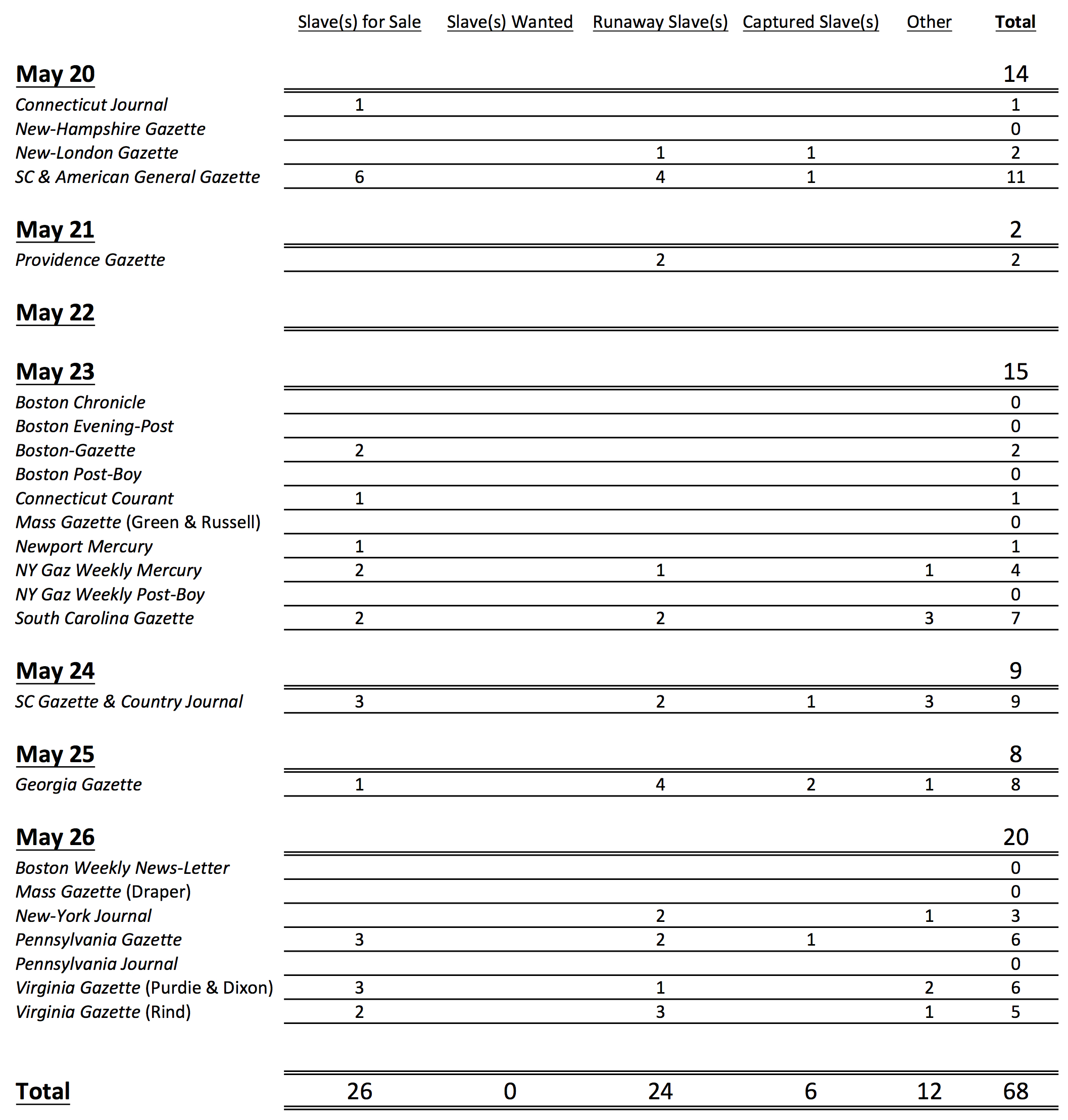
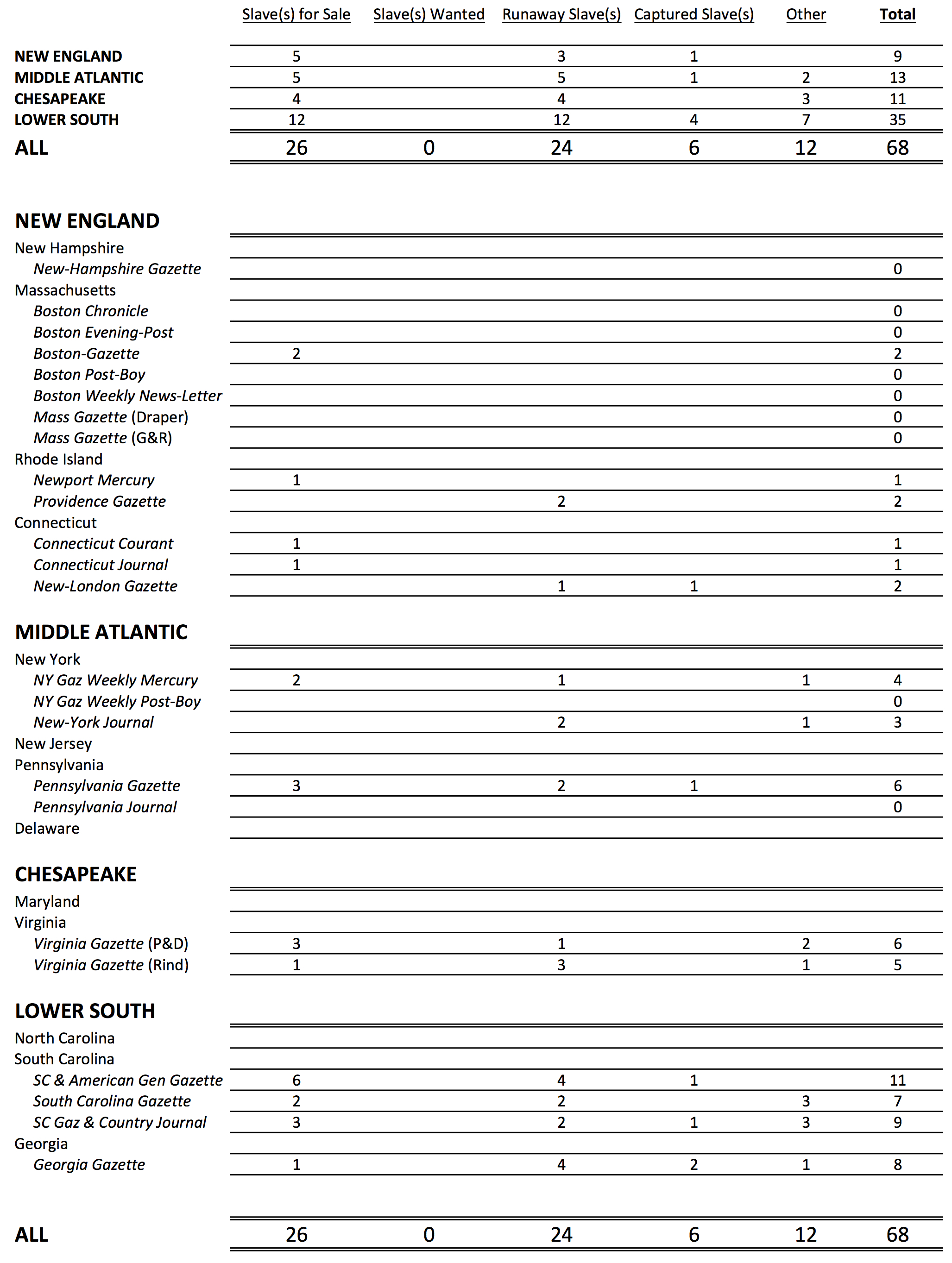
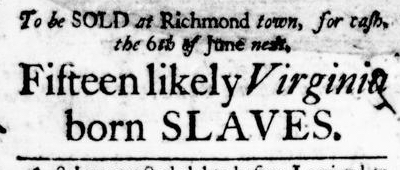
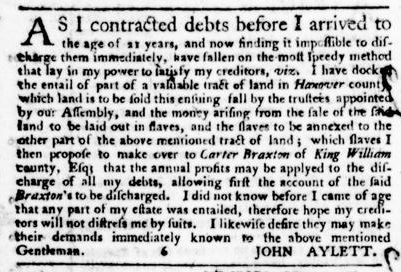
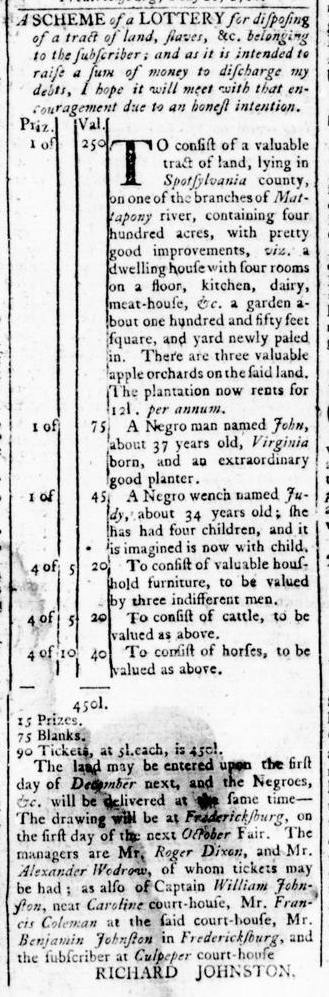
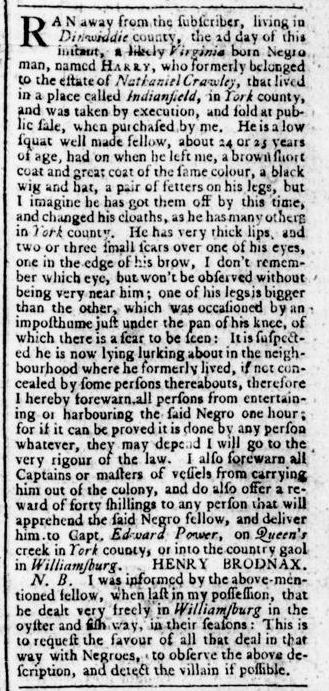
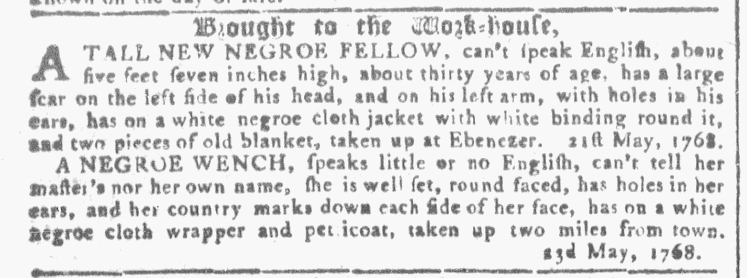
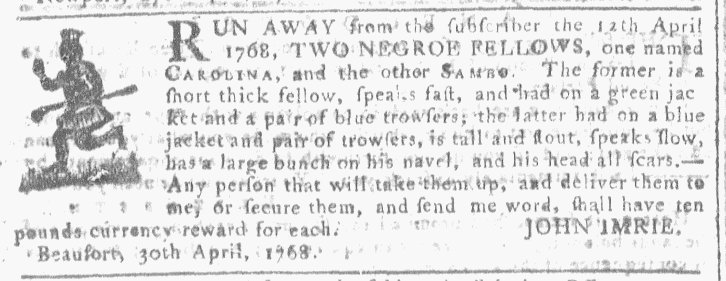
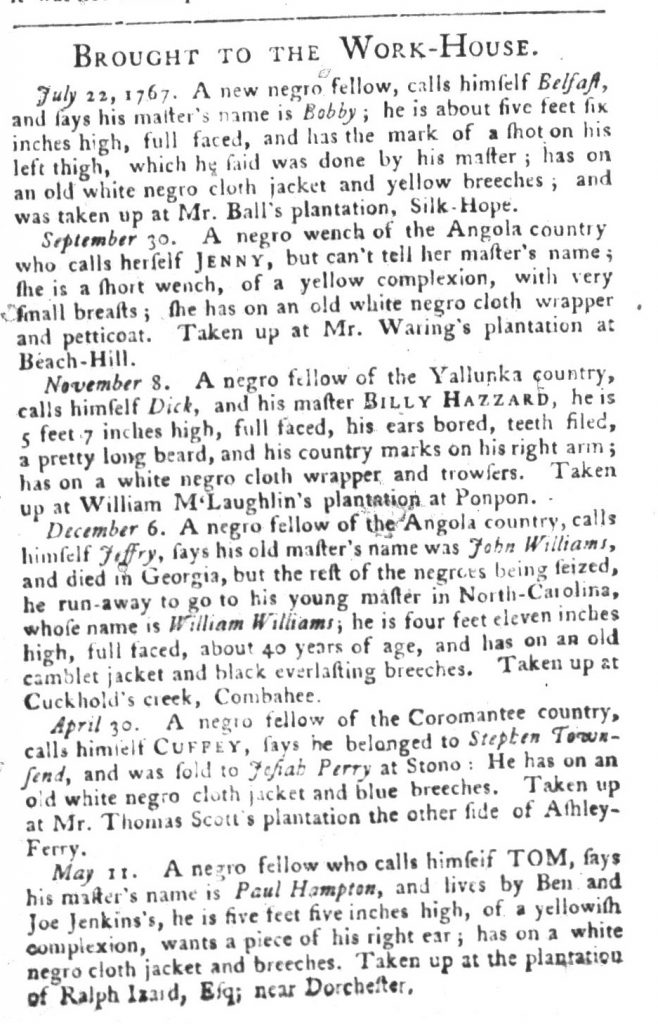
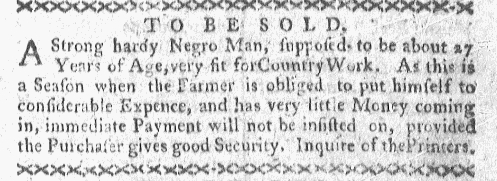
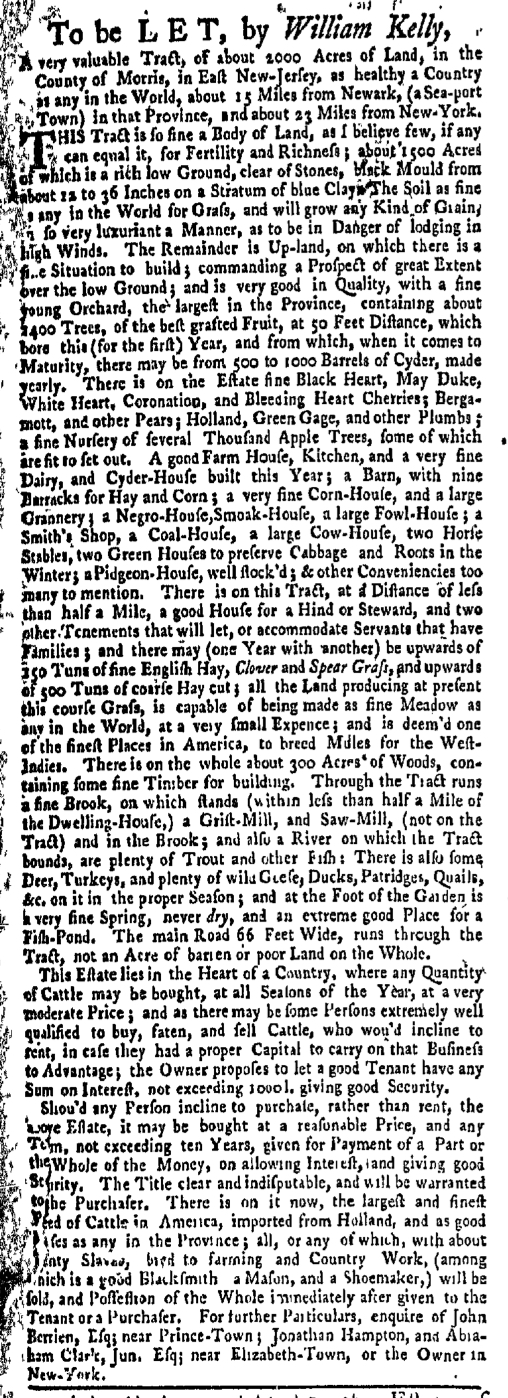
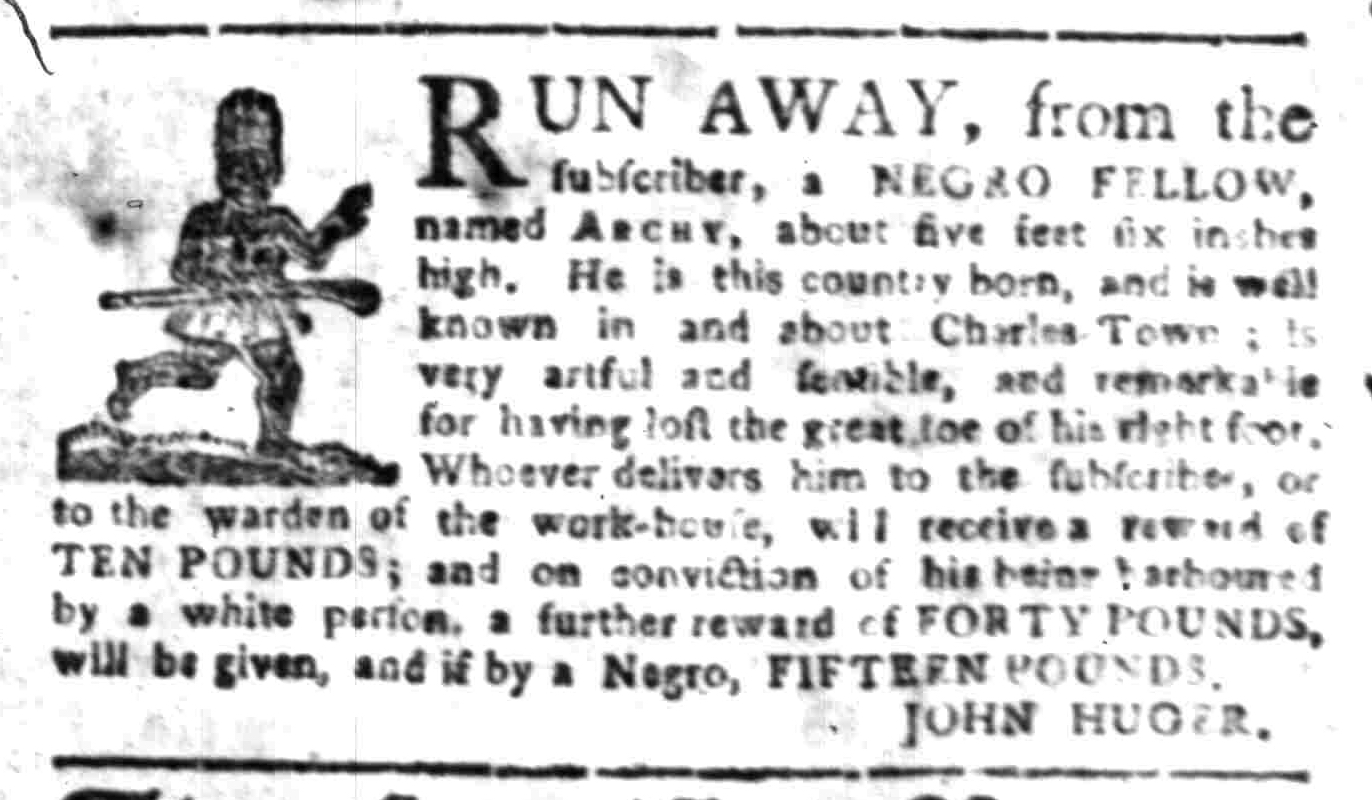
These tables indicate how many advertisements for slaves appeared in colonial American newspapers during the week of May 20-26, 1768.
Note: These tables are as comprehensive as currently digitized sources permit, but they may not be an exhaustive account. They includes all newspapers that have been digitized and made available via Accessible Archives, Colonial Williamsburg’s Digital Library, and Readex’s America’s Historical Newspapers. There are several reasons some newspapers may not have been consulted:
Issues that are no longer extant;
Issues that are extant but have not yet been digitized (including the Pennsylvania Journal); and
Newspapers published in a language other than English (including the Wochentliche Philadelphische Staatsbote).
**********
Slavery Advertisements Published May 20-26, 1768: By Date
**********
Slavery Advertisements Published May 20-26, 1768: By Region
The Slavery Adverts 250 Project chronicles the role of newspaper advertising in perpetuating slavery in the era of the American Revolution. The project seeks to reveal the ubiquity of slavery in eighteenth-century life from New England to Georgia by republishing advertisements for slaves – for sale, wanted to purchase, runaways, captured fugitives – in daily digests on this site as well as in real time via the @SlaveAdverts250 Twitter feed, utilizing twenty-first-century media to stand in for the print media of the eighteenth century.
The project aims to provide modern audiences with a sense of just how often colonists encountered these advertisements in their daily lives. Enslaved men, women, and children appeared in print somewhere in the colonies almost every single day. Those advertisements served as a constant backdrop for social, cultural, economic, and political life in colonial and revolutionary America. Colonists who did not own slaves were still confronted with slavery as well as invited to maintain the system by purchasing slaves or assisting in the capture of runaways. The frequency of these newspaper advertisements suggests just how embedded slavery was in colonial and revolutionary American culture in everyday interactions beyond the printed page.
These advertisements also testify to the experiences of enslaved men, women, and children, though readers must consider that those experiences have been remediated through descriptions offered by slaveholders rather than the slaves themselves. Often unnamed in the advertisements, enslaved men, women, and children were not invisible or unimportant in early America.
These advertisements appeared in colonial American newspapers 250 years ago today.
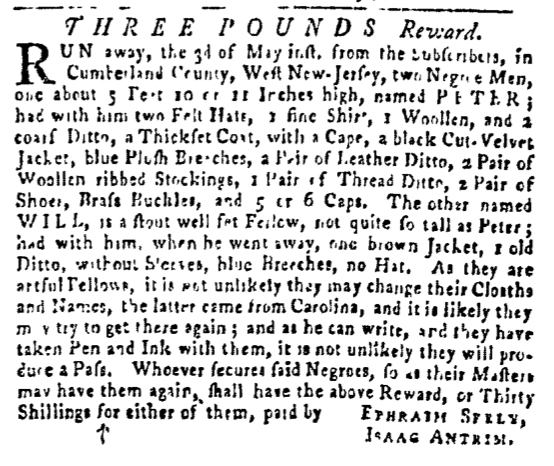
New-York Journal (May 26, 1768).
**********
New-York Journal (May 26, 1768).
**********
Supplement to the New-York Journal (May 26, 1768).
**********
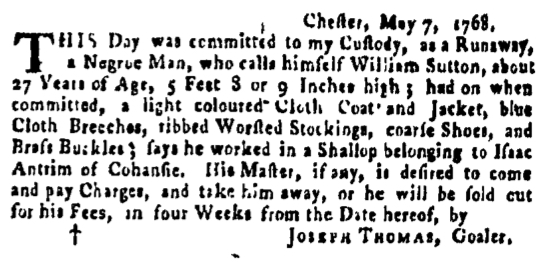
Pennsylvania Gazette (May 26, 1768).
**********
Pennsylvania Gazette (May 26, 1768).
**********
Pennsylvania Gazette (May 26, 1768).
**********
Supplement to the Pennsylvania Gazette (May 26, 1768).
**********
Supplement to the Pennsylvania Gazette (May 26, 1768).
**********
Supplement to the Pennsylvania Gazette (May 26, 1768).
What was advertised in a colonial American newspaper 250 years ago today?
Georgia Gazette (May 25, 1768).
“MANCHESTER and BIRMINGHAM WARES, daily expected from Bristol.”
In an advertisement they placed in the May 25, 1768, edition of the Georgia Gazette, merchants Inglis and Hall promoted merchandise they already had on hand. In addition, they attempted to stoke anticipation for inventory that would be available soon but had not yet arrived at their store in Savannah.
Inglis and Hall proclaimed that they “have just imported” an assortment of goods “from London.” They named the ships and captains that had transported that “QUANTITY of EUROPEAN and EAST-INDIA GOODS” across the Atlantic so readers could consult the shipping news or their own memories to confirm that they did indeed sell wares that had recently arrived in the colony.
At the same time, Inglis and Hall reported that they had ordered a “GENERAL ASSORTMENT of LINENS, WOOLENS, MANCHESTER and BIRMINGHAM WARES” that they expected to add to their stock soon since the vessel carrying them was “daily expected from Bristol.” Given that the Georgia Gazette, like every other newspaper published in the American colonies in 1768, appeared only once a week, it was quite possible that Inglis and Hall would make those goods available for sale before the next issue scheduled for publication on June 1. Previewing the merchandise might have drawn customers into the store for an initial visit to see what was available as well as a return visit to check for new arrivals, increasing foot traffic and potential sales.
This strategy also conditioned some prospective customers to read the weekly list of ships “ENTERED INWARDS at the CUSTOM-HOUSE” printed elsewhere in the Georgia Gazette as an extension of Inglis and Hall’s advertisement. The merchants created the possibility that anyone reading that a vessel had arrived from Bristol would associate that news with their advertisement trumpeting a much more extensive inventory. Although they did not have any authority over the other content in the newspaper, Inglis and Hall harnessed the shipping news as an auxiliary component of their own advertisement.
The Slavery Adverts 250 Project chronicles the role of newspaper advertising in perpetuating slavery in the era of the American Revolution. The project seeks to reveal the ubiquity of slavery in eighteenth-century life from New England to Georgia by republishing advertisements for slaves – for sale, wanted to purchase, runaways, captured fugitives – in daily digests on this site as well as in real time via the @SlaveAdverts250 Twitter feed, utilizing twenty-first-century media to stand in for the print media of the eighteenth century.
The project aims to provide modern audiences with a sense of just how often colonists encountered these advertisements in their daily lives. Enslaved men, women, and children appeared in print somewhere in the colonies almost every single day. Those advertisements served as a constant backdrop for social, cultural, economic, and political life in colonial and revolutionary America. Colonists who did not own slaves were still confronted with slavery as well as invited to maintain the system by purchasing slaves or assisting in the capture of runaways. The frequency of these newspaper advertisements suggests just how embedded slavery was in colonial and revolutionary American culture in everyday interactions beyond the printed page.
These advertisements also testify to the experiences of enslaved men, women, and children, though readers must consider that those experiences have been remediated through descriptions offered by slaveholders rather than the slaves themselves. Often unnamed in the advertisements, enslaved men, women, and children were not invisible or unimportant in early America.
These advertisements appeared in colonial American newspapers 250 years ago today.
What was advertised in a colonial American newspaper 250 years ago today?
South-Carolina Gazette and Country Journal (May 24, 1768).
“A CARGO of DRY GOODS … never yet exposed to SALE.”
In the spring of 1768 Samuel Prioleau, Jr., and Company placed an advertisement in the South-Carolina Gazette and Country Journal that announced their plans to auction “A CARGO of DRY GOODS” just imported from Liverpool. They provided a short list highlighting some of the merchandise, including “cotton and silk hollands,” “Scotch osnaburgs,” and “Drogheda linen,” but also promised “sundry other articles” too numerous to name in their notice.
Prioleau and Company proclaimed that their wares had “never yet been exposed to SALE.” In so doing, they assured potential buyers – retailers and end-use consumers alike – that this was not merely a cargo of castoffs that merchants and shopkeepers on the other side of the Atlantic had been unable to sell and then attempted to pawn off on distant colonists who did not have easy access to the newest and most fashionable goods. Colonial consumers sometimes complained that they were expected to be content with just such merchandise, which explains why so many eighteenth-century advertisers made a point of stressing that they stocked the newest fashions. This was not necessary for the “Irish linen” or “Scotch osnaburgs,” a coarse fabric often used to clothe slaves, but likely made a difference for “men and boys hats” and some of the higher end textiles that Prioleau and Company listed. They also indicated that this cargo had been “Just imported in the Ship Nanny, David Perry, Master, from Liverpool,” signaling to prospective customers that the textiles had not first been offered for sale in local warehouses or shops. According to the shipping news in the South-Carolina Gazette published the previous day, the Nanny was still in port. To underscore that these goods had “never yet been exposed to SALE,” the advertisers concluded by stating that they were “all bought at the manufactory.” Coming directly from the place of production, these items had not previously sat on shelves where they had been pawed and passed over by other prospective customers. Instead, colonists in Charleston had first shot at acquiring this assortment of fabrics.
The Slavery Adverts 250 Project chronicles the role of newspaper advertising in perpetuating slavery in the era of the American Revolution. The project seeks to reveal the ubiquity of slavery in eighteenth-century life from New England to Georgia by republishing advertisements for slaves – for sale, wanted to purchase, runaways, captured fugitives – in daily digests on this site as well as in real time via the @SlaveAdverts250 Twitter feed, utilizing twenty-first-century media to stand in for the print media of the eighteenth century.
The project aims to provide modern audiences with a sense of just how often colonists encountered these advertisements in their daily lives. Enslaved men, women, and children appeared in print somewhere in the colonies almost every single day. Those advertisements served as a constant backdrop for social, cultural, economic, and political life in colonial and revolutionary America. Colonists who did not own slaves were still confronted with slavery as well as invited to maintain the system by purchasing slaves or assisting in the capture of runaways. The frequency of these newspaper advertisements suggests just how embedded slavery was in colonial and revolutionary American culture in everyday interactions beyond the printed page.
These advertisements also testify to the experiences of enslaved men, women, and children, though readers must consider that those experiences have been remediated through descriptions offered by slaveholders rather than the slaves themselves. Often unnamed in the advertisements, enslaved men, women, and children were not invisible or unimportant in early America.
These advertisements appeared in colonial American newspapers 250 years ago today.
South-Carolina Gazette and Country Journal (May 24, 1768).
**********
South-Carolina Gazette and Country Journal (May 24, 1768).
**********
South-Carolina Gazette and Country Journal (May 24, 1768).
**********
South-Carolina Gazette and Country Journal (May 24, 1768).
**********
South-Carolina Gazette and Country Journal (May 24, 1768).
**********
Supplement to the South-Carolina Gazette and Country Journal (May 24, 1768).
**********
Supplement to the South-Carolina Gazette and Country Journal (May 24, 1768).
**********
Supplement to the South-Carolina Gazette and Country Journal (May 24, 1768).
**********
Supplement to the South-Carolina Gazette and Country Journal (May 24, 1768).
What was advertised in a colonial American newspaper 250 years ago today?
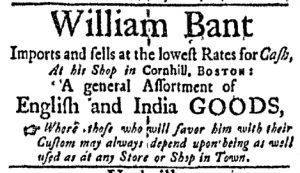
Boston Evening-Post (May 23, 1768).
“Those who will favor him with their Custom may always depend upon being as well used as at any Store or Shop in Town.”
Shopkeeper William Bant advertised in a very crowded marketplace. Residents of Boston encountered shops and stores practically everywhere they went as they traversed the city in the late 1760s. They also experienced a vibrant culture of advertising for consumer goods and services in the pages of the several newspapers published in the city. Some of those newspapers so overflowed with advertisements that the publishers regularly distributed supplements to accompany the regular issues. As the consumer revolution of the eighteenth century continued in Boston, Bant was just one of countless merchandisers attempting to entice prospective customers to patronize his shop.
As part of that effort, he inserted a relatively brief advertisement in the May 23, 1768, edition of the Boston Evening-Post. In it, he announced that he stocked “A general Assortment of English and India GOODS.” Unlike many other shopkeepers, however, Bant did not provide a list of his inventory. On the following page, Thomas Lee’s advertisement extended one-third of a column and listed dozens of imported goods he offered for sale. Jonathan and John Amory’s advertisement was twice as long and listed even more merchandise. John Gore, Jr., inserted an advertisement of a similar length, though its list of goods appeared even more crowded due to graphic design choices made by the compositor.
How did Bant attempt to compete with merchants and shopkeepers who invested in so much more space for promoting their wares in the public prints? He left the details of his “general Assortment” of goods to the imagination, instead opting to emphasize customer service. He pledged that “those who will favor him with their Custom may always depend upon being as well used as at any Store or Shop in Town.” Bant did not promise merely satisfactory service; he proclaimed that the service he provided was unsurpassed in the busy marketplace of Boston. He did not need to overwhelm prospective customers with dense and extensive lists of all the items they could purchase in his shop. Instead, he invited them to imagine the experience of shopping and interacting with the purveyors of the goods they desired. Just as merchandisers competed with each other for customers, consumers sometimes competed with each other for the attention of merchants and shopkeepers. Bant presumed that shoppers sometimes experienced frustration when they dealt with retailers. In turn, he assured prospective customers that they would not be disappointed in the service they received at his shop.
The Slavery Adverts 250 Project chronicles the role of newspaper advertising in perpetuating slavery in the era of the American Revolution. The project seeks to reveal the ubiquity of slavery in eighteenth-century life from New England to Georgia by republishing advertisements for slaves – for sale, wanted to purchase, runaways, captured fugitives – in daily digests on this site as well as in real time via the @SlaveAdverts250 Twitter feed, utilizing twenty-first-century media to stand in for the print media of the eighteenth century.
The project aims to provide modern audiences with a sense of just how often colonists encountered these advertisements in their daily lives. Enslaved men, women, and children appeared in print somewhere in the colonies almost every single day. Those advertisements served as a constant backdrop for social, cultural, economic, and political life in colonial and revolutionary America. Colonists who did not own slaves were still confronted with slavery as well as invited to maintain the system by purchasing slaves or assisting in the capture of runaways. The frequency of these newspaper advertisements suggests just how embedded slavery was in colonial and revolutionary American culture in everyday interactions beyond the printed page.
These advertisements also testify to the experiences of enslaved men, women, and children, though readers must consider that those experiences have been remediated through descriptions offered by slaveholders rather than the slaves themselves. Often unnamed in the advertisements, enslaved men, women, and children were not invisible or unimportant in early America.
These advertisements appeared in colonial American newspapers 250 years ago today.
Boston-Gazette (May 23, 1768).
**********
Boston-Gazette (May 23, 1768).
**********
Connecticut Courant (May 23, 1768).
**********
New-York Gazette and Weekly Mercury (May 23, 1768).
**********
New-York Gazette and Weekly Mercury (May 23, 1768).
**********
Supplement to the New-York Gazette and Weekly Mercury (May 23, 1768).
**********
Supplement to the New-York Gazette and Weekly Mercury (May 23, 1768).
**********
Newport Mercury (May 23, 1768).
**********
Postscript to the South-Carolina Gazette (May 23, 1768).
**********
Postscript to the South-Carolina Gazette (May 23, 1768).
**********
Postscript to the South-Carolina Gazette (May 23, 1768).
What was advertised in a colonial American newspaper 250 years ago this week?
Massachusetts Gazette (May 19, 1768).
“Said Paddock will take second hand Chaises in part Pay for new.”
In the late 1760s Adino Paddock operated a workshop “Where the Coach and Chaisemaking Business is carried on in every Branch.” In other words, Paddock made, repaired, and sold all sorts of carriages to the residents of Boston and its hinterlands. He frequently promoted his enterprise by inserting advertisements in multiple newspapers published in the city. In addition to some of the usual appeals made by other artisans, especially appeals to price and quality, Paddock deployed additional marketing strategies that seem strikingly modern.
For instance, in the May 19, 1768, edition of the Massachusetts Gazette Paddock provided a brief overview of some of his inventory. Among the various carriages available, he had “A very good second-hand Coach, Curricle, and several Chaises, some almost new.” He anticipated a common practice in the modern automobile industry. Then, as now, not all consumers could afford or wished to invest in a new vehicle, so Paddock provided an alternate means for acquiring carriages. His “second-hand Coach” was the eighteenth-century equivalent of today’s used car. Also like modern dealerships, Paddock realized that prospective customers balanced the price of a “second-hand” carriage against its condition. What kind of wear and tear took place before it landed in the resale market? To address such concerns, he described “several Chaises” as “almost new.” He offered the best of both worlds to his customers: lower prices for slightly used vehicles still in excellent condition. Paddock also incorporated another innovative marketing strategy into his advertisements: the trade-in. He advised readers that he “will take second hand Chaises in part Pay for new.” He simultaneously made his carriages more affordable and replenished his inventory.
Used vehicles and trade-ins are very familiar to modern consumers who buy vehicles, but these practices did not originate with the automobile industry. Instead, they were already in use in the colonial period, long before automobiles had even been invented. Automobile manufacturers and dealerships eventually adopted marketing strategies that their precursor industry had developed much earlier.
What was advertised in a colonial American newspaper 250 years ago today?
Providence Gazette (May 21, 1768).
“Will now undertake to make Kinds of Wigs.”
Convenience! That was the hallmark of Benjamin Gladding’s advertisement in the May 21, 1768, edition of the Providence Gazette. The peruke (wig) maker and hairdresser acknowledged that some of his potential clients had not previously had access to all the goods and services they desired in the local marketplace. In particular, he noted that some “Gentlemen … have heretofore been at the Trouble of sending to Boston for their Wigs.” That, Gladding proclaimed, was no longer necessary because “he has lately engaged a Journeyman” to assist in his shop. Together, they could meet the needs of prospective clients in Providence. Gentlemen no longer needed to resort to the inconvenience of having wigs shipped from Boston.
In case prospective clients were as concerned about quality as convenience, Gladding offered additional commentary about the skills and expertise of his new journeyman, describing him as “a compleat Workman.” Together, they labored “to make all Kinds of Wigs, in the neatest and best Manner, and in the most genteel Taste.” In making this assertion, Gladding underscored that he offered potential customers more than just convenience. He implicitly compared the wigs produced in his shop to those that came from Boston, stressing that they were not inferior in any way. They possessed the same quality, having been made “in the neatest and best Manner,” and they were just as fashionable, following “the most genteel Taste” currently in style in the colonies and the British Atlantic world. Gladding further emphasized his familiarity with the latest trends when he promoted his services as a hairdresser. Since he set hair according to “the newest Fashions,” his clients did not need to worry that friends and acquaintances would critique them as ignorant or outdated, at least not as far as their tonsorial choices were concerned.
Gladding concluded his advertisement by pledging that “his constant Endeavour will be to render every Satisfaction.” By then he had demonstrated what this promise meant: prospective clients could depend on attention to convenience, quality, and fashion when they patronized his shop.