September 13

What was advertised in a colonial American newspaper 250 years ago today?

Sep 13 - 9:13:1768 South-Carolina Gazette and Country Journal
South-Carolina Gazette and Country Journal (September 13, 1768).

“Black silk and cotton gauzes.”

Several merchants and shopkeepers placed list-style advertisements in the September 13, 1768, edition of the South-Carolina Gazette and Country Journal and its two-page supplement. Among them, George Ancrum and Company, Elizabeth Blaikie, Thomas Walter, Godfrey and Gadsden, and John McCall each enumerated dozens of items they offered for sale. Most of these advertisements took the form of dense paragraphs that did not incorporate visual signals intended to differentiate the various goods they listed. Godfrey and Gadsden, however, experimented with the format of one of their advertisements. Rather than a single paragraph, they opted for two columns with only one or two items listed on each line, making it easier for prospective customers to spot “coloured ribbons” and “parrot cages” amid the many other goods. This distinctive layout distinguished Godfrey and Gadsden’s advertisement from the many other notices on the same page, even though their inventory replicated the merchandise available from their competitors.

Yet this was not the only advertisement Godfrey and Gadsden placed in that issue. In another advertisement on the same page they deployed a lengthy paragraph that rivaled all others in its density. Although the advertisement with the dense paragraph of goods occupied a privileged position as the first item in the first column, the format of the advertisement divided into two columns (with significantly more white space) made the latter much more prominent, even though it appeared near the bottom of the final column. The disparity between the two demonstrates that Godfrey and Gadsden were not committed to one format over the other; it does suggest that they did intentionally experiment with the visual elements of their advertisements, perhaps of their own volition or perhaps at the urging of a compositor who made suggestions about possible alternatives. Compared to newspapers published in Boston, New York, and Philadelphia, the South-Carolina Gazette and Country Journal featured less variation when it came to the format of list-style advertisements in the late 1760s, yet advertisers and compositors did sometimes play with typography to create notices with unique graphic design elements.

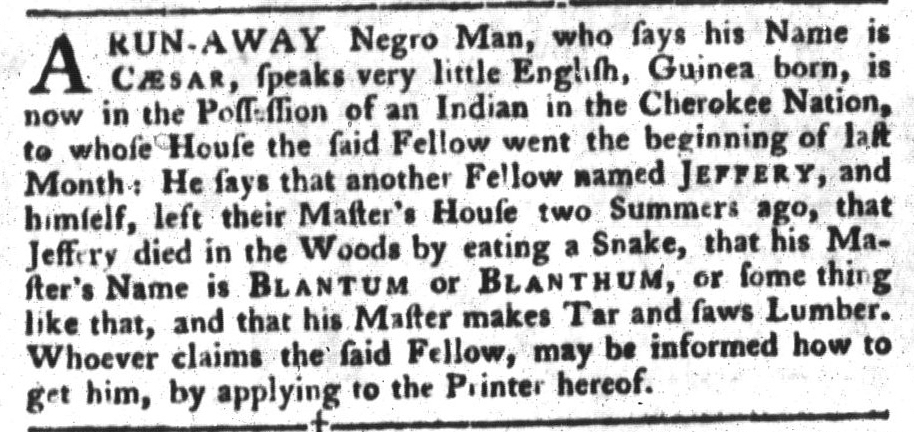
Slavery Advertisements Published September 13, 1768

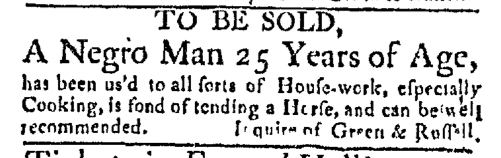
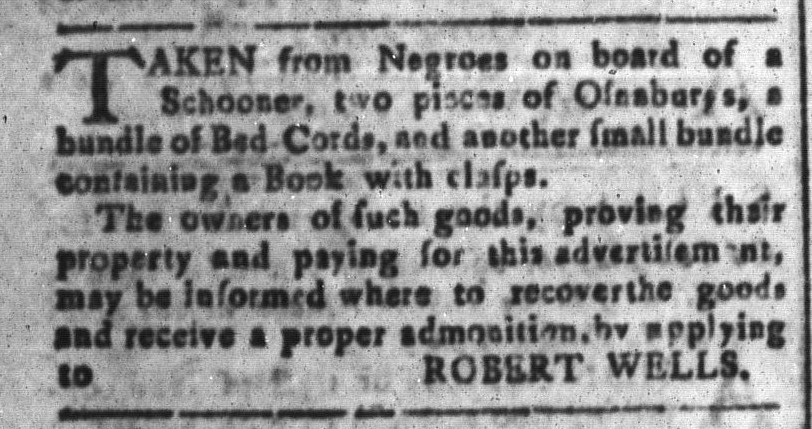
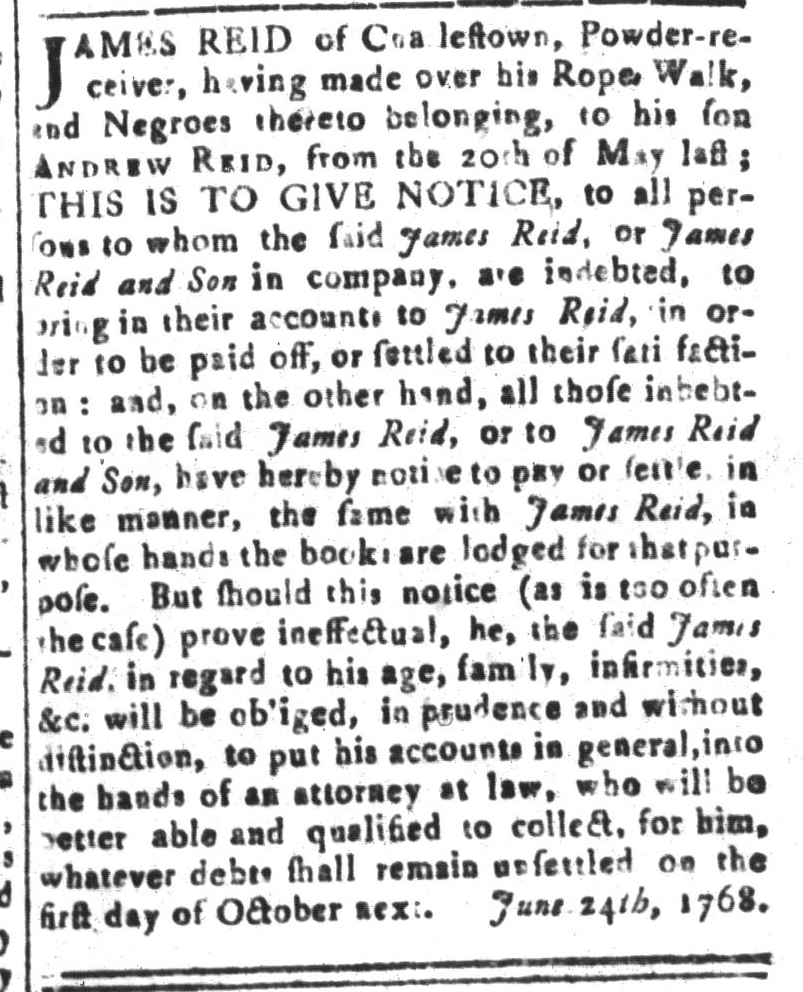
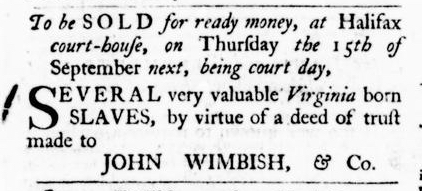
The Slavery Adverts 250 Project chronicles the role of newspaper advertising in perpetuating slavery in the era of the American Revolution. The project seeks to reveal the ubiquity of slavery in eighteenth-century life from New England to Georgia by republishing advertisements for slaves – for sale, wanted to purchase, runaways, captured fugitives – in daily digests on this site as well as in real time via the @SlaveAdverts250 Twitter feed, utilizing twenty-first-century media to stand in for the print media of the eighteenth century.

The project aims to provide modern audiences with a sense of just how often colonists encountered these advertisements in their daily lives. Enslaved men, women, and children appeared in print somewhere in the colonies almost every single day. Those advertisements served as a constant backdrop for social, cultural, economic, and political life in colonial and revolutionary America. Colonists who did not own slaves were still confronted with slavery as well as invited to maintain the system by purchasing slaves or assisting in the capture of runaways. The frequency of these newspaper advertisements suggests just how embedded slavery was in colonial and revolutionary American culture in everyday interactions beyond the printed page.

These advertisements also testify to the experiences of enslaved men, women, and children, though readers must consider that those experiences have been remediated through descriptions offered by slaveholders rather than the slaves themselves. Often unnamed in the advertisements, enslaved men, women, and children were not invisible or unimportant in early America.

These advertisements appeared in colonial American newspapers 250 years ago today.

Sep 13 - South-Carolina Gazette and Country Journal Slavery 1
South-Carolina Gazette and Country Journal (September 13, 1768).

**********

Sep 13 - South-Carolina Gazette and Country Journal Slavery 2
South-Carolina Gazette and Country Journal (September 13, 1768).

**********

Sep 13 - South-Carolina Gazette and Country Journal Slavery 3
South-Carolina Gazette and Country Journal (September 13, 1768).

**********

Sep 13 - South-Carolina Gazette and Country Journal Slavery 4
South-Carolina Gazette and Country Journal (September 13, 1768).

**********

Sep 13 - South-Carolina Gazette and Country Journal Supplement Slavery 1
Supplement to the South-Carolina Gazette and Country Journal (September 13, 1768).

**********

Sep 13 - South-Carolina Gazette and Country Journal Supplement Slavery 2
Supplement to the South-Carolina Gazette and Country Journal (September 13, 1768).

**********

Sep 13 - South-Carolina Gazette and Country Journal Supplement Slavery 3
Supplement to the South-Carolina Gazette and Country Journal (September 13, 1768).

September 12

What was advertised in a colonial American newspaper 250 years ago today?

Sep 12 - 9:12:1768 Boston-Gazette
Boston-Gazette (September 12, 1768).

“Those Persons who are desirous of Promoting our Own Manufactures.”

Enoch Brown mixed politics and commerce when he drew attention to his supply chain in an advertisement in the September 12, 1768, edition of the Boston-Gazette. Eighteenth-century advertisers frequently mentioned and even promoted the origins of the goods they sold, but prior to the 1760s they placed a premium on demonstrating that they carried imported goods. In the advertisement printed immediately above Brown’s notice, John Andrews noted that he had imported his inventory “in the last Ships from London and Bristol.” Further down the column, Moses Deshon announced that a “Variety of European” goods would be sold at public auction later in the week. In several other advertisements spread throughout the rest of the issue merchants and shopkeepers introduced their wares as “Imported from London.”

Brown did not make such proclamations. Instead, he tied his merchandise to recent calls to reduce and eliminate dependence on imported goods as a means of resisting Parliament’s ongoing efforts to raise revenues by imposing taxes within the colonies. In addition, colonists were concerned about an imbalance of trade that benefited Britain at the expense of the colonies. Nearly a year earlier the Boston town meeting had voted to encourage “domestic manufactures” as an alternative to importing goods from London and other English cities. Residents of other cities and towns throughout the colonies followed Boston’s lead, either through formal ballots or newspaper editorials that spread the word. By the fall of 1768, the residents of Boston and other urban ports were preparing for non-importation agreements set to go into effect in January 1769.

In his advertisement, Brown encouraged consumers to get an early start. He requested that “those Persons who are desirous of Promoting our Own Manufactures” supply him with “all Sorts of Country-made Cloths.” Brown would then either sell those items on commission or barter for “West-India Goods,” such as sugar, molasses, and rum. This advertisement also informed prospective customers that they could put their political principles into practice by visiting Brown’s store and purchasing textiles produced locally rather than patronizing the shops of his competitors who were attempting to sell goods imported from England before the new agreement went into effect.

Brown was part of the first wave of marketers who deployed “Buy American” appeals, advancing this strategy even before the colonies declared independence. As the imperial crisis intensified, more advertisers adopted this approach. Once the fighting ended, however, many retailers returned to promoting the European origins of their wares. Yet in the 1780s and 1790s those advertisements increasingly appeared alongside “Buy American” advertisements, following a course first plotted by Enoch Brown and other advertisers in the wake of the Stamp Act, Townshend Act, and other attempts to tax the colonies.

Slavery Advertisements Published September 12, 1768

The Slavery Adverts 250 Project chronicles the role of newspaper advertising in perpetuating slavery in the era of the American Revolution. The project seeks to reveal the ubiquity of slavery in eighteenth-century life from New England to Georgia by republishing advertisements for slaves – for sale, wanted to purchase, runaways, captured fugitives – in daily digests on this site as well as in real time via the @SlaveAdverts250 Twitter feed, utilizing twenty-first-century media to stand in for the print media of the eighteenth century.

The project aims to provide modern audiences with a sense of just how often colonists encountered these advertisements in their daily lives. Enslaved men, women, and children appeared in print somewhere in the colonies almost every single day. Those advertisements served as a constant backdrop for social, cultural, economic, and political life in colonial and revolutionary America. Colonists who did not own slaves were still confronted with slavery as well as invited to maintain the system by purchasing slaves or assisting in the capture of runaways. The frequency of these newspaper advertisements suggests just how embedded slavery was in colonial and revolutionary American culture in everyday interactions beyond the printed page.

These advertisements also testify to the experiences of enslaved men, women, and children, though readers must consider that those experiences have been remediated through descriptions offered by slaveholders rather than the slaves themselves. Often unnamed in the advertisements, enslaved men, women, and children were not invisible or unimportant in early America.

These advertisements appeared in colonial American newspapers 250 years ago today.

Sep 12 - Boston Post-Boy Slavery 1
Boston Post-Boy (September 12, 1768).

**********

Sep 12 - Boston-Gazette Slavery 1
Boston-Gazette (September 12, 1768).

**********

Sep 12 - New-York Gazette Weekly Mercury Slavery 1
New-York Gazette and Weekly Mercury (September 12, 1768).

**********

Sep 12 - New-York Gazette Weekly Mercury Slavery 2
New-York Gazette and Weekly Mercury (September 12, 1768).

**********

Sep 12 - New-York Gazette Weekly Mercury Slavery 3
New-York Gazette and Weekly Mercury (September 12, 1768).

**********

Sep 12 - New-York Gazette Weekly Mercury Slavery 4
New-York Gazette and Weekly Mercury (September 12, 1768).

**********

Sep 12 - New-York Gazette Weekly Mercury Slavery 5
New-York Gazette and Weekly Mercury (September 12, 1768).

**********

Sep 12 - New-York Gazette Weekly Mercury Supplement Slavery 1
Supplement to the New-York Gazette and Weekly Mercury (September 12, 1768).

**********

Sep 12 - New-York Gazette Weekly Mercury Supplement Slavery 2
Supplement to the New-York Gazette and Weekly Mercury (September 12, 1768).

**********

Sep 12 - South-Carolina Gazette Slavery 1
South-Carolina Gazette (September 12, 1768).

**********

Sep 12 - South-Carolina Gazette Slavery 2
South-Carolina Gazette (September 12, 1768).

**********

Sep 12 - South-Carolina Gazette Slavery 3
South-Carolina Gazette (September 12, 1768).

**********

Sep 12 - South-Carolina Gazette Slavery 4
South-Carolina Gazette (September 12, 1768).

September 11

What was advertised in a colonial American newspaper 250 years ago this week?

Sep 11 - 9:8:1768 New-York Journal
New-York Journal (September 8, 1768).

He has been mistaken for a Dancing-Master, whose Behaviour to his Scholars gave just Offence.”

Peter Vianey needed to do some damage control. Rumors had reached the itinerant dancing master that he had been confused for another dancing master, one known for having previously committed some sort of transgressions toward his students. Realizing that hearsay could scare away prospective clients, Vianey opted to address this case of mistaken identity in the public prints. He published an advertisement that did not look much different from those of his counterparts, except for the final paragraph. “Having been informed,” Vianey fretted, “that he has been mistaken for a Dancing-Master, whose Behaviour to his Scholars gave just Offence in this City some Years ago, he takes the Liberty to inform those who are not acquainted with him, that he never was in this Country, till the Year 1764.” Exercising discretion, Vianey did not offer any further details about the unsavory behavior of the other dancing master, a decision further calculated not to have another’s infractions attached to his name. After all, his ability to attract clients depended on his ability to establish and maintain a good reputation. To that end, he requested that “all who know him, will do him the Justice to testify that his Conduct has ever been regular and unexceptionable.” The only specific detail that mattered was that Vianey had only recently arrived, not only in New York but also in the colonies. His arrival was too recent for him to have been the culprit of whatever scandalous deeds had taken place several years earlier.

In Dangerous Economies: Status and Commerce in Imperial New York, Serena Zabin notes that “[a]t any time a dancing master might become an object of suspicion” because of the ambiguous status they held in colonial society. Dancing masters taught genteel conduct to their clients – in Vianey’s case, music and fencing in addition to dancing – but they were not themselves members of the genteel ranks. As Zabin explains, dancing masters “had to tread a social tightrope,” exhibiting sufficient gentility to avoid being considered a disreputable fraud but not so much as to confuse the distinctions in status that separated the instructors who provided a service and the students that paid their fees.[1] Vianey, like any other dancing master, was already in a difficult position when it came to marketing his lessons, an enterprise that made his identity, character, and status just as much the center of attention as the skills “discoverable in his Scholars” that emerged via his tutelage. Resurrecting old gossip and attributing misconduct to him only compounded his difficulties. Rather than pretend that he had not heard the malicious tales, Vianey vigorously defended his reputation in newspaper advertisements, requesting that others confirm that he was not the scoundrel that some mistakenly imagined.

**********

[1] Serena Zabin, Dangerous Economies: Status and Commerce in Imperial New York (Philadelphia: University of Pennsylvania Press, 2009), 103, 105.

September 10

What was advertised in a colonial American newspaper 250 years ago today?

Sep 10 - 9:10:1768 Providence Gazette
Providence Gazette (September 10, 1768).

“The Sign of the Elephant.”

Richard Jackson and John Updike informed prospective customers that their shop was located at “the Sign of the Elephant, opposite John Angell’s, Esq,” in an advertisement in the September 10, 1768, edition of the Providence Gazette. Elsewhere on the same page, Clark and Nightingale also used the combination of shop sign and landmarks to denote their location: “At the Sign of the Fish and Frying-Pan, opposite Oliver Arnold’s, Esq; near the Court-House.” Sarah Goddard and John Carter, printers of the Providence Gazette, did not list their location in either of the advertisements they inserted in the issue, but the colophon stated that “the Sign of Shakespear’s Head” adorned their printing office. Joseph Russell and William Russell also did not indicate their location in their advertisements in the September 10 issue, but these prominent merchants regularly ran other advertisements that told readers to seek them out at “the Sign of the Golden Eagle, near the Court-House.” Collectively, these advertisers paint a portrait of some of the sights colonists would have seen as they traversed the streets of Providence in the late 1760s.

Jackson and Updike marketed many of the same goods as Clark and Nightingale. Both sets of partners led their advertisements with “English and India Goods” before providing more complete accountings of their various sorts of merchandise. In selecting the visual images to identify and, in effect, brand their shops, however, they opted for different strategies. Jackson and Updike chose an elephant, an exotic beast unlikely to have been glimpsed by the vast majority of residents of Providence. Known only to most colonists through texts and perhaps a limited number of woodcuts and engravings in circulation in the Atlantic world, the elephant conjured images of the faraway origins of the “India Goods,” including textiles, sold at Jackson and Updike’s shop. Associating their wares with the elephant linked the merchant-shopkeepers to extensive networks of exchange that reached to the other side of the globe. Clark and Nightingale, on the other hand, advanced a much more utilitarian and familiar image. Neither the fish nor frying pan required imagination on the part of readers or passersby who saw their sign, but the image did communicate that the partners competently and efficiently outfitted their customers with the necessities. Their choice of logo emphasized the practical aspects of their merchandise.

Unfortunately, very few eighteenth-century shop signs have survived. The descriptions in newspapers advertisements do not indicate whether Jackson and Updike’s elephant or any of the other signs were carved or painted, but they do testify to their presence in colonial towns and cities. They also suggest that merchants, shopkeepers, and artisans not only displayed signs to assist prospective customers navigating the streets but also sometimes adopted images intended to convey messages about their wares.

September 9

What was advertised in a colonial American newspaper 250 years ago today?

Sep 9 - 9:9:1768 Connecticut Journal
Connecticut Journal (September 9, 1768).

“Brief Account of the LIFE, and abominable THEFTS, of the notorious Isaac Frasier.”

True Crime! In early September of 1768, Thomas Green and Samuel Green, printers of the Connecticut Journal and New-Haven Post-Boy, sold a pamphlet about an execution of a burglar that had just taken place. “Just published, and to be sold by the Printers hereof,” the Greens announced, “Brief Account of the LIFE, and abominable THEFTS, of the notorious Isaac Frasier, (Who was executed at Fairfield, on the 7th of September, 1768) penned from his own Mouth, and signed by him, a few Days before his Execution.” This advertisement first ran in the September 9 issue, just two days after the execution and presumably less than a week after the infamous thief had dictated his life’s story.

The Greens marketed memorabilia about an event currently in the news. To help sustain the attention Frasier and his trial and execution had generated, they ran a short article about the burglar, offering prospective customers a preview of the pamphlet. “Last Wednesday,” the Connecticut Journal reported, “Isaac Frasier, was executed at Fairfield, pursuant to the Sentence of the Superior Court, for the Third Offence of Burglary; the lenitive Laws of this Colony, only Punishing the first and second Offences with whipping, cropping, and branding. He was born at North-Kingston, in the Colony of Rhode-Island. It is said, he seem’d a good deal unconcerned, till a few Hours before he was turn’d off—and it is conjectured, by his Conduct, that he had some secret Hope of being cleared, some Way or other.” The Greens likely intended that this teaser provoke even more interest in Frasier, stimulating sales of the pamphlet.

To that end, all of the news from within the colony focused on thieves and burglars who had been captured and punished. Two days before Frasier’s execution, David Powers had been “cropt, branded and whipt” in New Haven after being discovered “breaking open a House.” He had previously experienced the same punishment in Hartford, where James Hardig was “whipt ten stripes at the public whipping post … for stealing.” The Greens described Hardig as “an old offender, as it appears he has already been cropt, branded and whipt.” If they did not change their ways, Powers and Hardig would find themselves “Candidate[s] for a greater Promotion” at their own executions. Frasier’s case offered a cautionary tale for anyone who chose to purchase and read his pamphlet.

Although Frasier was executed upon his third conviction for burglary, he recorded more than fifty burglaries and thefts in the Brief Account. According to Anthony Vaver, Frasier had “toured all over New England and into New York, covering hundreds of miles at a time and committing burglaries all along the way.” Vaver provides and overview of Frasier’s case at Early American Crime, including the circumstances of all three burglaries that led to his execution and a map of the route he followed on his crime spree.

Slavery Advertisements Published September 9, 1768

The Slavery Adverts 250 Project chronicles the role of newspaper advertising in perpetuating slavery in the era of the American Revolution. The project seeks to reveal the ubiquity of slavery in eighteenth-century life from New England to Georgia by republishing advertisements for slaves – for sale, wanted to purchase, runaways, captured fugitives – in daily digests on this site as well as in real time via the @SlaveAdverts250 Twitter feed, utilizing twenty-first-century media to stand in for the print media of the eighteenth century.

The project aims to provide modern audiences with a sense of just how often colonists encountered these advertisements in their daily lives. Enslaved men, women, and children appeared in print somewhere in the colonies almost every single day. Those advertisements served as a constant backdrop for social, cultural, economic, and political life in colonial and revolutionary America. Colonists who did not own slaves were still confronted with slavery as well as invited to maintain the system by purchasing slaves or assisting in the capture of runaways. The frequency of these newspaper advertisements suggests just how embedded slavery was in colonial and revolutionary American culture in everyday interactions beyond the printed page.

These advertisements also testify to the experiences of enslaved men, women, and children, though readers must consider that those experiences have been remediated through descriptions offered by slaveholders rather than the slaves themselves. Often unnamed in the advertisements, enslaved men, women, and children were not invisible or unimportant in early America.

These advertisements appeared in colonial American newspapers 250 years ago today.

Sep 9 - New-Hampshire Gazette Slavery 1
New-Hampshire Gazette (September 9, 1768).

**********

Sep 9 - New-London Gazette Slavery 1
New-London Gazette (September 9, 1768).

**********

Sep 9 - South-Carolina and American General Gazette Slavery 1
South-Carolina and American General Gazette (September 9, 1768).

**********

Sep 9 - South-Carolina and American General Gazette Slavery 2
South-Carolina and American General Gazette (September 9, 1768).

**********

Sep 9 - South-Carolina and American General Gazette Slavery 3
South-Carolina and American General Gazette (September 9, 1768).

**********

Sep 9 - South-Carolina and American General Gazette Slavery 4
South-Carolina and American General Gazette (September 9, 1768).

**********

Sep 9 - South-Carolina and American General Gazette Slavery 5
South-Carolina and American General Gazette (September 9, 1768).

**********

Sep 9 - South-Carolina and American General Gazette Slavery 7
South-Carolina and American General Gazette (September 9, 1768).

**********

Sep 9 - South-Carolina and American General Gazette Slavery 6
South-Carolina and American General Gazette (September 9, 1768).

September 8

What was advertised in a colonial American newspaper 250 years ago today?

Sep 8 - 9:8:1768 Massachusetts Gazette Draper
Massachusetts Gazette [Draper] (September 8, 1768).
“WHEREAS many Persons are so unfortunate as to lose their fore Teeth … they may have them replaced with false Ones … by PAUL REVERE.”

Although Paul Revere is primarily remembered as an engraver and silversmith who actively supported the Patriot cause throughout the era of the American Revolution, newspaper advertisements from the period demonstrate that he also tried his hand at dentistry. As summer turned to fall in 1768, Revere placed advertisements in both the Boston Evening-Post and Richard Draper’s Massachusetts Gazette to encourage prospective clients to hire him if they needed false teeth made or adjusted.

Like many others who marketed consumer goods and services in the public prints, Revere stoked anxieties as a means of convincing readers to avail themselves of his services. He proclaimed that “many Persons are so unfortunate as to lose their fore Teeth … to their Detriment, not only in looks, but speaking both in Public and Private.” Revere raised the insecurities that prospective clients likely already felt, but then presented a solution. Colonists who had lost their front teeth “may have them replaced with false Ones, that looks as well as the Natural, and answers the End of Speaking to all intents.” He assured prospective clients that they would no longer need to worry about their appearance or speech once they sought his assistance.

Revere also attempted to generate business from among the clientele of John Baker, an itinerant “Surgeon-Dentist” who had provided his services in Boston before moving along to Newport and New York and other cities. Baker was well known to the residents of Boston and its environs. In an advertisement in the New-York Journal he claimed to have provided his services to “upwards of two thousand persons in the town of Boston.” Even if that was an inflated estimate, it still indicated that Baker had served a significant number of clients there. Revere confirmed that was the case when he used a portion of his advertisement to address those clients. He claimed that he had “learnt the Method of fixing” false teeth that had come loose from Baker during the surgeon-dentist’s time in Boston.

Thanks to the poem by Henry Wadsworth Longfellow, Paul Revere is most famous for his “midnight ride” on the eve of the battles at Lexington and Concord. He also encouraged resistance to the British through his engravings, including “The Bloody Massacre Perpetrated in King Street, Boston.” In addition, Revere is remembered as an artisan who crafted fashionable silver teapots, buckles, and other items. This advertisement shows another facet of Revere’s attempts to earn his livelihood in Boston in the late colonial period, dabbling in dentistry as an extension of practicing his trade as a silversmith.
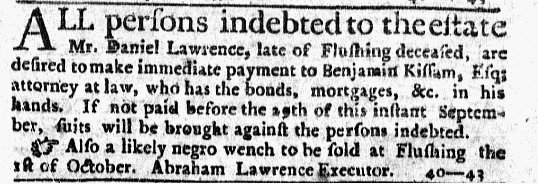
Slavery Advertisements Published September 8, 1768

The Slavery Adverts 250 Project chronicles the role of newspaper advertising in perpetuating slavery in the era of the American Revolution. The project seeks to reveal the ubiquity of slavery in eighteenth-century life from New England to Georgia by republishing advertisements for slaves – for sale, wanted to purchase, runaways, captured fugitives – in daily digests on this site as well as in real time via the @SlaveAdverts250 Twitter feed, utilizing twenty-first-century media to stand in for the print media of the eighteenth century.

The project aims to provide modern audiences with a sense of just how often colonists encountered these advertisements in their daily lives. Enslaved men, women, and children appeared in print somewhere in the colonies almost every single day. Those advertisements served as a constant backdrop for social, cultural, economic, and political life in colonial and revolutionary America. Colonists who did not own slaves were still confronted with slavery as well as invited to maintain the system by purchasing slaves or assisting in the capture of runaways. The frequency of these newspaper advertisements suggests just how embedded slavery was in colonial and revolutionary American culture in everyday interactions beyond the printed page.

These advertisements also testify to the experiences of enslaved men, women, and children, though readers must consider that those experiences have been remediated through descriptions offered by slaveholders rather than the slaves themselves. Often unnamed in the advertisements, enslaved men, women, and children were not invisible or unimportant in early America.

These advertisements appeared in colonial American newspapers 250 years ago today.

Sep 8 - Massachusetts Gazette Slavery 1
Massachusetts Gazette [Draper] (September 8, 1768).

**********

Sep 8 - New-York Journal Slavery 1
New-York Journal (September 8, 1768).

**********

Sep 8 - New-York Journal Slavery 2
New-York Journal (September 8, 1768).

**********

Sep 8 - New-York Journal Slavery 3
New-York Journal (September 8, 1768).

**********

Sep 8 - New-York Journal Slavery 4
New-York Journal (September 8, 1768).

**********

Sep 8 - Pennsylvania Gazette Slavery 1
Pennsylvania Gazette (September 8, 1768).

**********

Sep 8 - Pennsylvania Gazette Supplement Slavery 1
Supplement to the Pennsylvania Gazette (September 8, 1768).

**********

Sep 8 - Pennsylvania Gazette Supplement Slavery 2
Supplement to the Pennsylvania Gazette (September 8, 1768).

**********

Sep 8 - Virginia Gazette Purdie and Dixon Slavery 12
Virginia Gazette Gazette [Purdie & Dixon] (September 8, 1768).

**********

Sep 8 - Virginia Gazette Purdie and Dixon Postsctipt Slavery 1
Postscript to the Virginia Gazette Gazette [Purdie & Dixon] (September 8, 1768).

**********

Sep 8 - Virginia Gazette Purdie and Dixon Postsctipt Slavery 2
Postscript to the Virginia Gazette Gazette [Purdie & Dixon] (September 8, 1768).

**********

Sep 8 - Virginia Gazette Purdie and Dixon Slavery 1
Virginia Gazette Gazette [Purdie & Dixon] (September 8, 1768).

**********

Sep 8 - Virginia Gazette Purdie and Dixon Slavery 2
Virginia Gazette Gazette [Purdie & Dixon] (September 8, 1768).

**********

Sep 8 - Virginia Gazette Purdie and Dixon Slavery 3
Virginia Gazette Gazette [Purdie & Dixon] (September 8, 1768).

**********

Sep 8 - Virginia Gazette Purdie and Dixon Slavery 4
Virginia Gazette Gazette [Purdie & Dixon] (September 8, 1768).

**********

Sep 8 - Virginia Gazette Purdie and Dixon Slavery 5
Virginia Gazette Gazette [Purdie & Dixon] (September 8, 1768).

**********

Sep 8 - Virginia Gazette Purdie and Dixon Slavery 6
Virginia Gazette Gazette [Purdie & Dixon] (September 8, 1768).

**********

Sep 8 - Virginia Gazette Purdie and Dixon Slavery 7
Virginia Gazette Gazette [Purdie & Dixon] (September 8, 1768).

**********

Sep 8 - Virginia Gazette Purdie and Dixon Slavery 8
Virginia Gazette Gazette [Purdie & Dixon] (September 8, 1768).

**********

Sep 8 - Virginia Gazette Purdie and Dixon Slavery 9
Virginia Gazette Gazette [Purdie & Dixon] (September 8, 1768).

**********

Sep 8 - Virginia Gazette Purdie and Dixon Slavery 10
Virginia Gazette Gazette [Purdie & Dixon] (September 8, 1768).

**********

Sep 8 - Virginia Gazette Purdie and Dixon Slavery 11
Virginia Gazette Gazette [Purdie & Dixon] (September 8, 1768).